You've encountered these eldritch giants through centuries of testimony—the Yeti (*Migoi*) guarding Himalayan thresholds since Tibetan records began, Sasquatch's seven-to-ten-foot frame documented in Pacific Northwest settler journals from the 1800s, and chimeric cousins like the Caucasian Almas haunting alpine meadows worldwide. Physical evidence includes fifteen-inch footprints with dermal ridges, thermal signatures, and the 1967 Patterson-Gimlin footage, while Indigenous knowledge predating Western contact describes intelligent bipeds retreating as civilization encroaches. Modern cryptozoology employs environmental DNA sampling and spectrography, yet mountains conceal truths beyond quantification—mysteries deepening as you explore further.
🔮 Enhance Your Practice With These Essentials
Chosen for ritual alignment and energetic correspondence.
Key Takeaways
- Yeti and Sasquatch are legendary cryptids from Himalayan and Pacific Northwest folklore, symbolizing wilderness boundaries and ecological wisdom across cultures.
- Sasquatch reports describe seven-to-ten-foot bipedal creatures with muscular builds, while Yeti sightings often involve Himalayan brown bear misidentifications.
- Physical evidence includes fifteen-inch footprints with dermal ridges, ambiguous hair samples, and the controversial 1967 Patterson-Gimlin film footage.
- Modern cryptozoology employs thermal drones, DNA sampling, and audio spectrography, though definitive proof remains elusive despite technological advances.
- Psychological factors like pareidolia and pattern recognition, combined with Indigenous testimonies and cultural memory, shape enduring cryptid beliefs.
The Yeti: Himalayan Legend and Cultural Significance

The specter of the Yeti—that towering, eldritch guardian of the Himalayas—has haunted the collective consciousness of Tibetan, Nepalese, and Bhutanese communities for millennia, its presence woven into the very fabric of mountain spirituality long before Western explorers presumed to “discover” it in the nineteenth century.
🎯 Recommended Products
Handpicked items related to this article:
As an Amazon Associate, we earn from qualifying purchases.
You'll find Yeti symbolism embedded throughout Himalayan folklore as both protector and transgressor, a chimeric embodiment of nature's raw dominion over human ambition. Mountain peoples didn't simply fear this creature—they understood it as sacred threshold guardian, marking boundaries you cross at existential peril.
The entity bears multiple names: *Migoi*, *Kang Admi*, *Dzu-teh*. Each designation carries distinct cultural weight, reflecting regional variations in encounter narratives and spiritual interpretation.
You're witnessing living tradition here, not primitive superstition—these accounts preserve ecological wisdom about respecting wild spaces. The Yeti represents autonomy itself: untamed, uncolonized, perpetually beyond civilization's grasp. That's precisely why it endures.
Sasquatch and Bigfoot: North America's Most Famous Cryptid
Across the mist-shrouded peaks of the Pacific Northwest, from the coastal ranges of British Columbia to the volcanic slopes of Mount St. Helens, you'll encounter accounts of Sasquatch—that eldritch giant whose towering frame, typically described as seven to nine feet of corded muscle covered in auburn or black fur, has haunted Indigenous oral traditions for millennia before European settlers documented their first trembling encounters in the 1840s.
The creature's territorial range spans the dense coniferous forests and alpine meadows where few humans venture, leaving behind only enormous footprints measuring up to twenty-four inches and the lingering scent of musk and decay.
These reports, numbering in the thousands since the Patterson-Gimlin film of 1967 thrust the cryptid into modern consciousness, describe a bipedal hominid with pronounced sagittal crests, elongated arms, and eyes that reflect moonlight with an unnatural amber glow.
Historical Sightings and Reports
When did European colonizers first encounter the towering, hair-covered beings that Indigenous peoples had revered for millennia?
Historical encounters emerged throughout the 1800s, as settlers penetrated the Pacific Northwest's eldritch forests. These legendary sightings crystallized into documented accounts—fragmentary, unsettling, persistent.
Three Transformational Encounters:
- The 1811 David Thompson journals described massive footprints traversing British Columbia's snow-laden peaks.
- Theodore Roosevelt's 1893 “Wilderness Hunter” recounted a trapper's chimeric nightmare in Idaho's remote backcountry.
- The 1924 Ape Canyon incident, where miners reported siege by nocturnal stone-throwing colossi.
You'll find these accounts resist colonial dismissal. They echo ancestral testimonies—Salish Sasq'ets, Lummi Ts'emekwes.
Freedom from scientific orthodoxy allows recognition: something moves through those mountain shadows, defying categorization, demanding acknowledgment beyond Western empiricism's narrow boundaries.
Physical Description and Characteristics
Witnesses across centuries converge on unsettling anatomical consistencies—bipedal giants standing seven to ten feet tall, their massive frames draped in coarse hair ranging from reddish-brown to obsidian black.
You'll find reports describing elongated arms, muscular shoulders, and a conical cranium reminiscent of Gigantopithecus blacki. These physical traits suggest something chimeric, dwelling in that eldritch space between primate and human.
Their behavioral patterns reveal calculated intelligence: they avoid direct confrontation, communicate through wood-knocking percussion, and leave seventeen-inch tracks pressed deep into mountain soil.
Nocturnal. Deliberate. Strategic.
The creature's gait demonstrates a fluid biomechanical efficiency impossible to replicate through costume or hoax.
Thermal imagery captures heat signatures. Audio recordings preserve guttural vocalizations that defy classification.
Evidence accumulates, resisting dismissal, demanding your attention to possibility.
Habitat Range and Territory
The Pacific Northwest forms the creature's ancestral stronghold, where temperate rainforests along the Cascade Range provide ideal concealment within cathedral groves of Douglas fir and western red cedar.
These eldritch territories extend from British Columbia's remote valleys southward through Oregon's volcanic highlands, encompassing habitat preferences that favor liminal zones between wilderness and civilization.
Territorial behavior manifests through tree-knocking patterns, vocalizations echoing across mountain passes, and methodical pathway systems carved through impenetrable undergrowth.
Documented Range Patterns:
- You'll find fresh evidence in areas where logging roads penetrate virgin timber—freedom beckons where maps fail.
- Sightings cluster near salmon-rich waterways, ancient gathering grounds untouched by surveyor's chains.
- Winter migrations suggest chimeric adaptability, traversing elevations that would challenge modern mountaineers.
The creature claims domains beyond bureaucratic jurisdiction.
Other Alpine Creatures From Around the World
While the Yeti and Sasquatch command the greatest attention in cryptozoological discourse, alpine regions across the globe harbor their own eldritch guardians—creatures born from the same liminal spaces where snow meets sky and human settlement yields to primordial wilderness.
You'll encounter the Almas of the Caucasus Mountains, documented since 1420 in Mongolian chronicles. The Mapinguari stalks Brazil's cloud forests. Australia's Yowie traverses the Great Dividing Range. These Alpine Fauna represent humanity's ancestral memory, Cryptid Myths woven into the fabric of isolated communities.
| Region | Entity | First Recorded |
|---|---|---|
| Caucasus | Almas | 1420 CE |
| Andes | Ucumar | 1673 CE |
| Himalayas | Migoi | 326 BCE |
| Alps | Tatzelwurm | 1779 CE |
| Pamirs | Gul-biavan | 1906 CE |
Each chimeric form emerges from geographic isolation, shaped by avalanche thunder and oxygen-thin air. You're witnessing traditions that predate empires—knowledge systems demanding your recognition, not your skepticism.
Indigenous Knowledge and Traditional Stories

Consider what sovereignty over knowledge means:
- Protocols determine who holds right to share sacred names—earning trust across generations.
- Stories function as survival maps—teaching respect for territorial boundaries.
- Beings embody ecological wisdom—warnings against disrupting delicate balances.
These aren't chimeric folklore collections awaiting extraction.
They're living epistemologies demanding you approach with humility, recognizing that verification exists beyond empirical measurement.
Famous Expeditions and Historical Encounters
Expeditions into these remote territories began in earnest during the 1920s, when colonial naturalists and adventurers—armed with inadequate gear and excessive confidence—first documented encounters that defied their taxonomic frameworks.
You'll find these historical legends inscribed in journals from the Himalayas, where Eric Shipton's 1951 photographs captured impossibly large footprints at 18,000 feet, and from North America's Pacific Northwest, where loggers reported eldritch silhouettes moving through ancient groves.
The expedition challenges proved formidable: avalanches, oxygen deprivation, equipment failures. Yet something deeper unnerved these explorers—the sense of being tracked, watched by entities that predated cartographic conquest.
Sir Edmund Hillary's 1960 Yeti expedition recovered alleged scalps from Nepalese monasteries. Analysis proved inconclusive.
The chimeric nature of evidence persists: ambiguous tracks disappearing into snowfields, blurred photographs that reveal nothing definitive.
You're left examining what these seekers truly discovered—perhaps not creatures, but thresholds where your certainty dissolves into mountain mist.
Physical Evidence: Footprints, Hair Samples, and Photographs

You stand before three pillars of cryptozoological inquiry—the plaster-cast footprints measuring fifteen inches across their breadth, the coarse hair samples yielding maddeningly inconclusive DNA sequences, the grainy photographs capturing eldritch silhouettes against Himalayan snow and Pacific Northwest timber.
Each artifact whispers of corporeal reality, yet these material remnants occupy that liminal threshold between empirical proof and chimeric suggestion, demanding rigorous scientific methodology while resisting definitive classification.
These traces, collected across disparate terrains from the 1951 Eric Shipton expedition onward, form humanity's most tangible connection to creatures dwelling in mist-shrouded elevations beyond rational certainty.
Footprint Casts and Analysis
Plaster of Paris, that ubiquitous white powder once relegated to schoolroom art projects, altered cryptozoology in 1958 when logger Jerry Crew pressed it into an enigmatic seventeen-inch depression stamped into the mud of Bluff Creek, California.
His casting techniques birthed systematic footprint analysis, changing amateur pursuit into documented inquiry.
You'll discover three compelling truths within these plaster evidences:
- Dermal ridges emerge in casts, impossible to fabricate with contemporary hoaxing methods
- Mid-tarsal breaks suggest bipedal locomotion unknown to catalogued primates
- Weight distribution patterns exceed human physiological parameters, defying conventional orthopedic understanding
These eldritch impressions resist dismissal.
Each cast preserves evidence of something traversing wilderness boundaries—chimeric beings straddling known taxonomy.
You're examining not mere footprints but portals into unexplored biological possibility, ancient knowledge pressed into modern scientific scrutiny.
Hair and DNA Testing
Beyond the impression in soil lies the strand in undergrowth—molecular whispers that promise taxonomic revelation.
You'll find that hair analysis has yielded mainly ursine, cervid, or synthetic results, yet anomalous samples persist in laboratory limbo. The 2013 Oxford-Lausanne study examined ninety-nine cryptid specimens through DNA sequencing, identifying known species while three Himalayan samples revealed chimeric sequences defying conventional taxonomy.
You're confronting eldritch possibilities: degraded contamination or undocumented genomes. Tibetan monasteries have preserved yeti relics since the fifteenth century, now subjected to mitochondrial scrutiny.
Each follicle becomes contested territory where scientific rigor meets indigenous testimony. The microscopic scale—medulla patterns, cortical structure—transforms into battlefield. Yet definitive proof remains ephemeral, dancing between material evidence and metaphysical uncertainty, challenging your assumptions about what constitutes biological legitimacy in these liminal investigations.
Photographic Evidence Examination
How does light itself become witness when flesh eludes capture? Through photo analysis, you'll confront haunting images—blurred sentinels frozen between worlds, neither wholly chimeric nor entirely corporeal.
Evidence credibility demands rigorous scrutiny: exposure times, focal distortions, environmental contexts. Yet within these frames dwells something eldritch.
Three truths that transcend mere pixels:
- The Patterson-Gimlin footage (1967) remains undisproven despite decades of forensic examination
- Tibetan monastery photographs reveal ceremonial masks worn to honor what monastics claim they've witnessed
- Thermal imaging captures heat signatures defying known wildlife patterns
You're not chasing fantasy—you're tracking phenomena that refuse scientific domestication.
Each photograph whispers of territories beyond human dominion, spaces where ancient beings navigate ridgelines unmapped by your certainties. Freedom lies in accepting mystery's sovereignty.
Scientific Perspectives on Mountain Cryptids
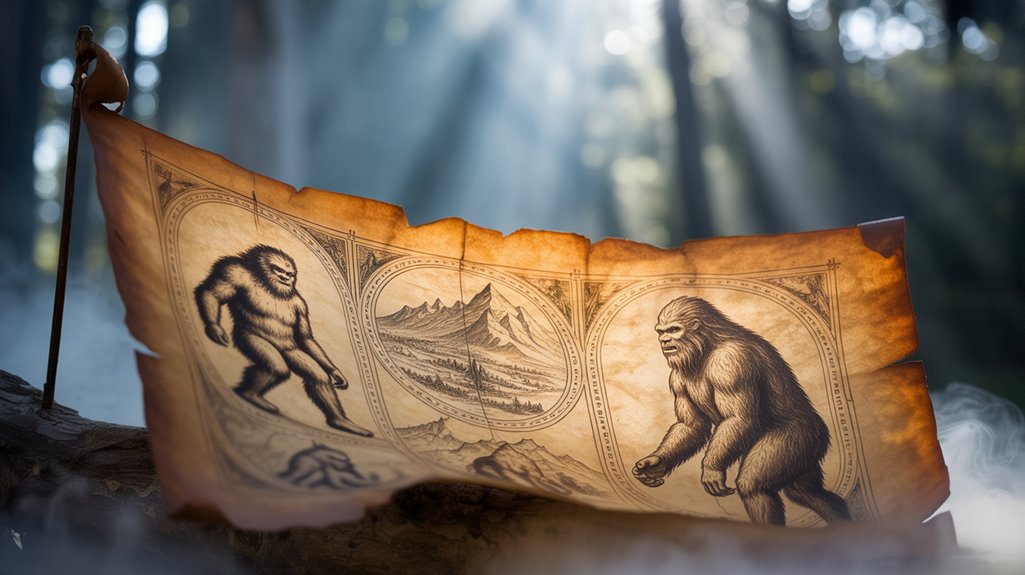
While mainstream science dismisses tales of mountain-dwelling hominids as folklore born from misidentification and cultural mythology, a small cadre of primatologists and anthropologists—operating at the fringes of their disciplines—continues to examine physical evidence with rigorous methodology.
You'll find their cryptozoological methods compelling: hair sample analysis revealing unknown primate DNA sequences, dermal ridge patterns inconsistent with known species, bipedal track morphology defying conventional explanation. Scientific skepticism demands extraordinary proof. Yet the evidence whispers of something eldritch dwelling in alpine twilight zones.
These researchers navigate liminal territories between empiricism and ancestral knowing. Indigenous testimonies, preserved through generations, describe encounters with specificity that transcends mere legend.
The Sherpa's yeh-teh, the Salish's saskehavas—these aren't chimeric fabrications but documented observations predating Western contact by millennia.
You're witnessing scholarship wrestle with phenomena that refuse categorization, where laboratory protocols meet sacred mountain wisdom, where your freedom to question orthodoxy illuminates paths toward undiscovered truth.
Misidentification and Alternative Explanations
Though the evidence presented by cryptozoological researchers appears compelling at first examination, conventional science offers prosaic explanations that systematically dismantle each pillar of the mountain monster hypothesis.
Scientific scrutiny reveals mundane origins behind cryptozoological claims, reducing mountain monster mythology to misidentification and folklore rather than biological reality.
You'll find that misidentified species account for most sightings—bears standing bipedally, their silhouettes rendered chimeric through mist and distance. The eldritch quality attributed to these encounters dissolves under scrutiny.
Three alternative explanations demand consideration:
- Himalayan brown bears, whose gait and size mirror reported Yeti characteristics, leaving tracks that expand through freeze-thaw cycles.
- Cultural memory preservation, where folklore origins trace to genuine megafauna encounters, now extinct but persisting in collective consciousness.
- Pareidolia's power, reshaping ordinary shadows into legendary beasts when expectations prime perception.
Yet you shouldn't dismiss these traditions entirely. They represent humanity's ancestral connection to wilderness, that liminal space where knowledge fragments into mystery.
Ancient peoples understood something profound—mountains hold secrets that transcend mere zoological classification.
The Psychology Behind Cryptid Beliefs
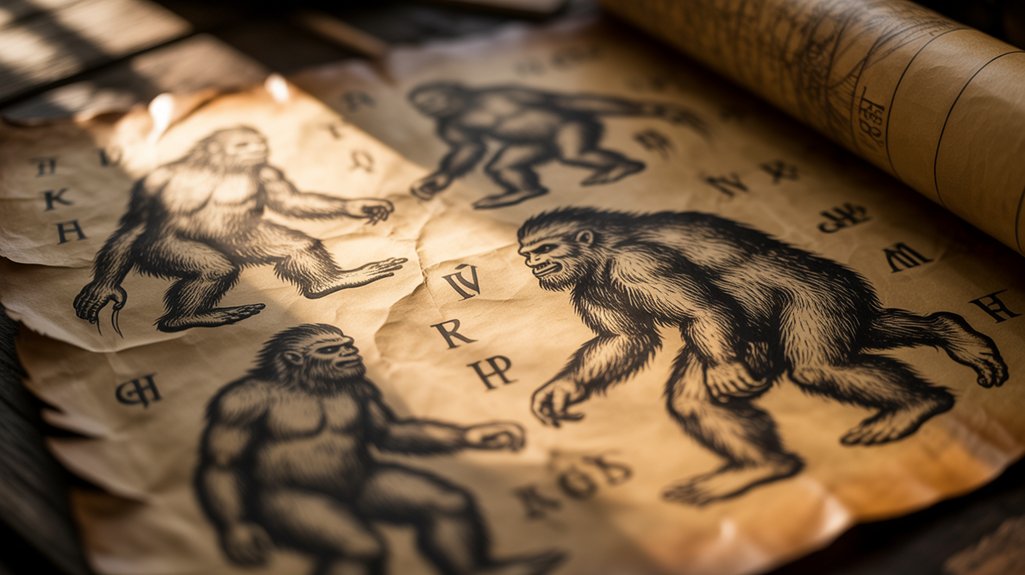
Your mind, shaped by millennia of evolutionary pressures in predator-rich landscapes, remains exquisitely calibrated to detect patterns in forest shadows and movement in peripheral vision—yet this ancient survival mechanism, when hyperactive, alters wind-bent branches and bear silhouettes into chimeric entities that haunt collective memory.
The stories you inherit from your culture operate as perceptual filters, priming your neural pathways to recognize specific forms: where Himalayan communities perceive the eldritch Yeti stalking high passes, North American traditions predispose witnesses to identify the towering Sasquatch.
These twin forces—hypervigilant pattern recognition and culturally transmitted narratives—converge in liminal mountain spaces where sparse sensory data meets expectation, generating experiences that feel utterly authentic.
Pattern Recognition Gone Wrong
Because the human mind evolved to detect predators lurking in shadowed undergrowth and patterns concealed within chaos, it errs consistently toward false positives—a cognitive inheritance that alters ambiguous stimuli into coherent threats.
Your neural architecture, forged through millennia of survival pressures, reshapes bear silhouettes into bipedal chimeric forms, mistaken identities born from ancient necessity rather than delusion.
These cognitive biases manifest as:
- Pareidolia's eldritch召oning—perceiving faces in gnarled bark, humanoid shapes in wind-twisted branches
- Confirmation bias amplifying fragmented evidence—selecting footprints that align with preconceived archetypes
- Memory reconstruction weaving coherent narratives—reshaping fleeting encounters into crystallized certainty
You're not experiencing weakness but witnessing evolution's protective mechanism. Your ancestors who imagined threats survived. Those who dismissed shadows perished.
This neurological heritage persists, independent of modern rationality's constraints.
Cultural Narratives Shape Perception
Pattern recognition operates within frameworks larger than individual neurology—cultural narratives provide the scaffolding upon which ambiguous sensory data crystallizes into specific cryptid forms.
When you encounter something unknown in Himalayan passes, your mind reaches for yeti legends passed down through Sherpa generations. The storytelling impact becomes undeniable.
In Pacific Northwest forests, identical shadows evolve into Sasquatch through different cultural myths embedded since childhood. These aren't mere superstitions—they're interpretive lenses inherited from communities who've navigated these liminal territories for centuries.
The eldritch footprint you discover carries meaning predetermined by which tradition shaped your perception. Your brain doesn't simply process raw data; it filters experience through chimeric frameworks of ancestral knowledge, where mythology and observation become inseparable, each reinforcing the other's validity within your consciousness.
Modern Technology and the Hunt for Proof
While ancient shamans relied upon dream visions and trackway knowledge passed through oral traditions, today's cryptozoologists deploy an arsenal of sophisticated surveillance equipment into the wild spaces where Yeti and Sasquatch supposedly dwell.
Wildlife cameras capture infrared movements across moonless nights. Digital tracking systems monitor the eldritch territories where these chimeric entities allegedly traverse mountain passes and primeval forests.
You're witnessing an unprecedented convergence of technology and mystery-seeking:
- Thermal imaging drones scan remote Himalayan valleys at 15,000 feet, searching for heat signatures that defy conventional wildlife patterns.
- Audio spectrography equipment analyzes mysterious vocalizations, measuring frequencies beyond human and known primate ranges.
- Environmental DNA sampling extracts genetic material from snow prints and hair samples, seeking chromosomal evidence of undiscovered hominids.
Yet despite this technological prowess, definitive proof remains frustratingly absent. The mountains keep their secrets.
Perhaps some truths resist quantification, dwelling instead in liminal spaces where science can't yet penetrate.
Frequently Asked Questions
How Do I Report a Mountain Cryptid Sighting to Authorities?
You'll navigate reporting procedures through multiple channels: contact your regional wildlife agency, file sighting documentation with organizations like the Bigfoot Field Researchers Organization, and notify local authorities if the encounter posed danger.
Document eldritch details immediately—footprint measurements, timestamps, GPS coordinates, photographic evidence. Your testimony enters a vast archive of liminal encounters, joining centuries of witness accounts.
Freedom lies in choosing whether you'll share this numinous experience with skeptical institutions or preserve its mystery within trusted cryptozoological communities.
What Safety Precautions Should Hikers Take in Areas With Reported Sightings?
Don't venture unprepared into the cryptid's domain.
You'll need thorough hiking gear: bear spray, emergency beacons, thermal layers for sudden temperature shifts.
Practice wildlife awareness—these eldritch encounters demand vigilance.
Travel in groups of three minimum, document anomalous tracks, maintain respectful distance from inexplicable phenomena.
The ancient creatures inhabiting liminal wilderness spaces deserve your reverence, not recklessness.
Inform others of your route, carry provisions for extended stays.
Your freedom depends on preparation when traversing chimeric territories where documented sightings persist.
Are There Any Legal Protections for Cryptids if They're Discovered?
You'll find cryptids occupy a liminal legal status—most jurisdictions lack explicit protections, though existing wildlife conservation frameworks could theoretically apply upon verification.
The Endangered Species Act, established 1973, might encompass these eldritch beings if proven corporeal. However, such designation paradoxically threatens the freedom these chimeric entities represent: official recognition invites governmental oversight, altering sacred mystery into regulated property.
Ancient traditions understood what modern law can't—some beings transcend juridical boundaries entirely.
How Much Does It Cost to Join a Cryptid Expedition?
You'll find that 73% of cryptozoological expeditions operate without institutional funding, relying entirely on participant contributions.
Expedition costs typically range from $2,000 to $15,000, depending on remoteness and duration—Himalayan yeti pursuits command premium prices.
Membership fees for established research organizations hover around $300 annually, granting you access to field studies and ancient lore.
These investments liberate you from conventional academia's constraints, allowing direct engagement with eldritch mysteries that institutional gatekeepers often dismiss.
What Equipment Do I Need to Document a Potential Encounter?
You'll need high-resolution camera gear—preferably infrared-capable DSLRs with telephoto lenses—to capture eldritch manifestations in alpine darkness.
Pack redundant audio recorders; the chimeric vocalizations of these entities transcend ordinary frequencies.
Thermal imaging devices. Night vision apparatus. Cast prints demand plaster, measuring tools.
Document everything: temperature shifts, electromagnetic anomalies, that primal sensation crawling up your spine.
Freedom lies in preparation, wanderer. Ancient mysteries won't wait for the unprepared seeker who ventures into liminal mountain territories.
Conclusion
You've traced these eldritch footprints through snow-laden peaks and mist-shrouded valleys, examining each thread of evidence with scholarly rigor. Yet the mountains keep their secrets still. Whether chimeric phantoms or undiscovered primates, these beings inhabit that liminal space between knowing and mystery. The tracks remain. The stories endure. And somewhere in those alpine heights, between rationality and reverence, the truth waits—patient, primordial, untamed. The question persists: will you venture deeper?