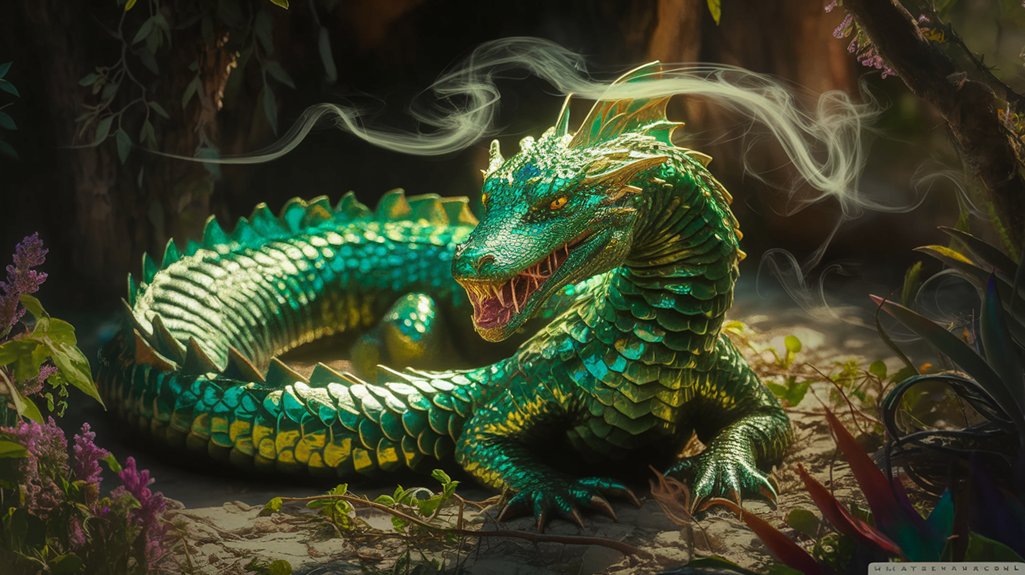

You’ll find civilization’s earliest serpent myths etched into Mesopotamian clay circa 2100 BCE, where the chimeric Mušḫuššu—bearing eagle talons and leonine forelegs—first coiled through sacred texts as Babylon’s guardian. Egypt’s sixteen-yard Apep emerged from Ra’s severed umbilical cord to threaten cosmic order nightly, while Greece’s Python wrapped Delphi’s prophetic fissure until Apollo’s arrows established divine authority. These ancient leviathans altered your species’ reptilian brain fear response into vessels of profound cosmological meaning, their regenerative symbolism—like Hydra’s multiplying heads—reflecting humanity’s eternal struggle between chaos and order, a narrative thread that continues weaving through modern mythologies awaiting your discovery.
Key Takeaways
- Mesopotamian Mušḫuššu emerged circa 2100 BCE as a composite dragon-serpent guardian, serving Ningishzida before becoming Marduk’s sacred protector of Babylon.
- Egyptian Apep, born from Ra’s severed umbilical cord, represents eternal chaos threatening to swallow the sun god’s light during nightly journeys.
- Greek Python coiled around Delphi, blocking Gaia’s prophetic fissure until Apollo’s arrows defeated it, establishing the oracle and Pythian Games.
- Chinese Qiulong embodies divine wisdom and carries the pearl of immortality, symbolizing the covenant between emperor and cosmos through agricultural abundance.
- Serpent mythology traces an unbroken thread from 2100 BCE onward, reflecting cultures’ fundamental struggles between chaos and order, destruction and creation.
Ancient Serpents Captivate Human Imagination

Since humanity first etched symbols onto cave walls and wove tales beneath starlit skies, serpents have coiled through our collective consciousness as creatures both divine and diabolic.
You’ll find their sinuous forms threading through civilizations separated by oceans and millennia—from Mesopotamia’s Mušḫuššu in 2100 BCE to Egypt’s chaos-embodying Apep, that sixteen-yard eldritch terror battling Ra nightly.
Serpent symbolism transcends mere fear; these primordial beings represent fundamental forces you recognize instinctively: creation and destruction, order and entropy.
The Python, born from post-diluvian mud, demonstrates how ancient peoples understood change itself.
Dragon evolution reveals humanity’s shifting relationship with the natural world—what began as giant serpents gradually evolved into chimeric beings across seventy-five thousand years of storytelling.
The Leviathan’s fire-breathing majesty in Hebrew scripture exemplifies this progression, altering aquatic serpent into something wholly other.
These aren’t simply monsters. They’re mirrors reflecting your ancestors’ attempts to comprehend powers beyond mortal ken.
##
You encounter these chimeric beings across four ancient civilizations, each culture forging its serpentine mythology from distinct cosmological anxieties and aspirations.
The Mesopotamian Mušḫuššu emerged circa 2100 BCE as a composite dragon-serpent guardian, while Egypt’s eldritch Apep embodied the eternal struggle between solar order and ophidian chaos in nocturnal battles beneath the earth.
Greece birthed Python from primordial mud at Delphi, and China raised the Qiulong to imperial divinity, each tradition revealing how humanity changed its terror of serpents into vessels of cosmic meaning.
These serpent narratives address fundamental questions about creation and cosmic order that have challenged civilizations throughout history.
Mesopotamian Mušḫuššu Dragon Tales
The Mušḫuššu—that “furious snake” first etched into clay tablets around 2100 BCE—slithers through Mesopotamian consciousness as perhaps the most enduring chimeric entity of the ancient Near East.
You’ll recognize its composite anatomy: eagle talons gripping earth below, leonine forelegs projecting power, serpentine tongue tasting divine air, horned skull crowned with authority.
Born from Tiamat’s primordial waters and Enki’s chaotic essence, this creature served Ningishzida before ascending to sacred status under Marduk’s patronage.
The Marduk connection altered it from chaos-spawn to civilizational guardian, adorning Babylon’s Ishtar Gate in glazed brick majesty.
Mušḫuššu symbolism embodied duality itself—terror and protection, wilderness and order.
Here stands freedom’s earliest paradox: power constrained becomes power legitimized, eldritch origins sanctified through ritual appropriation.
Egyptian Apep Chaos Serpent
Coiling through the Duat’s netherworld passages since the Old Kingdom’s earliest cosmological texts, Apep—Apophis to Hellenistic translators—manifests as chaos incarnate, a sixteen-yard leviathan whose flint-hewn skull shatters conventional notions of mythological vulnerability.
You’ll find no primordial origins here; this eldritch serpent springs from Ra’s severed umbilical cord, embodying opposition to cosmic order itself.
Apep’s symbolism transcends simple antagonism—each night, as Ra navigates celestial waters, the serpent strikes, his chaos representation threatening to swallow light eternally.
The Egyptians understood: this force can’t be destroyed. Their rituals, desperate incantations against unmaking, acknowledged an uncomfortable truth you might resist—some darkness endures.
Order requires eternal vigilance. This ancient serpent mythology would later influence Greek cosmological narratives, where similar primordial serpents like Python emerged as adversaries to divine order. The serpent waits, patient, indomitable, reminding free-seekers that chaos isn’t conquered; it’s merely held at bay.
Greek Python Delphi Legend
Four days after Leto’s desperate wandering began, the monstrous Python coiled itself tighter around Delphi’s limestone slopes, its primordial bulk—spawned from Gaia’s post-diluvian mud—blocking the prophetic fissure where earth’s pneuma rose in intoxicating vapors.
You’ll find Hera’s instrument of persecution here, guarding the Delphi oracle with eldritch malevolence. Yet freedom demands retribution. Apollo’s vengeance arrived swift—arrows piercing serpentine flesh, each strike dismantling chaos’s grip on civilization’s sacred threshold.
The newborn god claimed the prophetic sanctuary, altering persecution’s site into liberation’s altar. Blood-price demanded the Pythian Games, purification rituals acknowledging that even righteous slaughter carries weight.
This wasn’t mere monster-slaying. You’re witnessing order’s establishment through calculated violence, the chimeric forces of primordial darkness yielding to Olympian clarity, and humanity gaining access to prophetic wisdom once strangled by coiled terror.
Chinese Qiulong Water Dragons
Where Apollo’s arrows pierced chaotic flesh to claim prophetic territory, Chinese cosmology reveals an inverse theology—the Qiulong doesn’t obstruct divine wisdom but embodies it, serpentine coils carrying celestial mandate rather than primordial menace.
You’ll find this chimeric entity threading through storm clouds with stag antlers crowning its elongated form, eagle talons gripping the luminous pearl of immortality.
Qiulong symbolism merges cow ears, horse tail, and scales into living covenant between emperor and cosmos.
Unlike Western wyrms hoarding gold in subterranean darkness, these water dragons dispensed wealth through rain-swollen rivers, their presence sanctifying rather than threatening human domains.
Dragon mythology here alters reptilian into divine—benevolent guardian of aquatic domains where lightning births not destruction but agricultural abundance, each thunderclap announcing heaven’s favor upon the mortal territory below.
Mesopotamian Mušḫuššu, 2000 BCE

You’ll find the Mušḫuššu immortalized on Babylonian cylinder seals from circa 2100 BCE, its chimeric form—serpentine neck coiling above lion’s forelimbs and eagle’s talons—carved into lapis lazuli and limestone by Akkadian artisans who understood this creature as more than mere symbol.
This eldritch guardian stood sentinel at Marduk’s temple gates in ancient Babylon, its presence simultaneously warning intruders and sanctifying the threshold between mortal domain and divine.
The archaeological record preserves its image most famously on the Ishtar Gate’s glazed bricks, where processed ultramarine tiles captured the creature’s supernatural essence in cobalt permanence.
Babylonian Cylinder Seal Depictions
Deep within the clay archives of ancient Mesopotamia, the Mušḫuššu emerges from cylinder seal impressions as one of humanity’s earliest dragon myths, its sinuous form pressed into wet clay around 2100 BCE.
You’ll discover this chimeric guardian through cylinder seal artistry, where Babylonian craftsmen rendered its scaly magnificence: eagle talons for hind legs, leonine forelimbs, serpentine body crowned with horns.
Each rolling impression captured ancient mythology symbolism—the duality inherent in Tiamat and Enki’s spawn. These seals weren’t mere decorative objects. They were declarations of power.
When you examine these eldritch impressions, you’re witnessing Marduk’s protective emblem, pressed repeatedly into commercial tablets, temple inventories, royal decrees.
The Mušḫuššu’s repeated presence across Babylonian bureaucracy altered mundane documentation into sacred acts, binding divine authority to earthly transactions.
Ancient Babylon and Akkadian Regions
Beyond these impressed clay testimonies, the Mušḫuššu stalked through Babylon’s ziggurat shadows and palace corridors as living theology—not merely symbol, but intermediary between mortal domain and divine hierarchies. This chimeric sentinel embodied Mesopotamian mythology’s essential truth: power flows through composite forms. Akkadian culture recognized divinity in hybridity itself.
| Anatomical Feature | Symbolic Significance |
|---|---|
| Serpent body | Primordial chaos, eternal regeneration |
| Eagle talons (hind) | Celestial authority, aerial dominance |
| Lion forelimbs | Terrestrial sovereignty, martial prowess |
| Horned cranium | Divine appointment, sacred kingship |
| Scale patterns | Impenetrable defense, ancient knowledge |
The creature’s eldritch form proclaimed uncomfortable freedom: that creation emerges from chaos, that order requires guardianship of the untamed. Marduk claimed this beast, altering Tiamat’s vengeful progeny into Babylon’s protector. Sacred adoption, not subjugation.
Guardian of Marduk’s Temple Gates
Cobalt-glazed bricks met Babylonian sky, the Mušḫuššu transcended mere iconography to become threshold guardian—a liminal enforcer stationed at Marduk’s temple portals from approximately 2000 BCE onward.
You’ll find this chimeric sentinel embodying temple symbolism through its hybrid anatomy: eagle talons gripping earth, leonine forelimbs projecting strength, serpentine torso coiling between worlds.
As Marduk’s guardian, it manifested divine protection through calculated ferocity—”furious snake” in literal translation, yet sophisticated in function.
Descended from Tiamat’s primordial waters, it carried chaos-tamed-into-order, the exact alteration Marduk enacted upon creation itself.
Its scaly hide bore witness to countless pilgrims crossing sacred boundaries, while its eldritch form communicated unmistakable truth: here divinity dwells, here power concentrates, here only the worthy may pass.
Temple symbolism made flesh—or rather, made myth.
Egyptian Apep vs. Greek Python
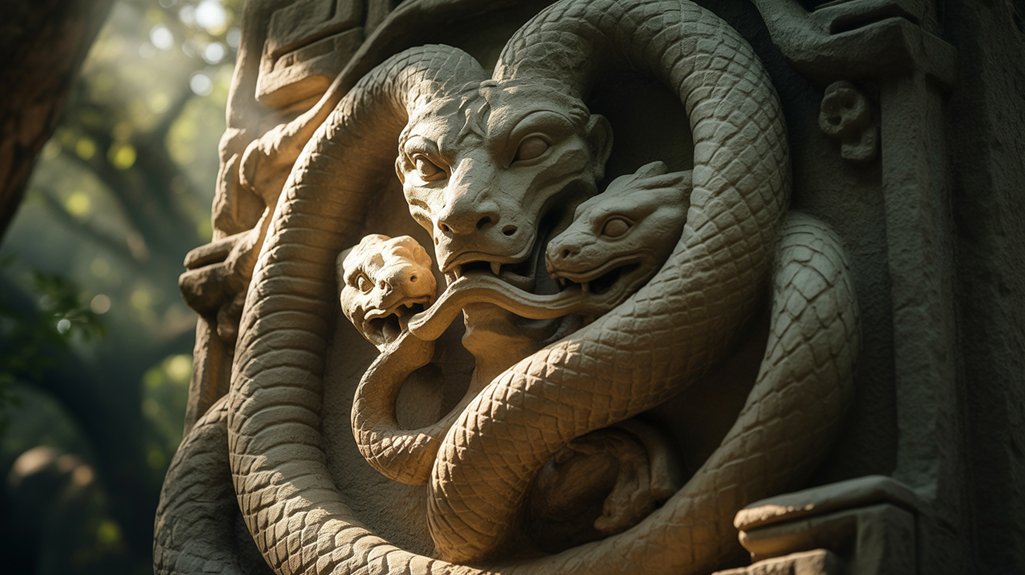
While both cultures conceived of serpentine antagonists as primordial forces of disorder, the Egyptian Apep and the Greek Python embody fundamentally divergent cosmological anxieties—one eternal, one vanquished.
Apep’s symbolism manifests through nightly combat, an eldritch struggle repeating infinitely as Ra traverses the underworld. Sixteen yards of serpentine chaos, born from the sun god’s own umbilical cord, threatens cosmic order perpetually. No triumph ends this battle.
Python’s defeat, conversely, represents definitive alteration. Apollo’s arrows pierced the creature spawned from Gaia’s post-diluvian mud, establishing Delphic authority through singular heroic action.
| Aspect | Egyptian Apep | Greek Python |
|---|---|---|
| Origin | Ra’s umbilical cord | Primordial flood mud |
| Length | 16 yards | Unspecified giant form |
| Purpose | Eternal chaos opposing order | Pursuing Zeus’s lovers |
| Conflict | Nightly cyclical battles | Single transformative combat |
| Outcome | Perpetual struggle | Slain, oracle established |
These serpents illuminate contrasting metaphysical architectures—Egypt’s cosmology demands continuous vigilance against returning darkness, while Greece celebrates chaos conquered.
Chaos vs. Order Duality
Across civilizations separated by millennia and continents, serpentine antagonists crystallize humanity’s most fundamental metaphysical terror—the fragility of cosmic order against primordial dissolution.
Serpent myths across cultures reveal our deepest fear: that cosmic order remains forever vulnerable to primordial chaos.
You’ll discover this chaos symbolism manifests through three distinct yet interconnected paradigms:
- Egyptian cosmology positions Apep as the eternal adversary of Ra’s solar barque, their nightly confrontation representing the perpetual tension between entropic void and illuminated structure.
- Mesopotamian theology presents Mušḫuššu as Marduk’s subdued chimeric servant, embodying civilization’s triumph over eldritch formlessness through divine sovereignty and architectural control.
- Chinese metaphysics envisions Qiulong as neither purely chaotic nor orderly, but rather the fluid equilibrium between storm-wrought devastation and life-sustaining precipitation.
This order representation transcends mere mythological narrative.
Python’s defeat establishes Apollo’s Delphic oracle. Leviathan’s writhing depths threaten Yahweh’s covenant.
Each serpent becomes the necessary shadow against which divine architects define their luminous domains—chaos eternally contained, never truly vanquished.
Lernaean Hydra’s Multiple Heads
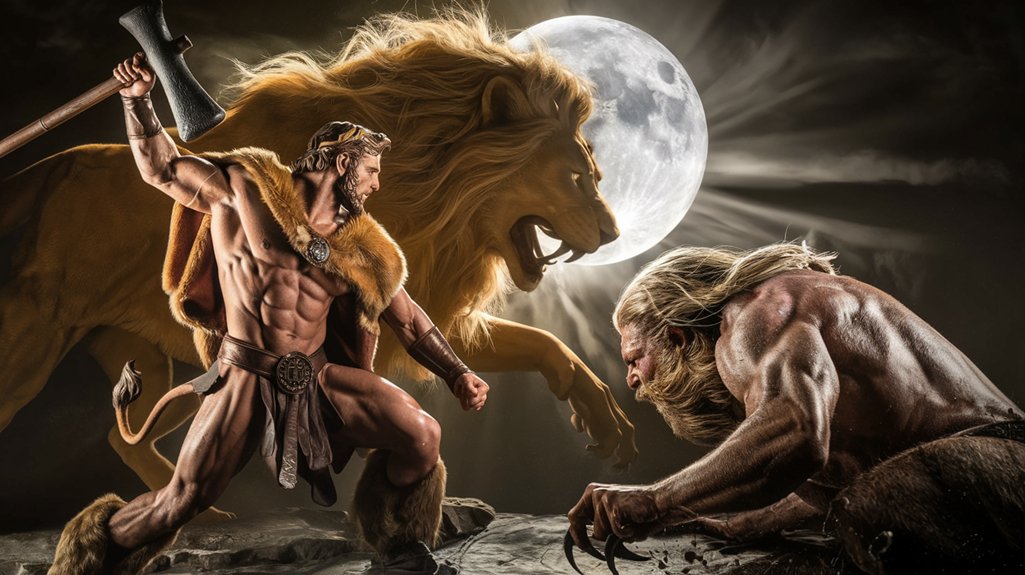
You’ll find the Hydra’s most eldritch feature wasn’t merely its serpentine form but its chimeric ability to regenerate—two heads sprouting from each severed neck, altering every heroic strike into multiplication rather than defeat.
Ancient sources disagree on the creature’s original head count, with some chroniclers recording five, others seven, and the canonical nine emerging only in later Hellenistic traditions, yet all accounts converge on one terrible truth: the central head possessed immortality itself.
This regenerative horror forced Heracles to abandon conventional combat, demanding instead the cauterizing flame, the strategic intervention of Iolaus, and ultimately the burial of that deathless skull beneath an immovable boulder near Lerna’s poisoned waters.
Regeneration After Each Strike
Few creatures in the mythological canon embody the principle of exponential threat quite like the Lernaean Hydra, whose writhing mass of nine serpentine heads presented Heracles with a mathematical nightmare of regeneration.
You’ll find in Hydra mythology a terrifying equation: one severed head birthed two more, changing each strike into doubled peril. This wasn’t mere physical resilience—it was regenerative symbolism incarnate, chaos propagating geometrically with every failed attempt at victory.
The immortal heads wouldn’t simply die; they required cauterization, fire applied to bleeding stumps to prevent that eldritch multiplication. Here stood an insurmountable challenge made manifest, a chimeric embodiment of problems that intensify through conventional solutions.
Only through Heracles’ cunning—employing flame alongside blade—could this recursive horror be conquered, proving that some battles demand innovation over brute force alone.
Number Varies by Source
While modern retellings frequently settle upon nine serpentine heads as canonical, the ancient sources themselves present a bewildering array of numerical variations that reveal the fluid nature of oral mythological transmission.
You’ll encounter texts describing anywhere from five to one hundred writhing appendages emerging from the creature’s chimeric form. Hesiod’s *Theogony* remains cryptically vague about exact quantities, while Apollodorus fixes the count at nine.
This discrepancy isn’t mere confusion—it reflects mythological symbolism operating beyond literal enumeration. The multiplying heads represent your struggle against escalating obstacles, where cultural interpretations shift based on regional storytelling traditions.
Each variation carries distinct philosophical weight, altering the Hydra from mere monster into eldritch embodiment of recursive challenge. The numbers themselves become symbolic architecture rather than biological taxonomy.
Immortal Central Head
Among the proliferating heads that crowned the Hydra’s serpentine necks, one possessed a quality that changed this creature from formidable beast into metaphysical paradox—immortality incarnate at its very center.
This eldritch truth altered Heracles’ labor into something beyond mere physical combat. You’ll find the immortal symbolism here transcends simple monster-slaying: the central head represented chaos that can’t die, only be contained. The hero’s solution? Burial beneath stone. Not destruction. Containment.
This heroic struggle illuminates ancient Greek understanding of cosmic order—some threats persist eternally, demanding perpetual vigilance rather than final victory.
The chimeric Hydra’s deathless core, severed yet undying, buried yet potent, whispers across millennia: certain evils regenerate endlessly. They multiply when confronted directly. They require wisdom beyond strength, acknowledging that absolute triumph remains forever beyond mortal reach.
Dragon Symbolism in Contemporary Media
As dragons breach the threshold between archaic mythology and twenty-first-century narrative landscapes, they carry with them centuries of accumulated meaning—chimeric vessels of our most primal anxieties and aspirations.
You’ll find dragon archetypes altered yet fundamentally unchanged, their eldritch essence preserved through shifting cultural representations that honor ancestral traditions while embracing contemporary complexity.
Modern storytelling channels these ancient forces through three primary manifestations:
Contemporary narratives transmute draconic mythology through strategic frameworks: moral complexity, sovereign symbolism, and participatory engagement with these primordial archetypes.
- Moral ambiguity: Dragons embody both chaos and protection, challenging binary notions of heroism and villainy.
- Political symbolism: They represent sovereign authority and destructive capability, their presence determining the fate of kingdoms and dynasties.
- Interactive mythology: Video games position you as participant rather than observer, forging alliances or waging war against these primordial beings.
From “Game of Thrones” to the “Elder Scrolls” franchise, dragons persist as guardians of treasure and wisdom—supernatural gatekeepers demanding that you prove your worth before accessing forbidden knowledge.
Reptilian Brain Fear Response
Deep within the triune architecture of your neural anatomy lies the basal ganglia—that ancient substrate neuroscientists term the “reptilian complex,” a paleocortical inheritance from ancestors who first crawled through Carboniferous swamps 320 million years ago.
This primordial circuitry still governs your reptilian instincts, triggering instantaneous threat assessment when confronted with serpentine forms. Your primal fears aren’t irrational superstitions but evolutionary wisdom encoded in synaptic pathways, honed through millennia of encounters with venomous predators.
The eldritch serpents of Mesopotamian chaos—Tiamat’s writhing coils, Apep’s darkness-bringing form, Leviathan’s chimeric anatomy—weren’t mere phantasms of overactive imaginations. They represented amplified threat responses, your brain’s tendency to heighten danger narratives for improved memorability and tribal transmission.
When Egyptian priests circa 3000 BCE depicted Apep as civilization’s antithesis, they externalized collective neurological patterns. Every culture independently manifested serpent-antagonists because your amygdala, that almond-shaped sentinel, recognizes these patterns instinctively.
Mythmaking begins in electrochemical cascades, altering survival mechanisms into sacred narratives.
Modern Dragon Myths Everywhere
While ancient civilizations encoded their serpent-fears into cuneiform tablets and hieroglyphic warnings, you’ve merely shifted these archetypal narratives onto pixelated screens and printed pages—your dragon myths haven’t vanished but metastasized into every conceivable medium of contemporary storytelling.
The dragon symbolism you encounter today transcends simple monster-versus-hero dichotomies, manifesting instead as chimeric entities embodying both destruction and wisdom, chaos and guardianship.
You’ll find Western wyrms breathing eldritch flames across fantasy landscapes while Eastern Qiulong serpents coil through water-blessed narratives of benevolence, each tradition maintaining its cultural significance within franchises that dominate your collective imagination.
“Game of Thrones,” “How to Train Your Dragon”—these aren’t departures from ancestral narratives but reinterpretations, ancient themes of heroism and alteration wrapped in modern production values.
You’re not escaping draconic mythology. You’re perpetuating it, ensuring these liminal guardians remain relevant to generations who’ve never carved warnings into stone yet still recognize their primal power.
Serpents’ Enduring Mythological Legacy
Since 2100 BCE, when Mesopotamian scribes first committed the Mušḫuššu’s composite form to clay—serpentine body writhing beneath eagle talons and leonine features—you’ve inherited an unbroken thread of ophidian mythology that refuses obsolescence.
This dragon evolution traces through Egyptian Apep’s chaotic coils battling Ra’s solar chariot, through Python’s mud-born form slain at Delphi, through Leviathan’s primordial depths challenging divine order itself. Each iteration reshapes serpent symbolism without severing ancestral connections.
You stand at mythology’s crossroads where serpents evolve endlessly. From benevolent rain-bringers to chaos embodied, these chimeric entities mirror your own struggle between constraint and liberation.
The Hebrew Bible’s Leviathan churns beneath consciousness; Apollo’s Python bleeds into oracular prophecy; Apophis swallows light perpetually, eternally defeated yet returning.
Four millennia haven’t diminished their eldritch power—they’ve amplified it, proving serpentine myths adapt, survive, transcend. Your freedom lies in recognizing these ancient patterns still coiling through modern consciousness.
Frequently Asked Questions
What Are the Oldest Serpent Myths From Chinese Mythology?
You’ll find China’s most ancient serpent narratives in the Shang Dynasty oracle bones (1600-1046 BCE), where dragon symbolism emerges through the primordial deity Nüwa—part woman, part serpent—who mended heaven’s fractured vault with molten stone.
These Chinese legends reveal dragons as benevolent, rain-bringing entities unlike their Western counterparts.
The eldritch creature Gonggong, a chimeric water-serpent, shattered cosmic pillars in prehistoric fury, tilting Earth’s axis, establishing dragons as fundamental architects of your world’s very structure and seasonal rhythms.
Did Norse Mythology Feature Dragons Before Christian Influence?
You’ll discover Norse dragon symbolism predates Christian dragon influence by centuries—undeniably.
The eldritch Fáfnir, altered through greed’s curse, coiled through Germanic lore since the Migration Period (400-800 CE).
Níðhöggr gnawed Yggdrasil’s roots in pre-Christian cosmology, embodying chaos and renewal.
These weren’t borrowed chimeric beasts but indigenous symbols woven into Nordic consciousness.
The Eddas, though transcribed by Christian scribes, preserved authentic draconic archetypes: Jörmungandr encircling Midgard represents primordial forces your ancestors understood millennia before Mediterranean influences arrived.
How Do Hindu Serpent Deities Differ From Middle Eastern Dragons?
You’ll find Hindu serpent deities—the Nagas—embody cosmic duality through Hindu symbolism: creation and destruction intertwined.
Unlike Middle Eastern dragons, perpetual chaos-bringers demanding conquest, serpent worship in Vedic traditions honors these beings as guardians, fertility spirits, keepers of sacred waters.
The cobra-crowned deity transcends mere monster—it’s divine protector, thousand-headed Shesha supporting Vishnu himself.
Middle Eastern wyrms hoard treasure, breathing flame and eldritch malice.
India’s serpents? They’re threshold-dwellers between mortal and divine domains, deserving reverence rather than the sword.
What Role Did Serpents Play in Pre-Columbian American Mythologies?
You’ll discover serpent symbolism permeating Pre-Columbian cosmologies with profound mythological significance.
Quetzalcoatl, the feathered serpent deity, emerged around 100 BCE among Teotihuacan cultures, embodying wisdom, creation, duality itself. The Mexica revered serpents as primordial forces—Coatlicue wore writhing serpent skirts, birthing gods from chaos.
Maya K’uk’ulkan descended from celestial spheres, his scales gleaming with astronomical knowledge. These weren’t mere beasts but chimeric bridges between earthly and divine dimensions, their undulating forms mapping sacred geography across temple walls.
Are There African Dragon Myths Predating Egyptian Records?
You’d think ancient African folklore would preserve pre-Egyptian serpent symbolism—yet the written record vanishes into desert sands.
Oral traditions, however, whisper of eldritch python deities from Congo Basin cultures, their origins lost beyond hieroglyphic memory.
The San people’s rain serpents likely predate Pharaonic dynasties, though you’ll find no papyrus proof.
Africa’s dragon myths existed in the liminal space of spoken word, where chimeric beings coiled through millennia without scribes to bind them.
Conclusion
You’ve devoured serpentine lore spanning millennia, yet tomorrow you’ll scroll past CGI dragons without contemplating their Mesopotamian ancestors. The mušḫuššu once commanded temple reverence; now it’s merchandised on lunch boxes. Your reptilian brain still quickens at serpentine forms—that primordial dread unchanged since 2000 BCE—but you’ve domesticated the eldritch into entertainment. Ancient chaos gods reduced to franchise villains. Such is modernity’s peculiar alchemy: converting sacred chimeric terrors into collectible figurines.