Ancient civilizations revered entities now dissolved into obscurity—Mesopotamia’s wind-demon Pazuzu, inscribed on clay tablets circa 1400 BCE; Celtic Ireland’s Aos Sí, guardians of liminal thresholds; Slavic forest spirits like Leshy, protectors of woodland sanctuaries. Cultural erosion altered these once-potent intermediaries between mortal and divine domains into fragmentary cuneiform impressions and weathered stone iconography. Modern psychology recognizes these archetypal narratives’ therapeutic potential, as neural research validates ancient patterns of externalizing psychological struggle through mythological frameworks. The mechanisms preserving—and obliterating—sacred knowledge reveal humanity’s evolving relationship with the numinous across millennia.
Key Takeaways
- Ancient Mesopotamian deities like Ninhursag, Ereshkigal, and Lamashtu have faded from memory due to cultural erosion and changing beliefs.
- Celtic folklore entities including Banshees, Dullahans, and Selkies symbolized mortality and transformation but are now largely forgotten.
- Slavic spirits like Domovoi, Rusalka, and Leshy represented domestic and natural forces in pre-Christian Eastern European cultures.
- Pre-Columbian deities such as Tlaloc and Chicomecoatl were lost to colonialism, erasing indigenous spiritual traditions and rituals.
- Cultural erosion dissolves once-revered spirits into obscurity as humanity’s relationship with the numinous evolves over time.
Spirits Vanish From Collective Memory

Although ancient civilizations carved their names into stone and papyrus with meticulous care, the spirits they revered have proven far more ephemeral than the monuments erected in their honor.
Stone endures while spirits dissolve—our monuments outlasting the very gods they were built to honor.
Cultural erosion operates with insidious precision, dissolving the eldritch entities that once commanded trembling reverence from countless generations. The Egyptian Ammit—devourer of unworthy souls, her chimeric form blending crocodile, lion, and hippopotamus—now exists merely as museum footnote.
The Yeti, that towering sentinel of Himalayan peaks, has diminished from sacred guardian to cryptozoological curiosity.
This mythological evolution reflects humanity’s shifting relationship with the numinous. Where ancestors perceived divine presence in every shadow and storm, modern consciousness constructs different frameworks for understanding existence.
Regional spirits, those countless local deities who governed springs, forests, and thresholds, fade fastest. Even the Mahaha, that ice-blue terror of Inuit mythology with its constant grin and deadly cold touch, survives now only in scholarly compilations rather than in the fearful whispers of Arctic communities. Gone. Their names unspoken, their offerings ceased, they retreat into that liminal space between memory and oblivion, leaving only fragmented whispers in folklore collections gathering dust.
##
Beyond the well-documented pantheons of Greece and Rome, civilizations across ancient Mesopotamia, Celtic territories, Slavic lands, and Pre-Columbian Americas nurtured intricate cosmologies populated by deities and spirits whose names have largely vanished from modern consciousness.
These forgotten divine entities—from the eldritch watchers of Sumerian city-states to the chimeric forest guardians of Mesoamerican highlands—once commanded profound reverence, their cults maintaining elaborate rituals that shaped entire societies.
The archaeological fragments and scattered textual references that survive offer only glimpses into these lost spiritual hierarchies, leaving scholars to reconstruct worldviews that thrived for millennia before succumbing to cultural erasure through conquest, conversion, and time’s relentless obscuration.
These myths explored fundamental themes of creation and origins, the nature of good versus evil, and the mysteries of life and death that represent humanity’s common quest for understanding across all cultures.
Ancient Mesopotamian Forgotten Deities
How many gods must slip beneath the sands of collective memory before civilizations recognize what they’ve forsaken?
Ancient Mesopotamia’s pantheon harbored deities whose names now whisper through archaeological fragments, their ancient rituals dissolved into cuneiform dust. Ninhursag, earth-mother embodying terrestrial fertility, commanded reverence alongside Enki, wisdom-keeper who channeled primordial waters through creation’s channels.
Below stretched Ereshkigal’s eldritch domain, where mortality’s inevitability consumed all who descended into shadow-realm depths. Yet darker forces prowled these forgotten myths: Lamashtu, chimeric demon of birthing-beds, manifested maternal terror through infant-snatching malevolence.
Adad’s storm-voice thundered across Tigris-Euphrates valleys, reminding clay-bound mortals of nature’s capricious sovereignty. These beings weren’t mere supernatural constructs but living cosmological anchors, their worship patterns revealing how fourth-millennium BCE civilizations negotiated existence’s fundamental mysteries through divine intermediaries now abandoned to time’s inexorable erasure.
Lost Celtic Spirit Beings
When twilight descended upon Ireland’s windswept hills and Scotland’s mist-shrouded glens, Celtic communities understood that reality’s membrane grew perilously thin—permitting passage for entities whose existence defied Christian cosmology’s later impositions.
The Banshee’s keening presaged mortality itself, while the headless Dullahan thundered through darkness as fate’s inexorable messenger.
Celtic folklore preserved these eldritch guardians alongside the Selkie—beings of mythical metamorphosis who shed sealskin for human flesh, embodying impossible yearnings between terrestrial and aquatic domains.
The Aos Sí dwelt parallel to mortal perception, ancient stewards whose sovereignty predated human encroachment.
Shape-shifting Púca traversed forms with chimeric fluidity, manifesting nature’s mercurial duality.
These spirits encoded ancestral wisdom: respect the unknown, honor the land’s mysteries. Transgression invited consequence. The membrane remained permeable.
Obscure Slavic Mythological Creatures
Across the vast expanse of Eastern Europe’s primordial forests and marshlands, Slavic peoples nurtured a cosmology teeming with spirits whose dominion over threshold spaces—hearth, water, wilderness—rendered them indispensable arbiters of mortal fortune.
Domovoi legends speak of bearded guardians dwelling within hearth-stones, protecting households from malevolent forces. Rusalka tales warn of drowned maidens haunting riverbanks, their eldritch beauty concealing vengeful hearts.
The Leshy folklore describes chimeric forest sentinels—moss-covered shapeshifters who confound travelers yet safeguard woodland creatures with fierce devotion. Vodyanoy myths depict bearded leviathans commanding aquatic depths, drowning those who disrespect sacred waters.
Kikimora stories reveal how domestic spirits, when neglected, alter beneficence into misfortune. These beings occupied liminal territories where human civilization met untamed nature, demanding respect, offerings, acknowledgment.
Their fading remembrance represents humanity’s retreat from acknowledging powers beyond rational comprehension.
Vanished Pre-Columbian Divine Entities
While Slavic spirits governed the threshold spaces of forest and hearth in Eastern Europe’s shadowed glades, the civilizations of Mesoamerica and the Andean highlands constructed theological architectures of staggering complexity—pantheons wherein divine entities didn’t merely inhabit nature but *were* nature’s animating force.
Tlaloc commanded rain through jade vessels. Chicomecoatl embodied maize itself, sustenance made flesh. The Inca’s Inti altered sunlight into cosmic genealogy, while the Chavín’s chimeric Lanzón—half-jaguar, half-human—manifested the eldritch communion between mortality and transcendence.
Sacred offerings and lost rituals sustained these relationships: bloodletting calendars, agricultural ceremonies, elaborate stone temples aligned to celestial movements.
Then European colonialism arrived. New theologies supplanted ancient cosmologies. The divine entities receded into archaeological fragments, their names whispered only in academic texts and indigenous memory-keepers’ defiant persistence.
Mesopotamian Clay Tablet Inscriptions
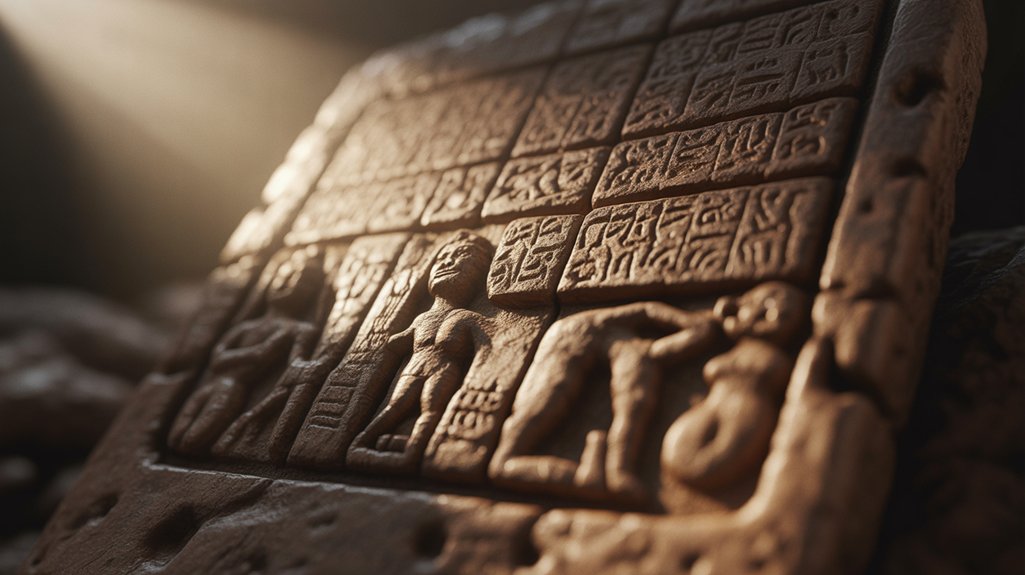
In the temple precincts of southern Iraq and Syria, where the Euphrates once nourished forgotten sanctuaries, Sumerian priests inscribed their cuneiform devotions onto clay around 2100 BCE, their wedge-shaped marks preserving eldritch rites meant to summon divine favor from beings whose names now echo only in archaeological silence.
These sacred tablets documented elaborate liturgies, hymns to chimeric deities, and purification ceremonies—each pressed symbol a desperate attempt to maintain cosmic order through ritualized communion with powers that dwelt beyond mortal comprehension.
The temple archives reveal not mere administrative records but living invocations, their ancient Sumerian script mapping the boundaries between earthly worship and transcendent domains where gods demanded blood, incense, and unwavering reverence.
Sumerian Cuneiform From 2100 BCE
Deep within the repositories of the British Museum and the Louvre rest fragments of humanity’s first deliberate attempts to capture thought itself—clay tablets inscribed with wedge-shaped marks that Sumerian scribes pressed into wet earth around 2100 BCE, though the system’s origins stretch back a millennium earlier to 3100 BCE.
These cuneiform inscriptions evolved from simple pictographs into sophisticated symbols encoding sound and meaning, preserving Sumerian mythology alongside administrative mundanity. The Epic of Gilgamesh emerged from this clay, its divine symbolism exploring mortality’s shadow.
Ancient literature intertwined with trade receipts, legal contracts with hymns to eldritch deities. Each wedge-shaped mark connected mortals to gods, bureaucrats to eternity.
The nineteenth-century decipherment revealed civilizations, revealing chimeric beings and forgotten spirits whose names once commanded reverence across Mesopotamian plains.
Southern Iraq and Syria
These Sumerian inscriptions represent merely the first whispers of a vast tradition that flourished across Mesopotamian territories—the clay tablets recovered from Southern Iraq and Syria chronicle an entire cosmos populated by beings who dwelt between the mortal and divine domains. The ancient folklore preserved in cuneiform reveals mythical symbolism that governed daily existence: Lamassu guardians, those chimeric sentinels bearing human wisdom and bestial strength, stood watch at palace gates. Pazuzu’s eldritch countenance warded against pestilence. The Apkallu emerged from primordial waters bearing civilization’s gifts.
| Entity | Form | Domain | Cultural Function |
|---|---|---|---|
| Lamassu | Human-headed bull/lion | Protection | Divine guardianship at thresholds |
| Apkallu | Fish-human hybrid | Wisdom | Primordial teachers of humanity |
| Pazuzu | Winged demon | Disease/Wind | Apotropaic defense against malevolence |
| Gilgamesh | Demigod king | Mortality | Heroic exemplar confronting death |
These beings embodied humanity’s deepest yearnings for autonomy against fate’s tyranny.
Religious Rituals and Temple Worship
When dawn’s first light pierced the ziggurat’s eastern facade, priests already moved through temple corridors with lustral waters drawn from sacred precincts—their footsteps echoing across limestone floors that’d witnessed millennia of devotional practice.
Clay tablets chronicle these eldritch ceremonies: hymns intoned in Sumerian, incantations carved deep into cuneiform columns. Sacred offerings—barley loaves, dates, slaughtered lambs—accumulated before divine statues whose eyes held lapis lazuli, whose presence demanded absolute devotion.
Priestesses conducted chimeric rituals, bridging mortal and celestial domains, petitioning gods for divine interventions against famine, pestilence, war. Each tablet preserved these transactions, altering ephemeral prayers into permanent record.
The relationship was contractual, transactional. Give, receive. Worship, survive. These inscriptions weren’t mere records—they were binding covenants etched into earth itself.
Akkadian Vs Babylonian Deity Names
As centuries collapsed into millennia and empires rose from the dust of their predecessors, the divine nomenclature of Mesopotamia underwent changes both subtle and profound—shifts that reveal far more than mere linguistic evolution.
The Akkadian deities witnessed profound Babylonian alterations, their divine attributes reshaping through religious changes. Marduk emerged from Amar-Utu’s eldritch essence, embodying wisdom’s chimeric nature. Enlil maintained mythological continuity across both pantheons—wind, storm, absolute authority. Ishtar defied nomenclatural drift entirely, her spiritual legacy transcending cultural significance through warfare and fertility alike. Most striking: Ea became Enki, suggesting deliberate pantheon development rather than mere linguistic shift.
| Akkadian Name | Babylonian Name | Divine Domain |
|---|---|---|
| Amar-Utu | Marduk | Wisdom, Magic |
| Ea | Enki | Water, Wisdom |
| Ishtar | Ishtar | Love, War |
These historical comparisons illuminate ancient worship’s fluid boundaries, where names carried power beyond designation—they embodied cosmological truth itself. The alteration revealed socio-political upheavals encoded within syllables.
Animal Forms Representing Divine Attributes
Through the primal consciousness of ancient civilizations, divine essence manifested not in abstract philosophy but in the sinew, scale, and feather of creatures who walked, swam, and soared through their world.
These embodiments of animal symbolism transcended mere representation—they became conduits through which mortals comprehended the incomprehensible.
Animal forms became sacred language—primal symbols translating divine mystery into flesh, feather, and fang that human hearts could finally grasp.
Divine characteristics encoded in flesh:
- Anubis’s jackal form guarded the liminal threshold between existence and oblivion, his nocturnal predator’s instincts transformed into psychopomp vigilance.
- Ganesha’s elephant visage channeled pachyderm memory and measured strength into wisdom that shattered obstacles with deliberate, unstoppable force.
- Inari’s kitsune messengers carried agricultural prosperity through vulpine cunning, their eldritch intelligence bridging mortal fields and celestial abundance.
The Mesopotamian Ishtar commanded leonine ferocity, her chimeric power radiating feminine sovereignty.
Native American traditions raised the eagle beyond avian reality into sky-spirit—freedom incarnate, vision unbound.
These weren’t metaphors. They were truth itself, wearing fur and wing.
Pazuzu and the Wind Demons
In the scorching wind-swept territories of ancient Mesopotamia, circa 1400 BCE, Pazuzu emerged as a chimeric sovereign whose leonine visage, raptor wings, and serpentine talons commanded both terror and veneration among those who etched his eldritch form onto protective amulets.
This paradoxical demon king wielded dominion over pestilential gales while simultaneously offering sanctuary against Lamashtu and other malevolent entities—a duality that positioned him as humanity’s monstrous guardian against forces even more sinister than himself.
His resurrection in twentieth-century Western consciousness through William Peter Blatty’s 1971 narrative altered this Akkadian wind-demon into an icon of possession horror, forever cementing Pazuzu’s shift from apotropaic deity to embodiment of irredeemable evil.
Ancient Mesopotamian Demon King
When the desert winds howled across ancient Sumer circa 3000 BCE, they carried more than sand and storm—they bore the essence of Pazuzu, the chimeric demon king whose dominion over atmospheric forces rendered him both savior and scourge to Mesopotamian civilization.
This eldritch entity manifested with canine visage and avian talons, embodying wind demon symbolism that reflected humanity’s primal relationship with unpredictable nature.
Pazuzu mythology reveals sophisticated theological complexity: priests invoked his protective power against Lamashtu, the child-killing demoness, converting one terror into guardian against another.
Communities depended on his temperamental nature—his winds either nourished harvests or obliterated settlements.
Ancient artisans crafted amulets bearing his grotesque countenance, tangible defenses against invisible malevolence.
Power recognized power. The demon king’s modern resurrection through “The Exorcist” demonstrates mythology’s enduring grip on collective consciousness.
Protection Against Evil Forces
Apotropaic magic—the ritualized art of turning away evil—found its most paradoxical champion in Pazuzu himself, whose fearsome countenance adorned thousands of clay amulets throughout the second and first millennia BCE.
Families clutched these protective amulets during childbirth’s darkest hours, when Lamashtu prowled. The demon’s chimeric form—lion-headed, talon-footed, scorpion-tailed—became synonymous with spiritual guardianship precisely because terror repels terror.
Mesopotamian households understood this eldritch calculus: invoke the king of wind demons to scatter lesser malevolence like chaff before storm winds. His dual nature embodied cosmic balance, that eternal negotiation between chaos and order.
Protection required embracing darkness to banish it. These rituals weren’t superstition but sophisticated spiritual technology, recognizing that power over evil sometimes wears evil’s face.
Pazuzu’s legacy endures because humans still comprehend this uncomfortable truth.
Modern Pop Culture Legacy
Though millennia separated ancient Assyrian temples from twentieth-century cinema, William Friedkin’s 1973 masterwork *The Exorcist* resurrected Pazuzu from archaeological obscurity into global consciousness.
The chimeric demon’s emergence altered horror storytelling, establishing psychological terror grounded in authentic mythological frameworks rather than fabricated monsters.
Pazuzu’s symbolism—simultaneously protective and destructive, guardian and tormentor—resonated with audiences confronting moral ambiguity in post-war America.
His eldritch presence catalyzed decades of wind demon adaptations across literature, gaming, and film, where ancient entities manifest as complex antagonists defying simple categorization.
Contemporary creators reimagine these Mesopotamian spirits not as cartoonish villains but as archetypal forces embodying humanity’s perpetual struggle with uncontrollable nature.
The demon’s enduring influence demonstrates how ancient wisdom infiltrates modern narratives, whispering truths about chaos, fear, and the permeable boundaries between protection and possession.
Pazuzu in The Exorcist Film
As director William Friedkin adapted William Peter Blatty’s 1971 novel to screen in 1973, he anchored his supernatural narrative in the terrifying figure of Pazuzu—a demon-king whose origins stretch back to Assyrian reliefs circa 800 BCE, where scribes documented his chimeric form through cuneiform tablets discovered in Nineveh’s ruins.
The Pazuzu film portrayal draws authenticity from archaeological evidence, particularly protective amulets bearing his grotesque visage.
Pazuzu symbolism permeates the narrative through three deliberate choices:
- The Iraqi prologue establishes ancient evil’s persistence across millennia, refusing containment by modern rationality.
- Regan’s possession embodies civilization’s fragility when confronted with primordial malevolence.
- The demon’s animal-like features—canine skull, serpentine eyes—manifest corruption’s physical toll on innocence.
This southwest wind’s harbinger didn’t merely possess a child; he shattered audience assumptions about evil’s boundaries.
The eldritch encounter sparked contemporary fascination with demonology, altering forgotten Mesopotamian entities into cultural touchstones.
Ancient protections failed. Modern faith trembled.
Neuroscience of Belief Formation
While ancient Mesopotamians carved protective amulets to ward off Pazuzu’s malevolence, modern neuroscience reveals that belief itself—whether in demons, deities, or material reality—emerges from precise electrochemical cascades within the brain’s architecture.
The prefrontal cortex negotiates with the limbic system’s emotional depths, forging convictions through dopamine-fueled reward pathways that alter abstract concepts into felt truths. Neuroscience insights demonstrate how confirmation bias becomes neurologically embedded: when adherents encounter familiar mythological narratives, their brains illuminate with reward-center activation, while contradictory evidence triggers cognitive dissonance—that uncomfortable friction between competing realities.
This phenomenon of belief perseverance explains why chimeric creatures and eldritch entities persisted across generations despite rational scrutiny. The brain dismisses counter-evidence, favoring information that reinforces established neural patterns.
Social interactions further entrench these pathways, as cultural narratives shape individual cognition. Consequently, whether venerating forgotten spirits or dismissing them entirely, humans remain bound by the same neurological mechanisms that once made Pazuzu terrifyingly real.
Modern Mental Health Applications
Understanding how neural architecture constructs and maintains belief systems opens pathways toward utilizing these ancient narratives for contemporary healing.
Mythical therapy utilizes the eldritch power of forgotten spirits—the Wendigo’s insatiable hunger becomes addiction’s mirror, its chimeric form reflecting psychological fragmentation. Clinicians employ folklore healing to externalize patients’ inner torments, altering abstract suffering into tangible narrative adversaries one can confront, negotiate, comprehend.
These therapeutic frameworks don’t diminish mental health struggles. They dignify them.
Modern adaptations of ancient monsters create resonance with contemporary audiences, facilitating discussions around anxiety, compulsion, moral injury. The symbolic language of myth provides what clinical terminology cannot: emotional authenticity, cultural rootedness, archetypal recognition.
Storytelling circles and digital folklore communities forge essential social support networks, combating isolation through shared mythological vocabularies. Patients wrestling with depression discover their experiences mirrored in seasonal deities’ cyclical descents; those battling trauma recognize their fragmentation in dismembered gods who achieve reconstitution.
Liberation emerges through recognition—these ancient patterns validate modern suffering while offering established pathways toward resilience, change, renewal.
Cultural Memory Preservation Strategies
Though civilizations crumble and empires dissolve into archaeological fragments, the phantasmal residue of their mythical beings persists—encoded in oral transmission networks that predate written language by millennia.
These cultural storytelling mechanisms sustain eldritch entities through generations, altering memory practices into vessels of collective consciousness.
Contemporary preservation strategies demonstrate remarkable adaptability. Digital platforms resurrect forgotten chimeric beings, enabling folkloric exchange across continents.
Digital platforms breathe new life into mythological creatures, fostering unprecedented cross-cultural dialogue in folkloric preservation.
Social media forums become liminal spaces where ancient narratives undergo transformation, reinterpreted through modern sensibilities while maintaining ancestral essence.
Community-centered initiatives prove equally essential. Folklore festivals change into sacred gatherings where participants engage directly with their mythological inheritance, reinforcing cultural identity through participatory storytelling.
Academic documentation complements these grassroots efforts, as scholars meticulously catalog regional spirits within their historical frameworks, ensuring their significance transcends temporal boundaries.
Films, video games, interactive media—these vehicles transport forgotten deities into contemporary consciousness, democratizing access to heritage once confined within specific cultural boundaries.
The integration succeeds because it honors source material while permitting necessary evolution.
Frequently Asked Questions
What Methods Do Archaeologists Use to Discover New Mythical Beings?
Over 80% of ancient mythological texts remain untranslated, their eldritch beings imprisoned in forgotten languages.
Archaeologists employ meticulous fieldwork techniques—excavating temple complexes, mapping ceremonial sites, documenting oral traditions before they vanish.
Through artifact analysis, they decode chimeric creatures from pottery shards, limestone tablets, weathered frescoes. Each fragment whispers truths suppressed by empires, revealing deities unshackled from colonial narratives.
These scholars venture into liminal spaces where dust meets divinity, liberating suppressed cosmologies. Discovery demands patience, reverence, intellectual courage.
How Do Different Cultures Influence Each Other’s Mythological Creatures?
Cultural exchange births chimeric legends through trade routes, conquest, and migration. Ancient civilizations didn’t merely borrow—they altered.
The Silk Road’s serpentine dragons merged with Persian divrikas, creating hybrid forms. Mythological adaptation occurs when seafaring Greeks encountered Egyptian sphinxes, reshaping leonine guardians into winged riddlers.
Colonial contact. Sacred融合. Indigenous peoples’ thunderbirds absorbed European griffin characteristics, yet retained their eldritch essence.
These adaptations aren’t theft—they’re living testimonies to humanity’s interconnected spiritual imagination, forever evolving across liminal borders.
Are There Any Forgotten Spirits Recently Rediscovered Through Archaeological Findings?
Remarkably, just as modern skepticism threatened to erase them entirely, forgotten deities have emerged from excavation sites worldwide.
The Hittite storm god Tarḫunna resurfaced through 2019 Anatolian tablets, revealing ancient rituals involving eldritch invocations at liminal thresholds.
Mesopotamian clay fragments unearthed in 2021 restored knowledge of Lamashtu’s chimeric form—part lion, part serpent, wholly autonomous.
These discoveries liberate suppressed narratives, proving that buried truths await those who dare excavate beyond conventional boundaries.
Time can’t silence what earth preserves.
Which Geographic Regions Have Lost the Most Mythical Beings From History?
Cultural erosion has devastated the Mediterranean basin and Mesopotamian crescent most severely, where successive empires systematically obliterated indigenous cosmologies.
Regional myths from pre-Columbian Mesoamerica suffered catastrophic loss through colonial suppression, while Siberian shamanic traditions vanished beneath Soviet persecution.
The Celtic territories—spanning Gaul, Britannia, Hibernia—witnessed druidic oral traditions extinguished by Roman conquest and Christian conversion.
These regions harbored countless eldritch entities now dwelling only in fragmentary inscriptions, archaeological whispers, echoing through centuries of calculated silence.
Can Forgotten Spirits Be Successfully Reintegrated Into Modern Spiritual Practices?
Like seeds dormant in forgotten earth, eldritch entities can bloom anew through intentional practice.
Spiritual integration succeeds when practitioners approach these chimeric beings with scholarly rigor and genuine reverence, not appropriation.
Cultural revival movements—from Iceland’s revived Ásatrú to contemporary animist practices—demonstrate that ancestral spirits respond when invoked with authentic understanding.
The liminal threshold between past and present remains permeable; those who seek unshackled connection need only honor the ancient contracts, study the original rites, and listen.
Conclusion
These celestial wanderers haven’t truly departed—they’ve merely withdrawn into quieter corners of human consciousness. Their essence persists in neurological pathways, cultural artifacts, therapeutic frameworks. Modern practitioners of the healing arts rediscover what ancient scribes knew: these eldritch forces shaped human psychology long before terminology existed. Clay tablets crumble. Names fade. Yet the chimeric forms endure, patient and eternal, awaiting recognition by those who dare traverse the liminal threshold between dismissal and reverence.