
Water spirits emerge across civilizations because water itself dictates human survival—comprising sixty-five percent of human physiology while simultaneously threatening destruction through floods and drowning. From Mesopotamia’s Apsu and Tiamat to West Africa’s Mami Wata, from Greek Poseidon to Scottish kelpies, cultures encode their relationship with this life-giving yet lethal element through spiritual frameworks. These entities aren’t mere superstition but ancestral acknowledgment of water’s duality: nurturer and annihilator, healer and harbinger. The mythologies that follow reveal how contemporary climate crises resurrect ancient warnings about humanity’s covenant with the depths.
Key Takeaways
- Water comprises sixty-five percent of human physiology, making it essential for survival and creating universal dependence across all civilizations.
- Early settlements formed near rivers and springs, where water determined agricultural success and community survival through irrigation and crop sustenance.
- Water’s dual nature as both life-giver and destroyer inspired deities embodying this duality, from nurturing Oshun to wrathful Poseidon.
- Indigenous traditions view water as sentient, requiring respectful acknowledgment through rituals that ensure sustainable relationships with aquatic resources.
- Water spirits serve as cautionary figures teaching environmental stewardship, warning communities about dangers while encoding reverence into cultural narratives.
Water’s Universal Human Connection

Since the first molecules coalesced in primordial seas, humanity’s relationship with water has transcended mere biological necessity—it’s become a sacred covenant written in myth, ritual, and reverence.
Every civilization that’s drawn sustenance from rivers, lakes, and oceans has recognized water’s eldritch duality: life-giver and destroyer, healer and harbinger. This universal dependency created parallel spiritual frameworks across continents, each culture weaving its own chimeric guardians to honor the element’s power.
Water’s paradox demands recognition: the same force that births civilizations can unmake them, inspiring humanity to craft protective myths across every shore.
Indigenous traditions worldwide view water as sentient, alive with spiritual significance that demands acknowledgment. The Yoruba goddesses Oshun and Yemaya embody this cultural symbolism—fertility, purity, healing—archetypes that echo through countless mythologies.
From Celtic kelpies to Japanese kappa, these spirits serve identical purposes: teaching respect, enforcing boundaries, protecting resources.
Water doesn’t merely sustain bodies; it nourishes souls. This shared existential truth explains why disparate peoples, separated by oceans and millennia, independently created remarkably similar spiritual frameworks.
Archaeological evidence, from Greek coastal settlements in the Black Sea to Byzantine hoards near the Sea of Galilee, reveals how profoundly ancient waterside communities integrated spiritual practices into their cultural and economic lives.
Survival demanded it. Reverence sanctified it.
##
Water’s primacy in human existence transcends mere biological necessity—it forms the luminous thread binding disparate civilizations across millennia, from the Fertile Crescent’s earliest agricultural settlements to the rice terraces carved into Himalayan slopes.
Every culture that has flourished beneath the sun has done so within calculated proximity to rivers, springs, or coastal waters, their survival contingent upon this eldritch substance that comprises seventy percent of the human body itself.
The quotidian act of drinking, of irrigating fields, of bathing infants becomes suffused with numinous significance when one recognizes that without water’s ceaseless provision, no temple would rise, no harvest would ripen, no story would survive to be told.
Water as Life Source
Throughout millennia of human consciousness, water has persisted as the primordial matrix from which all existence springs—not merely a chemical compound of hydrogen and oxygen, but an eldritch force woven into the very fabric of cosmological understanding.
Ancient civilizations recognized what modern science confirms: this liquid essence comprises sixty-five percent of human physiology, coursing through veins like rivers through earth. Sacred rituals emerged across continents, honoring water’s healing properties—from Ganges purifications to Celtic spring veneration.
These weren’t superstitious performances but profound acknowledgments of biological truth. Water births nations, sustains crops, quenches fundamental thirst. Its dual nature captivated ancestral minds: gentle nurturer one moment, chimeric destroyer the next.
This duality demanded respect, spawned deities, created mythologies that persist today—living heritage recognizing humanity’s absolute dependence on this transparent substance. Myths deal with supernatural water beings that served as fundamental explanations for the natural world’s most vital element and humanity’s relationship with it.
Universal Human Dependence Daily
Every dawn initiates an unconscious choreography of aqueous necessity—bodies demanding hydration before rational thought crystallizes, cells crying out for molecular replenishment that predates language itself.
This primal dependency transcends geographical boundaries, compelling every culture to develop elaborate cultural rituals honoring water’s sovereignty over existence. Ancient peoples understood what modern biology confirms: the human vessel contains sixty-five percent fluid, a walking tributary system requiring constant renewal.
Water spirits emerged not from superstition but from profound recognition—these eldritch guardians embodied humanity’s vulnerability before forces simultaneously nurturing and annihilating. Communities encoded environmental stewardship within mythological frameworks, altering daily survival into sacred covenant.
The chimeric nature of water deities reflected experiential truth: benevolence when respected, catastrophic when transgressed. Folklore became practical wisdom, teaching reverence through narrative.
Survival Across All Civilizations
When civilizations first coalesced around riverbanks and shorelines, their survival calculus crystallized into singular recognition—proximity to water determined existence itself.
Ancient settlements emerged where rivers carved pathways through wilderness, where springs bubbled forth from stone. This fundamental dependency spawned complex cultural symbolism, altering mere liquid into eldritch force worthy of veneration and fear.
Water spirits became guardians of humanity’s most precious resource, their chimeric forms reflecting both nourishment and destruction. Communities understood that environmental stewardship wasn’t optional philosophy but survival imperative.
The Nile’s annual floods sustained Egyptian agriculture; Mesopotamian canals channeled life itself. These civilizations encoded their dependence through myth, crafting narratives where spirits demanded respect, offerings, balance.
Without water’s blessing, crops withered. Communities perished. The spirits remembered everything.
Agricultural Communities Need Water
Rice paddies in ancient China demanded eighteen inches of standing water per season, their emerald shoots drinking from channels carved by generations who understood one immutable truth—the dragon kings controlled their fate.
Agricultural sustainability hinged upon these eldritch guardians, chimeric beings dwelling in rivers, springs, wells. Farmers prostrated themselves before water’s edge, offering incense, rice wine, prayers.
These water rituals weren’t superstition but calculated insurance, recognition that prosperity flowed from forces beyond mortal control. Mesopotamian communities venerated Enki. Egyptian fellaheen honored Hapi’s floods. Andean peoples revered mountain springs as apus.
Each culture developed elaborate ceremonies acknowledging dependency upon capricious spirits who determined whether crops flourished or withered. Water spirits embodied existential truth: freedom requires submission to natural law, sustainable abundance demands reciprocal relationship with earth’s liquid lifeblood.
Mesopotamian Apsu and Tiamat

The Enuma Elish emerged from the Tigris-Euphrates River Valley approximately 4,000 years ago, inscribed upon clay tablets by scribes who understood water’s eldritch duality—Apsu’s life-giving freshwater springs and Tiamat’s primordial saltwater chaos reflecting the precarious balance their civilization required for survival.
In this arid landscape where freshwater scarcity determined existence itself, the ancient Mesopotamians conceived deities whose cosmic warfare mirrored their daily struggle against drought, salinization, and the unpredictable floods that could either nourish or devastate.
The myth’s violent resolution, with Marduk slaying the chimeric Tiamat and fashioning heaven and earth from her corpse, encoded profound anxieties about controlling water resources in humanity’s earliest urban experiment.
Written 4,000 Years Ago
Among humanity’s earliest written records, carved into clay tablets across ancient Sumer and Babylon, dwell two primordial entities whose names still carry the weight of cosmic significance—Apsu, the abyssal freshwater deep, and Tiamat, his saltwater consort, often rendered in chimeric dragon form.
The Enuma Elish, inscribed circa 2000 BCE, chronicles their terrible conflict, embedding profound cultural symbolism into Mesopotamian consciousness. Here water reveals its dual essence: Apsu’s life-giving streams nurturing barley fields and date palms, Tiamat’s chaotic torrents threatening annihilation.
When Marduk dismembers the dragon-goddess, her corpse becomes cosmos itself—sky arching from ribcage, rivers flowing from eye-sockets. These ancient rituals of recitation altered water into metaphysical architecture, each spring flood reenacting creation’s violent birth, reminding agricultural societies that survival demanded negotiation with forces simultaneously benevolent and eldritch.
Tigris-Euphrates River Valley Birthplace
Between twin arteries of silt-laden water, civilizations sprouted from reed marshes and sun-baked clay—the Tigris and Euphrates carved Mesopotamia’s identity as surely as Marduk’s blade carved Tiamat’s flesh. Here, Tigris mythology flowed through freshwater Apsu, nurturing father-god whose subterranean chambers birthed creation itself. Euphrates symbolism intertwined with Tiamat’s saltwater chaos, primordial mother whose eldritch rage threatened cosmic order.
| Deity | Domain |
|---|---|
| Apsu | Freshwater abyss, life-giving sustenance |
| Tiamat | Saltwater chaos, chimeric destruction |
| Tigris | Northern fertility, trade routes |
| Euphrates | Southern agriculture, divine boundaries |
These rivers weren’t mere geography—they were cosmology incarnate. Every flood recalled Tiamat’s fury; every irrigation canal channeled Apsu’s benevolence. The Mesopotamians understood: water births civilizations and drowns them. Freedom required negotiating these liquid deities’ temperaments, altering chaos into nurtured paradise.
Freshwater Scarcity Shaped Beliefs
Where water became scarce, gods became essential—Mesopotamia’s relationship with Apsu crystallized this theological mathematics. The primordial freshwater deity emerged from agricultural desperation, altering freshwater management from mundane necessity into sacred covenant.
Apsu, dwelling in eldritch depths beneath parched earth, embodied life itself within arid landscapes where civilization’s survival hinged on cultural reverence for every precious drop. His saltwater counterpart, Tiamat, represented chaos incarnate. Their mythological conflict revealed deeper truths: water blessed and destroyed, nurtured and obliterated.
This duality wasn’t mere storytelling—it encoded survival wisdom for societies balancing irrigation against flood, bounty against devastation. The Tigris-Euphrates peoples understood intuitively what modern hydrology confirms: freshwater scarcity shapes belief systems with inexorable force.
Their chimeric water deities weren’t abstractions but reflections of environmental reality, altering hydrological anxiety into theological architecture that resonated across subsequent civilizations.
African Mami Wata Traditions
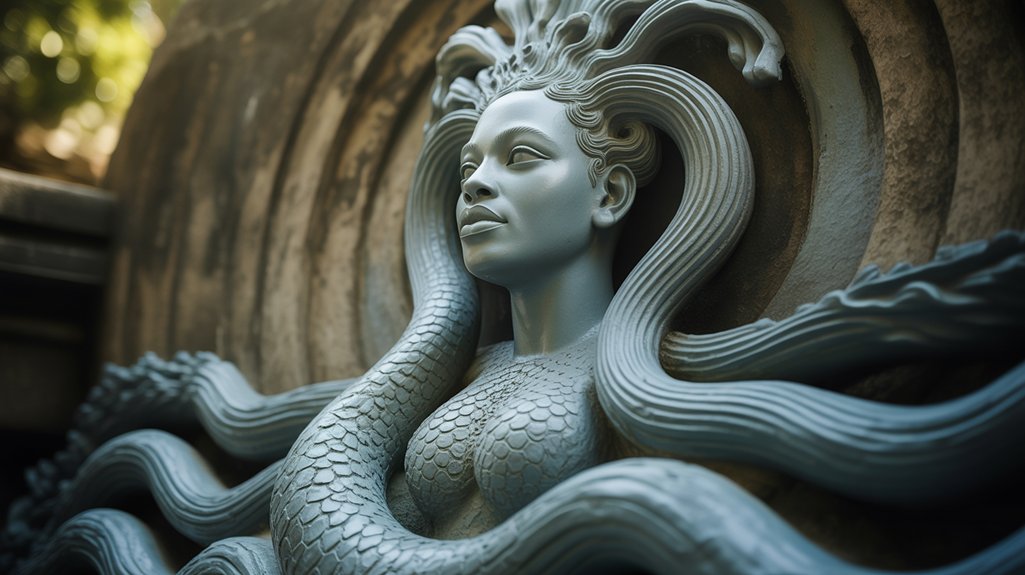
Across the coastal villages and riverine settlements of West and Central Africa, Mami Wata emerges as one of the continent’s most powerful and enigmatic spiritual forces—a chimeric deity whose serpentine beauty transcends national boundaries and ethnic divisions. Her worship encompasses profound cultural diversity, manifesting through water rituals that acknowledge both benevolence and peril.
| Aspect | Manifestation | Purpose |
|---|---|---|
| Serpentine allure | Beautiful women with snake features | Embodies duality of attraction and danger |
| Fertility offerings | Ceremonial gifts near water bodies | Guarantees abundance and reproductive vitality |
| Spiritual healing | Ritualistic invocations at rivers | Channels restorative powers through aquatic connection |
The mythical narratives surrounding Mami Wata symbolism reveal water’s eldritch capacity for alteration. Coastal worship traditions honor her as Yemoja among Yoruba communities, while maintaining shared reverence for her dual nature—nurturing provider and destructive force, wealth-bringer and chaos-wielder, healer and harbinger.
Water as Life-Death Boundary
Throughout humanity’s mythological consciousness, water stands as the primordial threshold—that liminal membrane separating mortal existence from the unfathomable domains beyond. This life death symbolism manifests across civilizations, from the River Styx’s eldritch currents to the Ganges’ purifying embrace, where spiritual transformations become tangible through liquid medium.
Water spirits embody this profound duality—nurturing abundance and catastrophic annihilation intertwined. These chimeric entities don’t merely inhabit boundaries; they *are* the boundary itself.
Water spirits exist as living thresholds—simultaneously the guardian, the gate, and the crossing itself made manifest.
The threshold manifests through:
- Baptismal metamorphosis in Christian tradition, where immersion drowns the obsolete self, birthing spiritual resurrection through controlled death
- Psychopomp water spirits guiding departed souls across forbidden currents, traversing that twilight passage between breathing and stillness
- Sacred rivers functioning as circular portals where death feeds rebirth eternally, dissolution becoming regeneration
Ancient peoples recognized water’s sovereignty over existence itself—one substance simultaneously sustaining breath and claiming it, cradling civilizations while swallowing them whole.
This paradox demands reverence, demands guardians.
Greek Poseidon and Celtic Kelpies
Across the churning waters of ancient Greece and the mist-shrouded lochs of Celtic Scotland, two distinct manifestations of aquatic power emerged—Poseidon, the Olympian sovereign whose trident commanded both ocean depths and terrestrial tremors, and the Kelpies, those eldritch shapeshifters who wore equine forms as masks for their predatory nature.
The Greek deity embodied dominion itself, his cult flourishing among sailors who understood water’s capacity to sustain and destroy with equal indifference.
The Celtic spirits, by contrast, represented water’s chimeric essence through deception and alteration, their beautiful horse-forms concealing the fatal undertow that claimed those who dared mount their slick, algae-draped backs.
Poseidon’s Domain and Power
While terrestrial deities ruled kingdoms bounded by mortal horizons, Poseidon commanded domains that stretched beyond human comprehension—the churning abyssal depths, the storm-wracked surfaces where ships foundered, and the subterranean aquifers that fed springs sacred to his worship.
His trident became more than symbol—it represented elemental authority itself. Three prongs channeling creation, destruction, equilibrium.
Trident Symbolism permeated Mediterranean consciousness, appearing on Minoan pottery circa 1600 BCE, etched into sailors’ amulets, carved upon temple facades where wave-spray met stone.
Poseidon’s Worship demanded constant appeasement. Blood offerings. Drowned horses. Black bulls slaughtered at coastal altars where salt air thickened with incense and fear.
His dominion wasn’t merely geographic—it was psychological, reflecting humanity’s eldritch terror before vast, indifferent waters that could nurture fishing communities or obliterate entire fleets with chimeric unpredictability.
Kelpies: Shapeshifting Water Horses
Celtic waterways birthed their own equine terrors—kelpies, those shapeshifting revenants that haunted Scottish rivers and lochs with predatory intelligence far removed from Poseidon’s divine grandeur.
*Each-uisge*, the Gaelic term whispered in Highland settlements, translated literally as “water horse,” though this mundane designation belied the creature’s chimeric malevolence.
These eldritch entities manifested primarily as midnight-black stallions, their sleek coats concealing adhesive skin that trapped unsuspecting riders, dragging victims beneath the surface to devour all save the liver.
Kelpie legends evolved as cautionary water mythology, warning travelers—especially children—against the seduction of solitary waterside encounters.
The creature’s shapeshifting extended to human forms, occasionally appearing as beautiful women near the River Forth.
Pure survival wisdom, encoded in folklore. Freedom demanded vigilance against nature’s deceptions.
Contrasting Benevolent and Malevolent
Though separated by centuries and coastlines, Mediterranean Olympus and Celtic riverbanks generated water deities that illuminated humanity’s bifurcated relationship with aquatic territories—Poseidon’s oceanic sovereignty versus the kelpie’s riverine predation revealing how geographical context shaped spiritual interpretation.
The Greek god embodied paradox: wrathful tempest-bringer yet guardian of sailors, earthquake-maker yet horse-lord, demonstrating how benevolent spirits contained multitudes within singular divine forms.
Conversely, kelpies emerged as purely malevolent entities—chimeric shapeshifters manifesting as magnificent steeds or alluring women, their eldritch glamour concealing murderous intent.
While Poseidon’s trident commanded respect through acknowledged duality, kelpies represented water’s deceptive face alone.
This theological divergence underscored universal recognition: aquatic domains nurture and annihilate simultaneously, their spiritual manifestations reflecting whether cultures viewed water primarily as life-sustaining highway or treacherous boundary requiring constant vigilance.
Contemporary Film and Anime Depictions
As cinema and animation have evolved into dominant narrative mediums of the twenty-first century, they’ve become vessels for ancient water spirit mythologies—reimagining these eldritch aquatic entities through the lens of digital artistry and cross-cultural synthesis.
Hayao Miyazaki’s “Ponyo” alters Japanese kami into whimsical, shape-shifting beings, while “Avatar: The Last Airbender” channels waterbending through shamanic traditions, positioning aquatic manipulation as both martial discipline and healing sacrament.
These contemporary works synthesize disparate cultural narratives into chimeric forms.
Modern animated symbolism manifests through:
- Personified oceans as conscious guardians, exemplified by “Moana’s” sentient sea—a nurturing deity guiding navigation and destiny
- Mermaid kingdoms drawing from pan-cultural water mythology, as Disney’s “The Little Mermaid” weaves Scandinavian, Slavic, and Caribbean traditions into hybrid underwater domains
- Sea-dwelling populations embodying liminal existence, where “Nagi-Asu: A Lull in the Sea” explores aquatic humanity’s metamorphic relationship with terrestrial civilizations
These visual mediums preserve ancestral reverence while democratizing access to sacred water traditions.
Jung’s Collective Unconscious Theory
Beyond the celluloid representations that transmit ancestral narratives through phosphorescent pixels lies a more profound question: why do water spirits emerge with such persistent regularity across civilizations separated by oceans, mountains, and millennia?
Carl Jung’s groundbreaking framework offers illumination. His Collective Unconscious Theory proposes that humanity shares inherited memories—archetypal symbolism embedded within our psychic substrate. Water spirits aren’t coincidental inventions but manifestations of universal patterns, eldritch impressions coded into consciousness itself.
These chimeric entities represent profound human encounters with water’s duality: nourisher and destroyer, womb and tomb, alteration incarnate. Jung recognized these unconscious influences as bridges between individual minds and primordial wisdom.
Cultures didn’t borrow these myths through contact; they independently accessed identical archetypal reservoirs. The naiad, rusalka, and kappa emerge from shared psychic depths, symbols through which humans confront life’s mysteries.
Water spirits become vessels for collective understanding, allowing civilizations to navigate existence’s fundamental paradoxes. They’re psychological necessities, not primitive superstitions—humanity’s attempt to comprehend forces simultaneously sustaining and obliterating us.
Climate Change Water Crises
While ancestral waters once flowed through myth as eternal wellsprings of change, contemporary oceans and aquifers now chronicle humanity’s most devastating paradox: the same species that revered water spirits across millennia has engineered their systematic desecration.
Climate impacts manifest as eldritch alterations—glaciers that sustained 2 billion souls dissolve into chimeric memories, their meltwater traditions evaporating beneath industrial skies. Water scarcity becomes absolute for 1.8 billion by 2025, the World Resources Institute intones, while droughts afflict over a billion supplicants who once honored rain deities with careful devotion.
Glaciers that nourished billions now dissolve into memory while water scarcity transforms from myth to mathematical certainty by 2025.
The Intergovernmental Panel on Climate Change documents saltwater intrusion corrupting coastal freshwater sources, ancient aquifers poisoned by rising seas. By 2030, water-related disasters will devastate 200 million annually—floods and droughts no longer divine judgments but anthropogenic catastrophes.
Where Apsaras danced and Nixies sang, only statistical projections remain. The spirits haven’t vanished; we’ve rendered their domains uninhabitable.
Global Waters, Shared Reverence
Across continents separated by vast oceans and millennia of isolation, humanity’s collective unconscious speaks in aqueous tongues—the Yoruba invoke Yemoja, mother of waters whose copper bracelets shimmer beneath Atlantic currents; Japanese villagers still leave cucumber offerings for Kappa dwelling in murky riverbeds; Celtic fishermen once negotiated with Selkies who shed seal-skins on moonlit shores; Greek priestesses channeled Naiads whose crystalline essences animated every spring and stream.
These convergent cultural narratives emerge not from direct contact but from shared existential recognition: water sustains, alters, destroys. The spiritual symbolism transcends geography precisely because the resource itself demands reverence.
When Bantu communities honor Mami Wata and Slavic peoples placate Rusalki, they’re articulating identical truths through different cosmologies. Each tradition understands water’s eldritch duality—nurturing crops while drowning children, purifying bodies while harboring disease.
This universal reverence alters ordinary tributaries into sacred thresholds where human morality intersects with elemental forces, binding disparate peoples through common recognition of water’s chimeric nature.
Frequently Asked Questions
How Do Water Spirits Differ From Sea Monsters in Folklore?
Water spirit characteristics emphasize benevolence, guardianship, and liminal communion—these numinous entities dwell between worlds, offering wisdom to those who approach respectfully.
Sea monster symbolism, conversely, manifests humanity’s primal dread: chimeric leviathans like Scylla embody chaos, destruction, territorial wrath.
Spirits invite relationship; monsters demand submission or death. The former guards sacred thresholds with eldritch grace, the latter devours transgressors.
One whispers ancient truths through mist and current, the other roars from abyssal depths, unbound by mortal comprehension.
Are Water Spirits Always Depicted as Female Across Different Cultures?
Contrary to popular Google searches, water spirits aren’t exclusively female across traditions.
While female representations dominate—Celtic kelpies, Slavic rusalki, Japanese kappa-onna—significant cultural variations exist.
Male entities like the Germanic Neck, African Mami Wata’s occasional masculine aspects, and India’s androgynous yaksha complicate simplistic gender binaries.
These eldritch beings transcend mortal categories; their forms shift, chimeric and liminal.
Ancient peoples understood what modern scholars rediscover: water itself defies containment, flowing beyond the rigid boundaries civilization attempts to impose upon the ineffable.
What Rituals Were Historically Performed to Appease Water Spirits?
Throughout millennia, cultures performed water offerings—casting flowers, coins, or food into rivers and springs—to honor eldritch aquatic entities.
Purification rituals dominated: Celtic communities bathed in sacred wells during Samhain, while Hindu devotees immersed themselves in the Ganges at dawn.
Blood sacrifice. Libations of wine or milk.
Japanese practitioners floated paper lanterns downstream, whispering prayers to kappa and mizuchi.
These weren’t mere superstitions—they represented humanity’s ancient covenant with those chimeric beings dwelling in liminal depths.
Do Landlocked Cultures Have Fewer Water Spirit Traditions Than Coastal Ones?
Like underground rivers carving silent cathedrals, landlocked beliefs flow just as deep.
Rivers, lakes, and sacred springs hold profound cultural significance—even distant from salt tides. The Mongols revered river spirits. Alpine communities honored glacial sources. Desert peoples built entire cosmologies around oases and ephemeral floods.
Geography shapes expression, not existence. Landlocked cultures don’t possess fewer water traditions; they’ve simply channeled their reverence toward different waters. The eldritch power of moisture transcends coastlines, adapting to whatever liquid sustains life.
Can Belief in Water Spirits Coexist With Modern Scientific Understanding?
Yes, they coexist harmoniously. Cultural perceptions of water spirits operate in liminal psychological territory—archetypal manifestations dwelling beyond empirical measurement.
Scientific interpretations explain hydrological phenomena through molecular interactions, thermodynamics, fluid mechanics. Yet neither domain eclipses the other.
Indigenous communities worldwide maintain reverence for numinous presences in springs and rivers while simultaneously employing modern water management.
The eldritch and the empirical occupy separate epistemological planes, each valid within its sphere, each offering distinct wisdom about humanity’s relationship with aqueous domains.
Conclusion
From Mesopotamian depths to contemporary cinema, water spirits persist—not as relics, but as living acknowledgments of humanity’s aqueous dependence. Consider the 2019 Australian bushfires: parched communities revived ancient Aboriginal rain ceremonies, seeking connection with ancestral water guardians. This wasn’t mere superstition. It was recognition of a primordial truth. Water remains our eldritch companion, the chimeric force bridging mortality and sustenance. These spirits endure because water’s power transcends culture. It simply *is*.