
Thunder deities across civilizations—Zeus with celestial eagles, Thor accompanied by resurrected goats, Shango wielding his double-headed axe—transformed meteorological phenomena into conscious expressions of cosmic will, their chimeric companions serving as manifestations of divine authority over agricultural cycles and mortal fate. From Mesopotamian cuneiform tablets (3000-1000 BCE) documenting Anu and Enlil’s celestial hierarchies to the Thunderbird’s storm-generating essence in Native American cosmology, humanity inscribed atmospheric chaos with sacred meaning. Ancient mythological frameworks intersect with contemporary meteorological understanding, revealing persistent truths about our species’ relationship with forces beyond mortal dominion—truths that await further exploration.
Key Takeaways
- Thunder gods like Zeus, Thor, Shango, and Tlaloc wielded celestial weapons to maintain cosmic order and agricultural cycles.
- Sacred animals accompanied thunder deities: eagles for Zeus, goats for Thor, bulls for Shango, and Thunderbirds in Native traditions.
- Mythical sky creatures include the Fenghuang, Roc, Firebird, Ziz, and Chickcharney, each embodying cultural values and cosmic power.
- Ancient Mesopotamian cuneiform tablets documented sky deities like Anu and Enlil, linking divine authority to mortal governance and harvests.
- Thunderstorms represented conscious divine will, with celestial battles symbolizing humanity’s struggle against chaos while nourishing civilizations.
Skies Alive With Divine Power
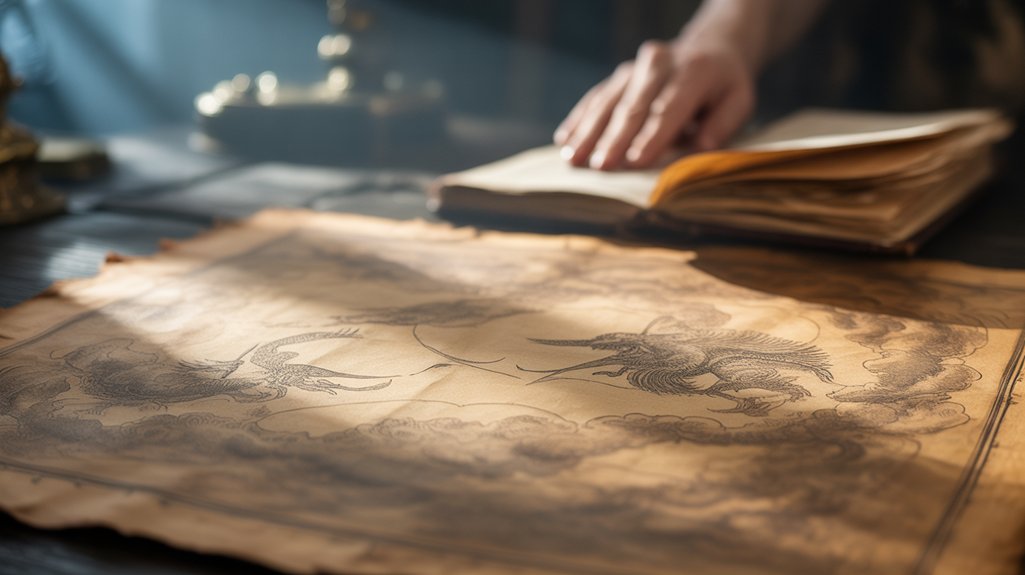
Everywhere across the ancient world, mortal eyes turned skyward with mingled dread and reverence, for the heavens themselves pulsed with divine agency. Thunder gods commanded these volatile domains—Zeus from Olympus, Thor across Asgard’s reaches, Raijin throughout Japan’s islands. Each wielded implements of eldritch power: thunderbolts crackling with celestial fire, Mjölnir’s devastating arc through storm-torn skies.
Across realms divine, thunder gods wielded eldritch implements—Zeus’s crackling bolts, Thor’s Mjölnir—commanding volatile heavens with devastating celestial power.
These weren’t mere meteorological phenomena. Divine thunderstorms manifested as conscious expressions of cosmic will, simultaneously destroying and nourishing the lands below.
Sacred creatures accompanied these deities—eagles soaring as Zeus’s messengers, goats drawing Thor’s chariot through roiling clouds. The Four Gods of Chinese cosmology stood eternal watch, each cardinal guardian embodying seasonal alteration and elemental dominion.
Celestial battles erupted regularly. Thor confronted the world-serpent Jörmungandr in apocalyptic fury. Zeus shattered Titan rebellion, establishing order from primordial chaos.
These conflicts weren’t distant mythology—they represented humanity’s perpetual struggle against entropy, freedom wrestling constraint, creation battling dissolution across heaven’s vast expanse. The Vikings who revered Thor sought wealth, prestige, and power through great deeds that would echo their mastery across both earthly and celestial realms.
##
Across the mythologies of earth, thunder deities command not only the crackling firmament but also sacred beasts whose forms embody celestial authority—Zeus’s raptor piercing clouds with prophetic vision, Thor’s caprine steeds whose hooves echo storm-rhythms across Nordic skies.
These chimeric companions transcend mere symbolism; they serve as extensions of divine power, guardians positioned at the threshold between mortal vulnerability and cosmic dominion.
Within epic confrontations against eldritch chaos, these winged and sanctified creatures manifest the thunder gods’ dual nature, their feathers and fur bearing witness to battles that sustain the delicate equilibrium between agricultural bounty and annihilating tempest.
Just as mythical creatures from diverse cultures symbolize humanity’s deepest fears and struggles, these celestial guardians embody the protective forces that stand between civilization and the destructive power of storms.
Winged Creatures Across Cultures
Throughout human civilization, the sky has birthed legends of creatures whose wings eclipse the sun—beings that transcend mere ornithology to become vessels of cultural truth and cosmic significance.
The Fenghuang embodies mythical symbolism within Chinese imperial cosmology, its iridescent plumage representing virtue’s triumph over chaos. Arabia’s eldritch Roc manifests primordial terror, clutching elephants skyward.
The Slavic Firebird burns with unattainable beauty, its luminous feathers promising both wonder and ruin. Jewish tradition’s Ziz stands sentinel against malevolence, chimeric wings darkening horizons.
Even the Bahamian Chickcharney wields dominion over human fate within pine-shadowed forests. These entities possess profound cultural significance—not mere folklore, but living affirmations to humanity’s eternal struggle with forces beyond mortal comprehension.
Each tradition preserves ancient truths about power, beauty, and the dangerous allure of the celestial dimension.
Thunder Gods’ Sacred Animals
Where lightning fractures primordial darkness, deific companions manifest—creatures whose forms encode thunder’s sovereignty across the world’s sacred architectures.
Zeus and Jupiter claimed eagles as divine manifestations of vigilance, their raptor authority surveying mortal domains.
Thor’s mythological connections transcended ornithological conventions—his chariot thundered behind eldritch goats, Tanngrisnir and Tanngnjóstr, whose resurrection after consumption embodied cyclical power.
In Yorubaland, Shango’s sacred symbolism merged with bovine strength; bulls channeled masculine justice through his double-headed axe.
Amadioha’s white ram carried cultural significance throughout Igbo cosmology, its pristine fleece representing purity in ritual sacrifice.
Thunder representations reached chimeric apotheosis with the Thunderbird—that massive avian guardian whose wingbeats generated storms across Native American traditions.
These animal attributes weren’t mere aesthetic choices but fundamental theological statements, encoding power’s essence through flesh and feather.
Celestial Beasts in Battle
When celestial architectures demanded martial enforcement, thunder deities released beast-companions whose combat modified meteorological phenomena into weapons of cosmic jurisdiction.
China’s Azure Dragon and Vermilion Bird embodied elemental sovereignty—wood and fire made manifest—as mythical guardians whose presence alone shifted atmospheric currents.
Thor’s confrontation with Jörmungandr demonstrated how celestial combat maintained universal equilibrium, serpent coils threatening to unravel creation’s fabric.
Zeus wielded lightning against titanic adversaries, establishing divine hierarchy through eldritch discharge.
Raijin’s drums converted thunder from mere sound into sustenance and devastation simultaneously.
These weren’t symbolic encounters.
Shango and Tlaloc engaged actual forces threatening agricultural cycles, their chimeric allies disrupting drought and chaos.
Each battle represented meteorological warfare—storms weaponized, rain commanded, thunder focused into precise instruments of cosmic law.
Sky Guardians’ Divine Powers
Divine authority manifested through specialized dominions, each sky guardian wielding powers intrinsically bound to cosmological architecture and seasonal metamorphosis.
The Four Gods exemplified this divine control—Qīnglóng commanded spring’s verdant awakening, Zhūquè blazed through summer’s zenith, Báihǔ ushered autumn’s harvest, Xuánwǔ endured winter’s dormancy.
These weren’t arbitrary assignments. Each beast’s eldritch essence resonated with directional chi flows governing terrestrial phenomena.
Thunder deities demonstrated similar specialization. Zeus’s thunderbolts. Thor’s Mjölnir. Weapons channeling atmospheric fury with surgical precision, maintaining elemental balance between destruction and renewal.
Their dual nature proved essential—storms devastated crops yet delivered life-giving rains. This paradox wasn’t weakness but sophisticated governance, acknowledging nature’s chimeric temperament.
Agricultural civilizations understood intimately: sky guardians determined survival itself. Their powers transcended mere spectacle, instead forming humanity’s existential framework where cosmic order directly influenced earthly sustenance.
Bronze Age Sky Deity Records
The earliest testimonies to Bronze Age sky deities emerge from ancient Mesopotamian cuneiform tablets, those clay-pressed archives that whispered of storm gods wielding eldritch power across the Tigris-Euphrates valley’s fertile crescent.
Within these wedge-marked texts, circa 2000 BCE, priest-kings documented their sacred intermediary role between celestial thunder-wielders and earthbound supplicants, inscribing rituals that bound divine authority to mortal governance.
These tablet records—fragmented yet luminous—reveal how sky deities weren’t mere mythological abstractions but living presences whose favor determined harvests, warfare, and the very legitimacy of royal bloodlines.
Ancient Mesopotamian Cuneiform Tablets
Carved into clay between 3000 and 1000 BCE, these cuneiform inscriptions preserve humanity’s earliest systematic attempts to map the numinous hierarchies governing storm-swept heavens. Anu reigned supreme—sovereign of celestial domains, his authority radiating through cuneiform symbolism that bound kingship to cosmic order.
Below him, Enlil commanded eldritch winds, his tempestuous breath determining whether mortals would feast or starve. The tablets reveal desperate invocations for rain, for mercy. Agricultural survival hung upon these deities’ temperaments.
Inanna blazed across twilight skies, chimeric warrior-lover straddling Venus’s dual manifestations, her essence too vast for singular interpretation. Each inscription chronicled divine justice enacted through drought, deluge, pestilence—celestial guardians whose interactions with humanity transcended mere worship, becoming contracts etched in fired clay, binding earth to heaven’s inscrutable will.
Tigris-Euphrates Valley Emergence
Between the twin rivers whose annual floods deposited both life and legend, Bronze Age scribes witnessed the crystallization of sky deity origins into systematic theological frameworks that would echo through millennia. The Sumerians raised Anu above all pantheons, establishing cosmic hierarchies where celestial powers governed mortal destinies. Marduk’s triumph over Tiamat in the Enuma Elish created order from eldritch chaos.
| Deity | Domain & Agricultural Significance |
|---|---|
| Anu | Supreme sky god, maintained cosmic order |
| Marduk | Storm-wielder, seasonal cycle controller |
| Adad/Ishkur | Thunder deity, bringer of fertilizing rains |
These storm-bringers weren’t mere abstractions. They embodied agricultural significance—rain, thunder, fertility—essential for survival. Divine kingship emerged naturally; rulers became chimeric figures, half-mortal administrator, half-celestial intermediary. Authority descended from above.
Priest-King Religious Authority Structures
Where divine mandate met earthly governance, Bronze Age priest-kings emerged as vessels through which celestial authority flowed into human institutions.
These divine intermediaries wielded eldritch power, conducting sacrifices to Zeus, Jupiter, and chimeric sky deities who commanded thunderbolts and fertility alike.
The priestly hierarchy maintained elaborate temples—architectural manifestations of cosmic order—where rituals appeased celestial forces controlling weather patterns essential for agricultural survival.
Sumerian and Egyptian records reveal this dual nature: sky gods as both creators and destroyers, their favor negotiated through blood offerings and incantations.
Thunder. Lightning. Sovereignty itself descended from above, legitimizing earthly rule through sacred ceremony.
These structures weren’t merely political constructs but living conduits connecting mortal domain to celestial dominion, ensuring socio-political stability through perpetual veneration of atmospheric powers.
East Asian Four Symbols Tradition
Within the cosmological framework of ancient Chinese civilization, four cardinal guardians emerged as celestial sentinels—creatures whose dominion extended beyond mere mythology into the fundamental architecture of reality itself. These Directional Guardians, known collectively as the Four Symbols, embodied elemental forces that governed seasonal cycles and spatial orientation. The Azure Dragon commanded spring’s eastern winds; the Vermilion Bird ignited southern summers with volcanic intensity. Westward, the White Tiger prowled through autumn’s metallic decay, while the Black Tortoise anchored winter’s northern depths in primordial waters.
| Guardian | Element & Season | Cultural Significance |
|---|---|---|
| Qīnglóng | Wood/Spring | Regeneration, growth |
| Báihǔ | Metal/Autumn | Harvest, change |
| Xuánwǔ | Water/Winter | Endurance, wisdom |
Their Elemental Associations permeated geomantic practice, astronomical calculation, architectural planning. Contemporary Influence persists through Artistic Representations in digital media, where these chimeric forms transcend temporal boundaries. Mythological Connections weave through Seasonal Symbolism, binding cosmic order to terrestrial existence—ancient knowledge refusing obsolescence.
Cardinal Directions and Seasonal Cycles
Through the ancient practice of cosmological mapping, Chinese astronomers forged an intricate correspondence between celestial mechanics and terrestrial phenomena—a system wherein the Four Symbols didn’t merely represent abstract forces but actively governed the metabolic rhythms of existence itself.
Each beast claimed dominion over directional influence, anchoring the cardinal points to elemental manifestations that rippled through temporal cycles.
The seasonal symbolism embedded within this framework operated as both calendar and philosophy:
- Azure Dragon (East): spring’s genesis, wood element, verdant awakening
- Vermilion Bird (South): summer’s conflagration, fire element, solar zenith
- White Tiger (West): autumn’s harvest, metal element, crystalline decay
- Black Tortoise (North): winter’s dormancy, water element, abyssal depths
- Center: Yellow Dragon, earth element, binding axis
This chimeric pantheon dictated agricultural rhythms, ritual observances, and cosmic harmony.
The guardians’ eldritch authority guaranteed civilization’s alignment with nature’s inexorable wheel—a liberation found not through resistance but through synchronization with celestial decree.
Azure Dragon’s Pearl Quest
The Azure Dragon’s pearl quest originates in primordial cosmological frameworks where celestial orbs embodied condensed qi, cosmic energy crystallized into tangible form through aeons of elemental convergence.
This luminous artifact, neither wholly physical nor entirely ethereal, binds itself to Qīnglóng through an ancient symbiosis—the dragon’s mastery over storm and tempest flows directly from the pearl’s eldritch properties, while the treasure requires its guardian’s vigilance against those who’d corrupt its power.
The eternal hunt persists across dynasties and dynasties: each legend reaffirms that guardian and gem exist in perpetual, sacred interdependence.
Pearl’s Mystical Power Origins
Luminous and pulsating with celestial qi, this dragon’s pearl emerges from Chinese cosmological traditions as far more than mere ornament—it’s the condensed essence of春 (chūn), the primordial force of spring itself, crystallized into physical form during the Eastern Han Dynasty’s systematization of the Wúxíng (五行) elemental framework around 25-220 CE.
The pearl symbolism transcends decorative function; scholars trace its mystical origins to wood element correspondences, where renewal energy coalesces into tangible matter.
Ancient texts describe seekers confronting eldritch trials, their worthiness measured against cosmic balance. The orb radiates protection against malevolent forces, its glow reflecting universal order.
This chimeric artifact embodies wisdom, fortune, and春’s regenerative power—a guardian talisman maintaining harmony between celestial domains and earthbound existence, forever burning with primordial luminescence.
Guardian’s Eternal Treasure Hunt
Across misty mountain peaks and turbulent seas, Qīnglóng pursues what can never truly be possessed—the luminous pearl that symbolizes enlightenment itself, forever dancing between tangible reality and ethereal abstraction.
This eternal wisdom quest transcends mere acquisition; the Azure Dragon’s treasure symbolism embodies humanity’s perpetual endeavor toward spiritual awakening.
Ancient texts position the pearl within oceanic abysses or celestial clouds, rendering it chimeric, simultaneously present and absent.
The guardian doesn’t merely seek; he becomes the search itself, manifesting Wood’s elemental principle of ceaseless growth.
Storm-summoner and Spring herald, Qīnglóng alters pursuit into philosophy, demonstrating that enlightenment resists capture precisely because it demands perpetual evolution.
The treasure hunt continues through millennia, an eldritch reminder that wisdom’s value lies not in possession but in the transformative journey toward understanding.
Dragon-Pearl Bond Symbolism
When celestial guardians intertwine with objects of power, symbolism transcends simple ownership—Qīnglóng’s relationship with his luminous sphere manifests as symbiotic unity rather than possessive dominion.
The pearl’s significance emerges through its eldritch radiance, embodying concentrated cosmic forces that channel through Spring’s verdant awakening. This isn’t mere treasure. The dragon’s wisdom flows bidirectionally, wisdom coursing between guardian and gem in perpetual exchange, neither complete without the other’s presence.
Ancient scrolls depict this bond as fundamental to maintaining celestial equilibrium, the Wood element’s regenerative power crystallized within opalescent depths.
Seekers who comprehend this chimeric relationship understand enlightenment’s true nature—not acquisition, but harmonious integration with forces greater than individual ambition. The pearl grants nothing; it reveals everything already present within those worthy of its luminescence.
Video Games and Anime Adaptations

Through the phosphorescent glow of pixel and screen, thunder gods have crossed beyond their ancient temple sanctuaries to inhabit digital domains where devotion takes the form of controller inputs and strategic gameplay decisions.
Video game adaptations have preserved these eldritch entities across multiple franchises—Final Fantasy’s Ramuh channeling primordial lightning through summoning rituals, while Breath of the Wild’s Thunderblight Ganon guards sacred technology with storm-born fury.
Anime representations equally honor these celestial arbiters:
- Naruto’s Raijin manifests through lightning-based jutsu, translating mythological power into kinematic combat sequences
- Smite alters Thor and Zeus into playable deities, their thunderous arsenals meticulously researched from source mythologies
- Persona 5’s Shōtō Hayasaka summons Raijin’s chimeric essence as psychological armor
- Strategic gameplay mechanics reflect ancient belief systems regarding elemental dominion
- Competitive settings democratize access to divine power structures
These digital incarnations function as contemporary shrines where players enact ritualistic engagement with storm gods, preserving cultural memory through interactive narrative architecture.
Pareidolia in Cloud Formations
Where terrestrial temples house carved idols and scrollwork texts, the atmosphere itself becomes canvas for divine manifestation—cloud formations serving as ephemeral galleries where human consciousness projects its most primal recognition patterns onto meteorological phenomena.
Pareidolia operates through humanity’s hardwired impulse to discern meaning within chaos, altering cumulus masses into chimeric dragons, cirrus wisps into celestial serpents, stratus blankets into slumbering leviathans. These cloud shapes trigger profound emotional responses, particularly when observers perceive beings from ancestral mythologies materializing overhead.
The brain’s pattern-seeking mechanisms convert amorphous vapor into eldritch guardians. Ancient cultures interpreted such visions as divine communications—omens transmitted through atmospheric scripture.
Cumulus formations, with their voluminous architecture, most readily suggest recognizable forms. Cirrus clouds offer delicate, ethereal configurations. Stratus layers present broader, more ambiguous canvases. Each meteorological variation yields distinct pareidolic possibilities, and individuals frequently assign deeply personal significance to their sightings, experiencing these momentary apparitions as numinous encounters rather than mere psychological phenomena.
Weather Pattern Cultural Interpretations
Beyond static visual recognition in cloud shapes, vibrant atmospheric events themselves become interpreted as conscious interventions by supernatural entities—thunderstorms, monsoons, hurricanes, and tempests read not as meteorological processes but as deliberate expressions of divine temperament.
Thunder symbolism permeates Indo-European, East Asian, and Mesoamerican cosmologies, where storm deities wield eldritch authority over agricultural prosperity and existential chaos. Zeus hurls lightning from Olympian heights. Thor battles chimeric giants threatening cosmic order. Raijin’s ceremonial drums resonate through Japanese archipelagos, announcing both devastation and renewal. The Aztec Tlaloc demands blood tributes—sacrifices ensuring rainfall’s fertile benediction upon maize fields.
Storm gods transform meteorological chaos into cosmic narratives—thunder becomes divine speech, lightning wields judgment, and rainfall flows from negotiated sacrifice.
These aren’t metaphorical constructs but interpretive frameworks through which autonomous peoples navigated unpredictable climates, altering meteorological uncertainty into relationships with personified forces. Wind deities like Boreas and Zephyros governed seasonal shifts, their temperaments dictating planting cycles and harvest outcomes.
Such interpretations granted agency where modern forecasting sees only pressure systems—weather patterns becoming narratives of divine intention, human reverence, and survival’s desperate negotiations.
Synthesis of Myth and Science
As contemporary meteorologists decode atmospheric phenomena through Doppler radar arrays and computational fluid movement, they inherit nomenclatural traditions steeped in mythological consciousness—hurricanes bearing names of ancient storm deities, celestial mechanics described through zodiacal cartography, planetary designations echoing Olympian pantheons.
These mythical interpretations persist within scientific discourse, revealing humanity’s enduring need to narrativize natural forces. The eldritch power attributed to Thor’s hammer finds scientific correlations in electrical discharge measurements; Zeus’s thunderbolts manifest as kiloampere lightning strikes ionizing nitrogen molecules.
Meteorological terminology itself preserves chimeric ancestry—cumulonimbus formations towering like celestial dragons, atmospheric rivers flowing through tropospheric corridors.
Ancient observers, lacking spectrometry and barometric instrumentation, constructed frameworks where thunder gods governed precipitation cycles essential for agricultural survival. Their cosmologies weren’t primitive superstitions but sophisticated epistemological systems encoding environmental patterns through accessible narrative structures.
Modern science doesn’t displace these traditions but translates them, acknowledging that both mythological and empirical frameworks seek identical truths: understanding the sky’s temperamental sovereignty over terrestrial existence.
Frequently Asked Questions
What Are the Most Famous Thunder Gods From Different Cultures Worldwide?
Thunder deities manifest across civilizations with electrifying sovereignty.
Zeus mythology dominates Hellenic tradition, wielding lightning from Olympus’s heights since approximately 1200 BCE.
Thor legends thunder through Norse cosmology, his hammer Mjölnir splitting storm-clouds across Midgard.
Japan venerates Raijin, whose drums echo through Shinto temples.
Hindu texts illuminate Indra, Vedic storm-lord commanding monsoons.
Africa honors Shango, Yoruba king converted into lightning itself.
These celestial warriors embody humanity’s primal encounter with atmospheric fury—eldritch forces channeling nature’s unbridled power through mythic consciousness.
How Do Modern Religions View Ancient Sky Deity Worship Practices?
Modern religious institutions often view ancient sky deity worship through lenses of religious syncretism—the phoenix of old beliefs rising altered within contemporary faith frameworks.
Catholic churches absorbed thunder god festivals into saint celebrations; Protestant scholars dissected ancient rituals as primitive precursors.
Yet indigenous communities resist this archaeological colonization. They maintain celestial practices as living traditions, not museum relics.
Eastern philosophies embrace multiplicity, honoring Indra alongside newer cosmologies, preserving eldritch wisdom without apologetic reframing.
Are There Any Archaeological Sites Dedicated to Celestial Guardian Worship?
Archaeological excavations have revealed numerous ancient temples devoted to celestial guardians across continents.
Sites like Göbekli Tepe showcase stellar alignments, while Mesopotamian ziggurats housed celestial artifacts—star charts, chimeric deity statues, cosmological tablets.
Egypt’s Dendera Temple preserves eldritch zodiac ceilings; Angkor Wat’s astronomical precision honors Vishnu’s cosmic form.
These sacred spaces weren’t mere monuments but portals where humanity communed with sky-dwelling protectors, their architecture encoding astronomical wisdom that modern seekers still decipher, reclaiming ancestral connections to celestial powers.
Which Mythical Sky Beasts Appear Most Commonly in Contemporary Popular Culture?
Like thunder rolling across ancient mountains, dragons dominate contemporary media’s mythological landscape. Their serpentine forms emerge in countless films, games, novels—from Smaug’s fire-wreathed magnificence to Daenerys’s scaled companions.
This enduring dragon imagery transcends mere entertainment; it channels humanity’s primal fascination with celestial symbolism and untamed power. The phoenix follows closely, its resurrection motif resonating with those seeking change.
These eldritch beings persist because they embody freedom itself—soaring, boundless, unshackled from earthly constraints that bind mortal existence.
How Did Ancient Civilizations Distinguish Between Different Types of Sky Phenomena?
Ancient civilizations employed sophisticated sky observation techniques to decode celestial mysteries. They distinguished lightning’s eldritch fury from aurora’s chimeric dance through careful pattern recognition, seasonal tracking, and mythological frameworks.
Their ancient meteorological beliefs weren’t mere superstition—they represented systematic knowledge transfer across generations. Babylonian astronomers catalogued storm formations by 1800 BCE.
Chinese observers documented meteors, comets, eclipses with reverent precision. Indigenous peoples worldwide developed intricate systems linking atmospheric phenomena to spiritual forces, liberating humanity’s understanding through sacred observation rather than dogmatic restriction.
Conclusion
The firmament remains humanity’s oldest cathedral, where celestial guardians and thunder deities continue their eternal vigil. These mythical beings—dragons coiling through monsoon clouds, chimeric phoenixes ascending through auroral veils—represent ancestral wisdom encoded in atmospheric phenomena. Modern pareidolia echoes Bronze Age veneration, proving that sky-bound divinity transcends temporal boundaries. As meteorology illuminates what ancients interpreted as divine caprice, the numinous persists. Science and mythology aren’t adversaries but kindred interpreters of eldritch patterns wheeling overhead, bridging empirical understanding with primordial wonder.