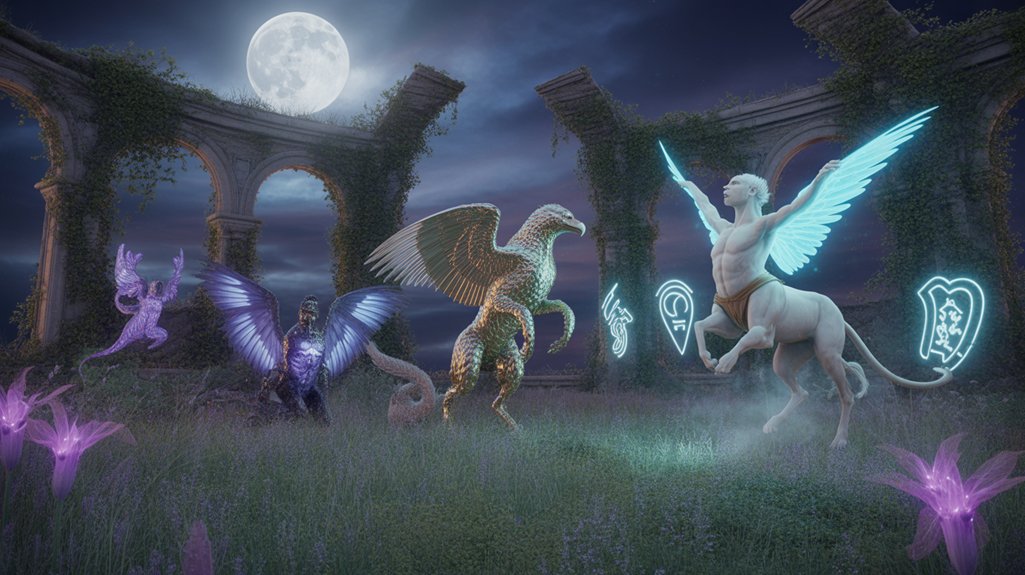
Hybrid mythical creatures emerged across ancient civilizations as epistemological tools encoding sacred knowledge through impossible anatomies—Mesopotamian lamassu combining human wisdom with leonine strength and avian transcendence, Egyptian sphinx variants binding consciousness to primal power, Greek griffins guarding terrestrial wealth with celestial ferocity. From Quetzalcoatl’s serpent-bird fusion to Japan’s turtle-human kappa, these chimeric forms reflected humanity’s struggle to comprehend nature’s chaotic potential and divine alteration. Modern interpretations through tabletop gaming and cinema perpetuate these ancient archetypes, demonstrating how pareidolia and cultural memory preserve liminal beings that continue revealing civilization’s deepest contradictions.
Key Takeaways
- Chimeric creatures like griffins, sphinxes, and mermaids combined animal and human traits to symbolize cultural fears and natural mysteries.
- Ancient civilizations carved hybrid beings into temples as epistemological tools, encoding sacred knowledge about power, chaos, and divine protection.
- Geography shaped regional variations: Asian dragons were benevolent, European dragons malevolent, and Quetzalcoatl merged serpent and bird forms.
- Hybrids served practical functions, from Lamassu guarding palace gates through psychological warfare to cylinder seals binding commerce with divine witness.
- Modern media transforms ancient hybrid archetypes through gaming, cinema, and merchandising, enabling direct interaction with mythical creatures today.
Chimeras, Griffins, Mermaids Unite
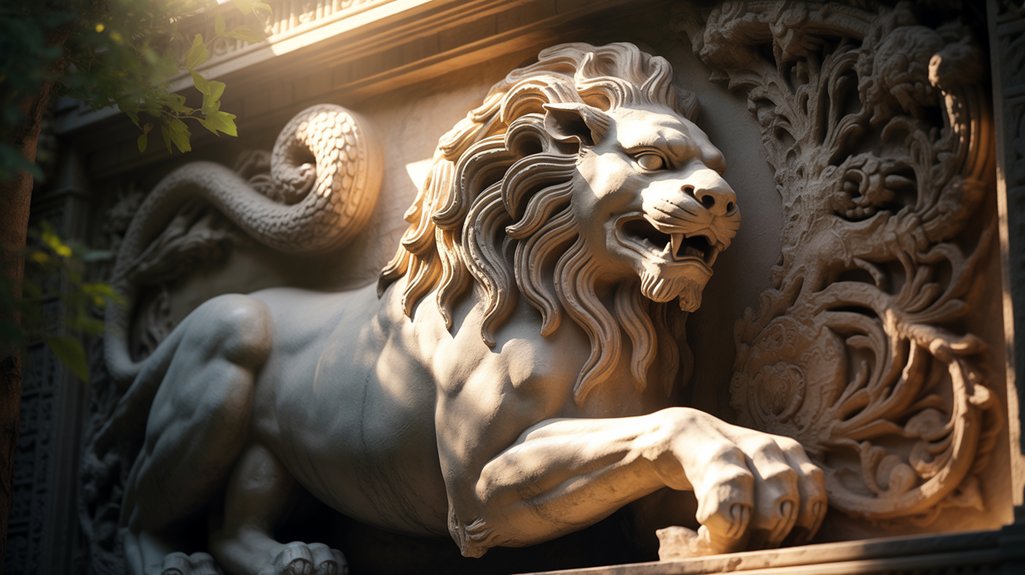
When ancient civilizations gazed upon the inexplicable—predators that defied categorization, storms that devoured ships, depths that swallowed men whole—they forged chimeric beings to contain their terror and wonder.
The Chimera emerged from Greek consciousness as lion-goat-serpent chaos incarnate, mythical symbolism manifest in flesh and flame. Griffins stood sentinel over hidden wealth, their leonine bodies bearing eagle wings—divine power protecting what mortals shouldn’t possess. Mermaids haunted Assyrian waters before claiming Greek shores, half-woman creatures embodying the sea’s dual nature: beauty concealing annihilation.
These hybrid forms weren’t mere fantasy. They were epistemological tools.
Ancient minds confronted nature’s mysteries through synthesis, blending familiar beasts into eldritch composites that explained the unexplainable. Each creature carried profound cultural significance across civilizations, evolving through centuries of retelling.
The combinations spoke truth: nature itself defies neat boundaries. Lion meets eagle. Woman becomes fish. In these liminal beings, humanity found freedom—permission to imagine beyond constraints, to acknowledge that reality’s edges blur into something stranger, wilder, more honest than simple categorization allows. These mythological creatures served as metaphors for humanity’s deepest struggles, embodying societal fears while offering cautionary wisdom through their terrifying forms.
##
Hybrid creatures emerged from humanity’s earliest attempts to comprehend the eldritch forces governing existence. Their chimeric forms served as vessels for complex philosophical truths that single-bodied beings couldn’t convey. Through the deliberate fusion of disparate anatomies—leonine strength merged with avian grace, piscine fluidity combined with human consciousness—ancient civilizations encoded their deepest anxieties and aspirations into living symbols that transcended mere monster-making.
These composite entities varied dramatically across geographical boundaries, from the scorpion-tailed Manticore prowling Persian imagination to the human-headed Sphinx guarding Egyptian necropolis gates. Each regional interpretation reflected the unique cosmological frameworks, environmental pressures, and spiritual hierarchies that shaped their respective cultures. The Chimera epitomized this tradition of mythical hybridization, combining lion, goat, and serpent into a single fire-breathing entity that represented nature’s chaotic potential before being slain by Bellerophon.
Ancient Origins and Meanings
Throughout the cradle civilizations of Mesopotamia, Egypt, and the Indus Valley—roughly 3500 BCE to 1500 BCE—priests and scribes carved chimeric forms into temple walls, capturing humanity’s earliest attempts to reconcile the inexplicable forces governing their world.
The Sphinx embodied mythical significance through its leonine strength merged with human consciousness, standing sentinel over pharaonic tombs. Greece’s Minotaur—imprisoned within Knossos’s labyrinth—reflected cultural reflections on civilization’s fragile boundaries against bestial impulses.
Hindu texts raised Narasimha beyond mere symbolism; his clawed emergence from a pillar demonstrated divine wrath transcending natural law.
These eldritch amalgamations weren’t decorative fantasies but theological architecture, each hybrid form encoding sacred knowledge about power, change, and the permeable membrane between mortal and divine domains.
Ancient minds constructed meaning through monstrosity.
Symbolic Power Through Combination
Because mythical architects understood that single-form creatures couldn’t contain civilization’s contradictions, they grafted disparate anatomies into unified vessels of meaning—the Chimera’s tri-natured body breathing fire through its lion’s throat while goat and serpent heads twisted from its spine, each segment encoding distinct cosmic forces that ancient Lycians believed governed their volcanic landscape.
These hybrid characteristics transcended mere aesthetic invention. The Griffon’s eagle-lion fusion merged terrestrial sovereignty with celestial dominion, its symbolic significance radiating through Persian and Scythian territories as guardian of sacred gold.
Ammit’s crocodile-leopard-hippopotamus form embodied judgment itself—devourer of unworthy hearts in Egyptian psychostasia.
Through chimeric synthesis, cultures weaponized taxonomy, forging entities that simultaneously represented duality and unity. Power emerged not despite contradiction but through it, each eldritch combination declaring sovereignty over liminal domains where categorization failed.
Cultural Beliefs Shape Hybrids
When societies pressed their deepest anxieties and aspirations into flesh, they didn’t merely invent monsters—they engineered psychological repositories that could metabolize collective wisdom across generations.
Ancient Egypt’s Ammit manifested moral consequence through chimeric form: crocodile jaws, leonine forelegs, hippopotamus haunches converging into devourer of unworthy souls.
Greek centaurs embodied civilization’s eternal struggle against barbarism, their hybrid traits splitting human reason from equine wildness.
Hindu Pratyangira’s leonine visage merged with human form crystallized protective ferocity, cultural symbolism demanding balance between cosmic forces.
Werewolf legends across continents altered humanity’s terror of its own primal nature into flesh that shifted beneath moonlight.
Each creature became mirror and warning, preservation and prophecy.
These eldritch forms weren’t escapism—they were survival mechanisms encoded in sinew and fang.
Regional Variations Across Continents
Geography carved mythical flesh into radically divergent forms, each landmass breeding hybrids that absorbed local terrors, venerated animals, and environmental pressures into their composite anatomies.
Asia’s dragons embodied duality—benevolent fortune-bringers in the East, malevolent treasure-hoarders in Europe. Cross cultural comparisons reveal stark contrasts: Japan’s Kappa merged human intellect with turtle armor, while China’s Long serpents commanded waters with draconic majesty.
Africa birthed the Adze, an eldritch vampire-werefirefly hybrid preying upon children.
Mesoamerica’s Quetzalcoatl fused serpent cunning with avian transcendence, mythical symbolism elevating both creatures to deity status.
Europe’s Chimera epitomized continental anxieties—lion, goat, serpent writhing in chimeric chaos.
Each continent’s hybrids materialized as psychological landscapes made flesh, environmental knowledge encoded in monstrous form.
Ancient Mesopotamian Cylinder Seals

The chimeric lamassu—those winged bull-deities with human heads crowned in horned tiaras—emerge repeatedly across ancient Mesopotamian cylinder seals. Their hybrid forms serve as apotropaic sentinels against the eldritch forces that threatened Sumerian city-states as early as 4000 BCE.
These guardian figures weren’t mere artistic flourishes but rather impressed declarations of cosmic order. Their images rolled into soft clay to invoke divine protection wherever the seal’s authority extended.
Each cylindrical impression altered mundane administrative documents and storage vessels into sanctified spaces, warding boundaries between civilization’s light and the primordial chaos lurking beyond city walls.
Lamassu Guardian Deity Sculptures
Towering sentinels of alabaster and limestone once guarded the thresholds of Assyrian power, their chimeric forms—bull-bodied, eagle-winged, human-headed—carved to embody what mortal flesh alone couldn’t protect.
These Lamassu, stationed at Nimrud and Nineveh’s gates since the 9th century BCE, weren’t mere decoration. They were divine architecture made manifest. Lamassu symbolism wove together terrestrial strength, celestial dominion, and human wisdom—a trifecta of attributes no single entity possessed.
Rulers wielded them as psychological warfare: anyone approaching Assyrian palaces confronted these eldritch guardians first. Their intricate stone features conveyed both majesty and menace.
Beyond monumental sculptures, Lamassu architecture permeated Mesopotamian consciousness through cylinder seals, rolling their protective imagery across clay tablets.
Religious devotion, political authority, spiritual defense—all compressed into one hybrid form standing eternal watch.
Sumerian City-States, 4000 BCE
Before these monumental guardians towered at palace gates, their hybrid forms already prowled across smaller, more intimate surfaces—cylinder seals no larger than a thumb, yet bearing worlds within their curved stone. Within Sumerian city-states like Uruk and Ur, cylinder seal craftsmanship altered commerce into sacred ritual, each impression binding mortal transactions to divine witness.
| Seal Element | Symbolic Function |
|---|---|
| Chimeric beings | Divine protection, authority |
| Cuneiform script | Legal documentation, ownership |
| Geometric patterns | Cosmic order, architectural harmony |
These eldritch miniatures embodied religious devotion—gods, goddesses, and their hybrid servants compressed into portable iconography. Cylinder seal craftsmanship paralleled Sumerian architecture’s vertical ambitions: ziggurats rising toward heaven, seals descending into clay’s yielding surface. Both mediums declared independence through permanence, converting ephemeral human endeavor into enduring witness.
Protection From Chaos Forces
Where cosmic order met primordial chaos, these diminutive seals functioned as apotropaic barriers—carved invocations that altered vulnerable thresholds into fortified boundaries.
Mesopotamian artisans incised eldritch imagery into stone between 4000-539 BCE, creating chimeric guardians whose very presence demanded chaotic balance. The lamassu emerged most prominently: human-headed, lion-bodied, wing-bearing sentinels whose composite forms synthesized rational intellect, bestial strength, celestial transcendence.
When pressed into clay, these impressions activated protective contracts with the numinous domain. Divine intervention materialized through ritual application—each seal-rolling ceremony changed mundane doorways, storage vessels, administrative documents into sanctified objects.
The hybrids weren’t mere decoration. They were theological architecture. Apotropaic shields. Their multiplicity of forms reflected fundamental cosmological truth: order required constant vigilance against entropy’s relentless encroachment.
Egyptian Sphinx Variant Forms

While the canonical image of the Sphinx—that leonine colossus bearing a human countenance—dominates contemporary understanding, ancient Egyptian civilization developed a far more diverse taxonomy of these liminal guardians. These Sphinx variations manifested distinct theological functions, each chimeric form embodying specific divine attributes that transcended mere architectural ornamentation.
| Variant | Physical Form | Symbolic Purpose |
|---|---|---|
| Androsphinx | Male human head, lion body | Wisdom, pharaonic power, solar divinity |
| Criosphinx | Ram head, lion body | Fertility, strength, Amun’s protection |
| Hieracosphinx | Hawk head, lion body | Sky dominion, Horus manifestation |
The Androsphinx characteristics merged masculine intellect with predatory might, while Criosphinx symbolism channeled the ram’s procreative essence. The Great Sphinx significance endures—that 4,500-year-old sentinel stretching 240 feet across Giza’s plateau represents humanity’s earliest monumental wrestling with eldritch boundary-crossing, where mortal consciousness fused with animal ferocity to guard sacred thresholds against chaos forces threatening cosmic order.
Power Merging Through Hybrid Forms
Through deliberate chimeric synthesis, ancient mythmakers engineered creatures that didn’t merely combine anatomical features—they compressed entire cosmological hierarchies into singular, transgressive forms.
Mythical hybrids weren’t mere anatomical mashups—they were compressed cosmologies, hierarchies of power collapsed into singular, transgressive flesh.
The Chimera’s tripartite composition exemplifies this profound manipulation of power relations. Lion, goat, serpent—earth, mountain, underworld—fused into one eldritch sentinel. Each head commanded distinct elemental dominion, creating beings that transcended simple predatory threat to become living theological statements.
Hybrid mythical symbolism manifests through:
- Manticore’s scorpion-tailed sovereignty: Persian intelligence merged with leonine ferocity, embodying Eastern conceptions of dangerous wisdom.
- Sphinx’s riddle-guarding synthesis: Human cognition weaponized through bestial permanence, making knowledge itself predatory.
- Lamassu’s winged protection: Mesopotamian bull-strength raised through avian transcendence, spanning earth and sky simultaneously.
- Garuda’s dual-realm authority: Vishnu’s mount bridging mortal and divine territories through calculated anatomical transgression.
- Chimeric hierarchies compressed: Multiple apex predators unified, shattering natural order to establish supernatural supremacy.
These weren’t evolutionary accidents. They were deliberate cosmological engineering—power made flesh through impossible synthesis.
Greek Griffin Treasure Guardians
In the mountainous borderlands of ancient Scythia, where Hellenic cartographers marked the edges of their known world circa the 7th century BCE, the griffin emerged as perhaps the most formidable chimeric sentinel in Greek mythological consciousness.
This eldritch fusion—leonine musculature crowned with raptor’s beak and wings—stood eternal vigil over auriferous hoards, its dual nature embodying both terrestrial sovereignty and celestial transcendence.
The creature’s iconography, etched into countless temple friezes and shield bosses, transmitted core Hellenic virtues: strength tempered by divine wisdom, ferocity channeled toward sacred protection.
Origins in Ancient Greece
Long before the Olympian gods claimed their thrones atop Mount Olympus, the griffin—that chimeric fusion of leonine power and aquiline majesty—prowled the mountainous borderlands between the known world and the domain of the divine.
Ancient Greek artisans carved these eldritch guardians into temple friezes and tomb facades, their talons eternally poised over celestial treasures. The griffin significance transcended mere decoration; these creatures embodied vigilance itself, their eagle eyes piercing mortal deception while their lion hearts defended sacred gold.
Ancient artistry captured their dual nature—earth-bound ferocity married to heaven-soaring grace. Greeks believed griffins patrolled that liminal threshold where mortal ambition met divine prohibition, their very existence a warning: some treasures aren’t meant for human hands.
They flew upward, always upward, carrying prayers and protecting what lay beyond mortal reach.
Guardian Role and Symbolism
Beyond their aesthetic grandeur as architectural ornaments, griffins served as the ancient world’s ultimate sentinels—creatures whose very anatomy proclaimed their fitness for eternal watch. Lion musculature merged with raptor talons. Perfect guardians for sacred treasures hidden within eldritch tombs and sun-drenched temples.
This chimeric form embodied guardian symbolism across Mediterranean civilizations, where griffin representation adorned royal burial chambers and divine sanctuaries from 3000 BCE onward. Their dual nature—terrestrial predator fused with celestial hunter—positioned them as liminal beings capable of protecting both earthly riches and spiritual domains.
Ancient artisans carved these sentinels into stone, believing their vigilant presence would repel malevolent forces seeking to defile consecrated spaces. The griffin’s unwavering gaze promised eternal protection, a covenant between mortal ambition and supernatural defense that transcended mere decorative purpose.
Physical Description and Depictions
Golden feathers cascaded down muscular leonine shoulders, where avian anatomy surrendered to feline power—this hybrid form crystallized in Greek artistic consciousness around the 7th century BCE, when eastern influences penetrated Aegean workshops through trade routes spanning Scythian steppes to Egyptian bazaars.
Griffin anatomy defied nature’s boundaries: razor talons gripped temple friezes, hooked beak curved into permanent vigilance, wings spread across thirteen-foot spans in architectural reliefs.
Artisans rendered these chimeric guardians with meticulous precision. Artistic interpretations varied—Athenian vase painters favored sleek profiles, while Minoan craftsmen emphasized musculature through bronze casting.
The creature’s eldritch presence dominated royal burial chambers, where painted eyes tracked intruders through millennia. Each depiction whispered the same promise: unbridled strength wed to celestial sovereignty, terrestrial dominion merged with aerial freedom.
Dungeons & Dragons Owlbear Creation
Although the Owlbear’s origins remain shrouded in the mists of early tabletop gaming history, its creation in 1977 marked a watershed moment in the evolution of chimeric beasts within fantasy role-playing.
Gary Gygax and his collaborators birthed this eldritch fusion within the original Monster Manual, synthesizing ursine ferocity with avian predation into something entirely unprecedented. The creature’s design philosophy rejected conventional mythological templates, instead embracing raw imaginative synthesis.
The Owlbear habitat encompasses primeval forests and craggy mountain territories, where these territorial sentinels guard their domains with unwavering aggression.
Their Owlbear abilities demonstrate remarkable convergence:
- Keen nocturnal vision inherited from their raptor heritage
- Devastating claw attacks powered by bear musculature
- Thick pelage combining protective fur and feathers
- Fierce territorial instincts driving relentless defense behaviors
- Challenge ratings scaled across editions for diverse adventurer encounters
This hybrid emerged as proof of gaming’s creative liberty, altering tabletop encounters into experiences of wonder.
Pure invention.
Pareidolia Pattern Recognition Response
The human mind’s extraordinary capacity to conjure dragons from cloud formations and faces from mountain crags reveals pareidolia as humanity’s primordial architect of hybrid mythology. This neurological phenomenon, where consciousness imposes familiar patterns onto chaotic stimuli, liberates imagination from empirical constraints.
Pareidolia in nature alters weathered bark into sphinxes, waves into sea serpents, shadows into chimeric guardians of threshold spaces. The psychological implications extend beyond mere misperception. Ancient peoples, witnessing leonine profiles in cliff faces or serpentine forms in river currents, didn’t simply hallucinate—they accessed humanity’s unshackled creative potential.
This pattern recognition response, emerging from survival mechanisms that once detected predators in foliage, evolved into something transcendent: the ability to perceive eldritch beings dwelling between reality and vision. Modern neuroscience confirms what shamans intuited millennia ago.
The fusiform gyrus, responsible for facial recognition, activates when observing random stimuli, generating spontaneous mythology. Consequently, griffins, mermaids, and countless hybrid entities emerged not from deliberate fabrication but from consciousness itself, forever unbound.
Modern Media Saturates Pop Culture
When cinema’s silver screen first flickered to life in the twentieth century, it released upon collective consciousness a torrent of hybrid entities that would reshape humanity’s relationship with the chimeric.
*Harry Potter*’s hippogriffs and basilisks, *The Lord of the Rings*’ fell beasts and wargs—these digital incarnations don’t merely entertain; they function as techno-shamanic vessels transmitting ancient archetypes through pixels and sound waves.
Video games like *Dungeons & Dragons* and *World of Warcraft* grant players unprecedented agency, allowing direct communion with griffins, manticores, and countless eldritch amalgamations.
Interactive mythologies collapse the distance between observer and archetype, transforming ancient chimeras from distant symbols into co-navigated digital experiences.
Pop culture has become the primary conduit through which hybrid representation reaches contemporary audiences. Streaming platforms now dedicate entire series to mythological exploration, democratizing access to once-obscure traditions.
The merchandising apparatus—toys, collectibles, digital avatars—transforms these creatures from passive symbols into tangible companions.
*Beauty and the Beast*’s titular character exemplifies this phenomenon: a leonine-cervine-ursine fusion rendered palatable, marketable.
Modern media hasn’t diluted sacred knowledge. It’s preserved it.
Hybrids Endure Through Storytelling
Narrative threads preserve what stone tablets cannot—the visceral truth of change, liminality, monstrosity. Hybrid symbolism transcends mere entertainment, embedding itself within humanity’s collective unconscious as evidence to our eternal fascination with alteration. The Chimera’s leonine fury merged with caprine docility and serpentine cunning exemplifies how mythical storytelling captures contradictions that define existence itself.
These chimeric forms endure because they articulate what rational discourse cannot—the eldritch spaces between categories, the permeable boundaries of self. From Crete’s Minotaur stalking labyrinthine corridors to contemporary Dracimeras prowling tabletop domains, each iteration carries forward ancient wisdom about duality’s inescapable nature.
Culture after culture returns to hybrid symbolism, recognizing in these composite beings the fundamental human struggle against classification, against limitation. Stories perpetuate where stone crumbles. They adapt, mutate, hybridize themselves—becoming vessels for moral instruction, psychological exploration, and liberation from rigid taxonomies.
The creature with multiple natures speaks to audiences craving freedom from singular identity, from bounded existence.
Frequently Asked Questions
What Psychological Benefits Do Hybrid Creatures Provide to Human Imagination and Creativity?
Hybrid creatures liberate consciousness from mundane constraints, offering profound imagination stimulation through their chimeric forms.
These eldritch beings—griffins melding eagle and lion, sphinxes fusing human intellect with leonine power—demonstrate creativity improvement by dissolving categorical boundaries.
Ancient civilizations understood this: Egyptian priests (circa 3000 BCE) crafted composite deities to access transcendent states.
When minds encounter impossible anatomies, neural pathways ignite, forging connections between disparate concepts.
Such encounters nurture psychological flexibility, enabling thinkers to transcend conventional limitations and explore uncharted cognitive territories.
Are There Any Hybrid Mythical Creatures Unique to Indigenous Australian Cultures?
Indigenous Australian traditions preserve chimeric beings that defy Western categorization.
The Rainbow Serpent—life-giver and destroyer—undulates through ancient Dreamtime Stories, its eldritch form merging python scales with cosmic forces.
The Yowie Legend speaks of towering ape-men haunting eucalyptus forests, liminal guardians of sacred boundaries.
Above all soars Bunjil Eagle, the creator-spirit whose avian majesty fuses with ancestral wisdom, shaping laws that liberate rather than constrain.
These beings remain living evidence to sixty thousand years of unbroken cultural continuity.
How Do Modern Scientists Classify Newly Discovered Animals Resembling Mythical Hybrids?
Modern taxonomists employ genetic classification systems to decode chimeric organisms that mirror ancestral legends. When species hybridization occurs—ligers, wholphins, beefalo—scientists analyze DNA sequences, establishing phylogenetic relationships through molecular evidence.
They’re bound by Linnaean hierarchies, yet certain discoveries defy conventional categories. The platypus, once dismissed as fraudulent, exemplifies nature’s eldritch capacity to manifest seemingly impossible forms.
These hybrid entities occupy liminal taxonomic spaces, challenging rigid classification while validating indigenous knowledge systems that’ve long honored nature’s boundless creativity.
Which Hybrid Creatures Appear Most Frequently in Children’s Literature Today?
Like ancient whispers echoing through time’s vast corridors, fantasy animals captivate young minds today.
Dragons—chimeric guardians of forgotten wisdom—dominate children’s books alongside phoenixes, their eldritch resurrection cycles mirroring metamorphosis’s eternal promise.
Unicorns embody untamed purity.
Griffins merge leonine strength with aquiline vision, teaching balance between earth and sky.
These creatures aren’t mere entertainment; they’re portals to limitless possibility, ancestral archetypes granting liberation from mundane constraints, inviting explorers to transcend boundaries society imposes.
Do Any Religions Consider Hybrid Creature Symbolism Sacred or Forbidden?
Various faiths hold divergent views on chimeric beings. Hinduism venerates Ganesha’s elephant-human form as sacred symbolism, while Garuda’s avian-humanoid essence commands devotion.
Conversely, Leviticus 19:19 prohibits mixing kinds, influencing Abrahamic interpretations of forbidden hybrids as unnatural transgressions.
Ancient Egyptian temples honored Anubis and Sekhmet—jackal-man, lion-woman—as divine intermediaries.
Islamic tradition debates jinn’s protean nature.
Buddhism’s naga serpent-deities embody enlightenment’s altering power.
Each tradition navigates humanity’s eldritch fascination with boundary-crossing entities, revealing deeper cosmological truths.
Conclusion
Though skeptics dismiss these chimeric forms as mere fantasy, such reductionism ignores their enduring psychological truth. From Mesopotamian cylinder seals to contemporary digital domains, hybrid creatures persist because they articulate humanity’s deepest intuitions about metamorphosis, liminality, and power’s syncretic nature. These eldritch amalgamations aren’t escapism—they’re symbolic technology, ancient and evolving. The griffin still guards its treasure. The sphinx still poses her riddle. They endure because wonder needs embodiment, and imagination demands its monsters.