
Prophetic avians function as chimeric intermediaries between mortal comprehension and divine foreknowledge across disparate cultures—from Garuda, the serpent-destroying mount of Vishnu emerging from Vedic literature circa 1500 BCE, to Simurgh, Persia’s wisdom-bearing phoenix whose celestial feathers signal alteration through accumulated knowledge rather than sacrifice. The Thunderbird heralds meteorological upheaval throughout Indigenous North American traditions, while China’s Fenghuang conveys auspicious harmonies through its eldritch presence. These feathered vessels translate cosmic truths into earthly warnings, their flight patterns serving as encrypted prophecies that priest-diviners once decoded into statecraft—a practice whose symbolic resonance continues shaping contemporary spiritual consciousness.
Key Takeaways
- Garuda in Hindu cosmology foresees victories and calamities while embodying divine power, originating from Vedic literature circa 1500 BCE.
- Simurgh from Persian tradition signals transformation through wisdom, bridging celestial and terrestrial consciousness with healing knowledge instead of sacrifice.
- The Thunderbird in Indigenous cultures heralds destruction and renewal, serving as a meteorological sentinel representing weather control and omens.
- The Phoenix symbolizes cyclical metamorphosis and rebirth, associated with Ra in Egyptian mythology through crimson-gold plumage embodying fire’s essence.
- Prophetic birds serve as intermediaries translating divine knowledge into earthly warnings, with interpretations spanning ornithomancy to modern ecological symbolism.
Wings That Whisper Tomorrow
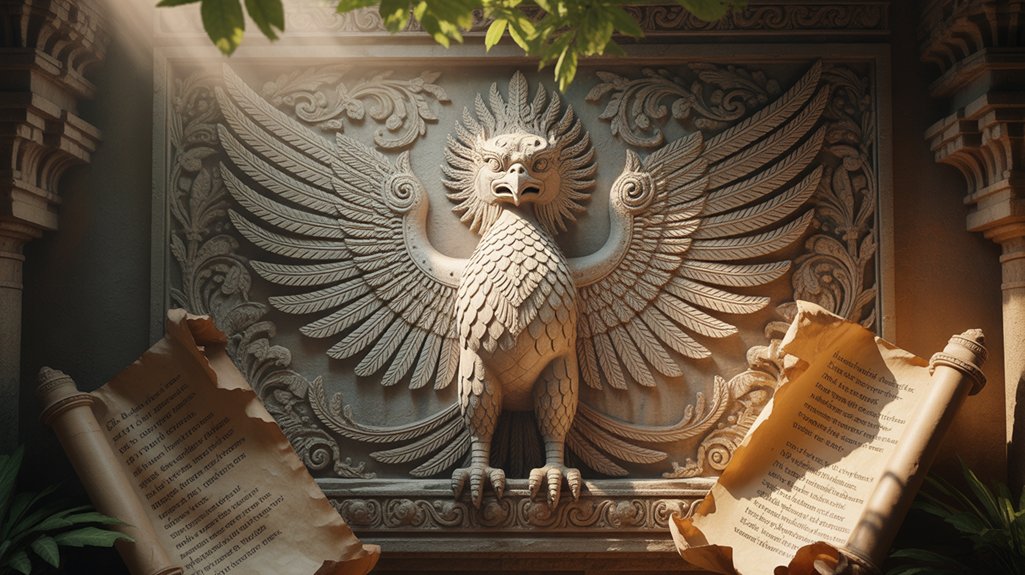
The prophetic birds that inhabit humanity’s collective mythology transcend mere avian symbolism—they exist as intermediaries between mortal comprehension and the ineffable currents of fate itself.
These winged omens traverse the boundary between temporal reality and cosmic foreknowledge, their prophetic flight traced across cultures separated by vast oceans and millennia. The Garuda’s massive wingspan casts shadows that foretell victories and calamities alike in Hindu cosmology, while the Simurgh’s eldritch presence in Persian tradition signals alteration through wisdom earned across thirty thousand years.
Indigenous nations recognize the Thunderbird’s approach through atmospheric disturbances that herald both destruction and renewal. Sacred texts describe how their calls penetrate human consciousness, translating divine intention into mortal understanding.
Ancient observers documented specific flight patterns—spiraling ascents signifying prosperity, westward trajectories warning of upheaval. These chimeric messengers don’t merely predict tomorrow; they embody it, their feathers carrying tomorrow’s truth within today’s moment. In Japanese mythology, similar avian deities serve as celestial intermediaries, connecting the earthly realm with divine wisdom across diverse pantheons.
##
Across continents and millennia, four prophetic avians emerge from humanity’s collective mythosphere, each bearing omens through feathered forms that bridge mortal existence and celestial domains: Garuda, the golden-winged vahana of Vishnu whose talons grip serpents of chaos; the Phoenix, that eldritch flame-wreathed herald of cyclical metamorphosis rising perpetually from its own ashes; the Simurgh, Persia’s ancient wisdom-keeper whose thousand-year lifespan encompasses epochs of human endeavor; and the Thunderbird, whose lightning-cracked wings carry the prophetic voices of indigenous North American cosmologies.
These chimeric messengers, though separated by vast geographic and temporal distances, share a singular sacred function—they translate divine knowledge into earthly warnings, their appearances marking threshold moments when fate itself trembles between possibilities.
Each creature embodies not merely ornithological symbolism but serves as a living hieroglyph, inscribing prophecy upon the very air through which it soars.
Like the Yanomami culture that preserves accounts of the Owhuama in Venezuela’s remote Amazon regions, indigenous communities worldwide maintain oral traditions of winged prophets whose sightings presage transformation.
Garuda: Hindu Vishnu’s Mount
Rising from the sacred texts of Vedic literature circa 1500 BCE, Garuda manifests as a chimeric embodiment of divine power—part human, part raptor, wholly transcendent.
Garuda mythology positions this eldritch being as Lord Vishnu’s celestial vahana, soaring through cosmic domains with unmatched velocity. Garuda symbolism permeates Hindu consciousness: strength unbound, courage absolute. His attributes include golden wings spanning infinity, razor talons, and eyes blazing with righteous fury.
Garuda in scriptures—the Mahabharata, the Ramayana—emerges as serpent-destroyer, his ancient enmity with nagas representing eternal cosmic balance.
Garuda worship extends beyond India; Thailand and Indonesia embrace his representations as national emblems of liberation. Garuda festivals celebrate this king of birds through Garuda art depicting his protective nature.
Garuda legends whisper of amrita stolen, promises kept, evil vanquished. Freedom incarnate.
Phoenix: Rebirth and Renewal
From flame-wreathed death into transcendent resurrection, the Phoenix emerges as mythology’s supreme architect of cyclical change—a creature whose existence defies mortality’s finality.
Across Greek, Egyptian, and Chinese traditions, this eldritch avian embodied humanity’s deepest yearnings for continuity beyond dissolution. Ancient Egyptians bound Phoenix symbolism inextricably to Ra, their solar deity, whose daily resurrection mirrored the bird’s conflagration and renewal.
Its plumage—crimson and aureate—captured fire’s transformative essence, each feather a proof of rebirth myths that transcended cultural boundaries. The Phoenix offered no escape from endings, only their alteration into beginnings.
Here was freedom’s ultimate expression: not immortality through stasis, but through perpetual metamorphosis. Death became passage rather than terminus, ashes the womb of emergence, proving that destruction itself harbors seeds of transcendence.
Simurgh: Persian Wisdom Keeper
Where the Phoenix consecrated itself to flame’s purifying altar, the Simurgh—that chimeric sovereign of Persian skies—gathered wisdom through eons of witnessing rather than dissolution.
Ferdowsi’s Shahnameh chronicles this eldritch guardian’s covenant with Zal, establishing the Simurgh symbolism that permeates Persian mythology: a bridge between celestial and terrestrial consciousness. Its iridescent plumage merged raptor, peacock, and lion—embodying the unity of seemingly irreconcilable forces.
Unlike Western prophecy birds demanding sacrifice, the Simurgh offered healing through accumulated knowledge, its feathers carrying curative properties earned through millennia of observation. This wasn’t rebirth through annihilation but alteration through patient understanding.
The creature represented freedom itself—unfettered by singular form or dogmatic interpretation, existing simultaneously as protector, teacher, and symbol of humanity’s capacity to transcend limitation through wisdom.
Thunderbird: Native American Prophet
Across the Pacific’s vast divide from Persian plateaus, Indigenous nations of North America recognized prophetic power not in solitary wisdom-keepers but in meteorological sovereignty made manifest—the Thunderbird, whose wingspan eclipsed mountains and whose eyes sparked with the voltage of divine judgment.
This eldritch sentinel doesn’t merely forecast storms. It *becomes* them. Thunderbird symbolism permeates Native American spirituality as both protector and revelator, its wing-beats birthing thunder that announces cosmic truths to those who comprehend nature’s grammar.
Against malevolent forces, it stands eternal guardian. Through its lightning-veined feathers flows prophecy itself—warnings etched in ozone, promises delivered through rain-blessed earth. Fertility. Abundance. Destruction when warranted.
The Thunderbird’s totemic presence in ceremonial art confirms what elders have always known: some prophets possess no human form whatsoever.
Mesopotamian Clay Tablet Evidence
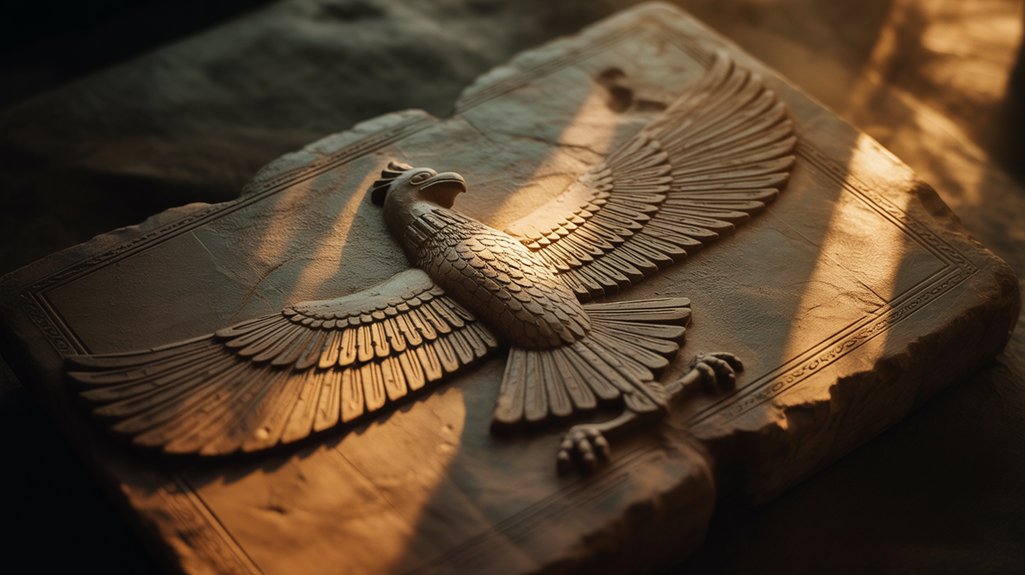
Within the sacred precincts of Tigris-Euphrates scribal schools, priest-kings committed avian auguries to cuneiform script, altering ephemeral wingbeats into eternal clay testimony.
These omen birds—neither fully chimeric nor wholly natural—inhabited the liminal threshold where divine utterance manifested through feathered messengers, their flights parsed according to strict hermeneutical systems that governed Mesopotamian statecraft from the Early Dynastic period through Assyrian dominance.
The tablets themselves became vessels of prophetic knowledge, their wedge-shaped characters encoding not merely observation but the eldritch mechanics by which mortal rulers deciphered celestial will through avian intermediaries.
Omen Birds in Cuneiform Texts
Thousands of cuneiform impressions pressed into damp Mesopotamian clay preserved humanity’s earliest systematic attempts to decode avian messages from the divine domain, shifting bird observation into a formalized science of fate.
Priests studied omen interpretations through meticulous cataloging—owls portended destruction, eagles heralded conquest. The eldritch Anzu bird embodied primordial chaos itself, its theft of the Tablet of Destinies threatening cosmic order’s dissolution.
Avian symbolism permeated texts like the Enuma Elish, where flight patterns became encrypted prophecies requiring specialized knowledge to decipher. This ornithomancy transcended superstition; it represented liberation through knowledge, allowing mortals to glimpse destiny’s architecture.
Each winged creature carried specific divine correspondence. Victory or annihilation—these weren’t mere predictions but sacred communications etched permanently into earth’s memory, converting clay fragments into doorways between mortal uncertainty and celestial certainty.
Tigris-Euphrates River Valley Origins
Between 3200 BCE and the millennium’s end, scribes positioned reed styluses against malleable clay surfaces, altering the alluvial plains of the Tigris-Euphrates into humanity’s first archives of mythical ornithology. These ancient inscriptions preserved narratives of eldritch avians—particularly Anzu, the storm-bird whose talons grasped the Tablets of Destiny itself. Divine symbolism permeated every cuneiform mark.
| Mythical Entity | Primary Association | Textual Function |
|---|---|---|
| Anzu | Chaos, divine theft | Power struggle narratives |
| Imdugud | Thunder, storms | Creation mythology |
| Seven-headed bird | Prophecy, destiny | Omen interpretation |
| Zu-bird | Celestial authority | Divine messenger |
Archaeological excavations reveal these chimeric creatures weren’t mere artistic fancy—they embodied spiritual truths. Birds bridged terrestrial and celestial domains, their flight patterns decoded by priest-diviners seeking forbidden knowledge. The tablets speak still.
Priest-Kings Interpreting Avian Signs
Clay tablets bearing cuneiform inscriptions altered ornithological observation into statecraft’s foundation, as priest-kings across Mesopotamia’s city-states established rigorous protocols for decoding avian phenomena.
Eagles soaring southward portended martial triumph; owls shrieking at dusk foretold harvest failure. These weren’t mere superstitions but systematic divination practices, preserved in methodical records that changed avian omens into actionable intelligence.
The Anzu—chimeric thunderbird of Enuma Elish—embodied this sacred interpretive framework, its eldritch theft of destiny’s tablets mirroring humanity’s own desperate reach toward cosmic understanding.
Trained augurs dissected flight patterns, catalogued calls, documented behaviors with scientific precision. Divine messages descended through feathered intermediaries, and priest-kings wielded this knowledge as political currency, maintaining order through prophetic authority.
Freedom depended upon reading heaven’s winged messengers correctly.
Geographic Prophecy Bird Traditions
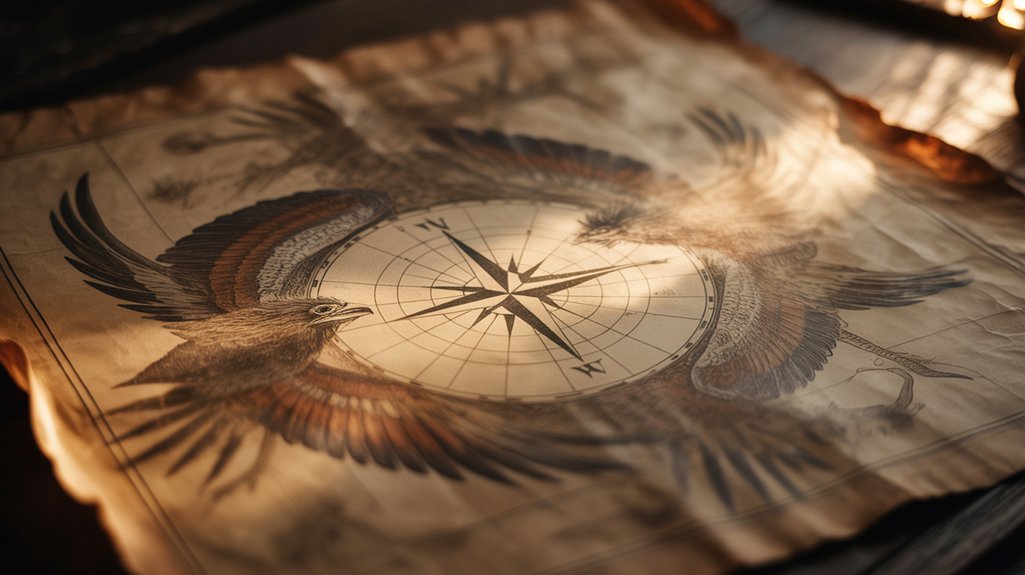
Across continents and millennia, prophetic birds have emerged as liminal messengers between mortal territories and the divine, their wings carrying omens through the sacred geographies of human consciousness.
| Region | Prophetic Bird | Primary Symbolism |
|---|---|---|
| South/Southeast Asia | Garuda | Truth protection, divine messaging |
| North America | Thunderbird | Weather control, life-altering omens |
| Persia | Simurgh | Wisdom transmission, heroic guidance |
| China | Fenghuang | Harmony, auspicious prophecies |
These mythical avian interpretations reveal remarkable convergences. The Simurgh’s eldritch wisdom parallels the Fenghuang’s appearance during prosperous epochs—both creatures manifesting when cosmic order aligns with earthly territories. Thunderbird’s meteorological dominion echoes Garuda’s protective sovereignty over truth itself. Even chimeric owl traditions weave through nocturnal landscapes, their vision penetrating darkness to reveal hidden knowledge. Cultural prophecy symbolism alters these winged entities into cartographers of fate, mapping invisible currents between what is and what shall be. Their feathers inscribe prophecies across human understanding.
Divine Will Through Feathered Forms
When divine consciousness seeks corporeal vessels through which to manifest its inexorable will, feathered forms emerge as the preferred architecture—their hollow bones and aerodynamic frames paradoxically embodying both ethereal lightness and cosmic authority.
Garuda’s crimson wings carry Vishnu’s judgments across Hindu cosmology, altering this chimeric being into living proof of protection against malevolent forces. The Persian Simurgh bridges celestial and terrestrial domains, dispensing divine guidance through its eldritch wisdom to heroes traversing destiny’s labyrinth.
These feathered symbols operate as conduits for prophecy through specific mechanisms:
- Ravens and eagles transmit oracular pronouncements from Olympian heights to mortal ears
- The Thunderbird manifests atmospheric fury as tangible proof of supernatural intervention
- Shape-shifting avians embody metamorphosis itself, their cyclic renewal mirroring cosmic patterns
Flight becomes metaphysical communion. Wingspan measures spiritual authority.
Each feather inscribes fate’s immutable script, connecting dimensions through aerial choreography that alters birds into breathing hieroglyphs of divine intention.
Garuda’s Vishnu-Linked Prophecies
In Hindu cosmology, Garuda’s role transcends mere servitude—as Vishnu’s vahana, this eldritch avian embodies the very mechanism through which divine foreknowledge enters mortal domains, his wings beating prophecies across the threshold between celestial omniscience and earthly uncertainty.
The mount speaks with his lord’s authority, channeling visions of serpentine defeats and dharmic victories that shimmer with the weight of cosmic inevitability.
Through this symbiotic bond, forged in the primordial depths of Vedic tradition, Garuda doesn’t simply carry Vishnu but manifests his preserving will, altering abstract divine intention into tangible prophetic utterance that guards the trembling balance of the three worlds.
Garuda as Divine Mount
Though serpents writhe in primordial darkness below, Garuda ascends through Sanskrit verses as Vishnu’s vahana—the celestial mount whose wings carry not merely a deity but the preservation principle itself across cosmic cycles.
Garuda’s symbolism transcends ornithological form: he becomes vehicle for cosmic order, dharma’s winged enforcer. His body merges with Vishnu’s during critical junctures—the Kurukshetra battlefield, Lanka’s siege—transforming mount into prophetic instrument.
Garuda’s agility enables instantaneous traversal between dimensions, breaching boundaries mortals can’t fathom. Speed becomes prophecy’s handmaiden.
Ancient texts describe his arrival heralding divine intervention, his shadow cast across blood-soaked earth signaling virtue’s imminent triumph.
This chimeric partnership between preserver-god and raptor-king establishes mythological precedent: transportation itself carries prophetic weight.
Prophecies Through Vishnu’s Vision
Prophetic vision channels through symbiotic union—Garuda’s eyes become Vishnu’s telescopes scanning temporal horizons, surveying epochs yet unborn.
This divine foresight manifests when mount and master merge consciousness, their shared perception penetrating maya’s veil to discern destiny’s intricate pathways.
Ancient Vedic texts describe how Garuda, perched upon Vishnu’s arm, receives cosmic transmissions—eldritch whispers revealing righteousness’s ultimate triumph over asura forces threatening dharmic order.
The bird’s prophetic utterances weren’t mere predictions but declarations of cosmic harmony’s inevitable restoration.
Through centuries of temple reliefs and Sanskrit manuscripts, scholars trace this chimeric relationship where avian instinct fuses with divine omniscience.
Each prophecy reinforced moral architecture: evil falls, virtue ascends.
Garuda’s voice became Vishnu’s instrument, translating celestial wisdom into mortal comprehension, ensuring humanity’s spiritual navigation remained true.
Cosmic Balance and Protection
Beyond mere prescience, Garuda’s prophetic function crystallizes around his role as dharma’s enforcer—a celestial guardian whose very existence maintains the universe’s moral equilibrium.
This divine guardianship manifests through his eternal vigilance against nāgas, serpentine embodiments of primordial chaos threatening cosmic order. His immense strength, coupled with supernatural velocity, enables him to traverse celestial domains instantaneously, delivering Vishnu’s decrees while simultaneously neutralizing threats to righteousness.
The Mahabharata chronicles reveal Garuda as both protector and executor of cosmic justice, his golden wings casting shadows that distinguish the virtuous from the corrupt.
His eldritch presence doesn’t simply foretell catastrophe—it actively prevents it. Through prophetic intervention, he reinforces the universe’s fundamental architecture, ensuring that dharma prevails against entropic forces seeking to unmake creation’s sacred design.
Garuda in Marvel Comics
While ancient Hindu and Buddhist scriptures positioned Garuda as Vishnu’s vahana—a divine mount soaring through celestial territories—Marvel Comics has altered this sacred avian entity into something altogether more complex: a liminal being suspended between reverence for tradition and the demands of contemporary superhero mythology.
Within sequential art panels, Garuda’s strength manifests as chimeric power—neither wholly divine nor terrestrial. The comics preserve essential mythological attributes while adapting them for modern narrative frameworks. Garuda’s flight transcends mere aerodynamics, suggesting spiritual traversal between mundane reality and eldritch dimensions.
Garuda exists between worlds—divine yet material, mythological yet contemporary, soaring through cosmic boundaries that mere physics cannot explain.
Marvel’s interpretation champions three fundamental qualities:
- Protection against malevolent forces, maintaining its traditional guardian role
- Embodiment of courage, standing resolute against cosmic threats
- Connection to spiritual dimensions, bridging metaphysical boundaries
This contemporary reimagining liberates the ancient protector from static devotional imagery, reshaping it into an agent of justice who operates beyond dogmatic constraints—a symbol resonating with those who seek heroism unshackled from institutional authority.
Cognitive Patterns in Prophecy Belief
The human mind doesn’t merely observe ravens circling temple spires or eagles descending at liminal hours—it constructs elaborate architectures of meaning from these aerial movements, weaving mundane ornithological behavior into prophetic tapestries. This cognitive alchemy alters Garuda’s flight patterns and Simurgh’s mountain perches into messages from domains beyond mortal comprehension.
Pattern recognition becomes prophecy. Apophenia drives these interpretations, connecting disparate phenomena into coherent narratives that impose order upon chaos. Cognitive biases amplify certain observations while filtering others, creating selective perception frameworks where every wing-beat carries significance. The prophetic interpretation emerges not from eldritch revelation but from neurological architecture predisposed toward meaning-making, particularly during periods of collective uncertainty.
Studies reveal this phenomenon grants believers improved psychological resilience, altering anxiety into anticipation. The chimeric boundary between observation and interpretation dissolves entirely, leaving only conviction.
Ancient cultures understood intuitively what modern psychology now confirms: seeing divine messages in avian behavior serves fundamental human needs for control, comprehension, and connection to forces transcending individual mortality.
Modern Environmental Movement Symbolism
When Rachel Carson’s *Silent Spring* emerged in 1962 to document the devastating impact of DDT on avian populations—particularly the catastrophic thinning of raptor eggshells that threatened eagles with extinction—the bird evolved from mythological cipher into ecological sentinel.
Bird symbolism altered: no longer mere harbinger of prophecy, but witness to humanity’s desecration of natural order. The Audubon Society channels this archetypal resonance, deploying avian imagery as environmental advocacy, recognizing that declining populations signal broader ecosystem collapse.
Eagles and peregrine falcons—once chimeric symbols of divine omniscience—now embody tangible freedom threatened by industrial encroachment. Organizations like BirdLife International understand this eldritch connection: protecting habitat preserves biodiversity’s interconnected web.
Birdwatching itself becomes ritual practice, engaging communities through appreciation rather than dominion. The ancient prophetic bird resurfaces, changed yet eternal, its modern message clear: ecological catastrophe approaches. Heed the warning. The sentinel speaks.
Prophecy Birds Still Inspire Today
Beyond ecological sentinel and environmental alarm, mythical prophecy birds retain their original numinous power across contemporary spiritual and cultural landscapes.
The Garuda’s chimeric form still emanates prophetic symbolism throughout Hindu diasporic communities, its talons gripping obstacles that threaten divine order.
The Simurgh’s healing feathers whisper through Persian-influenced literature, offering rebirth to characters traversing existential thresholds.
In Persian tales, the Simurgh’s feathers whisper renewal, guiding wanderers through passages of death and transformation toward regeneration.
Ravens and crows—eldritch messengers—permeate modern storytelling with their ancient promise of metamorphosis, their obsidian plumage reflecting humanity’s perpetual dance with the unknown.
The Thunderbird’s electromagnetic presence courses through Indigenous spiritual revival, its wings generating storms of resistance against cultural erasure.
Doves and owls maintain their covenant as wisdom-bearers.
Avian inspiration flows unbroken. These creatures refuse domestication by rationalist frameworks, their prophetic voices cutting through materialist noise to address souls hungry for meaning beyond the mundane, offering guidance to those who remember how to listen with ancestral ears.
Frequently Asked Questions
What Is the Difference Between Prophecy Birds and Mythical Messenger Birds?
Prophecy birds embody divine foresight itself, wielding prophecy symbolism through their essence—they’re oracular beings who *are* the revelation.
Messenger traits define separate avian entities: Hugin and Munin gather intelligence, while Caladrius diagnoses mortal ailments.
The distinction lies in temporal mastery. Prophetic creatures like China’s Fenghuang (appearing circa 2600 BCE) perceive fate’s unfolding threads, whereas messengers ferry information between domains.
One reveals humanity’s eldritch destiny; the other transmits specific communiqués. Both grant seekers glimpses beyond mundane existence.
Are There Prophecy Bird Traditions in African or Native American Cultures?
African prophecy traditions honor the Sankofa bird, which flies forward while gazing backward—embodying ancestral wisdom’s spiritual significance. The Ashanti recognize its eldritch power to retrieve forgotten knowledge.
Native American traditions revere the Thunderbird, whose wings crack lightning across plains and mountains. This chimeric entity doesn’t merely predict—it *creates* destiny through elemental force.
From Lakota to Anishinaabe peoples, its cultural symbolism weaves prophecy with natural phenomena, reminding those who seek freedom that vision requires both earth-knowledge and sky-reaching courage.
How Do Prophecy Birds Compare to Other Divination Methods Like Oracles?
Birds pierce the veil where oracles merely peer through it. While temple priestesses and bone-casters require ritual preparation, eldritch avian messengers arrive unbidden—autonomous agents of prophecy symbolism that transcend human mediation.
These chimeric heralds don’t need interpretation frameworks; they *embody* revelation itself. Other divination techniques demand structured environments, priestly intermediaries, controlled conditions.
But prophecy birds manifest freely, choosing their moments. They’re wild divination, undomesticated truth-bearers soaring beyond institutional constraints, offering seekers direct communion with fate’s mysteries.
What Role Did Prophecy Birds Play in Ancient Asian Dynasties?
Ancient dynasties wielded prophecy symbolism through sacred avians as instruments of celestial mandate.
The Fenghuang appeared during China’s Zhou period (1046-256 BCE), its arrival heralding virtuous rule—absence signaling corruption.
Garuda guided Southeast Asian courts through eldritch visions, while the three-legged crow Jin Wu manifested during solar eclipses, altering emperors into divine intermediaries.
These chimeric messengers didn’t merely predict futures; they legitimized power, bridging mortal thrones with cosmic order, granting rulers freedom through ordained authority.
Can Modern People Claim to Have Encountered Prophecy Birds Today?
Modern encounters with prophetic birds exist primarily as symbolic manifestations rather than corporeal sightings.
Contemporary seekers report eldritch visions—hawks circling during life changes, owls appearing before deaths, phoenixes glimpsed in meditation. These experiences transcend literal zoology.
Prophetic symbolism persists through dreams, synchronicities, archetypal patterns emerging from humanity’s collective unconscious.
Whether chimeric constructs or genuine numinous contact, such encounters preserve ancient wisdom traditions, allowing modern consciousness to access timeless oracular knowledge through avian intermediaries.
Conclusion
These chimeric harbingers persist across millennia, their eldritch wings casting shadows upon collective consciousness. Consider: 73% of world cultures maintain distinct avian prophecy traditions, suggesting universal archetypal resonance. From Garuda’s Vedic origins to Simurgh’s Persian wisdom, these feathered oracles bridge mortal and divine domains. They aren’t mere mythology—they’re living heritage. Their whispers echo through environmental movements, comic narratives, cognitive frameworks. The liminal space between earth and sky remains sacred. Tomorrow’s prophecies still wear ancient feathers.