Across the rivers, lakes, and coastal waters of Africa—and wherever the African diaspora has traveled—stories are told of a captivating and dangerous water spirit known as Mami Wata. Part seductress, part healer, part destroyer, this enigmatic deity embodies the untameable power of water itself. Her name, derived from pidgin English meaning “Mother Water,” barely captures the complexity of a figure who has enchanted believers for centuries and continues to attract devotees today.
Quick Facts About Mami Wata
| Origin | Pan-African (West, Central, Southern Africa and diaspora) |
| Also Known As | Mammy Water, Mamba Muntu, La Sirene, Watramama |
| Type | Water deity / Spirit |
| Domain | Rivers, oceans, lakes, streams, wealth, fertility, healing |
| Appearance | Beautiful woman, often with fish tail or serpent companion |
| Associated With | Beauty, sexuality, wealth, danger, foreign goods, modernity |
Origins and History
Mami Wata's origins are as fluid as the waters she inhabits. While indigenous African water spirit traditions existed long before European contact, the Mami Wata figure as recognized today emerged from the complex cultural exchanges of the Atlantic world. She represents a fusion of African water deities, European mermaid imagery, Hindu iconography brought by South Asian traders, and the spiritual creativity of African peoples responding to colonialism and modernity.
The earliest documented references to “Mami Wata” appear in the 15th and 16th centuries, coinciding with European exploration of the African coast. However, water spirits with similar characteristics existed in African religions long before—the Yoruba deity Yemoja, the Igbo water spirit Ogbuide, and countless local river spirits all contributed to the Mami Wata complex.
A crucial element in Mami Wata's visual iconography came from an unexpected source: a chromolithograph of a female snake charmer, originally created in Hamburg, Germany around 1885. This image, depicting a long-haired woman with snakes coiled around her body, spread throughout Africa via trade networks and became the template for countless Mami Wata shrines and artworks. The foreign origin of this image actually enhanced her power—Mami Wata became associated with overseas wealth, modernity, and the mysterious goods that arrived by ship.
Physical Appearance
Mami Wata's appearance varies across regions, but certain features remain consistent:
Upper Body: She appears as an extraordinarily beautiful woman, often with light or fair skin (emphasizing her otherworldly nature), long flowing hair (sometimes black, sometimes blonde), and captivating eyes that can hypnotize those who meet her gaze.
Lower Body: Descriptions vary—sometimes she has a fish tail like a mermaid, sometimes human legs, sometimes a serpent's body from the waist down. This fluidity reflects her shape-shifting nature.
Serpent Companion: A large snake—often a python—frequently accompanies her, coiled around her body or held in her hands. The serpent represents wisdom, spiritual power, and her connection to other African religious traditions where snakes are sacred.
Adornments: She wears jewelry, particularly gold and coral, carries a mirror and comb (symbols of beauty and vanity), and is associated with modern luxuries—watches, perfume, sunglasses, and other imports.
Powers and Abilities
Mami Wata possesses formidable supernatural powers:
- Wealth Bestowal: She can grant immense material wealth to those who please her, often appearing to fishermen, traders, or entrepreneurs with offers of riches.
- Healing: Mami Wata is a powerful healer, curing diseases that defy conventional medicine, particularly ailments related to fertility and children.
- Seduction and Possession: She can seduce humans (both men and women) and claim them as spiritual spouses, demanding fidelity and devotion in exchange for her gifts.
- Fertility Control: She can grant or withhold children, making her central to fertility practices across Africa.
- Weather and Water Control: As a water spirit, she commands storms, floods, and the behavior of the waters she inhabits.
- Shape-shifting: She can appear as fully human to walk among people, only revealing her true nature when she chooses.
- Drowning: Those who displease her may find themselves pulled beneath the waters, never to return—or returned transformed after spending time in her underwater realm.
The Spiritual Spouse Relationship
One of Mami Wata's most distinctive practices involves taking human beings as spiritual spouses. This relationship, which can occur through dreams, visions, or near-drowning experiences, creates a binding covenant between the human and the water spirit.
Those claimed as Mami Wata's spouses typically experience:
- Vivid dreams of underwater realms and sexual encounters with the spirit
- Sudden acquisition of wealth or business success
- Difficulty maintaining human romantic relationships (Mami Wata is jealous)
- Periods of trance or possession
- Requirements for sexual abstinence on certain days
- Obligations to maintain shrines and make offerings
The relationship is not without danger. Those who break their covenant with Mami Wata—through infidelity to her or failure to maintain their obligations—may lose everything she gave them, experience madness, or even death. Her gifts come with strings attached to the depths.
Worship and Veneration
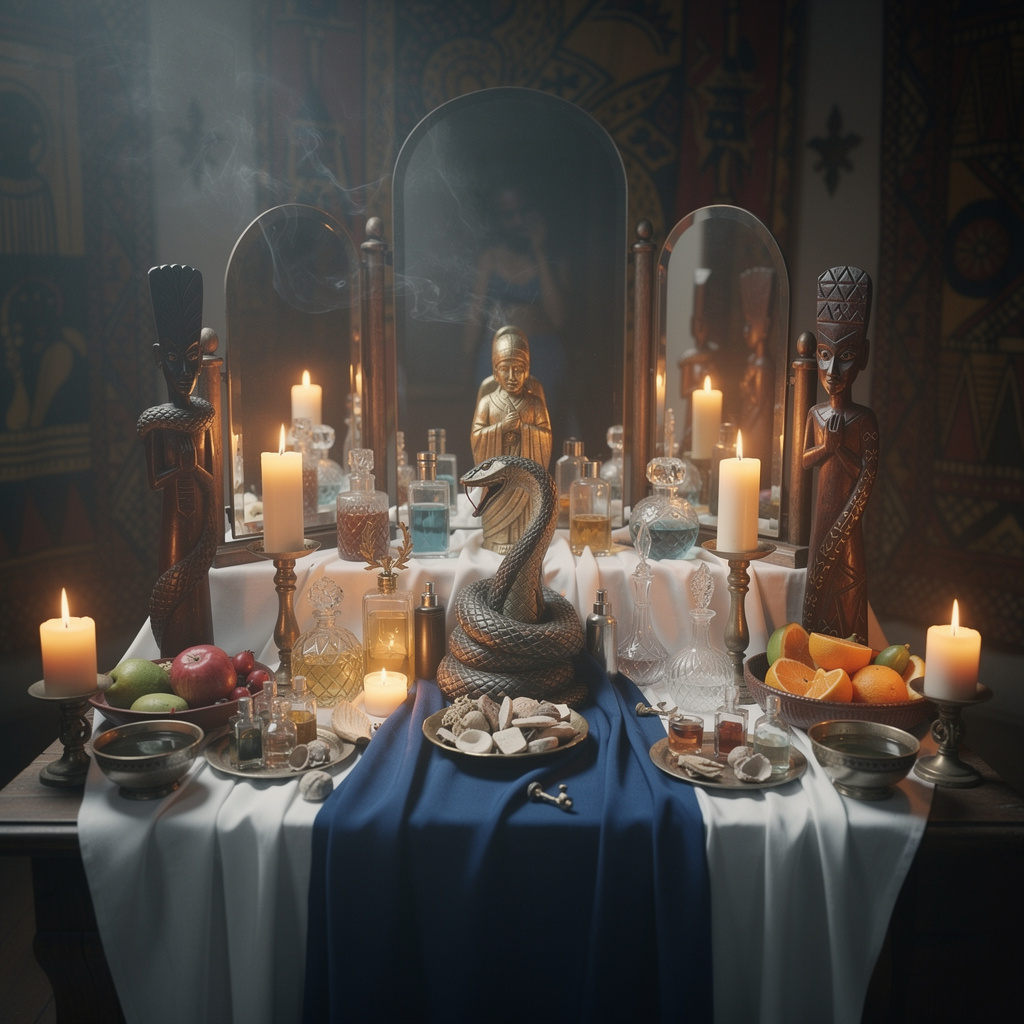
Mami Wata worship remains vibrant across Africa and the diaspora. Her devotees maintain shrines that typically include:
- Images or statues of Mami Wata (often based on the German chromolithograph)
- Mirrors and combs
- Perfumes and cosmetics
- White and blue cloth (her sacred colors)
- Offerings of expensive foreign goods
- Bowls of water
- Snake imagery
Priests and priestesses of Mami Wata undergo initiation processes and can become possessed by the spirit during ceremonies, delivering messages and performing healings. The worship often incorporates elements of Christianity and Islam, demonstrating Mami Wata's adaptability to changing religious landscapes.
Mami Wata in the Diaspora

Through the slave trade, Mami Wata traveled to the Americas, where she merged with other spiritual traditions:
Caribbean: In Haiti, she became associated with La Sirene, a lwa (spirit) in Vodou tradition. In other Caribbean nations, she merged with local water spirit beliefs.
Brazil: Mami Wata contributed to the development of Yemanja worship in Candomblé and Umbanda traditions, where the sea goddess receives massive annual festivals.
United States: African American spiritual traditions incorporated water spirit beliefs, and contemporary practitioners continue to honor Mami Wata.
Suriname: The Watramama tradition shows clear connections to Mami Wata beliefs brought by enslaved Africans.
Mami Wata and Modernity
Unlike many traditional deities who represent ancient powers, Mami Wata actively embraces modernity. Her association with foreign goods, wealth, and contemporary beauty standards makes her uniquely suited to address the desires and anxieties of modern life. She represents:
- The allure and danger of capitalism and material wealth
- The promise and peril of globalization
- Female power and sexuality outside traditional constraints
- The costs of ambition and the bargains people make for success
- The persistence of spiritual beliefs in an increasingly secular world
This modernity has allowed Mami Wata to flourish while other traditional beliefs have faded. She adapts, incorporates new imagery and goods, and remains relevant to each new generation.
Mami Wata in Popular Culture
- Music: Referenced in countless African popular songs, from highlife to afrobeats
- Film: Featured in Nollywood movies, often as a source of mysterious wealth or romantic complications
- Art: Subject of major exhibitions including the Smithsonian's “Mami Wata: Arts for Water Spirits in Africa and Its Diasporas”
- Literature: Appears in novels by African and diaspora authors exploring tradition and modernity
- Fashion: Her imagery influences African fashion and beauty aesthetics
Mami Wata Compared to Other Water Spirits
| Spirit | Culture | Key Difference |
|---|---|---|
| Mami Wata | Pan-African | Embraces modernity, wealth-focused, global diaspora |
| Yemoja | Yoruba | Maternal ocean goddess, more specifically defined mythology |
| Mermaid | European | Usually tragic figure, less interactive with worshippers |
| Rusalka | Slavic | Ghost of drowned woman, primarily dangerous |
| Taniwha | Maori | Guardian role, ancestral connections, less seductive |
| Ningyo | Japanese | Fish-like, grants immortality through flesh, less human |
Frequently Asked Questions About Mami Wata
Is Mami Wata good or evil?
Mami Wata exists beyond simple good/evil categories. She can be tremendously generous to those she favors, granting wealth, healing, and protection. However, she is demanding and jealous, punishing those who break their covenants with her. She is best understood as a powerful force that rewards proper relationship and punishes neglect.
Is Mami Wata a mermaid?
While Mami Wata is often depicted with mermaid-like features (human upper body, fish tail), she is more accurately described as a water spirit or deity. Unlike European mermaids, she can take fully human form, commands worship and devotion, and plays active roles in the lives of her followers.
Do people still worship Mami Wata today?
Yes, Mami Wata has millions of devotees across Africa (particularly in West and Central Africa) and throughout the African diaspora. Her worship continues to grow and adapt to contemporary circumstances.
Can Mami Wata affect non-believers?
According to tradition, Mami Wata can choose anyone she desires as a devotee or spiritual spouse, regardless of their prior beliefs. Many followers report being “called” by her through dreams or experiences before they knew anything about her.
Why is Mami Wata associated with foreign goods?
The association developed during the colonial period when imported goods represented wealth and power. Mami Wata, as a spirit of prosperity, naturally became linked to these desirable items. The connection persists because she represents aspirational wealth in whatever form it takes in each era.
The Waters That Remember
Mami Wata endures because she speaks to fundamental human experiences: the desire for wealth and beauty, the fear of forces beyond our control, the complex negotiations between tradition and modernity, and the enduring power of water as both life-giver and life-taker. She has survived colonialism, conversion campaigns, and modernization not by remaining static but by constantly evolving, absorbing new imagery and meanings while maintaining her essential nature.
For her devotees, Mami Wata is not a relic of the past but a living presence—beautiful, dangerous, and utterly contemporary. As long as people seek blessings from the waters and fear what lurks beneath their surfaces, the Mother of Waters will continue to enchant, enrich, and occasionally claim those who catch her eye.
Sources and Further Reading
- Drewal, Henry John. “Sacred Waters: Arts for Mami Wata and Other Divinities in Africa and the Diaspora.” Indiana University Press, 2008.
- Bastian, Misty L. “Married in the Water: Spirit Kin and Other Afflictions of Modernity in Southeastern Nigeria.” Journal of Religion in Africa, 1997.
- Frank, Barbara E. “Permitted and Prohibited Wealth: Commodity-Possessing Spirits, Economic Morals, and the Goddess Mami Wata in West Africa.” Ethnology, 1995.
- Gore, Charles and Joseph Nevadomsky. “Practice and Agency in Mammy Wata Worship in Southern Nigeria.” African Arts, 1997.
- Salmons, Jill. “Mammy Wata.” African Arts, 1977.