- The Primordial Cycles: Creation and the Five Suns
- The Pantheon's Pillars: Gods of Sun, War, and Rain
- Duality and the Sacred Feminine: Goddesses of Life and Death
- Frequently Asked Questions
- Who was the most powerful Aztec god?
- How does Aztec mythology differ from Greek or Roman mythology?
- Are there any surviving Aztec texts that tell these stories?
- Related Posts
- Related Posts
While the epics of Homer’s Greece and the poetic sagas of Ovid's Rome have long captivated the Western imagination, the ancient Americas forged mythologies of equal complexity and profound cosmic vision. The Aztec pantheon, born from the volcanic highlands of Mesoamerica, presents a world where creation is a precarious, bloody, and ongoing struggle. To explore these gods is not merely to catalog deities but to step into a universe animated by the primordial forces of duality, sacrifice, and the relentless pursuit of balance. Unlike the more familiar narratives of Norse or Celtic folklore, Aztec myth is a saga written in the movements of the sun, the rhythms of the calendar, and the very real, tangible presence of its gods in the daily life of the Mexica people.
The Primordial Cycles: Creation and the Five Suns
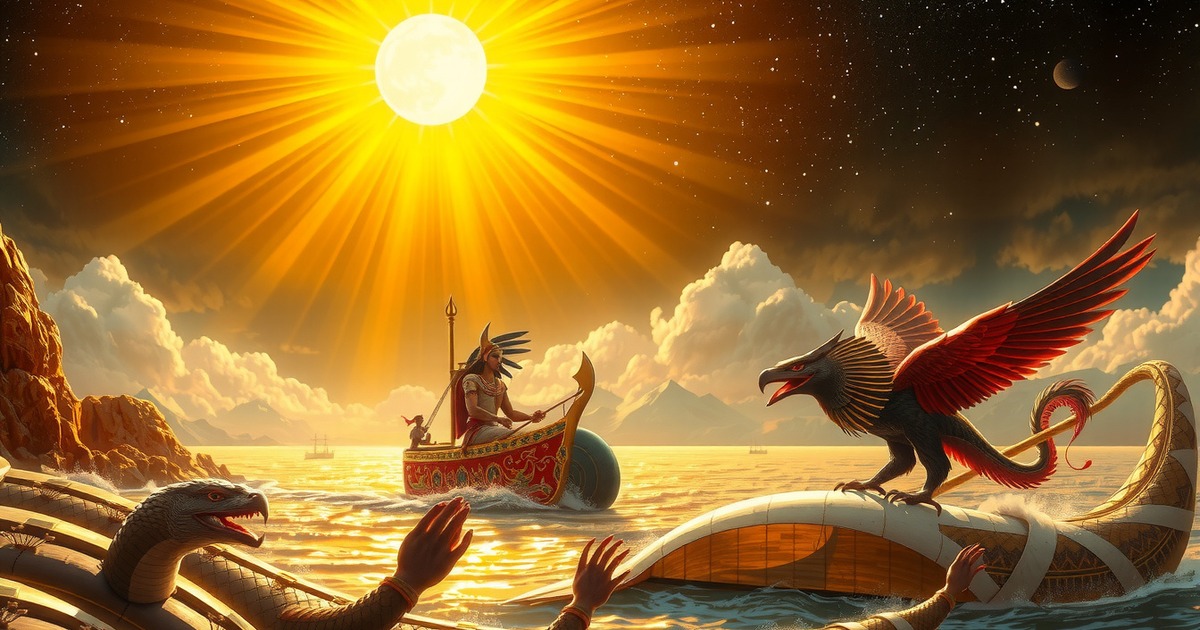
The foundational epic of Aztec cosmology is the Legend of the Five Suns, a breathtaking narrative of cyclical creation and destruction detailed in texts like the Historia de los mexicanos por sus pinturas. Before our current world, four previous ages, or “Suns,” were created and subsequently annihilated by cataclysmic forces—jaguars, wind, fire, and flood. Each Sun was governed by a different god and represented a failed attempt at equilibrium. This myth establishes a core tenet: the universe is inherently unstable, and the gods themselves are not omnipotent but are engaged in a constant, heroic effort to sustain existence. The current era, the Fifth Sun, known as 4-Movement, was born at the ancient city of Teotihuacan. Here, the legend tells of two gods, the proud Tecuciztecatl and the humble Nanahuatzin, who immolated themselves in a great pyre to become the sun and moon. But the newborn sun hung motionless, requiring the other gods to offer their own lifeblood as sacrifice to set it on its course—a powerful, chilling precedent for the central role of sacrifice in appeasing the divine and maintaining cosmic order.
The Pantheon's Pillars: Gods of Sun, War, and Rain
At the heart of the Aztec pantheon stand deities whose domains were inextricably linked to the survival of the empire. Huitzilopochtli, the patron god of the Mexica, was the fiery sun god and god of war. His name, “Hummingbird of the South,” evokes the warrior spirits believed to accompany the sun. His myth, a dramatic saga of conflict, begins with his miraculous birth at Coatepec (“Serpent Mountain”), where he sprang fully armed from his mother, the goddess Coatlicue, to defeat his sister Coyolxauhqui and her four hundred brothers, the stars. This daily celestial battle symbolized the sun's triumph over the moon and stars each dawn.
Equally vital was Tlaloc, the ancient god of rain, fertility, and water. Residing in a verdant paradise, Tlaloc could unleash life-giving showers or devastating droughts and tempests. His consort, the goddess Chalchiuhtlicue (“She of the Jade Skirt”), presided over freshwater lakes and rivers. Their influence was a constant reminder of nature's dual generosity and fury, a theme echoed in other global mythologies like the South African legend of the storm-bringing Inkanyamba. Another foundational figure was Quetzalcoatl, the “Feathered Serpent,” a culture hero of immense wisdom who gifted humanity with maize and the calendar, and whose promised return would later be catastrophically misinterpreted by the Aztec emperor Moctezuma II.
Duality and the Sacred Feminine: Goddesses of Life and Death
Aztec mythology is profoundly defined by duality, and its goddesses embody this principle with terrifying and awe-inspiring clarity. No figure represents this more than Coatlicue, the “Serpent Skirt” mother goddess. A statue of her in the National Museum of Anthropology in Mexico City is a masterwork of sacred terror: her skirt is a writhing mass of snakes, and her necklace is made of human hearts and hands. She is the earth mother who gives life and the devourer of corpses, a creator and destroyer simultaneously. This duality is mirrored in the goddess Tlazolteotl, the “Eater of Filth,” who could both inspire immoral acts and grant absolution through confession.
This complex view of the feminine divine extends to deities like Xochiquetzal, the goddess of beauty, love, and craft, whose domain was flowers and pleasure. Yet, she was also associated with weaving and childbirth, connecting her to both creative and procreative power. The Aztec pantheon, much like the Egyptian or Greek, features a rich tapestry of female figures who govern the full spectrum of existence, from the artistic to the mortal. Their stories, interwoven with those of heroes and monsters, create a mythological world as intricate and demanding as any found in the Old World. The fantastic creatures that fill these stories, from the celestial serpents to the spectral tzitzimime that threatened the world during solar eclipses, add further layers of symbolic meaning.
Frequently Asked Questions
Who was the most powerful Aztec god?
Power in the Aztec pantheon was contextual, not absolute. Huitzilopochtli was the paramount patron of the Mexica state, but Tlaloc controlled the essential rains, and the primordial god Ometeotl, the dual lord/lady of duality, was considered the supreme creative force underlying the universe. For a comparative look at powerful immortal beings, see our analysis of immortal creatures from Phoenix to Hydra.
How does Aztec mythology differ from Greek or Roman mythology?
A key difference is the Aztec emphasis on cyclical time and cosmic sacrifice. While Greek myths often focus on the personal dramas of the gods, Aztec myths are grand, metaphysical narratives about the universe's fragile state, where the gods themselves must sacrifice to keep it functioning. The stakes are the continued existence of the world itself.
Are there any surviving Aztec texts that tell these stories?
Yes, though they are largely post-Conquest documents written in the Latin alphabet by Spanish friars and literate Aztecs. Primary sources include the Florentine Codex by Bernardino de Sahagún, which is an encyclopedic work of Aztec life and belief, and the Codex Chimalpopoca, which contains the vital “Legend of the Five Suns.” These texts, while filtered through a colonial lens, provide an invaluable window into this rich mythological tradition.
Related Posts



Related Posts
📚 Explore More on This Topic
Editor's Pick: A detailed mythology puzzle to piece together Aztec legends.
The Mythical Chronicle
Gods, heroes and monsters, drawn from the primary sources.