- Introduction: The Enchanted Pantheon of the Celts
- The Great Goddesses: Divine Feminine Power in Celtic Lore
- The Male Gods: Heroes and Sovereigns of the Otherworld
- The Otherworld: Realm of Gods and Heroes
- Frequently Asked Questions
- What primary sources document Celtic mythology gods and goddesses?
- How do Celtic goddesses differ from Greek and Roman counterparts?
- Did Celtic peoples have organized priesthoods like classical civilizations?
- Related Posts
- Related Posts
- Related Posts
- Related Posts
Introduction: The Enchanted Pantheon of the Celts
The Celtic mythology gods and goddesses represent one of Europe's most captivating spiritual traditions, yet their stories remain tantalizingly fragmented compared to the well-preserved epics of Greek and Roman cultures. Unlike Homer's Iliad or Ovid's Metamorphoses, which survived intact through classical transmission, Celtic deity legends were largely preserved through oral tradition before Christian monks committed them to manuscript in medieval Ireland and Wales. This unique preservation method means we encounter these divine figures through layers of cultural transformation—filtered through both pagan reverence and monastic interpretation.
Disclosure: This post contains affiliate links. If you click through and make a purchase, we may earn a small commission at no extra cost to you. Thank you for supporting this site!
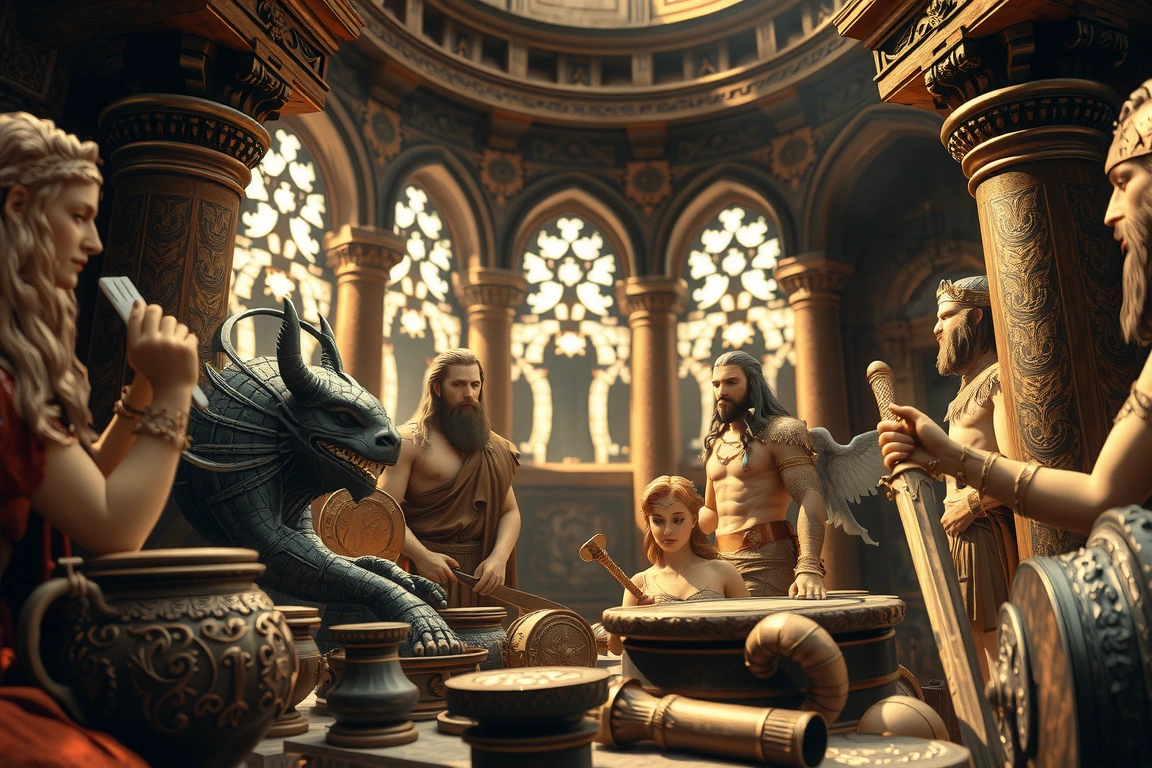
The Celtic pantheon encompasses a rich mythology spanning the British Isles and continental Europe, documented most vividly in texts like the Mabinogion and the four cycles of Irish myth: the Mythological Cycle, the Ulster Cycle, the Fenian Cycle, and the Historical Cycle. These sagas reveal a cosmos inhabited by gods who walk among mortals, shape-shift between forms, and embody natural forces with an intimacy rarely seen in Greek or Egyptian mythology.
The Great Goddesses: Divine Feminine Power in Celtic Lore
Celtic mythology gods and goddesses reveal a fascinating emphasis on feminine divinity that distinguished Celtic cultures from their Mediterranean neighbors. The goddess Danu, primordial mother of the Tuatha Dé Danann (the “People of the Goddess Danu”), represents the archetypal earth mother whose children literally became the divine pantheon of Ireland. Her sovereignty resonates throughout Celtic legend—a concept wherein the land itself is personified as goddess, and rightful kingship requires ceremonial union with this divine feminine principle.
Brigid, one of the most enduring goddesses in Celtic folklore, embodies the triple aspects of wisdom, healing, and smithcraft. The Metrical Dindshenchas (an ancient Irish tract on place-names) describes her as daughter of the Dagda, and her influence persisted so powerfully in Christian Ireland that she became Saint Brigid, absorbing pagan veneration into Christian hagiography. Mór-Ríghan, the “Great Queen,” appears as a war goddess of formidable power, associated with sovereignty and fate. Her appearances on Celtic battlefields—sometimes as a raven—recall the role of Valkyries in norse mythology, though Mór-Ríghan's mythology remains distinctly Celtic in character.
These goddesses wielded genuine political and supernatural authority within their sagas, controlling outcomes of war, granting or denying kingship, and mediating between the mortal and Otherworld realms in ways that challenge the patriarchal structures often assumed in comparative mythology.
The Male Gods: Heroes and Sovereigns of the Otherworld
The Dagda (“the Good God”) stands as the patriarchal counterpart to Danu, described in the Book of Invasions as a figure of immense power wielding a magic club and cauldron of inexhaustible plenty. His mythology interweaves with agricultural abundance and druidic wisdom—themes that permeate comparisons between Celtic and other Indo-European mythologies.
Lugh, the god of craftsmanship and light, embodies the hero-archetype central to Celtic epic tradition. His victory over the Formorians in the Second Battle of Magh Tuired represents triumph of divine order over chaos—a narrative structure echoing throughout world mythology. Nuada, the silver-handed king of the Tuatha Dé, exemplifies the concept of sacred kingship where divine legitimacy flows through the ruler's physical and spiritual perfection.
Manannán mac Lir, god of the sea and guardian of the Otherworld, occupies a liminal space between worlds. His magical abilities and otherworldly dwelling place reflect Celtic understanding of reality as permeable—a quality distinguishing Celtic mythology from the more rigidly hierarchical pantheons of Greece or Rome.
The Otherworld: Realm of Gods and Heroes
Central to understanding Celtic mythology gods and goddesses is the concept of the Otherworld (Tír na nÓg, Mag Mell, Annwn), a parallel realm where divine beings dwell. Unlike the distant Olympus of Greek tradition or the underworld kingdoms of classical mythology, the Celtic Otherworld interpenetrates mortal existence. Gods and heroes traverse between worlds through mist-veiled passages, magical vessels, or sudden transitions—moments when reality's fabric grows thin. This mythology emphasizes connectivity rather than separation between sacred and profane realms, creating narratives of remarkable psychological complexity.
Frequently Asked Questions
What primary sources document Celtic mythology gods and goddesses?
The primary manuscripts include the Book of Invasions (Lebor Gabála Érenn), the Book of Kells, the Mabinogion from Wales, and the Ulster Cycle texts. These medieval Irish and Welsh manuscripts preserve pagan mythology through Christian scribal transmission, creating fascinating textual layers we must read critically.
How do Celtic goddesses differ from Greek and Roman counterparts?
Celtic goddesses exercise direct political sovereignty and warfare authority rarely matched in classical mythology. Rather than serving as consorts or muses, Celtic goddesses control fate, grant kingship, and command armies—embodying power structurally similar to how Germanic mythologies conceptualize divine feminine authority.
Did Celtic peoples have organized priesthoods like classical civilizations?
Druidic orders served as both spiritual authorities and political advisors, preserving mythology through oral tradition. Their systematic knowledge of mythology, calendar, and cosmology suggests sophisticated theological frameworks, though less architecturally documented than Greek or Egyptian religious structures.
Related Posts

\n
}.lwrp .lwrp-description{
\n
}\n .lwrp .lwrp-list-container{\n }\n .lwrp .lwrp-list-multi-container{\n display: flex;\n }\n .lwrp .lwrp-list-double{\n width: 48%;\n }\n .lwrp .lwrp-list-triple{\n width: 32%;\n }\n .lwrp .lwrp-list-row-container{\n display: flex;\n justify-content: space-between;\n }\n .lwrp .lwrp-list-row-container .lwrp-list-item{\n width: calc(25% - 20px);\n }\n .lwrp .lwrp-list-item:not(.lwrp-no-posts-message-item){
\n
max-width: 150px;\n }\n .lwrp .lwrp-list-item img{\n max-width: 100%;\n height: auto;\n object-fit: cover;\n aspect-ratio: 1 / 1;\n }\n .lwrp .lwrp-list-item.lwrp-empty-list-item{\n background: initial !important;\n }\n .lwrp .lwrp-list-item .lwrp-list-link .lwrp-list-link-title-text,\n .lwrp .lwrp-list-item .lwrp-list-no-posts-message{
\n
}@media screen and (max-width: 480px) {\n .lwrp.link-whisper-related-posts{
\n
}\n .lwrp .lwrp-title{
\n
}.lwrp .lwrp-description{
\n
}\n .lwrp .lwrp-list-multi-container{\n flex-direction: column;\n" } } ] }
Related Posts
Related Posts
The Mythical Chronicle
Gods, heroes and monsters, drawn from the primary sources.