Rising from the ancient pyramids of Mesoamerica comes one of the most magnificent deities ever conceived by human imagination: Quetzalcoatl, the Feathered Serpent. This awe-inspiring fusion of the quetzal bird's iridescent plumage and the serpent's earthbound power represented the union of heaven and earth, the marriage of the celestial and the terrestrial. For thousands of years, from the great city of Teotihuacan to the Aztec empire's final days, Quetzalcoatl shaped the spiritual life of Mesoamerican civilizations.
Quick Facts About Quetzalcoatl
| Origin | Mesoamerican (Aztec, Maya, Toltec, Olmec) |
| Also Known As | Kukulkan (Maya), Gukumatz (K'iche'), Ehecatl (wind aspect) |
| Type | Deity / Creator god / Culture hero |
| Domain | Wind, air, learning, arts, civilization, morning star |
| Sacred Animal | Quetzal bird, rattlesnake |
| Associated With | Venus (morning star), priesthood, sacrifice, creation |
Origins Across Millennia
The Feathered Serpent's origins stretch back to the earliest Mesoamerican civilizations. Images of plumed serpents appear in Olmec art dating to 900 BCE, making Quetzalcoatl one of the oldest and most enduring deities in the Americas. The concept evolved across cultures:
Olmec Period (1500-400 BCE): The earliest feathered serpent imagery appears on Olmec monuments, establishing the iconographic foundation for later developments.
Teotihuacan (100-650 CE): The great city featured the Temple of the Feathered Serpent, covered with sculptured serpent heads adorned with feather collars. Here, Quetzalcoatl became associated with warfare, sacrifice, and political authority.
Toltec Period (900-1150 CE): At Tula, the Feathered Serpent became central to state ideology. The legendary priest-king Ce Acatl Topiltzin Quetzalcoatl may have been a historical figure who became conflated with the deity.
Aztec Empire (1345-1521 CE): The Aztecs inherited and elaborated Quetzalcoatl mythology, making him one of their most important gods while also associating him with the legendary Toltec past.
Maya Civilization: Known as Kukulkan among the Yucatec Maya and Gukumatz among the K'iche', the Feathered Serpent was worshipped at great centers like Chichen Itza, where the famous pyramid casts a serpent shadow during equinoxes.
Physical Appearance
Quetzalcoatl's appearance as a feathered serpent combines two of Mesoamerica's most symbolically powerful creatures:
The Quetzal Bird: This Central American bird was considered sacred for its iridescent green tail feathers, which could reach three feet in length. The feathers represented the sky, air, and divine breath. Quetzal feathers were so precious they served as currency, and killing a quetzal was punishable by death.
The Serpent: Snakes represented the earth, water, vegetation, and the underworld. The rattlesnake was particularly sacred, its undulating movement symbolizing flowing water and its rattle associated with rain.
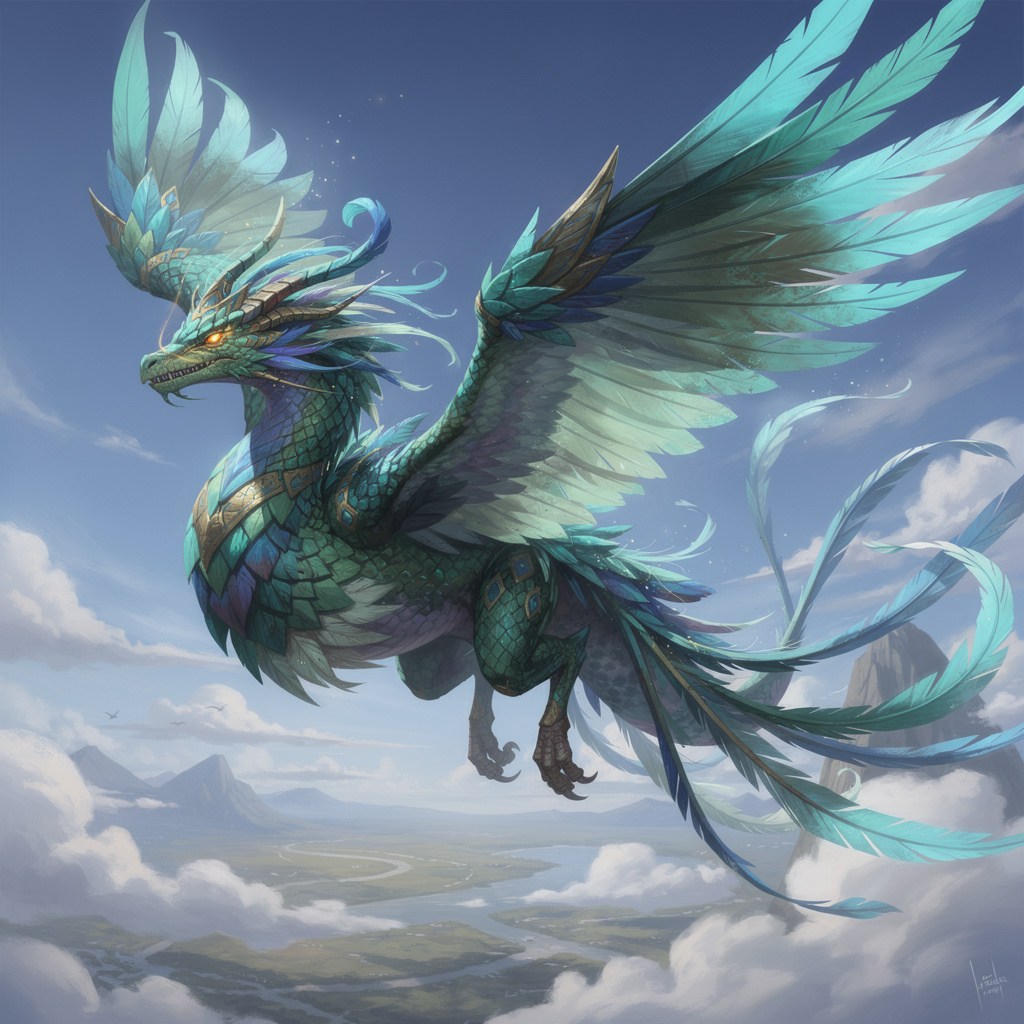
Combined, the feathered serpent represented the unity of opposites: sky and earth, air and ground, the celestial and the terrestrial. Artistic depictions show:
- A massive serpent body covered in brilliant green-blue quetzal feathers
- A serpent head often emerging from a collar of plumes
- Rattlesnake fangs and rattles
- Sometimes wings or multiple feathered crests
- Association with wind spirals and conch shell cross-sections
In his human aspect (as the priest-king or as Ehecatl), Quetzalcoatl appeared as a man wearing a conical hat, a curved wind mask resembling a duck's beak, and elaborate feathered regalia.
The Many Aspects of Quetzalcoatl
Quetzalcoatl was not a single, simple deity but a complex of interrelated aspects:
Ehecatl (Wind God): As the god of wind, Quetzalcoatl wore a distinctive mask and was believed to sweep the paths clean for the rain gods. Wind temples were built as cylindrical structures to offer no resistance to the wind.
Tlahuizcalpantecuhtli (Lord of the Dawn): Quetzalcoatl was associated with Venus as the morning star. After his descent to the underworld, he rose again as Venus, making him a death-and-resurrection deity.
Ce Acatl Topiltzin: A possibly historical priest-king of Tula who became so closely identified with the god that their stories merged. This Quetzalcoatl was said to have opposed human sacrifice and been tricked by the sorcerer Tezcatlipoca into disgrace and exile.
Creator God: In some myths, Quetzalcoatl created humanity of the Fifth Sun (the current world age) by descending to the underworld to retrieve the bones of previous humans and sprinkling them with his own blood.
Powers and Domains
Quetzalcoatl's powers were vast and varied:
- Wind Control: He commanded the winds and was essential for bringing rain-bearing clouds.
- Creation: He participated in creating the world, the calendar, and humanity itself.
- Knowledge: He invented the calendar, books, and brought corn (maize) to humanity.
- Transformation: He could shift between his serpent, human, and wind forms.
- Resurrection: His journey to the underworld and return as Venus established him as a deity of death and rebirth.
- Arts and Crafts: He was patron of metalworkers, artists, and craftsmen.
- Priesthood: The highest Aztec priests took the title “Quetzalcoatl,” and he represented the ideal of priestly virtue.
The Myth of Quetzalcoatl's Fall and Exile
One of the most famous Quetzalcoatl myths describes his downfall at Tula through the machinations of his rival Tezcatlipoca (Smoking Mirror):
Quetzalcoatl ruled Tula as a virtuous priest-king who refused human sacrifice, offering only snakes, birds, and butterflies to the gods. The sorcerer Tezcatlipoca, representing darkness and chaos, plotted his destruction.
Tezcatlipoca approached Quetzalcoatl with a mirror, saying “You should see your body.” When Quetzalcoatl looked, he saw himself as aged and ugly—a sight that disturbed the god who had never considered his physical form.
The trickster then offered Quetzalcoatl pulque (fermented agave drink), which the god had always avoided. Intoxicated, Quetzalcoatl committed unspeakable acts—some versions say he slept with his own sister or violated his priestly vows.
Awakening to shame, Quetzalcoatl had himself placed in a stone chest and burned for four days. He then rose as Venus, the morning star. In other versions, he departed to the east on a raft of serpents, promising to return.
This “return prophecy” would have devastating historical consequences when the Spanish arrived from the east in 1519.
Quetzalcoatl and the Creation of Humanity
In Aztec cosmology, the world had been created and destroyed four times before the current age. After the fourth sun's destruction, the gods gathered at Teotihuacan to create the fifth sun and new humans.
Quetzalcoatl volunteered to journey to Mictlan, the underworld, to retrieve the bones of the previous humanity. The death lord Mictlantecuhtli agreed to release them—if Quetzalcoatl could circle the underworld four times while blowing a conch shell trumpet. The trick: the conch shell had no holes.
Quetzalcoatl summoned worms to drill holes and bees to make the shell sound. He gathered the bones, but Mictlantecuhtli sent quails to attack him. Falling, Quetzalcoatl scattered and broke the bones—which is why humans come in different sizes.
He brought the bones to the goddess Cihuacoatl, who ground them into flour. Quetzalcoatl then cut his own flesh and bled upon the mixture, creating humanity from bone and divine blood. This act established the reciprocal relationship between gods and humans—the gods gave blood for humanity, so humanity owed blood to the gods.
The Gift of Corn
Another beloved myth credits Quetzalcoatl with bringing corn to humanity. According to legend, the precious corn was hidden inside a mountain, inaccessible to humans. Other gods tried to crack the mountain open with lightning but failed.
Quetzalcoatl transformed himself into a black ant and followed a red ant into the mountain. He retrieved the corn kernels, brought them to the gods, and the gods chewed them and fed the paste to infant humanity, giving them the strength to grow and thrive.
This myth established corn as a sacred gift requiring proper veneration and Quetzalcoatl as the benefactor of human civilization.
Worship and Temples
Quetzalcoatl worship involved elaborate temples and rituals:
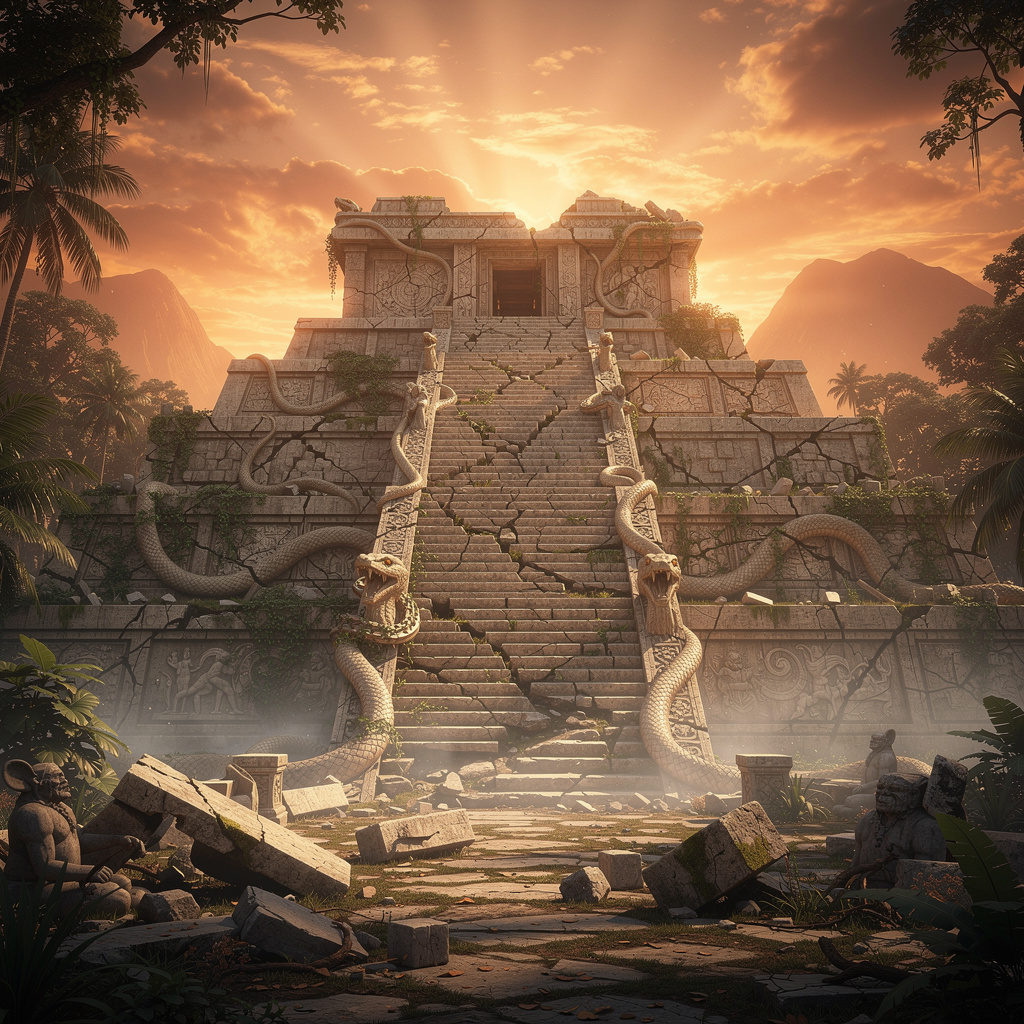
Temple Architecture: Round temples were sacred to Quetzalcoatl in his wind aspect, as circles offered no resistance to the wind. The famous Temple of the Feathered Serpent at Teotihuacan featured massive sculptured serpent heads emerging from feathered collars.
Priestly Orders: High priests of the Aztec empire took the title “Quetzalcoatl.” These priests maintained strict codes of conduct including celibacy, fasting, and bloodletting.
Sacrifices: While some traditions held that Quetzalcoatl opposed human sacrifice (preferring snakes and butterflies), the archaeological record at Teotihuacan shows that human sacrifices did occur at his temple. The relationship between Quetzalcoatl and sacrifice remained complex and varied across time and cultures.
Festivals: Major festivals honored Quetzalcoatl, including ceremonies where impersonators of the god were sacrificed to enable his renewal.
Quetzalcoatl and the Spanish Conquest
The arrival of Hernan Cortes in 1519 coincided with a year sacred to Quetzalcoatl in the Aztec calendar. Spanish accounts claim that Emperor Moctezuma II initially believed Cortes might be the returning Quetzalcoatl—though modern historians debate whether this belief was genuine, exaggerated by the Spanish, or invented entirely after the conquest to explain Aztec hesitation.
What is certain is that the Quetzalcoatl “return” narrative became useful for Spanish colonial justification. Missionaries also attempted to identify Quetzalcoatl with the apostle Thomas, suggesting pre-Columbian Christianity to legitimize conversion efforts.
After the conquest, Quetzalcoatl worship was suppressed, but the feathered serpent's imagery persisted in Mexican folk art and national identity, where it remains powerful today.
The Feathered Serpent in Modern Culture
- Mexican National Symbol: Quetzalcoatl imagery appears throughout Mexican art and architecture as a symbol of indigenous heritage.
- Literature: D.H. Lawrence's “The Plumed Serpent” (1926) explores Quetzalcoatl worship revival.
- Video Games: Appears in Final Fantasy, Smite, Fate/Grand Order, and numerous other games.
- Film: Featured in “The Road to El Dorado” and various documentaries.
- Dinosaur: The giant pterosaur Quetzalcoatlus was named for the feathered serpent.
Frequently Asked Questions About Quetzalcoatl
Was Quetzalcoatl a real person?
The priest-king Ce Acatl Topiltzin Quetzalcoatl of Tula may have been a historical figure whose story merged with the deity's mythology. However, the feathered serpent god predates any possible historical Quetzalcoatl by centuries.
Did Quetzalcoatl oppose human sacrifice?
Some myths, particularly those about the Toltec priest-king, portray Quetzalcoatl as opposing human sacrifice. However, archaeological evidence shows human sacrifices at temples dedicated to him, and Aztec religion included sacrifice to Quetzalcoatl. The anti-sacrifice narrative may reflect later political or colonial influences.
What's the difference between Quetzalcoatl and Kukulkan?
Kukulkan is the Maya name for the feathered serpent deity. While sharing the basic concept of a plumed serpent god, Kukulkan and Quetzalcoatl developed somewhat different mythologies within their respective cultures. They are generally considered the same deity under different names.
Why was the feathered serpent important?
The combination of bird (sky, air, divine) and serpent (earth, water, underworld) represented the union of cosmic forces and the connection between heavenly and earthly realms. This made the feathered serpent a powerful symbol of divine kingship and cosmic order.
The Eternal Serpent
Quetzalcoatl's endurance speaks to something profound in the human imagination. For over two thousand years, peoples across Mesoamerica looked upward at the quetzal's brilliant plumage and downward at the serpent's powerful coils and saw in their union something divine—a bridge between the realms of existence, a promise that the heavens could touch the earth.
The Feathered Serpent survived the fall of Teotihuacan, the collapse of the Toltecs, the violence of the Aztec empire, and the devastation of the Spanish conquest. Today, Quetzalcoatl lives on in Mexican national identity, in scholarly fascination with Mesoamerican civilization, and in the continuing spiritual practices of indigenous peoples. The plumed serpent still soars.
Sources and Further Reading
- Carrasco, David. “Quetzalcoatl and the Irony of Empire.” University Press of Colorado, 2000.
- Florescano, Enrique. “The Myth of Quetzalcoatl.” Johns Hopkins University Press, 1999.
- Nicholson, H.B. “Topiltzin Quetzalcoatl: The Once and Future Lord of the Toltecs.” University Press of Colorado, 2001.
- Taube, Karl. The Major Gods of Ancient Yucatan.” Dumbarton Oaks, 1992.
- Townsend, Richard F. “The Aztecs.” Thames & Hudson, 2009.