At the gates of the Greek underworld stands Cerberus, the monstrous three-headed hound whose duty is both simple and absolute: the dead may enter, but none may leave. This fearsome beast, offspring of the monsters Typhon and Echidna, has guarded the realm of Hades since time immemorial. With serpents writhing from his mane, a dragon's tail, and three sets of jaws that never sleep, Cerberus is the ultimate watchdog—and facing him was the final labor of the greatest Greek hero.
Quick Facts About Cerberus
| Origin | Greek mythology |
| Name Meaning | Possibly “spotted” or of unknown pre-Greek origin |
| Type | Monstrous beast / Guardian |
| Parents | Typhon and Echidna |
| Siblings | Hydra, Chimera, Orthrus, Nemean Lion |
| Domain | Gates of the Underworld (Hades) |
| Number of Heads | Three (sometimes fifty or one hundred) |
Origins and Parentage
Cerberus belongs to one of mythology's most terrifying families. His father, Typhon, was a giant so monstrous that even the Olympian gods fled before him. His mother, Echidna, was half-woman, half-serpent, known as the “Mother of All Monsters.”
From this union came many of Greek mythology's most famous beasts:
- The Lernaean Hydra: The many-headed water serpent slain by Heracles
- The Chimera: The fire-breathing lion-goat-serpent hybrid
- Orthrus: Cerberus's two-headed brother, who guarded Geryon's cattle
- The Nemean Lion: The invulnerable beast whose skin became Heracles' cloak
- The Sphinx: The riddling monster of Thebes (in some accounts)
Cerberus was thus brother to many of the monsters that heroes like Heracles, Bellerophon, and Oedipus faced in their legendary quests.
Physical Description
Ancient sources describe Cerberus with varying degrees of monstrousness:
The Classic Form: Three dog heads on a massive canine body. Each head is alert and watchful, ensuring nothing escapes notice. The standard depiction in art and literature.
Hesiod's Version: The poet Hesiod described Cerberus as having fifty heads, making him an even more terrifying presence at the underworld's gates.
The Serpent Elements: Most descriptions include serpents—either as a mane of snakes writhing around his heads, snakes sprouting from his back, or both. These serpents add an additional layer of danger.
The Tail: Cerberus's tail is often described as a serpent or dragon, capable of striking at anyone who might try to slip past from behind.
Size: Cerberus is enormous—large enough to block the gates of the underworld entirely, his shadow falling over all who approach.
The Guardian's Duty
Cerberus serves a singular purpose: to guard the entrance to the underworld. His role is twofold:
Welcoming the Dead: Souls of the deceased who have received proper burial rites pass by Cerberus without harm. Some accounts say he even greets them kindly, his tail wagging as they enter their eternal home.
Preventing Escape: Once inside, the dead cannot leave. Cerberus ensures no shade slips back to the world of the living. His three heads watch all directions; his serpent tail guards against approach from behind.
This duty makes Cerberus not evil, but necessary. He maintains the natural order, keeping the dead where they belong. Without him, the boundary between life and death would collapse.
The Twelfth Labor of Heracles
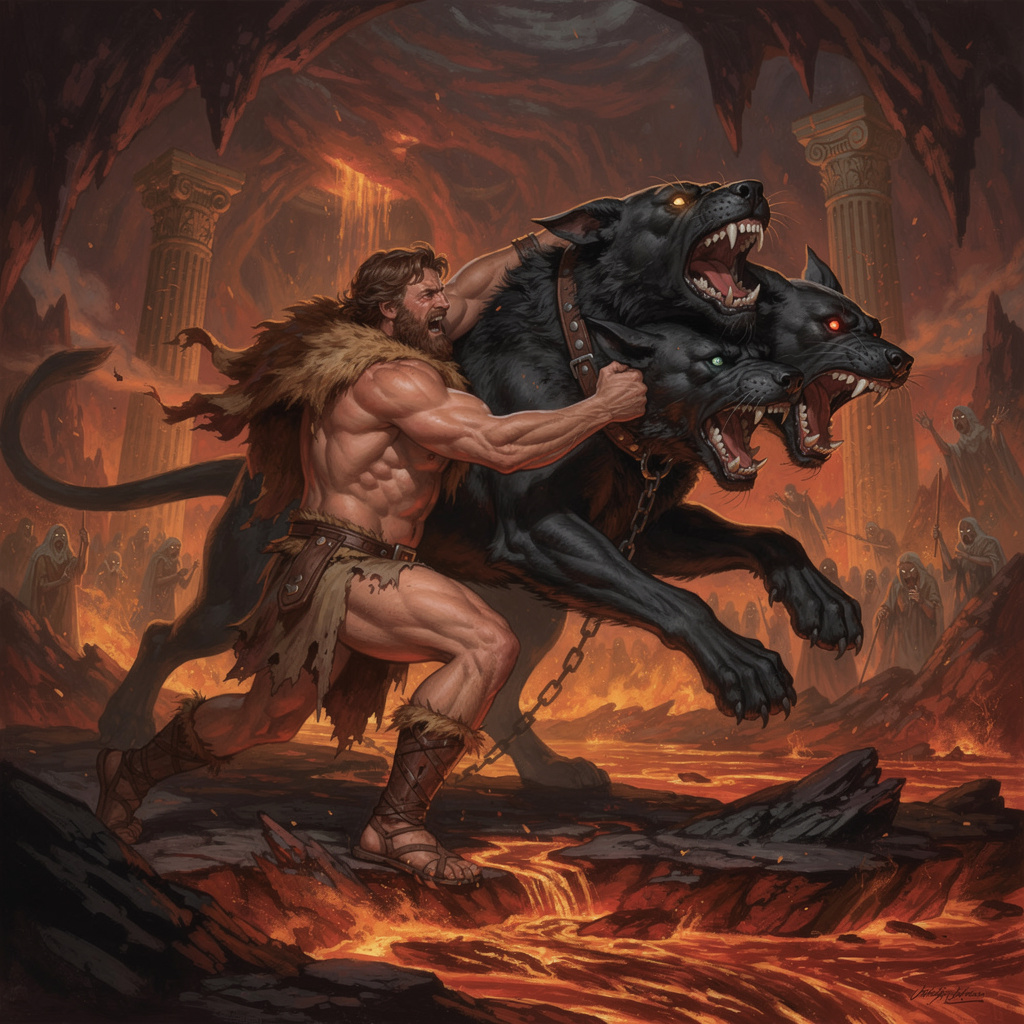
The most famous story involving Cerberus is his capture by Heracles as the hero's final labor:
King Eurystheus, who had assigned Heracles his labors, believed the twelfth task would be impossible. He commanded the hero to descend to the underworld and bring back Cerberus—alive.
Heracles prepared carefully. He was initiated into the Eleusinian Mysteries to learn the secrets of the underworld. The gods Hermes and Athena guided him on his journey.
Upon reaching Hades' realm, Heracles asked permission from the god of the dead himself. Hades agreed—on one condition: Heracles must subdue Cerberus using only his bare hands, without weapons.
Heracles found Cerberus at the gates. Protected by his lion-skin cloak, he wrestled the three-headed beast, eventually getting his arms around Cerberus's throat. Despite the serpents biting him and the three heads snapping, Heracles held on until the hound submitted.
Heracles dragged Cerberus to the surface and presented him to Eurystheus, who was so terrified he hid in a bronze jar and begged Heracles to return the monster. Cerberus was taken back to the underworld, his duty resumed.
Others Who Passed Cerberus

A few mortals found ways past the guardian without fighting him:
Orpheus: The legendary musician descended to rescue his wife Eurydice. He charmed Cerberus with his lyre, playing music so beautiful that all three heads closed their eyes in bliss, allowing Orpheus to pass.
Psyche: In her quest to retrieve a box of beauty from Persephone, Psyche was advised to bring honey cakes. She tossed one to each of Cerberus's heads, distracting him while she slipped past—and used the same trick on her return.
Aeneas: The Trojan hero, guided by the Sibyl, also used drugged honey cakes to put Cerberus to sleep during his journey to consult his father's shade.
Theseus and Pirithous: These heroes attempted to kidnap Persephone. They got past Cerberus but were trapped in the underworld—Hades bound them to chairs of forgetfulness. Heracles later freed Theseus, but Pirithous remained forever.
Cerberus in Ancient Sources
The hound appears throughout Greek and Roman literature:
Hesiod's Theogony: Describes Cerberus as the “brazen-voiced hound of Hades” with fifty heads.
Homer's Iliad and Odyssey: References Heracles's labor but doesn't describe Cerberus in detail.
Virgil's Aeneid: Describes the “huge Cerberus” barking from three throats, lying in a cave before the gates of Orcus (the underworld).
Ovid's Metamorphoses: Tells how Cerberus's saliva, dripping onto the ground when Heracles dragged him up, created the poisonous aconite plant.
Apollodorus: Provides one of the most complete accounts of Heracles's capture of the beast.
Symbolism and Meaning
Cerberus carries multiple symbolic meanings:
Death's Finality: Cerberus embodies the absolute boundary between life and death. You can enter the underworld, but you cannot return. His vigilance represents the irreversibility of death.
The Three Heads: Various interpretations exist. Some say the heads represent past, present, and future. Others suggest birth, youth, and old age—or alternatively, the three stages of death in Greek belief.
Loyal Service: Unlike many monsters who threaten heroes, Cerberus is not villainous. He faithfully performs his duty, serving Hades without question. He represents duty and loyalty above personal will.
The Threshold Guardian: In mythological terms, Cerberus is the archetypal guardian at the threshold—the monster every hero must face before completing their journey.
Cerberus in Art
Ancient artists depicted Cerberus frequently, particularly in scenes of Heracles's twelfth labor:
Greek Pottery: Cerberus appears on numerous vases, usually with three heads, often shown cowering or being led on a chain by Heracles.
Roman Sculpture: Statues often show Cerberus at Hades' feet or being subdued by Heracles.
Renaissance Art: Artists like Rubens depicted dramatic scenes of Heracles wrestling the hound.
Modern Interpretations: Contemporary art ranges from terrifying monster to surprisingly sympathetic dog—just one trying to do his job.
Cerberus in Modern Media
- Literature: Appears in Dante's Inferno (guarding the third circle), Rick Riordan's Percy Jackson series, and countless mythology retellings
- Film: Featured in “Clash of the Titans,” “Hercules” (Disney, 1997), and numerous fantasy films
- Video Games: Appears in “Hades,” “God of War,” “Kingdom Hearts,” “Assassin's Creed Odyssey,” and many RPGs
- Music: Referenced in various metal and classical compositions
- Television: Features in shows depicting Greek mythology
Cerberus Compared to Other Guardian Beasts
| Beast | Culture | What It Guards | Key Difference |
|---|---|---|---|
| Cerberus | Greek | Underworld entrance | Prevents escape, allows entry |
| Garm | Norse | Hel's gates | Guards the Norse underworld, howls at Ragnarok |
| Ammit | Egyptian | Hall of Judgment | Devours the unworthy dead |
| Foo Dogs | Chinese | Temples, homes | Protective spirits, not fearsome |
| Dragon | Various | Treasure, places | Guards for personal gain or duty |
The Name “Cerberus”
The etymology of “Cerberus” is debated. Some scholars connect it to the Greek word “kreoboros,” meaning “flesh-devourer.” Others suggest a connection to “Kerberos,” possibly meaning “spotted”—which would make Cerberus, ironically, named like any ordinary dog.
The most likely explanation is that the name is pre-Greek, inherited from an older tradition and later adapted into Greek mythology. This would explain why it doesn't have a clear Greek meaning.
Frequently Asked Questions
Why does Cerberus have three heads?
The number three appears frequently in Greek mythology, representing completion and power. Practically, three heads allow Cerberus to watch all directions at once. Symbolically, the heads may represent different aspects of death, time, or the three-part nature of existence.
Is Cerberus evil?
No. Cerberus is a guardian performing a necessary function. He doesn't hunt or kill the living—he simply prevents the dead from escaping. He serves the natural order rather than opposing it. In some accounts, he even welcomes the newly dead kindly.
Could Cerberus be killed?
Ancient sources don't address this directly. Heracles subdued him but was forbidden from harming him. As the offspring of immortal or semi-divine beings, Cerberus may be unkillable—or his death might be unthinkable, as it would leave the underworld unguarded.
What happened when Cerberus was brought to the surface?
According to Ovid, Cerberus's saliva dripped onto the ground, and from it grew aconite—also known as wolfsbane or monkshood, one of the most poisonous plants in existence. The hound was so terrified and enraged by the sunlight that his venomous drool became toxic plants.
The Eternal Watchdog
Cerberus endures as one of mythology's most recognizable creatures—a monster, yes, but also a faithful servant performing an essential duty. He represents the boundary that all must eventually cross and none may recross. The dead enter; the dead remain.
For the Greeks, Cerberus made death real and final. There could be no casual visits to the underworld, no easy reunions with lost loved ones. The three-headed hound ensured that death meant something—that the separation between worlds was absolute.
And still he waits, at the gates of a realm that exists wherever humans contemplate mortality. Three heads watching. Serpents coiling. A dragon's tail swishing in the darkness. The ultimate guard dog, patient and eternal, ensuring that what enters the realm of Hades stays there forever.
Sources and Further Reading
- Hesiod. “Theogony.” Translated by Hugh G. Evelyn-White, 1914.
- Apollodorus. “The Library.” Translated by James George Frazer, 1921.
- Virgil. “The Aeneid.” Translated by Robert Fagles, Penguin Classics, 2006.
- Ovid. “Metamorphoses.” Translated by Charles Martin, W.W. Norton, 2004.