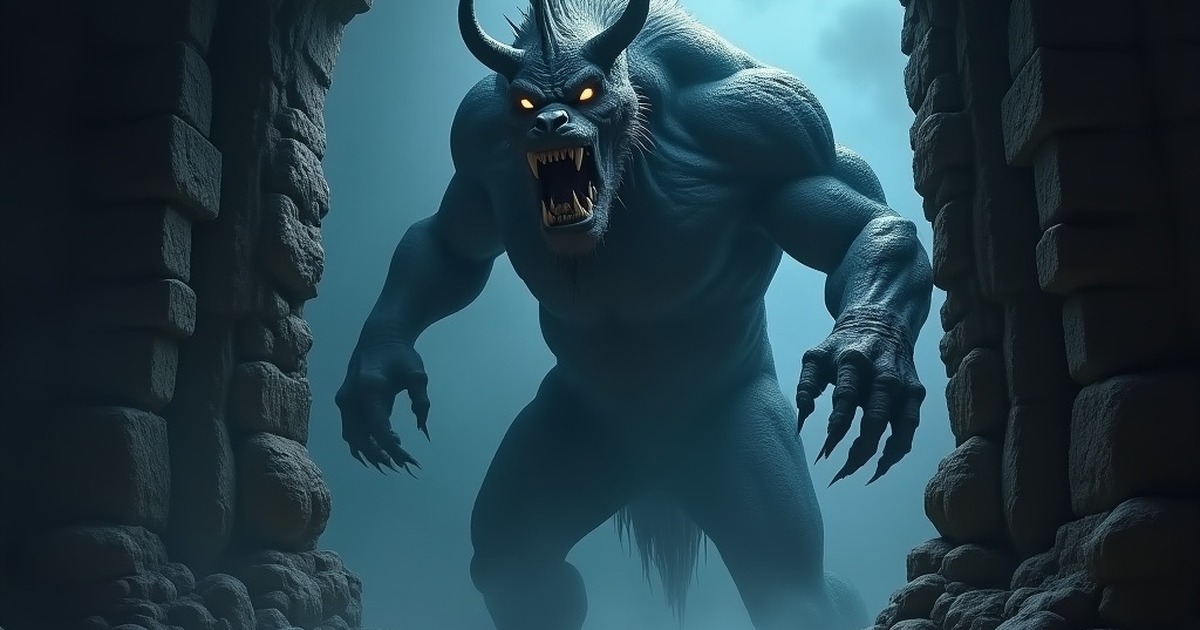
Among the most terrifying monsters of Greek mythology stands the Chimera (Χίμαιρα)—a fire-breathing abomination with a lion's head, a goat's body, and a serpent for a tail. Born from the same monstrous lineage that produced Cerberus and the Hydra, the Chimera ravaged the ancient kingdom of Lycia until the hero Bellerophon, riding the winged horse Pegasus, finally slew her. Yet the Chimera's legacy lives on—her name has become our word for any impossible hybrid, any wild fantasy, any creature that defies natural law.
Quick Facts About the Chimera
| Origin | Greek mythology |
| Name Meaning | “She-goat” or “winter” (disputed) |
| Type | Monstrous hybrid beast |
| Parents | Typhon and Echidna |
| Siblings | Cerberus, Hydra, Orthrus, Sphinx |
| Slain By | Bellerophon riding Pegasus |
| Location | Lycia (southwestern Anatolia) |
Origins and Family
The Chimera belongs to Greek mythology's most fearsome family. Her father, Typhon, was a monster so powerful that even Zeus feared him—a giant with a hundred dragon heads who once nearly overthrew the Olympians. Her mother, Echidna, was half-woman, half-serpent, known as the “Mother of All Monsters.”
From this union came many of the beasts that Greek heroes faced:
- Cerberus: The three-headed hound guarding the underworld
- The Lernaean Hydra: The many-headed water serpent
- Orthrus: The two-headed dog who guarded Geryon's cattle
- The Sphinx: The riddling lion-woman of Thebes (in some accounts)
In some versions, the Chimera herself was mother to the Sphinx and the Nemean Lion, mating with her brother Orthrus. This incestuous breeding of monsters reflected the Greeks' belief that evil breeds more evil.
Physical Description
Ancient sources describe the Chimera as a truly bizarre fusion of animals:
The Classic Form: Homer's Iliad describes her as “lion in front, serpent behind, goat in the middle.” Most artistic depictions show a lion's head and front body, a goat's head emerging from the back, and a serpent forming the tail.
The Fire: The Chimera breathed fire from her lion's mouth—a devastating weapon that made her nearly invincible. Some accounts say the goat head could also exhale flames.
The Three Heads: In the most common depiction, she has three heads—lion (primary), goat (sprouting from her back), and serpent (as her tail). Each head was fully alive and dangerous.
Size: Ancient sources describe her as enormous—large enough to terrorize an entire kingdom, powerful enough that whole armies failed to stop her.
The Terror of Lycia
The Chimera made her lair in the kingdom of Lycia, in what is now southwestern Turkey. From there, she ravaged the countryside:
She burned crops and villages with her fiery breath. Livestock disappeared. Anyone who tried to stop her was incinerated. King Iobates of Lycia was desperate—his kingdom was being destroyed, and no warrior could stand against the monster.
Some scholars have connected the Chimera legend to volcanic activity in the region. Mount Chimaera in Lycia (now called Yanartaş) has natural gas vents that produce eternal flames—fire emerging from the earth. Ancient observers might have attributed these flames to a fire-breathing monster lurking within.
Bellerophon and Pegasus

The hero who slew the Chimera was Bellerophon, and his story begins with treachery:
Bellerophon, a prince of Corinth, had been falsely accused of trying to seduce Anteia, wife of King Proetus of Tiryns. Rather than kill him directly (which would violate guest-right), Proetus sent Bellerophon to his father-in-law Iobates with a sealed letter requesting his death.
Iobates, unwilling to murder a guest himself, assigned Bellerophon an impossible task: kill the Chimera. No one had survived an encounter with the monster. Iobates expected her to do his dirty work.
But Bellerophon had an advantage: the winged horse Pegasus. With the help of the goddess Athena (or the seer Polyeidos, depending on the source), Bellerophon had tamed the divine stallion. Flying above the Chimera's flames, he could attack without being burned.
The Slaying of the Chimera
The battle between Bellerophon and the Chimera became one of Greek mythology's most famous monster-slayings:
Mounted on Pegasus, Bellerophon flew high above the Chimera, beyond the reach of her flames. He peppered her with arrows, but she was tough—difficult to kill with ordinary weapons.
Then Bellerophon had a clever idea. He attached a block of lead to his spear and drove it into the Chimera's throat. When she tried to breathe fire, the flames melted the lead, which poured down her throat and burned through her insides. The Chimera died, slain by her own fire.
King Iobates, impressed by this feat, gave Bellerophon more impossible tasks—fighting the Solymi warriors, the Amazons, and an ambush of Lycian champions. Bellerophon survived them all. Finally recognizing divine favor, Iobates gave Bellerophon his daughter's hand and half his kingdom.
Bellerophon's Fate
The story of the Chimera's slayer has a tragic end:
Flushed with success, Bellerophon grew arrogant. He decided he deserved a place among the gods and attempted to fly Pegasus to Mount Olympus. Zeus sent a gadfly to sting Pegasus, and Bellerophon was thrown from the horse's back.
He survived the fall but was crippled, blinded, or maddened (sources vary). He spent the rest of his days wandering alone, shunned by gods and men, a cautionary tale about hubris. Pegasus, meanwhile, was welcomed to Olympus and became the bearer of Zeus's thunderbolts.
Symbolism and Interpretation
The Chimera has been interpreted in various ways:
Natural Phenomenon: Some ancient authors, including Pliny the Elder, suggested the Chimera represented a volcanic mountain in Lycia with lions at the top, goats in the middle meadows, and snakes at the base.
Seasonal Symbol: One interpretation sees the three animals as representing different seasons—the lion for summer's heat, the goat for spring, and the serpent for winter.
Chaos Incarnate: As an impossible hybrid, the Chimera represents chaos, the violation of natural boundaries, the monstrous potential of mixing what should remain separate.
Unconquerable Challenges: The term “chimera” has come to mean an impossible dream, an unrealistic fantasy—something as impossible as a fire-breathing lion-goat-serpent.
The Chimera in Ancient Art

Ancient artists frequently depicted the Chimera:
The Chimera of Arezzo: The most famous ancient depiction is an Etruscan bronze sculpture from around 400 BCE, discovered in Arezzo, Italy, in 1553. It shows the Chimera wounded and dying, with exquisite detail. The serpent tail was restored during the Renaissance.
Greek Pottery: Numerous vases show Bellerophon on Pegasus battling the Chimera, establishing the three-headed form that became standard.
Roman Mosaics: The Chimera remained popular in Roman art, often shown in hunting scenes or as a symbol of conquered chaos.
The Chimera in Modern Language
The Chimera's name has given us several modern terms:
Chimera/Chimaera: In common usage, any imaginary monster made of incongruous parts, or more broadly, any wild fantasy or impossible dream.
Chimera (Biology): An organism containing cells from two or more individuals—for example, transplant recipients or organisms created through genetic engineering.
Chimeric: Adjective meaning composed of disparate elements, wildly fanciful, or (in biology) relating to genetic chimeras.
Chimerism: The medical condition of having two distinct genetic lineages within one body.
The Chimera in Modern Media
- Literature: Appears in numerous fantasy novels and mythology retellings
- Film: Featured in “Clash of the Titans,” “Percy Jackson,” “Mission: Impossible II” (as a virus name)
- Video Games: Appears in “God of War,” “Final Fantasy,” “Dragon's Dogma,” “Titan Quest,” and countless RPGs
- Television: Referenced in various shows dealing with mythology
- Science: The term “chimera” is widely used in genetics and biomedical research
Chimera Compared to Other Hybrid Monsters
| Creature | Culture | Components | Key Difference |
|---|---|---|---|
| Chimera | Greek | Lion, goat, serpent | Fire-breathing, three heads |
| Manticore | Persian/Greek | Lion, human, scorpion | Human face, poison tail |
| Griffin | Various | Lion, eagle | Guardian, not monstrous |
| Sphinx | Egyptian/Greek | Lion, human (wings in Greek) | Riddles, intelligence |
| Lamassu | Mesopotamian | Lion/bull, human, eagle | Protective deity |
Frequently Asked Questions
Was the Chimera male or female?
Female. The Greek word “chimaira” is feminine, and ancient sources consistently refer to the Chimera as female. Some myths say she mated with her brother Orthrus to produce the Sphinx and Nemean Lion.
Could the Chimera fly?
No. Unlike some modern depictions, the original Chimera had no wings. This is precisely why Bellerophon needed Pegasus—the flying horse allowed him to attack from above, beyond the reach of her fire.
Why did Bellerophon use lead?
Lead has a low melting point (about 621°F/327°C). When the Chimera's fire melted it in her throat, the molten metal poured into her body, killing her from within. It was a clever use of her own power against her.
Is there a real Mount Chimera?
Yes. Yanartaş (“burning rock”) in modern Turkey was anciently called Mount Chimaera. Natural gas vents create flames that have burned continuously for at least 2,500 years. Ancient sailors used these flames as a navigational landmark.
The Eternal Flame
The Chimera represents more than just a monster—she embodies the terrifying power of nature's chaos, the fear of things that should not exist, the horror of boundaries violated. She was a walking paradox, an impossible creature whose very existence defied natural law.
Yet we've taken her name to describe our own impossible dreams, our wildest imaginings, our most fanciful creations. In modern genetics, chimeras are organisms that break the boundaries between individuals. The monster's legacy has become strangely hopeful—if even impossible things can exist, perhaps nothing is truly impossible.
And on the rocky slopes of Yanartaş, the eternal flames still burn. The Chimera may be dead, but her fire—the fire that terrified ancient Lycia, that Bellerophon turned against her, that inspired legends for millennia—still flickers in the Turkish night.
Sources and Further Reading
- Homer. “The Iliad.” Translated by Robert Fagles, Penguin Classics, 1998.
- Hesiod. “Theogony.” Translated by Hugh G. Evelyn-White, 1914.
- Apollodorus. “The Library.” Translated by James George Frazer, 1921.
- Pindar. “Olympian Odes.” Various translations.