No mythological creature bridges ancient cultures quite like the Sphinx. In Egypt, the Great Sphinx of Giza has watched over the pyramids for 4,500 years—a benevolent guardian with a lion's body and a pharaoh's face. In Greece, the Sphinx was something far more sinister: a winged monster who devoured anyone who failed to answer her deadly riddle. These two traditions gave the world one of mythology's most enduring and enigmatic figures—a being whose very name means “strangler.”
Quick Facts About the Sphinx
| Origin | Egyptian and Greek mythology |
| Name Meaning | Greek “sphingein” = to strangle |
| Egyptian Form | Male, benevolent guardian |
| Greek Form | Female, winged, deadly |
| Body | Lion's body, human head |
| Famous Example | Great Sphinx of Giza (Egyptian); Sphinx of Thebes (Greek) |
The Egyptian Sphinx
The Egyptian sphinx predates the Greek version by over two thousand years. To the Egyptians, sphinxes were powerful guardian spirits, protectors of sacred places, and symbols of royal power.
Form: Egyptian sphinxes have a lion's body and a human head—typically the face of the reigning pharaoh. Unlike the Greek version, Egyptian sphinxes are wingless and almost always male.
Purpose: They served as protectors of temples, tombs, and sacred sites. Their lion's strength and human wisdom combined to create the perfect guardian.
The Great Sphinx: The most famous sphinx in the world crouches on the Giza plateau, carved from living limestone during the reign of Pharaoh Khafre (circa 2500 BCE). At 240 feet long and 66 feet high, it is the largest monolithic statue in the ancient world.
Symbolism: The Egyptian sphinx represented the union of the pharaoh's wisdom (the human head) with the lion's power and divine authority. It was associated with the sun god Ra and the horizon.
The Great Sphinx of Giza
The Great Sphinx deserves special attention as the most famous sphinx in existence:
Construction: Built around 2500 BCE, likely during the reign of Pharaoh Khafre of the Fourth Dynasty. The face is believed to be Khafre's own likeness.
Dimensions: 240 feet (73 meters) long, 66 feet (20 meters) high, with a face 13 feet (4 meters) wide.
The Missing Nose: Contrary to popular legend, Napoleon's soldiers did not shoot off the sphinx's nose. Historical drawings from before Napoleon's time show it already missing. Medieval historian al-Maqrizi attributed the damage to a Sufi zealot in 1378 CE who was outraged that local peasants made offerings to the sphinx.
The Dream Stele: Between the sphinx's paws stands a stone tablet telling how Pharaoh Thutmose IV, while still a prince, fell asleep in the sphinx's shadow. The sphinx spoke to him in a dream, promising him the throne if he cleared away the sand covering its body. Thutmose did so and became pharaoh.
Restoration: The sphinx has been restored multiple times throughout history, from ancient Egyptian repairs to modern conservation efforts.
The Greek Sphinx

When the sphinx concept reached Greece, it transformed into something far more terrifying:
Form: The Greek sphinx has a lion's body, a woman's head, and great feathered wings. Sometimes she is depicted with a serpent's tail.
Parentage: According to Hesiod, she was the daughter of Orthrus (the two-headed dog) and Chimera. Other accounts name Typhon and Echidna as her parents, making her sister to Cerberus and the Hydra.
Personality: Unlike the benevolent Egyptian guardian, the Greek sphinx was a monster—cunning, cruel, and deadly. She delighted in testing mortals with riddles and devouring those who failed.
The Name: The Greeks called her “Sphinx,” from the verb “sphingein,” meaning “to strangle” or “to bind tight”—a reference to how she killed her victims.
The Riddle of the Sphinx
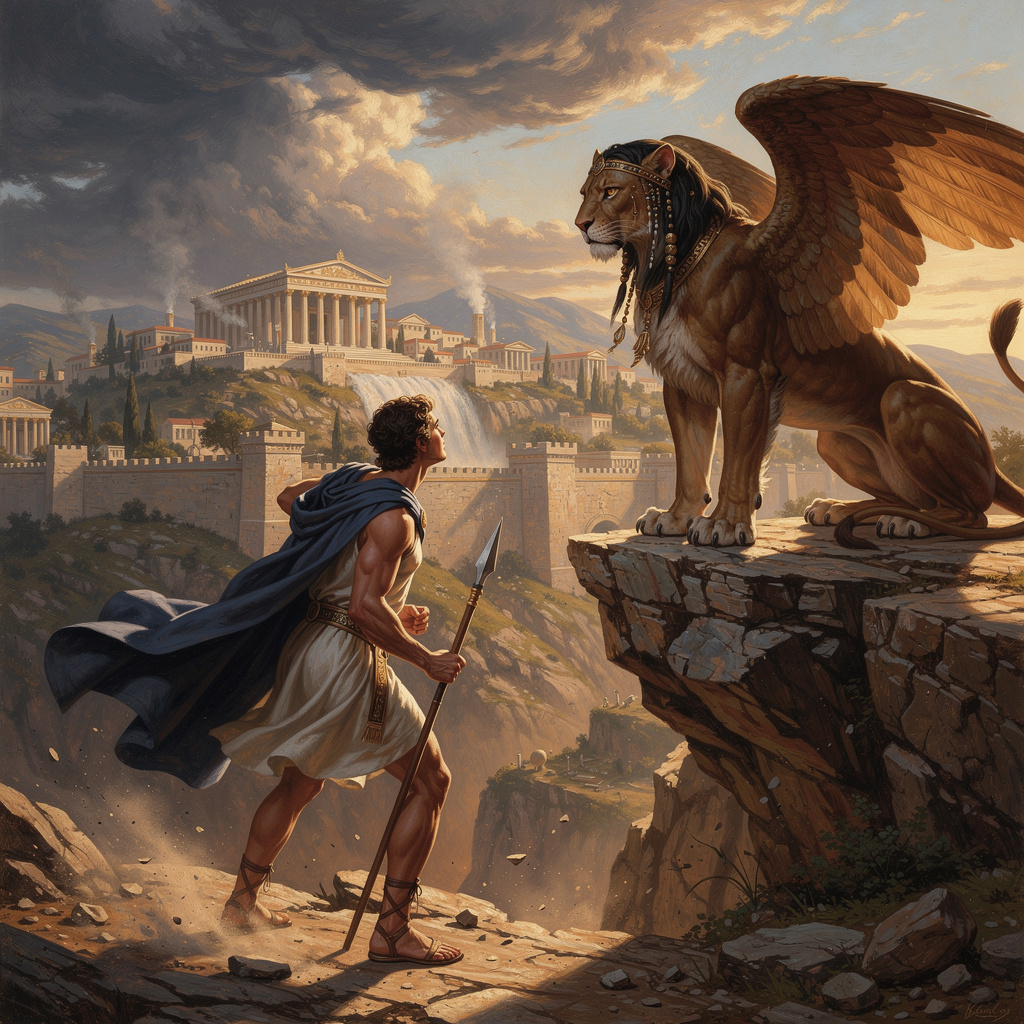
The Greek sphinx is most famous for her riddle, which she posed to travelers approaching Thebes:
“What walks on four legs in the morning, two legs at noon, and three legs in the evening?”
Those who answered incorrectly were strangled and devoured. For years, the sphinx terrorized Thebes, killing all who attempted to pass.
Finally, Oedipus arrived. He answered: “Man.” A human crawls on all fours as a baby (morning of life), walks upright as an adult (noon), and uses a cane in old age (evening).
The sphinx, defeated, threw herself from her rocky perch to her death. Thebes was freed, and Oedipus was rewarded with the throne and the hand of the widowed queen—his own mother, Jocasta, though he did not know it. Thus the sphinx's defeat led directly to the tragedy of Oedipus.
The Sphinx and Thebes
The Greek sphinx had a specific connection to the city of Thebes:
The Curse: Hera or Ares (depending on the account) sent the sphinx to Thebes as punishment. The goddess was angry at the Thebans for a religious offense, while Ares sought revenge for the slaying of his sacred dragon by Cadmus, Thebes' founder.
Mount Phicium: The sphinx perched on Mount Phicium (or Sphingium), which overlooked the road to Thebes. All travelers had to pass her and answer her riddle.
The Terror: For years, the sphinx killed so many Thebans that the city was effectively under siege. King Laius (Oedipus's biological father) was killed while traveling—though by Oedipus himself, not the sphinx.
The Prize: The Thebans promised the throne and Queen Jocasta's hand to whoever could defeat the sphinx. This is what Oedipus won—and what ultimately destroyed him.
Other Sphinx Riddles
Some ancient sources give the sphinx a second riddle:
“There are two sisters: one gives birth to the other, and she in turn gives birth to the first. Who are they?”
The answer: Day and Night. In Greek, both words (hemera and nyx) are feminine, and each gives way to the other in an endless cycle.
Whether Oedipus answered one riddle or two varies by source, but the first riddle about man is far more famous.
Symbolism and Meaning
The sphinx carries profound symbolic weight in both traditions:
The Mystery of Human Nature: The riddle's answer—”man”—suggests that the sphinx embodies the mystery of human existence. Her riddle forces travelers to contemplate what it means to be human.
Knowledge as Power: The sphinx controls through knowledge. She doesn't simply attack—she tests. Those with wisdom pass; those without die. This represents the Greek emphasis on knowledge as the ultimate power.
The Union of Opposites: With her lion's body and human head, the sphinx represents the union of animal and human, instinct and reason, nature and civilization.
Guardianship: In Egypt, the sphinx represents protective power. In Greece, she represents the dangers that guard forbidden knowledge—the price one might pay for seeking truth.
Riddle of Existence: The sphinx's unanswerable presence at Giza—who built it? why? what does it mean?—has made “sphinx-like” synonymous with mystery and inscrutability.
Sphinxes in Other Cultures
The sphinx concept appears across multiple civilizations:
Mesopotamian Lamassu: Human-headed winged bulls or lions that guarded Assyrian and Babylonian palaces. Similar protective function to Egyptian sphinxes.
Indian Purushamriga: Human-faced lions that appear in Hindu and Buddhist art, serving as temple guardians.
Southeast Asian Singha: Lion figures with some human characteristics found in Thai, Burmese, and Cambodian temple architecture.
Whether these represent independent development or cultural transmission remains debated by scholars.
The Sphinx in Modern Media
- Literature: Appears in countless works, from Sophocles' “Oedipus Rex” to modern fantasy novels
- Film: Featured in “Gods of Egypt,” various mummy movies, and historical epics
- Video Games: Appears in “Assassin's Creed Origins,” “Age of Mythology,” “Civilization” series
- Television: Featured in documentaries and fictional series involving ancient Egypt
- Architecture: Sphinx statues adorn museums, bridges, and buildings worldwide
The Sphinx Compared to Similar Creatures
| Creature | Culture | Key Difference |
|---|---|---|
| Egyptian Sphinx | Egyptian | Male, wingless, benevolent guardian |
| Greek Sphinx | Greek | Female, winged, poses riddles, kills |
| Lamassu | Mesopotamian | Winged bull/lion, five legs, male head |
| Manticore | Persian/Greek | Lion body, human head, scorpion tail |
| Chimera | Greek | Lion/goat/serpent hybrid, no riddles |
Frequently Asked Questions
Is the Sphinx male or female?
Both. Egyptian sphinxes are typically male, with the head representing a pharaoh. Greek sphinxes are female—the Sphinx of Thebes is always depicted as a woman with wings. The two traditions developed independently.
Why does the Greek Sphinx have wings?
Greek artists added wings to emphasize her supernatural nature and to align her with other Greek monsters. The wings also enable her dramatic death—throwing herself from her perch when Oedipus defeats her.
How old is the Great Sphinx of Giza?
Approximately 4,500 years old, built around 2500 BCE during Egypt's Fourth Dynasty. Some fringe theories propose an older date, but mainstream Egyptology firmly dates it to Khafre's reign.
What happened to the Great Sphinx's nose?
Historical records suggest it was damaged by a Sufi named Muhammad Sa'im al-Dahr in 1378 CE, who was outraged by local religious practices involving the sphinx. The story that Napoleon's soldiers shot it off is a myth—drawings from before Napoleon's time show the nose already missing.
The Eternal Riddle
The sphinx remains one of mythology's most potent symbols—guardian and destroyer, protector and predator, ancient mystery and eternal question. Whether gazing silently across the Egyptian desert or posing deadly riddles at Thebes, the sphinx demands that humanity confront its own nature.
“What walks on four legs in the morning, two at noon, and three in the evening?” The answer is us. The sphinx's riddle was never really about cleverness—it was about self-knowledge. Only by understanding what we are can we pass the guardian at the gate.
And at Giza, the Great Sphinx still watches. It has seen the rise and fall of civilizations, the birth of religions, the march of conquerors. Its lips are sealed, but its riddle remains: what are you, mortal, who stand so briefly in the shadow of eternity?
Sources and Further Reading
- Sophocles. “Oedipus Rex.” Various translations available.
- Lehner, Mark. “The Complete Pyramids.” Thames & Hudson, 1997.
- Hesiod. “Theogony.” Translated by Hugh G. Evelyn-White, 1914.
- Apollodorus. “The Library.” Translated by James George Frazer, 1921.