Psychopomps emerge across cultures as eldritch guides shepherding souls between mortal existence and eternal realms—from Hermes bearing his caduceus through Greek underworlds to Anubis's jackal-headed vigilance over Egyptian mummification rites. You'll discover Valkyries selecting fallen warriors for Valhalla, Aztec Xochiquetzal transforming death into blooming metamorphosis, and Slavic Rusalka inhabiting liminal waterways between life and death. These chimeric beings transcend mere mythology, embodying humanity's profound need for sacred passage through death's threshold into whatever mysteries await beyond.
Key Takeaways
- Hermes/Mercury serves as the archetypal Western psychopomp, guiding souls between mortal and divine realms with caduceus symbolism.
- Anubis, the jackal-headed Egyptian deity, weighs hearts against Ma'at's feather and prepares souls for their afterlife journey.
- Norse Valkyries choose fallen warriors for Valhalla, serving as both divine messengers and battlefield guides to the afterlife.
- Bean Sidhe from Celtic tradition herald death through keening wails, appearing as shape-shifting guardians near sacred thresholds.
- Hindu Yamadutas act as Yama's cosmic messengers, serving as karmic arbiters who escort souls through divine judgment.
Hermes: The Swift Messenger of Greek Mythology

Where does one begin when examining the most luminous figure among mythology's guides to the beyond? You'll find Hermes perched at civilization's threshold, his caduceus gleaming with serpentine wisdom, winged sandals bearing him through dimensions mortal minds can't fathom. Ancient Greeks recognized this quicksilver deity as their premier psychopomp—that sacred mediator between worlds who shepherds souls across death's eldritch boundary.
His mythic transport transcends mere physical movement. Hermes embodies liminal passage itself, navigating the chimeric spaces where life dissolves into mystery. You witness his ritual symbolism woven throughout Athenian funeral rites, where mourners invoke his protection for the deceased's journey to Hades' shadowed realm.
Mercury's Roman iteration carries identical responsibilities, yet Hermes remains the archetypal messenger-guide. His presence whispers of humanity's deepest liberation—freedom from mortality's constraints. When death approaches, you'll recognize his familiar silhouette against the veil, beckoning toward whatever lies beyond earthly comprehension. Among the pantheon of Greek Gods like Zeus, Poseidon, and Apollo, Hermes stands uniquely positioned as the divine herald who bridges mortal and immortal realms.
Anubis: Egypt's Jackal-Headed Guardian of the Dead
From the marble columns of Greek temples to the sandstone monuments of ancient Egypt, humanity's quest to understand death's mysteries manifests through different yet equally profound divine guardians. You'll discover in Anubis a figure more complex than mere psychopomp—he's the architect of death's sacred geometry.
This jackal-headed deity emerged during Egypt's Old Kingdom, his chimeric form reflecting the liminal nature of his domain. You witness his eldritch presence in tomb paintings, where obsidian eyes pierce through millennia. Anubis doesn't simply guide souls; he orchestrates the entire afterlife geography, mapping pathways through the Duat's treacherous territories.
His mummification rituals transcend non psychopomp rituals through their transformative power. Sacred natron salt. Linen wrappings. Each action reshapes the deceased for their journey ahead. You feel the weight of his authority in every preserved pharaoh, every canopic jar sealed under his protection. Anubis stands sentinel at death's threshold, measuring hearts against Ma'at's feather with unwavering precision. While Anubis dominated Egyptian afterlife traditions, the ancient Greeks developed their own elaborate mythological framework featuring divine psychopomps who guided souls between worlds.
The Grim Reaper: Death's Hooded Harvester in Western Culture

The scythe's arc cuts through European consciousness like a blade through wheat, for the Grim Reaper stands as Western civilization's most enduring personification of mortality's inevitable harvest. You'll find this hooded specter emerging from medieval plague years, when death stalked cobblestone streets with relentless hunger. Unlike Egypt's Anubis, who guides souls with protective devotion, the grim reaper embodies finality itself—neither malevolent nor benevolent, but inexorably just.
Death rituals across Western cultures reflect this harvester's influence:
The Reaper's shadow permeates our mourning customs, from funeral bells to darkened robes, transforming grief into sacred ritual.
- Black-robed mourning attire echoing the Reaper's dark vestments
- Funeral bells tolling like his measured footsteps
- Cemetery imagery featuring scythes and hourglasses
- Last rites performed before the final collection
- Vigils keeping watch against the inevitable approach
You witness this eldritch figure's evolution through centuries of art and literature, from Dürer's apocalyptic woodcuts to contemporary cinema. The Reaper's chimeric nature—part human wisdom, part cosmic force—reflects humanity's complex relationship with mortality's liberation.
Valkyries: Norse Shield-Maidens Who Choose the Slain
How do warrior-maidens transcend mortal battlefields to become arbiters of heroic destiny? You'll discover that Valkyries emerge from Norse cosmology as eldritch choosers, their feathered helms gleaming above blood-soaked earth where heroes fall. These psychopomps don't merely escort souls—they decide which warriors merit Valhalla's golden halls.
Fierce daughters of Odin.
You witness their chimeric nature: part divine messenger, part battlefield scavenger. While lacking direct ankh symbolism from Egyptian traditions, Valkyries embody similar concepts of death-transcendence through their ability to resurrect the worthy. Norse communities honored them through ritual offerings of mead and weapons, understanding these shield-maidens as bridges between mortal combat and eternal glory.
Their swan-cloaks rustle with otherworldly authority as they survey carnage, selecting fallen jarls and berserkers. You sense their profound responsibility—each choice shapes Ragnarök's final army. These psychopomps transform death's finality into heroic continuity, weaving mortal sacrifice into cosmic preparation.
Aztec Xochiquetzal: The Flower Feather Goddess of Souls

Where Norse battle-cries fade into Valhalla's echoing halls, Mesoamerican temple bells summon you toward gardens where death blooms eternal. In the chimeric landscape of Aztec cosmology, you'll encounter Xochiquetzal, the flower goddess whose eldritrich beauty transcends mortal comprehension. She doesn't merely guide souls—she transforms them through sacred metamorphosis, her feathered serpent crown gleaming with jade and obsidian.
Your souls journey ritual begins at Tenochtitlan's temple pyramids, where copal incense mingles with marigold petals. Blood offerings. Sacred mushrooms. The Aztec Xochiquetzal appears wreathed in hummingbird plumage, her divine essence flowing through:
- Butterfly wings symbolizing resurrection through beauty
- Sacred flowers marking transition points between worlds
- Jade ornaments connecting earth's fertility to celestial realms
- Hummingbird feathers representing souls' swift passage
- Obsidian mirrors reflecting true spiritual essence
Through her guidance, you understand death as flowering—not ending, but blooming into otherworldly splendor where consciousness becomes eternal nectar.
Celtic Bean Sidhe: Wailing Women Who Herald Death
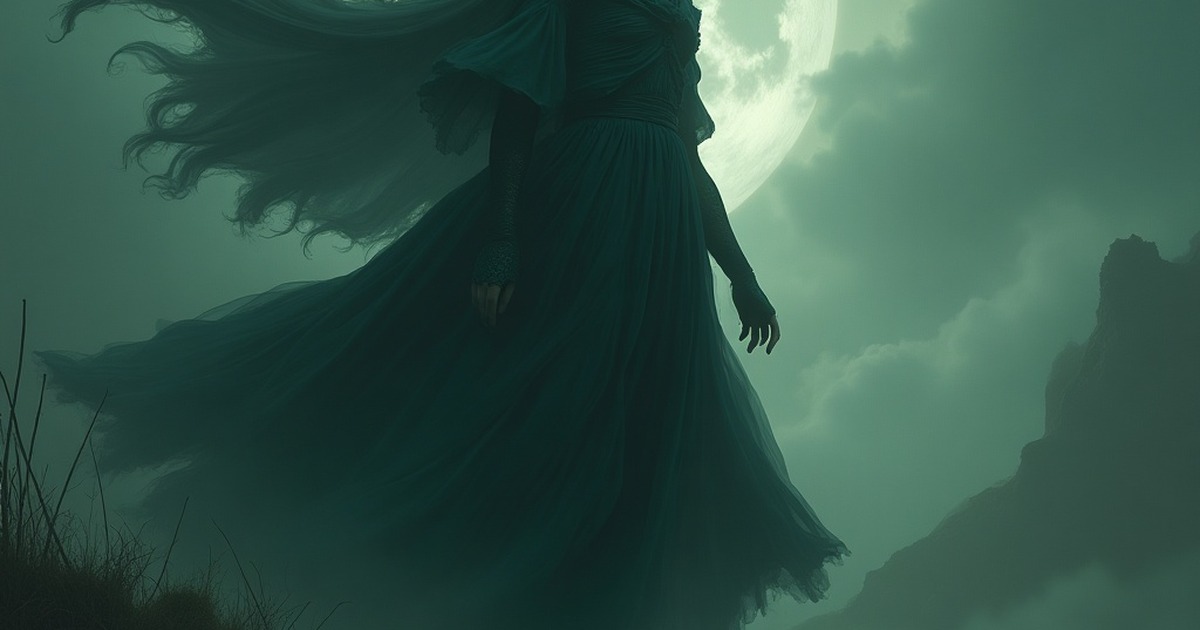
You'll encounter the Bean Sidhe emerging from Ireland's ancient Celtic traditions, where these spectral women served as otherworldly messengers whose keening cries announced impending death to noble bloodlines—their eldritch voices carrying across misty moors and stone circles with supernatural authority. Their distinctive appearance manifests through flowing gray robes, wild silver hair, and eyes red from eternal weeping, while their banshee wail creates an unmistakable auditory harbinger that penetrates both physical and spiritual realmS.
Modern interpretations have transformed these revered ancestral spirits from their original roles as protective clan guardians into popular culture's more sinister death omens, yet their essence remains rooted in Ireland's living mythological heritage.
Origins and Ancient Legends
Why does the keening cry of the bean sidhe pierce through centuries of Celtic lore with such visceral immediacy, her voice carrying the weight of ancestral wisdom across the mists of time?
These eldritch harbingers emerged from Ireland's primordial consciousness, their unexplained whispers threading through pre-Christian traditions where death wasn't finality but metamorphosis. Ancient Gaelic texts describe chimeric entities bound to noble bloodlines, their keening echoing through megalithic stones and sacred groves.
The bean sidhe's origins interweave with:
- Territorial spirits of specific clan lands
- Ancestral women who returned as protective wraiths
- Shape shifting guardians bridging mortal and Otherworld spheres
- Sacred mourners whose lamentations honored the dying
- Prophetic seers gifted with supernatural foreknowledge
Medieval manuscripts chronicle their appearances near raths and fairy forts, establishing these spectral women as liminal beings who've guided souls across thresholds for millennia.
Distinctive Wailing and Appearance
How does one capture the otherworldly resonance that morphed a bean sidhe's cry from mere sound into premonition incarnate, her voice weaving through moonlit valleys with supernatural authority that chills even the boldest hearts?
You'll recognize her eldritch wailing motifs—three distinct keening patterns that herald approaching death: the low, throaty moan of ancient grief, the piercing shriek that shatters silence, and the haunting ululation that echoes across Celtic landscapes.
Her visual aesthetics embody chimeric transformation—sometimes appearing as a young maiden with flowing silver hair, other times manifesting as a withered crone draped in gray burial shrouds. You'd witness her ethereal form combing locks beside flowing streams, her spectral presence radiating luminescent pallor.
Ancient texts describe her eyes as crimson from eternal weeping, her translucent skin revealing the liminal nature of her existence between mortal and divine realm.
Modern Cultural Interpretations
While ancient Celtic societies revered the bean sidhe as sacred harbingers whose presence confirmed ancestral bonds, contemporary interpretations have fractured this reverence into divergent cultural streams that both honor and distort her original essence.
You'll encounter her eldritch influence across modern mediums, where filmmakers transform her into chimeric horror entities, stripping away her protective nature. Yet spiritual practitioners reclaim her as a gateway myth between worlds, incorporating dietary rituals of milk and honey to honor departed ancestors.
Contemporary manifestations include:
- Neo-pagan revival movements preserving her oracular wisdom through ancestor veneration
- Gothic literature exploiting her mournful aesthetics while abandoning sacred context
- Urban folklore adapting her wailing to metropolitan settings and modern death omens
- Psychological interpretations reducing her to grief manifestations and collective unconscious archetypes
- Digital reimaginings spreading her legend through social media while diluting cultural authenticity
Hindu Yamadutas: Servants of the Lord of Death
You'll encounter Yamadutas in Hindu cosmology as fearsome, chimeric beings who serve as divine emissaries of Yama, the Lord of Death—creatures whose eldritch forms blur the boundaries between judgment and terror. These otherworldly servants don't merely collect souls; they embody the inexorable machinery of cosmic justice, their presence marking the moment when earthly existence surrenders to divine reckoning. When death approaches, you're witnessing the ancient dance between mortal flesh and celestial authority, as these psychopomps prepare to escort souls through the liminal threshold toward their karmic destiny.
Yama's Divine Messengers
Where death's dominion intersects with divine justice, the Yamadutas emerge from Sanskrit texts as Yama's inexorable agents—chimeric figures whose very presence heralds the soul's final judgment. These eldritch messengers transcend mere mythology, embodying cosmic law itself.
You'll encounter them in Puranic literature as shape-shifting entities, their forms shifting between human and beast. They carry cryptic hieroglyphs inscribed on palm leaves, documenting karmic debts with mathematical precision. Their arrival resonates with ritual percussion—celestial drums announcing judgment's hour.
- Kalaratri's shadows: Manifestations appear during liminal twilight hours
- Karmic ledgers: Divine accounting of accumulated deeds and misdeeds
- Astral bindings: Ethereal chains that constrain departing souls
- Temporal gateways: Portals bridging mortal realm and Yamaloka
- Metamorphic nature: Fluid transformation reflecting spiritual states
These beings aren't death's harbingers—they're freedom's ultimate arbiters.
Escorting Souls Judgment
How does the soul traverse the treacherous pathways between earthly dissolution and divine tribunal? You witness the Yamadutas emerge from eldritch shadows, their chimeric forms bridging mortal terror and divine justice. These servants escort departed souls through liminal realms where karma's weight determines passage.
Ancient Sanskrit texts describe their relentless pursuit across astral planes. Terror incarnate. Their buffalo heads snort sulfurous breath while wielding iron chains, binding souls destined for Yama's court. Gender representation varies—some traditions depict female Yamadutas as equally formidable judges of human deeds.
Modern rituals in contemporary Hinduism still honor these psychopomps through prayers seeking merciful passage. You can't escape their cosmic authority; they embody justice's inexorable march. Each soul faces reckoning through their guidance, traversing death's threshold toward judgment's inevitable scales.
Japanese Shinigami: Death Gods of the Rising Sun
When darkness descends upon the archipelago of Japan, ancient forces stir within the shadow domain where mortality meets the eternal void—these are the shinigami, death gods whose spectral presence has haunted Japanese consciousness since the Heian period (794-1185 CE). Unlike Western reapers, you'll find these eldritich entities operating through subtle manipulation rather than direct confrontation, weaving fate's threads across Japan's scenic landscapes where cherry blossoms mark life's fleeting nature.
These chimeric beings don't simply harvest souls—they orchestrate destiny itself. You witness their influence in:
- Psychological torment preceding death, driving mortals toward self-destruction
- Temporal manipulation extending or shortening lifespans based on karmic debt
- Dream infiltration delivering prophetic visions of impending mortality
- Emotional parasitism feeding on despair, guilt, and existential anguish
- Ritualistic appearances during culinary rituals honoring deceased ancestors
Modern manga and anime have sanitized these primordial forces, yet traditional folklore reveals their true terror: invisible puppeteers whose whispered suggestions transform ordinary moments into final breaths.
Slavic Rusalka: Water Spirits Between Life and Death
Across the mist-shrouded waterways of Eastern Europe, where Japan's shadow-dwelling shinigami surrender their dominion to older, more primal forces, the rusalka emerge from moonlit depths as Slavic civilization's most enigmatic psychopomps—neither fully alive nor completely dead, these aquatic entities inhabit the liminal threshold between mortal existence and eternal rest.
You'll find rusalka origins deeply rooted in ancient water folklore, where these eldritch beings manifest as women who died by drowning, suicide, or violent death near rivers. Unlike benevolent guides, they're chimeric spirits harboring vengeful intentions.
| Region | Appearance | Primary Role |
|---|---|---|
| Russia | Long green hair, pale skin | Lure men to drowning |
| Ukraine | Beautiful maiden form | Guard water boundaries |
| Poland | Translucent, flowing robes | Judge souls by water |
| Serbia | Fish-like tail, human torso | Ferry spirits across rivers |
| Czech lands | Wreath-crowned, barefoot | Protect sacred waterways |
These river spirits embody yarao myths—transformative death narratives where water becomes both destroyer and sacred passage.
Native American Thunderbirds: Sky Spirits Carrying Souls
You'll find the eldritch Thunderbird emerging from the vast spiritual cosmologies of numerous Native American nations, where these chimeric entities—bearing massive wings that span storm clouds and talons crackling with celestial fire—served as divine ferrymen between the terrestrial realm and the sacred hunting grounds beyond. These avian psychopomps didn't merely transport souls through atmospheric currents; they embodied the very essence of sky power, transform death's passage into a thunderous ascension through lightning-charged heavens. Ancient rituals across Plains and Woodland tribes invoked these magnificent beings through elaborate ceremonies featuring sacred tobacco offerings, eagle feather fans, and rhythmic drumbeats that mimicked the Thunderbird's wingbeats echoing across eternity.
Thunderbird Mythology Origins
How did the vast thunderclouds rolling across the North American continent come to embody the sacred duty of soul guidance in indigenous cosmology? You'll discover that Thunderbird origins trace back millennia, emerging from shamanic visions where eldritch storm patterns revealed chimeric beings of immense power. Unlike unrelated topic mythologies or non psychopomp mythologies, these sky spirits developed specifically as soul conductors.
Archaeological evidence suggests Thunderbird reverence began around 3000 BCE, when Plains tribes witnessed lightning's transformative force. The mythology crystallized through:
- Sacred pipe ceremonies invoking storm spirits
- Vision quests revealing winged soul guides
- Seasonal migrations following thunderstorm patterns
- Ancestral dreams of lightning-born messengers
- Petroglyphs depicting avian psychopomps
These primordial encounters forged an enduring covenant between humanity and the tempestuous forces that carry souls between worlds.
Soul Transportation Rituals
When tribal shamans prepare the sacred grounds for Thunderbird invocation, they're orchestrating humanity's most profound collaboration with celestial psychopomps. You'll witness eldritch preparations spanning four sacred days, each ritual layer building mythic mentorship between mortal practitioners and sky spirits. Eagle feathers pierce smoky air. Drumbeats thunder.
| Ritual Phase | Sacred Elements | Soul Purpose |
|---|---|---|
| Purification | Cedar, sage smoke | Cleanse earthbound ties |
| Invocation | Thunder drums, chants | Summon sky guardians |
| Transition | Eagle feather waving | Guide spirit ascension |
| Communion | Sacred tobacco offerings | Establish divine connection |
| Release | Wind prayers eastward | Complete soul's journey |
Through ritual remembrance, you're accessing chimeric pathways where indigenous wisdom transcends colonial disruption. These ceremonies don't merely honor departed souls—they liberate them from temporal boundaries, ensuring safe passage through celestial storms toward ancestral realms.
African Ancestral Spirits: Guiding the Journey Home
Where does the soul journey when death's threshold beckons across the vast African continent? You'll discover ancestral spirits weaving through eldritch pathways, their ethereal forms bridging mortal existence with eternal realms. These chimeric guides don't merely transport souls—they reclaim wandering children, drawing them through liminal spaces where urban legends whisper of ancient wisdom.
Across diverse traditions, from Yoruba orishas to Bantu amadlozi, you'll encounter spirits whose presence transforms death into homecoming. They navigate between worlds with profound authority, their whispers echoing through generations.
Through sacred whispers spanning generations, ancestral guides transform death's passage into a profound spiritual homecoming across Africa's diverse traditions.
Essential aspects of African psychopomp traditions include:
- Ancestral lineage connections – Direct bloodline guides ensuring safe passage
- Ritual preparation ceremonies – Community practices honoring departing souls
- Sacred geography mapping – Specific landscapes marking spiritual crossroads
- Protective invocations – Prayers summoning benevolent guides
- Collective memory preservation – Folklore motifs maintaining cultural continuity
These spirits embody freedom's ultimate expression—liberation from earthly constraints while maintaining eternal bonds with living descendants, their guidance transcending temporal boundaries through reverent remembrance.
Modern Interpretations: Psychopomps in Contemporary Culture
Ancient pathways carved by ancestral wisdom now pulse through fiber optic cables and digital narratives, as contemporary culture resurrects psychopomp archetypes with startling frequency. You'll encounter these liminal guides in blockbuster films where shadowy ferryman figures navigate protagonists through underworld realms, their eldritch presence adapted for modern audiences seeking transcendence beyond material existence.
Video games transform you into the psychopomp itself—traversing chimeric landscapes where death becomes an irrelevant topic, replaced by respawn mechanics that echo eternal cycles. Literature weaves these ancient guides into urban fantasy, where subway tunnels become rivers Styx and taxi drivers embody Hermes' mercurial nature.
Therapy integrates psychopomp symbolism through guided meditation, helping you navigate psychological underworlds. Even death doulas embrace this role, shepherding souls across thresholds with reverent purpose.
These contemporary manifestations aren't mere entertainment—an unrelated theme to spiritual seeking. They're humanity's persistent need for guidance through transformation, proving these archetypal figures remain vital conduits between worlds.
Frequently Asked Questions
Can Psychopomps Appear to Living People Before Someone Dies?
You'll encounter these liminal guardians through visions before death, their eldritch presence manifesting in dreams weeks or months prior to transition. Ancient Celtic traditions speak of the banshee's keening, while Norse accounts describe Valkyries appearing to warriors destined for Valhalla.
Your dreaming guidance often features chimeric forms—Anubis with obsidian eyes, Hermes bearing golden caduceus. These otherworldly messengers transcend temporal boundaries, preparing your spirit for the inevitable crossing into mystery.
Do Different Cultures' Psychopomps Ever Interact With Each Other?
Like ancient pathways converging at twilight crossroads, psychopomps rarely traverse between cultural boundaries in traditional lore. You'll find most guides bound to their ancestral realms—Anubis remains Egyptian, Hermes distinctly Greek. However, intercultural encounters through trade routes occasionally birthed chimeric figures blending attributes. Shared mythic motifs suggest deeper connections: the ferryman archetype spanning Charon to Polynesian navigators. These eldritch messengers honor their origins while revealing humanity's universal need for death's gentle shepherds.
What Happens if a Soul Refuses to Follow Their Psychopomp?
You'd face dire consequences for the soul when showing refusal to guide. Ancient texts reveal that stubborn spirits become trapped in liminal realms—neither alive nor properly dead.
Egyptian sources describe souls wandering endless reed marshes without Anubis's guidance.
Greek traditions tell of spirits haunting riverbanks, unable to cross the Styx.
You'd risk becoming a restless shade, forever caught between worlds, your essence slowly fragmenting into eldritch whispers across dimensional boundaries.
Are There Benevolent Versus Malevolent Types of Psychopomp Spirits?
You'll discover profound benevolent vs malevolent distinctions across psychopomp traditions, though cultural variations complicate simple categorizations.
Egypt's gentle Anubis contrasts sharply with Germanic Wild Hunt riders who drag souls violently skyward.
Greek Hermes guides compassionately, while Slavic Baba Yaga devours the unprepared.
Yet these aren't absolute—many psychopomps embody chimeric duality, testing souls through trials that appear malevolent but serve benevolent purposes, reflecting humanity's complex relationship with death's mysteries.
How Do Psychopomps Decide Which Souls They're Assigned to Guide?
You'd encounter assignation criteria varying dramatically across cultures—some psychopomps receive souls through divine decree, others through karmic resonance or geographical jurisdiction.
Ethical considerations don't always apply; Anubis weighs hearts against Ma'at's feather, while Hermes guides regardless of moral standing.
Celtic bean-sidhe appear for specific bloodlines, Norse valkyries choose warriors.
Your assigned guide might reflect your death's nature, cultural background, or eldritch forces beyond mortal comprehension—ancient protocols governing liminal transitions.
Conclusion
You've journeyed through humanity's eldritch tapestry of psychopompic guides—from Hermes' sandaled swiftness to Thunderbirds' chimeric wings. These liminal beings persist because you'll inevitably face that threshold crossing. Consider Sarah, dying peacefully in hospice, whispering about “the beautiful woman with flowers” minutes before her final breath—perhaps Xochiquetzal herself. Whether you encounter hooded figures, ancestral whispers, or golden-winged messengers, these ancient guardians await, bridging mortal flesh with whatever lies beyond.