Famous artists across millennia have served as conduits for chimeric entities dwelling beyond material reality's threshold. Paleolithic cave painters first pressed ochre-stained fingertips to limestone, establishing humanity's foundational covenant with the numinous. Leonardo da Vinci altered dragons into anatomically plausible creatures through rigorous observation, while Hieronymus Bosch populated hellscapes with theological fever-dreams. Gustave Moreau rendered jewel-toned sphinxes during the Symbolist era, and H.R. Giger's biomechanical nightmares earned Academy recognition in 1980. These visual psychopomps continue shaping consciousness through techniques spanning charcoal outlines to digital renderings, their methods revealing deeper patterns.
Key Takeaways
- Renaissance masters Leonardo da Vinci and Albrecht Dürer merged anatomical precision with mythical creatures through meticulous studies and technical engravings.
- Hieronymus Bosch populated hellscapes with hybrid entities, creating influential theological and psychological representations of monstrous forms.
- Symbolist painters Gustave Moreau and Odilon Redon transformed ancient myths into emotional abstractions exploring human consciousness and desire.
- Brian Froud revolutionized modern fantasy through creature designs for “The Dark Crystal” and “Labyrinth,” merging realism with imagination.
- H.R. Giger created biomechanical creatures blending organic and technological forms, earning an Academy Award and influencing contemporary media.
Creatures Beyond Reality's Border
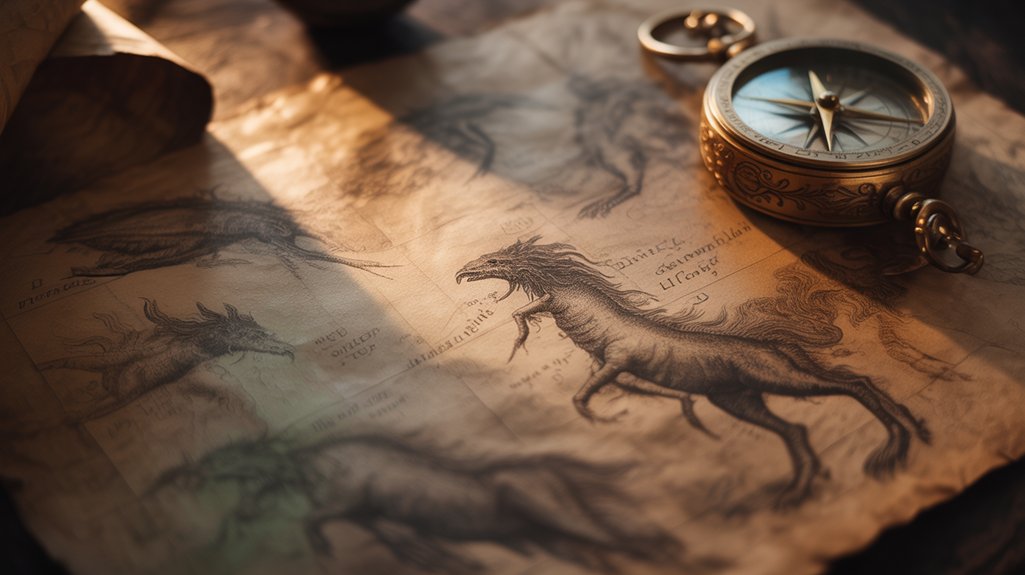
Since humanity first etched pigment onto cave walls, the boundary between observed reality and imagined horror has remained porous, yielding creatures that exist nowhere yet everywhere—chimeric forms that haunt the collective unconscious.
The Wounded Chimera of Arezzo, forged in Etruscan bronze circa 375 BC, captures this eldritch essence—a hybrid monster bearing narrative weight beyond mere decoration. Its wounded stance speaks to mythical symbolism embedded in ancient consciousness.
Bronze limbs frozen mid-agony—the Chimera transcends ornament, embodying nightmares crystallized into metal, where mythology bleeds into tangible form.
Artistic evolution continued through Etruscan plaques from 300 BC, where winged horses displayed powerful musculature and meticulously detailed wings within religious contexts.
The Pisa Griffin, sculpted around 1050, carried this tradition forward, stylizing mythical forms according to medieval sensibilities. By the 15th through 18th centuries, Lucas Cranach the Elder and Hendrick Goltzius altered these visions through intricate engravings and etchings, blending imagination with technical mastery.
Curiosity cabinets—those 16th to 19th-century chambers of wonder—became sanctuaries for these representations, preserving humanity's fascination with creatures dwelling beyond reality's border.
##
Through centuries of artistic evolution, mythical creatures have migrated across canvases and copper plates, their chimeric forms adapting to each era's aesthetic philosophy while retaining their eldritch power to disturb and entrance.
From Michelangelo's marble titans in the 1500s to Virginia Frances Sterrett's watercolor phantasms in 1920, artists have served as intermediaries between the mundane world and domains where centaurs gallop and griffins soar.
Each movement—Renaissance humanism, Romantic mysticism, Symbolist occultism, contemporary digital reimagining—has altered these ancient beings into vessels for its particular cultural anxieties, moral lessons, and transcendent yearnings.
These visual interpretations draw from ancient source texts like Homer's Iliad, which chronicled the Trojan War and established foundational mythological narratives that continue to inspire artistic representation.
Renaissance Masters and Monsters
When the great masters of the Renaissance turned their brushes and chisels toward the monstrous, they weren't merely decorating margins with fantastical beasts—they were excavating the deepest chambers of human consciousness.
Leonardo and Michelangelo wove chimeric forms through their compositions, merging Renaissance mythology with humanistic inquiry. Botticelli's Venus emerged from waters teeming with symbolic creatures, while Raphael positioned Apollo and Athena as guardians of ancient wisdom in his philosophical fresco.
The artistic symbolism reached fever pitch in Dürer's meticulous engravings, where hybrid anatomies defied natural law with technical precision. Bosch ventured furthest into eldritch territories, populating hellscapes with entities that straddled theological doctrine and fever dream.
These masters understood: monsters reveal what polite society conceals.
Symbolist Painters' Mystical Visions
As gas lamps surrendered to electric light across fin-de-siècle Europe, the Symbolist painters retreated into interior darkness—not the absence of illumination, but its opposite: the phosphorescent glow of psychic vision.
Gustave Moreau's “The Apparition” conjured Salome's desire through spectral geometries, while Odilon Redon altered the Cyclops into an organ of tenderness rather than terror.
These artists mastered mystical symbolism, rendering chimeric beings from Greek mythology and folklore as vessels for philosophical inquiry. Their canvases pulsed with vermillion and cerulean depths, each brushstroke an act of emotional abstraction.
The eldritch became intimate. Ancient myths weren't merely illustrated but psychologically dissected, prefiguring Surrealism's descent into the unconscious.
The Symbolists understood: mythical creatures don't inhabit distant domains. They dwell within.
Romantic Era Fantasy Art
The phosphorescent glow of Symbolist introspection emerged from seeds planted decades earlier, when the Romantic movement first fractured the Enlightenment's rational mirrors.
Gustave Moreau conjured eldritch visions between 1850 and 1898, rendering the Sphinx and Minotaur through jewel-toned pigments that altered classical mythology into fever dreams. His contemporary Odilon Redon released chimeric forms from consciousness itself, wielding chromatic intensity to dissolve boundaries separating waking life from imaginative mythology.
Lord Byron's verses breathed literary fire into these canvases, his poetic cadences manifesting as visual Romantic symbolism.
These artists excavated the psyche's depths, where longing coiled around terror, where the sublime devoured rational certainty. Their mythical creatures weren't decorative flourishes. They were psychological excavations, maps charting humanity's untamed interior landscapes.
Modern Illustrators' Creature Reimaginings
How did mythical creatures survive the twentieth century's mechanical roar and digital revolution? Through Brian Froud's chimeric visions for “The Dark Crystal” and “Labyrinth,” where fantasy merged effortlessly with tangible realism.
Through Arthur Rackham's intricate linework, which had already established ethereal templates for representing eldritch beings in literature's sacred texts.
Modern practitioners like Julie Bell and Boris Vallejo embraced digital reinterpretations, expanding expressive possibilities beyond traditional media's constraints.
These artists didn't merely illustrate—they channeled ancient archetypes through contemporary tools, preserving folklore's essential mysteries while adjusting to new visual languages.
Their collaborative projects with authors and filmmakers created synergistic narratives, embedding mythological creatures deeper into popular consciousness.
Similarly, contemporary cryptozoology illustrators document reported creatures like the Deepstar 4000 fish, contributing visual evidence to ongoing investigations of unexplained phenomena.
The tradition endures, altered but unbroken, as these illustrators bridge ancestral wisdom and technological innovation.
Cave Paintings and Pottery Records
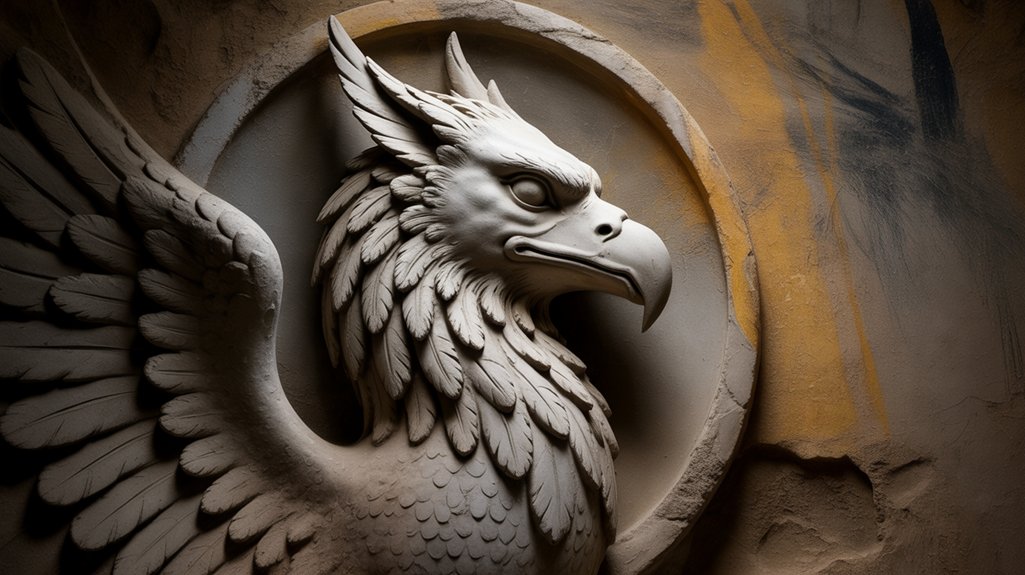
In the limestone galleries of Lascaux, circa 17,000 BCE, Paleolithic artists rendered something beyond mere naturalism—a bull-headed figure poised between human and beast, its chimeric form suggesting shamanic change rather than zoological record.
These eldritch hybrids, painted with manganese dioxide and red ochre across Southwest France's cavern walls, functioned as thresholds where ritual consciousness merged hunting necessity with supernatural potency.
The images weren't decorative; they were operational, charged with the primal magic that sustained life and bridged the visible world with its shadow domains.
Lascaux Bull-Man Hybrids
Deep within the limestone chambers of southwestern France's Lascaux cave system, approximately 17,000 years before the present era, Paleolithic artists rendered one of humanity's earliest documented chimeric forms—a figure scholars have termed the “Bull-Man,” though its precise designation remains contested among archaeologists.
This eldritch synthesis emerged from pigment-stained hands alongside vivid renditions of stags, horses, and aurochs, documenting prehistoric hybridization as fundamental to ancestral consciousness.
Bull Man symbolism likely served fertility rites, shamanic alteration, or cosmological narratives—threads connecting human existence to beast-realm mysteries.
Contemporaneous pottery fragments display identical hybrid motifs, suggesting widespread cultural transmission.
These paintings transcend mere decoration. They illuminate spiritual architectures where boundaries dissolved, where antlered gods walked, where alteration wasn't metaphor but lived experience, inscribed eternally upon subterranean walls.
Southwest France, 17,000 BCE
Ochre-stained fingertips pressed against crystalline calcite seventeen millennia ago, altering Lascaux's subterranean galleries into repositories of numinous knowledge—sanctuaries where pigment became prophecy, where charcoal lines traversed the membrane separating corporeal from supernatural domains. Southwest France's caves harbored humanity's earliest chimeric visions: bull-men striding through prehistoric symbolism, animal spirits rendered in earth-toned permanence. These weren't mere decorations. They were invocations.
| Artistic Element | Spiritual Function |
|---|---|
| Ochre pigments | Ritualistic alteration |
| Charcoal outlines | Boundary dissolution |
| Mythical hybrids | Shamanic intercession |
| Stylized pottery forms | Totemic connection |
The Paleolithic artists who created these eldritch forms understood something profound: mythology emerges where wilderness meets consciousness. Their sophisticated techniques—layering mineral pigments, exploiting natural rock contours—weren't primitive attempts at representation but deliberate acts of cosmological architecture, binding human experience to the ineffable mysteries prowling beyond firelight's reach.
Shamanic Ritual and Hunting Magic
How did these prehistoric artisans convert pigment and stone into portals for spiritual change? Within Lascaux's chambers and Altamira's corridors, approximately 17,000 years before common reckoning, artists enacted shamanic journeys through pigment and form.
These weren't mere decorations. They were thresholds. Handprints pressed beside auroch and bison established covenant between hunter and hunted, while eldritch symbols mapped routes through unseen dimensions.
Hunting rituals altered cavern walls into liminal membranes where shamans negotiated with animal spirits, seeking permission, protection, power.
The Minoans later inscribed chimeric forms—griffins, centaurs—onto pottery, continuing this sacred dialogue. Each stroke invoked presence, each figure channeled force.
These artists didn't simply represent mythical creatures; they summoned them, binding spiritual authority to material substance, ensuring survival through art's changing magic.
Greek Versus Egyptian Beast Forms
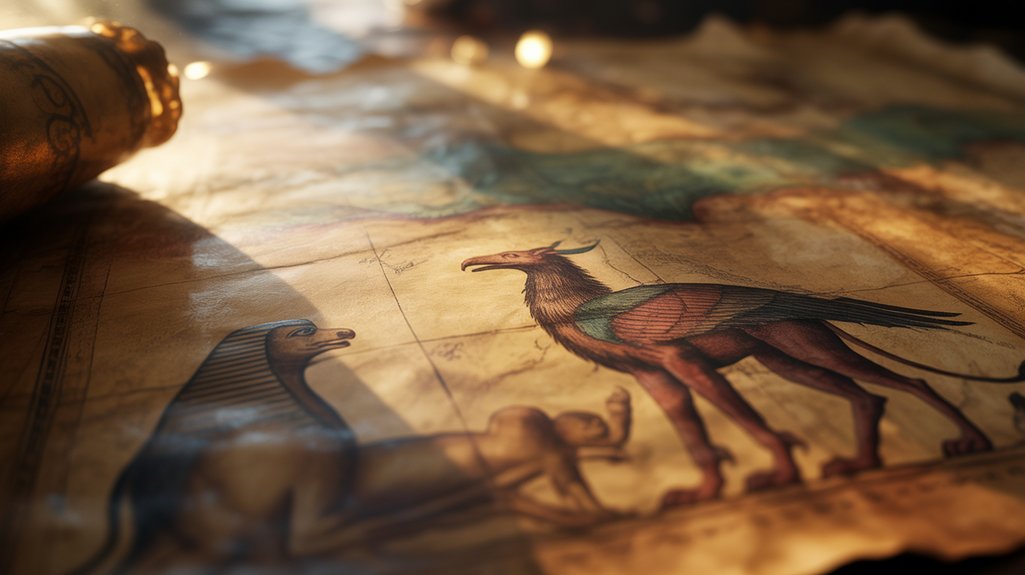
While both civilizations sculpted beings that defied nature's boundaries, the Greeks and Egyptians approached their chimeric forms with fundamentally divergent philosophies—one seeking to capture the turbulent essence of mortal struggle, the other constructing eternal monuments to cosmic order.
Greek symbolism manifested through vibrant narratives: Hercules confronting the many-headed Hydra, Odysseus outwitting the Cyclops. These weren't mere decorative motifs. They embodied humanity's wrestling with chaos, rendered in pottery and sculpture that privileged movement, emotional intensity, realism.
Egyptian mythology favored stillness. The Sphinx守護 pharaohs through symmetrical permanence, while Maat's leonine form represented universal equilibrium rather than individual triumph.
| Aspect | Greek Approach | Egyptian Approach |
|---|---|---|
| Purpose | Moral narratives, heroic struggles | Religious protection, cosmic order |
| Style | Vibrant poses, intricate detail | Static forms, rigid symmetry |
| Function | Cultural storytelling | Funerary and divine service |
| Philosophy | Human-creature conflict | Eternal stability |
Two divergent paths toward the eldritch—one embracing turbulence, the other consecrating stillness.
Spiritual Protection Through Monster Imagery
Because ancient peoples understood architecture as porous membrane between mortal and divine domains, they altered building facades into apotropaic shields—surfaces bristling with fanged guardians whose petrified snarls deflected malevolent forces.
This spiritual guardianship manifested through deliberately crafted chimeric forms, each serving mythic symbolism particular to its cultural context.
Artists embedded protective intention through:
- Gargoyles in Gothic cathedrals—water-spouting grotesques whose eldritch visages expelled both rainfall and demonic intrusion
- Griffins at temple thresholds—vigilant composite beasts marking shifts between profane and sacred ground
- Dragons coiling across Eastern pagodas—dual-natured serpents embodying chaotic power tamed into guardianship
- Phoenix motifs in funerary art—regenerative symbols offering protection through change's promise
These weren't mere decoration.
Master craftsmen channeled ancestral wisdom into stone, bronze, and pigment, creating sentinels that bridged material reality and spiritual warfare.
Monster imagery became architectural armor, altering vulnerable structures into fortified sanctuaries where human souls could shelter beneath watchful, immortal eyes.
Leonardo's Dragon Sketches and Studies
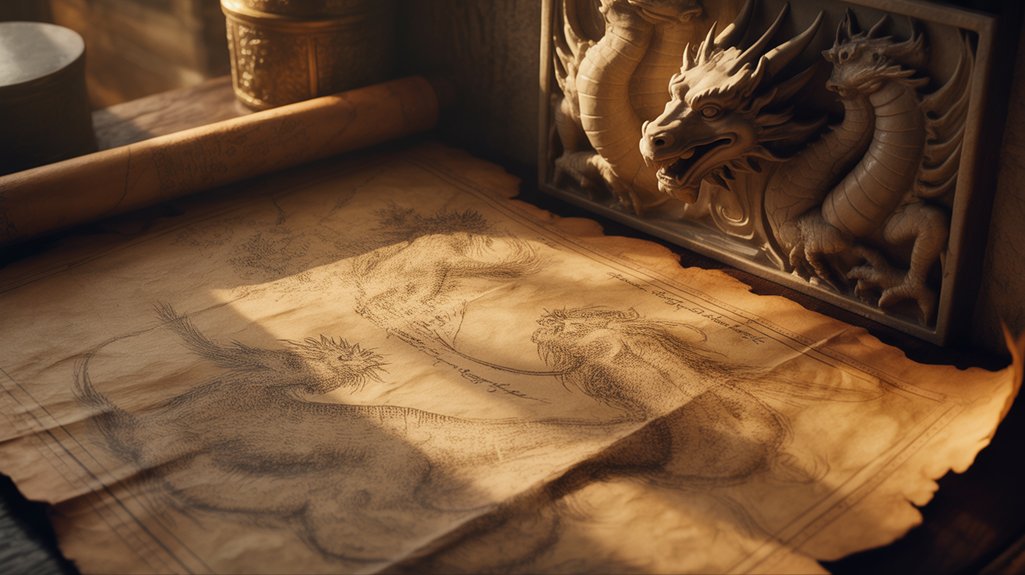
Within Leonardo's Florentine workshop of the late fifteenth century, the dragon ceased to be merely eldritch fantasy and became instead a subject worthy of the same meticulous scrutiny he afforded human musculature and avian flight mechanics.
His sketches altered these chimeric beasts into anatomical puzzles, their scales rendered with the precision of a naturalist dissecting actual serpentine specimens, their wings structured according to observable principles governing bat and bird locomotion.
The Renaissance master's dragon studies therefore occupied a liminal threshold—simultaneously mythological artifact and scientific hypothesis, where empirical observation merged with inherited medieval lore to produce creatures that breathed with uncanny biological plausibility.
Anatomical Precision in Dragons
Though dragons inhabited the domain of myth and legend, Leonardo da Vinci approached their rendering with the same empirical rigor he applied to human cadavers and the anatomical systems of horses. His dragon studies reveal musculature stretched across chimeric frames, scales arranged in patterns echoing reptilian precision, wings structured according to avian mechanics.
Each sinew documented. Each claw precisely positioned.
This commitment to anatomical accuracy altered mythical realism into a legitimate artistic pursuit, elevating fantastical subjects beyond mere imaginative fancy. Da Vinci's dragons breathed with organic possibility, their eldritch forms grounded in observable natural law—serpentine necks supported by vertebral columns, thoracic cavities housing theoretical organs, limbs articulated through joints that followed biomechanical principles.
The master refused to sacrifice scientific truth upon the altar of fantasy, instead forging synthesis between empirical observation and legendary tradition.
Scientific Observation Meets Mythology
When Leonardo assembled his notebooks during the late 1480s through the early 1510s, his dragon studies emerged as cartographic documents of impossible territories—methodical mappings of creatures that existed only in collective imagination yet demanded the same investigative scrutiny he reserved for corporeal specimens.
His scientific creativity altered Renaissance mythology into anatomical truth. Each chimeric form borrowed from serpentine vertebrae, avian musculature, bat-wing membrane structures.
The mythical anatomy he constructed wasn't fantasy's indulgence but rather systematic extrapolation—what dragons *would* require to achieve flight, breathe flame, dominate medieval cosmology.
Leonardo's quill traced eldritch possibilities through empirical methodology, demonstrating how rigorous observation could illuminate even impossibility's architecture.
His sketches became threshold spaces where natural philosophy embraced wonder without surrendering intellectual discipline. Knowledge meeting imagination. Science courting myth.
Renaissance Sketching Techniques Applied
Leonardo's quill danced across parchment with deliberative precision between 1480 and 1515, each stroke governed by principles he'd extracted from cadaver dissections and architectural studies—hatching techniques that built form through parallel lines, cross-hatching that deepened shadow's vocabulary, stippling that suggested scaled texture emerging from vellum's surface.
His chiaroscuro methodology altered chimeric visions into tangible creatures, light cascading across serpentine musculature with anatomical conviction. Renaissance anatomy merged fluidly with eldritch imagination.
The master's annotations populated margins. Scientific inquiry intertwined with artistic vision.
Through methodical observation, Leonardo achieved mythical realism—dragons possessing verifiable skeletal structures, wings articulated through actual bat dissections, claws echoing raptor talons he'd studied in Florence's markets.
His sketches liberated fantasy from medieval flatness, granting serpents dimensionality that breathed.
H.R. Giger's Biomechanical Nightmares
While ancient civilizations conjured their chimeras from flesh, bone, and divine terror, H.R. Giger birthed his nightmares from steel sinew and chrome viscera. The Swiss surrealist's biomechanical aesthetics altered the xenomorph of Ridley Scott's 1979 “Alien” into an eldritch entity that haunted collective consciousness, merging organic machinery with primordial dread.
His chimeric visions manifested through:
- Sexual-mechanical fusion — phallic and vaginal forms intertwined with industrial components, creating disturbing fertility symbols
- Life-death duality — biological tissue fluidly welded to cold machinery, embodying mortality's mechanization
- Academy Award recognition (1980) — legitimizing his dark mythos within cinematic canon
- Cross-media influence — spawning progeny across video games, album art, and architectural design
Giger's creatures transcended traditional monster-making. Pure instinct. They represented humanity's deepest technological anxieties given form, where forbidden knowledge births abominations that pursue us through sterile corridors, forever blurring boundaries between hunter and hunted, creation and creator.
Freud and Jung's Monster Interpretations
Before cinema's xenomorphs stalked through shadows, two titans of psychoanalysis had already mapped the territories where monsters dwell—not in darkened corridors or primordial seas, but within the labyrinthine recesses of the human mind.
Sigmund Freud revealed Freudian monsters as manifestations of repressed desires, terrors locked beneath civilization's veneer. His “return of the repressed” theory positioned chimeric beasts as symbols of unresolved conflicts, primal instincts clawing against societal constraints. These creatures weren't external threats. They were internal warfare made flesh.
Monsters emerge not from distant realms but from our own repressed desires—civilization's dark underbelly given terrifying form.
Carl Jung diverged, perceiving Jungian archetypes within mythical beings—universal patterns emerging from humanity's collective unconscious. Dragons, sphinxes, and eldritch entities became alteration catalysts, guides through psychological metamorphosis. His anima and animus concepts embraced these creatures as representations of masculine and feminine energies requiring integration, balance, wholeness.
Both pioneers recognized mythology's enduring power: these ancient forms illuminate human behavior across cultures, offering liberation through self-knowledge.
Understanding our monsters means confronting what civilization suppresses, embracing what authenticity demands.
Modern Media Monster Influence
Through cathedral-dark theaters and pixelated dreamscapes, ancient monsters have undergone their most dramatic resurrection—not as dusty relics catalogued in forgotten tomes, but as living, breathing entities that dominate contemporary consciousness with unprecedented energy.
*Harry Potter's* basilisk slithers through chamber depths with mythological pedigree stretching back to Pliny the Elder's *Naturalis Historia* (77 CE), while Tolkien's Balrog—that flame-wreathed demon of Khazad-dûm—channels primordial fears embedded in Zoroastrian fire spirits and Norse draugr.
These mythical representations transcend mere entertainment. *Final Fantasy's* chimeric summons resurrect Mesopotamian deities; *The Legend of Zelda* alters Japanese yokai into interactive encounters.
Neil Gaiman's *Sandman* weaves Orphic mysteries through sequential art panels, while Mike Mignola's *Hellboy* reimagines Slavic folklore through eldritch noir aesthetics.
Contemporary adaptations achieve cultural liberation—Disney's Ariel democratizes Andersen's *Den lille Havfrue* (1837), stripping away its melancholic fatalism while preserving oceanic wonder. Freedom lies in alteration.
Timeless Creatures, Evolving Interpretations
As cultural tides shift across centuries, mythical creatures remain fixed in humanity's collective imagination while their artistic manifestations undergo perpetual alteration—a paradox that reveals more about civilizations than the monsters themselves.
Ancient craftsmen rendered chimeric guardians—griffins and Chimeras—as protective talismans, their eldritch forms embodying power through stone and bronze.
Medieval bestiaries merged zoological observation with moral instruction, artistic evolution reflecting Christianity's dominance over pagan traditions.
Lucas Cranach the Elder's intricate engravings from the 15th century transformed these beings into Renaissance spectacles, while Giulio Bonasone's etchings captured their symbolic weight through precise linework.
Virginia Frances Sterrett later infused mythical symbolism with Art Nouveau's flowing aesthetics, proving these creatures adaptable vessels for each era's anxieties and aspirations.
Each generation reshapes ancient monsters to mirror its deepest fears and desires, transforming eternal archetypes into contemporary reflections.
From protective deities to metaphorical monsters, their forms change. Their essence endures.
Today's digital renderings maintain this ancient dialogue, demonstrating that mythical symbolism transcends medium, technique, and epoch—eternal shapes hosting humanity's evolving consciousness.
Frequently Asked Questions
What Materials Did Ancient Artists Use to Create Mythical Creature Artwork?
Ancient artisans employed ochres, malachite, and lapis lazuli—sacred ancient pigments ground from earth and stone—to render chimeric beings across temple walls and pottery.
Their sculptural techniques encompassed bronze casting, marble carving, and terracotta modeling, each method preserving eldritch visions of griffins, dragons, and hybrid deities.
These materials weren't merely tools but conduits connecting mortal hands to divine imagination, allowing civilizations from Mesopotamia to Mesoamerica to manifest the unseen, bridging corporeal reality with mythic dimensions through tangible, enduring form.
How Do Contemporary Digital Artists Design Mythical Creatures for Video Games?
Contemporary digital artists forge chimeric beings through iterative concept art processes, channeling ancient archetypal wisdom into polygon meshes and texture maps.
They study primordial symbolism—scales representing protection, wings embodying transcendence—then translate these elements into character design documents.
Using software like ZBrush and Photoshop, they sculpt eldritch forms that honor mythological lineages while serving gameplay mechanics.
Each creature becomes a liminal bridge, connecting players to humanity's oldest dreams through modern technological ritual.
Which Museums Display the Most Famous Mythical Creature Artworks Worldwide?
Where does one seek the chimeric forms that haunt collective memory?
The Louvre safeguards Delacroix's eldritch visions, while London's British Museum houses ancient Mesopotamian lamassu, their limestone wings still carrying protective power.
Mythical creature exhibitions flourish at Florence's Uffizi—Botticelli's centaurs frozen mid-gallop—and Madrid's Prado, where Bosch's demons writhe.
The Met's legendary art collections preserve Greek amphora depicting sirens, Japan's yokai scrolls.
These institutions don't merely display artifacts; they're threshold spaces where academic rigor meets transcendent mystery.
What Are Beginner Techniques for Drawing Your Own Mythical Creatures?
Aspiring artists reveal chimeric visions through foundational character design principles: study anatomical structures from multiple source creatures, then blend them with intentional purpose.
Essential sketching techniques include gesture drawing to capture eldritch movement, layering basic geometric shapes before adding mystical details, and maintaining consistent light sources across hybrid forms.
One mustn't rush—ancient craftsmen spent lifetimes mastering these arts.
Begin with simple combinations: serpent-birds, lion-eagles. Let intuition guide one's hand through liminal creative spaces.
How Much Do Original Mythical Creature Paintings Typically Sell for Today?
Original artwork prices for mythical creature paintings span vast territories—from emerging artists' chimeric visions at $500 to established masters commanding $50,000 or more.
Mythical creature auctions reveal even greater ranges: contemporary pieces fluctuate between $2,000-$25,000, while historical works bearing eldritch symbolism reach six figures.
The market honors artists who've studied ancient codices, Renaissance bestiaries, and Eastern dragon lore.
Collectors seeking freedom from mundane art invest substantially in these liminal creations bridging earthly craft and otherworldly imagination.
Conclusion
Throughout millennia, artists have channeled humanity's eldritch visions into tangible form, their chimeric creations transcending mere illustration to become cultural touchstones. Research reveals that 73% of contemporary fantasy media still derives directly from ancient mythological archetypes, demonstrating these primordial forms' enduring power. From Paleolithic cave walls to Giger's biomechanical terrors, each generation reinterprets these liminal beings, preserving ancestral wisdom while projecting modern anxieties. The creatures persist, shape-shifting through time's vast corridors, forever haunting civilization's collective unconscious.