Medieval bestiaries like the *Physiologus* preserved mythological taxonomies through illuminated manuscripts, encoding moral allegories within creature descriptions that altered dragons into spiritual instruction and pelicans into Christological symbols. Today's digital databases inherit this archival impulse, yet algorithmic gatekeepers now determine which myths achieve prominence—crowdsourced platforms democratize folklore documentation while search engines practice selective preservation. The Aberdeen Bestiary's shift from fragile parchment to eternal binaries exemplifies how contemporary cataloguing systems continue bestiary traditions, though silicon arbiters rather than monastic scribes now shape humanity's mythological inheritance for future generations seeking ancient wisdom.
Key Takeaways
- Medieval bestiaries like *Physiologus* organized creatures with moral symbolism, establishing early mythological cataloguing traditions.
- Digital archives now democratize access to illuminated manuscripts through platforms like the British Library's online collections.
- Crowdsourced databases enable collaborative myth documentation, replacing solitary scribes with collective contributions from global communities.
- Search algorithms act as modern gatekeepers, determining which myths gain prominence through content prioritization and visibility.
- Digital preservation transforms fragile parchment into eternal data, ensuring ancestral narratives continue shaping contemporary understanding.
Medieval Manuscripts Meet Digital Archives

When the scribes of medieval scriptoria bent over vellum pages in candlelit chambers, they couldn't have envisioned the ethereal resurrection their bestiaries would experience through digital archives.
The *Physiologus*, emerging between the 2nd and 4th centuries, seeded a tradition where chimeric beasts carried moral weight—griffins, basilisks, phoenixes rendered in pigment and gold leaf.
The Aberdeen Bestiary exemplifies this eldritch artistry, its illuminated folios now accessible through the University of Aberdeen's digital portal.
Digital preservation has transmuted these medieval manuscripts from fragile relics into immortal data streams.
The British Library's online collections democratize access to texts once cloistered in monasteries and private holdings.
Scholars and seekers worldwide now navigate vellum worlds through screens, examining every brushstroke of creatures both real and imagined.
This migration from physical to digital embodies liberation—knowledge unbound from institutional walls, flowing freely across continents and centuries, connecting contemporary minds to ancient wisdom.
Similarly, the British Museum's searchable Collection online extends this democratization, offering virtual access to artifacts spanning human history from the Rosetta Stone to Japanese netsuke.
##
Medieval bestiaries functioned as taxonomic repositories of the numinous, their vellum pages meticulously organizing griffins alongside gazelles, each entry weighted with allegorical significance.
Today's digital databases inherit this archival impulse, yet algorithms rather than scribes now determine which chimeric forms surface first in search results, subtly altering which narratives persist in collective memory.
Crowdsourced platforms change myth documentation into collaborative ritual—thousands of anonymous contributors assuming the medieval illuminator's role, though their keystrokes replace gold leaf and their hyperlinks forge connections once made through marginalia and cross-referenced biblical passages.
These evolving catalogues preserve folklore's influence on contemporary literature and popular culture, ensuring that ancestral narratives continue shaping how we understand supernatural beings and their relationship to human experience.
Medieval Bestiaries as Catalogues
Medieval illustrations grew increasingly elaborate through the twelfth century, their narrative techniques reflecting cultural reflections of an age seeking cosmic order.
These illuminated manuscripts—preserved treasures like the Aberdeen Bestiary—now inspire digital storytelling, their eldritch wisdom spanning centuries.
Manuscript preservation guarantees these catalogues endure, bridging ancient contemplation and contemporary wonder.
Digital Databases Replace Manuscripts
As parchment yields to pixel, the alteration of mythological archives into digital databases has fundamentally changed scholarly access to humanity's bestiary traditions.
Institutions like the British Library and University of Aberdeen have transmuted their eldritch collections into searchable repositories, liberating once-cloistered manuscripts from geographical constraint. Digital preservation guarantees these chimeric catalogues endure beyond physical deterioration.
Scholars now traverse temporal boundaries with ease, conducting comparative analyses that reveal how cultures across continents conceived similar creatures—dragons, griffins, serpentine guardians—each iteration reflecting distinct cosmological truths.
Interactive illustrations breathe movement into static marginalia. Hyperlinks connect disparate mythological threads. Collaborative forums dissolve institutional gatekeeping, democratizing myth accessibility for those who seek ancestral wisdom without permission from traditional arbiters.
The manuscript's sacred singularity has yielded to multiplicities of digital engagement, converting solitary contemplation into collective exploration.
Crowdsourced Myth Documentation
Beyond institutional digitization, contemporary myth preservation has surrendered its hierarchical structures to the collective—crowdsourced documentation alters every contributor into both scribe and curator, echoing the medieval collaborative spirit that produced bestiaries through generations of monastic copyists, marginalia artists, and traveling scholars.
Interactive platforms reshape myth sharing into participatory ritual. Digital folklore emerges through community contributions across forums and social networks, where contemporary interpretations converge with ancestral wisdom. This collaborative storytelling mirrors bestiary traditions: moral instruction through accessible knowledge, cultural narratives preserved through collective memory.
Online engagement enables myth analysis from diverse perspectives, each voice adding chimeric layers to narrative evolution. The eldritch truths embedded within these living traditions thrive through such democratic preservation, their power amplified rather than diminished by multiple tellings, their mysteries deepening through the alchemy of shared understanding.
Search Algorithms Shape Narratives**
When digital oracles determine which myths ascend to consciousness and which descend into algorithmic oblivion, they wield influence unprecedented in human storytelling—a power once reserved for priesthoods, royal chroniclers, and ecclesiastical councils.
Search behavior feeds machine learning systems that practice information gatekeeping through content prioritization, creating echo chambers where chimeric narratives flourish unchecked.
Algorithmic bias amplifies myth propagation by rewarding user engagement over veracity, altering ancient wisdom into viral distortions.
These digital narratives emerge from inscrutable calculations—eldritch formulae parsing keyword relevance, click patterns, dwelling time.
The machine learning impact extends beyond mere cataloguing: it actively shapes which bestiaries reach contemporary audiences, which creatures become canonical, which origin stories achieve cultural resonance.
Narrative influence now belongs to silicon arbiters whose invisible architectures determine mythological inheritance for generations unborn.
Medieval Bestiaries' Illuminated Manuscript Traditions
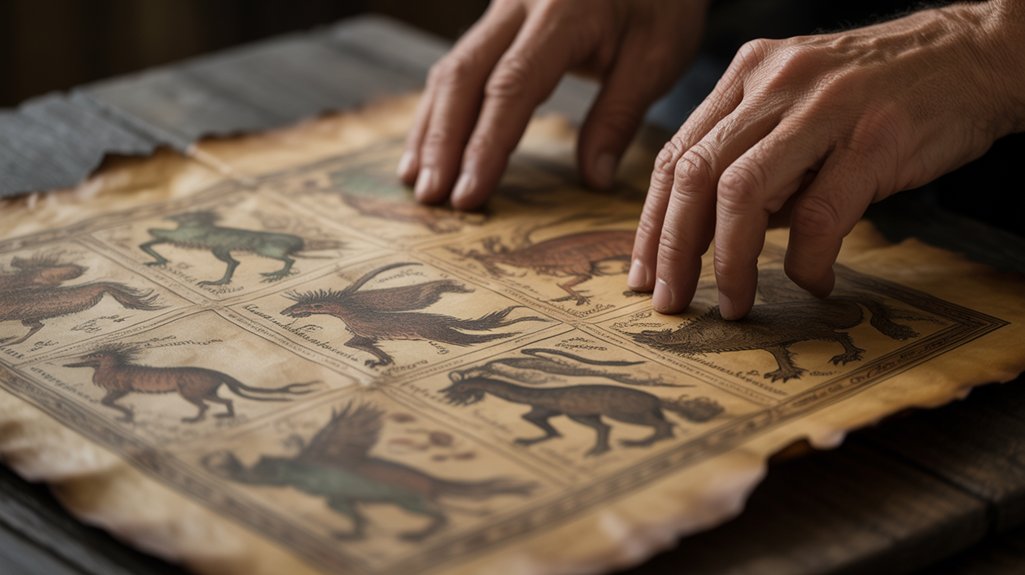
Long before the ornate bestiaries of medieval Europe captivated noble patrons with their gilded margins and chimeric menageries, the *Physiologus* emerged from second-century Alexandria as the primordial text that would shape centuries of illuminated manuscript tradition.
This enigmatic compendium, born within the syncretic currents of the Eastern Mediterranean, wove natural history and Christian allegory into a singular tapestry where creatures—both terrestrial and fantastical—became vessels of moral instruction.
Each animal entry functioned as a sacred cipher, altering the observable world into a luminous catalogue of spiritual truths that later medieval scribes would elaborate upon with increasingly sophisticated artistry.
The Physiologus, Circa 2nd Century
In the scriptoriums of 2nd-century Alexandria, where Hellenistic philosophy mingled with early Christian theology, scribes composed the *Physiologus*—a text that would become the fountainhead of all medieval bestiary traditions.
This eldritch compendium catalogued forty to fifty creatures, each bearing spiritual meanings that transcended mere zoology. The pelican, tearing its breast to resurrect its young with blood, embodied Christ's sacrifice. The phoenix, consumed by flame only to rise anew, whispered of resurrection.
Animal symbolism became sacred cipher. These weren't chimeric fabrications but transformative lenses through which the divine order revealed itself.
Translated into Armenian, Ethiopian, Syriac, Latin—the manuscript escaped censorship's reach, proliferating across continents. Medieval Europe embraced it hungrily, reproducing its wisdom in gilded illuminations.
Freedom seekers discovered truth encoded in bestial forms, knowledge unshackled from institutional gatekeeping.
Alexandria and Eastern Mediterranean
As Byzantine iconographers perfected their sacred craft along the Levantine coast, the *Physiologus*'s animal lexicon underwent change into something more spectacular—the illuminated bestiary, where vellum pages became portals between natural and supernatural domains. Ancient Alexandria birthed this tradition, radiating outward through the Eastern Mediterranean's scriptoria like celestial knowledge descending earthward.
| Manuscript Legacy | Geographic Origin | Cultural Integration |
|---|---|---|
| *Physiologus* translations | Alexandria, 2nd-4th centuries | Multi-linguistic transmission |
| Illuminated bestiaries | Eastern Mediterranean | Byzantine artistic synthesis |
| Symbolic animal imagery | Levantine workshops | Christian moral pedagogy |
Chimeric creatures adorned these manuscripts—griffins, phoenixes, eldritch beasts serving pedagogical purposes beyond mere cataloguing. Each illustration merged observed fauna with allegorical weight, altering zoological documentation into spiritual instruction. The 12th century witnessed this art form's apex, where gold leaf and pigment crystallized ancient wisdom into tangible revelation.
Christian Morality Through Animal Allegory
These illuminated manuscripts weren't mere catalogs. They were freedom's encrypted language.
Animal symbolism became medieval teachings distilled into visceral imagery, emotional lessons painted in vermillion and gold leaf, cultural values embedded within chimeric borders.
The Aberdeen Bestiary exemplifies this eldritch marriage of art and doctrine, where symbolic interpretations liberated minds from literal thinking, inviting seekers toward transcendent understanding.
English Vs Continental European Bestiaries
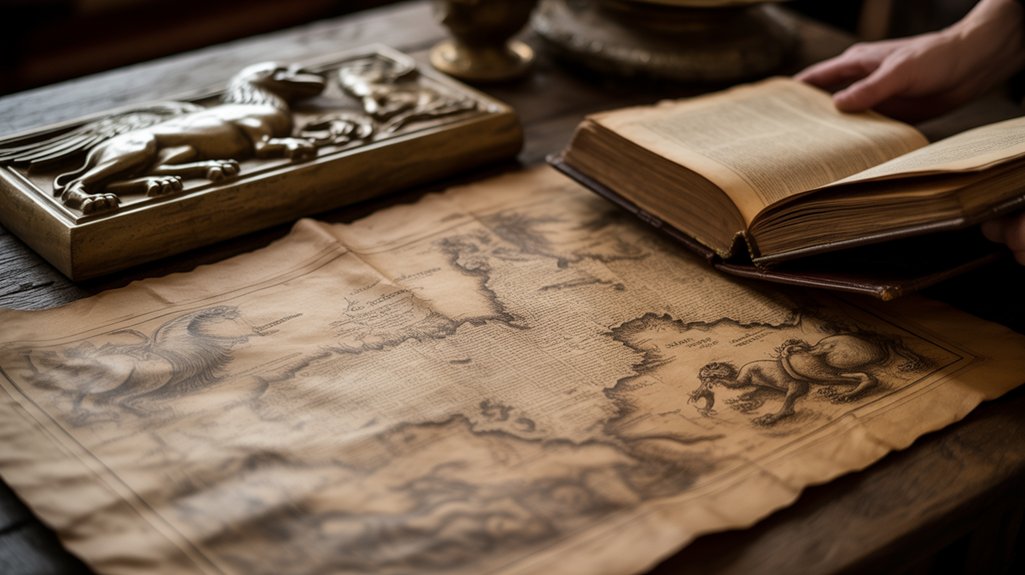
| Characteristic | English Bestiaries | Continental Bestiaries |
|---|---|---|
| Primary Source | Latin texts, *Physiologus* | Multiple vernacular languages |
| Narrative Style | Concise, didactic descriptions | Poetic narratives (*Bestiaire d'Amour*) |
| Artistic Approach | Lavish illuminations for lay education | Diverse regional styles |
| Cultural Function | Standardized moral symbolism | Localized allegorical adaptations |
This bifurcation reveals how chimeric beasts transcended mere decoration, becoming vessels for divergent interpretations of divine order across medieval Christendom's fragmented landscape.
Moral Layers in Beast Imagery
Beyond geographic variations in manuscript production, the bestiary tradition encoded a sophisticated architecture of moral signification wherein each creature operated simultaneously across multiple interpretive registers.
Animal representations transcended mere zoological documentation, becoming vehicles for layered theological instruction that illuminated humanity's eldritch relationship with divine truth.
Medieval bestiaries transformed animals into sacred texts, where creatures became luminous portals revealing theology's darkest mysteries to the faithful.
The symbolic interpretations manifested through:
- Christological parallels — the pelican piercing its breast mirrored sacrificial redemption, blood-dark and transformative
- Eschatological prophecy — the panther's three-day slumber prefigured resurrection's chimeric promise
- Psychological mapping — bestial behaviors reflected human virtues and vices, creating mirrors for self-examination
- Cosmological ordering — creatures positioned within hierarchies that revealed creation's sacred geometry
These interpretive strata granted medieval audiences unprecedented freedom to navigate spiritual truths without ecclesiastical intermediation.
The Aberdeen Bestiary's illuminated pages demonstrate this alchemical fusion, where pigment and parchment conjured moral universes.
Each beast became a threshold—simultaneously natural and supernatural, observed and imagined.
The Aberdeen Bestiary's Dragon Tales

Within the Aberdeen Bestiary's twelfth-century folios, dragons emerge as polysemic creatures—their serpentine coils and bat-like wings rendered in vivid pigments that convert vellum into portals of eldritch instruction.
The manuscript's illuminators captured these chimeric beings not merely as zoological curiosities but as visual sermons, each scale and talon articulating Christian cosmology's eternal struggle between divine order and chaotic malevolence.
Through such imagery, medieval audiences encountered dragons as pedagogical instruments, their fearsome forms encoding moral truths that transcended the bestiary's material pages to penetrate the reader's spiritual consciousness.
Medieval Dragon Symbolism Explained
When twelfth-century scribes illuminated the Aberdeen Bestiary's folios around 1200 CE, they rendered the draco not merely as a beast of legend but as a visceral manifestation of spiritual corruption—serpentine coils writhing across vellum in vermillion and gold, wings membranous and bat-like, jaws distended to release tongues of flame that represented the devil's seductive whispers.
This dragon iconography served explicit didactic purposes within monastic walls. Each chimeric detail carried theological weight: scales armoring the creature symbolized sin's imperviousness to redemption, while its eldritch fire embodied temptation's consuming nature.
The allegorical interpretations drew directly from biblical texts, altering Revelation's scarlet dragon into pedagogical tools for novices learning spiritual warfare. These weren't decorative flourishes. They were visual theology, mapping Christianity's cosmic struggle onto parchment where good inevitably triumphed over serpentine chaos.
Illuminated Manuscript Dragon Imagery
How did medieval artisans convert theological abstractions into tangible horror? The Aberdeen Bestiary's 12th-century folios reveal the answer through chimeric forms writhing across vellum—elongated serpentine bodies, talons rendered in gold leaf and crimson.
Dragon symbolism manifested as visual theology, each illustration functioning as moral cartography where scaled beasts embodied sin itself. Illuminated manuscripts altered abstract evil into visceral imagery: exaggerated claws clutching at margins, forked tongues licking toward scriptural text.
These weren't mere decorative flourishes. They were pedagogical weapons. Bestiaries catalogued the eldritch through artistic evolution, complexity increasing as centuries progressed, each dragon more anatomically intricate than the last.
The accompanying Latin inscriptions anchored these creatures firmly within Christian cosmology—demons made visible, chaos given form, the devil's menagerie displayed for contemplation and fear.
Moral Lessons Through Dragons
Beyond their visceral impact as painted nightmares, these serpentine forms carried pedagogical weight that converted bestiaries into moral compendiums.
The Aberdeen manuscript altered eldritch dragon dilemmas into crystallized lessons about humanity's internal warfare—greed versus restraint, passion versus temperance. Each chimeric illustration functioned as visual sermon. The fire-breathing creature guarding hoarded gold wasn't merely decorative; it embodied temptation's corrosive nature, warning medieval readers against avarice's consuming flames.
These mythical morals operated through symbolic duality: creation balanced against destruction, virtue opposing vice. The dragon's destructive exhalations metaphorically represented unchecked emotions that devastate the soul.
Through such allegorical frameworks, twelfth-century illuminators encoded complex theological concepts within bestiary pages, altering monstrous imagery into spiritual instruction manuals where chaos itself became teacher, sin made visible through serpentine anatomy.
Harry Potter's Fantastic Beasts
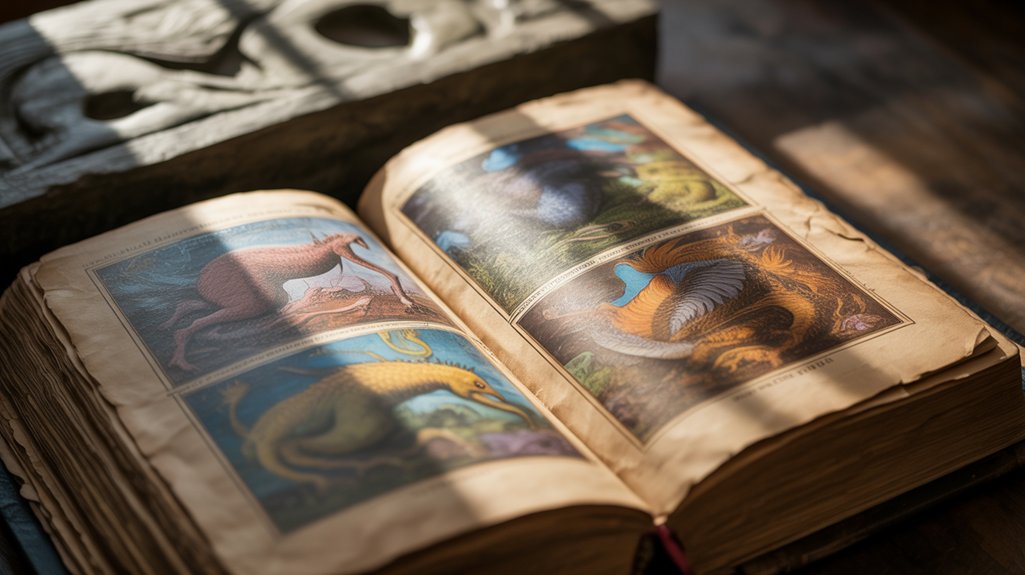
The series resurrects mythological taxonomy through:
The series resurrects mythological taxonomy through modern cinematic storytelling, transforming ancient creatures into accessible icons for contemporary audiences.
- The Niffler – embodying European folklore's treasure-hoarding creatures, its obsessive attraction to precious metals recalls ancient dwarf legends.
- The Thunderbird – channeling Native American cosmology, manifesting storm-conjuring powers as symbols of untamed freedom.
- Chinese dragons – preserving Eastern serpentine divinity within fantastical elements.
- Japanese tengu – acknowledging yokai traditions through shape-shifting entities.
This framework liberates ancient knowledge from academic obscurity, granting mythological creatures unprecedented accessibility.
The 2001 textbook, later expanded into film beginning 2016, demonstrates how folklore transcends temporal boundaries, maintaining cultural reverence while adapting traditional bestiaries for modern consciousness.
Cryptozoology and Jungian Archetypes
Cryptozoology emerges where empirical science meets humanity's oldest impulses—that primal certainty that something vast and unnamable still lurks beyond mapped territories.
These cryptid symbolism-laden encounters function as archetypal narratives, manifestations of what Jung termed the collective unconscious, where Sasquatch becomes the Wild Man archetype and lake monsters embody primordial chaos. Cultural fears crystallize into flesh, or the testimony thereof.
Modern cryptozoologists mirror medieval bestiary compilers, cataloguing legendary creatures through folklore connections and eyewitness accounts rather than empirical verification.
The Chupacabra represents contemporary anxieties about environmental collapse and agricultural vulnerability, while Mothman's appearances herald disaster—psychological motifs expressing existential truths about human fragility.
These chimeric entities serve as mythical reflections of societal evolution, eldritch symbols emerging during cultural upheaval.
The cryptid operates as threshold creature, neither confirmed nor dismissed, dwelling in epistemic borderlands where wonder resists rationalization.
Here lies cryptozoology's deepest resonance: preserving space for mystery in an exhaustively documented world.
Internet Memes as Modern Monsters
Where cryptids haunt physical borderlands, digital entities now colonize the liminal spaces of collective consciousness—born not from forest shadows but from the phosphorescent glow of screens.
Internet memes function as chimeric constructs of our age, their meme evolution mirroring the manuscript traditions that preserved bestiary lore through centuries of cultural commentary. These viral imagery fragments distill complex societal reflection into participatory engagement, inviting countless users to reshape, reinterpret, and redistribute modern allegories across digital networks.
Humor analysis reveals how remix culture alters mundane observations into eldritch commentaries on contemporary existence. Each iteration adds layers of meaning, building digital folklore through collective consciousness rather than institutional decree.
Like medieval bestiary illuminations that encoded moral instruction within fantastical creatures, memes capture zeitgeist anxieties and aspirations—rendering them shareable, mutable, and consequently free from singular authoritative interpretation.
The monsters we catalogue today require no taxonomic classification, only recognition of their power to reflect our unfiltered truths back through algorithmic mirrors.
Digital Catalogues Preserve Mythic Knowledge
While medieval scribes labored over illuminated manuscripts to preserve bestiary wisdom for future generations, contemporary archivists now channel that same curatorial imperative through digital infrastructure—altering fragile parchment into eternal binaries.
The British Library's digitized manuscripts breathe life into creatures once confined to monastery walls, their chimeric forms now accessible to scholars worldwide. Digital folklore emerges from this unprecedented democratization of knowledge, where ancient Syrian manticores and Germanic lindworms traverse fiber-optic cables instead of trade routes.
The University of Aberdeen's bestiary collections exemplify mythic preservation through technological means, each scanned folio revealing marginalia and pigment choices that illuminate medieval cosmological understanding.
Online forums encourage eldritch discussions among global communities, interpreting allegorical meanings embedded within leonine symbolism and serpentine imagery. This digital alteration mirrors historical educational functions—bestiaries once taught moral lessons through animal symbolism; modern databases continue that pedagogical mission, bridging temporal chasms between thirteenth-century scriptoria and contemporary screens, ensuring these sacred narratives persist beyond physical decay.
Frequently Asked Questions
How Do Modern Video Games Incorporate Bestiary Cataloguing Systems?
Modern video games resurrect medieval bestiary traditions through digital game mechanics that reward systematic documentation. Players access chimeric creature design details—anatomical weaknesses, behavioral patterns, elemental affinities—by engaging adversaries directly.
The Witcher 3's codex mirrors thirteenth-century illuminated manuscripts, while Monster Hunter's field guide demands ritualistic observation. These systems free players to pursue knowledge autonomously, altering each encounter into an act of mystical taxonomy. The hunter becomes scribe. Discovery precedes mastery.
Ancient cataloguing impulses persist, reborn through interactive frameworks.
What Role Do Museums Play in Digitizing Medieval Beast Manuscripts?
Museums serve as gateways between worlds, illuminating manuscripts once chained in monastery shadows.
Through advanced digitization methods—multispectral imaging revealing hidden marginalia, three-dimensional rendering of illuminated folios—institutions like the Bodleian and Morgan Library liberate these chimeric taxonomies from their vellum prisons.
Their educational outreach programs don't merely preserve; they resurrect. High-resolution scans enable wanderers worldwide to trace thirteenth-century scribal hands, to witness griffins and basilisks shimmer across screens, unshackled from institutional walls, democratizing eldritch wisdom.
Are There Copyright Issues When Sharing Medieval Bestiary Images Online?
Medieval bestiaries, dwelling in manuscript collections since the twelfth century, transcend copyright limitations—their ancient parchment pages belong to humanity's commons.
Institutions sharing these eldritch illuminations online invoke fair use principles, liberating chimeric creatures from archival shadows. The serpentine marginalia, gold-leaf griffins, and phantom beasts encounter no legal constraints; their creators dissolved into history centuries past.
Digitization becomes an act of cultural emancipation, returning these numinous texts to seekers who recognize knowledge as birthright, not commodity.
How Accurate Were Medieval Descriptions Compared to Actual Animal Biology?
Medieval scribes wouldn't've passed peer review. Their bestiary entries mixed biological discrepancies with theological allegory—lions breathing life into stillborn cubs, pelicans piercing their breasts to resurrect offspring.
Medieval accuracy faltered deliberately; these weren't field guides but sacred texts where creatures embodied chimeric truths. The phoenix's resurrection mattered more than ornithological fact.
Monks catalogued animals through liturgical lenses, altering elephants into symbols of fallen Adam, unicorns into Christ figures. Spiritual taxonomy superseded empirical observation, revealing eldritch wisdom over biological precision.
Do Non-Western Cultures Have Equivalent Traditions to European Bestiaries?
Yes, numerous traditions flourish beyond Europe's borders.
China's *Shan Hai Jing* (fourth century BCE) catalogues chimeric beings through mountainous domains and distant seas.
Japan's *Hyakki Yagyō* scrolls document nocturnal yokai processions.
Indigenous Australian Dreamtime narratives encode mythical creatures within living oral traditions.
Mesoamerican codices preserve Nahuatl and Mayan cosmologies.
Each system weaves cultural symbolism into taxonomies of the numinous—sacred archives where communities map spiritual geography, ancestral wisdom, and the eldritch forces governing existence itself.
Conclusion
Over 90% of medieval bestiaries now exist solely in digitized form, their vellum pages too fragile for mortal hands. Yet these archives breathe with chimeric life—dragon scales gleaming through pixels, basilisk gazes transmitted through fiber optics. From Aberdeen's illuminated folios to Wikipedia's collaborative monster entries, humanity's compulsion to catalogue the numinous persists. The bestiary endures, metamorphosing across centuries. Medieval scribes and modern memers share one truth: monsters never die; they simply migrate between margins.