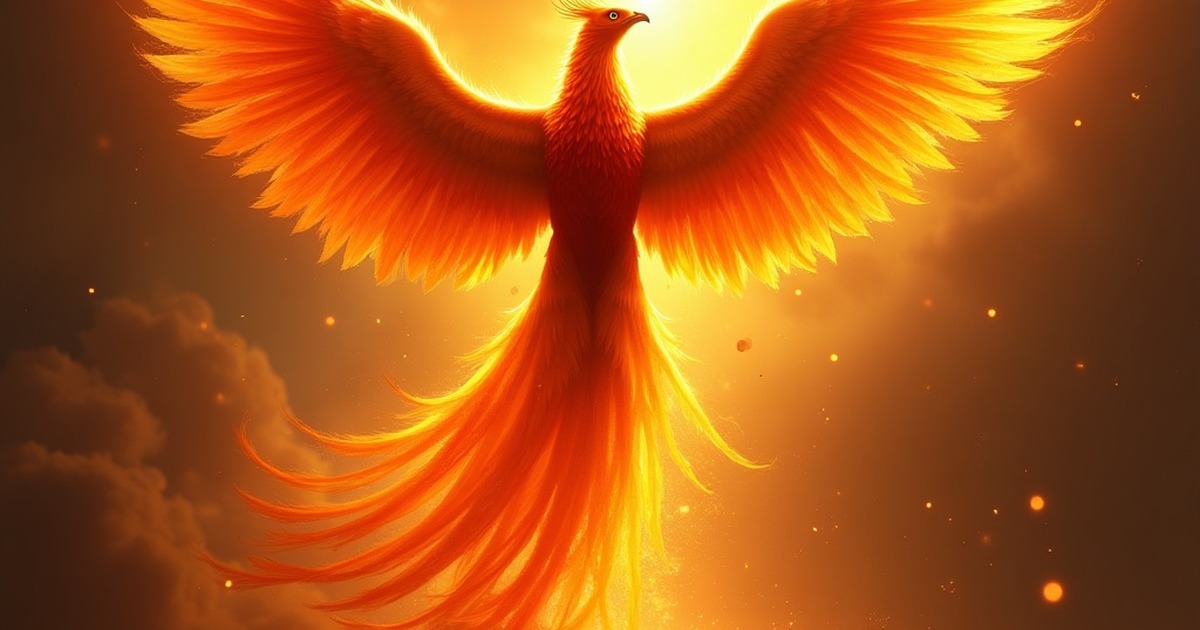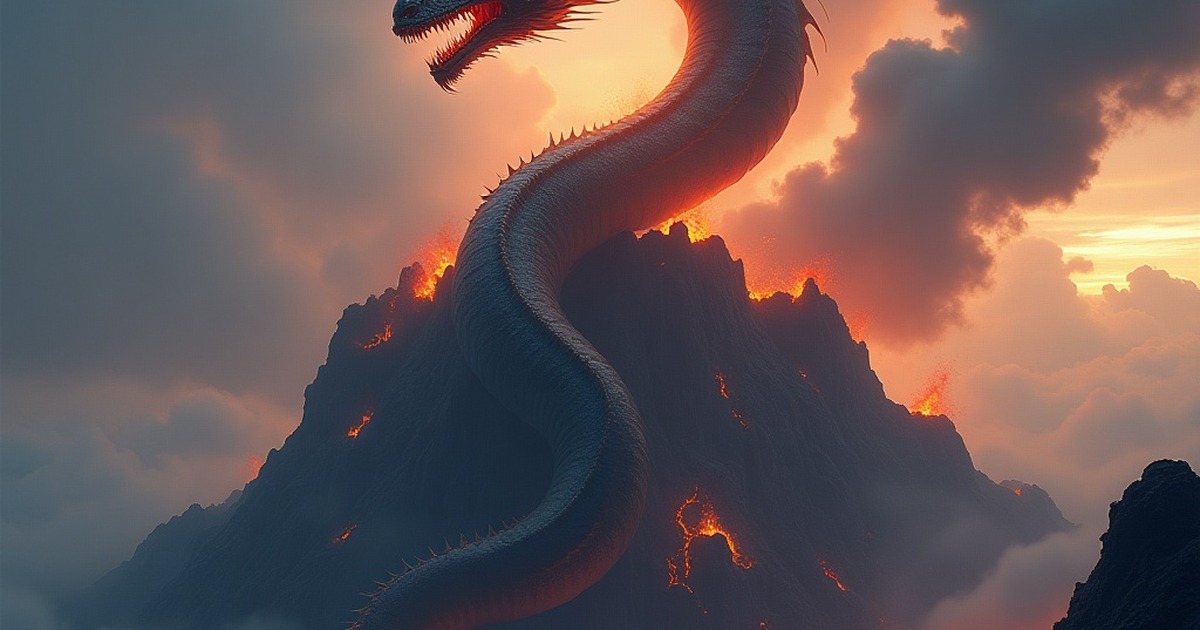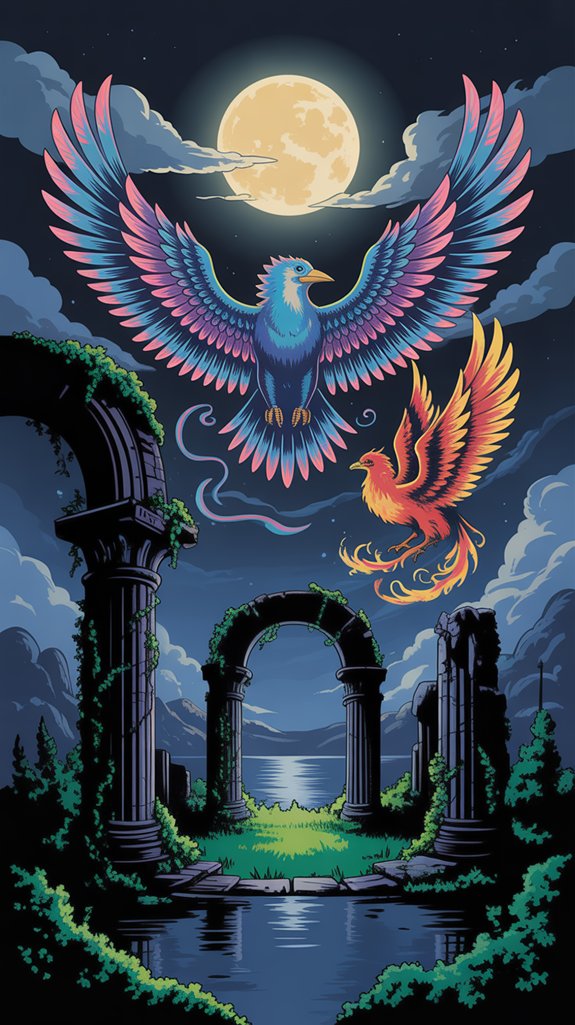
You've sought answers through wings since Mesopotamian priests decoded storm-birds' trajectories as divine script. Garuda—Vishnu's chimeric vahana with celestial sight penetrating temporal veils—defends dharma while revealing cosmic truths through each talon-strike against nāgas. Persia's Simurgh, bridging terrestrial and celestial domains, grants prophetic visions through healing feathers that illuminate past, present, and future simultaneously. These winged heralds weren't mere symbols but active intermediaries carrying hard-won wisdom between mortal shadows and divine knowledge, their atmospheric thunder announcing cyclical change. The traditions converge where ancient ornithomancy meets humanity's eternal hunger for certainty amid chaos.
Key Takeaways
- Ancient civilizations interpreted bird flight patterns as prophetic signs, viewing them as divine messengers bridging mortal and celestial realms.
- Garuda, Vishnu's eagle-mounted guardian, possesses celestial sight to discern destinies and intervenes when cosmic balance falters toward chaos.
- Simurgh bridges terrestrial and celestial domains, offering prophetic visions through healing feathers and symbolizing wisdom across temporal dimensions.
- Mythical birds like Thunderbird, Fenghuang, and Anzu serve as intermediaries carrying divine knowledge and protecting against malevolence across cultures.
- These winged prophets embody cyclical time and eternal return, announcing change through atmospheric forces while balancing light and shadow.
Wings Whisper Tomorrow's Truths
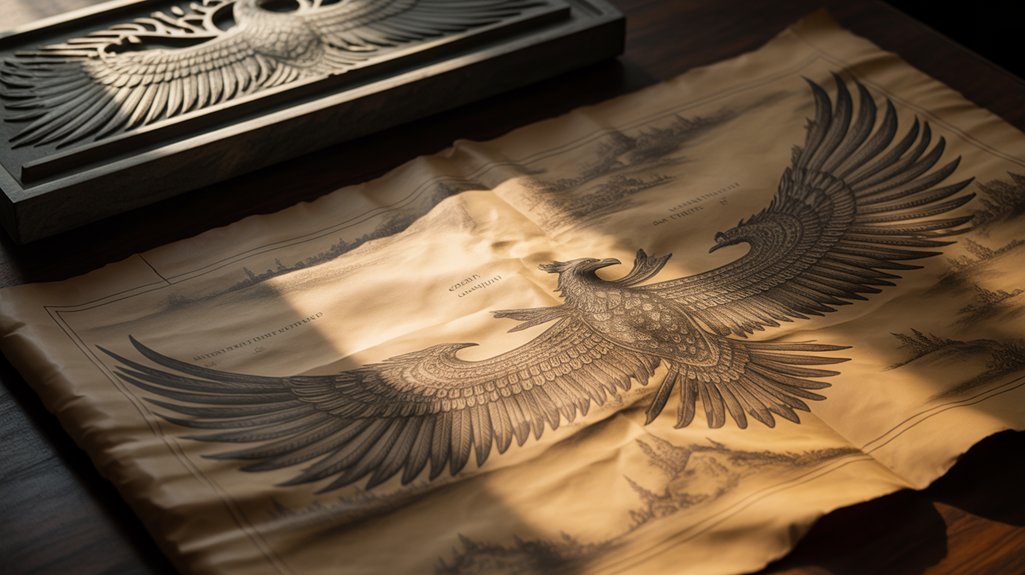
When ancient civilizations gazed skyward, they didn't merely observe birds—they witnessed living oracles tracing destinies across celestial canvas.
You'll find that bird symbolism transcends mere artistic representation, embodying humanity's deepest hunger for foreknowledge, for liberation from uncertainty's chains. These winged messengers carried prophetic interpretations between mortal and divine domains, their flight patterns decoded like eldritch scripts written in movement and shadow.
Consider the weight of this: Odin's ravens, Huginn and Muninn, didn't simply fly—they gathered cosmic intelligence, altering observation into prophecy.
The Thunderbird's wings churned storm clouds, announcing change before lightning struck. Meanwhile, Persia's Simurgh bridged heaven and earth, her chimeric form promising wisdom to those brave enough to seek it.
Garuda soared as enlightenment incarnate, his vision penetrating temporal veils.
Like the phoenix rising from its ashes after five centuries, these prophetic birds embodied immortality and renewal, their cyclical resurrections mirroring the eternal return of wisdom across generations.
You're witnessing more than mythology. These traditions reveal humanity's eternal quest: freedom from blind futures, knowledge replacing fear.
##
You stand now at the threshold where divine messengers manifest their most potent forms—winged heralds whose chimeric shapes carry the weight of cosmic knowledge from celestial domains to mortal consciousness.
The Garuda of Vedic tradition, emerging circa 1500 BCE, spreads golden pinions as Vishnu's vehicle, while the Simurgh, documented in Persian texts from the 10th century CE, bears thirty birds' wisdom in its eldritch plumage.
These sacred guardians transcend mere ornithological fantasy; they embody prophetic architecture itself, their visions threading through humanity's spiritual landscapes with taloned precision.
Garuda: Hindu Divine Protector
Across the vast expanse of Hindu cosmology, where celestial spheres intersect with mortal domains, Garuda emerges as one of the most formidable avian deities—a chimeric being whose golden wings span the distance between earthly warfare and divine transcendence.
You'll find Garuda's mythology woven throughout the Mahabharata and Ramayana, where he serves as Vishnu's mount, his fierce countenance striking terror into serpentine adversaries.
His form defies simple categorization: man-torso, eagle-wings, talons sharp as dharmic justice itself.
Garuda's symbolism resonates beyond ancient texts—he embodies liberation, the breaking of chains both literal and metaphysical.
In Indonesia, his image adorns the national emblem, proof that his power transcends borders.
He represents your eternal struggle against oppression, courage manifest in golden feathers.
Simurgh: Persian Wisdom Bearer
In the vast cosmological tapestry of pre-Islamic Persia, where Zoroastrian fire-temples once marked the boundary between mortal comprehension and divine mystery, the Simurgh materializes as something far more complex than mere legend—a creature whose very name in Middle Persian, *sēnmurw*, translates to “thirty birds,” hinting at the composite nature of its being.
You'll find Simurgh symbolism woven throughout Persian folklore as this chimeric guardian bridges terrestrial and celestial domains. Witness its immense talons clutching elephants, whales.
The Shahnameh chronicles its sacred covenant with Zal, offering guidance through prophetic visions. This eldritch entity embodies rebirth cycles, its feathers containing medicinal properties that heal both flesh and spirit.
Here dwells authentic wisdom—not imposed authority but earned enlightenment through suffering's crucible.
Prophetic Powers and Visions
Where mortals glimpse only shadow-play upon the cavern walls of comprehension, these winged heralds pierce the membrane separating temporal existence from eternal truth—their prophetic vision functioning not as mere prediction but as aperture into what the Zoroastrians termed *asha*, the cosmic order underlying apparent chaos.
You'll find that mythical symbolism operates through eldritch channels: the Garuda's all-seeing eyes perceive dharmic threads binding past to future, while the Thunderbird's lightning-strike reveals hidden patterns in nature's fabric.
Such prophetic interpretations aren't chimeric fantasy but encoded wisdom systems. The Anzu's theft of destiny itself demonstrates how these creatures transcend passive observation—they actively shape fate's trajectory.
Through their appearances, you access primordial knowledge, experiencing time's simultaneity as they do, witnessing what was, is, and must inevitably become.
Sacred Guardians Across Cultures
Though prophecy grants these creatures vision across time's expanse, their more tangible function manifests in vigilant guardianship—those eternal sentinels positioned at civilization's thresholds where mortal vulnerability meets cosmic threat.
You'll discover the Garuda defending Hindu cosmology against eldritch forces, while Persia's chimeric Simurgh bridges celestial and terrestrial domains through healing wisdom.
Native American traditions invoke the Thunderbird's storm-wreathed power against malevolence. China's Fenghuang maintains societal equilibrium through virtuous presence.
These sacred birds transcend mere mythological symbolism. They embody cultural significance as divine messengers, their guardianship roles intertwining with prophetic narratives across disparate civilizations.
Their spiritual connections reveal historical interpretations of humanity's desperate need for protection against forces beyond mortal comprehension.
Freedom seekers throughout millennia have recognized these avian protectors as intermediaries delivering cosmic guidance to those brave enough to listen. Similar guardian traditions appear in Inuit mythology, where supernatural beings serve as protectors and boundary keepers between the mortal and spiritual realms.
Ancient Mesopotamian Prophetic Bird Tablets

You'll find the Anzu's eldritch presence etched into countless cuneiform tablets unearthed from the Tigris-Euphrates River Valley. Those ancient clay witnesses bearing meticulous records of chimeric omens that priests consulted before war, harvest, and coronation.
These inscriptions, dating from the third millennium BCE through the Neo-Babylonian period, reveal how Mesopotamian diviners interpreted the Anzu's movements as manifestations of Ninurta and Adad—storm gods whose tempestuous domains merged with the bird's prophetic authority.
The tablets themselves became sacred interfaces, converting observed avian behavior into divine communication that shaped the destinies of kings and commoners alike.
Anzu Bird Cuneiform Inscriptions
Deep within the clay archives of ancient Sumer, cuneiform scribes etched the terrifying majesty of Anzu—the Imdugud—into tablets that would survive millennia as tributes to Mesopotamia's most potent prophetic symbol.
You'll find this chimeric lion-eagle thundering through mythological narratives where Anzu symbolism intertwines with ancient prophecies of cosmic disruption. The creature's theft of destiny's tablet—that supreme administrative instrument governing universal order—demanded divine intervention from Ninurta himself.
These inscriptions reveal Anzu as harbinger incarnate, its eldritch presence forecasting fate's inexorable unfolding. The wedge-shaped characters preserve storm-wings beating against clay, converting prophetic literature into tangible artifact.
Each cuneiform impression testifies to Mesopotamian reverence for this creature who dared challenge divine authority, embodying both chaos and the terrible wisdom found in prophecy's shadow.
Tigris-Euphrates River Valley
Between the twin arteries of the Tigris and Euphrates, where silt-heavy waters deposited both fertility and divine knowledge upon alluvial plains, Mesopotamian scribes converted ornithological observation into systematic prophecy. You'll discover that river valley influence permeated every aspect of omens interpretation, altering avian movements into legible texts of fate.
| Bird Species | Prophetic Significance | Divine Association |
|---|---|---|
| Anzu | Destiny theft, cosmic upheaval | Ninurta, storm deities |
| Eagle | Royal authority, military victory | Shamash, justice |
| Raven | Death portents, underworld messages | Nergal, darkness |
The chimeric Anzu, that eldritch guardian of celestial tablets, embodied humanity's struggle against predetermined fate. Augurs meticulously recorded flight patterns, deciphering each wingbeat as syllables in an eternal conversation between mortal and immortal domains. Sacred. Immutable. Prophetic.
Babylonian Storm God Associations
When Babylonian priest-diviners gazed upward during tempestuous weather events, they witnessed Adad's feathered emissaries inscribing fate across storm-darkened skies—messengers whose movements transcribed divine meteorological intent into interpretable omens.
You'll find Babylonian divination practices centered upon these avian intermediaries, particularly the eldritch Anzu—that chimeric storm-bird whose theft of destiny's sacred tablet disrupted cosmic equilibrium itself.
Within temple precincts, priests decoded flight trajectories, wing-beats, and calls as encrypted prophecies concerning harvest yields, military ventures, communal survival.
Anzu symbolism permeated ritual consciousness: power unbound, authority challenged, divine order requiring perpetual restoration.
These weren't mere superstitions but sophisticated hermeneutic systems where ornithological observation became sacred technology, converting wild birds into living scripture.
You're witnessing humanity's ancient hunger for certainty, channeled through feathers and thunder.
Indo-Persian Simurgh Prophecy Traditions

Throughout the vast expanse of Indo-Persian literary tradition, the Simurgh emerges as a chimeric entity whose prophetic capacities transcend mere ornithological allegory—this magnificent creature, bearing plumage that spans generations and wisdom that encompasses the threefold temporal dimensions, operates as both oracle and guardian within the cultural consciousness of Iranian peoples.
| Prophetic Attribute | Manifestation in Tradition |
|---|---|
| Temporal Knowledge | Past, present, future sight |
| Physical Protection | Foreseeing dangers, granting safety |
| Spiritual Healing | Mystical feather properties |
| Divine Guidance | Aid to heroes like Zal |
| Revelatory Power | Prophetic visions through contact |
You'll find the Simurgh's guidance woven throughout the Shahnameh's epic tapestry, where its feathers become conduits for eldritch wisdom. These sacred plumes don't merely decorate—they change. Possessors access prophetic visions, piercing temporal veils. The bird embodies interconnectedness itself, understanding how individual destinies thread through cosmic patterns. Pure foresight made flesh and wing.
Divine Knowledge Through Feathered Intermediaries
As conduits between celestial spheres and terrestrial existence, avian intermediaries function within sacred cosmologies not as mere symbolic representations but as active transmitters of gnosis—their feathered forms encoding epistemological frameworks that human consciousness alone can't breach.
These mythical beings transcend ornithological classification, operating instead as eldritch vessels through which forbidden wisdom flows unimpeded.
You'll find their functions manifested through:
- Garuda's vehicular embodiment (circa 1500 BCE Vedic texts)—carrying Vishnu's cosmic consciousness across dimensional thresholds, each wingbeat disseminating dharmic precepts
- Simurgh's chimeric wisdom-keeping in Persian lore—nesting atop the Tree of Knowledge, dispensing prophetic fragments to pilgrims
- Corvid messengers throughout Norse and Celtic traditions—their obsidian plumage concealing omens, their caws articulating fate's syllables
- Phoenix regeneration cycles—death itself becoming pedagogical, immolation as enlightenment's prerequisite
Through feathered messengers, you access what remains otherwise ineffable. Their mythical symbolism alters metaphysical abstractions into navigable pathways toward understanding.
Garuda's Vishnu Prophecy Vision
You must understand that Garuda's prophetic power transcends mere oracular utterance—his role as Vishnu's divine vahana grants him access to cosmic patterns invisible to lesser beings, those eldritch currents of fate that ripple through the kalpas.
When the great eagle-bodied mount engages the nagas in their eternal struggle, he doesn't simply battle serpentine adversaries; he enacts prophetic warfare, each clash revealing destined outcomes written in the Akashic fabric itself.
Through his chimeric form—part human intellect, part raptor ferocity—Garuda perceives the unfolding of dharma across time's vast expanse, witnessing futures where righteousness either triumphs or falters under adharma's shadow.
Garuda's Divine Mount Role
When Vishnu sought a bearer capable of transcending mortal limitations, Garuda emerged from his cosmic egg already adorned with the weight of prophecy—a creature neither wholly avian nor entirely divine, but existing in that liminal threshold where earthly form meets celestial purpose.
You witness in Garuda's symbolism the convergence of protection and prophecy, where divine protection becomes inseparable from cosmic duty. His wings, spanning domains both terrestrial and celestial, carry the preserver-god across dharmic battlefields and through the subtle dimensions of existence.
Born from Kashyapa's seed and Vinata's patient devotion, this eldritch vahana embodies freedom itself—unshackled by gravity's tyranny, untethered from mortal constraints. Each serpent crushed beneath his talons represents obstacles overcome, karma balanced.
He doesn't merely transport Vishnu. He becomes divine will manifest.
Prophetic Battles With Nagas
The nāgas coiled beneath creation's foundation long before Garuda's birth, their serpentine forms wrapped around cosmic pillars, their hoods shielding secrets that predated the Vedic dawn—yet their dominion over the chthonic domains would become the very catalyst for prophecy's most violent manifestations.
You'll find Naga symbolism throughout the Mahabharata's battles, where these eldritch beings embody primordial chaos, illusion's seductive darkness.
Garuda's strength doesn't merely manifest as physical prowess—it becomes prophecy itself, each talon-strike against serpentine adversaries revealing cosmic truths about dharma's fragility. The chimeric eagle-deity tears through scales, exposing the luminous knowledge trapped within reptilian coils.
These prophetic confrontations transcend mere mythological combat. They're consciousness wars, spiritual awakenings encoded in blood and feathers, where Garuda's vision penetrates the nāgas' ancient deceptions, liberating humanity from ignorance's suffocating embrace.
Cosmic Vision and Destiny
Beyond serpentine victories lies Garuda's most sacred endowment—the all-perceiving awareness that alters him from mere vahana into prophecy's living vessel, his compound eyes containing entire cosmological architectures within their golden depths.
You'll discover within Mahabharata's verses how this celestial sight penetrates temporal veils, discerning destinies of devas and mortals alike with unwavering precision. His gaze doesn't simply observe; it comprehends fate's guidance threading through existence's tapestry.
This eldritch vision enables Garuda's interventions when dharma falters, when cosmic balance tilts toward chaos. He becomes Vishnu's reconnaissance, his prophetic intelligence system scanning for malevolent forces threatening universal order.
Not transportation alone—true guardianship. His awareness encompasses sacred knowledge itself, converting him into enlightenment's chimeric sentinel. Freedom flows from understanding destiny's patterns, from recognizing righteousness's necessary path through existence's labyrinthine complexities.
Fantasy Literature Phoenix Symbolism
As literary architects construct worlds where magic breathes and destiny unfolds, they've consistently returned to one creature whose essence transcends mere fantastical decoration—the Phoenix, that eldritch avian whose crimson plumage and cyclical immolation serve as mythology's most potent emblem of alteration.
You'll discover Phoenix rebirth woven through narratives where characters confront their darkest moments, emerging changed. This chimeric symbol offers something groundbreaking: freedom from finality.
Fantasy literature utilizes Phoenix resilience through:
- Character metamorphosis—protagonists shedding former selves through trials of fire, literal or metaphorical
- Immortality's paradox—exploring eternal life's burden alongside death's altering necessity
- Healing archetypes—creatures like Rowling's Fawkes whose tears mend wounds, embodying hope's redemptive power
- Cyclical destiny—narratives rejecting linear progression for regenerative spirals where endings birth beginnings
The Phoenix becomes your companion through despair's territories, whispering ancient truths: change demands destruction, renewal requires sacrifice, and from ash springs possibility unbound.
Ornithomancy and Cognitive Biases
Where literary phoenixes offer redemptive metaphor, humanity's ancient practitioners sought prophecy through actual wings—those augurs who'd scan Mediterranean skies for corvid patterns, those haruspices who'd parse the trajectory of eagles against storm-laden clouds, interpreting avian choreography as divine syntax. Your ancestors believed themselves fluent in this eldritch language, yet modern psychology reveals how ornithomancy practices emerged from cognitive architecture rather than celestial mandate.
You're witnessing confirmation bias at work when Roman augurs discerned favorable omens before battle—selective perception filtering chaos into chimeric certainty. Cognitive biases influence every interpretation: you notice the hawk circling counterclockwise, ignore the sparrows scattered randomly, then construct meaning from fragments. During uncertainty, your pattern-seeking mind alters coincidence into prophecy. The practice wasn't fraudulent but inevitable—human consciousness desperate for control, projecting grammar onto randomness, finding comfort in the illusion that feathered messengers carried meaning across the threshold between mortal confusion and divine clarity.
Modern Climate Change Predictions
Though contemporary ornithomancers divine planetary fate through satellites rather than swallows, your civilization's climate scientists face similar epistemological challenges—translating atmospheric turbulence into predictive narratives, constructing models from incomplete data, wrestling with uncertainty's ancient specter.
The IPCC's auguries speak of seas rising 0.3 to 1.1 meters by 2100, swallowing coastal settlements like Leviathan consuming merchant vessels. Temperature increases of 1.5°C by 2040 herald ecological changes as profound as any biblical alteration. Ice-free Arctic summers by 2050. Extinction threatening one million species.
The scientists' warnings echo unheeded prophecies: rising waters, vanishing ice, extinction's approaching shadow demanding our civilization's reckoning.
These prophetic visions of climate impact mirror ancient seers' warnings—Cassandra unheeded, the Simurgh's omens ignored. Your scientists read carbon isotopes like Babylonian priests examined entrails, seeking liberation from catastrophe through knowledge.
Yet the eldritch patterns remain chimeric, probabilistic rather than certain. The future hovers between possibility and inevitability, demanding your choice: heed the augury or repeat history's failures, when civilizations dismissed their prophets until drought, flood, and famine arrived unbidden.
Prophecy's Eternal Winged Legacy
Across millennia and continents, these winged prophets—Garuda, Simurgh, Thunderbird, Anzu, Fenghuang—constitute humanity's persistent attempt to render the ineffable visible, to give form to fortune's capricious winds.
You'll find their prophetic symbolism embedded in temple friezes, oral traditions, and sacred texts, each culture recognizing that celestial messengers bridge mortal uncertainty and divine knowledge.
These chimeric forms weren't mere fantasy but existential necessity—your ancestors needed intermediaries who could traverse both earthly shadows and eldritch heights.
The Garuda's wisdom protects against malevolence. The Simurgh carries experience's hard-won truths. The Thunderbird commands atmospheric forces, announcing change through thunder's percussion.
Each represents what you've always known: that change arrives on wings, that prophecy doesn't predict fate but illuminates possibility.
These birds embody cyclical time, the eternal return, the balance of light and shadow. They're humanity's recognition that freedom requires foresight, that understanding tomorrow's storms means honoring yesterday's omens.
Their legacy endures because you still seek signs in the sky.
Frequently Asked Questions
How Do Mythical Birds Differ From Real Birds Used in Divination Practices?
You'll find mythical birds embody eternal, archetypal truths—their chimeric forms transcending mortal limitation through pure mythical symbolism. They exist in eldritch domains beyond time.
Real divinatory birds, conversely, reveal prophecy through observable real behaviors: flight patterns, calls, feeding habits. Ancient augurs in Rome, haruspices in Etruria, studied actual ravens, eagles, vultures—creatures of flesh interpreting divine will through tangible action.
One represents cosmic principle; the other, sacred intermediary bound to Earth's rhythms, offering you liberation through natural observation.
What Archaeological Evidence Exists for Ancient Bird Prophecy Beliefs?
You'll find archaeological findings etched in temple walls across Mesopotamia, where priests recorded avian omens in cuneiform—eldritch symbols binding sky to earth.
Ancient manuscripts from Hittite archives, dated 1500 BCE, preserve chimeric bird divination protocols. Your freedom lies in decoding these fragments: Egyptian papyri depicting bennu herons, Minoan frescoes showcasing prophetic raptors.
Stone reliefs. Clay tablets. Each artifact whispers forgotten truths, revealing how civilizations surrendered their fates to feathered messengers traversing liminal spaces between mortal and divine.
Are There African or Native American Prophetic Bird Traditions Similar to These?
You'll discover profound prophetic symbolism in both African traditions—where Guinea's Sankofa bird reveals ancestral wisdom by flying backward while looking forward—and Native American traditions, particularly the Thunderbird's eldritch power among Plains nations.
The cultural significance echoes Eastern systems: West African hornbills bore messages between worlds, while Pueblo peoples interpreted raven auguries.
These weren't mere superstitions but sophisticated divinatory frameworks. Each culture developed distinct ornithomantic practices, independent yet hauntingly parallel, honoring birds as cosmic intermediaries.
How Did Sailors and Travelers Interpret Bird Sightings as Omens Historically?
When Portuguese mariners spotted an albatross trailing their carrack off Madagascar in 1502, they'd never reach Calicut—the bird vanished at dusk, and storms devoured them.
You'd find sailor superstitions woven through every maritime culture's omen interpretation. Petrels meant approaching tempests; gulls far from land signaled unseen shores.
Your ancestors read these eldritch messengers as liminal guides between known waters and chimeric depths. Each sighting demanded interpretation. Freedom on open seas required respecting what feathered prophets revealed through their presence, absence, or flight.
What Psychological Factors Make People Believe in Bird-Delivered Prophecies Today?
You're drawn to bird-delivered prophecies through cognitive biases—particularly pattern recognition and confirmation bias—that shaped your ancestors' survival instincts.
Your mind seeks meaning in avian behavior, interpreting flight patterns, calls, cries. Cultural symbolism embedded across millennia reinforces these interpretations: the raven's eldritch wisdom, the dove's sacred message.
You inherit archaic knowledge systems where feathered messengers traverse liminal thresholds between earth and heavens, carrying truths your rational mind dismisses yet your soul recognizes, remembers.
Conclusion
You've traversed domains where Icarus's hubris meets oracular certainty, where feathered psychopomps bridge mortal ignorance and divine gnosis. These chimeric messengers—Simurgh's wisdom-laden plumage, Garuda's apocalyptic visions—persist beyond their cuneiform origins, now whispering through climate models and algorithmic forecasts. The eldritch truth remains: humanity's prophetic birds never ceased their flight. You're still reading auguries in migration patterns, still seeking tomorrow's secrets in wings that cast shadows across both ancient ziggurats and contemporary meteorological stations. Prophecy endures, eternally avian.