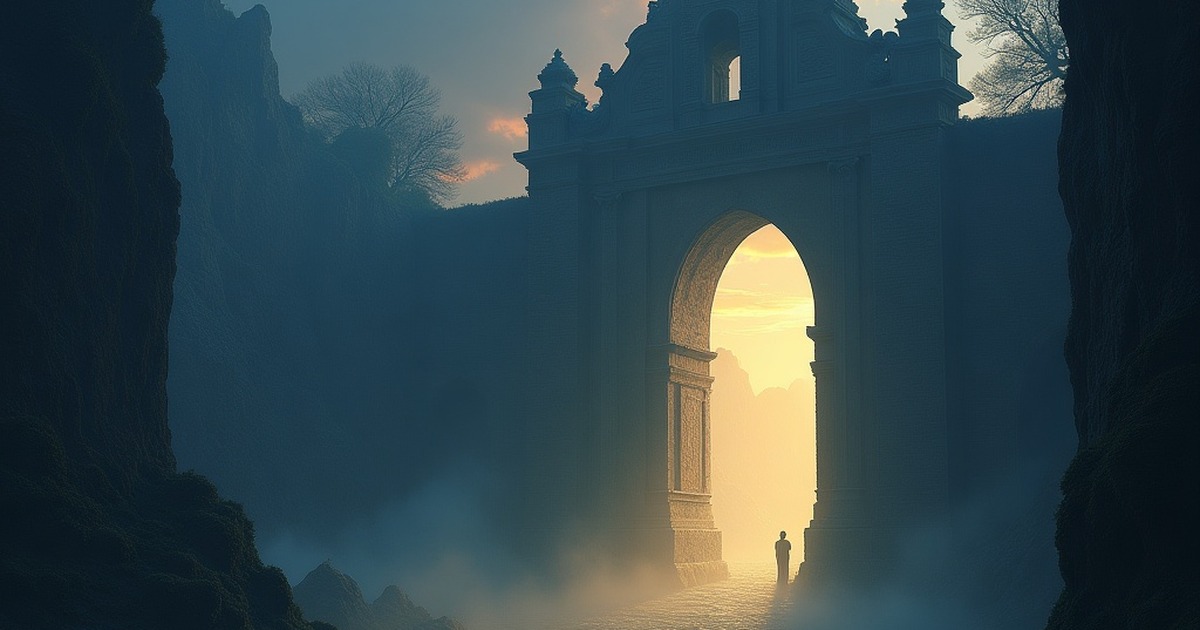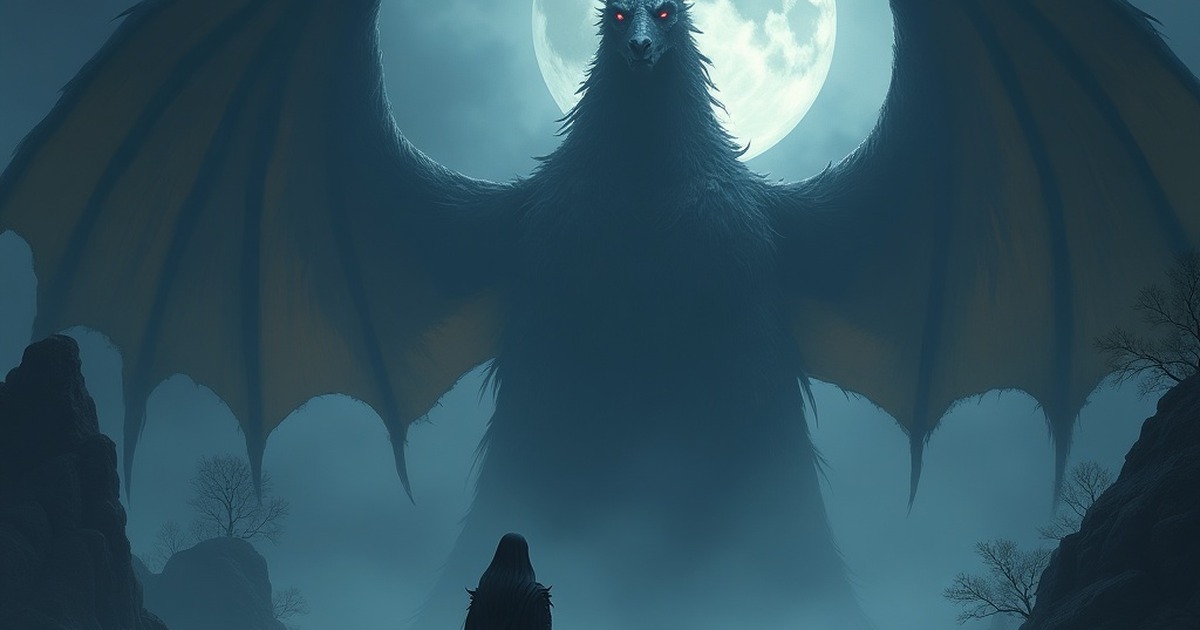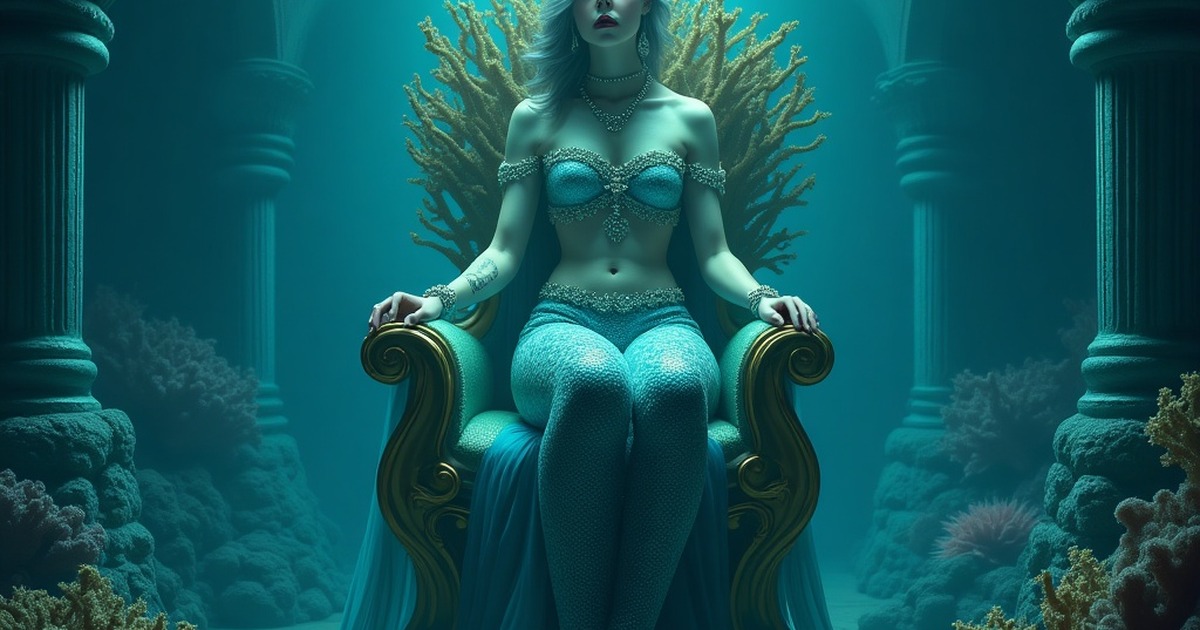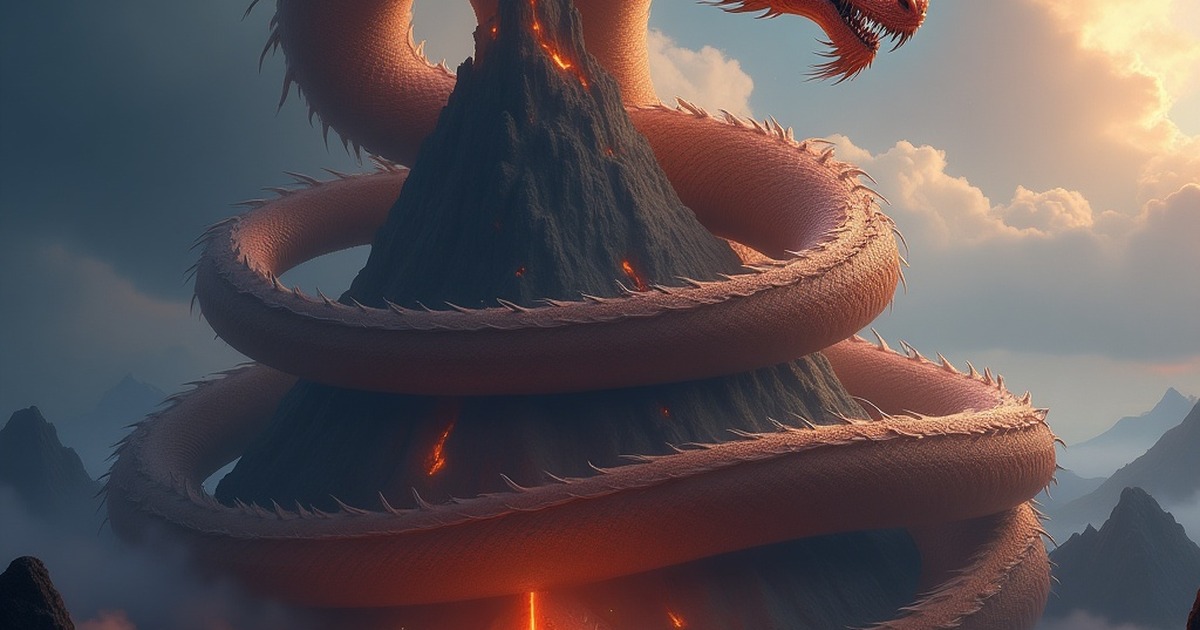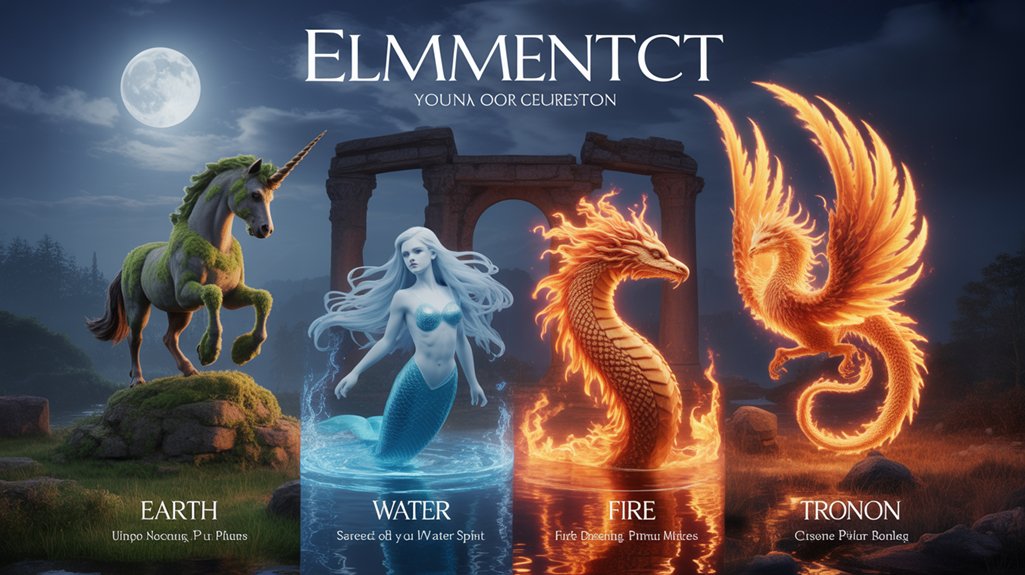
Mythical creatures embodying the four classical elements emerge across millennia of human imagination: gnomes, earth's subterranean guardians who craft treasures in mineral darkness; undines, water's enchanting spirits whose fluid forms command aqueous depths; sylphs, air's ephemeral entities shaping atmospheric phenomena and thought itself; salamanders, fire's primordial beings wreathed in flame's altering power. Paracelsus codified these elemental taxonomies in sixteenth-century alchemical treatises, synthesizing Aristotelian physics with Neoplatonic mysticism, while Chinese cosmology articulated parallel wisdom through the Azure Dragon, Vermilion Bird, White Tiger, and Black Tortoise—celestial guardians whose archetypal resonance persists through contemporary interpretations spanning Jungian psychology to modern fantasy media, their ancient significance unfolding through deeper exploration.
Key Takeaways
- Fire elementals include salamanders, depicted as flame-wreathed serpentine beings representing destruction, resilience, and transformation in alchemical traditions.
- Water creatures feature undines, enchanting feminine spirits in European folklore, and dragons symbolizing metamorphosis and depth in mythology.
- Earth-bound gnomes serve as subterranean guardians possessing ancient wisdom, skilled craftsmanship, and communion with nature's terrestrial mysteries.
- Air spirits include sylphs governing weather and thought, alongside Eastern dragons commanding atmospheric phenomena through celestial flight.
- Paracelsus systematically classified elemental beings as gnomes, undines, sylphs, and salamanders, merging alchemical symbolism with animistic folklore.
Ancient Elemental Beings Across Cultures
Since humanity first gazed upon the primal forces shaping existence, cultures spanning continents have recognized that the four classical elements—earth, water, air, and fire—weren't merely inanimate substances but rather dwelling places for conscious, otherworldly entities.
The elements themselves breathe with ancient intelligence, housing beings older than human memory.
The sixteenth-century physician-mystic Paracelsus systematized elemental mythology through his taxonomy of gnomes, undines, sylphs, and salamanders, codifying knowledge whispered through millennia. These beings embodied sovereignty over their respective territories.
Gnomes dwelt in subterranean darkness, wisdom-keepers guarding mineral wealth and coaxing vegetation from soil. Undines manifested as enchanting water nymphs, voices cascading like mountain streams, wielding restorative powers.
Sylphs haunted atmospheric domains—winged, eldritch presences manipulating winds and infiltrating human consciousness. Salamanders burned within conflagration itself, chimeric lizards representing change's dual nature: annihilation and rebirth.
Cultural interpretations varied across civilizations, yet all acknowledged these elementals as mediators between material reality and transcendent forces. Pure energy given form. Consciousness woven into creation's fabric. Within Celtic traditions, mythical creatures similarly embodied elemental forces, their symbolism and cultural impact woven deeply into the fabric of ancient lore and sacred understanding.
##
The four classical elements—fire, water, earth, and air—have spawned countless eldritch beings across civilizations, each embodying the primal forces that ancient peoples both feared and revered.
From the flame-wreathed salamanders emerging from medieval European hearths to the luminous undines haunting Germanic waterways, these chimeric entities served as bridges between the material world and the numinous domain of elemental power.
The gnomes burrowing beneath Paracelsian earth and sylphs dancing through Renaissance skies completed this quaternary of spirits, their attributes meticulously catalogued by alchemists and mystics who understood nature as animate, conscious, sacred.
In colder climates, ice itself became an element of terror, manifesting in creatures like the Mahaha from Inuit mythology, a skeletal, blue-skinned being whose frozen touch and maniacal grin embodied the lethal power of arctic frost.
Fire Element Mythical Beings
Among fire's most enigmatic manifestations in mythological tradition, salamanders emerge as primordial spirits whose very existence challenges the boundary between elemental force and conscious being.
Medieval artisans rendered these eldritch creatures as serpentine forms wreathed in perpetual flame, their vibrant crimson scales embodying salamander symbolism's core paradox: destruction as sustenance.
Fire folklore chronicles their emergence from conflagrations unscathed, witnesses to their chimeric resilience. Alchemists venerated them as sovereign manipulators of flame itself, elemental beings who didn't merely survive heat but commanded it, channeled it, became it.
Forest fires birthed legends, observers marking their exodus from ash and ember. Pure manifestation. Living inferno.
These lizard-kin dwelt within flames as mortals inhabit air, their orange bodies flickering symbols to primal combustion made conscious, altering devastation into dwelling place.
Water Creatures and Legends
Where flame subsides, water's territory begins—elemental antithesis manifesting in beings no less powerful, yet governed by altogether different mythological architectures.
Undines emerge from water spirit legends as eldritch feminine forces dwelling in European waterways, their enchanting voices luring mortals toward alteration through love—though betrayal invites catastrophic ruin.
These beings manipulate their liquid dominion with sovereign authority. Alluring mermaids and naiads embody water's chimeric duality: salvation and destruction intertwined.
Chinese mythology presents the Black Tortoise, northern guardian whose aquatic essence channels endurance, protection flowing through ancient cosmological frameworks.
Water dragons symbolize metamorphosis itself, their serpentine forms resonating with those claiming affinity to depths.
Each creature reflects water's fundamental paradox—beauty concealing danger, tranquility masking overwhelming force, surfaces hiding unknowable mysteries beneath.
Earth-Bound Mystical Entities
Stone and soil birth their own guardians—entities whose essence crystallizes from bedrock itself, embodying earth's primordial steadfastness through forms both diminutive and formidable.
Within gnome folklore, these eldritch beings emerge as archetypal earth guardians, their wizened countenances carved by millennia beneath mountain and root.
These diminutive stewards possess an intrinsic communion with subterranean veins of precious metals, guiding growth through fungal networks, whispering to burrowing creatures in forgotten dialects.
Their craftsmanship rivals any mortal artisan's work. Caves become workshops where chimeric treasures take shape under gnarled hands.
Yet their mischievous temperament belies profound wisdom—knowledge extracted from geological epochs, compressed into beings no taller than a child.
They don't simply inhabit earth. They embody its consciousness, its patient accumulation of secrets, its refusal to yield mysteries without worthy supplicants willing to descend into darkness.
Air Spirits and Dragons
While earth-bound entities crystallize permanence through stone and root, air spirits manifest as ephemeral consciousness—beings who've never known gravity's constraint, who breathe existence itself into corporeal approximation.
Sylph symbolism permeates European folklore and alchemical traditions, depicting winged entities who govern wind, clouds, weather patterns. These ethereal beings possess invisible magical powers, their eldritch nature rendering them simultaneously present and imperceptible.
Dragon mythology converges with air elementalism most profoundly in Eastern traditions, where serpentine forms command atmospheric phenomena through flight.
Eastern dragons embody freedom's essence—untethered, sovereign, chimeric. Air signs, particularly Geminis and Librans, recognize kinship with these creatures, their elemental identity resonating with dragons' mastery of sky-bound dominion.
Both sylphs and dragons symbolize insight, communication, the ineffable quality of thought made manifest through wind's whisper and storm's roar.
Greek Philosopher Paracelsus' Sixteenth-Century Writings
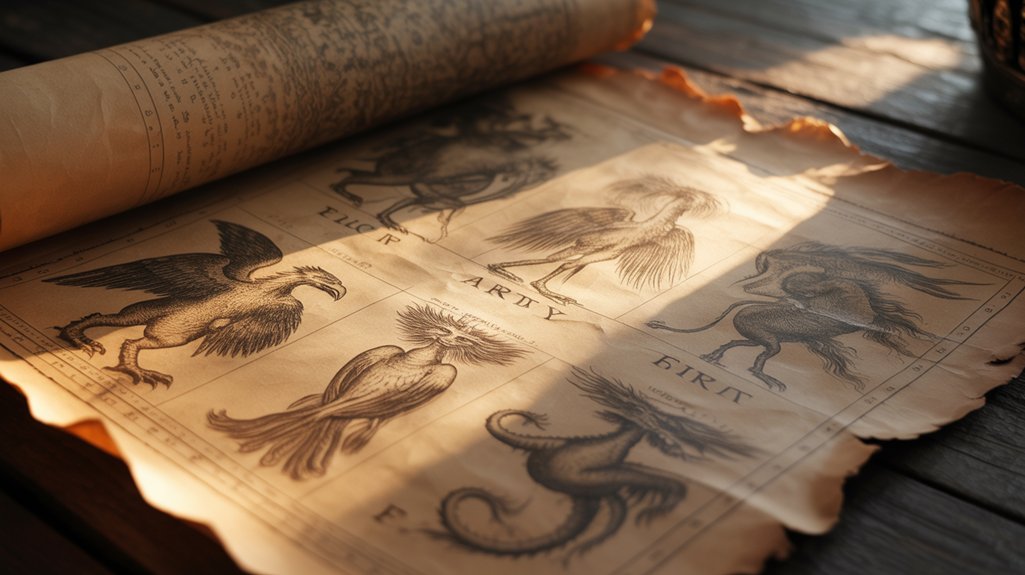
In the shadows of the Swiss-German Alps, Paracelsus—physician, alchemist, and mystic—composed his 1566 treatise that would crystallize the elemental taxonomy still whispered among occultists today.
Born Theophrastus von Hohenheim in Einsiedeln, this Renaissance philosopher synthesized Hermetic wisdom, Christian mysticism, and empirical observation into a chimeric philosophy that positioned gnomes, undines, sylphs, and salamanders as tangible inhabitants of nature's hidden strata.
His work emerged from an era when alchemical philosophy sought not merely to transmute base metals but to reveal the eldritch mechanisms binding spirit to matter, soul to element, mortal flesh to immortal essence.
Paracelsus' 1566 Alchemical Treatise
Through the transmutative lens of Renaissance alchemy, Paracelsus—the Swiss-German physician and occult philosopher whose innovative works emerged during the turbulent sixteenth century—crafted his 1566 treatise “A Book on Nymphs, Sylphs, Pygmies, and Salamanders,” establishing a systematic taxonomy of elemental spirits that would reverberate through Western esoteric thought for centuries to come.
Paracelsus' influence manifested through precise elemental symbolism: Gnomes guarded terrestrial mysteries, small and humanoid. Undines commanded aqueous domains, enchanting and fluid. Sylphs inhabited atmospheric heights, ethereal winged beings who shaped thoughts and dreams. Salamanders dwelt within flames themselves, lizard-like and immune to conflagration.
This chimeric quaternary integrated philosophical principles into cultural narratives, liberating imagination from orthodox constraints. His elemental taxonomy became foundational—esoteric traditions and Romantic literature embraced these entities as gateways to understanding nature's eldritch architecture.
Paracelsus' Swiss-German Background
Born Theophrastus Phillippus Aureolus Bombastus von Hohenheim in 1493 near Einsiedeln, Switzerland, Paracelsus inherited a landscape steeped in alpine mystery and mineral wealth—geological forces that shaped his understanding of terrestrial spirits and subterranean powers. His Swiss-German heritage bridged multiple linguistic and cultural traditions, positioning him uniquely within Renaissance esoteric thought.
| Element | Spirit Classification | Paracelsian Sphere |
|---|---|---|
| Earth | Gnomes | Mountain depths |
| Water | Undines | Alpine streams |
| Air | Sylphs | Ethereal heights |
| Fire | Salamanders | Alchemical furnaces |
Paracelsus' influence reshaped elemental philosophy by grounding chimeric beings within observable nature—not dismissing them as folklore but elevating them to ontological necessity. His writings treated these eldritch entities as bridges between matter and spirit, physical and metaphysical domains coexisting within Switzerland's crystalline peaks and shadowed valleys.
Renaissance Alchemical Philosophy Context
Although Paracelsus lived and worked during the sixteenth century—not in ancient Greece—his alchemical philosophy drew deeply from Hellenic traditions of elemental cosmology, synthesizing Aristotelian physics with Neoplatonic mysticism to forge an entirely new taxonomy of spiritual beings.
His 1566 posthumous treatise disclosed Gnomes, Undines, Sylphs, and Salamanders as archetypal entities capable of traversing their elemental domains without constraint—earth, water, air, and fire respectively.
This classification system merged alchemical symbolism with animistic folklore, positioning elemental alterations as both physical and metaphysical phenomena.
Paracelsus envisioned these eldritch inhabitants as bridges between material reality and spiritual essence, their chimeric nature embodying the very forces they represented.
His work profoundly influenced Rosicrucian practices, which later developed elaborate rituals for perceiving these otherwise invisible intelligences dwelling within nature's hidden architecture.
Chinese Four Symbols Tradition
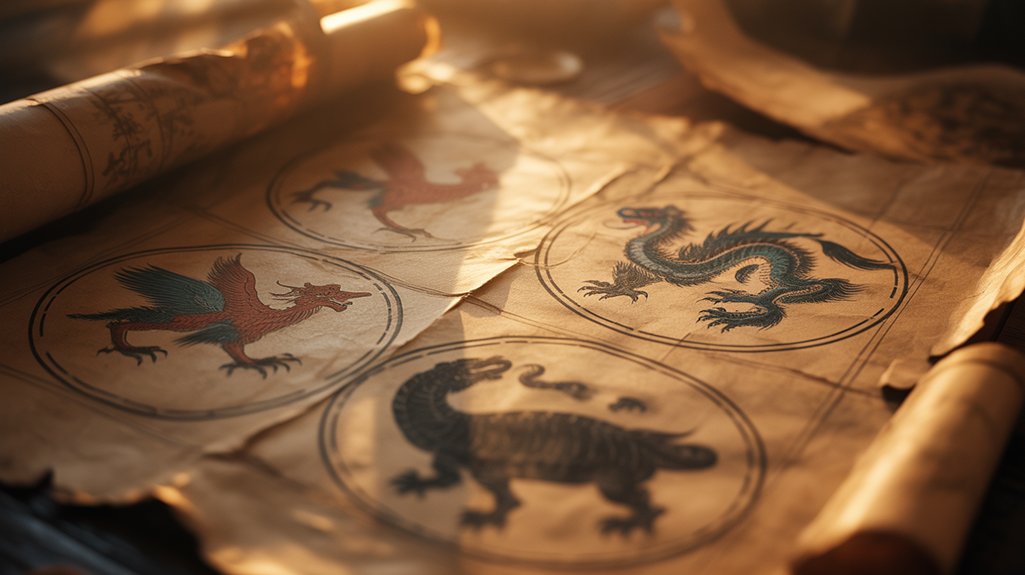
| Symbol | Direction | Element |
|---|---|---|
| Azure Dragon | East | Wood |
| Vermilion Bird | South | Fire |
| White Tiger | West | Metal |
| Black Tortoise | North | Water |
| Yellow Dragon | Center | Earth |
Their Cultural Significance resonates throughout the Sinosphere. Taoist philosophy grants them human identities, names, eldritch personalities.
Elemental Balance in Nature
When ancient cosmologies conceived the universe as a tapestry woven from elemental threads, they weren't merely crafting poetic metaphors—they were articulating a profound ecological truth that modern science has only begun to rediscover.
The elemental harmony sustained by Gnomes, Undines, Sylphs, and Salamanders reflects nature's delicate equilibrium, where each force maintains its sacred dominion while yielding to the others in perpetual, symbiotic dance.
This balance manifests through tangible ecological processes:
- Earth's steadfast foundation anchors vegetation, enabling roots to claim territory
- Water's flowing abundance circulates nutrients, sustaining all metabolic existence
- Air's invisible currents promote respiration, connecting breath across species
- Fire's altering power releases minerals, regenerating exhausted soils
Disruption of any single element cascades through entire ecosystems—drought withers forests, floods erode landscapes, stagnant air suffocates wildlife.
The eldritch wisdom preserved in mythological traditions teaches that ecological sustainability demands reverence for these interconnected forces, recognizing that humanity's freedom ultimately depends on honoring nature's chimeric architecture.
Phoenix as Fire Elemental
The Phoenix manifests fire's essence through its perpetual dance with flame and ash, embodying thermal alteration in cycles that mirror the sun's ancient journey across celestial boundaries.
Its plumage burns with chromatic intensity—scarlet, amber, and aureate hues merging into living conflagration—while aromatic smoke rises from self-constructed pyres after centuries of existence.
From Egyptian *Bennu* to Hellenistic traditions, this chimeric entity's immolation and subsequent resurrection from calcified remains represents fire's paradoxical nature: simultaneously destructive force and creative catalyst, death-bringer and life-giver united in one eldritch form.
Phoenix Rebirth and Flames
Among all elemental beings that haunt humanity's collective imagination, none embodies fire's changing essence more completely than the Phoenix—that resplendent avian whose very existence defies mortality's cruel finality.
Phoenix symbolism permeates ancient Greek tradition, where the creature lived centuries before constructing its aromatic pyre, immolating itself in eldritch flames, then emerging pristine from ash.
This conflagration isn't mere destruction. It's metamorphosis incarnate. The bird doesn't simply survive death—it evolves through it, wielding fire as both executioner and midwife.
Rebirth narratives surrounding this chimeric being resonate across millennia, infiltrating modern literature and cinema as proof to evolution's eternal appeal.
The Phoenix promises liberation from stagnation, from decay's tyranny. Its flames don't imprison; they release, offering humanity's restless spirit tangible evidence that endings birth beginnings.
Solar Symbolism and Heat
Beyond its cyclical resurrection, fire's celestial monarch commands dominion over solar mysteries that ancient civilizations recognized as divinity's most potent manifestation.
The Phoenix's radiant plumage—those eldritch feathers shimmering crimson, gold, amber—mirrors the sun's own chromatic authority. Solar deities from Ra to Helios found their earthbound analog in this chimeric creature, whose heat embodied alteration itself.
Ancient cultures understood fire symbolism through this luminous intermediary: the Phoenix didn't merely reflect solar power but channeled it, becoming light's emissary in mortal domains. Its flames weren't destructive chaos but purifying essence. Heat and radiance converged.
The creature's association with dawn, with celestial cycles, raised it beyond simple elemental representation into something approaching divine consciousness—a being where fire, light, and metaphysical renewal achieved perfect, terrible synthesis.
Ashes to Immortality
From these solar heights, the Phoenix's true elemental nature reveals itself most starkly in death's embrace—that moment when combustion becomes theology.
Ancient Egyptian priests understood this change, recording the Bennu bird's cyclical immolation as cosmic necessity rather than tragedy. The creature's rebirth symbolism transcends mere survival—it embodies alchemical perfection, where fire doesn't destroy but transmutes base matter into enlightened essence.
Greek scholars chronicled five-hundred-year cycles; Chinese texts described the Fenghuang's ash change as imperial mandate made manifest. Each civilization recognized the eldritch truth: immortality requires surrender to flame.
The pyre becomes womb, destruction births creation, and death itself becomes transformative act. From cremated remains, golden plumage emerges—proof that what appears as ending is merely metamorphosis, consciousness persisting through elemental fury.
Anne Stokes' Contemporary Fantasy Art
The brush of Anne Stokes summons forth chimeric visions where ancient elemental wisdom materializes through contemporary digital sorcery, modifying pixels and pigments into breathing repositories of mythic consciousness.
Stokes' artistry manifests through masterful fusion of traditional painting techniques with digital manipulation, birthing domains where fire-breathing wyrms and aqueous nymphs exist as tangible presences rather than mere illustrations.
Through Stokes' alchemical command of brush and pixel, mythological entities transcend decorative fantasy to inhabit realms of visceral, breathing reality.
Elemental themes permeate her portfolio through deliberate symbolic architecture:
- Dragons wreathed in conflagration embody primordial fire's altering rage
- Sylphs drift through cerulean atmospheres, incarnating air's intangible sovereignty
- Water spirits emerge from crystalline depths, their forms reflecting liquid metamorphosis
Her compositions draw substantially from pan-cultural folklore—Celtic traditions, Asian mythological frameworks, Norse cosmologies—rendering these diverse spiritual inheritances through chromatic intensity and meticulous anatomical detail.
This synthesis has established Stokes as contemporary fantasy art's preeminent interpreter of elemental beings, her merchandise and collectibles serving as accessible portals through which modern audiences encounter ancient elemental consciousness preserved within digital substrates.
Carl Jung's Archetypal Interpretations
While Anne Stokes' digital canvases externalize elemental consciousness through chromatic spectacle, Carl Jung's analytical psychology penetrates beneath these surface manifestations to excavate the psychic substrata from which such beings emerge.
His archetypal analysis reveals Salamanders as transformation's embodiment—passion incarnate, driving humanity's creative alteration. These eldritch fire-dwellers represent our instinctual urge toward rebirth, consuming stagnation with incandescent purpose.
Water's Undines dwell deeper still. They navigate the unconscious mind's abyssal currents, bearing intuition and empathy through psychic depths where logic drowns.
Jungian symbolism identifies these chimeric beings as emotion's avatars, fluid and boundary-less.
Sylphs command air's dominion, translating consciousness itself into communicable thought. They embody intellect's liberation, carrying ideas across mental landscapes where reason crystallizes.
Earth-bound Gnomes anchor this quaternary. Steadfast, immutable. They ground transcendent experience in material reality, connecting psyche to stone, root, soil—the tangible world from which consciousness first emerged and to which it perpetually returns.
Modern Media and Gaming Applications
Beyond Jung's archetypal frameworks and Stokes' chromatic visions, contemporary digital domains have altered these elemental beings into interactive mythology—pixels and polygons breathing new life into ancient cosmologies.
The Pokémon franchise materializes this convergence through Tornadus, Thundurus, and Landorus—chimeric entities channeling primordial weather forces into battling companions.
Final Fantasy XIV Online's Stormblood expansion resurrects the Four Symbols through elaborate quest-lines, reshaping ancient Chinese cosmology into playable narrative.
Overwatch's 2018 Lunar New Year event draped characters in Guardian-inspired skins, weaving elemental symbolism into first-person combat.
The webtoon “The God of High School” names martial techniques after these celestial protectors, while Digimon's Four Holy Beasts encode elemental wisdom into digital evolution trees.
These adaptations aren't mere appropriation—they're cultural transformation, where mythical creatures traverse temporal boundaries, offering modern seekers freedom to explore sacred geometries through controller and keyboard.
Ancient guardians persist, reborn in eldritch code.
Cultural Legacy and Evolution
Gaming screens flicker and fade, yet the elemental archetypes they resurrect persist across centuries—not as static relics but as breathing mythologies that adapt, merge, and regenerate through each cultural host they inhabit.
Paracelsus's 16th-century codification of gnomes, undines, sylphs, and salamanders didn't create these beings—it crystallized ancient whispers into alchemical doctrine. This cultural symbolism transcends European boundaries: Buddhism's Four Heavenly Kings guard cardinal directions with elemental ferocity, Jainism recognizes spirit-inhabited elements as sacred vessels.
The Romantic era reshaped them again; Fouqué's “Undine” and Dryden's verses rendered them eldritch yet accessible, chimeric fragments of nature's consciousness made literary flesh. Each generation receives this elemental mythology, remolds it through contemporary anxieties and aspirations, then passes forward something simultaneously familiar and altered.
They're cultural DNA, encoding humanity's persistent need to personify, categorize, and ultimately commune with the raw forces that sustain existence itself.
Frequently Asked Questions
What Are the Most Popular Elemental Creatures in Modern Video Games?
Contemporary gaming territories consistently feature fire dragons as apex predators, their scales gleaming with eldritch flame.
Water spirits—undines, naiads—flow through aquatic domains, offering players ethereal encounters.
Earth golems emerge from primordial stone, animated constructs guarding ancient secrets.
Air sylphs, those chimeric wind-dancers, grant swift movement across digital landscapes.
These archetypal beings aren't mere obstacles; they're portals to humanity's oldest spiritual taxonomies, altering pixels into sacred space where players exercise autonomy, confronting elemental forces that've haunted collective consciousness since Bronze Age mythology first crystallized.
How Do Different Religions View Mythical Elemental Beings?
Religious traditions change elemental beings into divine messengers, they raise natural forces into sacred symbols, they weave elemental symbolism through theological frameworks.
Christianity's angels command flames and winds; Islam's djinn inhabit smokeless fire; Hinduism's devas govern cosmic waters and celestial storms.
Buddhism perceives elemental spirits as sentient beings trapped in samsara's cycle.
Indigenous faiths recognize these entities as ancestors, guardians, divine beings themselves—eldritch powers demanding reverence, not mere chimeric folklore dismissed by colonial thought.
Are There Any Real Animals That Inspired Elemental Creature Myths?
Real animal inspirations shaped mythical creature origins across civilizations. The salamander's fire-resistant properties—observed when emerging from burning logs—birthed elemental flame myths.
Oceanic encounters with oarfish, their serpentine bodies stretching thirty feet, spawned aquatic dragon legends.
Desert mirages altered wandering cattle into chimeric djinn. The basilisk emerged from cobra observations in Mediterranean territories.
These tangible encounters with nature's eldritch manifestations provided primordial frameworks, allowing ancient peoples to codify elemental forces through biological phenomena they'd witnessed, changing zoological reality into sacred mythology.
Which Elemental Creature Would Win in a Battle Scenario?
Like chess pieces locked in eternal stalemate, no single elemental creature claims absolute dominion.
Fire vs water scenarios favor neither phoenix nor leviathan—each nullifies the other's essence.
Earth vs air conflicts see grounded giants outlasting sylphs in endurance, yet aerial beings maintain untouchable advantage.
Victory depends entirely upon terrain, cultural paradigm, and the seeker's own interpretation of power.
Ancient grimoires suggest balance, not supremacy, governs these eldritch forces—a truth that transcends conventional combat hierarchies.
Can Elemental Creatures From Different Cultures Be Mixed in Storytelling?
Cultural blending isn't just permitted—it's essential for contemporary mythmakers seeking authentic narratives.
Modern storytelling techniques thrive when weaving together disparate traditions: Japanese kappa merge with Celtic undines, djinn dance alongside salamanders.
This chimeric approach demands rigorous research, respectful acknowledgment of sources, and understanding each creature's sacred origins. The eldritch power emerges not from appropriation but synthesis.
Ancient cultures themselves borrowed freely. Today's writers inherit that freedom, creating liminal spaces where phoenix meets fenghuang, where boundaries dissolve into wonder.
Conclusion
These primordial guardians—phoenixes rising from ash, serpentine dragons commanding tides, sylphs dancing through aether, gnomes dwelling in earth's marrow—aren't mere relics of bygone superstition. They're living threads in humanity's collective consciousness, chimeric bridges spanning Paracelsus' laboratory to Jung's psyche, ancient Chinese cosmology to Stokes' canvas. The elements themselves whisper through these forms, eldritch and eternal. Each tradition weaves its unique pattern, yet the tapestry reveals universal truths: nature's balance reflected in mythic flesh, transcending centuries and civilizations.