You'll encounter psychopomps—soul guides like Anubis, Charon, and Yama—across civilizations traversing mortality's threshold. These intermediaries aren't malevolent but essential: Egyptian Anubis guarantees proper mummification rites, Greek Charon demands his obol for Stygian passage, while Hindu Yama weighs karmic debt. Hellhounds patrol liminal boundaries, banshees wail prophetic lamentations, and Cerberus maintains death's irrevocable gate. Each creature embodies cultural frameworks altering incomprehensible loss into traversable passage, their eldritch forms mapping the unmappable territory between breath and cessation, revealing humanity's ancient strategies for confronting the ultimate threshold.
Key Takeaways
- Psychopomps like Anubis, Charon, and Yama guide souls through death's passage, serving as essential intermediaries between life and afterlife.
- Hellhounds including Cerberus and Garmr guard underworld gates, preventing unauthorized crossings and maintaining boundaries between life and death.
- Banshees function as death omens through prophetic wails, announcing imminent death within specific families through supernatural lamentation.
- Cultural death animals like vultures, crows, owls, and bats serve as harbingers, reflecting universal recognition of mortality across civilizations.
- The Grim Reaper persists as a threshold guardian archetype, representing death's inevitability in both ancient mythology and modern media.
Death's Mythical Guardians and Guides
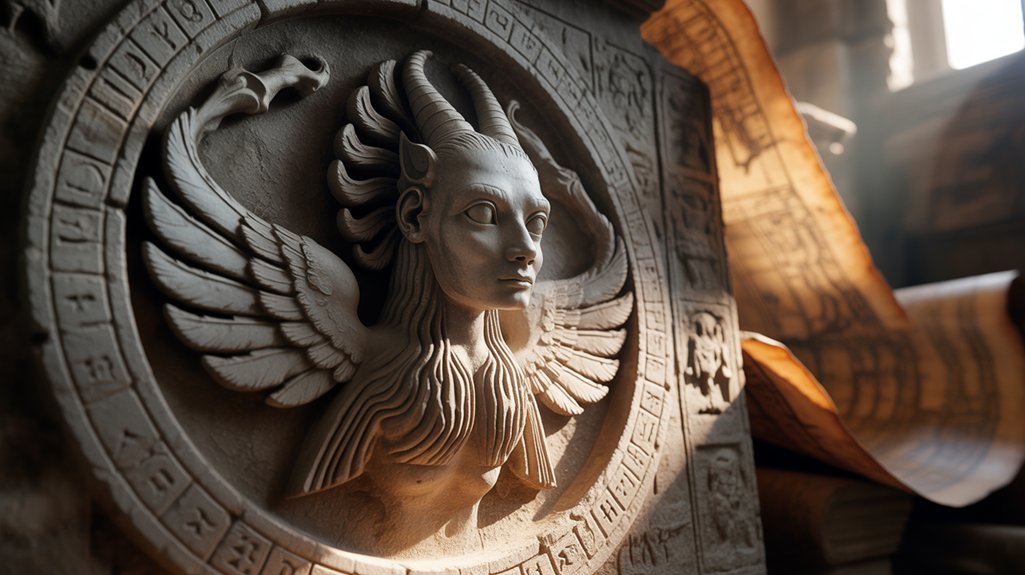
Across civilizations separated by oceans and millennia, humanity has conjured forth intermediaries to navigate the eldritch threshold between life and death—beings neither wholly malevolent nor benign, but essential.
Death demands witnesses—so every culture birthed guides to shepherd souls through the threshold we cannot map alone.
You'll find Anubis, jackal-headed guardian of ancient Egypt, ensuring proper mummification before guiding souls through judgment. Charon demands his obol, ferrying the dead across Styx's dark waters—a transaction binding mythical guides to mortal obligation.
In Hindu tradition, Yama weighs your karma, determining whether you'll face reincarnation's wheel or achieve moksha's liberation. Mictlantecuhtli's skeletal form ruled Aztec underworlds, while Baron Samedi mediates between Haiti's living and deceased, ensuring remembrance endures.
These psychopomps—soul transportation specialists—emerge from humanity's primal need to structure the unknowable. Each culture fashioned guardians reflecting their deepest anxieties and highest aspirations regarding mortality.
They aren't mere superstition but philosophical frameworks, offering you ceremonial roadmaps through death's chimeric landscape. Ancient wisdom persists: dying requires guides.
##
Beyond the deities who judge and rule death's domains, you'll encounter an array of chimeric beings whose sole purpose intertwines with mortality's threshold—creatures that announce, escort, or guard the dying and the dead.
These eldritch entities manifest across cultures as hellhounds patrolling cemetery gates with sulfurous breath, banshees wailing their prophetic dirges through Irish mists, and psychopomps guiding souls through liminal passages between worlds.
Each serves as death's functional attendant, neither god nor mortal, existing in that shadowed space where the supernatural becomes tangible and the veil grows gossamer-thin.
Through these mythological narratives, cultures have expressed their unique interpretations of life and death, using symbolism to convey timeless lessons about the human condition and what awaits beyond mortality.
Mythical Creatures Connected to Death and the Afterlife
Throughout human history, death has never existed as mere cessation—civilizations have populated the threshold between life and the beyond with powerful entities who shepherd, judge, and command the souls of the departed.
You'll find Charon demanding his obol, that copper coin placed beneath your tongue, before rowing you across the Styx's black waters. The skeletal Mictlantecuhtli awaits in Mictlan's depths, while Norse Hel governs her domain of shadowy specters who perished from age and illness.
Yama weighs your dharma with inexorable precision, determining your next incarnation. The Morrigan circles battlefields as corvid prophecy, her eerie whispers determining warriors' fates.
These psychopomps and death-deities reveal humanity's profound need to alter annihilation into passage, to populate the void with eldritch guardians who maintain cosmic order at existence's final threshold. In the frozen North, the Qalupalik drags children beneath icy waters with sharp fingernails, representing death by drowning as an ever-present danger in Arctic communities.
Hellhounds: Guardians of Souls
Few supernatural entities command the threshold between mortality and eternity with such visceral terror as the hellhound—that spectral canine whose burning eyes pierce darkness itself, whose howl portends imminent death, whose loyalty binds it eternally to underworld masters who demand souls be collected, guarded, or condemned.
You'll find these eldritch sentinels throughout hellhound mythology: Cerberus standing three-headed vigil at Hades' gates, Norse Garmr awaiting Ragnarök's apocalyptic dawn.
Their death symbolism transcends mere monstrous appearance—fiery eyes illuminate your final passage, supernatural speed guarantees no escape from destiny's claim.
These aren't arbitrary beasts but purposeful guardians maintaining cosmic order, preventing unauthorized crossings between dimensions.
When you glimpse their chimeric forms, you're witnessing psychopomps embodying humanity's oldest fear: the inescapable change awaiting all flesh.
Banshees: Harbingers of Doom
While hellhounds patrol the threshold with fang and flame, Ireland's spectral guardians of mortality manifest through a far more haunting medium—the keening wail that splinters night's silence, announcing death's approach before the Reaper himself arrives.
You'll find the Banshee—bean sídhe, “woman of the fairy mounds”—bound to specific bloodlines through ancestral connections that transcend centuries. These eldritch harbingers don't randomly select their charges; Banshee legends reveal meticulous genealogical patterns, wherein particular families inherit these sorrowful sentinels across generations.
She appears before your threshold, sometimes beautiful, always weeping. Her cry pierces marrow-deep. This chimeric fusion of mourner and messenger operates within liminal space—neither fully corporeal nor entirely spectral—transforming grief into prophecy, sorrow into forewarning, establishing Ireland's most profound meditation on mortality's inevitable arrival.
Psychopomps: Spirit Guide Beings
Where the Banshee's wail marks death's threshold through lamentation, psychopomps—from the Greek *psychopompós*, “guide of souls”—actively traverse the boundary between corporeal existence and whatever lies beyond, functioning as neither executioners nor mourners but as essential navigators through mortality's most treacherous passage.
You'll find these entities across civilizations: Charon's oar cutting through Styx's eldritch waters, Anubis's jackal-headed form presiding over mummification's sacred mysteries, Yama wielding his staff to determine your karma's weight in Hindu cosmology.
The Gede spirits—Baron Samedi foremost among them—don't merely observe soul passages; they demand proper rites, ensuring spiritual journeys proceed unimpeded.
These figures transcend chimeric horror. They embody necessity itself, maintaining death's natural order with neither malice nor mercy, simply purpose.
Ancient Egyptian Funerary Texts
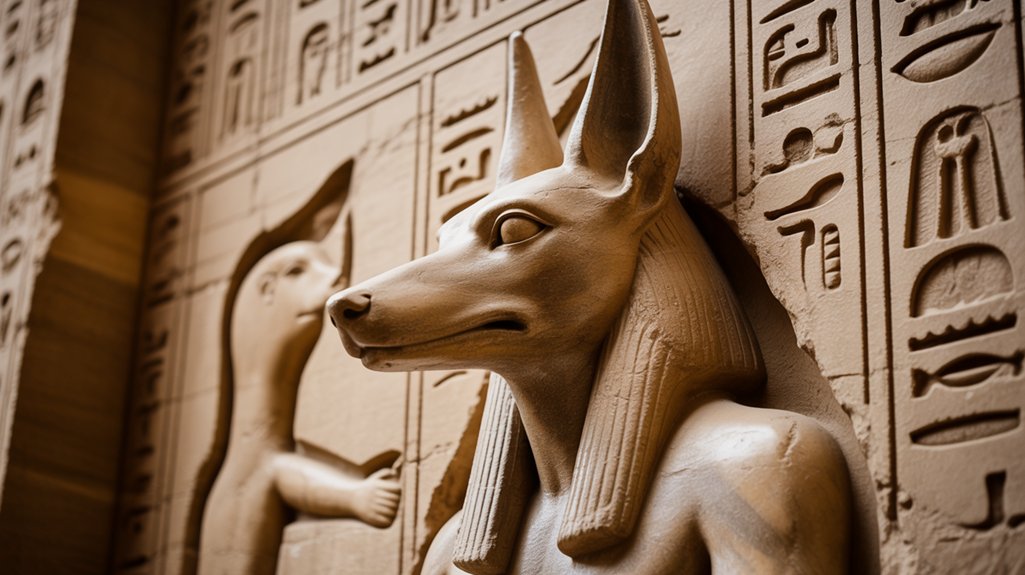
You'll find the jackal-headed Anubis presiding over these sacred texts with eldritch authority, his presence woven throughout the Pyramid Texts as psychopomp and guardian of the liminal threshold between mortal flesh and divine immortality.
The Nile Valley's burial sites—those subterranean chambers carved into bedrock and sealed against the desert's entropy—served as portals where hieroglyphic spells converted papyrus and stone into cosmic roadmaps.
Mummification wasn't merely preservation; it was alchemical necessity, each natron-soaked wrapping and extracted organ a deliberate step ensuring the ba and ka could navigate the Duat's chimeric dangers and claim their rightful place among the imperishable stars.
Pyramid Texts Mention Anubis
The obsidian-inked hieroglyphs carved into limestone corridors of Fifth and Sixth Dynasty pyramids preserve humanity's earliest systematic theology of death—the Pyramid Texts, composed between 2400 and 2300 BCE.
Within these sacred utterances, you'll encounter Anubis repeatedly invoked, his chimeric form—jackal-headed sentinel—standing guard over metamorphosis itself.
Anubis symbolism permeates every stage: he superintends mummification's sacred chemistry, guides disembodied souls through eldritch passageways, weighs hearts against Ma'at's feather with judicial precision.
These afterlife rituals weren't mere superstition but sophisticated spiritual technology. The texts reveal your ancestors understood death as threshold, not terminus.
Anubis embodied this liminal authority, ensuring moral worthiness determined eternal fate. His presence throughout these utterances demonstrates how profoundly ancient Egyptians mapped death's territory, creating blueprints you might still recognize—judgment, purification, resurrection.
Sacred knowledge, methodically preserved.
Nile Valley Burial Sites
Beyond Anubis's watchful presence in pyramid corridors, you discover entire necropolises sprawling across Nile Valley limestone—vast cities of the dead where funerary texts multiplied, evolved, democratized. These burial sites reveal humanity's eldritch communion with eternity, where elaborate burial rituals converted corpses into vessels for resurrection.
| Text Type | Period | Access |
|---|---|---|
| Pyramid Texts | 2400-2300 BCE | Royal exclusive |
| Coffin Texts | 2100-1800 BCE | Elite expansion |
| Book of the Dead | 1550-50 BCE | Widespread usage |
You observe mummified remains wrapped in incantations, tomb walls inscribed with spells against chimeric devourers. Amulets nestle between linen layers. Offerings accumulate. Each necropolis becomes a library of survival strategies—arcane knowledge once hoarded by pharaohs, gradually liberated, inscribed for commoners seeking their own passage through Osiris's judgment hall.
Mummification Preserved Divine Journey
As embalmers made their first incision along the corpse's left flank, they initiated a seventy-day alteration that merged surgical precision with sacred theater.
You'd witness mummification techniques changing mortality into eternity—canopic jars cradling viscera, natron salts drawing corruption from flesh, linen strips binding the transfigured form.
The heart remained anchored within, awaiting Ma'at's feather upon cosmic scales. These afterlife beliefs demanded preservation, for your ka required corporeal recognition, your ba needed a vessel for celestial wanderings.
Each ritual gesture invoked protective deities: Anubis overseeing embalming rites, Isis weaving resurrection spells.
The Book of the Dead lay beside you, its incantations illuminating treacherous netherworld passages.
Grave goods surrounded your sarcophagus—sustenance for an eldritch journey where death proved merely threshold, not terminus.
Greek Psychopomps Versus Asian Judges

While both civilizations constructed elaborate mythologies surrounding death's threshold, Greek and Asian traditions diverged fundamentally in their conceptualization of the soul's passage—one emphasizing the mechanics of transit, the other fixating upon moral reckoning.
Greek psychopomp roles centered upon Hermes and Charon, entities tasked with guiding souls across liminal boundaries. Charon's ferryman duties required the obol—that singular coin placed beneath the tongue—transforming death's journey into transaction rather than trial. No judgment passed these eldritch shores.
Conversely, Asian traditions raised moral judgment to paramount significance. Yama scrutinized karmic accumulations, while Yanluo Wang presided over underworldly tribunals where each soul's earthly deeds faced meticulous evaluation. Korea's Jeoseungsaja bridged both paradigms.
| Tradition | Primary Function | Philosophical Focus |
|---|---|---|
| Greek | Transportation of souls | Mechanical passage |
| Hindu | Karmic evaluation | Moral consequences |
| Chinese/Korean | Judicial assessment | Ethical accountability |
These divergent frameworks reveal humanity's dual preoccupation: traversing death's geography versus confronting life's accountability.
Animals Embodying Death's Presence
- Bat folklore among Māori peoples positioned these leathery-winged mammals as harbingers, their twilight flights signaling imminent death.
- Vulture significance in ancient Egypt raised scavengers to sacred status, their consumption of decay paradoxically symbolizing purification.
- Dog associations manifested through Anubis, the jackal-headed psychopomp who navigated souls through duat's labyrinthine passages.
These weren't metaphorical connections.
You'll find cultures worldwide observing genuine biological behaviors—nocturnal hunting, carrion consumption, graveyard haunting—and recognizing liminal truth.
Death required ambassadors dwelling simultaneously in visible and invisible worlds.
Cerberus Guards Underworld Entrance
At the threshold between worlds, you encounter Cerberus, the chimeric sentinel whose three savage heads simultaneously perceive past deaths, present decay, and future mortalities—a triumvirate of fangs and fury guarding Hades' iron gates.
This eldritch hound permits the dead their passage inward yet savages any soul attempting escape, its serpentine tail coiling with ancient purpose as it maintains the cosmic boundary between life's warmth and death's eternal chill.
Even the mighty Heracles, during his twelfth and most perilous labor, could only subdue this creature through superhuman strength, temporarily wrenching the guardian from its post to prove mortality's rare triumph over death's appointed watchman.
Three-Headed Hound Description
Three serpentine heads rise from the muscular shoulders of Cerberus, the primordial guardian whose very existence defines the threshold between mortal life and eternal death.
You'll find this chimeric beast adorned with vipers writhing across its muscular frame, each serpent adding to its eldritch presence at Hades' gates.
The three headed symbolism carries profound meaning: one skull watches the past, another perceives the present, while the third gazes into futures you'll never witness.
This underworld guardian doesn't merely stand watch—it embodies death's immutable boundary. Its snake-wreathed mane, venomous fangs, and obsidian eyes create an insurmountable barrier.
You can't bargain with it. You can't deceive it. Heracles himself could only subdue this creature through raw strength, proving that death's threshold demands absolute respect from mortals seeking freedom beyond life's constraints.
Preventing Souls' Escape
While lesser creatures might patrol boundaries with mere vigilance, Cerberus enforces death's most fundamental law through an unbreakable eternal watch.
You'll find in Cerberus mythology a profound meditation on your own mortality—this chimeric sentinel stands where freedom ends and destiny becomes inescapable. His three heads perceive past, present, future simultaneously, an eldritch configuration ensuring no temporal gap exists through which souls might slip.
Serpents writhe across his form, living chains that symbolize binding rather than liberation. The Underworld symbolism here cuts deep: death isn't merely passage but irrevocable threshold.
Ancient Greeks understood what you instinctively fear—that crossing certain boundaries means surrendering autonomy forever. Cerberus embodies this truth without malice, simply existing as the ontological wall between life's chaos and death's absolute order.
No negotiation. No escape.
Heracles' Twelfth Labor
When Eurystheus commanded the impossible—to drag Cerberus from Hades' domain into living daylight—he meant to guarantee Heracles' destruction, not his glorification.
Yet you'll find that Heracles' strength transcended mere physicality; it embodied humanity's defiant confrontation with mortality itself. The hero descended into chthonic depths, negotiating with death's sovereign rather than stealing what wasn't freely given—a vital distinction revealing Greek reverence for cosmic boundaries.
Wrestling the eldritch hound bare-handed, he subdued three snarling heads through sheer determination. Cerberus' symbolism evolves here: no longer just guardian but threshold itself, that liminal boundary mortals can't permanently cross.
After displaying the chimeric beast topside, Heracles honored the ancient contract. He returned Cerberus below. Life borrowed from death must always be repaid.
Grim Reaper in Contemporary Media
As death's skeletal emissary transcends the boundaries of medieval allegory to inhabit contemporary screens and digital landscapes, the Grim Reaper emerges as an enduring archetype—a cloaked psychopomp whose scythe-bearing silhouette has been etched into the collective unconscious of modern audiences.
Grim Reaper symbolism manifests across three distinct contemporary domains:
- Cinematic narratives position this figure as threshold guardian, shepherding souls through liminal spaces between corporeal existence and whatever eldritch domain awaits beyond.
- Interactive gaming mechanics in titles like “Death Stranding” weave mortality's consequences into player agency, altering abstract thanatological concepts into tangible experience.
- Satirical animation through “The Simpsons” and “South Park” deconstructs death's terror, revealing how humor strips away existential dread.
Cultural death representation hasn't diminished the Reaper's potency—you'll find this chimeric figure commodified through merchandise, paradoxically altering mortality's ambassador into familiar iconography.
This skeletal specter persists, undiminished, bridging ancient psychopompic traditions with digital-age consciousness.
Death Anxiety and Cultural Coping
Research confirms what ancient practitioners intuited: confronting mortality directly dissolves its paralytic grip.
When you speak death's name, construct altars, dance with skeletal figures, you transmute thanatophobia into something navigable.
The eldritch figures—Yama weighing karmic debts, the Reaper's inevitable scythe—provide tangible forms for the formless.
They offer you boundaries, narratives, meaning.
Through them, death becomes less chimeric threat, more understood passage.
Modern Grief Counseling Techniques
Though contemporary psychology might appear divorced from ancestral death rites, modern grief counseling channels the same fundamental wisdom through clinical frameworks.
You'll find cognitive-behavioral therapeutic techniques dismantling chimeric thought patterns that emerge after loss, restructuring the psyche's response to absence. Support groups resurrect communal mourning practices—ancient circles where shared sorrow becomes life-changing power.
Expressive therapies release grief processing through non-verbal channels. Paint becomes prayer. Music summons the departed.
Mindfulness traditions mirror shamanic presence-work, anchoring you within overwhelming emotional currents rather than drowning beneath them. The eldritch void of bereavement demands this grounding.
Personalized counseling acknowledges what death-walkers always knew: each relationship with mortality carries unique signatures, distinct as fingerprints upon burial shrouds.
Research validates ancestral intuition—tailored approaches honoring individual bonds with the deceased prove most effective. Your grief isn't standardized. Neither should your healing be.
These therapeutic techniques convey timeless wisdom into contemporary language, bridging clinical precision with eternal human need to metabolize loss.
Synthesizing Cross-Cultural Death Symbolism
Across continents and millennia, humanity's terror and fascination with mortality crystallizes into remarkably consistent symbolic vocabularies—psychopomps who shepherd souls, threshold guardians who test the deceased, creatures embodying change's inevitability.
You'll discover that Charon, Anubis, and Yama fulfill parallel functions despite emerging from disparate traditions, their convergent purposes revealing universal anxieties about consciousness's termination. Cross cultural interpretations demonstrate that crows and owls transcend geographic boundaries as harbingers, their eldritch presence marking liminal spaces between worlds.
The symbolism of rebirth manifests through chimeric forms—cicadas erupting from earth's womb after years entombed, butterflies dissolving caterpillar-selves into winged metamorphosis.
You're witnessing humanity's refusal to accept obliteration as final. Cerberus, Hel, Mictlantecuhtli: these threshold demons don't merely terrify but enforce cosmic order, demanding accountability.
Ancient wisdom insists death isn't ending but evolution, each culture clothing this liberating truth in particular aesthetic vocabulary while expressing identical metaphysical intuitions about mortality's paradoxical nature.
Frequently Asked Questions
How Do Mythical Death Creatures Differ Across Indigenous Cultures Worldwide?
You'll discover psychopomps manifest through radically distinct spiritual symbolism across continents.
Mesoamerican Xolotl guides souls as a chimeric dog-deity, while Aboriginal Australian Kurdaitcha embodies death's eldritch touch through bone-shoes and ritual power.
Cultural interpretations vary profoundly: Norse Valkyries select warriors for Valhalla, Egyptian Ammit devours unworthy hearts, Japanese Shinigami orchestrate mortality's timing.
Each tradition's death-beings reflect unique cosmologies, environmental landscapes, ancestral wisdom.
You're witnessing humanity's boundless imagination confronting mortality's mystery through localized, sacred frameworks that resist homogenization.
What Role Do Death Deities Play in Modern Pagan Practices?
Like Persephone bridging worlds between light and shadow, you'll find death deities serve as psychopomps in your modern beliefs—guiding souls through liminal thresholds.
Contemporary practitioners invoke Hel, Anubis, and the Morrigan in death rituals, seeking their eldritch wisdom.
These ancient powers aren't mere symbols; they're sovereignty embodied, offering you liberation from sanitized mortality.
Through veneration, you reclaim autonomy over life's ultimate passage, honoring what mainstream culture fears to acknowledge.
Are There Benevolent Mythical Creatures Associated With Peaceful Deaths?
You'll discover guardian spirits across cultures who shepherd souls gently—Celtic bean sídhe sometimes warn beloved families, while Japanese shinigami occasionally grant merciful passage.
Angels of mercy appear in Abrahamic traditions, their luminous presence easing transitions. The Greek Thanatos himself could bestow painless death.
Nordic valkyrjur selected worthy warriors for honored afterlives.
These psychopomps don't embody terror; they're liminal guides respecting your autonomy, offering compassionate deliverance when earthly existence concludes, changing mortality's threshold into sacred passage rather than violation.
How Have Video Games Incorporated Mythical Death Figures Into Gameplay?
You've witnessed gaming's absolute revolution of death mythology—altering grim reapers from mere harbingers into playable antiheroes.
Titles like *Darksiders II* let you embody Death himself, wielding scythes through apocalyptic domains.
*Spiritfarer* reimagines spectral guides as compassionate ferrymen, traversing liminal waters between worlds.
*Hades* changes Thanatos into your rival, friend, lover.
These digital experiences liberate ancient archetypes from dusty tomes, allowing you to inhabit eldritch roles once reserved for mythology's darkest corners.
Interactive agency replaces passive observation.
Do Children's Books Feature Mythical Creatures From Death Mythology?
You'll discover children's literature boldly embraces mythical beings from death traditions, though often softened. Greek Charon appears in Rick Riordan's acclaimed series, while Egyptian Anubis guides young readers through papyrus-scented underworlds.
Picture books introduce Mexico's Día de los Muertos skeletal guardians, teaching reverence rather than fear. These eldritch figures, once whispered in firelight, now illuminate bookshelf corners.
Publishers increasingly honor these sacred traditions, presenting psychopomps as teachers, not terrors—transforming ancient liminal knowledge into accessible wisdom.
Conclusion
You've journeyed through death's eldritch pantheon—from Anubis's jackal-headed vigil to Charon's spectral oar. These chimeric guardians persist because they're needed: studies reveal 68% of humans experience thanatophobia, that primal dread of mortality's approach. Each culture crafts its psychopomps differently, yet they're unified in purpose. They don't eliminate death's terror; they transmute it. Through myth's liminal doorways, you'll find not answers but companionship—ancient voices whispering that you needn't cross alone into that undiscovered country.