Ancient civilizations reshaped celestial observations into mythological frameworks, projecting chimeric guardians like China's Qinglong and Greece's Draco across stellar arrangements to encode agricultural cycles and navigation routes. Babylonian tablets from 1700 BCE cataloged sixty-six constellations intertwined with cosmic narratives, while cultures worldwide recognized familiar forms through pareidolia—identifying leonine hunters, serpentine protectors, and ursine wanderers in random stellar coordinates. These mythical creatures didn't merely decorate the heavens; they functioned as mnemonic devices synchronizing human existence with celestial timekeeping, their symbolism preserving cultural memory within cosmic architecture that continues illuminating humanity's relationship with the universe.
Key Takeaways
- Ancient civilizations projected mythological figures like dragons, lions, and serpents onto star patterns to create meaningful celestial narratives.
- Constellations served dual purposes: encoding practical navigation and agricultural knowledge while embodying cultural stories about gods and legendary creatures.
- Dragons like Draco and Qinglong represented cosmic order, seasonal changes, and eternal vigilance across Greek and Chinese astronomical traditions.
- Mythical beasts transformed random stellar arrangements into memorable maps, enabling ancient mariners and farmers to navigate and track time.
- Cognitive pattern recognition drove humans to identify familiar creatures in stars, creating shared meaning from celestial chaos across diverse cultures.
Stars Guide Human Imagination

When ancient peoples lifted their eyes toward the celestial vault, they didn't merely observe distant luminous spheres—they witnessed a vast, animate tapestry where gods walked, heroes fought, and chimeric beasts prowled through darkness eternal.
Star myths emerged as humanity's first cosmic storytelling, altering cold stellar arrangements into narratives pulsing with meaning. The Greeks perceived Orion striding eternally across heaven's dome, forever pursuing Pleiades through eldritch night. Draco coiled overhead, guardian serpent altered through katasterismoi into celestial permanence.
These weren't idle fantasies. They were frameworks of freedom—liberating consciousness from earthbound limitations.
Andromeda's constellation preserved her mythic bondage and rescue, while Leo embodied solar ferocity, Canis Major proclaimed canine loyalty unto death.
Each pattern served dual purpose: navigation through terrestrial darkness and navigation through existential uncertainty. Ancient astronomers understood what modern civilization often forgets—that meaning-making isn't weakness but necessity.
The stars didn't just guide ships. They guided souls, offering coordinates for understanding humanity's place within infinite mystery. These celestial narratives represented timeless tales that connected generations through shared stories of creation, gods, and the eternal struggle between good and evil.
##
Across the nocturnal vault, civilizations from Mesopotamia to Mesoamerica inscribed their most eldritch imaginings—serpents coiling through celestial rivers, winged beasts marking seasonal passages, chimeric guardians standing eternal watch at the zodiac's gates.
These stellar maps weren't mere decoration but served as navigation tools, calendrical systems, and mnemonic devices, their monstrous forms encoding agricultural cycles, seafaring routes, and cosmological truths within recognizable patterns.
The dragon Draco circling the pole star, the sea monster Cetus rising with autumn's storms—each creature represented humanity's attempt to impose narrative order upon chaos, altering the infinite into the knowable through myth's enduring architecture.
These celestial narratives functioned as creation myths, explaining both the origins of the cosmos and the natural phenomena observable in the heavens above.
Dragons in Stellar Maps
Throughout antiquity's vast chronologies, civilizations gazed upward and inscribed their most formidable mythos among the stars—dragons, those serpentine embodiments of cosmic force, coiled themselves into the celestial sphere with deliberate purpose.
China's Qinglong, the Azure Dragon, dominated eastern quadrants within the Four Symbols system, its eldritch form marking seasonal changes and agricultural rhythms. Westward, Draco wound its chimeric body around Polaris itself, embodying Ladon's eternal vigilance from Hellenic tradition.
Dragon symbolism transcended mere constellation; these celestial guardians represented cosmic equilibrium—benevolent watchers in some cultures, chaotic forces in others. Mesopotamian astronomers, alongside their Chinese counterparts, wove draconic figures into calendrical systems, binding heaven's movements to earthbound harvest cycles.
Such stellar cartography influenced millennia of artistic expression, philosophical discourse, and folkloric tradition worldwide.
Celestial Beasts Across Cultures
While dragons dominated particular celestial domains, other mythical beasts prowled the star-scattered vault with equal prominence—each culture inscribing its own zoological pantheon across night's infinite canvas.
Greek astronomers beheld Leo, the Nemean Lion slain by Hercules, altering mortal triumph into celestial symbolism. Mesopotamian priests tracked Tiamat's chaos-serpent form, while Capricorn's chimeric sea-goat bridged terrestrial and aquatic domains—ancient interpretations reflecting nature's duality.
Bears manifested across hemispheres: Ursa Major and Minor represented sacred wildlife to Inuit and Native American peoples, demonstrating shared reverence for these creatures.
Egyptian agriculturalists venerated Hathor through Taurus, the bull embodying fertility's eldritch power.
These constellations weren't mere astronomical markers. They were living mythologies, cultural memories etched in starlight, preserving humanity's most profound relationship with the cosmos.
Monsters as Constellation Origins
When ancient civilizations gazed upward and perceived monstrous forms writhing among stellar configurations, they weren't merely cataloging astronomical phenomena—they were inscribing cosmic warnings, preserving cautionary tales in the eternal archive of night.
Mythical monsters became constellation stories through deliberate cultural interpretations: Cetus emerged from Andromeda's narrative, Hydra immortalized serpentine terror, while Mesopotamian astronomers traced Tiamat's eldritch presence across star patterns.
These celestial narratives altered astronomical myths into narrative symbolism, binding chimeric entities like Draco's guardian serpent and Scorpius's venomous form to specific stellar coordinates.
Ancient cultures encoded dangerous archetypes within these configurations, establishing permanent records of heroism, dread, and transcendence.
Each constellation story represents liberation from temporal limitations—monsters frozen in perpetual motion, accessible to any soul seeking communion with primordial fears and triumphs embedded within darkness itself.
Mythical Animals Guide Navigation
As celestial cartography evolved beyond mere observation into systematic wayfinding, ancient mariners converted mythical animals into precise navigational instruments—creatures whose stellar embodiments provided directional coordinates, seasonal markers, and temporal measurements essential for survival across treacherous expanses.
The ursine constellations, Ursa Major and Minor, altered eldritch bears into celestial compasses guiding oceanic journeys across Mediterranean darkness. Canis Major's lupine form, anchored by Sirius's blazing eye, dictated summer departure times. Greek sailors read chimeric Capricorn's sea-goat silhouette to predict agricultural cycles.
Orion's hunter-form stretched across equatorial skies, his belt tracing east-west axes. Polynesian navigators mastered mythical navigation through Southern Cross interpretations, threading Pacific vastness using stellar creatures as living cartography.
These weren't mere stories. Liberation incarnate—ancient wisdom encoded in beast-shapes, granting autonomy to those who'd read the heavens.
Babylonian Star Catalogs 1700 BCE
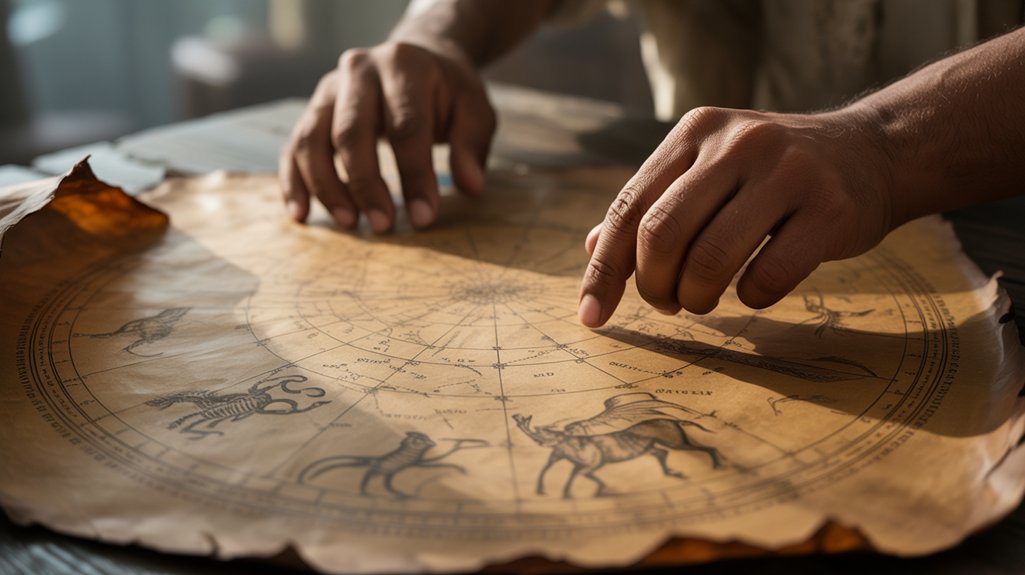
The MUL.APIN tablets, compiled across centuries within the reed-lined ziggurat complexes of ancient Mesopotamia's river valleys, preserved celestial knowledge through cuneiform inscriptions that mapped the eldritch patterns of wandering stars against fixed constellations.
These astronomical compendium documents served a purpose both sacred and pragmatic, their star-lists and planetary omens directing priests in calculating flood cycles, sowing dates, and harvest times along the Tigris and Euphrates.
Within their clay surfaces lay encoded an agricultural calendar coordination system that bound the chimeric figures of heaven—the Bull, the Scorpion Man, the celestial waters—to the earthbound rhythms of grain and soil.
MUL.Apin Astronomical Compendium Tablets
Cuneiform wedges pressed into clay preserved humanity's earliest systematic attempt to map the celestial sphere, creating what scholars now recognize as the MUL.Apin—a Mesopotamian astronomical compendium whose influence ripples through millennia of stargazing traditions.
Dating to 1700 BCE, these tablets cataloged sixty-six constellations, each constellation bearing the weight of Babylonian mythology—the Bull of Heaven charging across darkness, the Great Lion stalking stellar prey.
The MUL.Apin significance extends beyond mere star-charting; these inscriptions represented humanity's first methodical effort to impose narrative order upon cosmic chaos.
Chimeric forms and eldritch figures populated the night sky, converting astronomical observation into mythological theater.
Greek astronomers would later inherit this celestial framework, adapting Mesopotamian wisdom to Hellenic sensibilities, ensuring that Babylonian star-lore would illuminate Western consciousness for millennia.
Ancient Mesopotamian River Valleys
Between the twin arteries of Tigris and Euphrates, where silt-rich waters carved civilization from primordial chaos, Babylonian priest-astronomers converted the heavens into an intricate mathematical manuscript. Their base-60 system—legacy enduring through our sixty-minute hours—transformed celestial agriculture into precise science. Ancient rivers nourished both crops and cosmic understanding.
| Celestial Entity | Mythical Association |
|---|---|
| MUL.GU₄.AN.NA | Bull of Heaven |
| MUL.GÍR.TAB | Scorpion Man |
| MUL.ḪUN.GÁ | Agrarian Deity |
| MUL.A.IKU | Field Measure |
The 1700 BCE catalogs documented over 1,000 celestial bodies, interweaving eldritch creatures with agricultural calendars. Each chimeric constellation served dual purpose: navigation tool and mythological record. The Enuma Elish cosmology merged divine narrative with astronomical observation, creating systems where gods walked among stars, where freedom meant understanding celestial patterns governing flood seasons and harvests.
Agricultural Calendar Coordination System
When celestial mathematics intersected with terrestrial survival, Babylonian astronomers engineered what remained fundamentally humanity's first precision agriculture system—a thorough network of stellar timekeepers that changed subsistence farming into calculated science.
These 1700 BCE catalogs documented eldritch patterns across night's vault, altering Pleiades and Orion into agricultural cycles' guardians. Farmers decoded stellar positions with ritualistic precision, their lunar calendar synchronizing planting rhythms with cosmic clockwork.
This wasn't mere celestial navigation—it was chimeric fusion of astronomy and sustenance, where heavenly mathematics dictated earthly survival. Each constellation became hierophantic text, revealing prime harvest windows through ancient observational rigor.
Such integration raised Mesopotamian civilization beyond subsistence, anchoring their economy within celestial architecture. The stars spoke; humanity learned listening's profound necessity.
Greek Versus Chinese Zodiac Systems
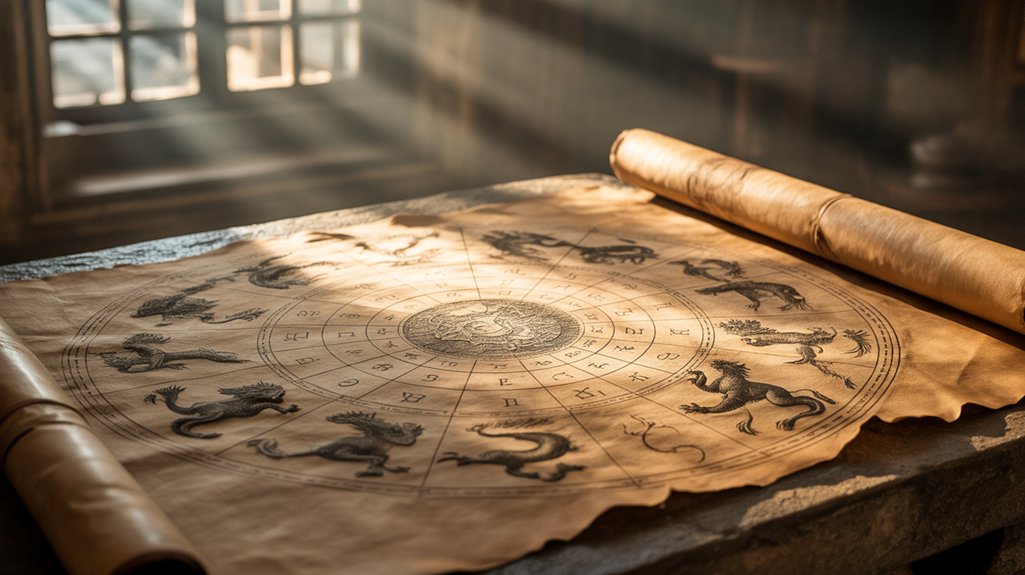
Across civilizations separated by seven thousand miles of ancient trade routes, two monumental systems emerged to map humanity's relationship with the cosmos—each one chimeric in its fusion of celestial observation and mythological narrative, yet fundamentally distinct in structure and philosophical underpinning. The Greek zodiac anchors itself to solar movements through constellation positions, marking individual destinies with rams, lions, and other eldritch beings. The Chinese system follows lunar cycles across twelve-year periods, assigning annual animals whose characteristics shape collective fortune and interpersonal compatibility. These zodiac differences reveal profound cultural significance:
| Aspect | Greek System | Chinese System |
|---|---|---|
| Temporal Foundation | Solar calendar, monthly divisions | Lunar calendar, twelve-year cycles |
| Primary Focus | Individual personality traits | Communal interactions and compatibility |
| Mythological Sources | Constellation mythology, heroic narratives | Animal symbolism, ancestral wisdom |
Both frameworks liberated ancient peoples from cosmic uncertainty, altering celestial chaos into comprehensible patterns—yet each culture carved its own path toward understanding humanity's place beneath star-scattered heavens.
Sacred Animals as Celestial Markers
The celestial vault demanded more than geometric abstraction from those who studied its nightly changes—ancient astronomers encoded their star maps with creatures both earthly and numinous, altering mathematical coordinates into breathing mythology.
These sacred animals weren't mere decorative flourishes but functional markers embedding cultural significance into astronomical practice.
Sacred Symbolism Manifested in Four Constellations:
- Leo's Lion—embodying solar power and celestial sovereignty, marking seasonal shifts through its commanding presence across the ecliptic plane.
- Taurus's Bull—representing agricultural fertility and cosmic strength, its heliacal rising signaling planting cycles throughout Mesopotamian territories.
- Egyptian Sekhmet—the lioness goddess whose eldritch form bridged terrestrial warfare and stellar phenomena, converting astronomical observation into divine communion.
- Capricorn's Chimeric Goat-Fish—Aegipan's hybrid nature reflecting liminal agricultural boundaries, where terrestrial cultivation met maritime commerce.
These creatures transcended decoration, becoming navigational instruments for freedom-seeking travelers and establishing temporal frameworks liberating societies from seasonal uncertainty.
Orion the Hunter's Belt
Across the celestial vault, three luminous stars pierce the darkness in perfect alignment—Alnitak, Alnilam, and Mintaka—forming the unmistakable girdle of Orion, the primordial hunter whose mythic presence spans eight hundred to twelve hundred light years from Earth's surface.
This stellar triad, revered by ancient civilizations as both sacred marker and navigational compass, embodied the warrior's eternal readiness, his belt drawn tight for cosmic battles against chimeric beasts that lurked beyond mortal comprehension.
The Greeks knew him as the great hunter whose eldritch strength challenged gods and monsters alike, yet cultures from the Egyptians to the Maya recognized these same three points of light, weaving their own sacred narratives around this celestial beacon that measured both space and time.
Three Stars in Alignment
When ancient skywatchers lifted their gazes toward the celestial vault, three luminous sentinels burning in perfect alignment commanded their attention with an authority that transcended mere astronomical curiosity—Alnitak, Alnilam, and Mintaka, the cosmic markers of Orion's Belt, carved themselves into humanity's collective consciousness as both navigational beacons and mythic signposts.
This stellar alignment, stretching across 800 to 1,500 light-years of cosmic expanse, became instrumental for agricultural societies tracking seasonal shifts and maritime navigators charting courses through eldritch darkness.
The cultural significance of these celestial bodies resonated through Greek mythology's depiction of Orion as a giant huntsman, his belt symbolizing prowess and strength.
Each star's distinct luminosity—varying in size and brilliance—created a chimeric trinity that inspired narratives of adventure across civilizations, binding terrestrial existence to celestial wonder.
Mythological Origins and Legends
Beyond their astronomical significance, these three stellar markers served as monuments to one of antiquity's most compelling mythological narratives—a tale woven through Mediterranean tradition that altered a mortal hunter into an eternal constellation. Greek legends portrayed Orion as prowess incarnate, battling chimeric beasts until tragedy changed him into celestial fire.
Egypt reimagined these same stars through Osiris, lord of resurrection. Native American tribes perceived warrior-hunter figures in identical patterns, demonstrating humanity's universal impulse toward mythical symbolism.
The eldritch permanence of Alnitak, Alnilam, and Mintaka anchored agricultural calendars across continents, their seasonal appearances marking planting cycles. These celestial narratives transcended mere navigation—they embodied humanity's deepest existential questions, crystallizing mortality's anguish into stellar immortality.
Ancient astronomers understood what moderns often forget: constellations weren't arbitrary dot-connecting exercises but sacred repositories where cultural memory intersected with cosmic architecture.
Navigation and Timekeeping Tool
Though mythology granted these stellar triplets their narrative power, practical necessity modified them into humanity's compass and chronometer.
Ancient navigation depended upon Alnitak, Alnilam, and Mintaka—their eldritch alignment with cardinal points shifting oceanic voyages from chimeric ventures into calculated journeys. Egyptian astronomers recognized their seasonal precision, marking agricultural rhythms with celestial authority. The constellation's appearance signaled planting times, harvest readiness, hunting expeditions.
Mariners crossing vast waters found orientation in their unwavering geometry, while civilizations synchronized their existence to these cosmic sentinels. Celestial timekeeping emerged not as abstract science but survival knowledge, encoded in temple walls and transmitted through generations.
The Belt's consistent rising and setting throughout the year provided humanity with temporal anchors, embedding astronomical observation into daily consciousness—navigation and chronology unified under three luminous points.
Astronomy in Fantasy Fiction
Since time immemorial, fantasy authors have woven celestial cartography into the fabric of their mythopoeic worlds, altering ancient stellar lore into narrative architecture.
These writers reshape constellations into living chimeric entities, drawing from Draco's serpentine coils and Centaurus's archer-sage duality. The celestial narratives embedded within fantasy symbolism create profound resonances between earthbound quests and cosmic patterns, mirroring how ancient civilizations interpreted the heavens through mythological frameworks.
Constellations transform into chimeric beings, bridging earthly narratives with cosmic mythology through serpentine dragons and centaur-sages of ancient celestial lore.
Contemporary fantasy literature perpetuates this tradition through:
- Star-based navigation systems that echo Polynesian wayfinding and Viking stellar orientation techniques
- Dragon cosmologies mapping directly onto draconic constellations, their eldritch presence governing seasonal cycles
- Phoenix resurrection myths aligned with stellar rebirth patterns and astronomical phenomena
- Constellation-bound prophecies where celestial arrangements dictate narrative fate
This interweaving of astronomical knowledge with mythopoeic imagination liberates readers from mundane constraints, offering pathways into liminal domains where ancient wisdom illuminates contemporary storytelling.
The night sky becomes text, mythology becomes map.
Pattern Recognition in Human Brains
When ancient peoples gazed upward into star-scattered darkness, their neural architecture altered random stellar coordinates into meaningful narratives—a cognitive alchemy rooted in pareidolia, wherein the brain's pattern-recognition systems impose order upon celestial chaos.
This fundamental aspect of cognitive evolution changed scattered luminous points into dragons, scorpions, and chimeric beings across every civilization. Visual processing prioritizes familiar forms over randomness, an adaptation that once distinguished predator from shadow now conjures mythological architectures in stellar arrangements.
The mechanism operates automatically. Unconsciously. Different cultures—Babylonian astronomers circa 1200 BCE, Chinese stargazers, Polynesian navigators—identified disparate figures within identical constellations, each society projecting its unique pantheon of sacred creatures onto the cosmos.
Yet the impulse remains universal: humanity's shared neural circuitry demands meaning from the void, seeking eldritch patterns where mathematics recognizes mere probability. This cognitive function, evolved through millennia of survival necessity, became the foundation for astronomy itself—changing humanity's relationship with darkness into a canvas for immortal narratives.
Modern Star Navigation Methods
While ancient civilizations converted celestial chaos into mythological cartography, contemporary navigators have inherited this stellar dependence—though their instruments now measure angles rather than invoke deities. Polaris endures.
The eldritch North Star, once Odin's watchful eye and Thoth's celestial marker, now guides maritime vessels through GPS-compromised waters with the same unwavering precision that shepherded Phoenician traders across Mediterranean darkness.
Sextants and astrolabes—descendants of Babylonian measurement tools—calculate star alignment through geometric precision, altering chimeric constellation patterns into quantifiable degrees.
The Big Dipper, ancient bear-spirit to countless cultures, remains essential for latitude determination, its stellar configuration unchanged since humanity first interpreted its form.
Modern celestial navigation synthesizes archaic wisdom with satellite technology, acknowledging that when electromagnetic pulses fail, aviators and sailors return to primordial methods.
This fusion demonstrates humanity's unbreakable tether to the cosmos—ancient star patterns functioning as eternal waypoints, their mythological significance transcending into navigational necessity.
Myths Unite Sky Watchers
Beyond mere navigation, these stellar arrangements functioned as civilization's first shared library—an archive written in light where mythical creatures bound disparate peoples through collective imagination.
Ancient communities forged identity through celestial storytelling, gathering beneath Draco's serpentine coils and Pegasus's chimeric form to transmit sacred knowledge across generations. These mythical narratives weren't mere entertainment—they constituted living pedagogy, embedding astronomical data within culturally resonant frameworks that altered abstract stellar positions into memorable characters.
The constellation Hydra coiled across southern skies, its eldritch presence reminding Greek, Egyptian, and Babylonian observers of primordial chaos subdued by cosmic order. Each culture projected distinct meanings onto identical patterns, yet shared the fundamental practice of weaving myth with measurement.
Sky watchers became keeper-priests of communal memory, their stories ensuring survival knowledge persisted through oral tradition. This synthesis of mythology and astronomy created bonds stronger than political alliances—unified humanity under a common vault where imagination and empirical observation merged into transcendent understanding.
Frequently Asked Questions
How Did Ancient Civilizations Determine Which Animals Represented Specific Constellations?
Ancient astronomers didn't arbitrarily assign creatures to celestial patterns—they wove animal symbolism through observation of seasonal migrations, hunting cycles, and agricultural rhythms.
Each culture's cultural mythology emerged from intimate environmental knowledge, altering stellar arrangements into chimeric guardians. Mesopotamian priests traced Taurus during spring equinoxes around 4000 BCE, while Egyptian stargazers recognized Orion as Osiris.
These cosmic mappings reflected earthbound realities: predators, prey, and sacred beasts became eternal, allowing societies to navigate both physical landscapes and eldritch spiritual dimensions through remembered constellation-stories.
What Tools Did Babylonian Astronomers Use to Create Their Star Catalogs?
Babylonian astronomers crafted their star catalogs through naked-eye observation, celestial geometry, and clay tablets inscribed with cuneiform script.
They employed shadow-casting gnomons, water clocks measuring temporal intervals, and astronomical diaries recording planetary movements across the ecliptic.
These ancient practitioners tracked Venus's eldritch patterns, lunar cycles, and stellar risings with mathematical precision—no telescopes, only devoted watchfulness beneath desert skies.
Their astronomical tools remained deceptively simple, yet their measurements achieved remarkable accuracy, encoding cosmic wisdom into humanity's earliest systematic celestial archives.
Why Do Greek and Chinese Zodiac Systems Have Different Numbers of Signs?
The celestial vault splits into divergent paths—twelve stations mark Greece's ecliptic journey, while China's cosmic wheel turns through twenty-eight lunar mansions.
This fundamental difference springs from cultural variations in astronomical observation: Greeks tracked the sun's annual passage through zodiac symbolism, creating their dodecamorphic system around 500 BCE.
Chinese astronomers, conversely, mapped the moon's nightly progression, their xiu marking eldritch stations where lunar energies altered.
Each civilization's freedom to interpret heaven's mysteries forged distinct yet equally profound cosmological architectures.
How Accurate Were Ancient Navigation Methods Compared to Modern GPS Technology?
Ancient navigation achieved remarkable precision through celestial techniques, though it can't match GPS's meter-level accuracy.
Polynesian wayfinders traversed vast Pacific expanses using star paths, wave patterns, and ancestral knowledge—an eldritch synthesis of observation and intuition.
Viking sailors employed sun compasses and stellar bearings. These mariners routinely crossed oceans with errors of mere miles, a demonstration of humanity's innate connection with cosmic rhythms.
Modern technology offers convenience, yet those primordial methods represented true liberation through understanding nature's ineffable patterns.
Which Mythical Creature Appears Most Frequently Across Different Cultural Astronomy Systems?
The dragon manifests across disparate astronomical traditions with unparalleled frequency. Its serpentine form coils through Chinese celestial charts, guards Mesopotamian ecliptic pathways, and writhes within Nordic star-lore.
This chimeric beast's celestial significance transcends mere constellation mapping—it embodies cosmic forces themselves. Dragon symbolism emerges in Vedic astronomy, Mesoamerican calendrical systems, and Mediterranean zodiacal arrangements.
Such universal presence suggests humanity's collective recognition of something eldritch yet fundamental, a primordial archetype connecting earthbound observers to the vast, mysterious heavens above.
Conclusion
Across forty-eight constellations catalogued by Ptolemy in 150 CE, humanity's chimeric pantheon crystallized into celestial permanence, each eldritch form marking seasonal passages and navigational truths. These stellar mythologies weren't mere superstition—they represented sophisticated astronomical frameworks that unified disparate cultures through shared wonder. Pattern-seeking minds changed cold hydrogen fires into sacred narratives, bridging empirical observation with numinous meaning. The ancient sky watchers understood what modern astronomy sometimes forgets: stars don't just illuminate darkness; they've always illuminated humanity's deepest yearning to comprehend its place within the cosmos's infinite expanse.