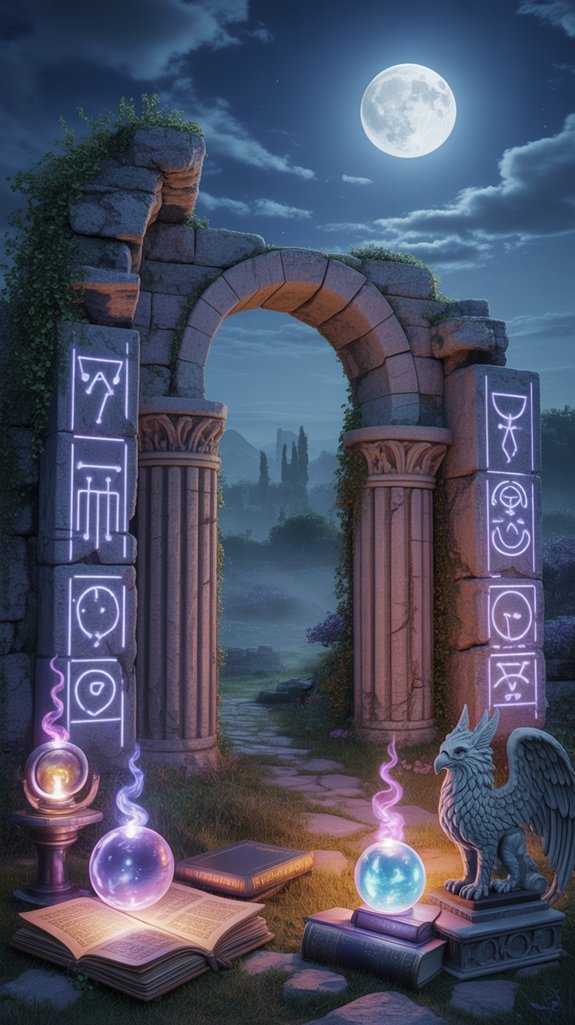
You've encountered the griffin's chimeric form—eagle forequarters fused with lion hindquarters—across five millennia of human consciousness, from Persian temples in 3000 BCE to modern corporate emblems. This eldritch guardian operates as what Jung identified as a primordial template within your collective unconscious, reconciling opposing forces essential for authentic selfhood. Ancient cultures positioned griffins at sacred thresholds not as decorative fantasy, but as psychic technology encoding the dual inheritance of instinctual ferocity and celestial intelligence you require during civilizational upheaval. What follows reveals how to activate this sovereignty within.
Key Takeaways
- Griffins have symbolized protection and power across millennia, from ancient Persian temples to modern corporate logos and university crests.
- The hybrid form unites opposing forces—earthly strength and divine vision—reflecting humanity's quest to reconcile dualities and transcend limitations.
- Ancient symbols function as technologies of meaning, encoding universal truths about guardianship, courage, and the bridge between material and spiritual realms.
- In Jungian psychology, the griffin operates as a primordial template guiding individuation by helping reconcile internal contradictions toward authentic selfhood.
- Modern manifestations in fantasy literature, gaming, and branding demonstrate ancient symbols' adaptability in addressing contemporary needs for protection and transformation.
*You've Seen the Griffin Before**
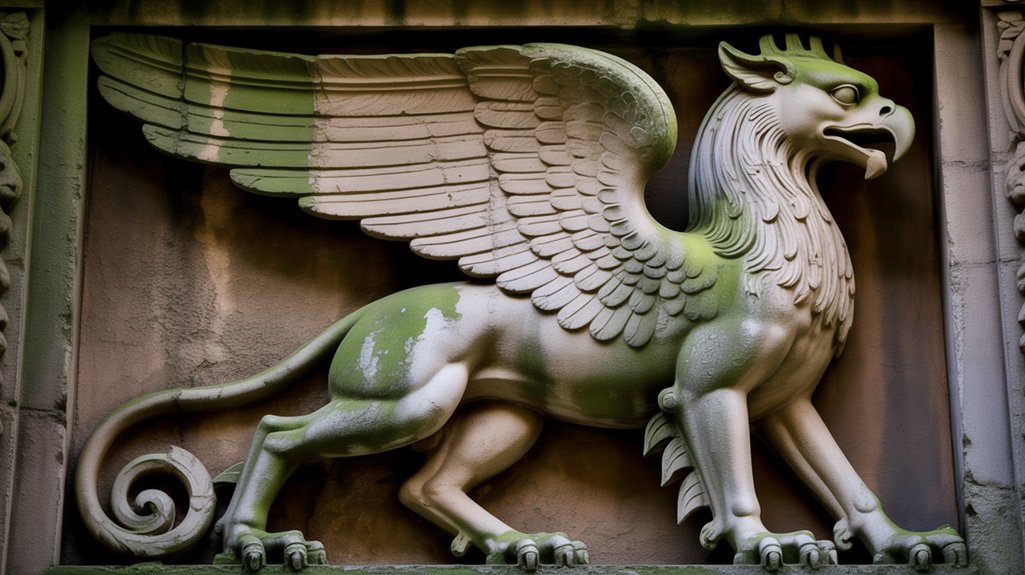
The griffin haunts your visual memory whether you recognize it or not—perched atop corporate logos, carved into university crests, prowling through fantasy novels and films, its chimeric form so ubiquitous that you've likely ceased to register its presence at all.
Yet this eldritch sentinel predates Christianity by millennia, its taloned footprints stretching back to 2000 BC. Ancient guardians stood watch over Egyptian tombs, their eagle wings and leonine bodies fused into protection incarnate—cousins to the Sphinx in function, if not form.
Medieval scribes preserved griffin symbolism through bestiaries thick with moral instruction, altering the creature into justice embodied, courage given flesh.
Consider Saint Cuthbert's “griffin claw” resting behind museum glass, physical proof of humanity's desperate need to manifest this guardian into reality.
You've inherited this obsession. The griffin persists because you refuse to let it vanish, embedding it into commerce, entertainment, institutional identity. Freedom demands vigilant protectors.
##
You stand at the threshold where myth converts into meaning, where the griffin's chimeric form transcends mere decoration to become keeper of humanity's most profound truths.
Across millennia, from the palace walls of Persepolis to medieval European monasteries, this eldritch sentinel has guarded not merely gold and jewels but something far more precious—the sacred knowledge that binds civilizations together through shared symbols and archetypal wisdom.
The griffin watches still, its eagle eyes fixed upon the mysteries we've forgotten, challenging you to remember what ancient peoples understood instinctively about power, protection, and the numinous forces that shape human consciousness.
Like the Norse who saw their myths as means to reach the numinous, ancient cultures recognized these hybrid guardians as bridges between the earthly and divine, encoding universal truths within their impossible anatomy.
The Return of the Griffin: Why Ancient Symbols Still Matter
Across millennia and continents, humanity has perpetually returned to the griffin—that chimeric sentinel whose leonine haunches and aquiline wings have guarded the threshold between earthly dominion and celestial wisdom since at least 3300 BCE, when Elamite artisans first carved its form into the walls of Susa.
You're drawn to these mythical creatures not through nostalgia but necessity. Their cultural significance transcends mere decoration; griffins embody your innate rebellion against limitation, your refusal to choose between earth and sky, strength and intellect. They represent autonomy.
When ancient peoples carved Protoceratops fossils into legend, they weren't fabricating fantasy—they were interpreting reality through symbolic language, altering bone into meaning.
Today, you resurrect these eldritch guardians because they speak to something unchanging: your desire to transcend boundaries, to claim both wisdom and power without compromise. Like the Chimera's fire-breathing hybrid form of lion, goat, and serpent, the griffin's composite nature symbolizes humanity's eternal drive to merge seemingly incompatible strengths into a singular, formidable identity.
SUBTOPIC: [Awaiting Subtopic
Understanding why griffins persist explains nothing if you can't recognize how they function—how their symbolic architecture operates within the psyche and across cultural boundaries.
This mythical representation transcends mere decoration. It activates primal recognition.
The chimeric form—eagle merged with lion—creates cognitive resonance, forcing you to confront duality itself. Its cultural significance emerges from this tension: celestial meets terrestrial, intellect bonds with instinct. You witness sovereignty embodied.
From Mesopotamian cylinder seals to medieval heraldry, the griffin guards thresholds between known and eldritch domains. It doesn't merely symbolize power; it *manifests* the guardian archetype that your consciousness requires.
Protection. Vigilance. The fierce synthesis of opposing forces.
Ancient peoples understood: symbols aren't representations. They're technologies of meaning, still operational across millennia.
Subheading Discussion Points
When Protoceratops skeletons emerged from Gobi sands—beaked skulls, quadrupedal frames, shoulder blades suggesting wing-like projections—ancient prospectors didn't need paleontology degrees to construct meaning.
These fossils became mythical origins for creatures guarding gold veins, altering paleontological evidence into protective deities. You'll find this pattern recurring: reality seeds legend, legend shapes culture.
The griffin's chimeric form wasn't arbitrary invention but cultural adaptation, each civilization refining its eldritch guardian according to territorial needs. Mediterranean merchants required celestial watchers for sea routes; Persian empires demanded terrestrial sentinels for desert caravans.
The creature evolved through transmission, absorbing local anxieties and aspirations. What matters isn't factual accuracy but functional truth—these symbols operated as psychological architecture, frameworks allowing disparate peoples to conceptualize power, balance, vigilance.
Ancient wisdom encoded in bestial form.
Guardian of Sacred Knowledge
The griffin's talons closed not around physical gold but around gnosis itself—that luminous thread of wisdom the uninitiated mistake for mere knowledge.
You'll find this chimeric sentinel stationed at consciousness's threshold, its beaked mouth piercing illusions like damascened steel through gossamer veils.
Sacred wisdom demands spiritual guardianship, and the griffin embodies both prerequisites: leonine will, aquiline vision.
Ancient initiates understood what modernity forgot—that esoteric truth requires fierce protection from those who'd commodify mystery into doctrine.
You're called to master these dual natures within yourself, cultivating the courage to defend what can't be possessed, only transmitted.
The griffin's return signals your readiness to stand guard over that eldritch flame of understanding that tyrannies throughout history sought desperately to extinguish.
*Bronze Age Temple Carvings**
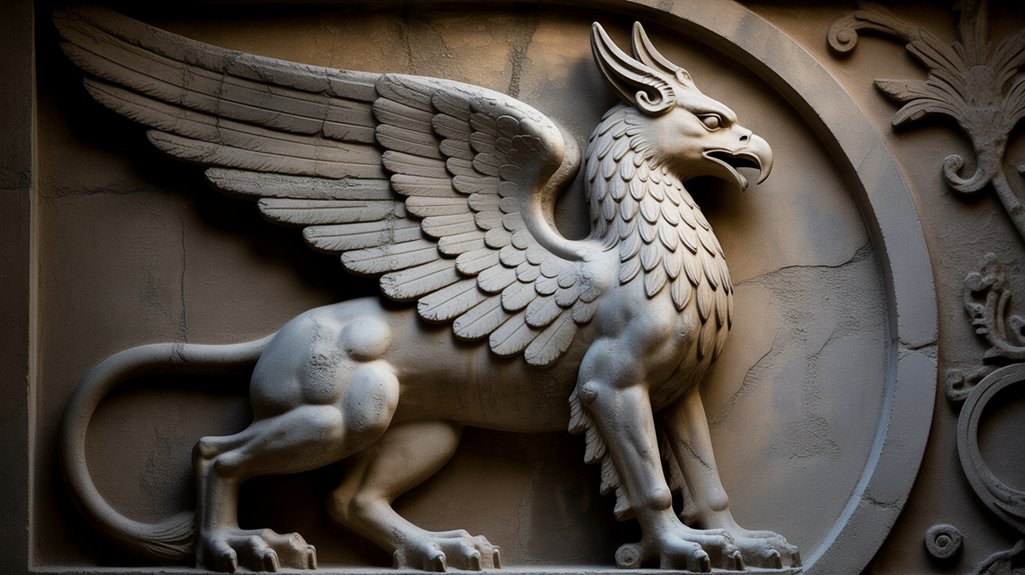
You'll find the griffin's earliest temple manifestations not in Minoan Crete but in Persian artifacts from 3000 BCE, where artisans of the Ancient Near East Heartlands carved these chimeric sentinels into sacred stone with deliberate, ritual precision.
The hybrid form—leonine haunches fused with aquiline majesty—wasn't mere decorative whimsy but rather a calculated theology rendered in relief, embodying Divine Authority Through Sacred Hybridity that priests and kings alike invoked as celestial intermediaries.
These eldritch guardians, positioned at thresholds between profane courtyards and sanctified inner chambers, announced a cosmological truth: that power flows through liminal beings who transcend earthbound categories.
Persian Artifacts, 3000 BCE
Among Persia's earliest bronze temples, dating to approximately 3000 BCE, excavated carvings reveal chimeric guardians etched into metal with startling precision—griffins rendered in composite forms that merge leonine musculature with raptor talons and wings.
You're witnessing ancient craftsmanship that transcends mere decoration. These weren't idle artistic experiments; they embodied sovereignty itself, sentinels positioned where mortal and divine territories intersected.
The metalworkers who shaped these eldritch protectors understood something you've perhaps forgotten: symbols carry power beyond representation. Their mythological significance permeated religious ceremonies and political legitimacy alike, altering bronze into spiritual armor.
The griffin's presence in Persian temples established a pattern that would echo through millennia—this wasn't mythology confined to stories but rather living iconography that demanded acknowledgment.
Power recognized. Protection guaranteed. Freedom defended through symbolic might rendered permanent in metal.
*Ancient Near East Heartlands**
From Persia's bronze temples, the griffin's influence radiated outward across the Ancient Near East, where temple artisans converted this composite sentinel into architectural proclamation. You'll find these chimeric guardians carved into sacred thresholds, their eldritch forms protecting divine sanctuaries and consecrated treasures from profane intrusion.
| Location | Symbolic Function |
|---|---|
| Temple Entrances | Guardian Threshold |
| Sacred Chambers | Divine Protection |
| Treasure Repositories | Vigilant Sentinel |
Ancient civilizations synthesized Mesopotamian and Egyptian iconography into these intricate reliefs, their symbolic heritage manifesting through meticulous detailing. Lion strength merges with eagle vigilance. The griffin becomes liminal bridge, connecting earthly supplicants with celestial powers through stone-carved permanence. This wasn't mere decoration—it was architectural theology, granting you passage between domains through sacred geometry and mythic form.
*Divine Authority Through Sacred Hybridity**
When Bronze Age priest-sculptors chiseled griffin forms into temple limestone, they weren't merely creating decorative motifs—they were engineering legitimacy itself through sacred zoomorphic fusion.
You witness across Mediterranean heartlands how eagle and lion merged into chimeric sovereignty, establishing divine authority through hybrid symbolism that transcended mortal boundaries. This eldritch convergence embodied celestial vigilance merged with terrestrial strength, positioning rulers as intermediaries between cosmic and earthly domains.
Sacred guardianship materialized in limestone and bronze, altering temples into threshold spaces where kings claimed god-sanctioned power.
The griffin's composite anatomy—raptor's wings ascending, predator's musculature grounding—manifested dual legitimacy. Archaeological evidence reveals consistent deployment: treasuries, throne rooms, sanctum boundaries.
Each carving reinforced hierarchy through zoomorphic theology, binding political sovereignty to numinous protection. Authority became corporeal through mythic hybridity.
*Greek vs. Egyptian Griffin Forms**

Though separated by the Mediterranean's azure expanse, Greek and Egyptian civilizations conjured forth distinct chimeric visions of the griffin—each form reflecting the spiritual architecture of its culture.
| Aspect | Greek Griffin | Egyptian Griffin |
|---|---|---|
| Physical Form | Eagle forequarters merged with leonine hindquarters | Sphinx-like embodiment, lion corpus crowned with human countenance |
| Cultural Symbolism | Heroic strength, guardianship of Scythian gold deposits, divine association with Apollo and Nemesis | Spiritual protection, threshold guardians of tombs, conduits between mortal and divine dimensions |
| Primary Function | Territorial sentinels of precious mineral wealth | Protectors of afterlife passages, embodiments of sacred wisdom |
You'll find these contrasting artistic representations reveal profound differences. Greek griffins embodied martial prowess and material guardianship—eldritch sentinels of earthly treasure. Egyptian counterparts transcended mere physicality, becoming psychopomps guiding souls through liminal darkness. Each culture's griffin materialized its deepest anxieties and aspirations through sacred hybridity.
*Alchemical Fire Meets Volatile Air**
Within medieval laboratories where mercury pooled in clay vessels and sulfurous smoke curled toward vaulted ceilings, the griffin emerged as something far beyond mythological ornament—it became the central emblem of change itself.
You'll find this chimeric sentinel guarding the threshold where elemental forces converge, where earthbound lion-consciousness meets the ascending intellect of the eagle.
The alchemist's pursuit demanded perfect union:
- Fixed Fire (Lion): Solar courage anchoring the volatile spirit, representing sulfur's binding principle and the philosopher's gold
- Volatile Air (Eagle): Mercury's ascending force, the quicksilver intelligence piercing celestial mysteries
- The Marriage: Transformative consciousness emerging from their fusion—neither purely material nor wholly ethereal
This alchemical balance wasn't mere symbolic flourish. It mapped the seeker's internal revolution, that eldritch work where base consciousness changes into illuminated awareness.
The griffin stood as your witness, your warning: transformation requires both grounding and flight, courage and wisdom fused.
*Dante's Purgatorio Griffin Allegory**

In Dante's Purgatorio, you encounter the griffin not as mere beast but as chimeric revelation—its eagle-headed sovereignty fused with leonine strength embodies Christ's dual nature, that ineffable union of divine transcendence and incarnate flesh.
This guardian pulls the chariot of ecclesiastical truth through purgatorial fire, its golden feathers and blood-red frame arresting Beatrice herself in canto XXXI, altering theological abstraction into visceral witness.
You stand before sacred metamorphosis: the griffin becomes axis mundi where redeemed humanity ascends, where courage and wisdom cease their opposition and become singular, eldritch path toward beatific vision.
Divine Dual Nature Symbolism
As Dante ascended through the terraced mountain of Purgatorio in 1308-1321, he encountered perhaps the most theologically sophisticated chimeric being in medieval literature: the griffin who drew the chariot of the Church triumphant.
You witness here divine balance incarnate—eagle wings merging with leonine haunches, celestial intellect fused with terrestrial power. This wasn't mere fantasy. The griffin embodied Christ's hypostatic union, simultaneously God and man, neither diminished by the other.
When you observe the creature simultaneously walking and capable of flight, you're seeing spiritual ascension made tangible: the transcendence of divine spirit over mortal constraint. The griffin beckons souls toward change, inviting them to embrace their own dual inheritance—flesh bound yet spirit-capable.
Ancient wisdom crystallized. The path upward revealed.
Guardian of Sacred Transformation
When the soul stands trembling at the threshold between sin and salvation, the griffin materializes not as adversary but as sentinel—watching, weighing, determining readiness for ascent.
In Dante's thirteenth-century vision, this chimeric guardian pulls the chariot divine, its eagle wings bearing celestial authority while leonine haunches ground it in earthly wisdom.
You can't bypass such a keeper through deception or force. The altering power it wields flows from integration: spirit married to flesh, justice tempered by mercy, transcendence rooted in material reality.
Here stands protection against premature ascension, against false enlightenment. The sacred journey demands this eldritch fusion—your higher consciousness emerging only when you've reconciled the warring opposites within.
The griffin permits passage solely to those prepared for purgatorial fire.
Chariot of Redeemed Humanity
The chariot emerges from Dante's 1308-1320 masterwork bearing weight far heavier than wood and wheel—it carries the architecture of human redemption itself.
You witness the chimeric griffin—eagle-crowned, lion-haunched—drawing this sacred conveyance through Purgatorio's terraced slopes, its dual nature mirroring Christ's terrestrial and celestial essence. This redemption journey demands both talon and sinew, wisdom and strength fused into singular purpose.
The chariot blazes with polychromatic splendor, each hue representing humanity's myriad struggles toward transcendence.
You can't achieve liberation through denial of either domain—the earthbound or the eldritch. Here lies your path: spiritual guidance channeled through this magnificent beast, pulling souls from shadow into illumination.
The griffin's steady gait confirms what ancient wisdom knew—redemption requires embracing your complete nature, neither rejecting flesh nor forsaking spirit.
*Corporate Logos and Fantasy Franchises**
Though centuries have separated the griffin's ancient temple guardians from today's marketplace, this chimeric sentinel has discovered renewed purpose within corporate heraldry and fantasy entertainment—a migration that speaks to humanity's persistent need for symbols embodying protection, valor, and transcendent power.
You'll encounter these mythical creatures defending brand identities, their talons clutching corporate shields as they once guarded Mesopotamian sanctuaries.
Their cultural significance manifests across three distinct modern areas:
- Corporate emblems of local enterprises wielding griffin imagery to channel ancestral associations with strength and leadership
- Fantasy literature and cinema, from Harry Potter's noble specimens to eldritch guardians populating countless narrative worlds
- Interactive gaming domains including Dungeons & Dragons and The Elder Scrolls, where griffins serve as formidable adversaries or stalwart companions
This enduring presence demonstrates how ancient symbolism refuses confinement to archaeological strata.
Instead, it resurges, adapts, colonizes contemporary consciousness—proving that humanity's yearning for transcendent protectors remains undiminished across millennia.
*Jung's Collective Unconscious Archetypes**
Carl Jung's innovative framework of the collective unconscious offers perhaps the most compelling theoretical architecture for understanding why griffins—and kindred hybrid sentinels—refuse extinction from humanity's symbolic vocabulary.
Within this psychic substrate, the griffin operates as primordial template, its chimeric form encoding essential truths about psychological integration—the reconciliation of opposing forces that defines authentic selfhood. You encounter mythical symbolism not as cultural artifact but as living inheritance, the eagle-lion fusion representing intellect married to courage, spirit bound to flesh.
Through individuation's eldritch pathways, the griffin becomes guide rather than ornament, its dual nature mirroring your own internal contradictions demanding synthesis. Jung recognized these archetypal figures as psychic constants, inherited structures shaping perception across millennia, cultures, generations.
When you engage the griffin's image—whether in medieval manuscript or modern fantasy—you're accessing something older than language itself. Ancient wisdom crystallized into form. The archetype persists because it maps genuine psychological territory, offering coordinates for traversing consciousness's unmapped depths.
*Inner Sovereignty in Chaotic Times**
When civilizational foundations tremble—economies convulsing, institutions fracturing, collective certainties dissolving into informational chaos—the griffin's ancient counsel acquires renewed urgency. Its fusion-form offers not escapism but operational wisdom for guiding through turbulence. You needn't await external salvation when this chimeric guardian reveals self-actualization strategies encoded within its dual nature: leonine courage anchoring your instinctive power, aquiline vision elevating perspective beyond immediate panic.
Steering through uncertainty demands precisely this alchemical marriage—grounded ferocity meeting transcendent clarity. The griffin's guardianship of sacred knowledge wasn't metaphorical decoration but practical instruction. In liminal moments when old orders collapse, you're called to become sovereign territory unto yourself, maintaining interior truth while external structures dissolve.
This isn't solitary isolation but authentic presence. Draw upon both taloned strength and soaring intellect simultaneously. Rise above chaos without abandoning earthly engagement. The eldritch wisdom persists: your integrated self—neither purely reactive nor abstractly detached—becomes the stabilizing axis around which coherent reality reconstellates.
*Reclaim Your Griffin Within**
Activation of the griffin consciousness begins not through invocation of external forces but through archaeological excavation of your own psychic strata—those compressed layers where instinctual ferocity and celestial intelligence have always coexisted, awaiting recognition.
This mythical legacy doesn't require elaborate ritual. It demands honest confrontation with your fragmented sovereignty, those moments when you've surrendered authority to systems designed to keep you domesticated, compliant, earthbound.
Personal enablement through the griffin archetype means refusing the false binary between spiritual transcendence and material engagement. You're neither purely ethereal nor merely corporeal—you're the eldritch synthesis, the chimeric guardian standing at civilization's threshold.
Your lion-heart pumps courage through inherited bloodlines. Your eagle-vision penetrates manufactured illusions.
The griffin awakens when you acknowledge this dual inheritance without compartmentalization. Ancient Mesopotamians understood what modern institutions obscure: sovereignty isn't granted. It's reclaimed through integration of your ground-level ferocity with your high-altitude perception.
Wholeness, not perfection. Embodiment, not escape.
Frequently Asked Questions
What Other Hybrid Creatures Share Similar Symbolic Meanings With the Griffin?
You'll find the sphinx guards similar thresholds between earth and sky, blending human wisdom with leonine strength.
The chimera—that ancient chimeric being from Lycia's volcanic slopes—unites serpent, lion, and goat in primordial fury.
Mesopotamia's lamassu, those colossal bull-winged guardians standing since 883 BCE, protect sacred boundaries.
These mythical creatures embody sovereignty, divine protection, liminal power.
They're gatekeepers between domains, synthesizing disparate forces into unified symbols of transcendent authority that challenge your understanding of fixed categories.
How Did Griffin Symbolism Differ Across Various Asian Cultures and Traditions?
Ever wonder how chimeric guardians transcended borders, shapeshifting through cultural consciousness?
Chinese griffins—the *Pixiu*—devoured evil, hoarded celestial wealth, channeling yang energy through jade-carved forms during Han Dynasty temples.
Indian griffins, the eldritch *Sharabha*, manifested as lion-bird hybrids in Vedic texts, destroying chaos itself.
You'll find they weren't mere copies but autonomous symbols: China emphasized prosperity and imperial power, while India's tradition celebrated divine intervention.
Different lands, different freedoms sought—yet both revered these liminal protectors guarding transcendent domains.
Are There Any Surviving Griffin Artifacts Displayed in Major Museums Today?
You'll discover magnificent griffin artifacts across the world's premier museum displays—the British Museum houses Persian achaemenid gold plaques, while the Louvre preserves Mesopotamian chimeric guardians from Susa's palace gates.
The Metropolitan Museum showcases Greek ceremonial vessels adorned with eldritch talons and wings.
Ancient bronze figurines, carved ivory panels, and painted ceramic fragments survive as evidence of this creature's sacred power.
Each piece whispers forgotten knowledge, beckoning you to witness humanity's eternal fascination with transcendent hybrid forms.
What Role Did Griffins Play in Medieval Heraldry and Family Crests?
You'll find griffins bore profound heraldic significance throughout medieval Europe, marking family lineage with their chimeric power.
Noble houses—particularly in 12th-century Italy and Germany—claimed the creature's dual nature: leonine courage, aquiline vigilance. These weren't mere decorations. They were ancestral declarations of strength, guardianship over wealth and territory.
The griffin's eldritch presence on shields and banners proclaimed your bloodline's divine right to rule, merging earthly dominion with celestial authority in heraldic tradition.
How Can Someone Incorporate Griffin Symbolism Into Their Daily Spiritual Practice?
You'll download griffin imagery to your phone's wallpaper, letting chimeric power permeate your consciousness.
Incorporate meditative rituals at dawn—visualize the creature's eldritch duality, eagle meeting lion, sky touching earth.
Your daily affirmations should invoke its guardian essence: “I embody both wisdom and strength.”
Sketch griffins in journals. Wear their symbols.
Ancient Mesopotamian priests understood this: repeated contact with sacred iconography alters consciousness, breaking mundane chains that bind your spirit to the ordinary.
Conclusion
You've traced the griffin's flight through millennia—now let its chimeric form awaken within you. This eldritch sentinel guards no external treasure; it's calling you toward inner alchemy, that sacred marriage of earth-bound courage and celestial vision. When chaos threatens to fragment your sovereignty, remember: you carry ancient flame and transcendent air in your very bones. The griffin never left. It simply waited for your recognition.