Mythical monsters emerged across civilizations as psychological architecture reshaping nature's sovereign violence into comprehensible narratives—dragons embodied seismic ruptures and floods, serpents personified water's nurturing-yet-destructive duality, while leviathans crystallized maritime terror. From Babylonian Tiamat's primordial chaos to Japan's thunder-wielding Raijin, these chimeric beings converted catastrophic forces into survival mechanisms, their scales and fangs memorializing epochs when nature's indifference swallowed cities whole. Modern incarnations like Godzilla's atomic breath perpetuate this archetypal function, now encoding nuclear anxiety and climate collapse into monstrous form, suggesting humanity's deepest fears remain encoded in mythic language awaiting interpretation.
Key Takeaways
- Monsters symbolize elemental forces like fire, water, and storms that ancient civilizations struggled to understand and control.
- Dragons, serpents, and demons personify natural disasters such as floods, earthquakes, and volcanic eruptions across cultures.
- Chaoskampf myths depict heroes battling monsters to represent civilization's attempt to impose order on nature's chaos.
- Water creatures embody duality—both nurturing life through fertility and destroying it through floods and droughts.
- Modern monsters like Godzilla reflect contemporary fears of environmental collapse and humanity's inability to control nature.
Monsters Lurk in Every Civilization
When civilizations first carved their fears into clay tablets and temple walls, they birthed dragons—those serpentine embodiments of nature's most eldritch terrors. From Babylonian Tiamat, primordial goddess of saltwater chaos, to China's Long, celestial guardians of storms and rivers, these chimeric beings transcended geographical boundaries.
Cultural interpretations varied: Sumerian texts depicted scaled behemoths emerging from cosmic waters, while Germanic sagas told of wyrms coiled beneath world-trees. The mythological significance of these creatures extended beyond mere folklore. They represented humanity's visceral confrontation with uncontrollable forces—floods swallowing villages, lightning splitting ancient oaks, predators stalking moonless nights.
Shinto shrines honored serpentine kami, acknowledging nature's dual capacity for destruction and renewal. The Moche civilization's Moon Animal linked celestial cycles to agricultural survival, demonstrating how monsters mediated between human vulnerability and environmental dominance.
These weren't fantasies. They were survival mechanisms, psychological armor forged in the crucible of primordial uncertainty, binding communities through shared reverence for powers that defied comprehension. Through storytelling across generations, these myths explained natural phenomena that threatened existence while simultaneously providing frameworks for understanding humanity's place within an unpredictable cosmos.
##
Across the threshold of human consciousness and the natural world's untamed dominion, mythical creatures emerged not as mere fantasy but as embodied translations of elemental terror—each monster a cultural cipher for the forces that could, without warning, unmake civilizations.
Dragons commanded fire and storm, their chimeric forms merging serpent, bird, and beast into avatars of atmospheric fury, while demons personified the sudden violence of earthquakes, floods, and pestilence that shattered agrarian stability.
The serpent coiled through mythology's depths as water incarnate, simultaneously life-giver and destroyer, and the wilderness beasts—griffins, manticores, and other eldritch predators—channeled the primal chaos lurking beyond the campfire's protective ring.
The legendary Kraken of Norse folklore, capsizing ships with its massive tentacles, embodied the ocean's capacity for sudden devastation and the maritime world's constant threat of annihilation.
Dragons Embody Elemental Forces
Throughout millennia of human imagination, dragons haven't merely represented supernatural beasts—they've crystallized humanity's primal understanding of elemental forces themselves.
Dragon symbolism manifests distinctly across civilizations: Western traditions envision fire-breathing terrors embodying volcanic fury, while Chinese cosmology venerates water-serpents commanding rain and agricultural abundance.
The Babylonian Tiamat, that eldritch oceanic chaos-bringer from “Enūma Eliš,” exemplifies elemental representation through her dual nature—simultaneously destructive deluge and creative wellspring.
This chimeric fusion of natural phenomena persists across continents. Floods, eruptions, tempests—all attributed to draconic wrath.
Yet dragons also guard treasures, symbolizing nature's hidden mysteries awaiting human comprehension. They're neither wholly malevolent nor benign.
Pure elemental force incarnate. These ancient creatures map humanity's eternal struggle understanding, respecting, perhaps controlling the sublime, terrible powers governing existence itself.
Demons Reflect Natural Disasters
While dragons crystallize elemental majesty in serpentine form, demons embody nature's most catastrophic ruptures—those sudden, inexplicable violations of cosmic order that shatter human civilization in moments.
These demonic manifestations personify earthquakes, floods, volcanic eruptions—nature's fury incarnate. Japan's Raijin thunders across storm-darkened skies, his drums echoing humanity's primal terror before lightning's eldritch power. Mesoamerica's Tezcatlipoca commands hurricanes, weaving chaos through wind and deluge.
Across cultures, such beings convert incomprehensible destruction into narratives humans can grasp, confronting mortality's fragility. Ancient peoples attributed catastrophes to demonic wrath, creating cosmologies where supernatural malevolence explained nature's unpredictability.
These chimeric entities don't merely threaten—they reveal humanity's perpetual struggle against forces beyond control or understanding, converting raw geological violence into mythological language that grants meaning to devastation.
Serpents Symbolize Water's Duality
If dragons command fire's altering rage and demons channel catastrophe's sudden violence, serpents weave through humanity's mythological consciousness as water's eternal mediators—creatures whose sinuous forms mirror rivers' meandering paths and whose cold-blooded nature reflects aquatic depths where sunlight dissolves into shadow.
Serpent symbolism manifests this duality across civilizations: Egypt's Wadjet embodied the Nile's protective sovereignty, while Babylonian Tiamat personified primordial chaos itself.
Hindu nagas emerged as water guardians, balancing fertility against drought's devastation. Quetzalcoatl merged earth with aquatic forces, sustaining Mesoamerican agriculture through eldritch conjunction.
These scaled deities didn't merely represent water—they *were* its essence made flesh, embodying both nurturing rain and flood's annihilation.
Freedom from nature's extremes required their propitiation, their serpentine forms forever coiling through humanity's collective psyche.
Beasts Channel Wilderness Chaos
Where serpents mediated between cosmic order and aquatic flux, beasts erupted from wilderness itself—incarnations of untamed territorial violence that resisted all human boundary-making.
These mythical beasts embodied wilderness chaos in its purest form, from Babylonian Tiamat's primordial fury to the chimeric creatures guarding sacred thresholds.
The Chaoskampf tradition crystallized humanity's existential struggle against nature's eldritch sovereignty, each dragon-slaying hero attempting to impose civilization upon the formless wild.
Ancient encounters with massive reptiles, coupled with volcanic eruptions and seismic upheavals, generated these fearsome archetypes.
The beasts weren't mere monsters—they were nature's raw declaration of autonomy, reminding would-be conquerors that wilderness answers to no master, acknowledges no surveyor's stake, bows to no crown.
This folkloric resistance still whispers: some territories refuse domestication.
Ancient Mesopotamian Monster Tablets
The Sumerian clay tablets emerged from the Tigris-Ephrates River Valley around 3000 BCE, their cuneiform inscriptions preserving humanity's earliest confrontations with nature's eldritch fury incarnate in monstrous form.
These primordial records, fired in kilns and pressed with reed styluses, bear witness to a civilization whose very existence depended upon appeasing capricious waters—floods that brought both life-sustaining silt and catastrophic devastation.
Within their brittle surfaces dwells flood mythology interwoven with divine wrath, where gods wielded deluge as cosmic punishment and chimeric beings embodied the terrifying unpredictability of riverine forces beyond mortal control.
Sumerian Clay Tablets, 3000 BCE
Clay-pressed cuneiform marks from 3000 BCE preserve humanity's earliest sustained attempt to catalogue the eldritch, to render in wet earth what lurked beyond the torchlight of Sumerian settlements.
These tablets immortalize Sumerian monsters like Humbaba, the cedar-guarding colossus whose breath was pestilence, whose voice was flood. Ancient beliefs coalesced around such figures—chimeric embodiments of nature's chaos that explained why rivers swallowed villages, why winds stripped harvest bare.
The Sumerians understood what modernity forgets: chaos can't be controlled, only acknowledged. These mythical guardians stood at civilization's threshold, neither wholly malevolent nor benign, reflecting the duality inherent in wilderness itself.
Natural disasters became divine narratives, comprehensible through monster-mediated theology. Each cuneiform wedge documented humanity's primal negotiation with forces beyond mastery, altering existential terror into structured cosmology.
Tigris-Euphrates River Valley Origins
Between twin arteries of silt-laden water, the Tigris and Euphrates carved civilization from wilderness, and with civilization came the monsters that explained why those waters turned destroyer. Ancient narratives etched upon clay preserved Tiamat, the eldritch chaos dragon whose serpentine form embodied floods that devastated harvests without warning.
| Monster | Natural Force |
|---|---|
| Tiamat | Destructive floods, storms |
| Laḫmu | Primordial silt, sediment |
| Mušḫuššu | River currents, undertow |
The “Enūma Eliš” chronicles chimeric beings born from aquatic chaos, cultural symbolism demanding gods impose order upon nature's fury. These tablets weren't mere mythology. They were survival manuals, teaching farmers that prosperity and annihilation flowed from identical sources, that monsters lived in every life-giving river.
Flood Mythology and Divine Wrath
When humanity's transgressions accumulated beyond divine tolerance, Mesopotamian gods didn't simply punish—they liberated the abyssal waters themselves, altering life's foundation into an instrument of annihilation.
The Epic of Gilgamesh chronicles Enlil's catastrophic flood narratives, where divine punishment manifested through primordial chaos. Tiamat, the eldritch serpent-mother, embodied water's uncontrollable fury—not merely monster, but cosmic force released. These tablets preserved humanity's terror before nature's violence.
Ancient Mesopotamians understood floods weren't random. They were cosmic recalibrations.
Chimeric water-beings in these myths represented environmental apocalypse, translating riverine devastation into theological framework. The Tigris-Euphrates valleys flooded unpredictably, drowning civilizations overnight.
Scribes immortalized this dread through divine wrath mythology, converting incomprehensible natural disaster into narrative their communities could grasp. These weren't cautionary tales alone—they were philosophical treaties negotiating humanity's precarious relationship with nature's overwhelming sovereignty.
Greek Vs Norse Sea Beasts
Across the wine-dark Mediterranean and the storm-wracked Nordic fjords, two ancient civilizations crafted monuments of terror in their collective imaginations—sea beasts that embodied the eldritch power of waters beyond human dominion. The Greeks conjured the Kraken, that tentacled nightmare rising from abyssal trenches, its Kraken symbolism representing chaos incarnate. The Norse envisioned Jörmungandr chaos—the world-encircling serpent whose venomous coils heralded Ragnarök itself.
| Aspect | Greek Tradition | Norse Tradition |
|---|---|---|
| Primary Beast | Kraken, Scylla | Jörmungandr, Fenrir |
| Symbolic Function | Unknown depths, immediate danger | Cosmic destruction, apocalyptic threat |
| Cultural Message | Sea's unpredictability | Fate's inevitability |
Both mythologies altered oceanic terror into chimeric forms that sailors whispered about during night watches. Scylla's multiple jaws devoured crews whole. The Midgard Serpent's thrashing would drown continents. These weren't mere monsters—they were humanity's acknowledgment that nature's dominion remained absolute, that freedom itself depended upon respecting forces no mortal could ever truly master.
Nature's Chaos and Human Fear
Though civilization erected stone temples and forged bronze weapons to proclaim dominion over the natural world, humanity's deepest narratives betray a primordial terror—the acknowledgment that nature remains fundamentally ungovernable, a force whose chaotic appetites could devour order itself.
Dragons manifest this human anxiety through their elemental fury. Ancient cultures personified nature's wrath through these chimeric beings, converting incomprehensible destruction into tangible adversaries:
- Tiamat's Primordial Chaos: Babylonian mythology's serpent goddess embodied the untamed waters preceding creation, representing the eternal tension between cosmic order and dissolution.
- Earthquake Dragons: Medieval chronicles attributed seismic devastation to subterranean wyrms, their thrashing coils explaining ground ruptures and collapsed fortifications.
- Chaoskampf Narratives: Heroes battling eldritch serpents symbolized humanity's perpetual struggle against nature's unpredictability, converting helplessness into mythic agency.
These creatures evolved alongside civilization's relationship with chaotic nature—from manifestations of pure terror to symbols of power humanity might utilize, reflecting our desperate quest for autonomy against forces eternally indifferent to human sovereignty.
Leviathan in Biblical Texts
Within the turbulent verses of Job and Psalms, Leviathan emerges as the eldritch personification of primordial chaos—a serpentine colossus dwelling in waters that preceded creation's order.
This creature isn't merely God's adversary but rather His ultimate witness, a chimeric marvel so formidable that only divine power can bridle its thrashing coils and flame-breathing maw.
The beast remains untameable by mortal hands, its impenetrable scales and crushing jaws serving as living proof of nature's savage autonomy beyond human dominion.
Chaos Waters Personified
In the turbulent depths of biblical cosmology, Leviathan emerges as chaos incarnate—a serpentine colossus whose writhing form embodies the primordial waters that preceded divine order. This eldritch beast serves as chaos representation in its purest manifestation, coiling through the untamed seas that ancient Hebrews recognized as humanity's existential adversary.
Job 41's vivid catalogue of invulnerability—scales like bronze shields, breath igniting coals—transforms Leviathan into elemental symbolism itself, where water's dual nature crystallizes into flesh and fang. The creature parallels Tiamat's chimeric vastness in Babylonian chaoskampf narratives, establishing a Near Eastern pattern: divine sovereignty proved through the subjugation of aquatic chaos.
These chaos waters, personified and monstrous, remind humanity that beneath civilization's fragile order writhes something wild, unbroken, forever resistant to control.
God's Ultimate Creation
When Yahweh answers Job from the whirlwind, He doesn't defend His cosmic justice through philosophical argument—He summons Leviathan.
This eldritch behemoth, armored in impenetrable scales that defy human weapons, breathing flame from chimeric jaws, stands as divine creation's most terrifying masterwork. The creature embodies chaotic forces that predated Eden's ordering, yet bows to its Maker alone.
Job 41 alters monster into theological paradox: Leviathan's very existence proves divine sovereignty over primordial chaos. No hook pierces its hide, no sword finds purchase between those bronze-hard scales.
The beast doesn't symbolize evil requiring destruction—it represents nature's untamable sublime, that terrible beauty which humanity can neither conquer nor comprehend.
God's rhetorical question echoes through millennia: “Can you draw out Leviathan with a fishhook?” The answer illuminates freedom's deepest truth: acknowledging powers beyond human dominion.
Untameable Sea Serpent
Though ancient scribes lacked taxonomic precision, their terror possessed crystalline clarity—Leviathan coils through biblical verse as humanity's oldest maritime nightmare made theological flesh.
Job's chronicle renders this eldritch behemoth in scales that mock iron, breath igniting coals, eyes gleaming like dawn's first blood. The creature embodies untameable chaos, defying Solomon's wisdom and David's strength alike.
Its chimeric form—part serpent, part dragon, wholly unknowable—parallels Tiamat's primordial fury in Babylonian cosmology, establishing mythical symbolism across Mesopotamian consciousness.
These weren't mere monster tales but philosophical treatises on power's limits. When waves swallowed ships without mercy, when storms devoured coastlines, ancient peoples recognized forces beyond mortal dominion.
Leviathan represented nature's sovereign indifference, teaching humility to those who'd claim mastery over the deep's mysterious territories.
Godzilla as Nuclear Anxiety
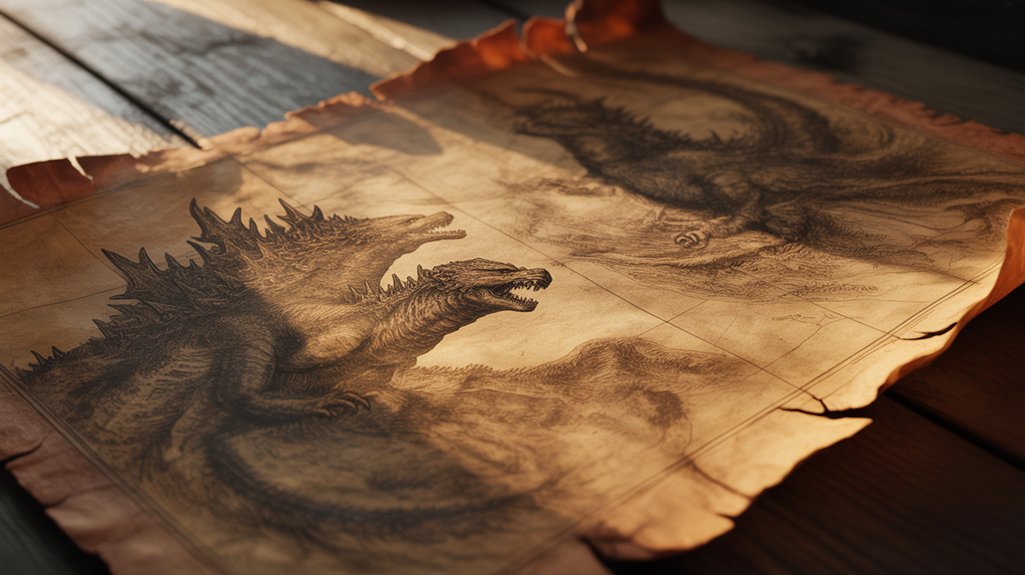
The kaiju's nuclear symbolism operates through three devastating manifestations:
- Atomic breath—radioactive fire expelled from depths unknown, mirroring mushroom clouds that consumed Hiroshima and Nagasaki.
- Charred, keloid-textured skin—deliberate evocation of radiation burns scarring hibakusha survivors.
- Unstoppable rampage—embodying technology's cascade beyond human control.
This prehistoric leviathan, mutated by hydrogen bomb testing, became Japan's chimeric exorcism of nuclear trauma.
Through subsequent cultural reinterpretation, Godzilla evolved from pure antagonist to reluctant defender, reflecting shifting anxieties about environmental collapse and genetic manipulation.
The monster endures because it channels primal terror: nature's power weaponized through humanity's own recklessness, returning to obliterate its creators.
Jung's Collective Unconscious Theory
Beyond individual memory's fragile boundaries lies Jung's cartography of deeper waters—the collective unconscious, that primordial reservoir where humanity's oldest terrors and transcendent visions coalesce into archetypal forms.
These collective dreams manifest across disparate civilizations, birthing dragons from Chinese temples to Nordic sagas, serpentine leviathans that embody nature's unfathomable power.
Jung understood that archetypal symbols weren't mere cultural accidents. They emerged from humanity's primal confrontation with the eldritch forces governing existence—storms that shattered settlements, floods that devoured valleys, volcanic fury that reshaped landscapes.
The dragon, that chimeric synthesis of serpent, bird, and beast, represents nature's chaotic supremacy, the Chaoskampf that haunts our species-memory.
These monsters transcend folklore. They're psychological inheritances, encoded responses to nature's grandeur and menace.
When ancient peoples carved dragons into stone, they externalized an internal archetype—humanity's perpetual struggle against forces beyond comprehension, beyond control.
Nature's power demands representation; the psyche answers with monsters.
Climate Change Monster Metaphors
Contemporary civilization now confronts its own archetypal beast—climate change rendered monstrous through metaphor and myth-making, as urgent as any dragon that darkened medieval skies.
The Ice Monster dissolves into ocean, its crystalline form fragmenting. The Fire Beast ravages forests with chimeric hunger. These eldritch manifestations of climate anxiety convert scientific data into visceral, narrative truth that pierces collective denial.
Mother Nature herself has metamorphosed from benevolent provider into wrathful deity, her dual aspects—nurturing, destructive—no longer balanced but catastrophically skewed.
Ancient sea serpents resurface in modern consciousness, embodying oceanic turmoil, rising tides that threaten coastal existence. These reimagined creatures don't simply terrify; they illuminate environmental justice struggles, revealing how vulnerable populations face disproportionate devastation while the privileged remain insulated.
Such monsters function as cautionary totems, ancestral warnings translated into contemporary crisis. They demand acknowledgment, action, freedom from systems perpetuating ecological collapse.
Before conversion becomes irreversible.
Monsters Mirror Our Survival Instincts
When primordial humans first heard thunder crack across savanna skies or witnessed cave bears rear from darkness, their nervous systems didn't pause for philosophical reflection—they encoded these encounters as survival imperatives, weaving predatory forms into mythic consciousness.
These ancient survival tales altered environmental threats into chimeric entities whose eldritch characteristics mirrored genuine dangers: serpentine coils echoing constrictors, wings representing aerial predators, fire-breathing maws symbolizing volcanic devastation.
Nature's wrath demanded cognitive mapping strategies. Monsters became mnemonic devices, teaching progeny which territories harbored lethal risks, which seasonal patterns threatened famine, which waters concealed drowning depths.
The Babylonian Tiamat embodied oceanic chaos circa 1900 BCE, her defeat representing humanity's agricultural mastery over unpredictable flooding. Norse Jörmungandr encircled Midgard as maritime peril incarnate, reminding coastal communities of the sea's capacity for annihilation.
These narratives weren't mere entertainment—they constituted survival curricula, imprinting behavioral algorithms into collective memory.
Respecting mythical boundaries meant acknowledging nature's supremacy. Liberation emerges not through conquering wilderness, but through understanding our place within its merciless architecture.
Frequently Asked Questions
How Do Modern Horror Films Use Mythical Monsters Differently Than Ancient Cultures?
Modern horror films reshape mythical creature evolution into psychological metaphors, where ancient guardians of sacred thresholds become externalized trauma, existential dread made flesh.
This cinematic symbolism strips creatures of their primordial reverence—the chimeric beings once honored as nature's emissaries now serve entertainment's appetites.
Ancient cultures approached these eldritch entities with ritual gravity, maintaining balance between worlds.
Contemporary cinema, however, exploits their imagery for visceral thrills, severing monsters from their cosmological roots, reducing transformative spiritual encounters to jump-scares that liberate audiences from nothing except perhaps their comfort zones.
What Psychological Effects Do Monster Stories Have on Children's Development?
Monster tales serve as crucibles for young minds, forging strength through shadow. These eldritch narratives promote essential fear processing, allowing children to confront primordial anxieties—death, abandonment, chaos—within safe boundaries.
Through repeated exposure to chimeric threats and their resolution, young psyches develop emotional resilience, that coveted armor against life's uncertainties. Ancient cultures understood this: monsters weren't merely entertainment but developmental tools, teaching survival, discernment, and courage.
The child who masters fictional darkness gains sovereignty over real terrors.
Are There Cultures That View Monsters as Protectors Rather Than Threats?
Many cultures revere monsters as guardian spirits rather than adversaries. Japanese oni protect temple gates, while Chinese dragons embody benevolent cosmic forces, their serpentine forms warding against malevolent entities.
Celtic folklore honors the púca—shapeshifters who guard sacred boundaries. This cultural symbolism reflects humanity's recognition that eldritch power exists beyond moral binaries.
Indigenous Australian traditions venerate Rainbow Serpent as life-giver and protector. These chimeric beings transcend Western narratives, embodying nature's dual capacity for destruction and preservation—ancient wisdom acknowledging that protection requires strength.
How Have Feminist Scholars Reinterpreted Traditional Female Monster Figures Like Medusa?
Feminist scholars reclaim Medusa, they reinterpret Lilith, they convert the Gorgon's petrifying gaze from patriarchal punishment into female liberation.
The serpent-crowned figure becomes liberation itself—a woman refusing subjugation, her monstrous femininity now armor against violation.
Scholars trace her Libyan origins, revealing pre-Hellenic goddess heritage. Her decapitation represents masculine fear of autonomous female power.
Stone-making eyes? They're boundaries enforced, agency reclaimed.
The eldritch becomes emancipatory, converting victim narratives into chimeric symbols of resistance against systems demanding women's silence, compliance, erasure.
Do Monster Myths Influence Modern Environmental Policy and Conservation Efforts?
Mythical creatures increasingly shape environmental ethics through their resurrection in conservation narratives.
The dragon's territorial fury, the kelpie's drowned valleys—these eldritch warnings now frame ecological catastrophe in terms audiences viscerally understand.
Serpent-guardians of ancient wells become ambassadors for watershed protection; leviathans embody ocean vulnerability.
Conservation organizations deliberately invoke these chimeric figures to generate public awareness, altering forgotten folklore into policy influence.
Such mythic frameworks liberate environmental discourse from sterile data, awakening primal recognition of nature's sovereignty.
Conclusion
Throughout human history, over 80% of cultures have independently conjured aquatic leviathans—creatures born from humanity's primordial terror of unfathomable depths. These chimeric manifestations aren't mere folklore. They're ancestral warnings etched into collective memory. From Tiamat's eldritch coils to Jörmungandr's world-encircling form, monsters externalize nature's incomprehensible violence, altering abstract dread into tangible adversaries. Today's climate-spawned catastrophes resurrect these ancient archetypes, proving that humanity still needs its monsters—those liminal guardians reminding mortals of their insignificance before nature's sublime, terrifying power.