- Winged Creatures of greek mythology
- 1. Pegasus — the Winged Horse Born of Blood
- 2. The Griffin — Eagle and Lion in One Body
- 3. Harpies — the Snatchers
- 4. The Sirens — Bird-Women, Not Mermaids
- Mythical Winged Creatures — Winged Mythical Beings — Sacred Flyers of Asia: Mythical Flying Creatures
- 5. Garuda — the Mount of Vishnu
- 6. Fenghuang — the Chinese “Phoenix” That Never Burns
- 7. The Simurgh — Persia's Ancient Wisdom-Bird
- 8. The Roc — the Bird That Carries Elephants
- Flyers of the North
- 9. The Thunderbird — Storm Made Visible
- 10. Hræsvelgr — the Eagle at the World's Edge
- Dragons and Serpents of the Air
- 11. The Wyvern — the Two-Legged Dragon of Heraldry
- 12. Quetzalcoatl — the Feathered Serpent
- Birds of Omen and Paradise
- 13. The Phoenix — Death as a Beginning
- 14. The Ziz — the Sky's Counterpart to Leviathan
- 15. The Alkonost and Sirin — Russia's Birds of Joy and Sorrow
- Why Every Mythology Fills Its Sky
- Frequently Asked Questions
- What is the most famous mythical flying creature?
- What is the largest flying creature in mythology?
- Are sirens flying creatures?
- Which cultures have flying horse myths?
- Related Posts
- Related Posts
Long before aircraft, every civilization that watched birds cross the sky asked the same question: what else might be up there? The answers they gave — recorded in Greek epic, Vedic hymn, Norse saga, and Persian court poetry — form one of mythology's richest bestiaries. This guide gathers fifteen of the most significant mythical flying creatures from world mythology, with the primary sources that first described them.
Disclosure: This post contains affiliate links. If you click through and make a purchase, we may earn a small commission at no extra cost to you. Thank you for supporting this site!
Winged Creatures of greek mythology
1. Pegasus — the Winged Horse Born of Blood
Pegasus is probably the most recognizable winged creature in Western mythology, and his origin is far stranger than his modern image. In Hesiod's Theogony (c. 700 BCE, lines 280–286), Pegasus springs from the neck of the Gorgon Medusa at the moment Perseus beheads her. He later carries the hero Bellerophon in the battle against the Chimera — but when Bellerophon attempts to fly to Olympus itself, Zeus sends a gadfly to unseat him. Pegasus alone completes the journey, and Zeus sets him among the stars as a constellation that still bears his name.
2. The Griffin — Eagle and Lion in One Body
With the head and wings of an eagle on the body of a lion, the griffin fuses the king of birds with the king of beasts. Herodotus (Histories, Book 3.116, c. 430 BCE) reports griffins guarding gold in the mountains beyond Scythia, locked in perpetual war with the one-eyed Arimaspians who tried to steal it. Some historians of folklore, following Adrienne Mayor's work, have suggested the legend grew from Scythian encounters with Protoceratops fossils — beaked, four-legged skeletons weathering out of gold-bearing rock.
3. Harpies — the Snatchers
The harpies' name comes from the Greek harpazein, “to snatch,” and that is precisely what they do. In Apollonius of Rhodes' Argonautica (3rd century BCE, Book 2), they torment the blind king Phineus by stealing and fouling his food at every meal, until the winged Boreads — sons of the North Wind — drive them off. Homer and Hesiod describe them as storm-wind spirits; their later bird-bodied, woman-faced form is a development of the classical and medieval imagination.
4. The Sirens — Bird-Women, Not Mermaids
Modern audiences picture sirens as mermaids, but the earliest Greek art and texts show something different: birds with the heads of women. On Attic vases of the 6th century BCE, and in Homer's Odyssey (Book 12), the sirens are winged singers whose voices lure sailors onto the rocks. The fish-tailed siren is a medieval conflation. Their transformation over two millennia is one of mythology's clearest examples of a creature evolving to fit each era's fears.
Look it up: the Mythical Creature Power Lookup sorts 28 creatures by what they could do (flight, rebirth, a killing gaze, a road to the underworld) and names the ancient text behind each one.
The Mythical Chronicle: one creature and the text it came from, every week.
Mythical Winged Creatures — Winged Mythical Beings — Sacred Flyers of Asia: Mythical Flying Creatures
5. Garuda — the Mount of Vishnu
In Hindu tradition, Garuda is not merely a creature but a divinity: the eagle-king who serves as the vahana (mount) of Vishnu. The Mahabharata (Adi Parva) tells how Garuda stole the amrita — the nectar of immortality — from the gods to ransom his mother from slavery, defeating Indra himself in the attempt. So central is he that Garuda appears today on the national emblems of both Indonesia and Thailand, a mythological figure serving as a modern state symbol.
6. Fenghuang — the Chinese “Phoenix” That Never Burns
Western writers call the fenghuang the “Chinese phoenix,” but the comparison misleads: the fenghuang has no fire, no death, and no rebirth. Described in texts as early as the Shan Hai Jing (Classic of Mountains and Seas, compiled c. 4th century BCE), it is a composite bird whose appearance heralds an era of just rule. Paired with the dragon, it came to represent the empress alongside the emperor's dragon — a symbol of cosmic harmony rather than resurrection. Readers interested in China's other legendary beings can compare it with the qilin, China's unicorn of good omens.
7. The Simurgh — Persia's Ancient Wisdom-Bird
The simurgh nests in the Tree of All Seeds in Zoroastrian cosmology, and in Ferdowsi's epic Shahnameh (c. 1010 CE) she raises the abandoned prince Zal as her own child, later granting him three feathers to burn whenever he needs her aid. Attar of Nishapur's 12th-century Conference of the Birds turns her into literature's great pun: thirty birds (si murgh in Persian) journey to find the Simurgh, only to discover the divine king they sought is themselves.
8. The Roc — the Bird That Carries Elephants
The roc is scale made into a creature: a bird of prey so vast it feeds elephants to its chicks. It appears in the Second and Fifth Voyages of Sinbad in the One Thousand and One Nights, where sailors mistake its egg for a building and pay dearly for breaking it. Marco Polo's Travels (c. 1300) locates the roc near Madagascar — likely garbled reports of the real, recently extinct elephant bird, whose eggs still wash from Malagasy dunes.
Flyers of the North
9. The Thunderbird — Storm Made Visible
Across many Indigenous North American traditions — Lakota, Ojibwe, and the peoples of the Pacific Northwest coast among them — the thunderbird is a powerful being whose wingbeats are thunder and whose eyes flash lightning. On the Northwest coast it battles whales and appears at the top of monumental crest poles. It is important to say plainly: these are living religious traditions, not museum pieces, and accounts differ meaningfully between nations. The thunderbird belongs to those nations first.
10. Hræsvelgr — the Eagle at the World's Edge
Norse cosmology gives wind itself a body. In the eddic poem Vafþrúðnismál (stanza 37) and Snorri Sturluson's Prose Edda (Gylfaginning, c. 1220), the jötunn Hræsvelgr — “Corpse-Swallower” — sits at the edge of the sky in eagle form, and the beating of his wings drives every wind that crosses the world. For more on how Norse cosmology compares with the Greek system, see our Norse vs Greek mythology guide.
Dragons and Serpents of the Air
11. The Wyvern — the Two-Legged Dragon of Heraldry
Medieval bestiaries and coats of arms distinguish carefully between the four-legged dragon and the wyvern, which has two legs, two wings, and often a barbed tail. The distinction matters mostly in heraldry, where the wyvern became a favorite charge on English and Welsh arms from the 15th century onward — a flying creature that owes its precise anatomy less to legend than to the rules of blazon.
12. Quetzalcoatl — the Feathered Serpent
The Feathered Serpent deity appears in Mesoamerican iconography as early as Teotihuacan's Temple of the Feathered Serpent (c. 200 CE), centuries before the Aztecs called him Quetzalcoatl — a name joining the quetzal bird's iridescent green plumage with coatl, “serpent.” In Aztec tradition recorded in the Florentine Codex (16th century), he is a creator god associated with wind, learning, and the planet Venus: sky and earth fused in a single body.
Birds of Omen and Paradise
13. The Phoenix — Death as a Beginning
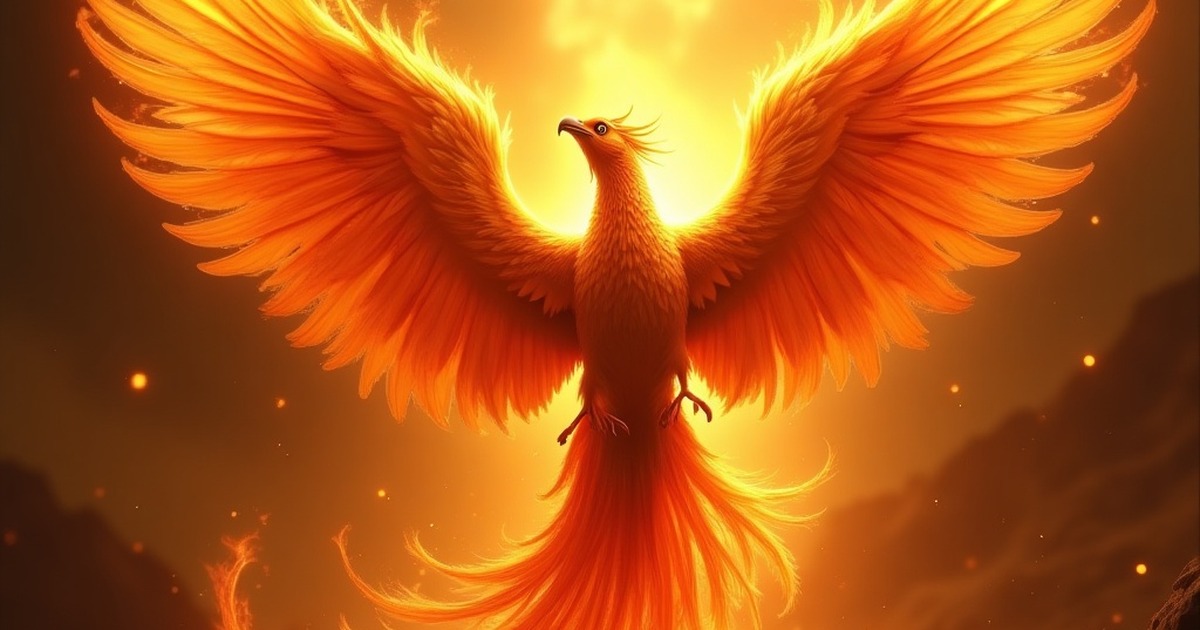
Herodotus (Histories, Book 2.73) heard of the phoenix in Egypt: a red-and-gold bird that arrives from Arabia once every five hundred years, bearing its parent's body embalmed in myrrh. The self-immolation and rebirth in flame that define the modern phoenix arrive later, in Roman and early Christian sources — Lactantius' poem De Ave Phoenice (c. 300 CE) gives the full fiery resurrection, which made the bird an early Christian symbol of the Resurrection itself.
14. The Ziz — the Sky's Counterpart to Leviathan
Jewish tradition pairs the sea-monster Leviathan and the land-beast Behemoth with a third, far less famous giant: the Ziz, ruler of the air. The Babylonian Talmud (Bava Batra 73b) describes a bird standing in the sea with its head brushing the sky, its wingspan vast enough to darken the sun. Like its two companions, the Ziz is destined to be served at the feast of the righteous at the end of days.
15. The Alkonost and Sirin — Russia's Birds of Joy and Sorrow
Russian folklore and lubok prints depict two woman-faced birds of paradise: the Alkonost, whose song brings joy so complete the listener forgets everything else, and the Sirin, whose song carries such sorrow it can be fatal to hear. Their names trace back through Byzantine art to the Greek Alcyone and the sirens — a living example of how flying creatures migrate between mythologies just as birds migrate between continents.
Why Every Mythology Fills Its Sky
Set these fifteen side by side and a pattern emerges. Flight in mythology is almost never mere transportation — it is a claim about hierarchy. The creatures of the air stand between humans and gods: Garuda carries a god, Pegasus carries a hero toward heaven and is stopped, the Simurgh dispenses divine wisdom, the thunderbird wields the weather itself. Wings mark a being as belonging, at least partly, to the upper world. When it comes to mythical flying creatures, this is especially important to keep in mind.
The sources tell us these creatures were never interchangeable monsters. A griffin guards treasure; a harpy punishes; a fenghuang legitimizes a dynasty; a phoenix promises that endings are beginnings. Each answers a different question its culture was asking of the sky.
Frequently Asked Questions
What is the most famous mythical flying creature?
By modern recognition, Pegasus and the phoenix lead — both benefit from continuous reuse from classical antiquity through contemporary film and fantasy. Within their own cultures, Garuda (still on two national emblems) and the fenghuang (paired with the imperial dragon for centuries) carried far greater weight. This ties directly back to why winged mythical beings matters so much.
What is the largest flying creature in mythology?
The roc and the Ziz compete for the title. The roc of the One Thousand and One Nights carries off elephants; the Talmudic Ziz blots out the sun with its wingspan. Both are deliberate exercises in imagining the upper limit of scale.
Are sirens flying creatures?
In their original Greek form, yes — archaic art and the Odyssey tradition present them as bird-bodied women. The fish-tailed mermaid-siren is a later medieval development that eventually displaced the winged original in popular imagination. Understanding mythical flying creatures can make a meaningful difference in your results.
Which cultures have flying horse myths?
Greece's Pegasus is the most famous, but he has company: al-Buraq, the winged steed of Islamic tradition who carries the Prophet on the Night Journey; Chollima, the thousand-li horse of Korean legend; and Tulpar, the winged horse of Turkic and Central Asian epic. The winged horse appears wherever horsemanship and sky-worship met.
📚 Explore More on This Topic
Editor's Pick: mythology tarot deck featuring winged beings for immersive mythical storytelling and art.
Related Posts


Related Posts
The Mythical Chronicle
Gods, heroes and monsters, drawn from the primary sources.