In the darkest corners of Chinese folklore lurks the Jiangshi (僵尸), often translated as “hopping vampire” or “Chinese hopping ghost.” These reanimated corpses, stiff with rigor mortis, hop forward with arms outstretched, seeking the living to drain their qi—their life force. Dressed in the official robes of the Qing dynasty, with greenish skin and long fingernails, Jiangshi are instantly recognizable figures in Asian horror. Part vampire, part zombie, and wholly terrifying, they represent one of Chinese folklore's most enduring monsters.
Quick Facts About Jiangshi
| Origin | Chinese folklore |
| Name Meaning | “Stiff corpse” (jiang = stiff, shi = corpse) |
| Also Known As | Chinese hopping vampire, hopping ghost, geungsi (Cantonese) |
| Type | Reanimated corpse / Undead |
| Movement | Hopping (due to rigor mortis) |
| Feeds On | Qi (life force/breath) |
| Weaknesses | Talismans, mirrors, sticky rice, rooster crow |
Origins of the Jiangshi
The Jiangshi legend has roots in several Chinese traditions and beliefs:
Corpse Transportation: In ancient China, families wanted their deceased relatives buried in their ancestral homeland. When someone died far from home, Taoist priests would be hired to “walk” the corpse back. According to legend, they would reanimate the corpse just enough to make it hop home behind the priest, moving at night to avoid terrifying villagers.
The Reality: Historians suggest the actual practice involved bamboo poles across the shoulders of porters, with corpses tied upright between them. From a distance, the bouncing motion of the porters made the corpses appear to hop.
Chinese Death Beliefs: Traditional Chinese belief holds that the body has two souls—the hun (spiritual soul) and po (corporeal soul). When someone dies improperly—without proper burial, through violence, or with unfinished business—the po soul might reanimate the body.
Qi Vampirism: Unlike Western vampires who drink blood, Jiangshi absorb qi—the vital life energy that Chinese philosophy considers essential to life. This makes them more like spiritual parasites than blood-drinkers.
Physical Appearance
The classic Jiangshi appearance has been codified through centuries of folklore and modern films:
Clothing: Qing dynasty official robes—long, dark (often black or dark blue), with mandarin collars. This reflects the age of most Jiangshi stories and gives them an antiquated, unsettling appearance.
Skin: Greenish or grayish, showing advanced decomposition. The face may be covered with mold or white/green fungus.
Fingernails: Long, black, claw-like—continuing to grow after death.
Hair: Long, white or gray, disheveled and tangled.
Posture: Arms stretched forward, body rigid from rigor mortis. They cannot bend their limbs, which is why they hop.
The Talisman: In many depictions, a Jiangshi has a paper talisman stuck to its forehead—this is what controls or restrains it. If the talisman falls off, the creature becomes uncontrollable.
How to Become a Jiangshi
Various causes can create a Jiangshi:
Improper Burial: A corpse not buried correctly, or buried in the wrong place, may rise as a Jiangshi.
Death by Suicide: Those who take their own lives may become Jiangshi, particularly if their deaths were caused by injustice.
Death by Violence: Murder victims, especially those unavenged, might return.
Lightning or Cat: If lightning strikes a corpse, or if a cat jumps over an unburied body, it may reanimate.
Spirit Possession: A malevolent spirit entering a corpse can create a Jiangshi.
Deliberate Creation: Taoist sorcerers might create Jiangshi for various purposes—including the corpse transportation mentioned earlier.
Powers and Hunting Methods
Despite their rigid bodies, Jiangshi are dangerous predators:
Qi Detection: They cannot see in the traditional sense—their eyes are often filmed over with decay. Instead, they detect the living by sensing their breath (qi). This is why holding your breath is a traditional defense.
Superhuman Strength: The undead body is far stronger than it was in life.
Qi Absorption: When they catch a victim, they drain their life force, either killing them outright or turning them into another Jiangshi.
Invulnerability: Normal weapons do little damage. They don't feel pain and don't bleed.
Evolution: The longer a Jiangshi exists and the more qi it absorbs, the more powerful it becomes. Ancient Jiangshi may gain abilities like flight, transformation, and even intelligence.
Weaknesses and Defenses
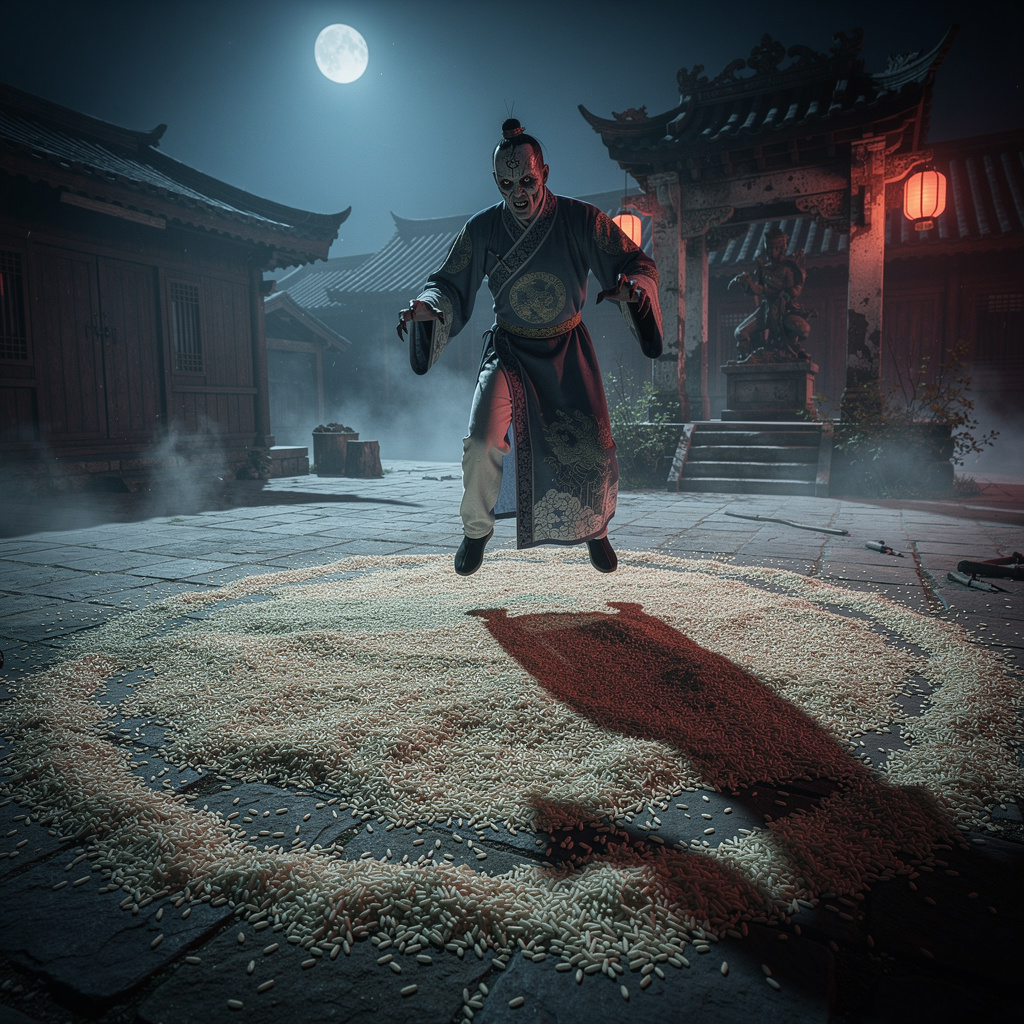
Fortunately, Jiangshi have numerous weaknesses:
Yellow Paper Talismans: The most iconic defense. Taoist spells written on yellow paper can freeze a Jiangshi in place or control its movements. Placing one on its forehead renders it harmless.
Sticky (Glutinous) Rice: Regular rice doesn't work—it must be glutinous rice (sticky rice). Throwing it at a Jiangshi or creating barriers with it repels them. Some traditions say it absorbs their negative energy.
Mirrors: Jiangshi are terrified of their own reflections, which remind them they are dead.
Rooster Crowing: Like Western vampires with sunlight, Jiangshi fear the rooster's crow, which signals dawn. They must return to their hiding place before sunrise.
Holding Your Breath: Since they hunt by detecting breath, not breathing renders you invisible to them—but you can only hold your breath so long.
Peach Wood: Considered sacred in Chinese tradition, peach wood weapons can harm them.
Fire: Complete burning can destroy a Jiangshi.
Bells and Loud Noises: Sudden loud sounds can disorient them.
Jiangshi Stages of Development
Chinese folklore describes Jiangshi evolving over time:
Stage 1 – Newly Risen: Mindless, slow, strictly nocturnal. Can only hop. Repelled by simple means.
Stage 2 – Developed: Faster, more aggressive. May develop limited intelligence. Harder to repel.
Stage 3 – Flying Jiangshi: Ancient, powerful Jiangshi that have absorbed enormous amounts of qi. Can fly, may appear fully human, possess intelligence and magical abilities.
Stage 4 – Demon: The oldest Jiangshi essentially become demons (gui), almost impossible to destroy and incredibly dangerous.
Taoist Priests and Jiangshi

In folklore and film, Taoist priests are the traditional enemies and controllers of Jiangshi:
Armed with talismans, peach wood swords, and arcane knowledge, these priests (often called “Taoist exorcists” in movies) specialize in dealing with the undead. They can create, control, bind, or destroy Jiangshi.
The image of a Taoist priest leading a line of hopping Jiangshi through the night—using a bell to guide them and talismans to control them—became iconic in Chinese horror cinema.
Jiangshi in Popular Culture
The Jiangshi became a horror movie icon in the 1980s:
“Mr. Vampire” (1985): This Hong Kong comedy-horror film, starring Lam Ching-ying as a Taoist priest, launched the Jiangshi film genre. It combined genuine scares with humor and martial arts.
Film Series: The success of Mr. Vampire spawned numerous sequels and imitators throughout the late 1980s and 1990s, making Jiangshi internationally recognized.
Modern Appearances: Jiangshi appear in video games (“Shenmue,” “Darkstalkers,” “Overwatch”), anime, and continue to feature in Chinese horror films and television.
Jiangshi in Modern Media
- Film: “Mr. Vampire” series, “Rigor Mortis” (2013), “Jiangshi vs. Vampire” (2012)
- Video Games: “Darkstalkers” (Hsien-Ko character), “Overwatch” (Mei skin), “Shenmue,” “Super Mario Land”
- Anime: “Shaman King,” “Hell Teacher Nūbē,” “Corpse Princess”
- Television: Various Hong Kong and Chinese TV series
- Comics: Appear in various Asian comic traditions
Jiangshi Compared to Other Undead
| Creature | Culture | Key Difference |
|---|---|---|
| Jiangshi | Chinese | Hops, absorbs qi, repelled by rice |
| Vampire | European | Drinks blood, intelligent, fears sunlight |
| Zombie | Haitian/Modern | Mindless, eats flesh/brains |
| Draugr | Norse | Intelligent, guards treasure, in graves |
| Revenant | European | Returns for vengeance, specific target |
Frequently Asked Questions
Why do Jiangshi hop?
According to folklore, rigor mortis has set in so completely that the Jiangshi's joints are locked stiff. Unable to bend their legs, they can only move by hopping. This distinctive motion makes them instantly recognizable and adds to their eeriness.
Are Jiangshi vampires or zombies?
They're neither exactly, but have elements of both. Like vampires, they drain life energy and can be repelled by certain items. Like zombies, they're reanimated corpses with limited intelligence (at least initially). They're best understood as their own unique category of undead.
Why are Jiangshi dressed in Qing dynasty clothes?
The Jiangshi legend developed primarily during and after the Qing dynasty (1644-1912). The distinctive Qing official robes became their iconic costume, reinforcing their antiquated, “out of time” nature. Modern interpretations sometimes vary the clothing.
Can Jiangshi be cured?
In most traditions, no—destruction is the only solution. However, some stories suggest that if a Jiangshi is caught soon after rising, and the cause of its reanimation is resolved (proper burial, avenging their death), it might rest peacefully again.
The Hopping Dead
The Jiangshi represents uniquely Chinese fears about death and the dead—not Western blood-drinking, not Haitian zombie servitude, but the terror of improper burial, of unresolved deaths, of the dead being unable to rest. They embody the importance Chinese culture places on proper funeral rites and ancestor veneration.
Yet the Jiangshi has also become something else: a beloved horror-comedy icon, a creature so distinctive that it transcends cultures. From Hong Kong cinema to video games worldwide, the image of the hopping corpse with outstretched arms and official robes has become instantly recognizable.
Remember: if you ever find yourself facing one, hold your breath, reach for the sticky rice, and pray for the rooster's crow. Or better yet, find a Taoist priest with good talismans.
Sources and Further Reading
- de Groot, Jan Jakob Maria. “The Religious System of China.” E.J. Brill, 1892-1910.
- Zheng, Xiao. “The Complete Collection of Yuewei Cottage Notes” (閱微草堂筆記). Qing Dynasty.
- Lam, Lana. “Mr. Vampire and the Jiangshi Genre.” Asian Film Archive, 2018.
- Kohn, Livia. “Daoism and Chinese Culture.” Three Pines Press, 2001.