Along the wild coasts of Scotland, Ireland, Iceland, and the Faroe Islands, fishermen tell of the Selkie—seal folk who shed their skins to walk on land as beautiful humans. These shapeshifters live as seals in the sea but can remove their sealskins to become men and women of unearthly beauty. Selkie stories are among the most poignant in folklore: tales of impossible love between land and sea, of stolen skins and captive brides, and of the eternal longing for a home one can never truly reach.
Quick Facts About Selkies
| Origin | Scottish, Irish, Icelandic, Faroese, Orcadian folklore |
| Also Known As | Silkie, Selchie, Selky, Roane (Irish) |
| Type | Shapeshifter / Fae creature |
| Domain | Ocean, coastal areas, islands |
| Transformation | Seal to human by removing sealskin |
| Key Themes | Captivity, longing, impossible love |
Origins and Distribution
Selkie legends are found throughout the Celtic fringe and Norse-influenced areas of the North Atlantic:
Scotland: Particularly strong in the Orkney and Shetland Islands, with their Norse heritage, and along the Hebrides. The word “selkie” (or “silkie”) comes from the Scots word for seal.
Ireland: Known as “roane” in Irish tradition, with stories concentrated along the western coast.
Faroe Islands: Called “kópakonan” (seal woman), with rich traditions about marriages between humans and selkies.
Iceland: Known as “selkolla” or “selkies,” with stories similar to those in Scotland.
The overlap between Celtic and Norse cultures in these regions has created a rich and varied tradition, with each area adding its own details while maintaining the core elements of the legend.
The Transformation
The mechanics of selkie transformation are consistent across traditions:
In the sea, selkies are ordinary seals—or at least appear so. They live as seals, hunt as seals, and swim as seals. But they possess a magical sealskin that allows them to take human form.
To become human, a selkie comes ashore and literally sheds its seal skin, stepping out as a beautiful man or woman. They might shed their skins to dance on beaches by moonlight, to explore the land, or simply to experience human form.
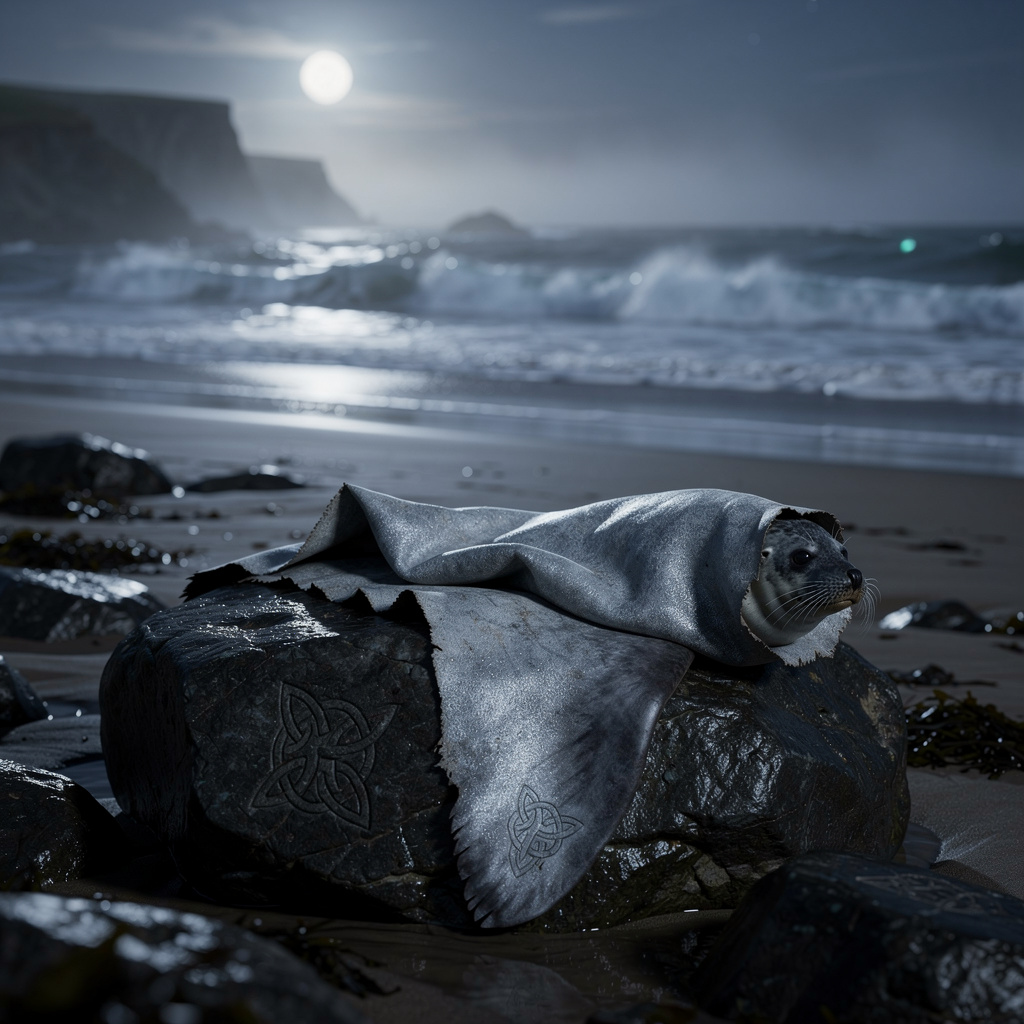
To return to seal form, they must put the skin back on. Without their skin, they cannot return to the sea—or rather, they can enter the water, but only as vulnerable humans, not as seals. The skin is everything.
This is why so many selkie stories revolve around stolen skins: if a human steals a selkie's skin and hides it, the selkie is trapped on land in human form.
Physical Appearance
In human form, selkies are described as extraordinarily beautiful:
Female Selkies: Strikingly beautiful women with long dark hair, dark eyes, and a melancholy or otherworldly air. Their beauty is often described as “too perfect” or unsettling to mortal eyes.
Male Selkies: Handsome men with dark features and a powerful presence. They are said to be irresistible to human women, particularly those unhappy in their marriages.
Distinguishing Features: Some stories say selkies retain seal-like characteristics—webbed fingers, large dark eyes, a slightly oily quality to their skin, or an inability to truly dry off.
In Seal Form: As seals, selkies are often larger and more intelligent-looking than ordinary seals, with eyes that seem to hold human understanding.
The Stolen Skin: The Classic Selkie Tale
The most common selkie story follows this pattern:
A fisherman or farmer walking along the shore at night sees a group of beautiful women dancing naked on the beach. Nearby lie their sealskins. He watches, enchanted, then creeps forward and steals one of the skins.
When dawn approaches, the women rush for their skins and slip back into seal form, returning to the sea. But one woman cannot find her skin. She is trapped.
The fisherman emerges, offering her his cloak. He takes her home. In time, they marry. She bears him children. Years pass. She is a good wife and mother, but there is always a sadness about her, and she often gazes out at the sea.
One day—perhaps a child finds the hidden skin, perhaps she discovers it herself—the sealskin is found. She puts it on and returns to the sea without hesitation, leaving husband and children behind.
Sometimes she is seen offshore, watching her children play on the beach. Sometimes she helps her fisherman-husband by driving fish into his nets. But she never returns to land.
Male Selkies
Male selkie stories follow a different pattern:
Male selkies typically appear to lonely women—fishermen's wives whose husbands are long at sea, or women in unhappy marriages. The selkie man comes ashore, seduces the woman, and then returns to the sea.
Children born of these unions are said to have webbed hands and feet, or unusual skill with boats and swimming. Some Scottish and Irish families claim selkie ancestry, pointing to webbed fingers as proof.
Unlike female selkie stories, these tales rarely involve stolen skins. The male selkie comes and goes freely; it is the human woman who is left waiting and longing. This reversal of the captivity narrative creates a different kind of tragedy.
The Orcadian Selkie Tradition
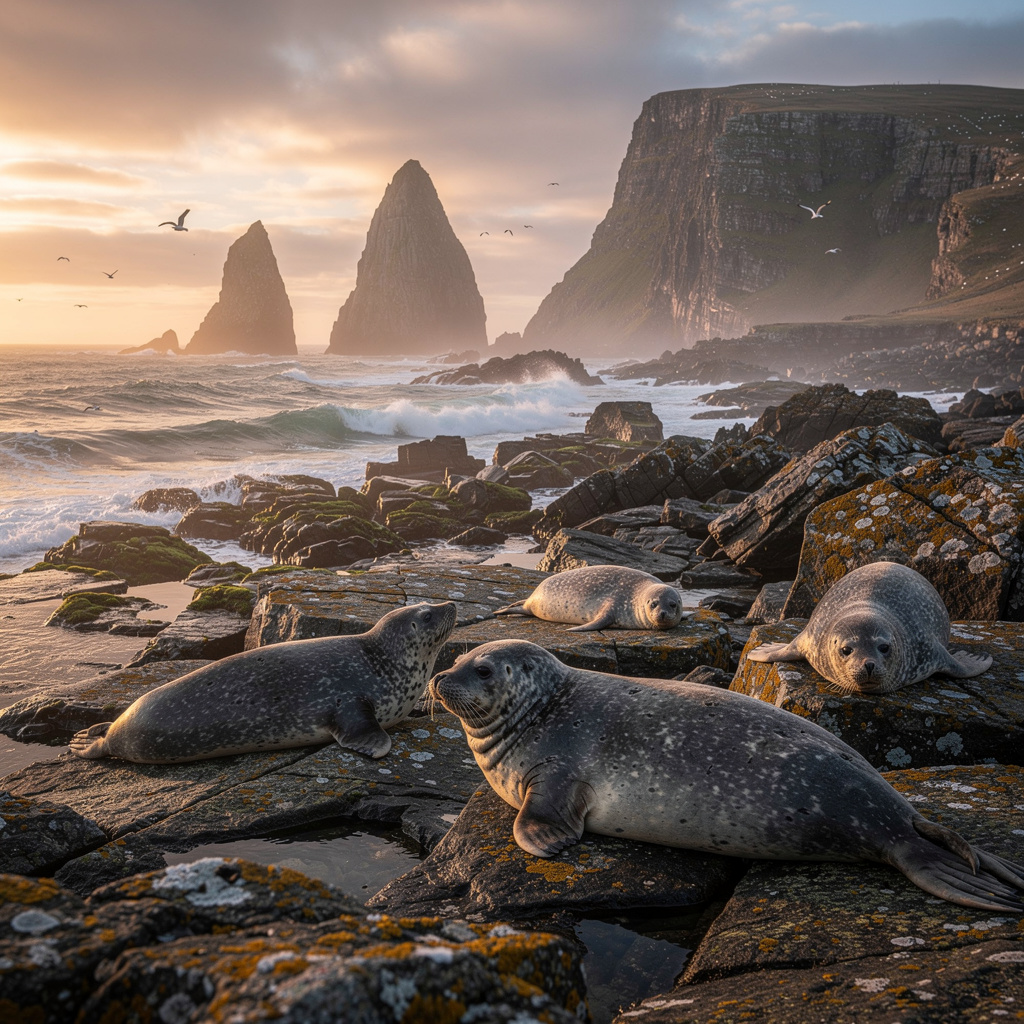
The Orkney Islands have particularly rich selkie traditions:
The Selkie as Ancestor: Some Orcadian families claim descent from selkies, explaining unusual features or talents as their supernatural heritage.
The Seventh Son: In some traditions, every seventh son of a seventh son can transform into a seal.
The Selkie Cull: It was taboo in Orkney to kill seals, as one might be killing a selkie—or even an ancestor.
Summoning Selkies: Tradition holds that one can summon a selkie by shedding seven tears into the sea at high tide.
Symbolism and Meaning
Selkie stories carry deep symbolic resonance:
Freedom and Captivity: The stolen skin represents freedom itself—identity, autonomy, the ability to be one's true self. Selkie brides are sympathetic figures not because they love their husbands less, but because no love can compensate for the loss of freedom.
Women's Experience: Many scholars see selkie stories as metaphors for women's experience in patriarchal societies—taken from their homes, trapped in marriages not of their choosing, longing for a freedom they remember but can never reach.
Immigration and Exile: In communities that lost many people to emigration, selkie stories spoke to the experience of being forever caught between two worlds, belonging fully to neither.
The Call of the Wild: Selkies embody the tension between civilization and wildness, domesticity and freedom, land and sea.
Selkies in Culture
Music: The traditional song “The Great Silkie of Sule Skerry” is one of the most famous selkie ballads, telling of a male selkie who fathers a child with a human woman.
Literature: Countless novels and short stories draw on selkie mythology, particularly in contemporary Celtic fantasy.
Film: “Ondine” (2009), “The Secret of Roan Inish” (1994), “Song of the Sea” (2014)
Art: Selkies feature prominently in Scottish and Irish art, often depicted in the moment of transformation.
Selkies in Modern Media
- Film: “Song of the Sea” (2014 animated film), “Ondine” (2009), “The Secret of Roan Inish” (1994)
- Television: Appears in various fantasy series with Celtic themes
- Literature: Featured in works by writers like Molly Gloss, Margo Lanagan, and many others
- Music: “The Grey Selkie of Sule Skerry” is covered by many folk artists
- Video Games: Appears in various fantasy RPGs and Celtic-themed games
Selkies Compared to Similar Beings
| Being | Culture | Key Difference |
|---|---|---|
| Selkie | Celtic/Norse | Seal transformation, skin can be stolen |
| Mermaid | Various | Permanently half-fish, no transformation needed |
| Swan Maiden | Various | Bird form, feather cloak, similar skin-theft motif |
| Kelpie | Scottish | Horse form, malevolent drowning spirit |
| Finfolk | Orcadian | Dark, malevolent sea people, kidnap humans |
Frequently Asked Questions
Are selkies dangerous?
Unlike many sea spirits, selkies are not typically dangerous. They do not drown people or cause shipwrecks. Their danger is more subtle—the danger of falling in love with someone who can never truly belong to your world.
Can selkies choose to stay with humans?
In most stories, selkies cannot resist the call of the sea once they have their skins. Even happy selkie wives who love their families will return to the ocean if they find their skins. Some stories suggest this is magical compulsion; others imply it's simply their true nature reasserting itself.
What happens to the children of selkies?
The half-human children of selkies remain human but may inherit supernatural traits—webbed fingers, unusual swimming ability, an affinity for the sea, or a strange longing they can never explain. They cannot transform into seals themselves.
How do you pronounce “selkie”?
SEL-kee, with emphasis on the first syllable. The alternate spelling “silkie” is pronounced the same way.
Between Land and Sea
Selkie stories endure because they speak to experiences we all understand: the longing for freedom, the pain of being caught between two worlds, the impossibility of love that crosses fundamental boundaries. They are among the most human of supernatural tales, even though their subjects are not human at all.
In the islands of Scotland, Ireland, and beyond, people still speak of the seal-folk with a mixture of wonder and melancholy. When seals gather offshore and seem to watch the land with knowing eyes, when a fisherman's wife stares too long at the sea, when a child is born with strange webbing between their fingers—the old stories are remembered.
For those who feel caught between worlds, who sense they belong somewhere they can never reach, who love what they cannot keep—the selkie's story is their story too.
Sources and Further Reading
- Briggs, Katharine. “An Encyclopedia of Fairies.” Pantheon, 1976.
- Thomson, David. “The People of the Sea.” Canongate, 1996.
- Marwick, Ernest. “The Folklore of Orkney and Shetland.” Rowman & Littlefield, 1975.
- MacKillop, James. “A Dictionary of Celtic Mythology.” Oxford University Press, 1998.