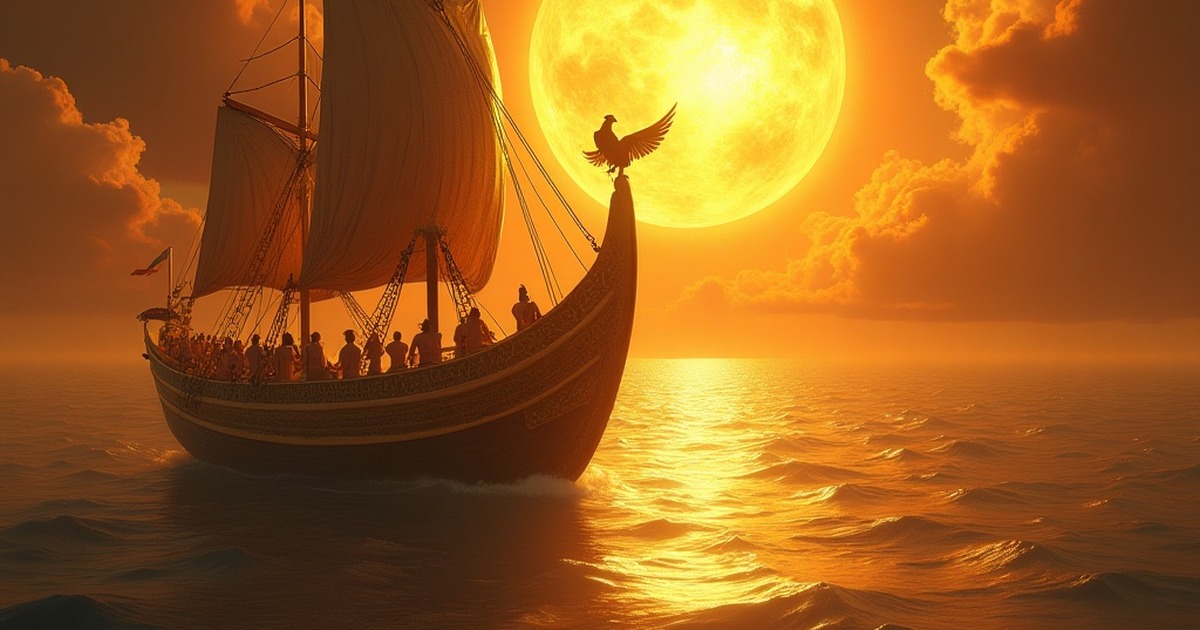
Atop Mount Qaf, at the center of the world where mortal feet have never tread, there nests a bird so ancient that it has witnessed the world's destruction and rebirth three times over. The Simurgh (سیمرغ)—also spelled Simorgh, Simurg, or Sēnmurw—reigns as the supreme avian being of Persian mythology, a creature of such wisdom and benevolence that kings sought its counsel and heroes owed their lives to its intervention. With feathers said to contain all the healing knowledge of creation and a wingspan that darkens the sun, the Simurgh stands among the most magnificent mythological creatures ever conceived.
Quick Facts About the Simurgh
| Origin | Ancient Persian/Iranian mythology (Zoroastrian and later Islamic) |
| Also Known As | Simorgh, Simurg, Sēnmurw, Angha, Sīna-Mrū |
| Type | Divine/Primordial bird |
| Domain | Mount Qaf (Alborz Mountains), the Tree of Life |
| First Recorded | Avesta (ancient Zoroastrian texts, c. 1500-500 BCE) |
| Associated Texts | Shahnameh, Conference of the Birds, Avesta |
| Primary Qualities | Wisdom, healing, nurturing, divine knowledge |
Origins and Evolution
The Simurgh's origins reach back to the earliest known Persian religious texts. In the ancient Avesta, the sacred scriptures of Zoroastrianism, the creature appears as Saēna or Sēnmurw, a great bird that sits on the “Tree of All Seeds” (Vīspo.bīš). When this primordial bird takes flight, a thousand branches shake and scatter seeds across the world—thus connecting the Simurgh to fertility, renewal, and the cycle of life itself.
The name “Simurgh” likely derives from the Avestan words saēna (eagle or falcon) and mərəγa (bird), essentially meaning “the bird Saēna.” Over millennia of Persian cultural development, the creature evolved from this Zoroastrian origin into the fully realized mythological being celebrated in medieval Persian literature.
By the time Ferdowsi composed the Shahnameh (“Book of Kings”) around 1000 CE, the Simurgh had become firmly established as a benevolent supernatural being intimately connected to Persian heroic legend. Ferdowsi's epic presents the Simurgh as a nurturing mother figure, a source of divine wisdom, and a crucial ally to Persia's greatest heroes.
The creature gained additional mystical significance through Sufi Islamic literature, particularly in Farid ud-Din Attar's 12th-century allegorical poem The Conference of the Birds (Manṭiq-uṭ-Ṭayr), where the Simurgh represents divine unity and the ultimate goal of spiritual enlightenment.
Physical Description: A Being Beyond Nature
The Simurgh's appearance defies simple classification, combining features of multiple creatures into a form of supreme beauty:
- Size: Enormous beyond measure—some accounts say large enough to carry an elephant or whale; others describe wings that eclipse the sun when spread. The Simurgh is not merely big but cosmically vast.
- Body: Often described as having the body of a peacock, combining aspects of a falcon or eagle with more ornamental features. Some Sasanian-era depictions show a dog-like body with bird wings and tail.
- Feathers: Copper or orange-red in color, though some texts describe iridescent plumage containing all colors of creation. The feathers possess healing properties—a single feather can cure any wound or illness.
- Head: Typically that of a dog or human face in older depictions; later Persian art shows a more traditionally avian head with elaborate crest feathers.
- Tail: A magnificent peacock-like tail, often depicted with the same eye-patterns that would influence later phoenix imagery.
- Age: The Simurgh is ancient beyond comprehension—it has lived so long that it has seen the world destroyed and recreated three times. Its wisdom encompasses all knowledge that has ever existed.
The Simurgh and the Hero Zal: A Tale of Divine Nurturing
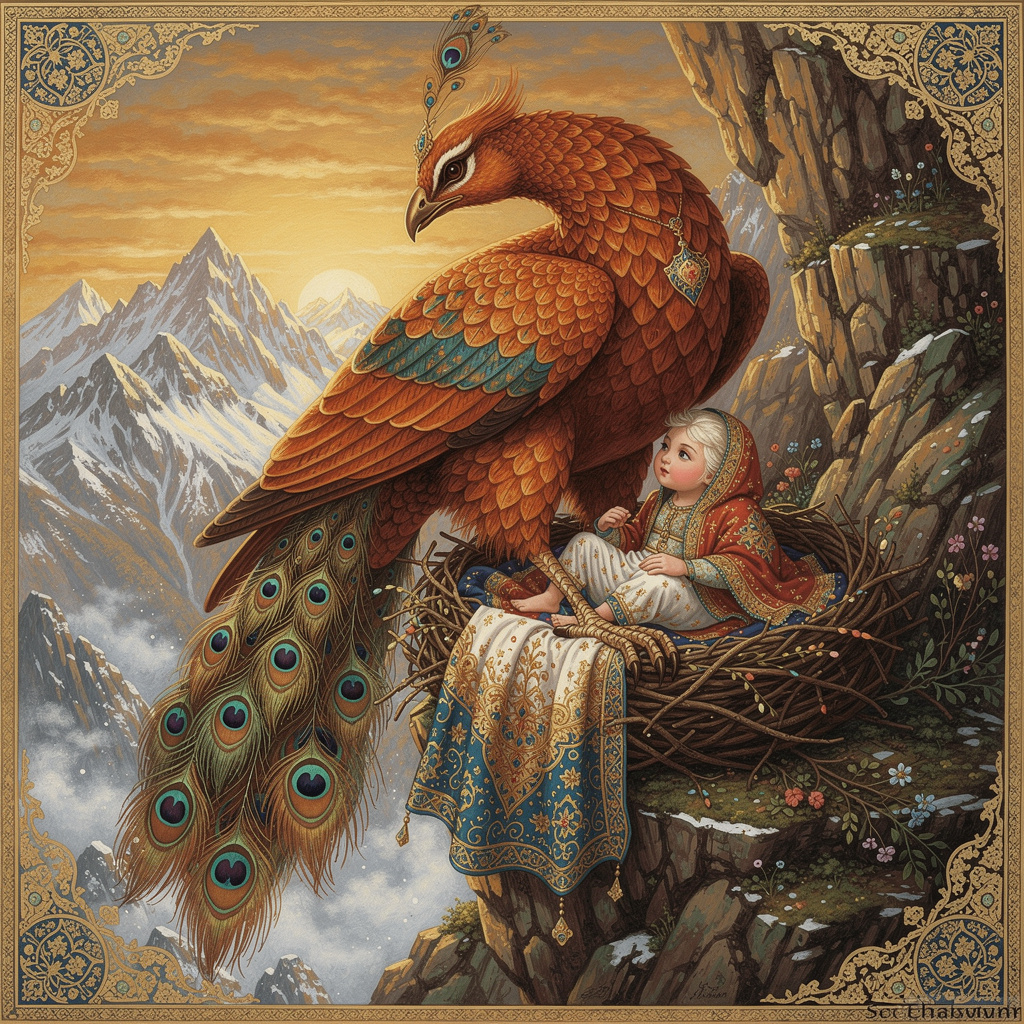
The most famous Simurgh narrative appears in the Shahnameh, where the great bird plays a crucial role in the life of the hero Zal and, through him, the destiny of Persia itself.
When the warrior Sam's son was born with snow-white hair—an omen of ill fortune in ancient Persia—the shamed father abandoned the infant on Mount Alborz to die. But the Simurgh, whose nest crowned the mountain's peaks, found the crying child. Rather than ignoring or destroying him, the great bird took the baby into her nest and raised him alongside her own chicks.
For years, the Simurgh nursed Zal with care and tenderness, feeding him and protecting him from the elements. She taught him wisdom drawn from her countless centuries of existence. When Zal grew to manhood and Sam, overcome with guilt, came seeking his abandoned son, the Simurgh released him with her blessing—but not before giving him three of her feathers.
“When you are in dire need,” she told him, “burn one of these feathers, and I shall come to your aid.”
This promise would be honored twice in the Shahnameh. When Zal's wife Rudabeh struggled in childbirth with their son Rostam (destined to become Persia's greatest hero), the Simurgh appeared to guide the birth—performing what some scholars interpret as the first cesarean section in literature. Years later, when Rostam lay dying from poisoned wounds, the Simurgh came once more to heal him.
Powers and Abilities
The Simurgh possesses abilities that mark it as one of mythology's most powerful benevolent beings:
- Healing: The Simurgh's primary power is the ability to cure any wound or illness. Its feathers, when applied to injuries or burned in ritual, bring immediate healing. It possesses knowledge of all medicinal plants and treatments.
- Wisdom: Having lived since before the current age of the world, the Simurgh knows everything that has ever happened and much of what will be. Its counsel is infallible.
- Fertility: As the being that shakes the Tree of All Seeds, the Simurgh governs the renewal of plant life across the world. Its flight spreads the seeds of all plants.
- Purification: The Simurgh's presence purifies corruption. In some traditions, it will appear at the end of time to help cleanse the world for renewal.
- Nurturing: Beyond physical abilities, the Simurgh embodies perfect maternal care—willing to raise and protect those abandoned by their own kind.
- Prophecy: The great bird can see destiny and fate, offering guidance that shapes the course of empires.
- Flight: Obviously capable of flight, but of a supernatural kind—the Simurgh can traverse impossible distances and appears wherever it is needed when its feathers are burned.
The Conference of the Birds: Simurgh as Divine Unity
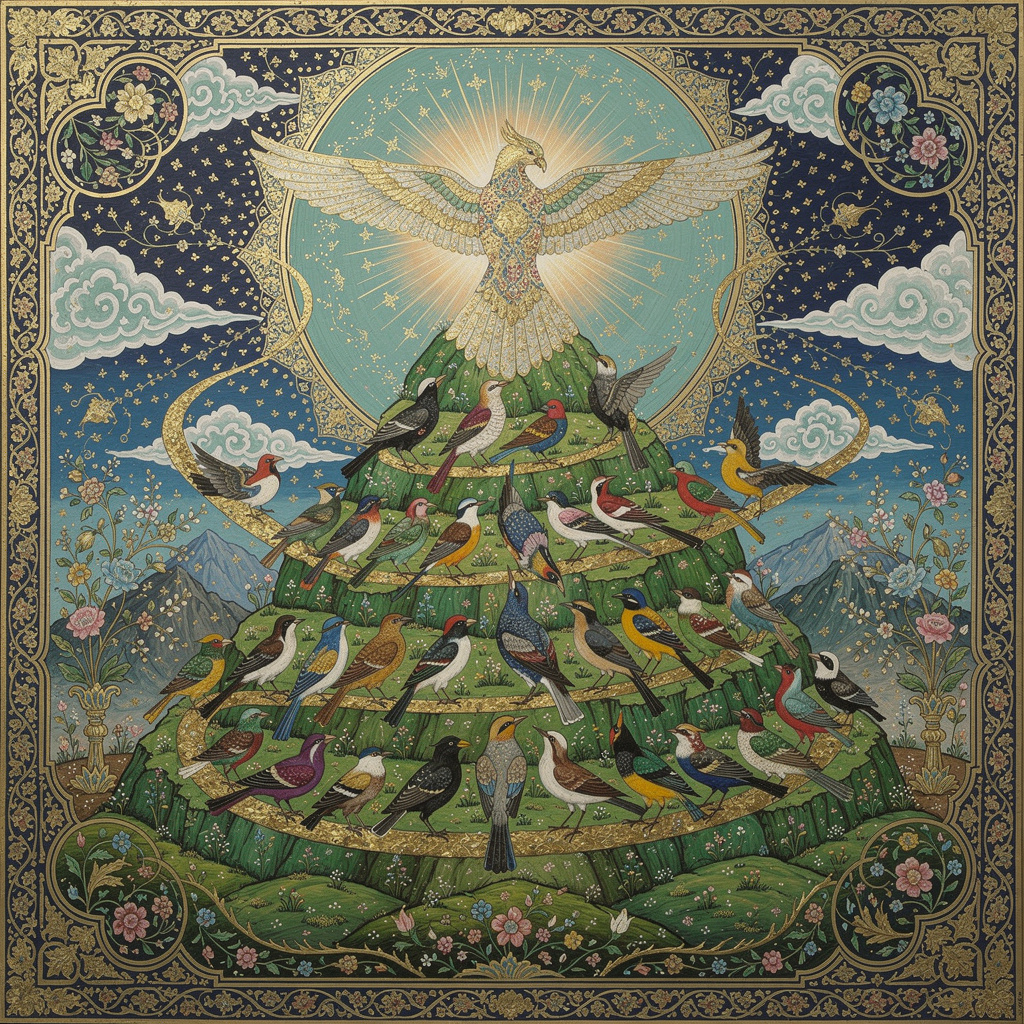
The 12th-century Sufi poet Farid ud-Din Attar transformed the Simurgh into a profound mystical symbol in his allegorical masterpiece The Conference of the Birds (Manṭiq-uṭ-Ṭayr).
In this poem, the birds of the world gather to seek a king. The wise hoopoe proposes they find the Simurgh, who lives beyond the seven valleys that represent stages of spiritual development: Quest, Love, Understanding, Detachment, Unity, Bewilderment, and finally Poverty and Annihilation.
Thousands of birds begin the journey, but the path is arduous. Many turn back; many perish. Of the original multitude, only thirty birds (si murgh in Persian) complete the journey to Mount Qaf. When they finally reach the Simurgh's court, they discover a profound truth: the Simurgh they sought is themselves—”si murgh” (thirty birds) contains “Simurgh.” In seeing the Simurgh, they see their own reflection; in unity with the divine bird, they discover divine unity within themselves.
This mystical interpretation elevated the Simurgh from mythological creature to spiritual symbol, representing the divine essence that seekers realize exists within themselves all along. The journey to find the Simurgh is the journey of the soul to God.
Mount Qaf: The Simurgh's Cosmic Home
The Simurgh nests atop Mount Qaf (or Kaf), a location of profound mythological significance in Persian and Islamic cosmology. Mount Qaf is described as a mountain range encircling the entire world, made of emerald or green stone, whose reflections give the sky its color.
This cosmic mountain exists beyond the mortal world—it cannot be reached by ordinary travel but only through spiritual journey or divine intervention. At its peak grows the Tree of All Seeds (also called the Tree of Life or the Gaokerena Tree), in whose branches the Simurgh makes its nest.
The connection between the Simurgh, the Tree, and Mount Qaf forms a complete cosmological system: the world-encircling mountain represents the boundary between mortal and divine realms; the Tree contains the seeds of all life; and the Simurgh, by shaking the Tree and scattering seeds, connects the divine source to earthly manifestation.
The Simurgh Compared to Other Mythological Birds
The Simurgh shares characteristics with several other legendary birds while maintaining distinct qualities:
- Phoenix (Greek/Egyptian): Both are associated with regeneration and possess healing powers. However, the Phoenix constantly dies and is reborn, while the Simurgh has lived continuously through multiple world-cycles. The Phoenix represents personal transformation; the Simurgh represents accumulated eternal wisdom.
- Garuda (Hindu): Both are divine birds of immense power associated with major religious traditions. Garuda serves Vishnu and battles serpents; the Simurgh nurtures heroes and heals the wounded. Garuda embodies martial devotion; the Simurgh embodies maternal wisdom.
- Roc (Arabian): Both are enormous birds capable of carrying elephants. But the Roc is primarily a creature of physical power, while the Simurgh's significance lies in wisdom and healing rather than mere strength.
- Thunderbird (Native American): Both control natural forces and possess cosmic significance. However, the Thunderbird governs weather and storms, while the Simurgh governs fertility and healing.
- Fenghuang (Chinese): Both are composite birds representing virtue and good fortune. The Fenghuang symbolizes harmony between yin and yang; the Simurgh symbolizes divine wisdom and nurturing care.
Cultural Significance in Persian Civilization
The Simurgh has been central to Persian identity for over two millennia:
Artistic Representation
Simurgh imagery appears throughout Persian art history—on Sasanian silver plates, in illuminated manuscripts, on ceramic tiles, woven into carpets, and carved into architectural elements. The creature's form influenced artistic representations across the Islamic world and into medieval Europe.
Royal Symbolism
Persian monarchs associated themselves with the Simurgh's qualities: wisdom, protection of their people, and connection to divine legitimacy. The Simurgh appeared on royal standards and seals, representing the beneficent power of righteous rule.
Modern Iran
The Simurgh remains a potent national symbol in contemporary Iran. It appeared on the emblem of the Imperial Government before 1979 and continues to feature in Iranian art, literature, and cultural expression. Iran Air's logo and various Iranian institutions invoke the Simurgh to connect modern Iran with its ancient heritage.
The Simurgh in Modern Media
While less prominent in Western media than some mythological creatures, the Simurgh has appeared in various contemporary works:
- The Lion, the Witch and the Wardrobe: While not explicitly named, C.S. Lewis's Phoenix owes much to Simurgh mythology.
- Video Games: The Simurgh appears in Smite, Age of Mythology, and Final Fantasy series, typically as a powerful flying creature.
- Literature: Salman Rushdie's The Enchantress of Florence and other works incorporate Simurgh imagery. The creature features prominently in Sufi-influenced poetry and modern Iranian literature.
- Music: Progressive rock and metal bands have drawn on Simurgh mythology, particularly its connection to spiritual journeys.
- Animation: Various animated works, particularly from Iran and regions with Persian cultural influence, feature Simurgh characters.
Frequently Asked Questions About the Simurgh
Is the Simurgh the same as a Phoenix?
While they share some qualities—both are great birds associated with healing and renewal—they differ significantly. The Phoenix dies and is reborn from its ashes in a cycle of death and resurrection. The Simurgh has never died; it is so ancient that it has watched the world be destroyed and recreated multiple times, but it persists continuously. The Phoenix represents transformation through death; the Simurgh represents wisdom accumulated through eternal existence.
How old is the Simurgh?
According to Persian tradition, the Simurgh is ancient beyond human comprehension. It has witnessed the world's destruction and recreation three times—not the destruction of cities or empires, but the actual end and rebirth of existence itself. This makes the Simurgh effectively primordial, existing since before the current age of creation and possessing all knowledge from ages now lost.
Can the Simurgh be summoned?
In the Shahnameh, the Simurgh gave three feathers to Zal with instructions to burn one when in dire need. This suggests the Simurgh can indeed be summoned, but only by those it has blessed with its feathers. The creature comes willingly to help those it loves—it is not compelled or bound by the summoning. Ordinary mortals have no means to call the Simurgh; it appears only to those it chooses or has previously bonded with.
Is the Simurgh male or female?
The Simurgh is typically depicted as female in Persian literature, particularly in its nurturing role toward Zal. The creature functions as an ideal mother figure—rescuing, raising, and protecting an abandoned child, then continuing to assist him throughout his life. However, some texts treat the Simurgh as beyond gender, an entity so ancient and cosmic that mortal categories don't apply. The mystical Simurgh of Sufi literature, representing divine unity, transcends gender entirely.
The Eternal Guardian
In a world of mythological creatures defined by their power to destroy—dragons that burn, monsters that devour, demons that corrupt—the Simurgh stands apart. Here is a being of cosmic power whose primary impulse is not to harm but to heal, not to take but to give, not to judge but to nurture. The Simurgh rescued an abandoned baby, raised him with care, and continued protecting his lineage for generations. When called upon, it came not to punish enemies but to save lives.
Perhaps this is why the Simurgh has endured in Persian consciousness for three millennia. It represents an ideal that transcends religion and era: that the greatest power is the power used in service of others, that true wisdom manifests as compassion, and that even the most ancient and mighty being might choose to be a protector rather than a destroyer.
The thirty birds who sought the Simurgh discovered they themselves contained divinity. In the Simurgh's ancient eyes, perhaps humans reflect the same light—small and struggling, but worthy of aid, worthy of wisdom, worthy of the healing touch of copper-colored wings that have seen eternity unfold and still choose love.
Sources and Further Reading
- Ferdowsi. Shahnameh: The Persian Book of Kings. Translated by Dick Davis. Penguin Classics, 2016.
- Attar, Farid ud-Din. The Conference of the Birds. Translated by Afkham Darbandi and Dick Davis. Penguin Classics, 1984.
- Curtis, Vesta Sarkhosh. Persian Myths. University of Texas Press, 1993.
- Schmidt, Hanns-Peter. “Simorgh.” Encyclopædia Iranica, 2002.
- Van Zutphen, Marjolijn. “Farr(ah).” Encyclopædia Iranica, 1999.