You'll discover humanity's earliest systematic documentation of legendary creatures inscribed upon Mesopotamian clay tablets from approximately 2100 BCE, where Sumerian scribes immortalized chimeric beings like Humbaba—the lion-faced guardian of cedar forests—and Tiamat, the primordial chaos-dragon of creation. These cuneiform records preceded Greek natural philosophers' encyclopedic compilations, Hebrew scribes' classifications of Leviathan and Behemoth, and Norse skalds' preservation of Fenris and Jörmungandr through manuscript traditions. Below, we'll trace how these ancient catalogings converted oral traditions into permanent monuments that encoded civilization's deepest anxieties.
Key Takeaways
- Mesopotamian cuneiform tablets from circa 2100 BCE provide the earliest written records of legendary creatures like Humbaba and Tiamat.
- The Epic of Gilgamesh documented Humbaba, the chimeric guardian, representing humanity's first systematic catalog of monstrous beings.
- Greek naturalists Aelian and Pliny the Elder compiled encyclopedic collections documenting griffins, phoenixes, and unicorns in classical antiquity.
- Hebrew biblical texts classified primordial creatures like Leviathan and Behemoth, symbolizing chaos and divine order's boundaries.
- Norse Poetic and Prose Eddas, along with 13th-century sagas, chronicled creatures like Fenris wolf, Jörmungandr, and the Kraken.
Monsters Immortalized Through Written Word

Since humanity first pressed stylus to clay and brush to papyrus, legendary creatures have clawed their way from oral tradition into permanent literary form, modifying ephemeral campfire tales into immortal representations of collective fear and wonder.
You'll discover Humbaba emerging from Mesopotamian clay tablets circa 2100 BCE, guardian of cedar groves, embodying legendary symbolism of nature's untamed sovereignty. The monstrous becomes tangible through Homer's verses, where chimeric amalgamations—lion-goat-serpent hybrids—prowl through hexameter lines as mythical archetypes of chaos.
Egypt's papyri preserved Apep, the serpentine void-dweller threatening cosmic order nightly. Norse sagas and Old Norse poems similarly immortalized creatures like Fenrir and Jörmungandr, preserving pre-Christian Germanic religion through written accounts that transformed spoken mythology into enduring literary tradition. Permanence modified everything. What shamans once whispered became scripture, what flickered in firelight achieved stone-carved eternity.
These eldritch beings transcended mere entertainment, encoding cultural anxieties, moral boundaries, threshold guardians between civilization and wilderness. Written texts didn't simply record monsters—they consecrated them, granting immortality denied to their mortal chroniclers.
Baring-Gould's 1865 compendium and Campbell's Celtic dragon studies continued this sacred preservation, ensuring you'd inherit these creatures millennia later, still breathing.
##
You'll trace these eldritch beings to their primordial sources—the cuneiform impressions of Mesopotamian scribes who first gave form to chaos, the meticulous bestiaries compiled by Greco-Roman naturalists blending observation with cosmic dread, the frost-laden verses of Norse skalds preserving entities born from Ginnungagap's void.
Each textual tradition emerges from distinct theological landscapes, yet all wrestle with humanity's need to name the unnameable, to inscribe chimeric forms onto clay, papyrus, and vellum as evidence to powers beyond mortal comprehension.
Biblical chroniclers, Nordic poets, Mediterranean philosophers—all served as threshold guardians, recording encounters with creatures that embodied their cultures' deepest fears and most sacred mysteries.
These ancient records now live within community-driven platforms where modern enthusiasts share knowledge, compare translations, and preserve the collective wisdom of mythological traditions spanning continents and millennia.
Origins in Mesopotamian Tablets
When scholars first deciphered the wedge-shaped impressions of cuneiform script pressed into clay millennia ago, they uncovered humanity's earliest systematic catalog of the monstrous and divine—a lexicon of legendary creatures that predates written accounts from any other civilization.
You'll find Mesopotamia's tablets preserve mythical beings like Humbaba, guardian of primordial forests, and Tiamat, the dragon-goddess embodying chaos itself. These weren't mere fantasies. The Sumerian King List deliberately interweaves divine entities with mortal rulers, demonstrating the cultural significance of chimeric forms in legitimizing power.
You'll encounter the Anzu bird, lion-bodied and eagle-winged, alongside Lamassu sentinels whose human faces emerge from leonine frames. Each inscription reveals how ancient Mesopotamians understood their world through eldritch hybrids that transcended nature's boundaries.
Greek and Roman Bestiaries
As Mediterranean civilizations emerged from their Bronze Age collapse, natural philosophers and compilers in Greece and Rome began assembling encyclopedic collections—bestiaries—that merged empirical observation with inherited myth.
Aelian and Pliny the Elder cataloged griffins, phoenixes, unicorns—mythical creatures dwelling between zoology and folklore.
You'll find bestiary influence permeating medieval consciousness through the “Physiologus,” that pivotal Christian text altering animal description into spiritual allegory.
Dragons embodied eldritch chaos, sin incarnate. Unicorns radiated purity, prefiguring Christ himself.
These chimeric forms weren't mere fantasy but moral architecture, symbolic languages teaching righteousness through nature's cipher.
The ancient compilers created frameworks that survived centuries, their bestiary influence shaping how you encounter legendary beasts in art, literature, sacred texts—persistent shadows of Greco-Roman knowledge systems that refused extinction, adapted, changed.
Norse Sagas and Eddas
While Mediterranean scholars compiled their creature catalogs under Mediterranean sun, Nordic skalds preserved their own bestiary through oral verse and manuscript illumination—a literature forged in ice, salt spray, and the grinding darkness of Arctic winter.
You'll find the Kraken's earliest attestation in 13th-century Norse sagas, particularly the Örvar-Oddr saga, where this eldritch cephalopod drags vessels beneath churning waves.
The Poetic and Prose Eddas chronicle Norse mythology's pantheon of legendary creatures: Fenris wolf, Jörmungandr the world-serpent, trolls haunting mountain passes.
These weren't mere entertainment. They possessed profound cultural significance, encoding existential terrors about nature's raw dominion and cosmological catastrophe.
Sea legends especially reflected Viking reality—the ocean's chimeric threats made manifest through mythic storytelling. Ancient knowledge preserved through vellum and memory.
Biblical Creature Descriptions
Three millennia before Nordic skalds carved their saga verses, Hebrew scribes wrestled with their own taxonomy of the monstrous—creatures that erupted from the primordial deep and stalked the edges of divine order.
You'll find Leviathan coiling through Job 41, its scales impenetrable, breath kindling coals. Biblical symbolism alters this twisted serpent into chaos incarnate, a force only divine sovereignty can shatter.
The Behemoth rises from Job 40, muscles rippling like bronze, a land-bound counterpart to oceanic terror.
Creature comparisons reveal patterns: the six-winged Seraphim purifying Isaiah's lips, Revelation's crimson dragon embodying cosmic rebellion.
These weren't mere allegories—they represented liminal threats where creation's boundaries frayed, where eldritch powers tested covenant promises.
Each description carved freedom's price into ancient consciousness.
Epic of Gilgamesh's Humbaba

Upon the Mesopotamian cuneiform tablets dating to 2100 BCE, you'll encounter Humbaba, that eldritch sentinel whose monstrous form guards the sacred Cedar Forests of Lebanon—those ancient groves where mortal ambition collides with divine prohibition.
This chimeric warden, with his terrifying visage of scales and supernatural malevolence, embodies the threshold between civilization's ordered domain and the primordial wilderness that the gods themselves claimed as sanctuary.
You stand now at the precipice of understanding how Ancient Sumer conceived of power itself: not merely through kingship or bronze weaponry, but through the audacity to challenge those otherworldly guardians who dwell in the liminal spaces where humanity's reach falters.
Mesopotamian Cuneiform Tablets, 2100 BCE
Among humanity's earliest written narratives, the Mesopotamian cuneiform tablets containing the Epic of Gilgamesh stand as primordial testimony to our species' compulsion to chronicle the numinous and the monstrous.
Dating to 2100 BCE, these clay inscriptions preserve cuneiform symbolism that transcends mere documentation—they're gateways to eldritch understanding.
You'll encounter Humbaba within these mythical narratives, the chimeric guardian whose firestorm breath defended the Cedar Forest against mortal intrusion.
His terrifying visage embodied chaos itself, nature's untamed sovereignty. When Gilgamesh and Enkidu confronted this creature, they weren't merely battling a monster—they challenged the boundary between civilization and wilderness, mortality and transcendence.
These tablets reveal how ancient Mesopotamians encoded moral philosophy within creature-lore, altering Humbaba into something beyond horror.
A symbol. A warning. An eternal question about humanity's right to conquer what remains free.
Ancient Sumer and Cedar Forests
Beyond the weathered clay tablets themselves lies the geographical heart of this narrative: the Cedar Forest of ancient Lebanon, where Humbaba's dominion changed sacred groves into psychological battlegrounds. You'll encounter Cedar mythology intertwined with Sumerian ecology, where divine landscapes challenged mortal heroes.
| Aspect | Manifestation |
|---|---|
| Guardian | Humbaba, chimeric sentinel |
| Visage | Lion-faced, eldritch terror |
| Voice | Storm's roar, chaos embodied |
| Location | Sacred Lebanese cedars |
| Symbolism | Untamed divine nature |
Gilgamesh and Enkidu's confrontation wasn't mere conquest—it represented humanity's perpetual struggle against nature's sublime power. Their defiance of godly warning carried consequences that resonated through Sumerian consciousness, altering the forest into something more than terrain. A threshold between civilization and wilderness. Between human ambition and divine retribution. Between courage and hubris.
Guardian of Divine Wilderness
Through the fragmentary cuneiform inscriptions of the second millennium BCE, Humbaba emerges not as mere antagonist but as sacred threshold—a chimeric sentinel whose leonine visage and storm-voice marked the boundary where Sumerian civilization confronted the numinous terror of wilderness itself.
You'll find in this eldritch guardian something civilization perpetually fears: nature's protector who answers to no human law. His roar shook sacred landscapes, his arms mimicked predatory jaws.
When Gilgamesh and Enkidu challenged this divine warden, they enacted humanity's eternal rebellion—the urge to conquer what should remain wild. Their victory wasn't merely heroic triumph. It was transgression.
The Cedar Forest's guardian fell, and with him collapsed the barrier separating ambitious mortals from consequences they couldn't yet comprehend.
Babylonian vs. Assyrian Versions
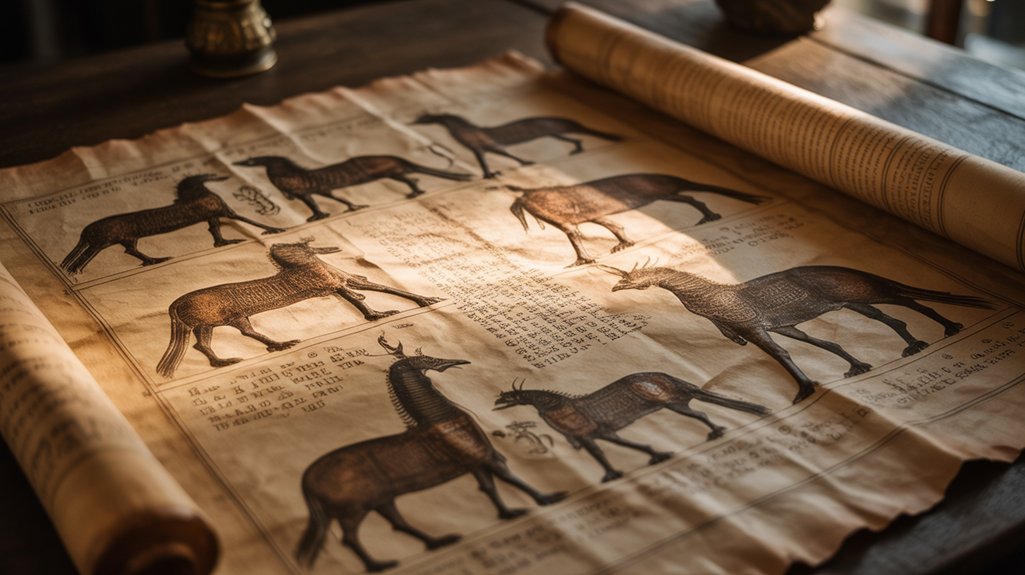
While scholars often conflate Mesopotamian mythologies into a singular tradition, the Babylonian and Assyrian civilizations nurtured distinctly different approaches to their legendary creatures—differences that reveal profound theological and cultural divergences between these sister cultures of the ancient Near East.
You'll discover that Babylonian myths, exemplified in the *Enuma Elish*, centered upon primordial chaos. Tiamat emerges—dragon-formed, eldritch embodiment of cosmic disorder. The *Epic of Gilgamesh* presents Humbaba, monstrous guardian whose cultural significance lies in humanity's struggle against divine wilderness.
Assyrian mythology diverged substantially. Their legendary beings served governance, protection.
| Aspect | Babylonian | Assyrian |
|---|---|---|
| Primary Text | *Enuma Elish* | *Myth of Adapa* |
| Iconic Creature | Tiamat (chaos dragon) | Lamassu (chimeric guardian) |
| Thematic Focus | Creation/chaos | Divine-human interaction |
| Function | Cosmological enemies | Protective symbols |
| Cultural Role | Explain origins | Legitimize authority |
The *Assyrian Royal Inscriptions* showcase lamassu—winged, bull-bodied chimeric sentinels guarding palace gates. Theological emphasis shifted from cosmic battles toward structured hierarchy.
Environmental Protection Through Terror
How did ancient civilizations weaponize fear itself to safeguard their ecosystems? Through eldritch tales of monstrous guardians, they inscribed environmental ethics into the collective consciousness, altering terror into stewardship.
These chimeric beings served four significant functions:
- Dragons embodied nature's retribution against those who'd desecrate sacred groves and mountain sanctuaries.
- Leviathans enforced maritime boundaries, their tentacled forms warning against overfishing and coastal exploitation.
- The Chimera represented environmental chaos released by human hubris, fire-breathing consequences of disrupted ecosystems.
- Krakens patrolled the abyssal depths, mythic symbolism protecting spawning grounds from ancient mariners.
Each creature operated as psychological infrastructure. Communities internalized reverence through visceral dread, understanding that violation invited destruction.
The texts functioned as environmental legislation written in blood and ichor, their allegorical frameworks more enduring than any stone tablet. These weren't mere stories. They were survival mechanisms, encoding sustainable practices within nightmares that protected watersheds, forests, and seas across generations.
Enkidu's Fatal Combat Encounter
You've witnessed Enkidu elevate his wild origins through friendship and triumph over Humbaba, yet the gods' wrath remains unappeased by cedar ash and severed heads.
When Ishtar's vengeful heart summons forth the celestial Bull of Heaven—that chimeric instrument of divine retribution—you'll observe how hubris elevates victors into victims, how the same strength that felled a forest guardian proves insufficient against astral fury.
The beast's descent marks not merely another combat trial but rather Enkidu's inexorable journey toward dissolution, his mortal frame bearing wounds that elevate flesh to strike at fate itself.
The Bull of Heaven
The divine wrath manifests in bovine form—a celestial beast whose hooves crack the earth and whose breath withers entire harvests. You'll find in Mesopotamian tablets that Ishtar's vengeance takes monstrous shape when Gilgamesh refuses her advances, dispatching this eldritch creature as divine retribution against mortal pride.
The bull's descent brings apocalypse: drought, famine, catastrophe incarnate.
Yet heroic courage prevails. Enkidu confronts this celestial horror, wrestling the creature alongside Gilgamesh in combat that shakes Uruk's foundations.
Their triumph proves costly—the gods demand payment for slaying their servant, condemning Enkidu to death. This moment crystallizes ancient Mesopotamia's worldview: mortals may challenge divine authority, but cosmic balance requires sacrifice.
The bull's defeat becomes catalyst for Gilgamesh's alteration, propelling him toward his quest for immortality.
Divine Punishment Unleashed
Victory's bitter aftertaste poisons the triumph—what Enkidu and Gilgamesh perceive as heroic conquest, the celestial hierarchy judges as blasphemous transgression.
You'll witness divine retribution descending upon Enkidu, the wild man torn from primordial landscapes, who dared strike down Ishtar's eldritch beast. The gods convene, their verdict absolute: death must answer death.
This punishment transcends mere vengeance—it reasserts moral order, reminding mortals that supernatural forces govern existence's fundamental architecture. Enkidu's fever-dreams grow dark, his once-mighty frame withering as celestial justice extracts its toll.
His demise shatters Gilgamesh's understanding of friendship, mortality, permanence. The chimeric boundary between civilization and wilderness collapses.
Here lies ancient Mesopotamia's profound meditation: no hero, however legendary, escapes divine law's inexorable weight. Mortality claims all.
Enkidu's Mortal Wound
When divine wrath materializes as seven-tons of celestial bovine fury, flesh proves tragically insufficient armor against supernatural vengeance.
You witness Enkidu's alteration reaching its tragic denouement as the Bull of Heaven's horn pierces his torso, crystallizing humanity's essential fragility. This eldritch wound transcends mere physical trauma—it represents civilization's ultimate vulnerability before cosmic forces, the inevitable price of abandoning nature's protective wilderness.
Enkidu's mortal vulnerability manifests in blood and bone, his body betraying the illusion of civilized invincibility. The horn's penetration marks more than injury; it inscribes death's signature upon formerly-wild flesh now domesticated, humanized, doomed.
His dying becomes Gilgamesh's catalyst, the wound that births humanity's eternal quest against mortality's inexorable tide. Ancient Mesopotamian scribes understood: when gods strike, mortals bleed.
Humbaba in Contemporary Gaming
Across digital landscapes spanning three decades, Humbaba has emerged from cuneiform tablets into pixelated domains. His eldritch presence manifesting in role-playing games that seek to resurrect Mesopotamian mythic power for contemporary audiences.
You'll encounter him in titles like *Final Fantasy: Brave Exvius*, where Humbaba's design draws directly from ancient Mesopotamian iconography—his scaled corpus, his chimeric visage radiating primordial terror.
His digital incarnations preserve core mythological elements:
Digital adaptations maintain Humbaba's essential mythic DNA—guardian function, overwhelming presence, and threshold symbolism—bridging ancient cuneiform narratives with contemporary interactive experiences.
- Guardian role translated into boss-battle mechanics requiring strategic mastery
- Imposing scale emphasizing his supernatural dominion over sacred cedar groves
- Visual aesthetics synthesizing archaeological evidence with contemporary fantasy conventions
- Narrative positioning as threshold guardian, testing your worthiness to advance
These gameplay mechanics honor ancient storytelling traditions while liberating them from dusty archives.
You're not merely defeating pixels; you're participating in myth-making processes that transcend temporal boundaries, experiencing firsthand why Bronze Age scribes immortalized this creature in their cuneiform chronicles.
Modern Interpretations of Monster Symbolism
As contemporary scholars excavate deeper into mythological substrata, legendary creatures reveal themselves not as primitive superstitions but as sophisticated symbolic architectures encoding humanity's perpetual confrontation with existential paradoxes.
Modern monster symbolism demonstrates how dragons embody your uncontrolled chaos, that eldritch force threatening civilization's fragile boundaries. You'll recognize cultural fear representation in the Chimera's fire-breathing hybridity—ancient Greece warning against nature's violation.
The Phoenix speaks to your death-defying aspirations, that immortal renewal you've always craved. Consider the Leviathan: humanity's environmental terror crystallized into scaled magnificence.
These aren't mere fantasies. They're psychological maps. The Griffin guards more than treasure—it protects sacred thresholds between mundane and numinous domains, reflecting cultural values that transcended mere material accumulation.
Unicorns channel your purity obsessions, innocence as chimeric ideal. Each monster functions as freedom's dark mirror, revealing what you simultaneously desire and dread within civilization's constraints.
Environmental Guardianship Resonates in Climate Crisis
Though ancient civilizations possessed no satellites to document retreating glaciers or sophisticated instruments to measure atmospheric carbon, their mythological frameworks encoded environmental wisdom that reverberates with catastrophic urgency through our warming world.
You'll discover dragons weren't mere monsters—they embodied ecological symbolism, fierce protectors against humanity's hubris. The Phoenix's cyclical immolation warned against irreversible destruction. Mythical stewardship permeates the Epic of Gilgamesh, where Enkidu's death following Humbaba's slaying demonstrates nature's brutal retaliation against desecration.
These eldritch guardians speak directly to our climate emergency. Griffin sentinels. Leviathan's terrible majesty. The Chimera's hybridized form—a prophecy of anthropogenic catastrophe.
Ancient Mesopotamian, Vedic, and Hellenic traditions understood what you're witnessing: environmental collapse follows ecological transgression. Their narratives functioned as survival mechanisms, embedding conservation ethics within cultural memory.
Today, as coral reefs bleach and permafrost surrenders methane, these primordial warnings transcend their origins, becoming necessary blueprints for planetary redemption.
Humbaba's Enduring Cultural Legacy
When Gilgamesh's axe severed Humbaba's leonine head in approximately 2100 BCE, the hero released a cultural archetype that would reverberate through millennia—the slain forest guardian whose death triggers civilization's estrangement from the natural world.
You'll recognize Humbaba's symbolism echoing through subsequent mythologies: the chimeric sentinels defending sacred groves, the eldritch wardens whose defeat marks humanity's pyrrhic victory over wilderness.
This Mesopotamian guardian's face, wreathed in fire and fury, established the template for nature's wrath personified—a being whose very existence questioned civilization's right to expand, to consume, to dominate.
His legacy persists in every tale where heroes confront monstrous protectors of untamed spaces.
The moral ambiguity embedded in Gilgamesh's triumph resonates today, forcing you to reckon with an uncomfortable truth: perhaps Humbaba wasn't the villain.
Perhaps humanity's first great epic celebrated not heroism but transgression—the moment we chose dominion over harmony, leaving the Cedar Forest silent.
Frequently Asked Questions
What Other Ancient Texts Besides Gilgamesh Describe Legendary Creatures?
You'll discover chimeric beings throughout ancient manuscripts: the Hindu Epics Mahabharata and Ramayana chronicle Garuda's celestial wings, while Greek Mythology‘s Hesiodic Theogony catalogs eldritch horrors.
Egyptian Papyrus scrolls—particularly the Book of the Dead—depict Ammit's crocodilian hunger.
The Norse Sagas, preserved in 13th-century Icelandic vellum, speak of Jörmungandr coiling through primordial seas.
These texts aren't mere stories; they're doorways into humanity's unbounded imagination, where you're free to explore consciousness itself through mythological cartography.
How Were Ancient Monster Stories Originally Transmitted Before Being Written Down?
You'll find that oral traditions carried these eldritch tales through generations before scribes captured them on clay and papyrus.
Bards, priests, and shamans embodied mythic storytelling—their voices weaving chimeric visions around firelight, altering memory into sacred performance. Each recitation breathed life into monsters anew.
The spoken word held power writing couldn't replicate: rhythm, gesture, communal witness. These weren't mere stories but living transmissions, shape-shifting with each teller while preserving their numinous core through mnemonic formulas and ritualized repetition.
Did Ancient Cultures Believe These Legendary Creatures Actually Existed?
You'll find ancient peoples navigated belief differently than modern binaries suggest.
Between literal truth and pure fiction existed nuanced mythical beliefs—chimeric entities served as cultural interpretations of nature's mysteries, moral lessons, ancestral memories.
The eldritch wasn't fantasy but lived reality, woven through daily ritual, agricultural cycles, storm patterns.
Your ancestors didn't question existence; they experienced these forces directly, unburdened by empirical demands.
Sacred and mundane merged. The creatures weren't believed in—they simply *were*, threaded through existence itself.
What Methods Did Scholars Use to Translate and Decipher These Ancient Texts?
You'll discover scholars employed multilingual comparative analysis, cross-referencing cognate terms across Akkadian, Sanskrit, and hieroglyphic scripts.
Translation techniques involved studying contextual mythology—decoding symbolic imagery of chimeric beings through cultural lens interpretation.
Deciphering methods required phonetic reconstruction, particularly for dead languages preserving eldritch creature lore.
Rosetta Stone breakthroughs (196 BCE) unblocked Egyptian bestiaries, while cuneiform tablets from Nineveh's library (7th century BCE) revealed Mesopotamian monsters.
These painstaking efforts liberated ancient wisdom from temporal obscurity, granting you access to primordial knowledge.
Are There Preserved Illustrations of These Creatures From Ancient Times?
You'll discover fewer than 5% of ancient manuscripts retain their original illuminations, yet those surviving preserved illustrations offer profound glimpses into humanity's eldritch imagination.
Babylonian clay tablets showcase chimeric beings like Pazuzu, wings spread across cuneiform text. Egyptian papyri depict serpentine Apophis coiling through underworld darkness.
Medieval bestiaries, though later copies, preserve Greco-Roman visualizations of griffins and basilisks.
These ancient manuscripts aren't mere records—they're portals where you're free to witness primordial visions, unmediated by modern interpretation.
Conclusion
You've witnessed Humbaba's metamorphosis—from primordial guardian to pixelated adversary. But here's the unsettling truth: perhaps humanity hasn't evolved beyond ancient Mesopotamia's paradigm. We still confront nature's eldritch protectors, renamed climate collapse, deforestation, extinction. These aren't metaphors. They're consequences of violating sacred boundaries our ancestors understood intrinsically. Gilgamesh's hubris echoes in corporate boardrooms; Enkidu's death presages our own. The cedar forest burns still—different coordinates, identical catastrophe. You can't slay what you've become.