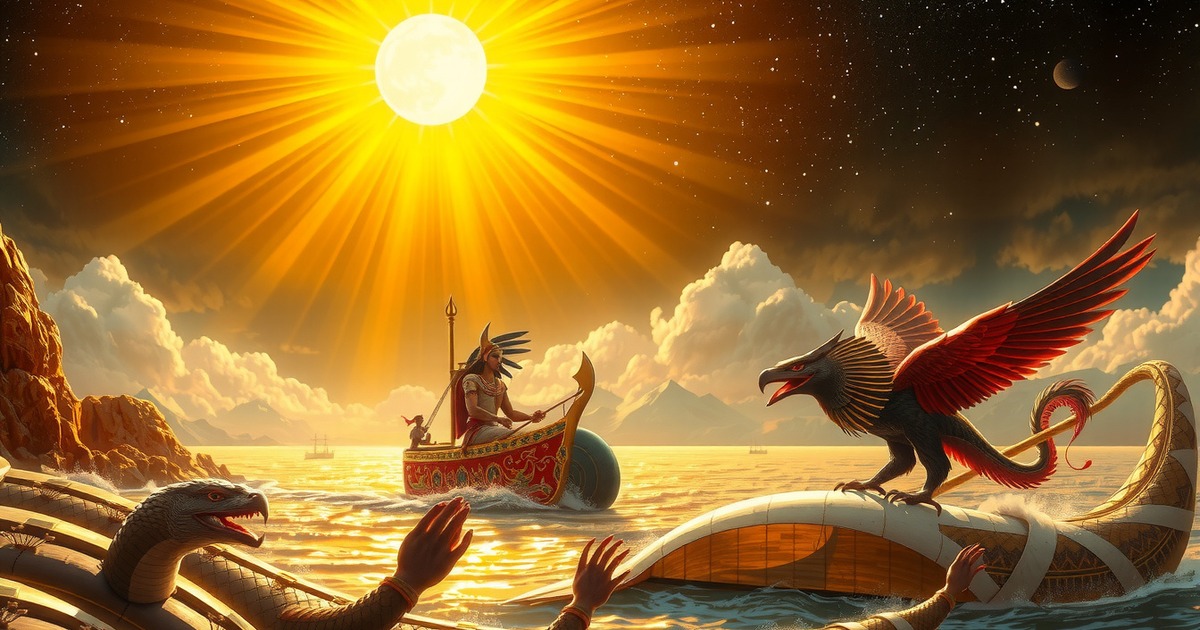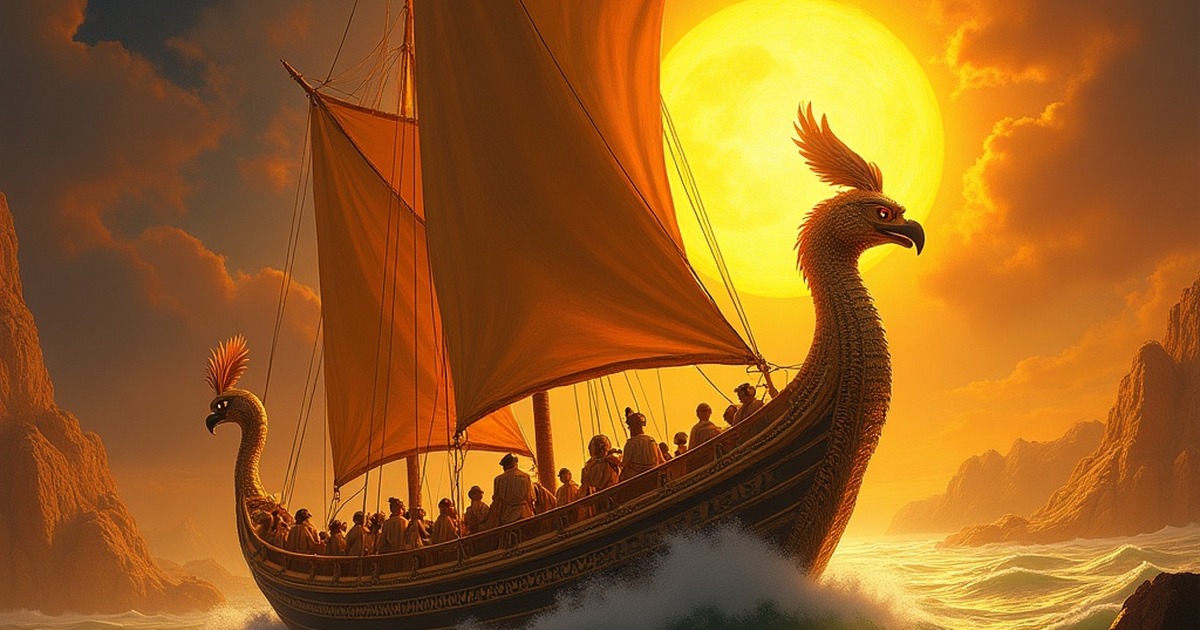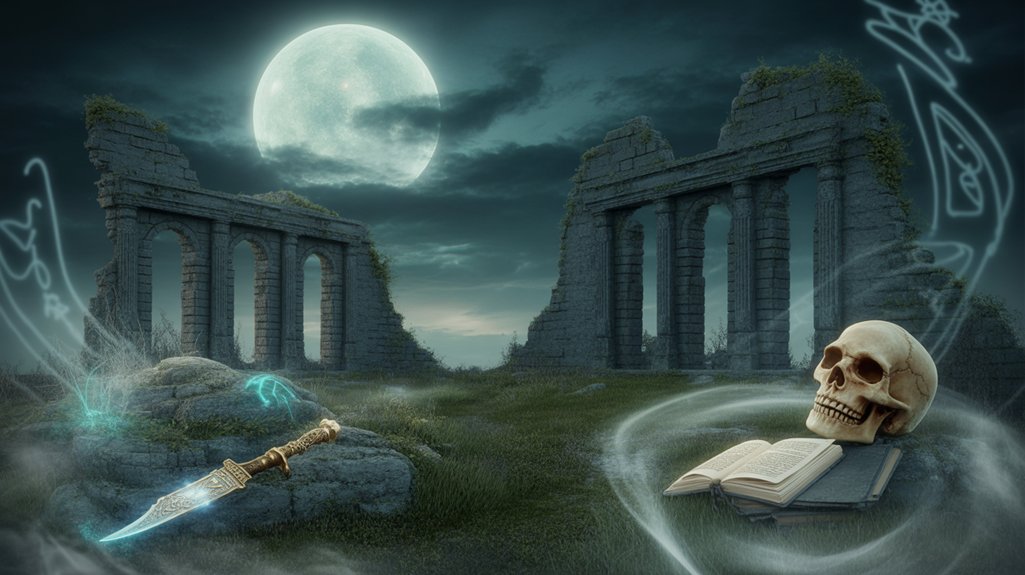
Psychopomp figures—spiritual escorts guiding souls through death's threshold—manifest across civilizations with striking parallels: Egypt's jackal-headed Anubis weighs hearts against Ma'at's feather in Duat's judgment halls, while Greek Charon demands his obol for passage across the Styx's eldritch waters. Hindu Yama, Aztec Mictlantecuhtli, and Vodou's Baron Samedi perform similar functions, each embodying their culture's understanding of mortality's liminal boundary. Chimeric guardians like three-headed Cerberus, Celtic Cù Sìth, and soul-devouring Ammit enforce underworld laws, their forms reflecting deeper truths about change, accountability, and humanity's eternal confrontation with finitude—themes documented in Mesopotamian clay tablets from 3000 BCE forward.
Key Takeaways
- Cerberus, the three-headed hound, guards the Greek Underworld's entrance, preventing souls from escaping back to the living world.
- Hellhounds like Cù Sìth and Garmr herald death across Celtic and Norse mythologies through ominous howling and doom symbolism.
- Galla demons from Sumerian mythology act as underworld guardians, preventing the deceased from returning to the realm of the living.
- Banshees are Irish spirits whose wailing announces imminent death and guides deceased family members connected to specific bloodlines homeward.
- Ammit the Soul Devourer consumes unworthy hearts in Egyptian mythology, representing moral accountability and denying resurrection through eternal oblivion.
Death's Supernatural Guardians Explored
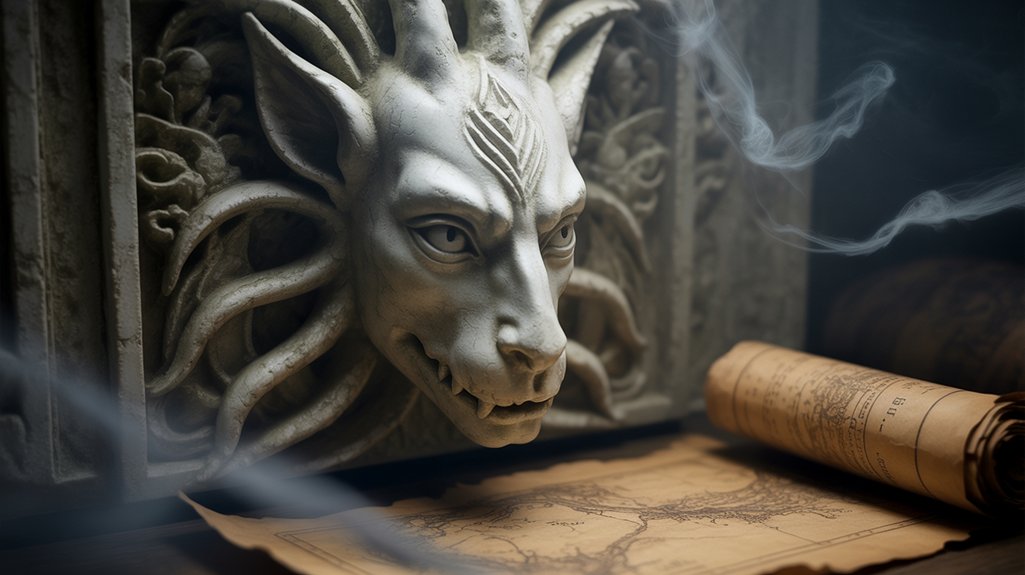
Since humanity first contemplated its own mortality, civilizations have conjured forth supernatural guardians to shepherd the dead through the treacherous passage between life and what lies beyond.
These eldritch figures transcend mere death symbols, embodying complex afterlife beliefs that reflect humanity's deepest existential concerns.
Ancient Egypt birthed Anubis, the jackal-headed psychopomp who guided souls through the Duat's shadowed corridors. His guardian roles extended beyond simple escort—he supervised mummification, preserving flesh for eternity.
Anubis transcended mere escort duty, presiding over mummification's sacred rituals to ensure the dead's eternal preservation through darkness.
Greece manifested Charon. Ferryman. Keeper of the Styx. Payment required: one obol placed beneath the tongue.
Hindu cosmology presents Yama, whose dharmic authority maintains universal equilibrium, judging souls in Naraka's depths with cosmic precision.
Mictlantecuhtli's skeletal visage dominated Aztec underworld domains, his chimeric form representing death's inevitable embrace.
Baron Samedi emerged from Haitian Vodou traditions, mediating between worlds with flamboyant authority.
These cultural interpretations reveal humanity's persistent need to alter death's chaos into ordered passage, appointing celestial gatekeepers to guard liminal thresholds.
##
Beyond the deities who judge and shepherd souls stands a vast menagerie of liminal beings—hellhounds whose sulfurous breath marks cursed thresholds, spectral guardians whose very presence announces the severance of life's thread, and those enigmatic psychopomps who traverse the boundaries between corporeal existence and the eternal beyond.
These creatures, ranging from the howling Cù Sìth of Celtic highlands to the wailing banshees whose keening pierces the veil between worlds, serve neither as mere symbols nor simple metaphors but as active participants in humanity's oldest transaction.
Their manifestations across cultures—whether as eldritch harbingers or chimeric escorts—reveal profound truths about how civilizations have conceptualized the moment when breath ceases and consciousness evolves into something altogether other.
The Myth and Folklore Wiki community has documented countless variations of these death-associated beings, drawing from diverse mythologies that span continents and millennia.
Mythical Creatures Connected to Death and the Afterlife
Throughout human history, the threshold between life and death has been guarded, judged, and governed by entities whose forms reflect the paradoxical nature of mortality itself—beings that embody both terror and necessity, corruption and change.
Cerberus, the chimeric hound of Hades, stands sentinel at the Underworld's gate, his three heads ensuring no soul escapes. Anubis, the jackal-headed psychopomp, guides Egyptian spirits through judgment, weighing hearts against Ma'at's feather.
Yama holds dominion over Hindu souls, his noose capturing the deceased for karmic evaluation. Mictlantecuhtli presides over Aztec Mictlan, his skeletal form accepting death's inevitability.
Hel rules Norse Helheim with dual visage—half living, half corpse. These spectral figures and ethereal beings manifest humanity's eternal reckoning with mortality's eldritch mysteries.
Hellhounds and Spectral Guardians
Where shadow-realms intersect with mortal geography, canine sentinels emerge from humanity's collective unconscious—creatures whose very existence challenges the boundary between guardian and executioner, protector and harbinger.
Hellhound legends manifest across disparate cultures: Cerberus's three-headed chimeric form preventing Underworld exodus, Norse Garmr awaiting Ragnarök's apocalyptic召oning, Britain's Dartmoor phantom announcing imminent mortality.
These eldritch beasts embody spectral symbolism that transcends mere folklore—they're psychopomps marking threshold spaces between existence and oblivion. Their obsidian fur absorbs light; sulfurous breath signals supernatural presence.
Such guardians don't simply threaten—they *enforce* cosmic order, ensuring death's sanctity remains inviolable. Unlike benign spirits, these creatures acknowledge mortality's terror while maintaining necessary boundaries.
Ancient accounts describe Cerberus with even more formidable attributes—a snake's mane, lion's claws, and according to Hesiod, fifty heads that consumed raw flesh.
They're neither cruel nor merciful. Absolute. Eternal. Watching where mortal courage fails and shadow-paths begin.
Psychopomps Across World Mythologies
While hellhounds patrol mortality's perimeters with territorial ferocity, another class of supernatural entities performs the delicate work of shepherding departed souls—psychopomps who navigate the treacherous cartography between corporeal existence and whatever lies beyond.
Greece's Charon demands his obol, that single coin payment securing passage across Styx's dark waters. Egypt's jackal-headed Anubis weighs hearts against Ma'at's feather, determining worthiness through precise calibration of mortal deeds.
Hindu tradition presents Yama escorting souls toward either Naraka's torments or moksha's liberation. Celtic Banshees keen mournful warnings before guiding familial dead homeward.
Haiti's Baron Samedi, resplendent among the Gede spirits, bridges living and deceased domains.
These psychopomp symbolism patterns reveal humanity's universal need for sacred escorts during afterlife journeys—navigators of eldritch passages where mortal consciousness dissolves into eternal mystery.
Banshees and Death Omens
Across Ireland's mist-shrouded landscapes, the bean sídhe manifests as death's herald—a spectral woman whose keening pierces the veil between mortal comprehension and inevitable dissolution.
Banshee mythology reveals an eldritch guardian bound to specific bloodlines, her apparition—whether radiant maiden or haggard crone—signaling imminent ancestral change. The creature's nocturnal wailing, varying from tender lament to soul-rending shriek, alters atmospheric darkness into prophetic theater.
These entities transcend mere harbingers of doom; they embody Ireland's profound understanding of mortality's sacred continuum. Family lineage remains their dominion, each banshee eternally tethered to particular clans, watching, waiting, announcing.
Their white or gray garments ripple through folklore as tangible reminders that death, though terrifying, arrives with ancient witnesses who honor the departed's passage from corporeal existence to the Otherworld's chimeric embrace.
Mesopotamian Underworld Texts 3000 BCE
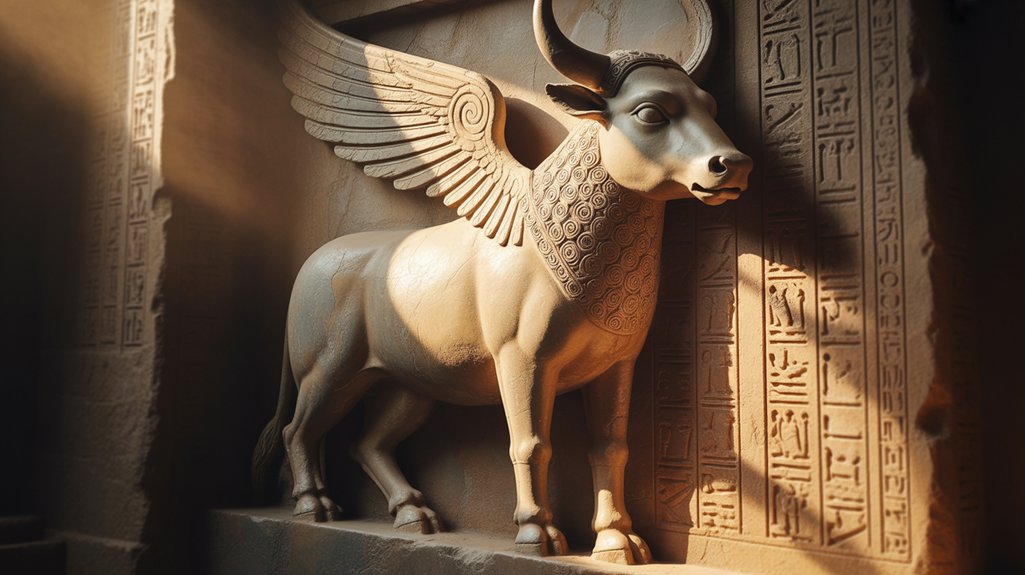
The clay tablets unearthed from the Tigris-Euphrates River Valley, inscribed circa 3000 BCE, reveal humanity's earliest systematic recordings of death rituals and the eldritch guardians who patrolled Kur's boundaries—demons whose chimeric forms were meticulously catalogued by Sumerian scribes.
These cuneiform documents, pressed into wet clay by ancient hands, describe the galla and other supernatural sentinels who prevented the dead from returning to the living world, their monstrous visages serving as psychopomps between earthly existence and Ereshkigal's shadowed domain.
Within these fragmentary texts lies evidence of elaborate funerary practices: libations poured, incantations spoken, offerings buried—all desperate attempts to appease the creatures lurking in liminal darkness.
Sumerian Demons Guarding Kur Realm
Beneath the seven gates of descending darkness, Kur existed as humanity's first systematized vision of the afterlife—a subterranean domain where demons didn't merely haunt but governed with bureaucratic precision.
Sumerian demons enforced cosmic order through eldritch authority, their roles meticulously defined within this chthonic hierarchy. Nergal's role merged plague-bearer with sentinel, his war-forged nature establishing boundaries between mortality and oblivion.
Ereshkigal's judgment determined each soul's eternal station, her sovereignty absolute within these lightless halls. The Galla demons—chimeric entities of pure terror—dragged the unwilling dead through descending passages, their grotesque forms immortalized in cuneiform tablets dating to 3000 BCE.
These Kur guardians weren't malevolent aberrations but necessary functionaries, maintaining the delicate balance between worlds. Inanna's descent revealed their true purpose: guardians preventing chaos, ensuring death's permanence, protecting existence itself.
Tigris-Euphrates River Valley Origins
Where silt-rich waters converged between twin rivers, humanity first codified death's architecture in wedge-shaped impressions upon clay. The Tigris-Euphrates River Valley birthed civilization's earliest underworld texts circa 3000 BCE, inscribing mythical origins into permanence. Ereshkigal ruled Irkalla's eldritch depths, enforcing judgment upon trembling souls who descended through sequential gates—each threshold measuring their mortal deeds against cosmic law.
| Mesopotamian Element | Sacred Function |
|---|---|
| River deities | Boundary guardians between worlds |
| Seven gates | Progressive soul purification |
| Funerary offerings | Spiritual currency for passage |
The Epic of Gilgamesh immortalized humanity's futile rebellion against mortality's inevitability. Death wasn't extinction but alteration—chimeric existence beyond life's confines. These ancient Sumerians understood freedom's ultimate paradox: liberation required acknowledging mortality's dominion, honoring the dead through ritual offerings that sustained both worlds simultaneously.
Death Ritual Clay Tablet Records
Pressed into damp clay with stylus-precision, Mesopotamia's scribes converted ephemeral death rites into permanent theological doctrine—each cuneiform wedge a deliberate cartography of soul-passage.
These tablets, crystallized circa 3000 BCE, documented the treacherous descent into Kur, where Ereshkigal's eldritch sovereignty awaited judgment. The Epic of Gilgamesh epitomized mortality's inexorable grip, immortality's chimeric nature laid bare through narrative weight.
Priests became psychopomps through recorded incantations, their burial practices meticulously preserved: offerings positioned with ritualistic exactitude, libations poured at prescribed intervals.
The soul journey demanded proper funerary observance—neglect meant eternal restlessness, wandering between thresholds.
These clay archives weren't mere records but protective spells themselves, altering transient ceremony into unchanging law, ensuring the departed navigated underworld passages with protocols humanity dared not forget.
Egyptian Versus Greek Psychopomps

Though separated by the Mediterranean's azure expanse and centuries of divergent theological development, the Egyptian Anubis and the Greek Charon emerged as civilization's most enduring psychopomps—those liminal guides who shepherd the deceased across the threshold between mortal existence and the domain of the dead.
| Aspect | Anubis | Charon |
|---|---|---|
| Physical Form | Jackal-headed divinity, eldritch guardian | Grim ferryman with weathered oar |
| Sacred Duty | Weighs hearts against Ma'at's feather | Transports souls across Styx's waters |
| Payment Required | Proper mummification rites | Single obol coin |
| Afterlife Vision | Life continues in blessed eternity | Shadowy existence under Hades |
| Cultural Role | Protector ensuring resurrection | Boundary enforcer of death's finality |
These psychopomp symbolism systems reveal profound afterlife beliefs. Anubis promised alteration through meticulous preservation. Charon demanded submission to inevitable dissolution. Both remain eternal sentinels of humanity's darkest crossing.
Cultural Metaphors for Mortality
Across continents and millennia, humanity has changed its terror of oblivion into an intricate bestiary of death-bearing entities, each culture sculpting mortality's formless dread into tangible guardians, judges, and collectors who grant the unknowable a face.
These cultural reflections manifest as mortality symbolism through:
Through boundary keepers, moral arbiters, and soul harvesters, cultures transform death's void into mythological architecture—terror crystallized into negotiable forms.
- Boundary Keepers: Cerberus, the three-headed hound stationed at Hades' threshold, represents the impermeable membrane between existence and extinction—a chimeric sentinel enforcing death's finality while the Aztec Mictlantecuhtli presides over Mictlan's nine eldritch levels.
- Moral Arbiters: Yama weighs karmic debt with celestial precision, altering death from mere cessation into cosmic judgment. His verdicts bind mortality to dharmic consequence.
- Soul Harvesters: The skeletal Ankou traverses Breton twilight collecting spirits, while owls ferry whispered messages between domains, their nocturnal flights mapping the liminal geography separating animate from inanimate.
Each figure changes abstract mortality into processable metaphor—death given shape, purpose, meaning.
Anubis Weighing Hearts Ceremony
In the sepulchral chambers of ancient Egypt's underworld, Anubis—the jackal-headed psychopomp—orchestrated humanity's most eldritch tribunal: the Weighing Scale Ritual, wherein each deceased soul's heart was measured against the pristine ostrich plume of Ma'at, goddess of cosmic truth and jurisprudence.
This chimeric ceremony, immortalized across tomb walls from the New Kingdom period (circa 1550-1077 BCE), converted moral philosophy into tangible substance; a heart laden with earthly transgressions would tip the balance toward damnation, while righteousness rendered it light as air.
Should the scales betray a life of wickedness, Ammit—that grotesque amalgamation of crocodile, lion, and hippopotamus—waited beneath with gaping jaws, prepared to devour the condemned soul into oblivion's maw, erasing its existence from both terrestrial memory and eternal Ka.
The Weighing Scale Ritual
When death claimed an ancient Egyptian, their journey didn't end with the cessation of breath—it changed into something far more perilous, a passage through the Duat where Anubis, the jackal-headed psychopomp, presided over humanity's most consequential reckoning.
Within the Hall of Two Truths, the weighing hearts ceremony commenced—Anubis judgment rendered absolute through sacred scales. The deceased's heart, that repository of earthly deeds and intentions, balanced against Ma'at's feather, light as truth itself.
Thoth recorded every measurement with scribal precision. A heart burdened by transgression tipped the scales toward damnation, summoning Ammit, that chimeric devourer whose eldritch form promised oblivion.
Lightness meant passage into eternity. This ritual embodied Egypt's cosmic order, where moral equilibrium determined one's fate beyond the veil separating life from death's infinite domain.
Feather of Ma'at Truth
At the precise fulcrum of Egyptian eschatology rests Ma'at's feather—that singular plume of ostrich down, white as bleached papyrus, light as morning mist across the Nile, yet weighted with the entirety of cosmic law.
Anubis, jackal-headed sentinel of the threshold, positioned this emblem upon bronze scales, counterbalancing mortal hearts against feather symbolism that transcended mere decoration. The ceremony wasn't symbolic theater. Actual judgment.
If one's heart exceeded the feather's ethereal weight—corrupted by lies, violence, disorder—Ammit waited. That chimeric devourer, part crocodile, part lion, part hippopotamus, consumed the unworthy utterly. Obliteration.
Yet Ma'at principles offered redemption: live truthfully, maintain cosmic order, speak honestly. The lightest hearts ascended.
Tomb paintings across dynasties preserved this eldritch moment, illuminating humanity's oldest bargain—ethical conduct exchanged for immortality.
Ammit the Soul Devourer
Beyond the scales' brass gleam, where judgment crystallized into irrevocable consequence, Ammit crouched—that composite nightmare whose very anatomy encoded Egypt's most lethal fauna into singular, mythological dread.
Crocodile jaws. Lion's torso. Hippopotamus haunches. This chimeric sentinel embodied nature's apex predators merged into eldritch purpose: consuming hearts heavier than Ma'at's feather.
Ammit's role transcended mere punishment; she represented moral accountability's absolute finality. When hearts failed truth's measure, she devoured them completely. Eternal oblivion followed. No resurrection. No Field of Reeds.
Ammit's symbolism permeated Egyptian consciousness as ultimate deterrent against earthly transgressions, her waiting presence ensuring citizens understood life's ethical weight.
Freedom existed only through virtue—for those denied passage faced something worse than death itself: complete annihilation of soul, identity erased from cosmic memory forever.
Grim Reaper in Contemporary Media
As contemporary culture grapples with mortality's ineffable nature, the Grim Reaper emerges as an enduring psychopomp whose skeletal visage—draped in eldritch robes, scythe gleaming—transcends its medieval European origins to inhabit the liminal spaces of modern storytelling.
Grim Reaper symbolism permeates twenty-first-century narratives, from Neil Gaiman's chimeric rendering in “The Sandman” to the horror franchise “Final Destination,” where death manifests as inescapable fate.
These Grim Reaper adaptations reveal humanity's perpetual fascination with mortality's threshold:
- Animation and Television: “The Grim Adventures of Billy & Mandy” alters the reaper into an unlikely protagonist, subverting traditional hierarchies of fear.
- Interactive Gaming: “Dark Souls” and “Death Stranding” weaponize death's imagery, forcing players to confront loss through participatory ritual.
- Commercial Appropriation: Advertisements exploit the reaper's iconic form—simultaneously edgy and humorous—demonstrating its cultural malleability.
This spectral figure persists, reminding audiences that death's shadow can't be banished from collective consciousness.
Neuroscience of Death Symbolism
When death's archetypal figures—reapers, psychopomps, spectral harbingers—manifest in human consciousness, they don't merely flutter across the mind's surface as ephemeral phantoms.
Neuroimaging reveals these eldritch symbols activate the amygdala's ancient circuitry, triggering primal fear responses while simultaneously engaging the brain's reward pathways. This chimeric neural dance suggests death imagery serves dual purposes: threat recognition and meaning-making.
The prefrontal cortex ignites during existential reflection, processing mortality's implications for identity and purpose. Death anxiety manifests through the anterior cingulate cortex, steering life decisions with invisible urgency.
Most striking: exposure to mortality cues boosts prosocial behavior. Social neuroscience demonstrates that contemplating death—whether through mythic symbols or direct confrontation—strengthens communal bonds, drives altruism.
The Reaper's shadow paradoxically illuminates connection. These neural mechanisms reveal why cultures worldwide craft elaborate death mythologies. Not escapism. Survival architecture. The brain alters terror into transcendence, forging meaning from the void.
Modern Grief Processing Applications
Digital domains now harbor the psychopomps of contemporary mourning—applications designed not to banish death's specter but to steer the bereaved through grief's labyrinthine passages with algorithmic precision.
These platforms manifest as digital memorials where the departed's essence crystallizes in pixels and perpetual remembrance, accessible beyond temporal constraints. Virtual support groups emerge as modern spirit circles, connecting isolated mourners across geographical chasms through shared testimony and communal witness.
The technology incorporates guided meditations reminiscent of ancient death rites, journaling prompts that mirror funerary inscriptions, educational resources illuminating grief's chimeric phases.
Some applications venture into eldritch territories—virtual reality constructs where bereaved souls commune with memory-shadows of the departed, traversing immersive landscapes designed for reflection and reconciliation.
Social media alters into spontaneous grief support networks, hashtags functioning as binding sigils that gather mourners into spontaneous communities.
These digital tools don't replace traditional mourning practices; they reconfigure them, offering liberation from isolation's crushing weight while honoring death's sacred mystery.
Cross-Cultural Legacy Synthesis
Through centuries of divergent cultural evolution, humanity's mythological guardians of death coalesce into a startling tapestry of shared psychological imperatives—the psychopomp transcending geographical boundaries to emerge as universal necessity rather than coincidental invention.
From Anubis's jackal-headed vigil to Charon's spectral oar cutting through Stygian waters, these entities manifest identical functions despite oceanic separation. Cultural interpretations diverge in aesthetic detail—Yama's verdant skin versus Mictlantecuhtli's skeletal grin—yet converge upon fundamental truths: death demands navigation, souls require guidance, change necessitates ritual.
The Banshee's keening and Hel's half-corrupted flesh represent distinct death symbolism, yet both embody transformation's eldritch terror.
These chimeric figures weren't spawned from shared texts or trade routes. Rather, they erupted from collective unconscious recognition that mortality's threshold demands guardianship. Their persistence across millennia demonstrates humanity's refusal to face oblivion unaccompanied, changing existential dread into mythological companionship—death personified becoming, paradoxically, death's antidote.
Frequently Asked Questions
What Mythical Creatures Guide Souls in Norse Mythology?
In Norse cosmology, Valkyries serve as psychopomps, their Valkyrie roles encompassing the selection of slain warriors destined for Valhalla's golden halls.
These eldritch maidens ride through battle's carnage, weaving fate's threads.
Meanwhile, the goddess Hel commands her eponymous territory—Hel's domain—a misty underworld beneath Yggdrasil's roots where those who perished from illness or age reside.
Together, these entities govern death's liminal passages, sorting souls according to ancient protocols established during the world's dawn.
Are There Benevolent Death Creatures in Asian Folklore Traditions?
Remarkably, over 80% of Asian cultures maintain traditions honoring protective deities who shepherd rather than threaten the deceased.
Japan's Jizō Bosatsu stands paramount among these benevolent spirits, guarding children's souls in the liminal Sanzu River crossing.
China venerates Dizang Wang, the earth-store bodhisattva who descends into hell domains to liberate trapped souls.
These compassionate psychopomps, documented in texts dating to the Tang Dynasty, embody freedom from suffering—merciful guides through death's eldritch threshold.
How Do Aztec Death Deities Differ From European Ones?
Aztec death deities embody change rather than finality—Mictlantecuhtli governs Mictlan's nine-layered underworld where souls undergo four-year journeys of metamorphosis.
The Aztec afterlife distinguishes itself through destination-based cosmology: warriors ascend to solar paradise, the drowned reach Tlalocan's verdant domain.
Conversely, European mortality traditions emphasize judgment and moral reckoning. Christianity's binary heaven-hell construct, the Greeks' shadowy Hades—these reflect ethical accountability.
Aztec cosmology honors death's cyclical nature, its regenerative power. European frameworks fear death's permanence, its punitive potential.
Different philosophical architectures entirely.
Which Cultures View Death Creatures as Protectors Rather Than Threats?
“Not all shadows herald doom.”
Ancient Egyptian, Japanese, and Mesoamerican civilizations revered death's emissaries as guardian spirits. Egypt's Anubis guided souls through the Duat's eldritch passages. Japan's Shinigami served as protective entities, shepherding spirits rather than harvesting them.
The Aztec Xolotl—chimeric, twin-souled—escorted the deceased through Mictlan's nine treacherous levels. These cultures understood a profound truth: death's creatures don't threaten liberation; they guarantee safe passage through transformation's darkest threshold, honoring the journey between worlds.
Do Native American Tribes Have Psychopomp Figures in Their Mythology?
Native American traditions across diverse nations maintain rich psychopomp symbolism, though manifestations vary profoundly.
The Lakota revere Owl Woman, who guides spirits along the Wanagi Tacanku—the Ghost Road.
Crows serve as liminal messengers among Pacific Northwest tribes, bridging corporeal and ethereal domains.
The Navajo acknowledge eldritch forces through ceremonial figures who shepherd souls through transformative darkness.
These aren't abstract concepts but living spiritual technologies, understood through generations of sacred practice, offering pathways toward ultimate freedom beyond mortal constraints.
Conclusion
These psychopomps remain threads in humanity's vast tapestry of mortality, their eldritch presence haunting collective consciousness across millennia. From Anubis's scales to the Reaper's scythe, such entities don't merely symbolize death—they've shaped grief rituals, neurocognitive responses, and contemporary psychological frameworks. Ancient Mesopotamian scribes couldn't have imagined their chimeric guardians enduring through digital resurrection. Yet here they persist, liminal figures bridging empirical understanding and ineffable mystery, proving humanity's relationship with mortality transcends epochs, demanding reverence for these enduring supernatural architects.