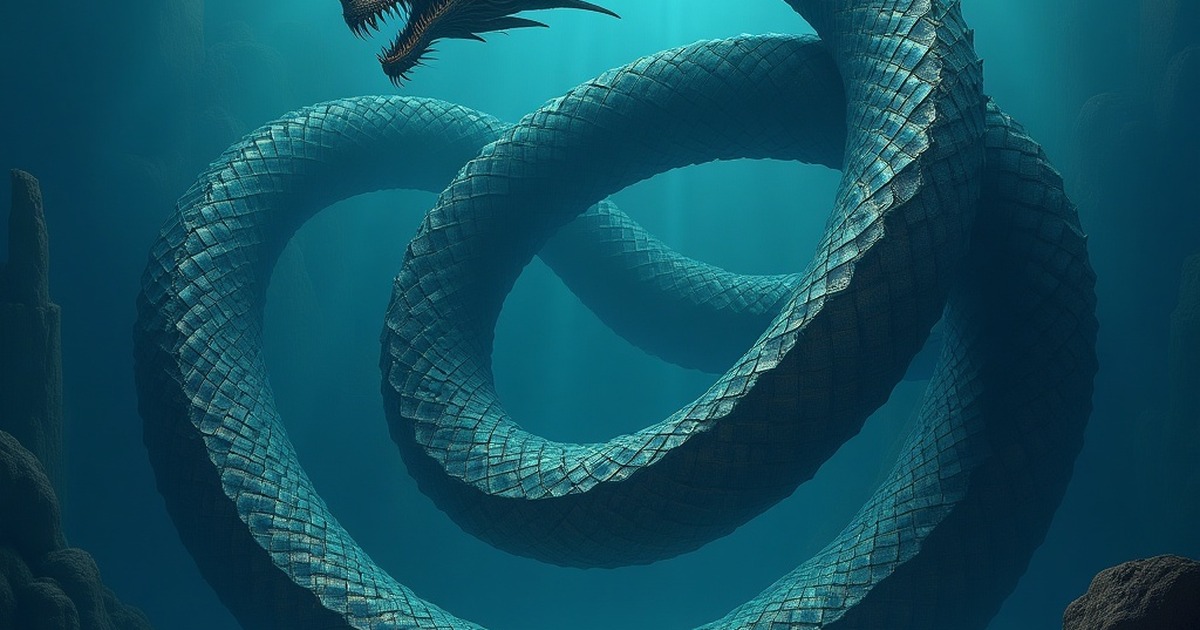
Mythical creatures have served as protective talismans across civilizations since Mesopotamian chimeras like Lamassu guarded thresholds around 3500 BCE. Eastern dragons—Chinese long, Japanese ryū, Korean yong—channel celestial beneficence and agricultural abundance, while Fu Dogs repel malevolent forces at temple entrances. These guardians evolved from cultural anxieties into psychological frameworks: Qilin symbolizing wise governance, Pixiu hoarding wealth, Ganesh removing obstacles. Contemporary research reveals that invoking protective symbology activates neural pathways related to agency and control, offering measurable relief from modern uncertainty—a phenomenon rooted in humanity's ancient need to project order onto chaos through liminal beings that bridge mortal fortune and divine will.
Key Takeaways
- Dragons symbolize fortune and prosperity across cultures, with Eastern varieties bringing abundance while Western dragons represent power and wealth accumulation.
- Fu Dogs and Lamassu guard thresholds against malevolent forces, serving as protective sentinels at entrances of temples, palaces, and homes.
- Ganesh removes obstacles and brings good fortune, with his elephant form widely represented in protective jewelry and household décor.
- Qilin and phoenixes embody governance wisdom and resilience, symbolizing auspicious energies and protection against adversity in Asian traditions.
- Dragon Turtles and Pixiu serve as modern wealth guardians, combining ancient protective symbolism with contemporary prosperity and financial security.
Universal Human Need for Protection
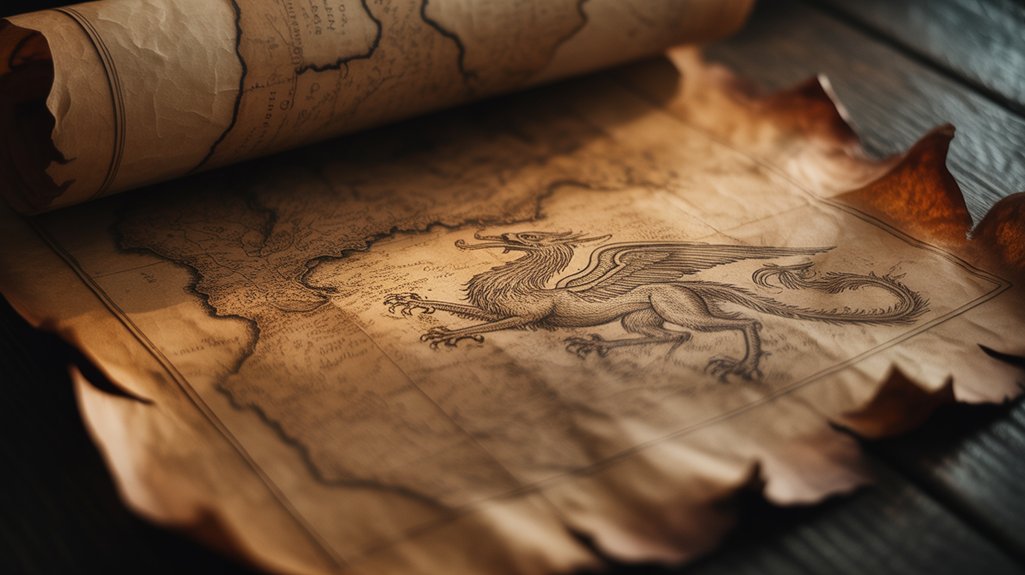
Since humanity first gathered around primordial fires to ward off the encroaching darkness, the need for protection has shaped civilizations and birthed pantheons of guardian spirits. This universal vulnerability transcends geographical boundaries, manifesting in cultural narratives that consistently position mythical beings as bulwarks against malevolent forces.
Dragons in Chinese tradition, griffins patrolling ancient treasuries, the eldritch Qilin heralding sovereign legitimacy—each represents humanity's desperate yearning for something greater than mortal flesh to stand between civilization and chaos.
Mythical guardians emerged from humanity's recognition that mortal strength alone cannot hold back the forces of chaos.
The pattern persists. Emperors claimed draconic lineage, not from vanity, but from existential necessity. When rulers declared themselves descendants of these chimeric protectors, they weren't merely asserting power; they were embedding protection into governance itself.
Even humble bats, their name echoing fú in Chinese phonetics, evolved from nocturnal creatures into household guardians. Buddhist elephants similarly emerged as fortune-bearers, their massive forms symbolically crushing negative influences.
Across millennia, cultures independently arrived at identical conclusions: protection requires forces beyond human comprehension. Yet not all mythical creatures served as guardians—some emerged as embodiments of humanity's darkest fears, cautionary figures meant to enforce cultural boundaries and teach survival in unforgiving environments.
##
Across the vast tapestry of human civilization, from the imperial courts of dynastic China to the mist-shrouded valleys of Celtic lands, mythical guardians have manifested in chimeric forms that transcend mere superstition—they embody humanity's deepest yearnings for protection and abundance.
These eldritch beings, whether scaled dragons commanding celestial waters or leonine sentinels guarding accumulated wealth, operate within sacred geometries of belief where symbolic power becomes tangible force.
The modern world hasn't abandoned these ancient protectors; instead, it's converted their veneration into contemporary practices, where feng shui arrangements and precious amulets carry forward millennia-old traditions of invoking supernatural providence.
The unicorn, originally depicted as goats rather than the elegant white horses of modern imagination, was revered for its power to purify contaminated water and restore life through its magical properties.
Dragons Across Different Cultures
Through the mists of antiquity, dragons emerge as perhaps the most paradoxical of all mythical beings—creatures whose very essence changes across continental boundaries, morphing from devastating harbingers of chaos in Western consciousness to celestial benefactors in Eastern cosmology.
These eldritch serpents embody cultural symbolism so profound that Chinese emperors proclaimed themselves dragon-descended, wielding this chimeric lineage as divine mandate.
Dragon myths diverge dramatically: Western fire-breathers covet golden hoards in mountain lairs, while Eastern long ascend cloud-wreathed peaks, dispensing wisdom and fortune.
During lunar celebrations, paper dragons writhe through crowded streets, activating auspicious energies. In Feng Shui practices, strategically positioned dragon imagery channels prosperity currents.
These guardians transcend mere superstition—they represent humanity's eternal dialogue with forces beyond mortal comprehension, bridging earthly aspirations with celestial power.
Guardian Creatures in Folklore
Beyond the territory of fortune-dispensing dragons lies another level of mythical beings—those whose primary purpose centers not on bestowing wealth but on vigilant protection.
Chinese Fu Dogs stand sentinel at temple thresholds, their leonine forms carved in stone, warding against eldritch forces that threaten sacred spaces. These guardian spirits embody imperial authority.
The Dragon Turtle merges chimeric elements—serpentine wisdom fused with testudinal endurance—creating mythical protectors that shield households through feng shui placement.
Hindu tradition honors Ganesh, whose elephant countenance removes obstacles blocking life's passage. Pure defense.
In each culture, these sentinels occupy liminal boundaries between mundane and numinous domains, their protective essence activated through ritual acknowledgment, altering architectural spaces into fortified sanctuaries where human aspirations commune with ancient safeguarding powers.
Symbolic Animals and Prosperity
While guardians shield against malevolent intrusions, another taxonomy of mythical beings channels prosperity's active flow into mortal existence.
The dragon's eldritch presence throughout Chinese civilization commands reverence, its serpentine form embodying symbolic meanings of strength, power, and fortune's inevitable arrival.
Koi fish navigate upstream currents, their perseverance mirroring humanity's struggle toward achievement—prosperity symbols forged in water's altering element.
Cranes, their wings folded into paper sanctuaries one thousand times, manifest wishes through ritualistic devotion across East Asian traditions.
The white elephant's massive form carries Buddhist and Hindu blessings, attracting abundance through sacred association.
Most chimeric among these creatures, the Qilin appears before sages emerge or depart, its hybrid anatomy announcing rulers worthy of heaven's mandate, changing governance into spiritual prosperity.
Modern Interpretations of Protectors
Contemporary existence hasn't diminished humanity's yearning for supernatural safeguarding—rather, it's metamorphosed ancient protective symbols into vessels that speak to modern anxieties.
Dragons and phoenixes emerge as paramount emblems of resilience, their mythical symbolism channeling strength against life's adversities. The chimeric dragon turtle merges aquatic stability with celestial power, its Feng Shui applications attracting prosperity while anchoring households against financial turbulence.
Ganesh's elephantine form manifests through jewelry and décor, protective attributes radiating from trunk to tusk. Cranes transcend ornamentation—each folded origami iteration becomes prayer incarnate, whispering longevity into relationships.
Pixiu prowls modern consciousness as wealth's sentinel, its eldritch form adorning wrists and necks, trapping fortune while repelling economic devastation.
These creatures persist not as relics but as living talismans, their protective essence adapting to contemporary needs while maintaining primordial potency.
Mesopotamian Clay Tablet Evidence
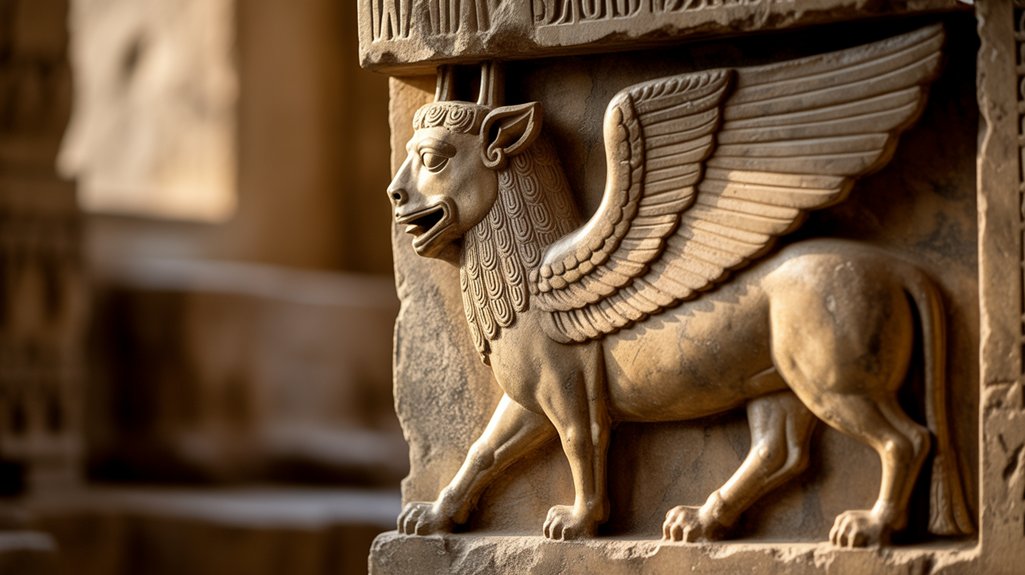
The earliest attestations of chimeric guardians emerge from fourth millennium BCE clay tablets unearthed across southern Iraq and Syria, where cuneiform inscriptions reveal elaborate theological systems centered on protective entities.
These ancient Mesopotamians inscribed their beliefs into wet clay with deliberate precision, documenting how lamassu and other eldritch beings stood sentinel at city gates and temple thresholds, their hybrid forms—leonine bodies crowned with human wisdom—designed to repel malevolent forces from the material domain.
The tablets speak plainly: such creatures weren't mere artistic flourishes but essential bulwarks against chaos, their presence ensuring cosmic order and communal prosperity in settlements where survival depended upon divine favor.
Fourth Millennium BCE Inscriptions
Among the scattered ruins of ancient Sumer, where humanity first pressed stylus to wet clay around 3500 BCE, archaeologists have unearthed compelling evidence that mythical creatures weren't mere artistic flourishes—they served as potent conduits between mortal fortune and divine will.
Fourth Millennium inscriptions reveal chimeric lions and eldritch dragons etched beside protective incantations, their forms deliberately positioned to channel celestial power earthward. These Mesopotamian symbols functioned as talismans, their images imbued with apotropaic force through accompanying spells.
The clay tablets demonstrate sophisticated understanding: mythical creatures acted as guardians against malevolent entities while invoking prosperity. Each cuneiform character carved near these beings amplified their efficacy.
BCE inscriptions therefore illuminate humanity's earliest attempts to utilize symbolic power, binding fortune to divine favor through carefully crafted iconography.
Southern Iraq and Syria
Carved into sun-baked clay between the Tigris and Euphrates, Mesopotamian tablets from Southern Iraq and Syria preserve humanity's most elaborate taxonomy of protective chimeras—catalogued, named, and ritually deployed. These inscriptions reveal the mythical origins of guardian entities that transcended mere superstition, becoming foundational to civic identity and personal autonomy. The cultural significance extended beyond architectural ornamentation into lived experience through portable amulets.
| Creature | Physical Form | Primary Function | Cultural Role |
|---|---|---|---|
| Lamassu | Human-lion-bird hybrid | Palace protection | Urban guardianship |
| Apkallu | Fish-man chimera | Wisdom transmission | Evil prevention |
| Enkidu | Divine wild man | Sacred companionship | Human-divine mediation |
| Hybrid amulets | Various eldritch combinations | Personal protection | Chaos deterrence |
Each being represented deliberate choices—freedom from misfortune achieved through divine alliance rather than subjugation.
Protection From Evil Spirits
When darkness descended upon ancient Mesopotamian households—bringing with it the whispered threat of unseen malevolence—scribes pressed reeds into wet clay to inscribe humanity's first systematic defense against spiritual predation.
These tablets documented protective rituals invoking chimeric lamassu, hybrid sentinels stationed at thresholds where the profane met the sacred. Amulets bearing these eldritch forms became talismans against corruption, while incantations summoned named deities as spiritual guardians.
Archaeological evidence reveals deliberate placement: clay figurines positioned at entrances, altering doorways into fortified boundaries. The cuneiform inscriptions weren't mere superstition—they represented structured metaphysical warfare.
Each impressed wedge captured ancestral wisdom about warding malevolent forces, creating portable sovereignty over one's dwelling. These tablets endure as evidence of humanity's primordial need: protection through invocation, safety through sacred geometry, freedom through spiritual alliance.
Regional Protective Creature Adaptations
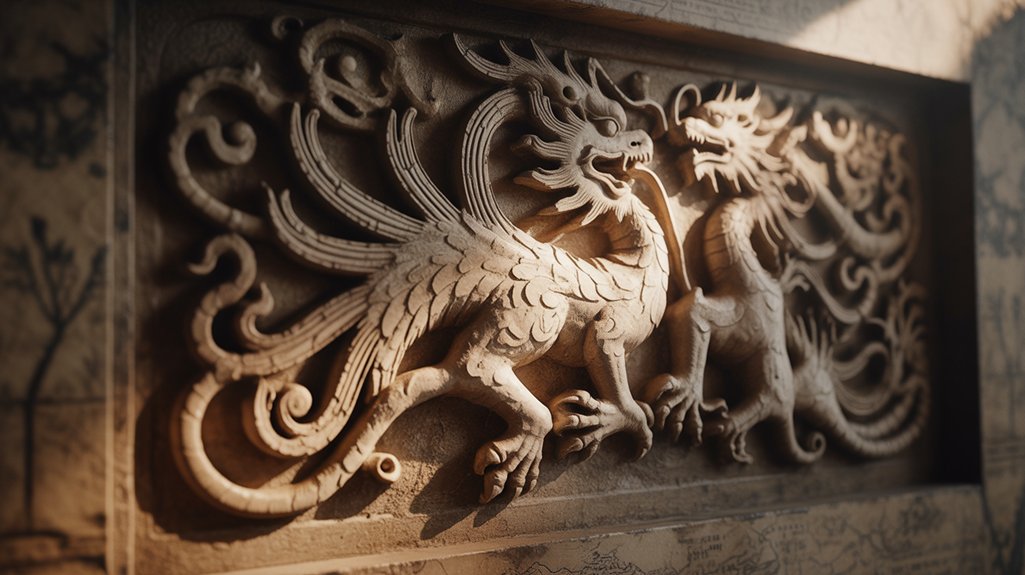
Throughout East Asia's cultural landscapes, protective mythical creatures haven't simply persisted as static symbols—they've experienced profound regional alterations that reflect each society's unique spiritual anxieties and aspirations. The chimeric Qilin, revered throughout China as harbinger of enlightened governance, manifests during moments of profound historical evolution—appearing at the births and deaths of sages, its eldritch presence validating cosmic order. Japan's Shishi adaptation altered continental guardian lions into indigenous protective spirits, their cultural significance embedded within Shinto architecture and ceremonial processions. These regional adaptations reveal distinct philosophical orientations toward protection itself.
| Creature | Primary Domain | Regional Origin |
|---|---|---|
| Qilin | Governance & Wisdom | Chinese Imperial Courts |
| Dragon Turtle | Wealth & Longevity | Feng Shui Traditions |
| Shishi | Spiritual Boundaries | Japanese Temples |
The Dragon Turtle fuses draconic power with testudinal permanence, while Pixiu's voracious appetite for gold converts abstract prosperity into tangible protection. Each adaptation speaks to liberation from specific fears—poverty, chaos, spiritual contamination.
Transformation Through Protective Symbolism
Beyond their static presence in temples and ancestral halls, these protective entities operate as changing agents—their symbolism doesn't merely ward off misfortune but actively reconstitutes the spaces they occupy into sanctified zones of perpetual change.
Protective symbols transcend mere defense—they actively transmute inhabited spaces into dynamic sanctuaries of continuous spiritual and energetic transformation.
The chimeric nature of these creatures embodies mythical alterations that reshape both physical and spiritual domains:
- Dragons and phoenixes create eldritch boundaries where strength merges with rebirth, altering mundane thresholds into passages of renewal and power accumulation.
- Pixiu and dragon turtles function as alchemical catalysts, converting stagnant chi into circulating prosperity—their protective symbolism restructures energetic patterns within homes and businesses.
- Fu dogs and qilins establish liminal guardianship, where their watchful presence alters entrances into selective membranes that filter malevolent forces while magnetizing auspicious energies.
These mythical alterations operate continuously, rendering protection not as passive defense but as active transmutation—spaces becoming laboratories of fortune, where protective symbolism orchestrates perpetual refinement of destiny itself.
Dragons Across Eastern Cultures
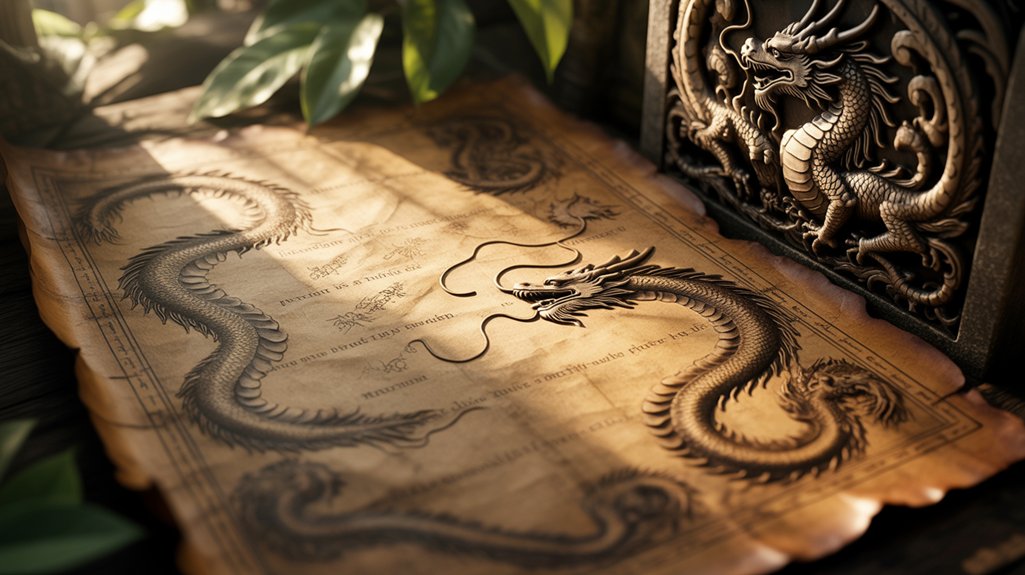
Across the vast expanse of Eastern civilizations, dragons emerge not as the malevolent, treasure-hoarding beasts of Western folklore but as chimeric embodiments of celestial beneficence—serpentine forms that spiral through temple friezes and festival processions with eldritch grace.
In China's imperial courts, where dynasties claimed draconic lineage to legitimize their mandate from heaven, these creatures symbolized agricultural abundance through their dominion over rain and rivers; in Japan, ryū granted protection against maritime perils; in Korea, yong ruled as aquatic deities governing life-sustaining waters.
Each cultural interpretation, though distinct in ritual practice and iconographic detail, converges upon a singular truth: the dragon's power flows toward fortune rather than devastation.
Dragon Symbolism in China
The celestial dragon—*long* in Mandarin—coils through Chinese consciousness as a creature fundamentally unlike the flame-breathing tyrants of Western mythology, embodying instead the life-giving forces of water, rain, and cosmic balance.
This serpentine deity, chimeric in form with its deer antlers, fish scales, and eagle talons, carries auspicious symbolism that permeates every stratum of society. Imperial robes bore five-clawed dragons, exclusive to emperors. Commoners displayed four-clawed variants.
Dragon folklore positioned these eldritch beings as protectors rather than adversaries, channeling torrential rains to parched fields, guarding sacred waterways, bestowing wisdom upon the righteous.
During Lunar New Year celebrations, undulating dragon puppets still dance through streets, their presence invoking prosperity. The Dragon Boat Festival honors their benevolent power.
Architectural guardians. Zodiacal authority. Eternal fortune-bringers dwelling between heaven and earth.
Japanese Dragon Protective Powers
While China's celestial dragons commanded imperial courts and cosmic rivers, Japan's *ryū* emerged from archipelagic waters as guardians of threshold spaces—shorelines, temple gates, mountain springs where the mundane world dissolves into sacred territory.
These serpentine, wingless entities embodied benevolence rather than conquest, their eldritch forms coiling through agricultural valleys to summon life-giving rains.
Ryū symbolism permeated imperial authority itself—emperors claimed draconic descent, legitimizing sovereignty through chimeric bloodlines.
Shinto shrines positioned bronze *ryū* at purification fountains; Buddhist temples carved them into pillars guarding sutras and relics.
Dragon festivals, particularly *Ryūko Matsuri*, ritualized communal protection through processions where paper serpents undulated above harvest fields.
The *ryū* didn't merely symbolize fortune—it actively interceded, a breathing presence between mortals and kami, ensuring prosperity flowed downward like mountain streams feeding rice paddies below.
Korean Dragon Water Deities
Beyond Japan's archipelagic mists, Korea's *yong* commanded aquatic domains with sovereign authority—not merely inhabiting rivers and seas but embodying their very essence as animate deities whose temperament determined agricultural fate.
Korean dragon symbolism diverged sharply from Western chimeric malevolence; these serpentine entities manifested as wingless benefactors, their sinuous forms bearing wisdom-pearls that radiated enlightenment.
Dragon water legends permeated agricultural consciousness—peasants and nobility alike recognized these eldritch guardians as arbiters of rainfall, their benevolence ensuring prosperous harvests or, conversely, their displeasure bringing drought.
Royal lineages claimed draconic patronage, legitimizing sovereign power through celestial association. The Dano Festival crystallized this reverence, communities gathering to petition these aquatic deities for meteorological favor.
Power flowed through them, animate channels between terrestrial need and cosmic abundance.
Contemporary Media Creature Representations

As digital storytelling reshapes humanity's relationship with ancient archetypes, dragons emerge from their primordial mythological origins into the luminous screens of contemporary cinema—transformed yet recognizable, their chimeric forms bearing both ancestral weight and modern reimagining.
These mythical representations maintain their cultural significance while adapting to modern sensibilities, bridging millennia through pixelated fire and rendered scales.
Contemporary manifestations of luck-bearing entities include:
- Dragons – “Game of Thrones” and “How to Train Your Dragon” portray these creatures as wisdom-keepers and protective guardians, their eldritch power channeled toward benevolent purposes rather than destruction.
- Chinese Phoenix – Animated narratives resurrect this symbol of rebirth, its iridescent plumage representing resilience against adversity, prosperity emerging from ash.
- Qilin – Fantasy literature employs these auspicious beings as harbingers of enlightened governance, their appearances signaling fortune's arrival.
Modern media consequently preserves ancestral reverence while democratizing access to protective symbols once confined to sacred texts and temple walls.
Cognitive Basis of Protective Beliefs
Through millennia of evolutionary adaptation, the human psyche has nurtured an intricate architecture of protective cognition—neural pathways etched deep within the limbic system that convert abstract symbols into tangible shields against chaos.
Cognitive anthropology reveals how minds instinctively anthropomorphize the eldritch and chimeric, projecting agency onto serpentine guardians and winged sentinels. This isn't mere superstition—it's survival encoded in consciousness.
Belief systems emerge when ancestral brains, confronting uncertainty's yawning void, construct frameworks of meaning. Dragons become wisdom incarnate. Griffins change into vigilance itself.
Ancestral minds transmute chaos into meaning—mythic guardians crystallize from neural necessity, transforming abstract dread into embodied wisdom.
The mechanism operates through pattern recognition, where symbolic creatures trigger neurochemical responses identical to genuine security. Psychological research demonstrates that invoking these protectors—carrying talismans, performing rituals—activates prefrontal cortex regions governing control and agency.
Such beliefs don't deceive; they liberate. They grant autonomy over fear, converting powerlessness into agency. The protective creature becomes both mirror and shield, reflecting humanity's deepest need for sovereignty against fate's capricious winds.
Modern Anxiety and Uncertainty
While ancient protective symbols once shielded humanity from plague, famine, and invasion—tangible horrors with visible boundaries—contemporary existence manifests threats that shift and multiply like hydra heads. Economic instability prowls like an eldritch predator. Social pressures crystallize into chimeric forms. The 2021 data reveals stark truth: 42% of American adults reported clinical anxiety symptoms, numbers surging beyond pre-pandemic baselines.
Modern uncertainty operates differently than ancestral fear. The immune system weakens under chronic stress, cardiovascular disease flourishes where anxiety takes root—invisible warfare within flesh itself. Yet cultural symbolism persists as anxiety management, ancient methodologies reborn. Mindfulness practices, descendants of millennia-old traditions, demonstrate measurable efficacy against contemporary dread.
The COVID-19 pandemic merely accelerated existing conditions, technological change eroding job security while social isolation fractured communal bonds. Those seeking freedom from such constraints increasingly turn toward protective mythologies, not as superstition but as psychological framework—symbols maintaining relevance precisely because human vulnerability remains eternal, merely wearing different masks across centuries.
Synthesizing Ancient and Modern Beliefs
The contemporary seeker discovers ancient protective symbology not through archaeological distance but through lived synthesis—dragons no longer confined to temple scrolls now materialize as smartphone wallpapers, meditation focal points, prosperity talismans clutched during job interviews.
This belief evolution transcends mere appropriation; it represents authentic engagement with mythical narratives that retain their cultural significance despite temporal displacement. The chimeric Qilin's auspicious appearances before sage births find modern parallels in expectant parents displaying dragon imagery, while koi fish symbolism permeates corporate logos signifying perseverance.
Cross cultural comparisons reveal consistent patterns: scarab beetles' ancient symbolism of resurrection echoes through contemporary protective rituals, phoenix iconography adorns wedding invitations honoring yin-yang harmony.
These folklore connections persist because they address fundamental human needs—security, prosperity, transcendence. Modern adaptations don't diminish ancient symbolism's potency; rather, they confirm these eldritch archetypes' enduring relevance, proving mythical creatures remain essential spiritual technologies for maneuvering uncertainty across millennia.
Frequently Asked Questions
Which Mythical Creatures Are Considered Unlucky or Bring Bad Fortune?
Across ancient traditions, certain cursed beings embody dread rather than fortune. The banshee of Celtic lore, with her eldritch wail, presages death's arrival.
Japan's bakeneko—chimeric cat-demons—herald calamity through supernatural alteration.
European folklore warns of the basilisk, whose venomous gaze brings immediate demise.
These misfortune symbols transcend mere superstition; they're cultural repositories of ancestral fear, representing humanity's primal understanding that some entities dwell beyond protective boundaries.
Liberation from their influence requires acknowledging their power without succumbing to paralysis.
How Do I Choose a Protective Creature Symbol for Myself?
When medieval alchemists selected their chimeric guardians, they'd first meditate upon their spiritual vulnerabilities—just as one must today.
Choosing protective symbolism requires authentic personal connection to a creature's eldritch essence. One shouldn't adopt a dragon merely because it's powerful; rather, examine which entity resonates with one's own struggles, ancestral heritage, or intuitive callings.
The most potent guardian emerges from genuine affinity, not arbitrary selection. Ancient wisdom teaches: forced bonds create hollow shields, while organic recognition forges impenetrable wards.
Can Wearing Mythical Creature Jewelry Actually Provide Real Protection?
Jewelry beliefs don't generate supernatural force fields, yet they wield genuine psychological power.
When one dons mythical symbolism—whether Celtic knots, Egyptian scarabs, or Norse runes—they activate ancestral memory, strengthening resolve through intentional focus.
This talismanic practice, documented across millennia from Mesopotamian amulets to Tibetan protection cords, creates real mental fortitude.
The eldritch charm doesn't repel evil through magic but through conviction, altering the wearer's consciousness into their own guardian.
Protection emerges from within.
What Are the Most Popular Lucky Creature Tattoos Today?
Like ancient grimoires opened anew, today's seekers inscribe their skin with protective symbols.
Dragon tattoos reign supreme—these serpentine guardians transcend cultures, from Chinese *lóng* embodying celestial wisdom to Norse *dreki* channeling primordial power.
Unicorn designs captivate free spirits, their single horn representing purity's eldritch force since Medieval bestiaries.
Phoenix flames. Koi ascending waterfalls.
These chimeric marks aren't mere decoration; they're talismanic contracts with archetypal forces, permanent invocations of protection for those rejecting conventional constraints.
Do Different Cultures Interpret the Same Creature's Luck Differently?
Cultural interpretations of mythical symbolism diverge dramatically across civilizations. The serpent embodies this paradox—venerated as divine protection in Egyptian and Hindu traditions, yet condemned as malevolent temptation in Judeo-Christian cosmology.
Dragons reveal similar contradictions: Eastern cultures revere them as benevolent rain-bringers and celestial guardians, while Western medieval societies feared their eldritch flames.
These chimeric beings alter meaning through cultural lenses, demonstrating how identical creatures carry opposing spiritual resonances. Context births significance; mythical symbolism remains eternally fluid, bound to ancestral interpretation.
Conclusion
From Mesopotamian apotropaic tablets to algorithmic feeds dispensing digital talismans, humanity's yearning for chimeric guardians persists—now we've merely traded clay for pixels. The eldritch creatures that once warded off pestilence apparently ward off existential dread with equal efficacy. Perhaps our ancestors, invoking dragons against marauding armies, would appreciate today's protective crystals combating Wi-Fi anxiety. The medium alters; the primal terror remains. We're still sketching monsters on cave walls, just with better lighting.