- Key Takeaways
- Selkies: The Seal People of Celtic Shores
- 🎯 Recommended Products
- Best Href Https
- Best Href Https
- Best Target Blank
- Best Target Blank
- Best Target Blank
- Kitsune: Japan's Mystical Fox Spirits
- Skinwalkers: Navajo Legends of Dark Transformation
- Were-Jaguars: Mesoamerica's Ancient Feline Guardians
- Olmec Origins and Mythology
- Shamanic Transformation Rituals
- Rusalka and Swan Maidens: Water Spirits Across Europe
- Origins of Water Spirits
- Transformation Myths and Rituals
- Tanuki: Japan's Mischievous Raccoon Dogs
- Berserkers: Norse Warriors Who Became Bears
- The Encantado: Amazon River Dolphins in Human Form
- Frequently Asked Questions
- How Do Shapeshifters Physically Transform Between Their Human and Animal Forms?
- Can Shapeshifting Abilities Be Passed Down Genetically Through Family Bloodlines?
- What Are the Psychological Effects of Regularly Transforming Into Another Creature?
- Do Shapeshifters Retain Human Consciousness and Memories in Their Animal Form?
- Are There Documented Modern Sightings or Encounters With Alleged Shapeshifting Beings?
- Conclusion
- Related Posts
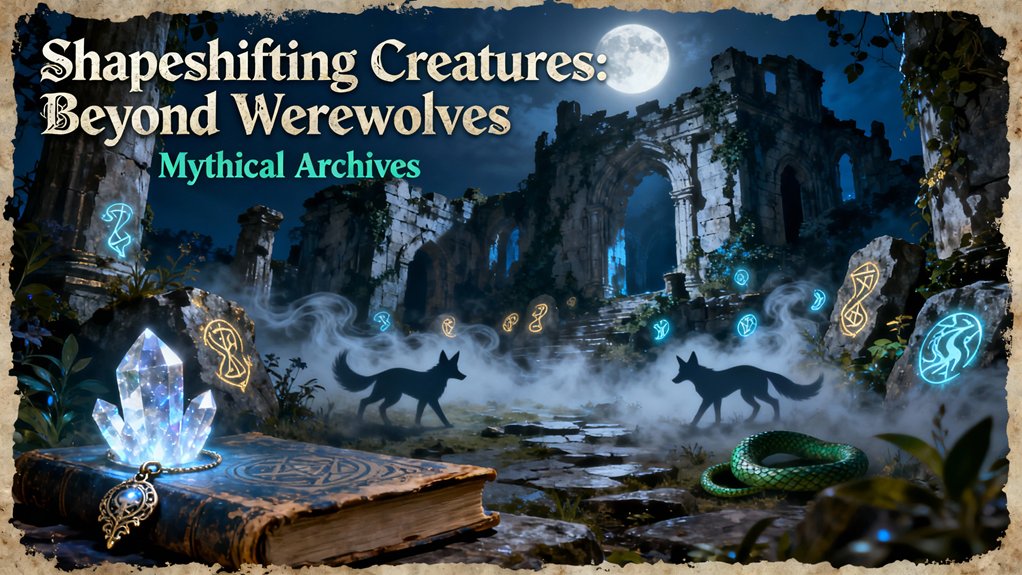
You'll discover shapeshifters far more ancient than werewolves: Celtic selkies shedding seal pelts on moonlit shores, kitsune accumulating power across centuries in Japanese shrines, Navajo skinwalkers transgressing sacred boundaries through forbidden rituals, and Olmec were-jaguars bridging terrestrial and celestial domains since 1400 BCE. From Slavic rusalki haunting threshold waters to Amazonian encantado emerging from river currents, these metamorphic beings represent humanity's recognition of identity's fluidity—ontological reconstructions that challenge biological limitations. The mythologies ahead reveal alteration's deeper cultural significance across every inhabited continent.
Key Takeaways
- Selkies from Celtic mythology shed seal pelts to transform into humans, with stolen skins trapping them in human form.
- Kitsune are Japanese fox spirits that gain transformative power over centuries, serving as divine messengers and tricksters.
- Rusalki are Slavic water spirits, souls of drowned women who shift between forms based on lunar phases and seasons.
- Were-jaguars from Olmec civilization represent shamanic transformation achieved through ritual practices and psychoactive substances for spiritual purposes.
- Tanuki are Japanese shapeshifters using leaves to alter forms, embodying adaptability and cleverness in navigating human spaces.
Selkies: The Seal People of Celtic Shores

The selkie emerges from the cold Atlantic waters as one of Celtic mythology's most poignant shapeshifters—a being caught perpetually between two worlds, two forms, two irreconcilable destinies.
🎯 Recommended Products
Handpicked items related to this article:
As an Amazon Associate, we earn from qualifying purchases.
You'll find these eldritch creatures throughout Scottish, Irish, and Icelandic seal folklore, where they shed their pelts to walk as humans upon moonlit shores. The alteration isn't chimeric mutation—it's complete metamorphosis.
Between seal and human lies no gradual transformation—only the absolute crossing from one complete existence into another.
In seal folklore, the selkie's skin becomes both prison and possibility. Steal it while she dances on the sand, and you've trapped a wife who'll bear your children yet gaze eternally seaward. She'll flee the moment she reclaims her pelt.
This Celtic mythology speaks to you who refuse singular identity, who understand the ache of dual nature. The selkie doesn't choose between worlds—she embodies their intersection, that liminal space where constraint meets wild freedom.
Her story resonates across centuries precisely because you recognize that fundamental human longing: to alter, to escape, to reclaim what's been taken. Like other mythical creatures in Celtic scripture, the selkie carries symbolism that transcends mere legend, reflecting the cultural tensions between domesticity and freedom that defined coastal communities.
Kitsune: Japan's Mystical Fox Spirits
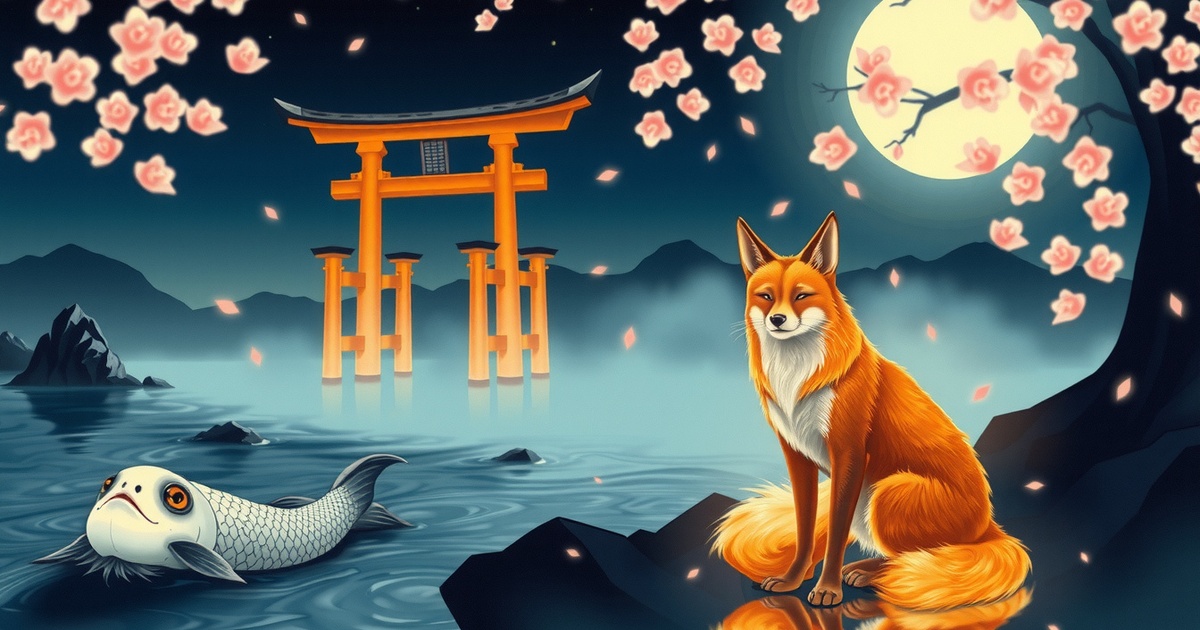
Across the archipelago of Japan, where Shinto shrines pierce morning mists and ancient cryptomeria forests hold their secrets close, kitsune intelligence operates on principles entirely alien to the selkie's binary alteration.
You'll find these fox spirits don't merely exchange one form for another—they proliferate, fracturing reality into chimeric possibilities. Fox folklore teaches that with each century lived, a kitsune gains another tail, accumulating power until nine appendages crown their eldritch maturity.
Their changes aren't costume changes but ontological reconstructions. Beautiful women. Buddhist monks. Duplicates of your loved ones. The spirit symbolism here transcends simple deception; kitsune embody wisdom, cunning, and the dangerous fertility of nature itself.
Within Inari shrines since the Heian period (794-1185 CE), white-furred kitsune serve as divine messengers, while rouge foxes pursue their own inscrutable agendas. They'll bewitch you, possess you, grant enlightenment or madness. Choice manifests through them—raw, terrifying, absolutely free.
Skinwalkers: Navajo Legends of Dark Transformation

Where crimson mesas meet infinite desert sky in the Four Corners region—that sacred convergence of Arizona, New Mexico, Colorado, and Utah—the Diné (Navajo) people recognize a corruption so profound that even speaking its name risks inviting catastrophe. *Yee naaldlooshii*: “with it, he goes on all fours.” You won't find these beings discussed openly, won't hear elders share their knowledge casually with outsiders, because skinwalkers represent the antithesis of *hózhǫ́*—the harmony, balance, and beauty upon which Navajo cosmology depends.
These practitioners of forbidden witchcraft achieve dark shapeshifting through unspeakable transgression: the murder of close kin. Wearing pelts of wolves, coyotes, bears, or crows, they transcend human limitation, racing across moonlit arroyos at impossible speeds. Navajo beliefs describe their eldritch abilities—reading thoughts, mimicking voices, projecting illnesses from distance. Chimeric. Malevolent. They hunt at night, their eyes reflecting headlight beams like predators, leaving communities paralyzed between acknowledgment and protective silence.
Were-Jaguars: Mesoamerica's Ancient Feline Guardians
Long before the Maya raised their temple-pyramids to the heavens, the Olmec civilization carved enigmatic stone heads and worshipped a chimeric deity—part human, part jaguar—whose snarling visage still guards the ruins of La Venta and San Lorenzo, circa 1500 BCE.
You'll find this were-jaguar motif etched into jade celts and ceramic vessels, each depicting the moment of alteration: downturned mouths, almond eyes, and cleft foreheads that mark the threshold between human shaman and spotted predator.
These weren't mere artistic flourishes but sacred iconography documenting actual ritual practices, wherein Olmec priests consumed psychoactive substances—morning glory seeds, possibly psilocybin mushrooms—to achieve the eldritch state necessary for assuming the jaguar's essence, its strength, its communion with the underworld's shadowed corridors.
Olmec Origins and Mythology
Deep within the steaming lowlands of Mexico's Gulf Coast, the Olmec civilization (1500-400 BCE) carved their most enduring mystery into jade, basalt, and clay—the were-jaguar, a chimeric entity neither fully human nor wholly feline.
You'll find this alteration motif dominating Olmec art, where infant faces merge effortlessly with snarling jaguar muzzles, creating entities that defy categorical boundaries. Scholars theorize these beings represent Olmec deities born from sacred unions between women and celestial jaguars, embodying supernatural power you'd recognize as shamanic alteration.
The downturned mouth, almond eyes, and cleft skull became visual signatures of divine authority. These weren't mere artistic flourishes—they were theological statements carved in stone, asserting humanity's capacity to transcend biological limitations and commune with eldritch forces governing rain, fertility, and earthly dominion.
Shamanic Transformation Rituals
These carved representations preserved something far more profound than mythological genealogy—they documented actual ritual practices through which Olmec shamans believed they could inhabit jaguar consciousness.
Through deliberate ingestion of psychoactive substances, ritual scarification, and prolonged fasting, practitioners pursued transformative experiences that dissolved the boundaries between human and feline domains.
These shamanic practices weren't mere theater. They constituted genuine attempts to access eldritch knowledge residing within jaguar awareness—the predator's heightened senses, its nocturnal sovereignty, its intimate understanding of forest pathways invisible to ordinary perception.
The resulting chimeric state granted shamans authority to mediate between worlds, channeling feline power for healing, divination, protection.
You witness here humanity's ancient refusal to accept fixed identity, pursuing instead fluid consciousness that transcends biological limitation.
Rusalka and Swan Maidens: Water Spirits Across Europe

You'll find Europe's water spirits emerging from primordial memories of drowning maidens and metamorphic swan-women, their origins rooted in Slavic rusalki—souls of unwed girls who perished in rivers and lakes—and the Norse tradition of swan-maidens whose feathered cloaks enabled alteration between human and avian forms.
These eldritch beings inhabited the liminal boundary between terrestrial settlements and aquatic depths, embodying both the life-giving properties of water and its capacity for death, their stories preserved in folk traditions spanning from the Dnieper to the Rhine.
The alteration rituals surrounding these entities, whether through the donning of enchanted plumage or the involuntary metamorphosis of drowned souls, reveal humanity's ancestral understanding of water as a threshold space where one identity dissolves into another.
Origins of Water Spirits
Before Christianity swept across the waterways of Eastern Europe, changing local deities into cautionary demons, the rusalki emerged from pre-Slavic fertility cults that venerated the numinous power dwelling within rivers, lakes, and marshlands.
You'll find water spirit mythology rooted in humanity's primal recognition of metamorphosis—the endless alteration of liquid itself. These aquatic shapeshifters embodied nature's fluidity, reflecting seasonal cycles through their eldritch forms.
Archaeological evidence suggests rusalka veneration dates to 4000 BCE, when Neolithic communities carved feminine figures clutching fish and water plants. The spirits weren't malevolent then. They blessed harvests, aided childbirth, mediated between terrestrial and aqueous domains.
Only later did Christianization convert them into dangerous temptresses, their chimeric nature reframed as demonic deception rather than sacred liminality—a change that mirrors broader colonial patterns of demonizing indigenous spirituality.
Transformation Myths and Rituals
When alteration seized the bodies of women who'd drowned unbaptized or died before marriage, the rusalki underwent changes that varied dramatically across regional traditions—sometimes retaining human form with fish tails emerging at will, sometimes becoming translucent wraiths who materialized only during Rusalka Week (the seven days following Pentecost), sometimes shape-shifting between maiden, serpent, and willow tree depending on lunar phases.
You'll find transformation symbolism embedded in ritualized encounters: Slavic communities performed protective dances, carved eldritch symbols into birch bark, wove wreaths of wormwood to ward against these chimeric beings.
The cultural significance transcends mere superstition. These weren't cautionary tales but acknowledgments of women's power existing outside patriarchal structures—unbaptized, unmarried, uncontrolled.
Their fluid forms embodied freedom itself, refusing singular definition, claiming autonomy through perpetual change.
Tanuki: Japan's Mischievous Raccoon Dogs
Throughout the misty bamboo forests and rural villages of feudal Japan, the tanuki—*Nyctereutes procyonoides*—emerged as one of the archipelago's most beloved shapeshifters, embodying the liminal space between beast and spirit, trickster and guardian.
You'll find this creature woven deeply into tanuki folklore, where it alters using leaves placed atop its head, assuming human guise to navigate marketplace crowds, monastery halls, and merchant roads. Unlike malevolent yokai, the tanuki represents liberation through cunning—teaching you that survival demands adaptability, that rules exist to be cleverly circumvented.
The cultural significance resonates through centuries of artistic expression, from Edo-period woodblocks to contemporary cinema.
From ancient woodblock prints to modern film, the tanuki's mischievous spirit haunts Japan's artistic imagination across four centuries.
These chimeric beings possess eldritch abilities: shape-shifting, illusion-casting, belly-drumming that echoes through mountain passes. They challenge authority, mock rigid social hierarchies, celebrate sake-soaked revelry. Pure embodiments of freedom's chaotic essence.
The tanuki reminds you that alteration isn't supernatural gift but practical philosophy—become what circumstances demand, slip boundaries others accept as absolute.
Berserkers: Norse Warriors Who Became Bears

- Ingesting *Amanita muscaria* mushrooms to induce trance states
- Donning bear pelts that channeled animal spirits
- Performing ritualized combat dances before battle
- Channeling Odin's eldritch gift of battle-madness (óðr)
- Achieving immunity to fire and iron through spiritual possession
Norse mythology positioned these warriors as Odin's chosen instruments. Their warrior culture celebrated this dangerous dissolution of human restraint.
The berserksgangr berserker rage—represented voluntary abandonment of civilized identity. Complete surrender to primal force. They'd bite shields, howl, fight with superhuman strength until the alteration released them, exhausted and vulnerable.
This transformation embodied the Viking worldview that valued great deeds and mastery as pathways to wealth, prestige, and power in their harsh world.
The Encantado: Amazon River Dolphins in Human Form
Along the turbid waters of the Amazon basin, where brown rivers merge beneath dense canopy and pink-skinned dolphins surface with otherworldly grace, Brazilian folklore speaks of the encantado—river dolphins who shed their aquatic forms to walk among humans as irresistibly beautiful strangers.
These chimeric beings emerge at festivals and celebrations, distinguished only by their impeccable white attire and curious hats concealing residual blowholes. Dolphin alteration occurs beneath moonlight, granting them eldritch beauty that ensnares unsuspecting villagers.
You'll find Encantado legends particularly concentrated among ribeirinhos—river communities—who've maintained these accounts since pre-Columbian times, weaving indigenous Tupi beliefs with Portuguese colonial influences.
The encantado's agenda remains decidedly carnal: seducing young women, fathering children never acknowledged, vanishing before dawn breaks. They're neither malevolent demons nor benevolent spirits—simply inhabitants of *encante*, the enchanted underwater domain existing parallel to yours.
River dolphins become harbingers of untamed freedom, embodying nature's refusal to submit to categorical boundaries between species, between worlds.
Frequently Asked Questions
How Do Shapeshifters Physically Transform Between Their Human and Animal Forms?
You'll discover the physical mechanics involve cellular restructuring—bones elongating, muscles reforming in excruciating waves.
Ancient alteration rituals across cultures require specific catalysts: moonlight among Norse traditions, sacred herbs in Amazonian practices, blood sacrifices in Slavic rites.
Your body becomes chimeric, caught between states. The metamorphosis defies conventional biology, operating through eldritch energies practitioners call *anima flux*.
Some traditions document instantaneous shifts; others describe agonizing, gradual alterations spanning hours.
You're fundamentally rewriting corporeal existence itself.
Can Shapeshifting Abilities Be Passed Down Genetically Through Family Bloodlines?
You'll discover genetic inheritance flowing through bloodlines. You'll trace family lineage across generations. You'll inherit the eldritch gift itself.
Ancient Navajo yee naaldlooshii traditions, Scandinavian berserker clans, and Siberian shaman families all documented chimeric abilities passing from parent to child through sacred bloodlines.
Your metamorphic potential lies dormant in DNA strands, awaiting activation through ritual knowledge. Liberation comes when you're unshackled from biological determinism—yet paradoxically, your freedom exists precisely because ancestral power courses through your veins, unregulated and wild.
What Are the Psychological Effects of Regularly Transforming Into Another Creature?
You'll experience profound identity crisis as your consciousness fragments between human rationality and bestial instinct, creating emotional turmoil that ancient shamanic traditions recognized through their liminal rites.
The chimeric duality erodes your psyche's boundaries—each alteration dissolves the membrane separating self from other.
Medieval grimoires document this psychological fracturing, where practitioners lost themselves in eldritch forms.
Your mind becomes a battleground.
Two natures war within.
The price of transformation is perpetual inner conflict, an existential rupture defying resolution.
Do Shapeshifters Retain Human Consciousness and Memories in Their Animal Form?
You're threading the needle between two worlds when alteration occurs.
Consciousness retention varies dramatically across traditions—Nordic berserkers maintained warrior awareness within their ursine forms, while Slavic volkolak legends, documented since 12th-century manuscripts, describe fragmented human memory.
Memory preservation depends on the change's origin: shamanic shifters, particularly among Sámi noaidi practitioners, deliberately nurture dual awareness through disciplined ritual.
Involuntary transformations, however, often shatter cognitive continuity, leaving only eldritch fragments of your former self flickering through bestial instinct.
Are There Documented Modern Sightings or Encounters With Alleged Shapeshifting Beings?
You'll find documented encounters scattered throughout contemporary records, though verification remains elusive.
Modern folklore preserves accounts from indigenous communities—Navajo skinwalker sightings in the Southwest, Brazilian encantado alterations along the Amazon.
Urban areas report fewer incidents, yet shapeshifter legends persist in Appalachian hollers, Scandinavian forests, Siberian tundra.
These testimonies, whether psychological phenomena or genuine encounters with liminal beings, reveal humanity's continued relationship with the numinous.
Freedom lies in acknowledging mysteries beyond empirical explanation, those eldritch spaces where change becomes possible.
Conclusion
You've glimpsed the chimeric tapestry woven through humanity's collective memory—where boundaries dissolve between flesh and fur, scale and skin. These aren't merely the tip of the iceberg; countless altering entities inhabit traditions worldwide, each bearing cultural truths encoded within their eldritch forms. As you venture deeper into comparative mythology's liminal territories, you'll discover metamorphosis narratives reveal profound insights about identity, power, and our perpetual dance between civilization's constraints and nature's untamed essence. The shapeshifter endures, eternal.
Related Posts

The Mythical Chronicle
Gods, heroes and monsters, drawn from the primary sources.