Mythical creatures embodying love and desire span civilizations: Greek Erotes wield emotion-altering arrows, Amazonian encantados seduce through cetacean shapeshifting, while Haitian Vodou's Erzulie Freda governs impossible longing. Yoruba tradition venerates Ósun's sacred sensuality, and Hungarian folklore whispers of the AET's blood-soaked transformative pacts. These aren't mere symbols but living theological architectures—Cupid's cherubic reduction from Eros's primal force, succubi harvesting nocturnal energy, Chinese dragons blessing marital fidelity through human alteration. Each pantheon maps desire's chimeric nature, revealing how cultures worldwide have personified passion's transcendent powers as supernatural agents operating beyond mortal governance, their ancient wisdom still illuminating contemporary understanding.
Key Takeaways
- Cupid (Eros) wields arrows altering emotions, symbolizing love's power to transform perception and create bonds beyond rational control.
- Erotes pantheon includes Anteros for reciprocated affection and Hylas for seduction, mapping desire's multifaceted nature in Greek mythology.
- Encantados seduce through shape-shifting cetacean spirits, while succubi harvest energy, representing attraction's dual creative and destructive capacities.
- Dragons function as romantic adversaries in Celtic tradition but bless marriages in Chinese cosmology, embodying love's transcendent qualities.
- Osun and Erzulie Freda represent desire's sacred dimensions in Yoruba and Haitian traditions, demonstrating universal theological explorations of passion.
Cupid's Arrows Aren't Alone
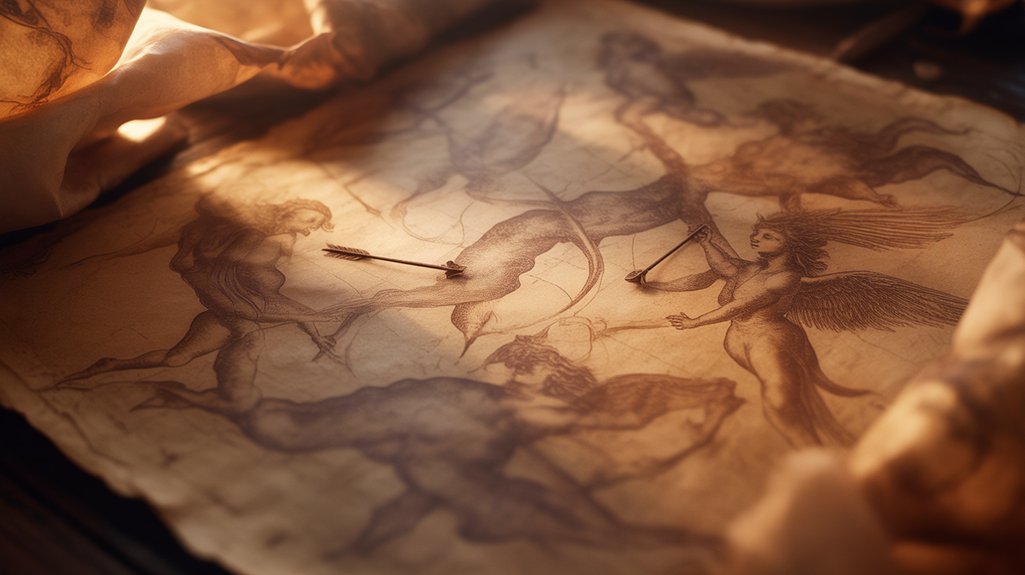
While Cupid's golden arrows have dominated Western imagination for millennia, his singular image obscures a far more intricate pantheon of desire's architects. The Erotes themselves—divine attendants of Aphrodite—numbered far beyond Rome's cherubic mascot. Anteros embodied reciprocated affection, the answering flame that alters yearning into communion. Hylas personified honeyed words and seduction's silver tongue, revealing how ancient Greeks recognized flattery as its own eldritch force.
Beyond Rome's winged child lay a constellation of desire's forces—each arrow distinct, each flame its own theology of longing.
This Eros symbolism extended beyond mere romantic categorization; it mapped desire's entire territory, acknowledging transformative love in its countless manifestations. These deities weren't abstract concepts. They were living powers.
Across oceans and centuries, other cultures developed equally sophisticated frameworks. Yoruba traditions honored Osun, whose rivers carried both beauty and sacred sensuality. Haitian Vodou revered Erzulie Freda, goddess of impossible love and aesthetic perfection.
Such figures weren't primitive analogues to Western cupids—they represented independent theological systems where desire held cosmological significance, shaping reality itself through its chimeric nature.
##
Across the eldritch tapestry of human mythology, creatures embodying erotic longing and amorous enchantment emerge not merely as symbols but as chimeric forces that shape mortal destinies through seduction, possession, and supernatural intervention.
The Greek Erotes—Eros with his fate-binding arrows, Anteros exacting vengeance upon the loveless—represent but one cultural constellation within a vast firmament of beings that manifest desire's power to alter, devastate, and transcend.
From the oil-slicked predation of Malaysia's Oong Minoc to the blood-demanding shapeshifting of Hungary's AET, from Amazonia's dolphin-formed Encantados to the window-haunting Karupi of Gani tradition, these entities reveal how cultures worldwide have personified sexual yearning as something external, preternatural, and profoundly dangerous.
These timeless tales serve as unique expressions of beliefs through which societies explore the fundamental tension between reason and passion, mortality and divine intervention, offering frameworks for understanding desire's capacity to both elevate and destroy the human spirit.
Mythical Creatures Representing Love and Desire
Desire manifests across mythologies in corporeal forms that blur the boundaries between predator and paramour, each culture sculpting its own eldritch embodiments of carnal longing.
The Hungarian AET allure operates through metamorphosis, adopting opposing gender forms to seduce owners into blood-soaked pacts wrapped in golden promises.
Amazonian waters birth Encantados seduction, where cetacean spirits don human flesh at riverside festivals, their supernatural charisma proving irresistible.
Malaysian nights witness Oily Man abduction, his petroleum-slicked flesh granting immunity from pursuit until precipitation or masculine garments break his power.
The Gani Karupi legend explains inexplicable conceptions through spectral visitations, its grotesque physicality penetrating walls and consciousness alike.
European demonology crystallizes this hunger through Succubi energy harvesting, where feminine apparitions extract essential essence for infernal alteration.
These entities transcend mere folklore, embodying humanity's eternal tension between attraction and annihilation.
Cupid and Cherub Symbolism
Classical antiquity's most enduring ambassador of amorous compulsion materializes through Eros—later Romanized as Cupid—whose diminutive form belies devastating psychological armament. His golden arrows pierce mortal consciousness, altering indifference into obsession, while leaden shafts manufacture revulsion. This duality reveals love's chimeric nature: simultaneously blessing and curse.
Cherubs emerged from Near Eastern guardianship traditions, their eldritch origins obscured by Christian adaptation. Where cupid's love manifests as passionate torment, cherub innocence embodies sanctified affection, untainted by carnal urgency. Byzantine iconography modified these winged sentinels into rosy-cheeked infants, domesticating their primordial power.
Venus anchors Cupid's mythology, their paired imagery saturating Renaissance canvases with erotic tension. This mother-son dialectic explores beauty's capacity to enslave rational minds. Ancient vase paintings and sculptures from the 6th to 4th B.C. period preserve visual testimony of Eros's cultural significance across Greek civilization.
Their legacy transcends Western boundaries, infiltrating global consciousness as Valentine's Day commodifies ancient mysteries into greeting-card sentiment.
Dragons in Romantic Folklore
While Mediterranean cupids perfected love's aerial assault through calculated arrow-strikes, draconic manifestations of romantic power operated through fundamentally different mechanisms—territorial dominion, metamorphic seduction, and the alchemical fusion of fear with desire.
Celtic traditions positioned these eldritch beings as romantic adversaries, obstacles demanding heroic conquest before union could arise. Chinese cosmology converted dragon guardianship into benediction—their presence consecrating marriages, their essence guaranteeing fidelity across mortal lifespans.
The chimeric ability to assume human form revealed deeper truths: authentic love transcends corporeal boundaries, rendering physical manifestation merely theatrical.
Medieval European chronicles documented dragons as passionate protectors, their territorial ferocity mirroring romantic devotion's intensity. Their hoarded treasures symbolized emotional bonds rather than material accumulation, each golden coin representing preserved memories, defended intimacies.
Dragon guardianship wasn't imprisonment—it was consecration through fire.
Sirens and Seductive Enchantment
Where dragons commanded devotion through territorial magnificence, sirens weaponized vulnerability itself—their power residing not in scales or flame but in the acoustic manipulation of longing's frequencies.
These eldritch maidens, anchored to Hellenic shores circa 800 BCE in Homer's documented encounters, altered desire into navigation's antithesis. Siren songs operated as chimeric instruments—simultaneously promise and annihilation, weaving melodies that bypassed rational thought to access primal yearning.
Their seductive danger wasn't aggression but invitation, luring sailors toward annihilation through manufactured intimacy. Odysseus's beeswax stratagem revealed humanity's recognition that certain freedoms require deliberate sensory limitation.
The paradox endures: sirens embodied liberation's shadow—the understanding that unrestrained pursuit of pleasure nurtures destruction. Beauty weaponized. Longing commodified. The maritime graves testified to desire's lethal trajectory.
Ancient Mesopotamian Love Demon Records
Within the temple precincts of ancient Sumer, where clay tablets bore witness to humanity's earliest literate invocations of desire, priests inscribed hymns to Inanna-Ishtar—that chimeric fusion of 战争 goddess and erotic sovereign—whose influence emanated from the fertile crescents between the Tigris and Euphrates.
These sacred spaces, dating from approximately 3500 BCE onward, housed ritual practitioners who enacted hieros gamos, the divine marriage ceremony wherein earthly bodies became vessels for celestial passions, their devotions recorded in cuneiform script that still radiates with eldritch intent.
The temple economies themselves intertwined spiritual devotion with corporeal ecstasy, creating a theology where love's power demanded both reverence and physical consecration.
Sumerian Inanna-Ishtar Temple Inscriptions
Across the sun-baked ziggurat temples of third-millennium BCE Sumer, priests carved hymns into clay tablets that revealed Inanna-Ishtar not as mere goddess but as something more primordal—a force of erotic sovereignty whose dominion encompassed both the marriage bed and the battlefield.
This erotic duality manifested through fertility rites where her priestesses enacted sacred sexual unions, collapsing boundaries between devotion and desire. The inscriptions detail her eldritch descent into death's domain, mapping love's volatile geography through mythic cartography.
Agricultural abundance and human fecundity flowed from identical celestial wellspring. Inanna Ishtar worship converted temple precincts into liminal zones where flesh became prayer, coupling became cosmology.
These cuneiform records preserve a chimeric vision: love-as-demon, desire-as-divinity, sexuality woven into civilization's foundational fabric.
Fertile Crescent River Valleys
The clay-rich floodplains between Tigris and Euphrates nurtured civilizations that catalogued desire's darker incarnations with taxonomic precision. Along fertile riverbanks, scribes etched cuneiform warnings of chimeric entities that corrupted matrimonial bonds. Ancient agricultural rituals invoked protective barriers against Asmodius and his kindred—demons who stalked newlywed chambers, suffocating legitimate passion with eldritch hunger.
| Entity Classification | Sphere of Influence |
|---|---|
| Ardat-lilî | Night visitations, masculine essence drain |
| Lilītu | Dream manipulation, fertility disruption |
| Irdu-lilî | Female desire corruption, womb possession |
| Asmodius variants | Conjugal interference, murderous jealousy |
Temple archives documented counter-rituals performed under moon phases, combining incantations with offerings to Nanaya and Inanna/Ishtar. These valley cultures understood desire's duality—simultaneously divine gift and demonic gateway.
Sacred Prostitution and Temple Rites
While scribes catalogued demonic threats in administrative tablets, temple complexes consecrated to Inanna harbored practices that blurred boundaries between spiritual devotion and carnal expression—sacred prostitution, or *qadishtu* rites, wherein priestesses embodied divine sexuality as living conduits between mortal supplicants and celestial powers.
These sacred harlots weren't mere courtesans but hierophantic vessels through whom sacred sexuality manifested, their bodies changing into liminal thresholds where flesh met the numinous.
Agricultural rhythms dictated these rites; planting seasons demanded carnal offerings to guarantee abundance.
The *hieros gamos*, or divine marriage, saw kings copulate with incarnate goddesses, establishing divine connection through ecstatic union.
Temple revenues swelled from these transactions, yet participants understood commerce as secondary to theurgy—each encounter a chimeric fusion of eros and pneuma, human desire transfigured into cosmic fertility.
Greek Eros Versus Roman Cupid

Love's manifestation in Greco-Roman antiquity split along divergent mythological currents, creating two distinct yet intertwined deities whose arrows pierced mortal hearts with vastly different intentions. Eros symbolism embraced primordial forces—the youthful god wielded devastating power over both carnal attraction and soul-deep connection, his eldritch influence reshaping destinies. His relationship with Psyche revealed love's altering trials. Cupid representations, conversely, softened these primal energies into playful mischief, depicting a cherubic child whose matchmaking antics emphasized romantic whimsy over existential complexity.
| Attribute | Greek Eros | Roman Cupid |
|---|---|---|
| Physical Form | Youthful, enigmatic figure | Chubby, innocent child |
| Domain | Physical desire and emotional bonds | Romantic love and playful matchmaking |
| Mythological Depth | Dual deity: physical/spiritual | Lighter, romantic focus |
| Narrative Function | Complex love overcoming obstacles | Whimsical interference in affairs |
| Cultural Symbolism | Primordial, altering power | Innocent, mischievous charm |
These chimeric interpretations reflected divergent cultural philosophies—Greek profundity versus Roman accessibility.
Wings Symbolizing Transcendent Passion
Feathers carved from celestial matter defied gravity's mundane constraints, altering love deities into liminal beings who traversed the membrane separating mortal yearning from divine ecstasy.
These winged beings embodied liberation itself, their pinions carrying souls beyond corporeal limitation into spheres where passion transcended earthly boundaries.
Eros emerged from Greek consciousness with wings signifying desire's unpredictable velocity. Kamadeva's Hindu manifestation similarly bore these eldritch appendages, transporting devotees toward emotional transcendence.
The chimeric nature of such deities revealed ancient wisdom: divine love demanded freedom from material constraints.
Wings symbolized metamorphosis's infinite possibility:
- Swift descent of passion striking without warning
- Elevation above mundane existence into ecstatic consciousness
- Boundary dissolution between mortal and celestial spheres
- Freedom from terrestrial limitations binding ordinary affection
- Transcendent movement toward spiritual communion
Angels and fairies inherited this symbolic language, their feathered anatomy signaling access to domains where authentic passion reigned supreme.
These mythological constructs offered humanity a vision of love unshackled, soaring beyond convention's restrictive architecture into limitless emotional territories.
Psyche and Eros Myth
The tale of Psyche and Eros stands as antiquity's most profound meditation on forbidden devotion, wherein a mortal woman of devastating beauty endured Aphrodite's wrathful trials—impossible labors that tested the very essence of her psyche—to reclaim the winged god who'd transgressed divine law for her sake.
Through her perilous journey into the chthonic depths and back, Psyche transcended mortality itself, her suffering alchemizing flesh into immortal radiance.
This myth crystallizes the ancient Greek understanding that eros and psyche—desire and soul—remain eternally intertwined, their union requiring sacrifice, metamorphosis, and the courage to gaze upon love's true, often terrible, face.
Forbidden Love and Trials
When beauty itself becomes a curse rather than a blessing, mortals find themselves thrust into the capricious attention of the divine—and so it was for Psyche, whose radiance incited Aphrodite's wrathful jealousy in this tale transmitted through Apuleius's *Metamorphoses* (c. 160 CE).
Eros's forbidden desires for this mortal woman transgressed divine hierarchy, creating an eldritch union that demanded secrecy. His nocturnal visits, shrouded in darkness, embodied the chimeric nature of their bond—simultaneously sacred and transgressive.
When Psyche illuminated her lover's face, she shattered trust's fragile vessel. The love challenges that followed—sorting seeds, gathering golden fleece, descending into Persephone's domain—transformed suffering into sacred trial.
Each ordeal stripped away mortality's limitations, forging divine essence from human frailty. Through endurance, she achieved apotheosis, proving love's alchemical power to transcend boundaries between mortal and immortal domains.
Transformation Into Immortal Goddess
Through ordeal's crucible, Psyche's evolution crystallized—not merely physical alteration but ontological shift from human essence to divine substance.
Aphrodite's trials, though vindictive in origin, forged within Psyche an eldritch resilience that transcended mortal limitations. She descended into Hades itself, retrieved Persephone's beauty, confronted chimeric dangers with unwavering determination. Each impossible task stripped away human frailty, revealing the divine core beneath.
Zeus, witnessing such extraordinary devotion, granted her ambrosia—the nectar of immortal change. Her apotheosis wasn't gift but earned ascension, love's ultimate alchemical work.
United with Eros in Olympus, their divine love embodied soul's journey toward enlightenment, proving that authentic connection transcends mortality's boundaries. Freedom from death's constraint.
Their union birthed Hedone, pleasure personified, symbolizing liberation through genuine intimacy.
Symbolism of Soul Unity
Beyond apotheosis lies meaning—the myth's deeper architecture reveals itself not as simple romance but as philosophical cartography of consciousness itself.
Psyche's name, derived from Greek ψυχή, literally signifies “soul,” rendering her union with Eros profoundly allegorical. These soul connections transcend corporeal desire, mapping emotional journeys toward wholeness.
Ancient Mediterranean philosophers recognized this dyad as representing humanity's fundamental division: physical yearning severed from spiritual comprehension. The trials—Aphrodite's cruel labors, each more eldritch than the last—weren't mere obstacles but necessary alchemical alterations.
Psyche's descent into Hades, her confrontation with chimeric forces, illuminated consciousness fragmenting before achieving integration. Trust became the catalyst. Doubt fractured unity; faith restored it.
Their reconciliation demonstrated that authentic love demands synthesizing sensual passion with transcendent understanding, creating sacred wholeness from human incompleteness.
Valentine's Day Commercial Imagery
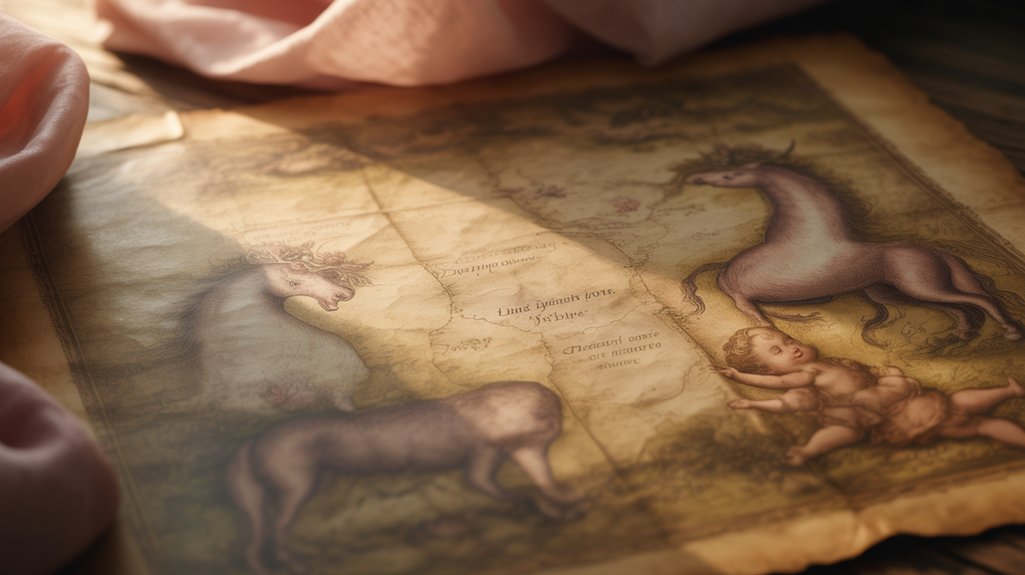
As February's commercial machinery awakens each year, the ancient Roman deity Cupid undergoes a peculiar alteration—stripped of his original complexity, changed into a sanitized cherub whose arrows pierce not flesh but consumer consciousness. This Valentine's iconography modifies eldritch divinity into marketable sentiment, diluting mythological potency through repetition and commodification.
The Romantic imagery deployed across commercial landscapes employs calculated visual strategies:
- Hearts rendered in crimson hues, geometric abstractions of visceral organs
- Roses positioned as offerings, their thorns conveniently erased from frame
- Chocolates arranged like devotional objects, sweetness replacing spiritual transcendence
- Couples frozen in choreographed intimacy, sanitized passion for mass consumption
- Pink and red palettes bleeding across advertisements, color theory weaponized for emotional manipulation
These chimeric assemblages merge Eros with his Roman counterpart, flattening Mediterranean mystery into digestible iconography. The Erotes—once attendants to Aphrodite's capricious whims—now hawk greeting cards.
Such commercial alchemy converts ancient longing into manufactured desire, freedom sacrificed upon capitalism's altar.
Neurochemistry of Romantic Attraction
Within the cathedral of human consciousness, romantic attraction manifests as an alchemical cascade—dopamine surges through neural pathways like quicksilver, transmuting mundane perception into obsessive focus. This neurotransmitter release activates the ventral tegmental area and caudate nucleus, ancient structures governing reward and romantic motivation.
The beloved becomes chimeric—simultaneously real and impossibly idealized. Oxytocin weaves its binding spell, nurturing attachment through touch and proximity. Meanwhile, serotonin fluctuates wildly, creating obsessive rumination that ancient poets mistook for divine possession. They weren't entirely wrong.
Love transforms the ordinary into mythology through oxytocin's embrace and serotonin's fevered dance—chemistry masquerading as divine intervention.
Brain activation patterns mirror addiction's eldritch grip. The emotional highs resemble substance-induced euphoria, followed by crushing withdrawal when separated from the beloved.
This neurochemical storm explains why lovers throughout history have described their passion as madness, enchantment, possession. Modern neuroscience confirms what mystics intuited: romantic love operates beyond rational control, governed by primal forces that predate civilization itself.
Modern Dating App Mythology
The digital domain has spawned its own pantheon of desire, where ancient archetypes resurrect themselves in algorithmic form. Cupid's arrow alters into swipe mechanics, his bow now wielded through touchscreens that promise instant chemistry.
These platforms embrace mythical gamification, changing courtship into heroic quests where users ascend through profile levels, each advancement echoing Odysseus's trials, Perseus's labors. The Erotes—those multiplicitous spirits of passion—manifest as preference algorithms, parsing desire's chimeric nature into data points.
Digital matchmaking resurrects the Encantado's transformative magic, that Amazonian river dolphin who assumed human form to seduce; users curate personas, shapeshifting between authentic selves and enchanted projections.
Behind the interface, Aphrodite's matchmaking prowess lives again through compatibility matrices, neural networks divining connections the ancients attributed to divine intervention. These eldritch systems calculate attraction's geometry, mapping desire's constellation across virtual spaces.
The boundary dissolves. Ancient mythology breathes through modern ritual, its eternal patterns merely wearing contemporary masks.
Global Love Symbols Endure Today
Countless civilizations have etched their understanding of desire into symbols that transcend temporal boundaries, persisting through millennia as tangible emblems of love's ineffable power.
The Encantados manifest within Amazonian consciousness, their enchanting melodies and otherworldly beauty representing desire's altering capacities. Greek Erotes—Eros, Anteros, and their divine kin—embody cultural love interpretations that infiltrated Western artistic consciousness, their arrows piercing hearts across centuries of enduring romantic myths.
Hungary's AET creature materializes where passion intersects commerce, demanding blood and flesh as payment for prosperity, demonstrating desire's darker transactions. Eldritch and uncompromising.
Malaysia's Oily Man stalks virgin daughters, personifying lust's predatory manifestations within Southeast Asian folklore. Gani's Karupi bridges carnality and creation, anchoring fertility within spiritual frameworks.
These chimeric beings don't fade into antiquarian obscurity; they pulse beneath contemporary consciousness, informing modern relationship paradigms through ancient wisdom. Their continued resonance reveals fundamental truths: desire alters, enchants, demands sacrifice, and perpetuates existence itself through forms simultaneously beautiful and terrifying.
Frequently Asked Questions
What Mythical Creatures Symbolize Heartbreak or Unrequited Love?
Heartbreak Spirits haunt Unrequited Mythology across cultures, manifesting sorrow's eldritch weight.
Japan's *Tsurara-onna*, the icicle woman, embodies frozen desire—beautiful, cold, unreachable.
Celtic folklore whispers of the *Leanan Sídhe*, who drains artists through one-sided passion, leaving inspiration's corpse behind.
Ancient Greece knew *Echo*, condemned to repeat others' words, forever loving Narcissus without return.
These entities don't merely symbolize loss; they're living repositories of humanity's deepest ache, chimeric forms born from collective suffering, dwelling in liminal spaces where love fractures.
Are There Any Love Creatures From Asian Mythology?
Asian love mythology reveals profound truths: scholars document over 300 distinct romance deities across the continent's civilizations.
The Chinese Yue Lao binds destined lovers with crimson threads—an eldritch practice dating to Tang Dynasty texts (618-907 CE).
Japan's Ame-no-Uzume performs mythical romance through sacred dance, awakening desire.
Vietnam's Thánh Gióng transcends martial origins to embody passionate devotion.
These entities don't merely symbolize affection; they manifest humanity's yearning for connection, threading through temple incense and moonlit prayers across millennia.
How Do Different Cultures Depict Love Demons or Spirits?
Cultural love spirits manifest through strikingly divergent demon love representations across civilizations.
Mediterranean succubi seduce through eldritch whispers and chimeric forms, draining life-force in nocturnal encounters.
East Asian fox spirits—huli jing, kitsune—transform desires into tangible vessels of obsession.
Slavic rusalki embody drowned passion, haunting waterways.
Islamic djinn ensnare hearts through supernatural contracts.
Each tradition reveals humanity's primal recognition that desire exists beyond mortal control—powerful, dangerous, intoxicating.
Ancient forces demanding reverence, not domestication.
What Mythical Creatures Represent Forbidden or Dangerous Love?
Cursed lovers manifest across mythologies as warnings against transgression. The succubus—eldritch, alluring—drains life through desire's embrace.
Slavic rusalki embody tragic romances, drowning those who dare approach. Japan's yuki-onna freezes wanderers with fatal beauty.
Ancient Greece birthed the Sirens, whose songs promised ecstasy yet delivered death. These entities represent love's shadow: obsession, possession, destruction.
They're chimeric manifestations of humanity's understanding that passion, unbound by wisdom or restraint, becomes monstrous—transforming devotion into damnation through forbidden union.
Do Any Folklore Creatures Punish Those Who Reject Love?
Ah, how convenient that humanity invented supernatural enforcers for romantic rejection—because mortals can't handle “no” gracefully.
Across cultures, vengeful spirits indeed torment rejected lovers' dismissive targets. The Japanese *onryō* manifests when spurned affection festers into eldritch fury, particularly the entity Oiwa.
Greek Erinyes pursued those violating sacred bonds. Slavic *rusalki*—drowned maidens betrayed by lovers—drag the unfeeling into watery graves.
These chimeric beings serve darker purposes: controlling autonomy through terror, ensuring none escape love's claims unpunished.
Conclusion
Though skeptics dismiss these chimeric beings as mere allegorical constructs, their enduring presence across millennia reveals something profound. Love's mythology persists—from eldritch Mesopotamian demons to Cupid's sanctified arrows—because humanity requires tangible vessels for intangible yearning. These winged messengers, these transcendent symbols, they've evolved through Valentine commodification and digital courtship, yet remain unchanged fundamentally. The neurochemical cascade science now charts was always there, ancient and true, demanding its sacred iconography.