Mythical guardians of the dead emerge across civilizations as sacred sentinels protecting vulnerable souls—Egypt's jackal-headed Anubis conducts spirits through the Duat while weighing hearts against Ma'at's feather, Mesoamerica's hairless Xoloitzcuintli navigates Mictlan's treacherous levels alongside deceased masters, Norse draugr rise as undead warriors defending burial mounds with superhuman strength, and Hindu tradition's Vetala inhabits corpses in cremation grounds, testing moral fortitude through riddles. These chimeric entities crystallize humanity's collective anxiety regarding death's threshold, altering existential terror into cultural frameworks that honor ancestral rest. The archetypal patterns underlying these protective figures reveal profound truths about mortality's liminal boundaries.
Key Takeaways
- Anubis, the jackal-headed Egyptian deity, guides souls through the afterlife and protects tombs from desecration through sacred rituals.
- Xoloitzcuintli dogs navigate deceased souls through Mictlan's nine levels in Aztec belief, providing warmth and protection against malevolent forces.
- Draugr are undead Norse sentinels possessing supernatural strength and shapeshifting abilities, defending burial mounds and treasures from grave robbers.
- Vetala spirits inhabit corpses in Hindu tradition, testing the living with riddles while maintaining boundaries between life and death.
- Cerberus guards Hades' gates in Greek mythology, preventing unauthorized souls from entering or leaving the underworld's domain.
Guardians Beyond the Grave
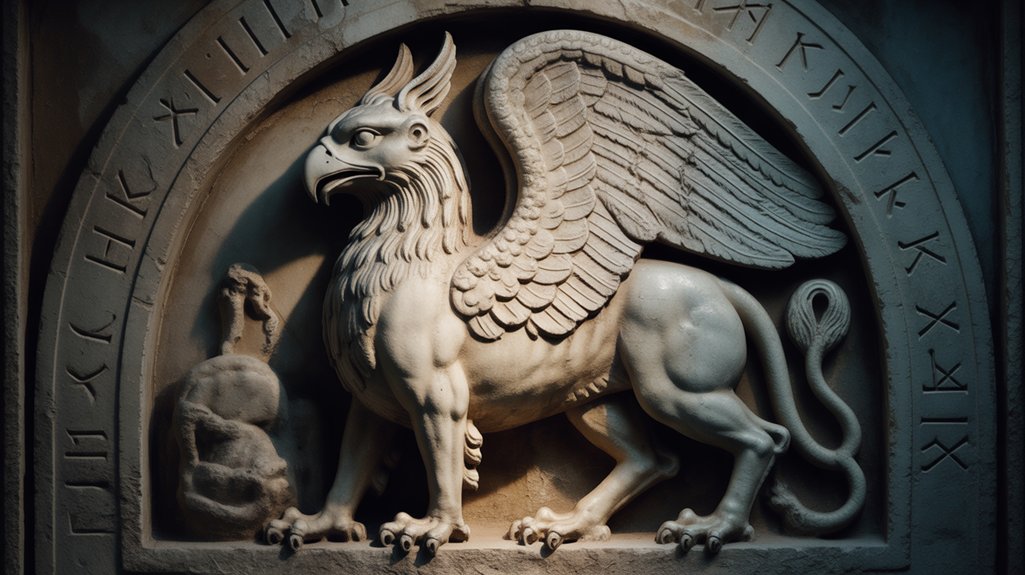
Since the earliest civilizations carved their first burial chambers into living rock, humanity has conceived of mythical guardians to watch over the threshold between life and death—creatures of eldritch power whose very existence speaks to a universal anxiety about the vulnerability of the deceased.
These spiritual guardians manifest across continents with striking parallels: Cerberus, the chimeric three-headed hound, bars Hades' gates against intruders and escapees alike. Anubis, jackal-headed psychopomp of ancient Egypt, escorts souls through their perilous journey while defending their sanctity. The Norse draugr rises corpse-pale from burial mounds, punishing grave robbers with supernatural vengeance. China's Jiang Shi guards its resting place with relentless purpose.
Each tradition reveals profound cultural significance—the dead aren't simply gone but require protection from the living. In the Viking worldview, the draugr embodied the dead's continued connection to earthly wealth and prestige, fiercely defending burial treasures that represented achievement in life. These myths don't merely frighten. They consecrate. They establish boundaries the living mustn't transgress, altering burial sites into sacred ground where mortal ambition meets otherworldly retribution.
##
Across disparate civilizations separated by vast oceans and millennia, guardian entities emerged from the collective unconscious to stand vigil over death's threshold—each culture manifesting its own chimeric protector shaped by indigenous cosmology and mortuary practice.
The jackal-headed Anubis prowled Egyptian necropolises with eldritch purpose, while the hairless Xoloitzcuintli descended into Mictlan's depths alongside Aztec souls, and the corpse-animated Draugr rose from Scandinavian barrows to ward against grave violations.
Beyond these familiar sentinels, the Vetala—a vampiric spirit of Hindu and Buddhist tradition—claimed dominion over India's cremation grounds, inhabiting corpses suspended between death and dissolution.
These death guardians joined the ranks of creatures once dismissed as mere folklore until verification processes transformed them from cryptids into recognized entities of cultural and historical significance.
Anubis Guards Egyptian Tombs
Throughout the necropolis of ancient Egypt, from the Third Dynasty onwards (circa 2686 BCE), Anubis emerged as the preeminent guardian of the threshold between life and death—a chimeric deity whose jackal-headed form embodied both the practical realities of desert scavengers and the profound mysteries of change.
Anubis mythology positioned him as psychopomp and protector, conducting souls through the eldritch corridors of the Duat. His most sacred function: weighing hearts against Ma'at's feather. Truth itself made manifest.
Anubis symbolism permeated funerary practices—jackal amulets nestled within linen wrappings, their presence invoking divine protection. Temples rose near cemeteries, liminal spaces where priests performed mummification rites under his watchful gaze.
He didn't merely guard tombs. He sanctified them, converting burial chambers into consecrated thresholds where mortality dissolved into eternity.
Xoloitzcuintli Guides Aztec Souls
While Anubis presided over Egyptian passageways to eternity, the Mesoamerican territory developed its own canine guardian of the dead—the Xoloitzcuintli, whose hairless form emerged from the volcanic heartlands of pre-Columbian Mexico as both earthly companion and supernatural psychopomp.
Xoloitzcuintli symbolism permeated Aztec cosmology through the deity Xolotl, lord of lightning and death's threshold. These eldritch creatures navigated Mictlan's nine treacherous levels, their bare skin radiating warmth against the underworld's perpetual cold.
The Aztec afterlife demanded passage across the Apanohuaya River, where malevolent spirits lurked, waiting to claim unaccompanied souls. Masters entombed their Xolos within burial chambers, ensuring protection through chimeric domains where physical laws dissolved.
The breed's varying sizes—toy, miniature, standard—served distinct ceremonial purposes, each calibrated to specific funerary rites that honored death's sovereignty without surrendering to its terror.
Draugr Haunts Norse Graves
Where the Xoloitzcuintli served as benevolent ferryman through Mictlan's depths, Norse cosmology conjured a far more malevolent guardian—the draugr, an undead sentinel whose corporeal resurrection altered burial mounds into fortresses of retribution.
Draugr characteristics manifested through supernatural strength, chimeric shapeshifting abilities, and weather manipulation—powers safeguarding accumulated treasures from mortal plunderers. These eldritch revenants arose specifically from graves housing individuals whose avarice transcended death itself.
Decay permeated their forms. Putrid stench announced their presence. Draugr folklore prescribed elaborate countermeasures: decapitation severing the corpse's animation, iron objects disrupting necromantic energies, deliberate misdirection during burial rites confounding the creature's spatial awareness.
Unlike psychopomps guiding souls toward peaceful afterlife destinations, draugrs embodied punishment—territorial wraiths whose very existence warned against disturbing ancestral rest.
Vetala Inhabits Cremation Grounds
Beyond the funerary pyres of South Asian tradition, where sandalwood smoke mingles with chanted mantras, the Vetala emerges as corpse-possessing wraith—neither guardian nor psychopomp, but riddling trickster whose territory encompasses the cremation ground's ash-strewn periphery.
Hindu mythology positions these eldritch entities as souls severed prematurely from life's thread, condemned to animate cadavers through Vetala possession. Their cunning manifests through cerebral challenges posed to the living, testing moral fortitude through paradoxical riddles. Unnatural death births them.
Communities developed specific Vetala rituals—propitiatory offerings ensuring these liminal beings maintain cosmic balance, shepherding departed souls toward proper transcendence. The Vetala's terrifying pedagogy teaches reverence for death's sanctity.
Each encounter becomes cautionary evidence: respect the boundary between worlds, honor those who've crossed over, recognize that life's choices echo beyond mortality's threshold into territories where ash becomes oracle.
Ancient Egyptian Anubis Origins
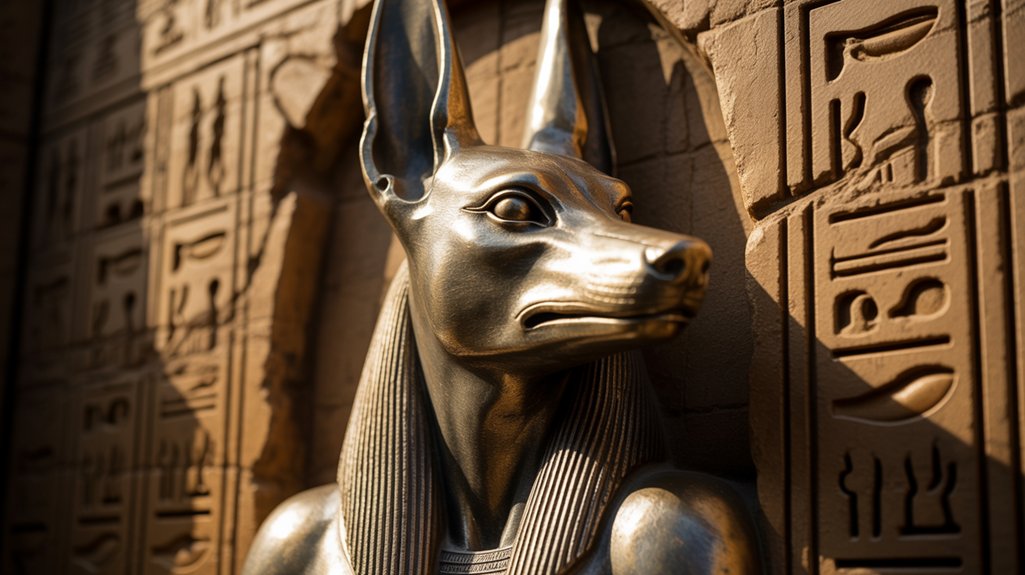
The jackal-headed deity's genesis stretches into Egypt's predynastic twilight, where tomb paintings from the fourth millennium BCE reveal Anubis's earliest manifestations as guardian of the necropolis, his chimeric form already fixed in the collective consciousness of Nile Valley settlements.
His cult achieved its zenith at Cynopolis—the “City of Dogs”—where priests maintained elaborate rituals honoring the psychopomp who shepherded souls through the eldritch domain between mortality and resurrection.
Within these sacred precincts, Anubis's dominion over mummification practices became inextricably woven into Egyptian eschatology, his presence invoked through natron-scented chambers where the dead underwent their metamorphosis into eternal beings.
Predynastic Period Tomb Paintings
Long before dynastic pharaohs erected monumental pyramids, Predynastic communities along the Nile's banks adorned their burial chambers with haunting images of a canid guardian—Anubis, whose jackal-headed form emerged from the desert's liminal edges where life surrendered to death.
These chimeric depictions revealed sophisticated Predynastic symbolism: jackals scavenged cemetery grounds, altering potential desecrators into protective sentinels through sacred inversion.
Tomb painters rendered Anubis overseeing embalming rituals, his dark silhouette guiding souls through eldritch passages between worlds. Afterlife practices demanded such guardianship.
Amulets bearing jackal imagery accompanied mummified remains, tangible shields against oblivion's threat. Each brushstroke embodied humanity's ancient covenant with death—not as ending, but as alteration requiring divine protection.
The jackal-god stood sentinel. Eternal. Unwavering. Necessary.
Cult Center at Cynopolis
Where jackals prowled cemetery margins, ancient Egyptians consecrated their most sacred nexus of death worship—Cynopolis, the “City of Dogs,” whose very nomenclature announced Anubis's dominion over mortal remains. This eldritch sanctuary housed elaborate temple complexes where Anubis symbolism permeated every ritual observance.
| Temple Function | Sacred Purpose |
|---|---|
| Soul Guidance Chamber | Weighing hearts against Ma'at's feather |
| Offering Sanctum | Provisions for afterlife passage |
| Mummification Shrine | Alteration of flesh to eternal vessel |
Cynopolis rituals involved chimeric ceremonies binding mortality to transcendence—priests channeling the jackal-headed psychopomp's power through incense-laden invocations. Here, liberation from corporeal bondage wasn't feared but celebrated, each supplicant's heart subjected to divine judgment. The god's presence suffused these liminal spaces where death became metamorphosis rather than termination.
Mummification and Afterlife Beliefs
Preservation of flesh altered mortality itself—natron salts desiccating organs, linen strips binding limbs into eternal stasis, all while Anubis's priests enacted seventy days of sacred alchemy upon corpses destined for immortality.
The jackal-headed psychopomp presided over mummification techniques that transcended mere bodily conservation, converting death into doorway.
Embalmers invoked his eldritch authority while extracting brains through nostrils, sealing viscera within canopic jars, anointing skin with cedar oils and myrrh.
Afterlife rituals demanded perfection—the ka and ba required physical vessels to reunite within Duat's shadowed halls.
Amulets bearing Anubis's chimeric form nestled between bandage layers, protective talismans against demons prowling the underworld's twelve gates.
His priests understood what pharaohs feared: without the body's preservation, the soul faced oblivion's absolute erasure.
Xoloitzcuintli as Aztec Psychopomps

In the cosmological architecture of Aztec belief, the Xoloitzcuintli—ancient, hairless, bearing skin like burnished copper—served as sacred navigator between the sphere of the living and Mictlan's nine-layered underworld. Archaeological evidence traces this eldritch breed across three millennia, establishing its primordial presence throughout Mesoamerican consciousness.
Xoloitzcuintli Symbolism manifested through multiple spiritual dimensions:
| Sacred Function | Cultural Significance |
|---|---|
| Psychopomp Guide | Navigated souls through Mictlan's treacherous depths |
| Spiritual Guardian | Warded against malevolent entities during passage |
| Healing Vessel | Absorbed negative energies through distinctive skin |
| Burial Companion | Interred alongside deceased to guarantee safe passage |
The Aztec afterlife demanded these chimeric guardians. Their hairlessness wasn't mere biological quirk—it embodied spiritual purpose, altering canine flesh into metaphysical shield. They protected. They guided. They liberated souls from corporeal bondage, assuring the dead reached their destined sphere unimpeded by darkness.
Guardian Roles Across Cultures
Beyond Mesoamerica's volcanic highlands, civilizations across temporal and geographic chasms constructed parallel mythologies—each culture forging its own spectral sentinels to patrol the threshold between breath and oblivion.
Cerberus, triple-crowned horror of Hellenic imagination, stationed himself at Hades' adamantine gates not merely as watcher but as cosmic enforcer: his three consciousness-bearing skulls guaranteed the dead remained imprisoned within their shadowed domain while the living couldn't breach those boundaries uninvited.
Cross cultural comparisons reveal consistent patterns in symbolic representations of afterlife guardianship:
- Anubis, jackal-headed arbiter of Egyptian tombs, shepherded souls through perilous underworld passages while defending corpses against desecration.
- Draugr of Scandinavian sagas haunted burial mounds as undead wardens, punishing treasure-seekers who defied sacred boundaries.
- Jiang Shi from Chinese tradition prevented improper souls from completing their death-journey, enforcing ritual compliance through vampiric interdiction.
Even corvids assumed guardian mantles—crows converted into eldritch monitors ensuring safe passage across mortality's threshold.
Icelandic Draugr Mound Guardians
In the mist-shrouded burial mounds of medieval Iceland, the draugr—or haugbúi when bound specifically to their grave sites—rise as eldritch sentinels whose putrefied forms belie their terrible strength and shapeshifting prowess.
These undead guardians don't merely haunt their earthen tombs; they actively defend accumulated treasures and ancestral remains through supernatural vigilance, their decayed hands capable of crushing bone and rending flesh.
The living responded with iron and steel: decapitation, metal stakes driven through corpses, preventative measures born from genuine terror of these mound-dwellers who blurred the boundary between protective ancestor and vengeful revenant.
Undead Mound-Dwellers Explained
The draugr emerges from Norse-Icelandic sagas as one of mythology's most formidable corpse-revenants, a creature born from the collision of death's finality and humanity's fear of the grave's impermanence.
These eldritch guardians manifest as putrefying sentinels, their superhuman strength married to chimeric abilities—shapeshifting, weather manipulation, territorial violence. The haugbúi, a specialized mound-dweller variant, can't abandon its haunted burial site, remaining eternally bound to defend accumulated treasure and ancestral ground from trespassers who dare disturb the dead's repose.
Their presence announces itself through carrion-stench, a sensory warning preceding supernatural assault.
Traditional countermeasures reflect humanity's desperate attempts at containment: iron implements placed upon corpses, decapitation severing the connection between undead legends and physical remains.
These practices reveal ancient Icelanders' pragmatic approach to liminal threats, acknowledging death's unpredictable nature while asserting mortal agency against forces that refuse mortality's constraints.
Guarding Treasure and Tombs
Greed's afterlife alters deceased misers into eternal sentinels, their avarice calcifying into supernatural purpose that transcends mortal death. Norse draugrs embody this alteration, manifesting eldritch treasure protection through corporeal decay and preternatural might.
These mound-dwellers deploy chimeric abilities—shapeshifting, weather manipulation—to repel intruders seeking hoarded wealth. Their undead characteristics include superhuman strength paired with putrefying flesh, creating visceral deterrents against grave robbery.
The draugr's vigil extends beyond mere physical guardianship. Ancient Icelanders recognized these entities as consequences of unchecked avarice, implementing counter-measures: iron placements within burial sites, disorienting funeral rites designed to confound revenants' spatial awareness.
Such practices acknowledge the draugr's terrible agency, treating these guardians not as superstitious phantoms but as genuine threats requiring ritualistic containment. The barrow becomes simultaneously vault and prison, protecting treasure while constraining its undead keeper's malevolent reach.
Powers and Prevention Methods
Beyond their spectral manifestations within Nordic barrows, draugr mound-dwellers command arsenals of preternatural abilities that blur corporeal boundaries between living flesh and revenant malice.
These haugbúi wielded superhuman strength capable of crushing iron and bone alike, their limbs animated by eldritch energies born from earthbound vengeance. Shapeshifting forms allowed alteration into chimeric apparitions—sometimes mist, sometimes beast, always terrifying.
Medieval Icelanders developed counter-measures steeped in ritual significance. Iron objects placed upon corpses created metaphysical barriers against reanimation. Binding prevented movement. Carrying bodies feet-first through doorways disoriented the nascent draugr's spatial awareness, severing its connection to familiar thresholds.
These prevention methods acknowledged an uncomfortable truth: greed and malevolence survived death's passage, manifesting as insatiable appetite for retribution against those disturbing sacred resting places.
Protection required understanding darkness itself.
Literary Draugr in Fantasy Fiction
When fantasy authors first adapted draugr from Norse sagas into modern literature, they recognized in these undead guardians a potent symbol—creatures that don't merely haunt gravesites but actively defend what they've claimed as eternally theirs.
Literary representations emphasize draugr characteristics rooted in ancient Scandinavian consciousness: eldritch beings manifesting humanity's moral failings, particularly avarice. These shapeshifting sentinels possess chimeric qualities, altering between corporeal and spectral forms to confound those seeking forbidden knowledge or hoarded wealth.
Traditional defeat methods appear across narratives:
- Decapitation with iron blades, severing the connection between corpse and animating force
- Burning remains completely, preventing resurrection through any arcane means
- Proper burial rites performed posthumously, addressing unresolved spiritual transgressions
Modern fantasy fiction portrays these guardians as consequences incarnate—physical manifestations of greed's corruption. Their superhuman strength and malevolence serve narrative purposes beyond mere antagonism; they represent boundaries mortals transgress at existential peril.
The draugr embodies liminal horror: neither living nor peacefully dead, eternally bound to treasures that consumed them.
Evolutionary Basis for Death Symbolism
Through evolutionary psychology's lens, humanity's elaborate death symbolism emerges not as arbitrary cultural invention but as adaptive cognitive architecture—neural patterns that allowed ancestral populations to navigate mortality's paradoxes while maintaining social cohesion.
The chimeric guardians—Cerberus with his triple-crowned vigilance, Anubis bearing his jackal-headed wisdom—represent encoded survival strategies, altering existential terror into manageable cultural beliefs. These eldritch protectors served essential functions: they regulated behavior through cautionary tales like the Nordic Draugr, enforced community standards, preserved territorial boundaries between sacred and profane domains.
Death's mythic guardians transformed primal terror into cultural architecture, regulating behavior and boundaries through encoded narrative wisdom.
Death rituals incorporating animal symbolism weren't mere superstition but sophisticated psychological tools, allowing groups to process grief collectively while maintaining operational stability. Dogs guarded thresholds because ancestral minds recognized their territorial instincts; jackals haunted burial grounds, inspiring protective deities.
Each mythical creature crystallized millennia of observation, fear, and reverence—evolutionary wisdom encoded in narrative form, safeguarding both the deceased and the living who remained behind.
Modern Death Ritual Practices
Although centuries have elapsed since Cerberus last prowled Hades' gates and Anubis weighed hearts against Ma'at's feather, contemporary death rituals preserve these ancient protective instincts through altered symbology—guardian angels replacing chimeric beasts, consecrated water substituting for apotropaic charms, yet serving identical psychological functions.
Modern funeral traditions maintain spiritual symbolism through deliberate acts: cleansing the deceased's body mirrors ancient purification rites, while specific burial garments echo protective vestments once warding against malevolent entities.
Candles illuminate pathways once traced by psychopomps. Flowers placate unseen guardians.
These protective rituals demonstrate humanity's enduring refusal to surrender loved ones undefended to death's eldritch mysteries. Offerings accompany prayers to guardian spirits—Christian, ancestral, animistic—ensuring safe passage through liminal territories.
Talismans nestle within coffins, contemporary amulets against unknown dangers.
The living maintain their vigil, converting grief into action, helplessness into agency. Such practices affirm an eternal truth: we can't follow beyond death's threshold, but we'll damn well arm our beloved dead for whatever awaits them there.
Contemporary Guardian Animal Memorials
Stone dogs crouch eternal on cemetery pathways, their marble haunches tensed as though perpetually ready to spring against intruders threatening their charges beneath the earth.
These contemporary sentinels—greyhounds, retrievers, even chimeric wolves—embody animal symbolism that transcends mere decoration, channeling ancient protective instincts into memorial design.
Stone guardians transform grief into permanence, wedding primordial protection rituals with modern mourning through carefully sculpted animal forms.
Pet cemeteries now mirror human burial grounds, their gates guarded by bronze lions, granite eagles spreading eldritch wings over smaller graves.
The practice liberates mourners from prescribed religious iconography, allowing ravens and wolves to serve as psychopomps according to personal conviction rather than institutional mandate.
Memorial jewelry extends this guardian presence beyond cemetery boundaries: silver charms shaped like beloved companions rest against grieving hearts, portable talismans connecting the living to their departed.
Modern death culture increasingly honors the bond between species, creating dedicated spaces where humans and animals lie together, watched over by protective effigies that blur boundaries between mythological tradition and contemporary devotion.
Frequently Asked Questions
Are There Mythical Creatures That Specifically Protect Children's Graves?
Yes, several cultures revered child guardians who specifically watched over young graves.
Ancient Slavic traditions honored rusalki—eldritch water spirits of deceased children—who'd protect other innocents.
Medieval European folklore spoke of grave protectors called kyrielicht, spectral flames hovering above children's burial sites.
Norse mythology featured dísir, fierce feminine entities safeguarding family bloodlines, particularly infants.
These chimeric beings represented humanity's desperate need to shield vulnerable souls, altering grief into supernatural vigilance across cultures.
Which Cultures Believe Animals Can See or Communicate With the Dead?
Like ancient threads weaving between domains, cultural beliefs animals possess extrasensory perception span millennia.
Celtic traditions honor dogs and horses detecting spectral presences, while Japanese folklore venerates cats—particularly the nekomata—sensing yurei.
Egyptian priests observed jackals' eldritch communion with Anubis.
Norse völvas recognized ravens' psychopomp nature.
Chinese Taoists documented animal spirit communication through dogs howling at invisible visitors.
Indigenous Australian, Mesoamerican, and Tibetan shamanic practices affirm creatures dwelling in liminal spaces perceive what human consciousness cannot—guardians of thresholds, witnesses to otherworldly passage.
Do Any Mythical Guardians Protect the Living From Malevolent Spirits?
Spiritual guardians permeate protective folklore across civilizations, standing vigil against malevolent forces.
The Mesopotamian lamassu—those chimeric sentinels with human faces and leonine bodies—warded temples from eldritch threats circa 3000 BCE.
Chinese door gods, the Menshen, repel malicious entities seeking entry.
Germanic alp-guardians protected sleepers from nightmare spirits, while Tibetan dharmapala deities fiercely combat demons threatening practitioners.
These ancient protectors remain embedded in living traditions, their sacred duty transcending mere mythology—they're humanity's answer to darkness itself.
Can Household Pets Become Protective Spirits After They Die?
Love transcends death's veil in countless traditions. Across cultures, pet spirit beliefs affirm that devoted companions don't simply vanish—they metamorphose into guardian presences.
Animal afterlife traditions span from ancient Egyptian cat veneration to Japanese *inugami* protective dog spirits. Celtic folklore speaks of spectral hounds watching homesteads, while contemporary paranormal accounts document familiar pawsteps, phantom purring.
These eldritch protectors remain tethered through affection's unbreakable bonds, defending households against malevolent forces, their essence lingering in liminal spaces between worlds, eternally vigilant.
What Offerings Are Traditionally Given to Appease Guardian Creatures?
Spiritual offerings to these eldritch guardians vary across cultures—incense, libations of wine or milk, honey cakes, and blood sacrifices once marked guardian rituals from ancient Egypt to Celtic barrows.
The Japanese leave rice and sake for protective kami, while Greek necropolis keepers received pomegranates and myrtle.
These tangible gifts create reciprocal bonds. Modern practitioners adapt traditions freely, recognizing that intention matters more than dogmatic adherence.
The offering becomes bridge between worlds, acknowledgment of liminal protectors who won't be controlled, only honored.
Conclusion
From eldritch Anubis to chimeric Xoloitzcuintli, from corporeal draugr to contemporary memorial guardians, humanity's threshold protectors persist across millennia. These psychopomps—whether canine, jackal-headed, or spectral—reveal universal anxieties regarding death's liminal passage. Their enduring presence in modern rituals proves that, when push comes to shove, civilizations inevitably conjure watchers for the vulnerable dead. Cultural variations merely dress identical fears in regional vestments. The guardians remain, eternal sentinels at mortality's gate, bridging mundane existence and ineffable beyond.