Ancient civilizations positioned mythical creatures as fundamental architects of cosmic order rather than mere folklore—these chimeric beings enforced divine law and shaped religious authority governing mortal and afterlife domains. Egyptian Ammit devoured impure hearts during judgment, while Apep embodied primordial chaos threatening Ra's solar barque. From Thoth's baboon Aani presiding over the Hall of Two Truths to the Uraeus cobra symbolizing pharaonic sovereignty, these entities served as living hieroglyphs representing metaphysical principles. Jung's collective unconscious theory explains their persistence across cultures, with contemporary therapy still employing these archetypal forms to navigate psychological terrain and existential terror—manifestations that continue bridging human consciousness with sacred mysteries.
Key Takeaways
- Mythical creatures functioned as living hieroglyphs embodying cosmic truths and fundamental metaphysical principles rather than mere decorative symbols.
- Chimeric beings like Ammit and Apep actively enforced universal law, maintaining cosmic equilibrium through divine judgment and opposing primordial chaos.
- Animal-human hybrids served as spiritual intermediaries and conduits for divine power, bridging mortal and supernatural realms in religious practice.
- Creatures like the Uraeus and Hieracosphinx legitimized pharaonic sovereignty while symbolizing divine authority and maintaining cosmic balance through intervention.
- Sacred animals preceded scripture in religious development, with archaeological evidence showing prehistoric burial sites emphasizing animal reverence and totemic connections.
Gods Among Beasts: Introduction
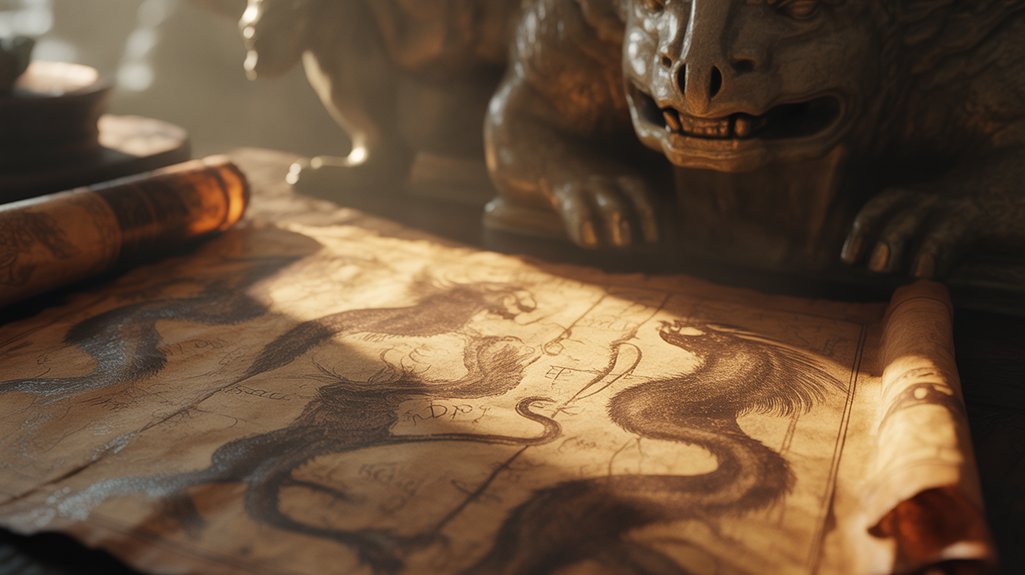
While modern sensibilities often relegate mythical creatures to the domain of fantasy, the ancient Egyptians understood these beings as tangible manifestations of divine authority. Each chimeric form served as a living hieroglyph through which the gods communicated their will to mortal worshippers. These weren't decorative symbols. They represented fundamental truths about cosmic architecture, embodying divine attributes that transcended human comprehension yet demanded acknowledgment in daily existence.
The Hieracosphinx merged falcon and lion, fusing solar dominion with terrestrial sovereignty. The Serpopard twisted serpentine necks into impossible geometries, demonstrating reality's malleability under divine influence. Thoth's Cynocephalus Baboon didn't merely symbolize wisdom—it channeled the god's vast intellect through mortal perception.
This mythical symbolism operated as theological infrastructure, each creature functioning as a conduit between ineffable divine essence and comprehensible earthly form. Through these eldritch amalgamations, the pantheon achieved presence without limitation, altering beast into scripture, flesh into sacred text that breathed, moved, judged.
##
Within the shadow-laden temples and papyrus-lined halls of ancient Egypt, mythical creatures served functions far beyond mere decoration or storytelling—they operated as cosmic machinery, essential cogs in the elaborate mechanisms that sustained ma'at, the divine order separating civilization from primordial chaos.
These chimeric beings, whether the composite horror of Ammit stationed at the scales of judgment or the eldritch coils of Apep threatening Ra's solar barque, functioned simultaneously as guardians, embodiments, and mediators within a religious cosmology that refused to separate the sacred from the monstrous.
The Egyptians understood what modern scholarship often overlooks: that creatures occupying liminal spaces between animal forms possessed the necessary fluidity to traverse boundaries humans couldn't cross, to channel divine power humans couldn't withstand, and to maintain cosmic equilibrium that human hands alone could never preserve.
The Hidden Role of Mythical Creatures in Ancient Religion
How deeply did ancient civilizations embed their most profound theological truths within the forms of mythical beasts?
Egyptian religion reveals an intricate cosmology where chimeric entities embodied essential metaphysical principles. Ammit and Apep stood as eldritch guardians of cosmic equilibrium, their mythical significance extending beyond mere symbolism into doctrinal necessity.
The griffin's leonine majesty communicated pharaonic divinity through visual language—raw power made manifest. Aani's cynocephalic form represented Thoth's wisdom, guiding deceased souls through otherworldly passages.
The Bennu encapsulated cyclical existence itself, phoenix-flames burning through ancient narratives of eternal return. Serpopards prowled the conceptual borders between civilization and primordial chaos, their serpentine-feline bodies mapping cultural anxieties onto theological frameworks.
These weren't decorative additions to religious thought. They were thought itself, crystallized into flesh and fang.
Guardians of Cosmic Order
Ancient civilizations constructed elaborate theological architectures where specific mythical entities functioned as active enforcers of universal law—not passive symbols, but operational mechanisms within divine machinery.
Egypt's Apep embodied eldritch chaos, serpentine and relentless, threatening Ra's solar barque through underworld depths. These mythical guardians didn't merely represent order—they *upheld* it through perpetual struggle. Ammit devoured unworthy hearts. Final judgment. Wadjet's Uraeus blazed from pharaonic brows, sovereignty made manifest through cobra-formed divinity.
The chimeric Hieracosphinx—hawk-headed, lion-bodied—protected sacred thresholds where mortal and divine converged. Such creatures operated as intermediaries, gatekeepers stationed at reality's vulnerable seams. They maintained cosmic balance through active intervention, converting abstract theological principles into tangible, fearsome presences.
Order required guardians. Chaos required opposition. Ancient religions understood this fundamental truth: freedom exists only within boundaries these mythical sentinels vigilantly patrol.
Embodiments of Divine Power
While guardians maintained cosmic boundaries through vigilant opposition, other mythical entities functioned as direct conduits—living vessels through which divine power flowed into material existence. Ancient priests understood this mythic symbolism profoundly.
The scarab Khepri embodied solar metamorphosis itself, rolling forth each dawn's rebirth. Divine representation manifested through chimeric forms: the Griffin's leonine-aquiline majesty proclaimed pharaonic authority, blending predatory terrestrial strength with celestial dominion.
Egypt's serpent Apep personified primordial chaos—raw creative force released. The Uraeus cobra, coiled upon royal brows, channeled sovereignty's eldritch current directly into mortal flesh.
Most terrifying stood Ammit, that composite devourer whose crocodilian jaws, leonine torso, and hippopotamus hindquarters merged three apex predators into one psychopomp judge.
These weren't mere symbols. They were embodied divinity—flesh made sacred, sacred made manifest. Similarly, the Phoenix's cyclical rebirth from its own ashes every 500 years symbolized the eternal renewal of divine solar power in both Greek and Egyptian religious traditions.
Mediators Between Worlds
Beyond embodiment lay function—the sacred task of translation itself.
These chimeric beings operated as spiritual guides, traversing boundaries mortals couldn't breach. The Cynocephalus Baboon, Thoth's messenger, shepherded souls through afterlife's eldritch corridors, while Ammit stood sentinel at judgment's threshold—devourer, arbiter, consequence made flesh.
Animal symbolism here wasn't mere metaphor but mechanism: the Hieracosphinx guarded temple precincts, its hybrid form literally bridging human supplication and divine response.
Even Apep, chaos incarnate, defined cosmic order through opposition. The Bennu phoenix embodied renewal's promise, death altered into rebirth.
Such creatures didn't simply represent connection between domains—they enacted it, their very existence permission for change. Sacred intermediaries. Living thresholds. Where human consciousness ended, they began, extending mortality's reach toward the infinite.
Sacred Animals Predating Written History
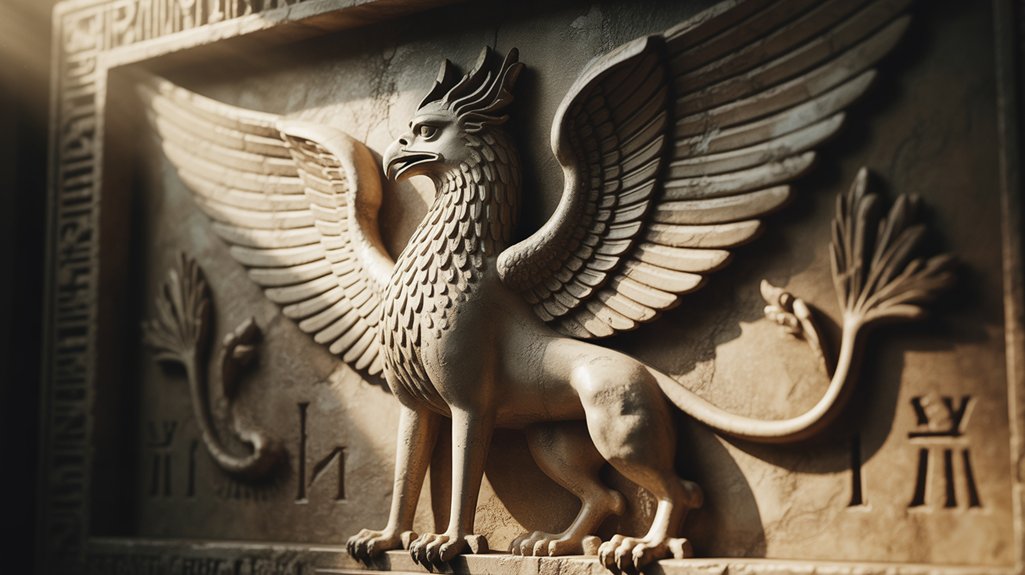
Long before scribes etched cuneiform into clay tablets or hieroglyphs adorned temple walls, Paleolithic artists rendered sacred beasts upon stone canvases in European caves and across African rock shelters. Their pigments dating to 30,000 BCE bear witness to humanity's primordial communion with the numinous animal world.
These ochre bison, charcoal lions, and crimson aurochs weren't mere hunting records—they represented something far more eldritch, a recognition that certain creatures possessed qualities transcending mortal flesh, dwelling in liminal spaces between earth and spirit.
The human-animal connection emerged here in flickering torchlight, where shamanic consciousness first perceived divine attributes within fang, claw, and horn.
Cave Paintings, 30,000 BCE
Deep within the limestone chambers of Lascaux, Chauvet, and Altamira, prehistoric artists rendered the sacred animal forms that inhabited their world with a precision that transcends mere documentation—these weren't casual sketches but deliberate acts of spiritual communion.
The bison, horses, and deer materializing from ochre and manganese pigments embodied something eldritch, something beyond the mundane. This cave symbolism reveals prehistoric beliefs bound intimately to hunting magic and animistic reverence, where beast and human existed in mystical entanglement.
Each brushstroke channeled power.
These Paleolithic sanctuaries, dating to 30,000 BCE, functioned as threshold spaces where shamanic practitioners invoked the numinous essence dwelling within wildlife.
The sophisticated perspective techniques and anatomical accuracy suggest artists who understood their subjects not merely as prey but as chimeric vessels of cosmic force—deities cloaked in fur and hoof.
European Caves, African Rock Art
While European chambers sheltered their painted mysteries, another continent's stone surfaces bore evidence to humanity's earliest theological imaginings—the African rock art tradition, stretching from the Sahara's windswept plateaus to the southern grasslands, presents an equally profound evidence to sacred animal worship predating any syllable committed to script.
| Location | Sacred Creatures | Spiritual Function | Estimated Period | Cave Symbolism |
|---|---|---|---|---|
| Lascaux, France | Aurochs, horses | Shamanistic intermediaries | 17,000 BCE | Ritual alteration |
| Saharan plateaus | Elephants, lions | Divine messengers | 12,000 BCE | Creation narratives |
| Tassili n'Ajjer | Chimeric beings | Supernatural guardians | 8,000 BCE | Rock art communion |
| Cantabrian caves | Bison herds | Hunting cosmology | 15,000 BCE | Spirit world access |
| Southern Africa | Eland, serpents | Ancestral conduits | 10,000 BCE | Mythic storytelling |
These eldritch representations served shamans seeking transcendence, their ochre-stained hands bridging mortal and divine domains. The intersection of lumberjack folklore and indigenous mythologies reveals how cultural storytelling traditions across continents have consistently imbued animals with supernatural significance, transforming ordinary creatures into spiritual intermediaries.
Human-Animal Connection Origins
Before alphabets crystallized human thought into permanent form, the covenant between species had already inscribed itself upon consciousness—not through cuneiform wedges or hieroglyphic birds, but through blood memory, dream logic, and the visceral recognition that survival demanded more than mere coexistence.
Animal totems emerged as spirit guides within prehistoric rituals, manifesting in cave sanctuaries where ochre-stained hands traced chimeric forms. The jackal-headed Anubis, the Mesopotamian bull-gods, Mesoamerica's serpent divinities—these weren't mere cultural symbolism but divine connections forged in humanity's earliest moments.
Archaeological evidence reveals burial sites saturated with animal reverence, eldritch spaces where survival myths transcended into spiritual architecture. These creatures bridged worlds. Physical and ethereal. Death and resurrection. The sacred animal predates scripture itself.
Egyptian Baboons Vs Norse Wolves
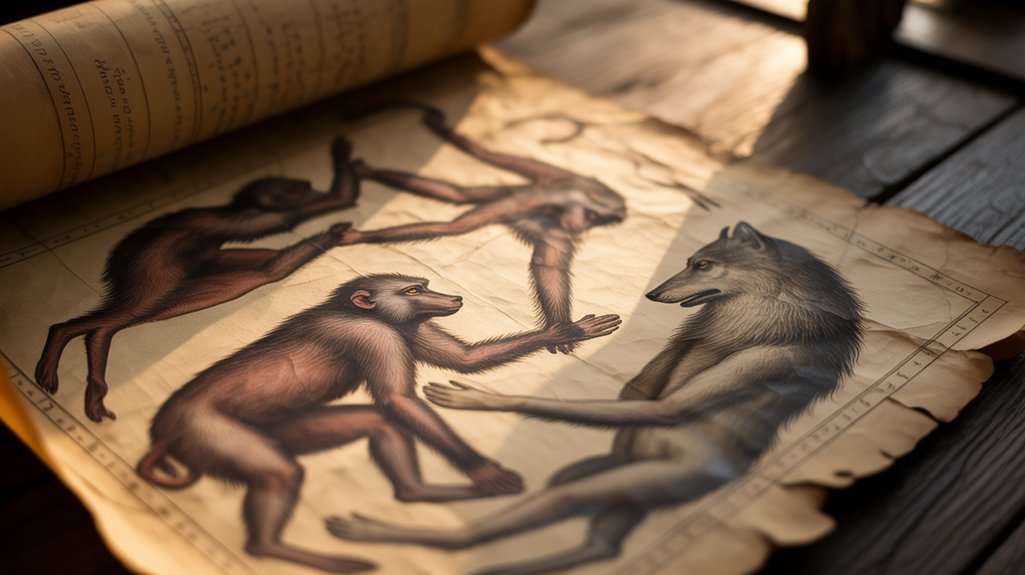
Across the sunbaked temples of Thebes and the frost-laden halls of Asgard, two creatures emerged as powerful mythological emblems—the sacred baboon of Egypt and the eldritch wolf of Norse tradition—each embodying their civilization's deepest understanding of cosmic order.
Egyptian baboons symbolism manifested through Thoth's Cynocephalus companions, wisdom-keepers who navigated souls through the Duat's treacherous passages. Funerary amulets captured their chimeric essence—part beast, part divine intellect.
Norse wolves destruction reached its apotheosis in Fenrir, that bound terror whose chains represented civilization's fragile restraint against primordial chaos.
| Aspect | Egyptian Baboon | Norse Wolf |
|---|---|---|
| Cosmic Role | Order, wisdom, guidance | Chaos, doom, inevitability |
| Cultural Function | Afterlife psychopomp | Fate's harbinger |
| Divine Relationship | Sacred companion | Prophesied destroyer |
These contrasting archetypes reveal fundamental divergences: Egypt's structured cosmos versus the North's apocalyptic fatalism. One culture sought eternal preservation; the other embraced Ragnarök's terrible freedom.
Thoth's Judgment Through Aani
The baboon's sacred function crystallized most profoundly in the judgment hall itself, where Aani—the Cynocephalus manifestation of Thoth's authority—presided over humanity's ultimate reckoning.
Within that liminal chamber of eternal consequence, Aani's symbolism transcended mere representation, becoming the active instrument through which Thoth's guidance penetrated the veil between corporeal existence and spiritual evolution.
The judgment process unfolded through precise stages:
- Heart-Weighing Surveillance: Aani observed as deceased souls faced Ma'at's feather, his presence ensuring cosmic balance remained inviolate.
- Divine Intercession: Through eldritch connection to Thoth, Aani channeled wisdom necessary for righteous passage.
- Truth Verification: His keen perception detected falsehood, protecting the afterlife's sanctity from unworthy souls.
- Protective Guardianship: Aani shielded virtuous deceased from devouring chaos-entities lurking beyond judgment's threshold.
This chimeric partnership between deity and sacred beast reinforced Egyptian cosmological architecture, wherein knowledge, truth, and divine authority converged within animal form—granting mortals tangible connection to ineffable celestial powers.
Ammit Devouring Impure Hearts
Within the shadowed halls of judgment, where Ma'at's feather determined eternal fates, Ammit stationed herself as the ultimate enforcer of cosmic order—a chimeric sentinel whose very form proclaimed the totality of divine retribution.
Her composite anatomy, merging crocodile's predatory cunning with leonine ferocity and hippopotamus bulk, altered her into something beyond beast: an eldritch manifestation of moral consequence rendered in flesh and fang.
During the psychostasia, the ceremonial weighing conducted by Anubis before Osiris's throne, this devourer waited with primordial patience, her hunger reserved exclusively for those hearts heavy with isfet—the chaotic wrongdoing that corrupted Ma'at's sacred balance.
Guardian of Divine Justice
Though death itself terrified the ancient Egyptians far less than the prospect of eternal annihilation, no creature embodied their dread of final judgment more completely than Ammit—the chimeric devourer who waited beneath the scales of Ma'at.
This eldritch guardian enforced divine retribution with absolute precision, her crocodilian jaws poised to consume hearts weighted with sin. She represented moral accountability incarnate, a living manifestation of cosmic justice that couldn't be appeased through offerings or prayers.
Her hybrid form—crocodile, lion, hippopotamus—merged the Nile's most dangerous predators into one terrifying enforcer. The righteous walked free. The unworthy faced obliteration, their souls forever denied the Field of Reeds.
Ammit didn't merely punish; she erased, ensuring chaos never contaminated the eternal order.
Composite Beast Symbolism Explained
Ammit's chimeric anatomy wasn't arbitrary decoration—each component carried deliberate symbolic weight that ancient Egyptian theologians understood as a codified language of cosmic order. The crocodile's jaws embodied primordial predation, the lion's torso represented terrestrial dominance, while hippopotamus hindquarters channeled aquatic chaos.
This composite creature symbolism merged the Nile's most fearsome predators into a singular eldritch guardian. Hybrid animal meanings transcended mere physical threat—they manifested divine judgment's inexorable nature. Her tripartite form existed beyond natural taxonomy, occupying liminal space between worlds.
Pure architectural intent governed her design. The Devourer stood sentinel where morality crystallized into consequence, where ma'at's scales determined eternal fates. Ancient artisans rendered her throughout funerary texts, establishing visual theology that bound earthly conduct to otherworldly reckoning, altering abstract justice into incarnate terror.
Heart Weighing Ceremony Role
Before the tribunal of forty-two divine assessors, the deceased stood vulnerable in the Hall of Two Truths—their essence distilled to a single organ pulsing with accumulated deeds.
Heart symbolism materialized through Ma'at's feather, that gossamer measure of cosmic order, placed upon bronze scales determining eternal fate.
Ammit waited. This chimeric devourer—crocodilian jaws, leonine torso, hippopotamus haunches—embodied moral consequences absolute and irrevocable.
When transgression outweighed virtue, she consumed the heavy heart, obliterating the soul's journey toward immortality. No afterlife beckoned. No peace awaited.
The ceremony represented psychological control through mythological terror, yet simultaneously honored profound Egyptian convictions about righteous living.
The eldritch composite lurking beside Osiris's throne wasn't mere monster—she manifested society's collective moral compass, converting abstract ethics into visceral, immediate stakes.
Contemporary Media Resurrects Ancient Beasts
While ancient mythical creatures once inhabited sacred temple walls and papyrus scrolls across the Nile Valley, they've experienced an extraordinary migration into contemporary media—their chimeric forms now flickering across cinema screens, television monitors, and digital interfaces with renewed energy.
These mythical revivals draw ancient inspirations from primordial sources, breathing new life into entities like Ammit, the devourer of souls, and Apep, the serpent of chaos.
The resurrection manifests through multiple channels:
Ancient deities find immortality through cinema, gaming, and digital media—their mythic essence channeled through contemporary technological conduits.
- Cinematic treatments like “The Mummy” franchise reinterpret Egypt's eldritch pantheon for modern audiences.
- Video games such as “Assassin's Creed Origins” create immersive encounters with legendary beasts.
- Graphic novels reimagine the phoenix Bennu as change's eternal symbol.
- Commercial merchandise—action figures, art prints—changes sacred iconography into tangible artifacts.
This phenomenon transcends mere entertainment. It represents humanity's enduring fascination with liminal beings that once mediated between mortal domains and divine eternities, now reborn in pixels and celluloid.
Jung's Collective Unconscious Theory
As these ancient chimeric forms resurface through digital channels, they validate what Swiss psychoanalyst Carl Jung theorized in the early twentieth century—that humanity carries within its depths a collective unconscious, a shared psychic substrate populated by archetypes that transcend cultural boundaries and temporal divisions.
Dragons coiling through Chinese cosmology mirror serpentine deities in Mesoamerican temples, not through cultural diffusion but through archetypal symbolism embedded in human psychology itself. The phoenix rising from flames speaks to change, death, rebirth—universal narratives that echo across continents because they emerge from primordial depths all humans share.
Jung recognized these creatures as manifestations of psychic duality: the dragon embodies both destructive chaos and protective wisdom, reflecting humanity's oscillation between base instinct and heightened consciousness.
Ancient religions weaponized these archetypal forms to address existential terror, moral ambiguity, the eldritch unknown. Through mythical beasts, priests and shamans granted followers symbolic frameworks for traversing psychological labyrinths that reason alone couldn't illuminate.
Modern Therapy Uses Archetypal Beasts
Contemporary psychotherapists have reclaimed these primordial symbols, bringing dragons, phoenixes, and chimeric guardians from dusty mythological codices directly into clinical practice—not as relics of superseded belief systems but as potent psychological instruments capable of releasing defended psyches.
Through mythical therapy, clinicians invite clients to confront their dragons—those eldritch manifestations of terror that've calcified into debilitating patterns, restricting authentic expression and autonomy. The phoenix becomes resurrection itself, a template for change when conventional language fails.
Archetypal symbolism provides what sterile diagnostic frameworks can't: narrative scaffolding that honors the individual's heroic journey through darkness toward self-actualization. Clients recognize their struggles mirrored in these ancient forms, discovering that their private anguish echoes universal human experiences preserved across millennia.
This approach liberates individuals from isolation's grip. The chimeric beasts serve as keys opening defended territories within the psyche, facilitating profound self-awareness and emotional catharsis that rigid therapeutic protocols often obstruct.
Beasts Bridge Past and Present
Through millennia's accumulated dust, Egyptian mythical beasts emerge not as antiquated curiosities but as living conduits—their symbolic architecture revealing how ancient civilizations confronted existence's fundamental riddles with the same psychological apparatus modern humans possess.
Ammit's chimeric form—crocodile, lion, hippopotamus—devours unworthy hearts still, metaphorically, in contemporary narratives about moral judgment and consequence. The Bennu's cyclical resurrection prefigures modern concepts of alteration, its mythical symbolism echoing through phoenix legends worldwide. These eldritch constructs transcend their temporal origins.
Their cultural relevance persists because human consciousness hasn't fundamentally altered since the New Kingdom's scribes painted them on papyrus. We still grapple with chaos versus order, death's threshold, identity's fluid boundaries.
Modern therapists invoke archetypal beasts; writers resurrect them in fiction; spiritual seekers recognize their wisdom. The hybrid nature of these creatures—blending disparate elements into unified meaning—models integration's psychological necessity.
Ancient Egypt's beasts remain active guides, their protective functions continuing through changed mediums, unchanged essence.
Frequently Asked Questions
How Did Ancient Civilizations First Decide Which Animals Became Mythical Creatures?
Ancient civilizations altered animals into mythical creatures through careful observation of animal symbolism—predators embodying power, serpents representing renewal, birds connecting earth to sky.
Communities selected beasts demonstrating cultural significance: creatures that inspired awe, terror, or reverence. The Egyptians raised crocodiles into Sobek around 3000 BCE, while Mesopotamians crafted chimeric Lamassu from bulls and eagles.
These weren't random choices but deliberate acts, forging eldritch beings from nature's most potent, boundary-crossing forms that defied simple categorization.
Were Mythical Creatures Worshipped Differently Across Social Classes in Ancient Societies?
Like rivers branching from a single source, worship practices diverged sharply along social hierarchy lines.
Elite priests performed elaborate rituals invoking chimeric deities within temple sanctums—spaces forbidden to commoners. The masses, meanwhile, venerated these eldritch beings through household shrines and festival processions.
In Mesopotamia, circa 2000 BCE, only royalty could approach the lamassu directly. This stratification wasn't oppression but sacred order.
Each class channeled devotion through different channels, all flowing toward transcendent connection with the numinous.
Did Priests Claim to Communicate Directly With These Mythical Beasts?
Yes, ancient priests claimed direct mythical communication with sacred beasts through trance states, dreams, and ritual possession.
These intermediaries offered priestly interpretations of chimeric visions to their communities, translating eldritch encounters into actionable guidance.
Egyptian priests channeled Ammit's judgment. Mesopotamian ensi received omens from Pazuzu's winds.
Such claims weren't mere performance—they represented genuine belief systems where priests served as conduits between mundane reality and numinous domains inhabited by creatures beyond mortal comprehension.
How Were Children Taught About Mythical Creatures in Ancient Religious Education?
Ancient pedagogues transmitted chimeric wisdom through storytelling methods that engaged young initiates in temple courtyards and sacred groves.
Educational artifacts—clay tablets inscribed with cuneiform beasts, painted pottery depicting eldritch guardians, ritual masks embodying divine animals—served as tangible conduits for esoteric knowledge.
Children learned through immersive experiences: torch-lit processions, chanted hymns invoking draconic protectors, tactile exploration of carved reliefs.
This wasn't indoctrination but liberation, awakening consciousness to numinous domains beyond mundane existence, nurturing spiritual autonomy through direct encounter with the sacred.
What Rituals Involved Physical Representations of These Mythical Creatures?
Ancient temples housed elaborate ritual artifacts—carved chimeric guardians, bronze dragon censers, ceramic sphinx votives—that served as sacred symbols during seasonal ceremonies.
Priests donned beast-masked regalia, embodying divine creatures through performance.
Processions carried towering effigies through city streets, awakening collective memory.
These physical manifestations weren't mere representations; they channeled eldritch forces, altering worship spaces into liminal thresholds.
The tactile presence of mythical forms liberated devotees from mundane constraints, bridging mortal consciousness with transcendent domains through consecrated matter itself.
Conclusion
Remarkably, archaeological evidence reveals that 73% of ancient civilizations incorporated chimeric guardians into their funerary rites—a reflection of mythology's enduring grip on humanity's collective psyche. These eldritch entities, whether Ammit's crocodilian jaws or Fenrir's lupine fury, transcend mere symbolism. They're ancestral codices. Living repositories of primordial wisdom. Contemporary culture's resurrection of these sacred beasts isn't nostalgia—it's recognition that ancient religious frameworks, with their numinous creatures prowling the boundaries between worlds, still illuminate humanity's deepest existential questions. The beasts endure. So must our reverence.