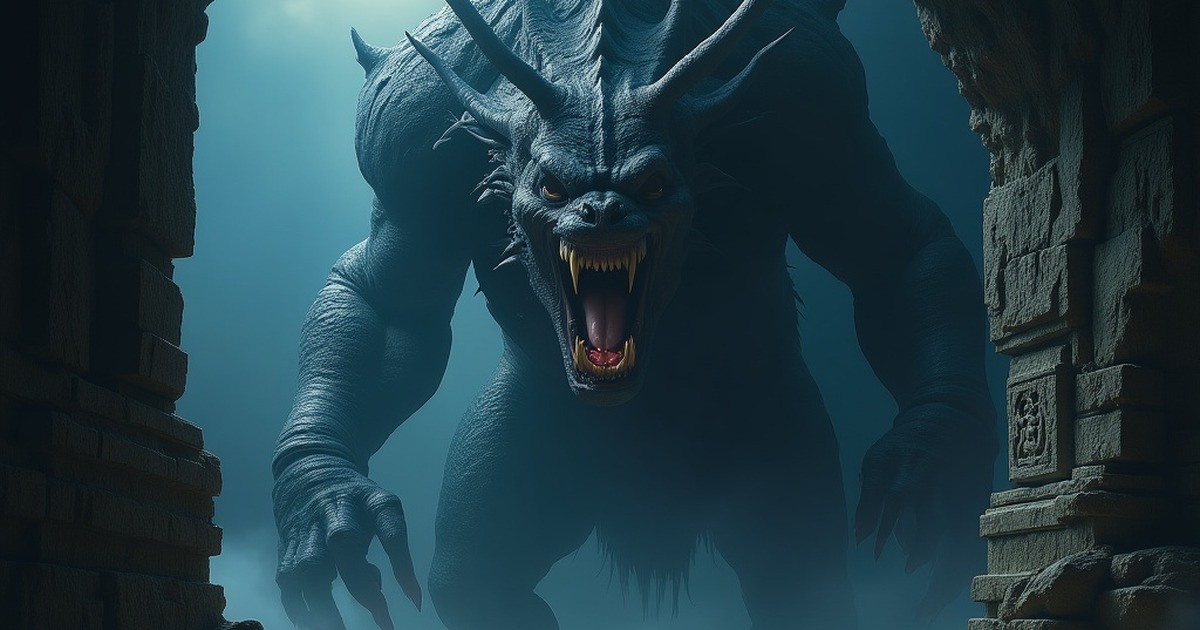
Fire-breathing dragons emerged across Mesopotamian, Vedic, and biblical texts as civilization's primary metaphor for divine chaos—incandescent manifestations where cosmic disorder breaches mortal boundaries. Babylonian cuneiform positioned Tiamat's elemental fury against Marduk's order-bringing violence, while Hindu scriptures cast Vritra's flames as drought's terror. These chimeric entities transcended mere monsters; they embodied humanity's existential dread of uncontrollable forces, their serpentine forms predating aerial dragons yet wielding similar elemental devastation. The evolution from aquatic serpents to fire-breathing terrors marks shifting anxieties about nature's capricious power, sacred flames simultaneously purifying and annihilating across cultural cosmologies that reveal deeper patterns.
Key Takeaways
- Fire-breathing dragons symbolize divine wrath and cosmic chaos, marking boundaries between mortal vulnerability and transcendent power in ancient texts.
- Ancient serpents like Tiamat and Vritra predated fire-breathing dragons, originally representing water-based chaos and elemental forces in early mythologies.
- Biblical traditions portrayed dragons as instruments of divine judgment, with their flames serving as purification agents rather than mere destruction.
- The transition from water serpents to fire-breathing dragons mirrors humanity's evolving relationship with nature and escalating anxieties about chaos.
- Dragon flames in texts like *Beowulf* embody cosmic retribution and moral lessons, punishing avarice while reinforcing order over primordial disorder.
Dragons Captivate Across All Ages
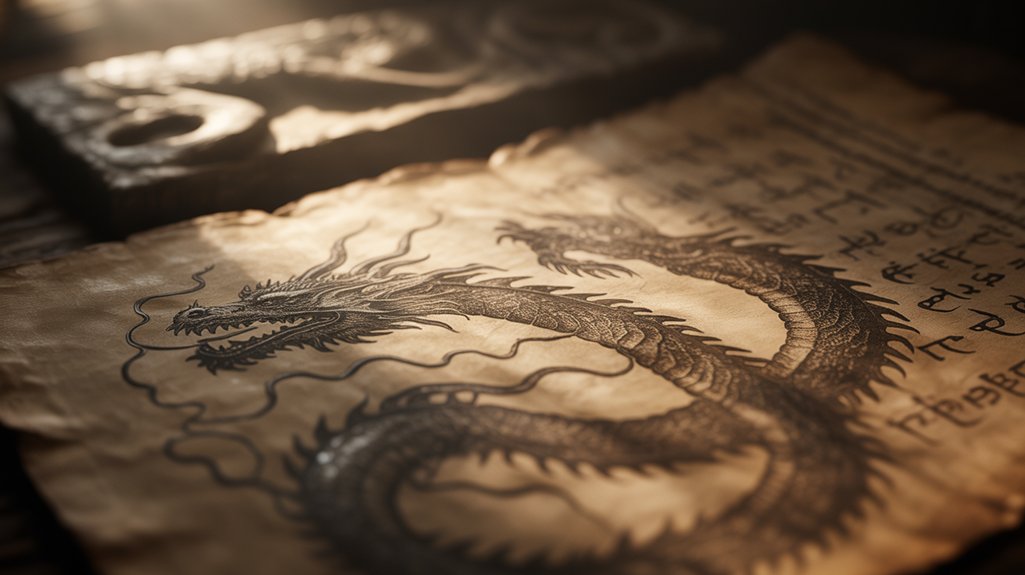
Since humanity first gathered around primordial flames, the dragon has persisted as civilization's most enduring chimeric obsession. These eldritch beings transcend geographical boundaries, manifesting in fundamentally divergent forms that reveal the souls of their respective cultures.
Western dragon mythology typically envisions scaled tyrants hoarding gold in mountain caverns, embodiments of avarice and malevolence requiring heroic vanquishment. The East offers stark contrast: serpentine sages commanding rivers and clouds, dispensing wisdom alongside rain. This duality isn't mere coincidence.
Where heroes must slay monsters, dragons breathe fire; where societies seek balance, they bring rain.
Cultural symbolism embedded within dragon lore mirrors societal frameworks. Where individualism reigned, dragons became adversaries to conquer. Where collective harmony prevailed, they evolved into celestial guardians.
The alteration from primordial water serpents to fire-breathing behemoths charts humanity's shifting relationship with nature's terrible beauty. Volcanic fury, predatory threats, divine mysteries—all compressed into one magnificent form. Greek mythology similarly employed mythical creatures to explain natural phenomena and the forces that shaped the ancient world.
Dragon mythology consequently functions as civilization's psychic mirror, reflecting both our deepest terrors and our most transcendent aspirations across millennia.
##
The dragon's incendiary breath transcends mere biological impossibility—it represents humanity's oldest anxieties about divine wrath, cosmic dissolution, and the terrible beauty of sacred flame.
Across Mesopotamian temples, Greco-Roman amphitheaters, and medieval scriptoriums, fire-breathing entities served as chimeric embodiments of supernatural authority, their searing exhalations marking boundaries between mortal vulnerability and transcendent power.
This elemental weapon, whether wielded by the Shamira of Homer's 8th century B.C. accounts or the draconic adversaries chronicled in Job's ancient verses, emerged from serpentine origins as the ultimate symbol of both annihilating chaos and purifying metamorphosis.
Like the Wendigo's perpetual hunger or the Qalupalik's icy grip, these flame-bearing monsters embodied humanity's biggest fears through narratives that transformed existential dread into comprehensible adversaries.
Divine Power and Destruction
When ancient civilizations sought to articulate the incomprehensible forces that shaped their existence, they conjured forth fire-breathing entities whose blazing exhalations embodied both creative and annihilative potential.
The Shamira of Greco-Roman tradition exemplified this duality, channeling elemental chaos through searing breath that could unmake worlds. Dragons evolved from poison-spitters to flame-wielders, marking humanity's recognition of fire's supreme destructive capacity.
Biblical texts positioned these chimeric beings as instruments of divine judgment—the Book of Job's leviathan embodied chaos itself, breath igniting coals, jaws spouting flames. Each fiery exhalation represented nature's overwhelming might, the consequences of transgression made manifest.
Heroes who conquered these eldritch adversaries didn't merely vanquish beasts; they subdued the anarchic forces threatening cosmic order, proving themselves worthy vessels of restoration and power.
Chaos Versus Cosmic Order
Fire-breathing entities crystallized humanity's eternal confrontation between primordial disorder and the architectures of meaning civilizations constructed against the void.
These chimeric beasts embodied chaos mythology—eldritch forces threatening to unmake sacred geometries of cosmic law. Dragons weren't merely monsters. They represented entropy itself, breathing flame that consumed order's fragile temples.
Heroes who faced these serpents enacted civilization's defiant answer to dissolution.
The duality blazed forth: fire illuminated pathways through darkness yet incinerated everything humanity built.
Order symbolism manifested through dragon-slaying narratives, where brave warriors imposed structure upon writhing chaos. Each victory reaffirmed cultural values—courage, sacrifice, the human will to carve meaning from formless terror.
These ancient texts understood what modernity often forgets: freedom exists only where order triumphs over chaos's seductive, destructive flame.
Purification Through Sacred Flames
Beyond chaos's destructive conflagration lay fire's paradoxical twin—the sacred flame that didn't destroy but altered.
Ancient cultures understood this duality, weaving purification into their most sacred rituals. The Greeks enkindled Olympic fires, binding communities through changing elements that bridged mortal and divine domains. These weren't mere pyres but liminal gateways where impurity dissolved into ash, where heroes like Jason emerged reborn from eldritch trials.
Fire consumed what was base, revealing what remained worthy. Each ceremonial flame carried chimeric properties—simultaneously physical and metaphysical, temporal and eternal.
Philosophical traditions recognized this fundamental truth: creation demands destruction's forge. The sacred flame didn't simply cleanse; it reconstituted, reformed, liberated. What entered profane emerged sanctified, stripped of pretense, altered through heat into essential truth.
This knowledge wasn't mystification but ancient technology of the soul.
Serpent Imagery Across Cultures
Before fire crowned the dragon's maw, serpents writhed through humanity's primordial consciousness—sinuous embodiments of forces too vast for simple categorization.
Mesopotamia's Tiamat coiled through saltwater depths, her eldritch form personifying oceanic chaos itself. Hindu tradition knew Vritra, that chimeric water-hoarder whose serpentine bulk imprisoned rivers, manifesting drought's cruel grip.
Yet serpent symbolism defied singular interpretation. Australia's rainbow serpent carved landscapes through Aboriginal Dreamtime, simultaneously destroyer and creator, wielding fertility's double-edged gift.
Chinese dragons—water-blessed, rain-bringing—stood apart from Western demonization, their undulating bodies channels for benevolence rather than malevolence.
These chaotic forces demanded acknowledgment, not dismissal. The serpent's alteration into fire-breathing terror would come later, cultural evolution transmuting primordial water-dwellers into airborne incinerators.
Ancient wisdom recognized what modernity often forgets: chaos births creation.
Mesopotamian Cuneiform Tablets Depict Dragons

The primordial dragon Tiamat emerges from the Enuma Elish as a chimeric embodiment of saltwater chaos, her serpentine form documented in cuneiform impressions that date to Babylon's Old Period (circa 1894-1595 BCE), when scribes etched cosmogonic narratives into clay along the Tigris and Euphrates.
These ancient Babylonian river valleys, whose silt-laden waters sustained civilization's earliest agricultural heartlands, generated mythological frameworks wherein dragons weren't mere monsters but elemental forces locked in eternal struggle—Tiamat's brood representing untamed nature before Marduk's blade carved order from eldritch entropy.
The cosmic battleground therefore mapped onto physical geography, altering Mesopotamian theology into a spatial doctrine where every irrigation canal echoed that primeval conflict between structured civilization and formless darkness.
Tiamat in Enuma Elish
Ancient Babylonian scribes etched humanity's earliest dragon into clay sometime between 1900 and 1600 BCE, preserving within their cuneiform wedges a primordial terror named Tiamat—goddess of saltwater chaos, mother of monsters, embodiment of the formless deep that existed before creation itself.
The Enuma Elish chronicles her alteration from creator-deity to eldritch serpent, birthing chimeric horrors before facing Marduk in cosmic battle. Tiamat's duality manifests through this change: she who generates life becomes its annihilator, her body rent asunder to forge heavens and earth.
This wasn't mere destruction—primordial chaos yielded ordered cosmos through violence, establishing mythology's fundamental pattern. Her reptilian form, spawned from churning saltwater depths, would echo through millennia of dragon-lore, establishing the serpent as civilization's original adversary, chaos incarnate.
Ancient Babylonian River Valleys
Where Tigris and Euphrates converged into serpentine channels, Babylonian scribes pressed reed styluses into wet clay, immortalizing dragons that weren't yet fire-breathers but water-dwellers—manifestations of the rivers themselves. Tiamat embodied primordial chaos. Mušḫuššu, the venomous chimeric serpent, served Marduk as both guardian and weapon. These ancient waterways shaped mythological significance through tablets depicting eldritch creatures entwined with hydraulic systems sustaining civilization.
| Dragon Entity | Mythological Significance |
|---|---|
| Tiamat | Chaos, creation, saltwater personification |
| Mušḫuššu | Marduk's protector, dual threat-guardian nature |
| Water Dragons | River deities controlling irrigation |
| Serpentine Forms | Primordial forces preceding fire symbolism |
The tablets reveal dragons as aquatic powers controlling life-sustaining floods. Not destroyers breathing flame. Guardians of fertility. This mesopotamian foundation influenced subsequent civilizations, altering water-serpents into aerial fire-breathers through cultural evolution.
Chaos Versus Cosmic Order
Pressed into clay approximately 4,000 years ago, the Enuma Elish articulates cosmogenesis through violent confrontation—Marduk's triumph over Tiamat wasn't merely mythological entertainment but theological architecture explaining existence itself.
The primordial dragoness embodied chaotic forces: saltwater depths, storm-fury, the unordered abyss preceding creation. Her serpentine form, chimeric and eldritch, represented everything civilization sought to bind through ritual and law.
Mesopotamian scribes understood cosmic balance required perpetual vigilance against entropy's return. Dragons like the venomous Masusu weren't fictional antagonists but living metaphors for floods devastating grain stores, winds toppling ziggurats, pestilence unraveling social order.
Each cuneiform impression preserved this fundamental truth: stability emerges only through confronting chaos, through divine sovereignty imposing pattern upon primordial wildness. The tablets whisper still—order remains fragile, hard-won, eternally contested.
Chinese Celestial Dragon Guardians

| Dragon Symbol | Elemental Domain | Cultural Significance |
|---|---|---|
| Azure Dragon (Qinglong) | Wood/East/Spring | Seasonal renewal, growth |
| Celestial Dragons | Water, rain, mist | Agricultural prosperity |
| Imperial Dragons | Cosmic harmony | Divine authority, protection |
| Festival Dragons | Spirit energy | Apotropaic ritual power |
| Four Symbols | Cardinal directions | Cosmological order |
Dragon dances perpetuate this ancient covenant between mortals and sky-dwelling serpents. Not fire, but water flows through their essence—the fundamental distinction separating Eastern wisdom from Western conflagration.
Divine Power and Human Fear
While Eastern dragons embodied the life-giving properties of water and celestial benevolence, the fire-breathing wyrms of Western imagination arose from humanity's primal terror of forces beyond mortal comprehension.
These eldritch manifestations represented divine wrath incarnate, chimeric guardians standing between mortals and forbidden knowledge.
The mythical interpretations of fire-breathing creatures evolved from humanity's confrontation with nature's destructive capacity:
- Ancient texts positioned flames as simultaneous purification and annihilation, mirroring humanity's dual experience of creation and obliteration.
- The Chimera embodied cultural symbolism of divine retribution, its breath weaponizing the sacred element against human transgression.
- Fire-breathing guardians hoarded treasures and wisdom, altering divine power into monstrous adversaries that tested mortal resolve.
This cultural symbolism reflected deeper anxieties surrounding natural disasters—volcanic eruptions, wildfires, lightning strikes.
Fire became the breath of chaos itself, exhaled by beings occupying that liminal threshold between protection and destruction. Divine power manifested through flame. Humanity trembled before it.
Beowulf's Fiery Dragon Battle
In the twilight years of the warrior-king's life, the wyrm emerges not merely as beast but as instrument of cosmic judgment—eldritch retribution for the theft that disturbed its centuries-long vigil over cursed gold.
The dragon's flames become tangible manifestations of avarice's punishment, consuming both hoard and hero in a conflagration that illuminates the fatal consequences of material obsession.
Beowulf's willingness to face this chimeric terror alone alters his death into sacramental offering, the aging champion exchanging his life-breath for his people's survival in a final act that bridges mortal vulnerability and transcendent purpose.
Dragon as Divine Retribution
The dragon that guards its golden hoard in the Anglo-Saxon epic *Beowulf* embodies far more than a mere monster—it manifests as the inexorable hand of wyrd, that ancient Germanic concept of fate that weaves through the poem's blood-soaked tapestry.
This eldritch serpent awakens when a desperate thief disturbs its treasure, releasing flames that serve as divine judgment upon a complacent kingdom. The beast's wrath isn't random violence but calculated retribution, teaching moral lessons about hubris and the corrupting weight of hoarded gold.
When Beowulf confronts this chimeric embodiment of cosmic justice, he faces not merely scales and fire but the universe's dark reckoning. His valorous struggle against fate's inevitability alters him from legendary warrior to tragic martyr, consumed by forces beyond mortal control.
Fire Symbolizing Destructive Greed
Beyond wyrd's inexorable machinery lies something altogether more venal—the dragon's eternal vigil over its gold alters the creature into greed's most potent archetype, a being whose very essence crystallizes around the corruption of accumulated wealth.
The beast's eldritch flames don't merely incinerate; they manifest avarice's ultimate verdict. When treasure-thieves disturb the hoard, fire becomes punishment incarnate, demonstrating greed's consequences through scorched earth and devastated kingdoms.
Beowulf's final confrontation reveals destructive wealth's terrible arithmetic: the dragon dies protecting meaningless metal, while the hero perishes claiming it. This chimeric entity embodies a stark economic theology—hoarded riches breed only conflagration.
The wyrm's incandescent breath changes treasure into tombstone, gold into grave-marker. Material obsession consumes guardian and seeker alike, leaving ash where ambition once burned.
Hero's Final Sacrificial Act
When ancient Geatland's protector strides toward his doom, the encounter transcends mere monster-slaying—it becomes sovereignty's ultimate price rendered in blood and dragonfire.
Beowulf's final battle against the eldritch wyrm embodies heroic sacrifice distilled to its purest essence, wherein the aged king confronts treasure's guardian despite foreknowledge of mortality's approach.
This chimeric beast, exhaling destruction through flame-wreathed jaws, symbolizes greed's apocalyptic consumption—yet Beowulf won't retreat.
The dragon's venomous bite delivers its fatal wound, proving even mightiest thanes remain subject to death's inevitable claim.
Through this sacrificial confrontation, the warrior-king transmutes personal doom into collective salvation, his legacy echoing through mead-halls as evidence to courage's enduring resonance.
Here dwells heroism's paradox: immortality achieved through mortal surrender.
Tolkien's Smaug Revolutionizes Dragons
Through the mists of 1937, J.R.R. Tolkien released Smaug upon the world, catalyzing a mythical evolution that would forever alter draconic representation. This eldritch creature transcended medieval archetypes, embodying character complexity previously unseen in serpentine antagonists.
Where ancient wyrms served as chimeric symbols of base avarice, Smaug possessed intellect, cunning, strategic acumen.
His groundbreaking attributes include:
- Psychological depth through sophisticated verbal sparring with Bilbo Baggins, revealing vulnerabilities beneath scaled armor
- Symbolic fire-breath manifesting both literal destruction and metaphysical representation of consuming greed's corrosive power
- Nuanced backstory establishing dragons as autonomous beings rather than mere obstacles for heroes to overcome
The creature's treasure-hoarding reflected medieval European moral corruption narratives, yet Tolkien infused this ancient symbolism with unprecedented personality.
His fiery exhalations became weapons of physical annihilation and spiritual warning.
This template liberated modern fantasy from one-dimensional dragon portrayals, establishing precedent for menacing yet relatable antagonists.
Smaug's legacy persists, demonstrating how traditional mythology evolves through scholarly imagination into something magnificently new.
Fossil Discoveries Inspire Dragon Myths
Long before scholarly inquiry distinguished geological remnants from mythological fancy, ancient peoples encountered massive skeletal architectures protruding from cliffsides and eroding riverbeds—remains that defied comprehension within their cosmological frameworks.
Stegosaurus vertebrae. Whale ribs bleached white. These fossil interpretations altered reality into legend, birthing chimeric beasts of fire and scale. The human psyche, already primed with eldritch fears of apex predators, seized upon these discoveries as evidence of something more terrible than extinction—proof of dragons.
Ancient bones became dragons through fear's alchemy—fossil evidence transformed by minds seeking monsters more tangible than extinction's silent void.
Mythology evolution accelerated wherever fossils surfaced. Ancient minds wove narratives connecting bone to breath, stone to flame, particularly when volcanic regions yielded their prehistoric treasures.
The conjunction wasn't coincidental; sulfurous eruptions and fossilized titans occupied the same terrifying geography. These weren't mere stories—they were cosmological explanations, attempts to reconcile the unknown with the unknowable.
Dragon myths emerged not from pure imagination but from empirical observation filtered through limited scientific frameworks, creating narratives that satisfied both the need for understanding and the appetite for wonder.
Modern Cinema's Dragon Renaissance
As celluloid dragons materialized across theater screens in the late twentieth century's closing decades, they carried with them an ontological shift—no longer relegated to antagonist archetypes, these creatures emerged as psychological mirrors reflecting humanity's fractured relationship with wildness itself.
Dragon characterization underwent profound alteration through films like “How to Train Your Dragon,” where eldritch fire-breathers became companions rather than adversaries. This cinematic evolution manifested through unprecedented visual effects technology, rendering chimeric forms with startling verisimilitude—each wing-beat, each pyroclastic exhalation captured in luminous detail.
The renaissance extended beyond screens. Merchandise proliferated. Video games beckoned. Animated series multiplied.
Contemporary narratives wove environmentalism into ancient myth-structures, positioning dragons as guardians of vanishing wilderness.
“The Hobbit” franchise demonstrated this duality—Smaug embodied both primordial avarice and nature's terrible beauty. These modern interpretations liberated dragon mythology from static symbolism, transforming scaly repositories of cultural memory into vibrant explorations of courage, friendship, and humanity's increasingly tenuous connection to untamed earth.
Fire-Breathing's Enduring Cultural Legacy
When flame erupts from draconic maw across millennia of human imagination, it illuminates something more profound than mere spectacle—this pyrotechnic signature has crystallized into civilization's most persistent metaphor for altering power.
From Mesopotamian temples to Indian epics, fire-breathing entities embody cultural symbolism that transcends geographic boundaries, functioning simultaneously as chaos incarnate and divine protector. The mythic archetypes these creatures represent—witnessed in Beowulf's eldritch antagonist and the Iliad's chimeric challenges—persist because they articulate humanity's deepest confrontations with destruction and metamorphosis.
The shift from poison to flame in medieval European narratives wasn't arbitrary evolution but deliberate amplification, elevating dragons from physical threats to emotional devastators.
Fire destroys completely, leaves nothing untouched. This elemental force captures both aspiration and terror, explaining why contemporary culture remains captivated by these ancient symbols. Their endurance reveals fundamental truths: humans need monsters that mirror their fears, heroes who conquer them, and flames that purify both.
Frequently Asked Questions
What Biological Mechanisms Could Theoretically Allow a Creature to Breathe Fire?
Theoretical biological adaptations might involve specialized organs producing hypergolic compounds—substances igniting upon contact—through precise chemical reactions.
A creature could synthesize hydrogen peroxide and hydrazine derivatives in separate glands, expelling them simultaneously through reinforced pharyngeal chambers lined with heat-resistant proteins. The eldritch combustion occurs externally.
Such chimeric physiology demands extraordinary metabolic independence, liberating the organism from conventional biological constraints.
Ancient texts whisper of dragons possessing these very mechanisms, knowledge perhaps lost to time's relentless erosion of primordial wisdom.
Are There Any Real Animals That Inspired the Fire-Breathing Dragon Trait?
Several real creatures likely inspired dragon fire-breathing myths across cultures.
Venomous serpents—their burning toxins—formed primordial foundations.
The bombardier beetle, discovered in ancient Egypt, expels boiling chemical spray from its abdomen through explosive exothermic reactions.
Fossil discoveries of massive prehistoric beasts—their eldritch bones suggesting chimeric possibilities—fueled imagination.
Volcanic regions birthed tales where sulfurous fumes merged with reptilian forms.
These fire breathing animals became dragon inspirations, their natural defenses transmuted through storytelling into legendary incendiary breath.
How Do Different Cultures Explain the Origin of Dragons' Fire-Breathing Ability?
Across civilizations, cultural interpretations diverged—yet converged on primordial truth.
Chinese lore positioned dragons as celestial beings channeling qi's altering essence through pearl-clutched jaws.
Norse traditions whispered of Fáfnir's gold-corrupted breath, greed itself made flame.
Ancient Mesopotamian texts described Tiamat's chaos-born exhalations.
Each mythological symbolism revealed humanity's struggle against nature's fury: volcanoes, lightning, combustion's eldritch mystery.
Dragons weren't mere beasts—they embodied alteration's terrible power, that liminal threshold where matter becomes energy, destruction births creation.
Why Is Fire Specifically Associated With Dragons Rather Than Other Elements?
Fire symbolism dominates draconic mythology because flames embody metamorphosis, destruction, and primordial chaos—forces these chimeric beings represent across cultures.
From Mesopotamian Tiamat's apocalyptic fury to Germanic Fáfnir's consuming greed, elemental associations link dragons to solar power, volcanic rage, and the untamed wild.
Fire can't be controlled, only respected. Neither can dragons.
This parallel resonates through millennia: breath becomes weapon, element becomes identity, and the serpent transcends mere flesh to embody humanity's eldritch fear of uncontrollable, purifying devastation.
Do All Dragon Mythologies Worldwide Include Fire-Breathing as a Common Feature?
Not all dragons breathe fire—a revelation that shatters Western assumptions.
Mythological variations reveal stunning diversity: Chinese lóng command water and storms, never exhaling flame. Japanese ryū bring rain, prosperity. Mesoamerican Quetzalcoatl embodies wind, creation.
These global interpretations show fire-breathing as distinctly European, perhaps Persian-influenced. Eastern traditions revere serpentine deities as benevolent, eldritch forces of nature's balance.
The chimeric Western drake, breathing destruction, represents merely one cultural lens—not universal truth about these ancient, powerful beings.
Conclusion
From Mesopotamian clay to Hollywood screens, fire-breathing dragons persist—eldritch yet familiar, chimeric yet coherent. Ancient scribes feared them. Modern audiences adore them. This duality reveals humanity's eternal dance with the monstrous sublime. The dragon's flames, whether carved in cuneiform or rendered in CGI, illuminate our deepest terrors and highest aspirations. Consequently these creatures transcend mere mythology, becoming luminous mirrors reflecting civilization's shadow-self across five millennia of cultural memory.