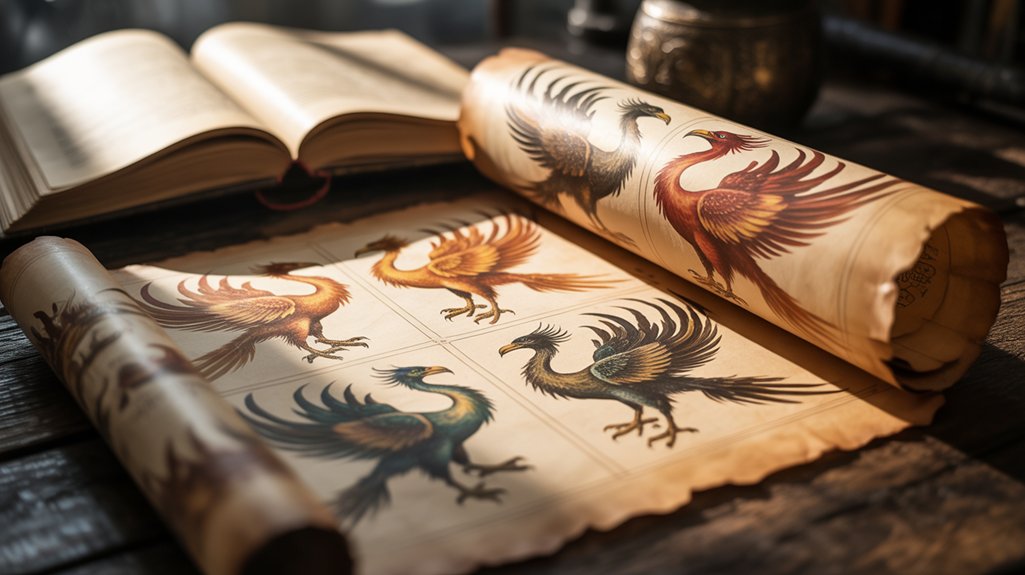
The phoenix archetype manifests across civilizations as humanity's most enduring metamorphosis symbol—from Egypt's Bennu emerging from primordial waters to embody Ra's solar journey, through Greece's self-immolating bird reborn from ash every five centuries, to China's Fenghuang balancing yin-yang duality as virtue incarnate. Persian Simurgh and Hindu Garuda complete this global tapestry of resurrection myths, each variant reflecting distinct cosmologies yet articulating the same eldritch truth: death functions merely as threshold rather than terminus, encoding *solve et coagula* principles that modern psychology now recognizes as resilience patterns, while corporate symbology continues appropriating these ancient flames to promise perpetual renewal.
Key Takeaways
- Egyptian Bennu emerges from primordial waters embodying solar resurrection, symbolizing Ra's cyclical journey and humanity's hope for renewal.
- Greek Phoenix self-immolates every 500 years, rising from ashes through aromatic resins, representing liberation from mortality's constraints.
- Chinese Fenghuang balances yin-yang duality, symbolizing virtue and the Empress's divine mandate in celestial harmony with Dragon.
- Persian Simurgh guards temporal boundaries dispensing healing wisdom, while Hindu Garuda guides souls through endless reincarnation cycles.
- Slavic Firebird intertwines blessings with curses, emphasizing transformation's dual nature where catastrophe becomes catalyst for renewal.
Death, Fire, and Eternal Return
When the primordial flames consume the Phoenix's mortal form, they don't merely destroy—they consecrate, initiating a cosmic exchange between annihilation and genesis that reverberates through humanity's oldest spiritual architectures.
The Greek Phoenix, completing its quincentennial cycle, constructs funeral pyres from aromatic wood—myrrh, cinnamon, frankincense—altering death into sacrament. This mythical interpretation finds its Egyptian antecedent in the Bennu bird, whose resurrection mirrors Ra's solar journey and the Nile's annual flooding, binding cosmic order to terrestrial rhythm.
Death transforms into ceremony when fire meets fragrant wood, echoing Ra's eternal cycle through terrestrial rhythms of flood and renewal.
Fire becomes threshold. The Persian Simurgh embodies this eldritch wisdom, while China's Fenghuang and India's Garuda perpetuate the pattern across continental divides.
Such cultural symbolism transcends mere allegory; it articulates humanity's deepest intuition about existence itself—that endings contain beginnings, that transformation requires surrender, that the eternal return isn't cyclical repetition but spiral ascension.
Like the cautionary tales that kept ancient communities vigilant against tangible threats, the Phoenix myth addresses humanity's existential anxieties through symbolic transformation rather than prohibition.
Death doesn't negate life. It refines it.
##
The phoenix archetype manifests across disparate civilizations with striking variations, each culture reshaping this eldritch symbol of cyclical renewal to reflect its own cosmological understanding.
From the Egyptian Bennu, which emerged from the primordial waters at creation's dawn, to the resplendent Chinese Fenghuang that embodies yin-yang duality, and the Slavic Firebird whose luminous plumage guards forbidden knowledge—these avian manifestations transcend mere mythological taxonomy.
They represent humanity's oldest attempt to conceptualize death's reversal, to bind immortality within feathered flesh and consecrated flame.
The Rebirth Myth: Phoenix Variants Across Global Cultures
Across civilizations separated by vast oceans and millennia, humanity's fascination with cyclical resurrection manifests through avian deities that burn, die, and rise again—each culture weaving its own luminous thread into this ancient tapestry of eternal return.
Egypt's Bennu emerged from primordial waters, embodying Ra's solar journey. Cultural interpretations diverge sharply: Greece's phoenix self-immolates after five centuries, achieving immortality through ash-born renewal.
China's Fenghuang transcends simple rebirth—this chimeric entity balances yin and yang, representing virtue incarnate. Persia's eldritch Simurgh guards temporal boundaries, dispensing healing wisdom across ages.
Hindu tradition positions Garuda as soul-carrier, guiding endless reincarnation cycles.
These mythical connections reveal fundamental truths about human consciousness. Death isn't finality—transformation awaits. Each variant speaks to liberation from temporal constraints, offering humanity pathways toward understanding existence beyond linear progression.
In Christian tradition, the phoenix became a powerful symbol of Christ's death and resurrection, reinforcing theological concepts of eternal life through its perpetual cycles of rebirth.
Ancient knowledge persists.
Egyptian Bennu Bird Origins
From Heliopolis's sacred precincts emerged humanity's earliest documented phoenix archetype—the Bennu, a heron-crowned manifestation of solar divinity whose mythos predates Greek variants by millennia.
This eldritch avian, radiant-plumed and sovereign, arose from Nun's primordial waters at creation's dawn, embodying ancient symbolism that intertwined solar deity worship with rebirth themes.
Egyptian mythology positioned the Bennu bird as Ra's sacred emanation, ascending each morning alongside the sun's triumphant arc, its presence consecrating life cycles through eternal renewal.
Heliopolis rituals celebrated the Nile's annual inundation as the Bennu's gift—death converted into fertile resurrection.
These creation myths weren't mere allegory but living cosmology, where the chimeric heron's cyclical return mirrored observable natural phenomena, binding human consciousness to the inexorable rhythms governing existence itself.
Pure becoming, crystallized in feathered form.
Chinese Fenghuang Divine Symbolism
Radiant synthesis of cosmic dualities, the Fenghuang emerged from China's philosophical heartland as something far more nuanced than its Western phoenix counterpart—a composite sovereign whose very anatomy encoded moral teachings.
This chimeric entity, adorned with luminous plumage that shifted through vermillion, gold, and azure, transcended mere Fenghuang symbolism to become divine architecture itself. Where dragon represented yang's masculine force, the Fenghuang embodied yin's feminine wisdom, their pairing manifesting perfect harmony balance in imperial cosmology.
Its mythical representations carried profound cultural significance—appearing only when benevolent rulers ascended, vanishing when corruption festered. Each feather held meaning: virtue, grace, righteousness.
The creature's eldritch song announced epochal alterations, its presence a celestial guarantee that cosmic order endured, that chaos would yield to renewal's eternal dance.
Slavic Firebird Magical Tales
While the Fenghuang manifested as imperial omen within Confucian order, Slavic territories birthed their own luminous enigma—the Zhar-Ptitsa, whose very name captured the creature's essence: fire-bird.
This eldritch being, radiating plumage bright as molten gold, embodied Firebird symbolism through its dual nature: blessing and curse intertwined. Heroic quests centered upon its capture, driving warriors through transformative adventures that tested courage, cunning, resilience.
The creature's chimeric light represented life's eternal cycle, purity reborn through flame—echoing phoenix mythology's universal resonance across distant lands. Folklore themes of wish-granting and misfortune wove through Slavic tales, each feather promising fortune or doom.
Stravinsky's 1910 ballet crystallized these ancient narratives, converting oral tradition into orchestral fire. The Firebird remained liminal: neither wholly benevolent nor malevolent, but rather transcendent—a luminous threshold between mortal aspiration and cosmic mystery.
Herodotus' 5th Century Account
In his *Histories*, Herodotus chronicles the phoenix's sacred journey to Heliopolis, where the creature's cyclical immolation and rebirth unfolded within the temple precinct dedicated to solar deities, bridging Hellenic curiosity with Egyptian cosmology.
The historian's account traces the phoenix to its ancestral counterpart, the Bennu bird—that primordial heron whose flight across predynastic Egypt symbolized the sun's eternal return from darkness, embodying *ma'at* through resurrection.
These interconnected narratives reveal how the phoenix emerged not as mere fable but as theological architecture, its five-hundred-year lifespan mirroring astronomical cycles that ancient priests observed and encoded within their mystery traditions.
Egyptian Bennu Bird Records
Through the meticulous chronicling of Herodotus—that peripatetic Greek historian who traversed the Mediterranean's sun-scorched expanses in the 5th century BCE—the Western world first encountered systematic documentation of Egypt's Bennu, a creature whose essence transcended mere ornithological classification.
This eldritch avian, intrinsically bound to Ra's solar dominion, embodied Bennu symbolism through its quincentennial existence culminating in aromatic self-immolation. The flames devoured. The ash stirred. Rebirth rituals found their corporeal manifestation in this chimeric entity whose very nomenclature—derived from Egyptian roots meaning “to rise” or “to shine”—crystallized resurrection's promise.
Herodotus recorded how each reborn Bennu transported its predecessor's remains to the temple of the Sun, an act simultaneously funerary and generative, death and genesis unified in perpetual oscillation.
Heliopolis Temple Connection Theory
Herodotus' peripatetic investigations coalesced at Heliopolis—that ancient nexus of solar veneration where limestone pylons pierced the Delta's luminous expanse—transmuting the Bennu's indigenous mythos into the phoenix narrative that would saturate Western consciousness. Within Ra's temple precincts, priests orchestrated ancient rituals celebrating the 500-year cycle: self-immolation through aromatic resins, rebirth from ash. Phoenix symbolism became inextricable from solar regeneration.
| Herodotean Element | Temple Correspondence |
|---|---|
| 500-year cycle | Nile's renewal patterns |
| Aromatic nest construction | Ritual incense offerings |
| Journey from Arabia | Pilgrimage routes to Ra's shrine |
The chimeric creature functioned as divine messenger—an eldritch bridge spanning mortality's chasm. This wasn't mere allegory. It represented humanity's eternal yearning for liberation from finality, encoded within sacred architecture and celestial observation.
Solar Resurrection Cycle Beliefs
Circa 440 BCE, the Father of History committed to papyrus an account so peculiar it would echo through millennia—a solar bird whose existence defied natural law yet resonated with unmistakable truth.
Herodotus chronicled the phoenix's quintcentennial evolution, its eldritch flames consuming aromatic wood while birthing resurrection itself. The creature's solar symbolism emerged unmistakable: Ra's immortal companion, mirroring dawn's daily conquest of darkness.
Death wasn't finality. Rebirth interpretations proliferated across Mediterranean consciousness, each culture recognizing in this chimeric entity their deepest cosmological truths.
The phoenix gathered its predecessor's remains, journeying to Heliopolis' solar temple—a pilgrimage cementing divinity's cyclical nature. Here burned something primal, ancient beyond reckoning: the understanding that endings merely herald evolution, that celestial fire doesn't destroy but perpetually renews.
Chinese Fenghuang Imperial Symbolism
While Western traditions fixated upon the solitary phoenix rising from ash, China's imperial courts improved the Fenghuang—a creature far more complex in its symbolic architecture. This chimeric being, resplendent in jade and vermillion hues, embodied virtue's highest expression. The Fenghuang symbolism transcended mere avian representation; it manifested the empress's divine mandate, her moral authority rendered visible through artistic depictions featuring elaborate plumage and sinuous tails that captured cosmic harmony itself.
| Symbolic Element | Imperial Representation |
|---|---|
| Yin-Yang Union | Empress (Fenghuang) / Emperor (Dragon) duality |
| Moral Authority | Justice, virtue, ethical governance |
| Appearance Timing | Periods of peace and prosperity |
The cultural significance resonated through palace corridors where painted scrolls depicted this eldritch messenger announcing change. When the Fenghuang descended upon prosperous dynasties, courtiers recognized heaven's approval. Its presence signaled renewal, not through destructive flame, but through graceful evolution—ancient wisdom acknowledging that power requires balance, that imperial representation demands both strength and compassion intertwined.
Alchemy and Spiritual Transformation Metaphors
Beyond death's threshold, medieval alchemists discovered their most potent metaphor—the phoenix whose immolation wasn't merely destruction but chrysalis. This eldritch bird embodied *solve et coagula*, the fundamental doctrine demanding dissolution before reconstitution.
Alchemy symbolism found its apex in the phoenix's ash-born resurrection, depicting the practitioner's journey toward the philosopher's stone—that chimeric prize promising perfection and immortality.
The phoenix's transformative cycle illuminated three essential stages of spiritual metamorphosis:
- Calcination – the soul's fiery purification through adversity and trial
- Putrefaction – the necessary darkness preceding enlightenment's dawn
- Sublimation – the spirit's ascension from corporeal limitation to transcendent liberation
Early Christian practitioners wove Christ's resurrection into this framework, altering pagan imagery into theological truth.
The phoenix became proof of faith's transformative power, an emblem proclaiming that destruction births renewal. For seekers unbound by dogma, this ancient symbol whispers still: embrace the flames, for only through annihilation does one achieve authentic rebirth.
Harry Potter's Fawkes the Phoenix
Within J.K. Rowling's wizarding world, Fawkes emerges as a creature of profound potency, his tears distilling the ancient phoenix's restorative powers into tangible magic capable of mending wounds inflicted by even the basilisk's venomous fangs.
The crimson-and-gold familiar embodies unwavering fealty to Albus Dumbledore, manifesting that eldritch bond through acts of deliverance that transcend mere servitude—a relationship echoing the phoenix's historical role as companion to emperors, alchemists, and the righteously devoted.
His cyclical immolation and resurrection, witnessed within Hogwarts' stone corridors, alters abstract mythology into visceral spectacle: flame consumes aged plumage, ash settles, and from that gray residue a fledgling rises anew.
Fawkes's Magical Healing Powers
The crimson tears of Fawkes possess curative properties that transcend conventional magical healing, operating through mechanisms that blend sympathetic resonance with the phoenix's intrinsic connection to life-force restoration.
These healing tears demonstrate eldritch potency when applied to mortal wounds, neutralizing basilisk venom and sealing traumatic injuries through cellular regeneration. The phenomenon mirrors ancient alchemical principles wherein phoenix essence served as prima materia for alteration.
Fawkes's uplifting melodies complement this restorative capacity, generating harmonic frequencies that fortify psychological resilience during combat situations.
The bird's loyalty to Harry Potter manifests through calculated interventions—strategic healing applications that preserve life at critical junctures. This symbiotic relationship embodies the phoenix's role as both protector and renewer, channeling primordial forces of regeneration.
Through flame-mediated rebirth cycles, Fawkes perpetuates an unbroken lineage of service, changing mortality's inevitability into renewal's promise.
Loyalty to Dumbledore Theme
Albus Dumbledore's bond with Fawkes transcends conventional wizarding familiarity, manifesting as a covenant forged through shared principles of sacrifice, moral clarity, and defiance against corrupting forces.
Fawkes' loyalty materializes through interventions at liminal moments—healing tears shed in serpent-poisoned chambers, melodious dirges piercing through eldritch despair, talons bearing ancient artifacts across impossible distances.
This devotion isn't servitude. It's recognition between kindred souls who understand mortality's weight, resurrection's price, renewal's necessity. Dumbledore's trust reciprocates absolutely, never commanding but accepting what's freely offered.
When flames consume aged plumage, revealing vulnerable chick-form, the headmaster witnesses vulnerability mirroring his own eventual mortality.
Their relationship embodies phoenix mythology's deepest truth: loyalty survives death's alteration, emerging stronger from ash-strewn crucibles. Such bonds defy chimeric Dark magic, proving resilience and unwavering devotion triumph where conventional power fails.
Death and Rebirth Cycles
Cyclical combustion defines Fawkes' existence—not as tragedy but as profound metaphysical architecture where endings birth beginnings through flame-wreathed changes.
This phoenix survives centuries before self-immolating, then resurrects from ancestral ash, embodying rebirth symbolism that transcends mere survival mythology. The creature's altering capacity manifests through eldritch flames that consume decrepit form, catalyzing regeneration rather than annihilation.
Such cyclical narratives mirror humanity's deepest philosophical yearnings—the promise that deterioration isn't finality but threshold. Fawkes doesn't fear death's approach; instead, it orchestrates conflagration as deliberate change, each iteration preserving essence while renewing vessel.
This chimeric perpetuity demonstrates resilience encoded within nature's most fundamental patterns: seasons rotating, tides returning, civilizations rising from predecessor ruins.
The phoenix's death-rebirth continuum offers liberation from linear temporality, suggesting consciousness itself might transcend corporeal limitations through altering dissolution.
X-Men's Jean Grey Transformation
This narrative exemplifies Phoenix symbolism through three chimeric manifestations:
- Resurrection through annihilation – Jean's physical dissolution preceding cosmic rebirth
- Elevated telekinetic mastery – Power to manipulate life's fundamental architecture
- Duality of creation and devastation – The Phoenix Force's capacity for salvation or apocalypse
Jean's identity fractures beneath this altering burden, embodying the ancient phoenix's cyclical nature while confronting modern anxieties about unlimited power's corrupting influence.
Her fiery apotheosis represents liberation from mortality's constraints, yet simultaneously threatens everything she cherishes.
Liberation from mortality's shackles arrives wrapped in flames that endanger all she holds sacred—transcendence demands impossible sacrifice.
The Phoenix Force doesn't merely elevate Jean—it reforges her essence entirely, creating a being suspended between human vulnerability and cosmic sovereignty.
Resilience Research in Modern Psychology
Researchers identify eldritch patterns. Social support networks. Optimism's steady flame. Problem-solving acuity. These elements coalesce within individuals who adopt growth mindsets, perceiving setbacks as thresholds rather than tombs.
The American Psychological Association's findings demonstrate that training programs improve coping mechanisms, fortifying emotional regulation against chaos's tide.
What ancient cultures encoded in phoenix mythology, contemporary science dissects with precision instruments—yet the fundamental truth remains unaltered. Resilience isn't inherited grace but earned change, achieved through deliberate practice and strategic adaptation.
The phoenix's rebirth, translated into psychological terminology, becomes measurable, teachable, replicable. Both ancient and modern frameworks acknowledge the same profound capacity: humans can emerge changed from their own ashes.
Corporate Branding and Logo Design
Boardrooms now house the same archetypal imagery that once adorned temple walls, converted into vectorized emblems and color-calibrated brand identities. The phoenix—that eldritch creature of flame and ash—manifests in corporate branding strategies as proof of change's enduring power.
Phoenix Life Insurance embraces resurrection's promise, weaving security with renewal through logo symbolism that speaks to clients seeking protection against entropy. Phoenix Technologies similarly invokes the myth, positioning innovation as perpetual rebirth, rising chimeric from obsolescence's ashes.
Colors matter deeply: vermillion, amber, gold—hues drawn from sacred fires that once burned in Heliopolis temples circa 2400 BCE. These pigments evoke warmth, optimism, energy. Raw energy.
Flame-hued palettes carry millennia of ritual weight, compressed into brand guidelines that monetize resurrection's visual vocabulary.
Rebranding campaigns frequently summon the bird when corporations need redemption narratives, fresh starts after financial collapse or reputation crises. The phoenix becomes permission. A declaration that failure needn't mean finality.
Ancient symbol meets quarterly earnings, mysticism serving capitalism's hunger for stories that promise perpetual resurrection without acknowledging death's permanence.
Synthesis: Universal Hope Symbol
Transcendence—that ancient human yearning to overcome annihilation—finds its most potent embodiment in the phoenix and its cultural cognates, creatures that change catastrophe into catalyst. The Bennu's solar resurrection, the Greek phoenix's 500-year conflagration, the Fenghuang's harmonious duality, the eldritch Simurgh, the chimeric Garuda—these beings share cultural significance that transcends geographical boundaries and temporal limitations.
Their mythological parallels reveal humanity's collective refusal to accept finality, each tradition weaving destruction and renewal into sacred narrative. These variants don't merely symbolize hope. They *demand* it.
From Egyptian temples to Persian epics, from Chinese dynasties to Hindu cosmologies, the rebirth archetype emerges independently yet universally, suggesting something fundamental about human consciousness itself. The phoenix becomes mirror and manifesto simultaneously, reflecting our deepest fears of oblivion while proclaiming our liberation from linear existence.
In ash and flame, in cyclical death and resurrection, cultures separated by millennia discovered identical truth: endings contain their own beginnings, and alteration remains eternally possible.
Frequently Asked Questions
What Are the Evolutionary Origins of Phoenix Myths Across Different Cultures?
The phoenix's mythical evolution emerges from humanity's primal observation of cyclical phenomena—solar death and resurrection, seasonal metamorphosis, volcanic renewal.
Ancient Egypt's Bennu (circa 3000 BCE) birthed this cultural symbolism, migrating through Hellenistic trade routes to Rome's phoenix, Persia's Simurgh, China's Fenghuang.
Each civilization distilled universal patterns into chimeric forms. Fire. Ash. Rebirth.
These weren't borrowed tales but parallel revelations, ancestral wisdom recognizing nature's eternal promise: destruction's eldritch power inevitably yields change for those who'd embrace freedom's flames.
How Do Native American Thunderbird Legends Compare to Phoenix Resurrection Narratives?
Thunderbird symbolism diverges fundamentally from phoenix narratives—the great avian sovereign doesn't die and resurrect but commands storms eternally, its wings releasing thunder across Pacific Northwest territories since time immemorial.
While resurrection themes define the phoenix's solitary immolation cycle, Thunderbirds embody perpetual cosmic power, clan guardianship, and weather sovereignty.
The Lakota Wakinyan, the Kwakwaka'wakw Kwunusela—these aren't reborn spirits but primordial forces dwelling between earth and sky, untouched by death's altering flames.
Are There African or Indigenous Australian Equivalents to the Phoenix Myth?
Africa's mythological landscape contains literally countless changing firebirds, though documentation remains frustratingly scarce.
The Sankofa bird of West African Akan traditions embodies cyclical renewal—retrieving ancient wisdom to forge futures.
Indigenous Australian cosmology presents no direct phoenix analogue; rather, Rainbow Serpent narratives express Indigenous rebirth through water's changing power.
These traditions resist Western categorization, preserving eldritch sovereignty through oral transmission.
Their chimeric essence transcends simplistic resurrection metaphors, celebrating regeneration as communal, elemental truth rather than individualistic immortality.
What Genetic or Archaeological Evidence Exists for Historical Phoenix-Like Birds?
No genetic or archaeological evidence supports literal phoenix existence—the creature remains purely mythological.
However, fossil discoveries of extinct avians like the *Argentavis magnificens* (6-million-year-old giant raptor, 23-foot wingspan) may have inspired regional bird symbolism. Ancient peoples encountering such remains could've woven them into resurrection narratives.
The phoenix transcends material proof; it's eldritch testimony to humanity's yearning for renewal, a chimeric symbol born from collective wonder rather than paleontological record.
Freedom lives in imagination, not bone.
How Have Feminist Scholars Interpreted the Phoenix as a Gendered Symbol?
Feminist interpretations reveal the phoenix's gender symbolism as paradoxically masculine—autonomous self-creation bypassing feminine birth.
Scholars note its solitary regeneration echoes patriarchal fantasies of reproduction without women, denying maternal power.
Yet some reclaim it: the bird's cyclical alteration, its embrace of destruction and renewal, mirrors menstrual cycles and feminine metamorphosis.
This eldritch creature becomes chimeric liberation—transcending binary constraints, embodying both death-bringer and life-giver.
Gender symbolism shifts, dependent upon who wields the ancient flame.
Conclusion
The phoenix endures—transcendent, eldritch, unwavering. Across millennia and continents, this chimeric figure rises from cinders, embodying humanity's deepest longing for renewal when all seems lost. From Herodotus' Egyptian pyre to Fawkes' crimson tears, from fenghuang silks to corporate logos, the pattern persists. Against death's finality, cultures answered with flame and feather. The myth hasn't merely survived; it's been reborn countless times. Like a phoenix rising from the ashes, hope remains humanity's most ancient, most necessary inheritance.