Mythical creatures functioned as primordial architects in ancient creation narratives, their chimeric forms embodying the violent alteration of chaos into ordered cosmos. Tiamat's dismembered body became Babylonian heaven and earth, while Chinese dragons orchestrated elemental harmony rather than destruction. These beings weren't decorative symbols but essential mathematical components—raw materials and divine engineers simultaneously—their defeats or alterations marking civilization's threshold moments. From Egypt's serpentine Apep to Greece's many-headed Hydra, each creature encoded specific cultural anxieties about entropy's perpetual threat, their stories serving as psychological technologies for steering existence's liminal spaces between dissolution and genesis.
Key Takeaways
- Primordial creatures like Tiamat and serpents embody chaos and raw cosmic forces that precede structured reality in creation narratives.
- Divine heroes defeat chaotic beings to establish order, transforming primordial matter into heaven, earth, and organized existence.
- Mythical creatures serve dual roles as both destructive chaos agents and essential raw materials for world construction.
- Guardian beings like dragons act as sentinels maintaining cosmic balance between chaos and order after creation.
- Creation myths use monsters to symbolize psychological archetypes representing humanity's internal struggle between disorder and consciousness.
Dragons, Serpents, and Cosmic Beasts
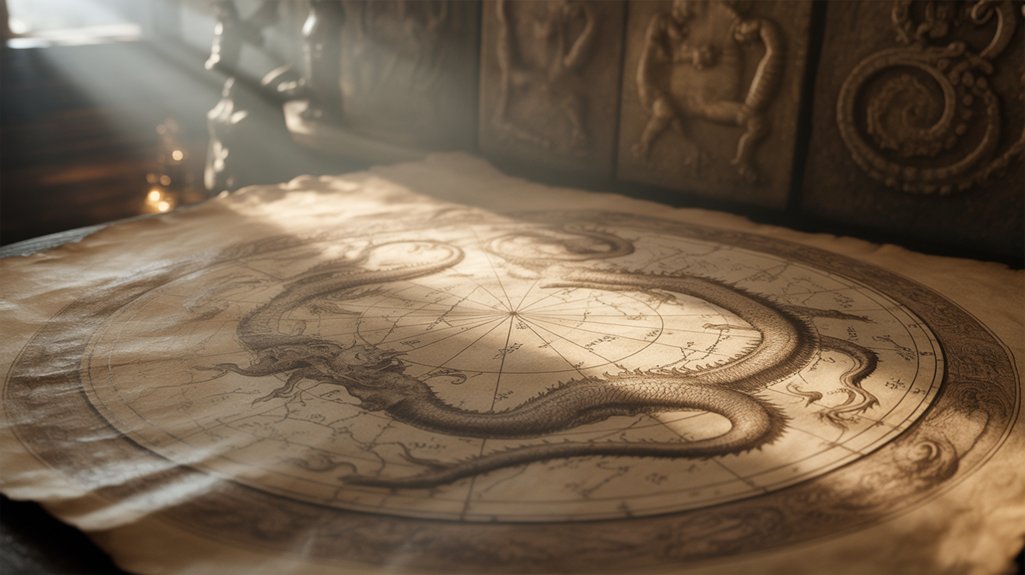
When the first cosmogonies took shape in human consciousness, dragons and serpents emerged as the primordial architects of existence itself—beings whose writhing, eldritch forms embodied the raw, untamed forces that preceded order.
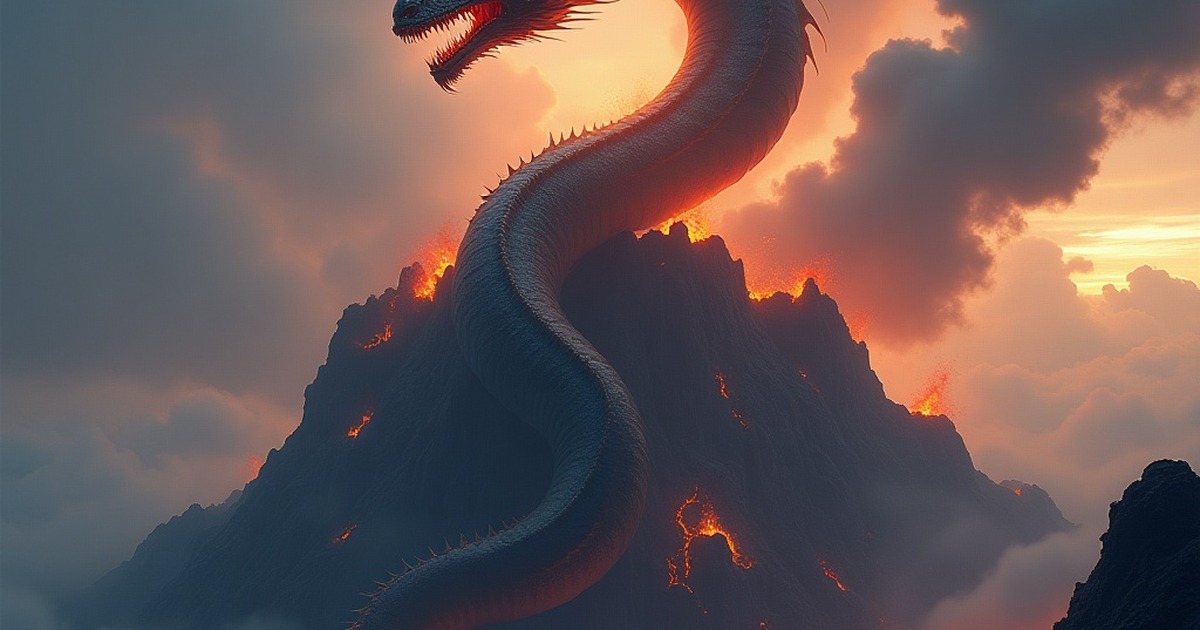
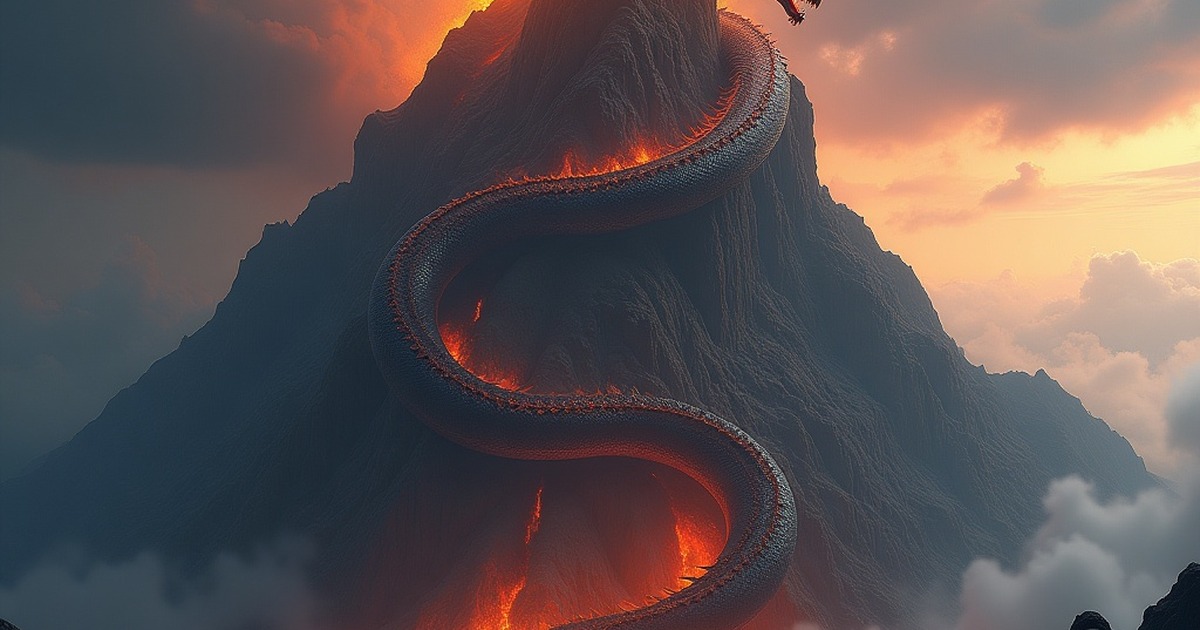
Dragon symbolism permeates creation narratives across civilizations, from Babylon's Tiamat—split asunder by Marduk to forge heaven and earth—to Egypt's Apep, the chaos-serpent eternally opposing Ra's solar authority. These creatures weren't mere monsters. They represented cosmic duality itself.
Serpent mythology reveals this tension: Hindu tradition casts Vasuki as the churning-rope extracting treasures from primordial oceans, simultaneously destructive and generative. Chinese dragons embody fertility and auspicious power rather than malevolence, cosmic forces aligned with creation's inexorable momentum.
Across these traditions, the pattern crystallizes—serpentine beings mark threshold moments where formlessness yields to structure, chaos alters into cosmos, through violence, sacrifice, or metamorphosis. The ancient world understood what modernity often forgets: creation demands confrontation with powers beyond human comprehension. The Greek term “drakōn” originally encompassed any giant serpent, reflecting how ancient peoples perceived these creatures as manifestations of primordial power rather than distinct species.
##
Across primordial cosmogonies, mythical creatures emerge not as mere inhabitants but as cosmic architects, their serpentine coils and chimeric forms actively weaving the fabric of existence itself.
These eldritch beings—from Tiamat's draconic vastness in 18th-century BCE Babylonian tablets to the feathered serpent deities of Mesoamerican steles—inhabit the liminal threshold between chaos and order, their bodies becoming mountains, their blood converting into rivers.
Within this sacred role, creatures serve simultaneously as the raw material of creation and its divine engineers, embodying the paradox that destruction and generation spring from identical primordial sources.
Creatures as Cosmic Architects
Though chaos reigned supreme in the primordial void, mythical creatures emerged as the first architects of cosmic order, wielding powers that transcended mortal comprehension to forge worlds from formless darkness.
Marduk's slaying of Tiamat in Babylon's Enuma Elish exemplifies this altering violence—her dismembered corpse becoming heaven and earth itself. Creation narratives across civilizations reveal similar patterns: Enki organizing Sumerian reality, Pangu separating celestial spheres in Chinese cosmology, Khnum molding humanity upon his potter's wheel beside the Nile.
The Earth Diver, retrieving terrestrial matter from abyssal waters, demonstrates mythical symbolism inherent in cosmic construction.
These eldritch beings didn't merely witness creation. They *were* creation—chimeric forces whose very existence established natural law, altering primeval chaos into structured cosmos through acts of deliberate, sacred craftsmanship.
Serpents and Primordial Waters
While chaos churned in formless voids before creation's dawn, serpents coiled through primordial waters as ancient civilizations‘ most potent symbols of cosmic duality—simultaneously threatening dissolution and promising genesis.
Serpent symbolism pervaded Mesopotamian consciousness: Tiamat's saline depths embodied primordial chaos in the Enuma Elish, her eldritch form demanding destruction before ordered existence could manifest.
Yet duality persisted. Enki, Sumerian architect of freshwater domains, assumed serpentine aspects—nurturing, generative, life-sustaining. This chimeric nature reflected humanity's understanding that creation demanded tension, balance wrested from competing forces.
Serpents weren't mere antagonists; they served as both adversaries and allies to divine powers, their sinuous bodies mapping the threshold between formlessness and structure.
Across cultures, this motif endured: metamorphosis emerging from watery depths, cosmic equilibrium achieved through struggle. These mythical creatures symbolized humanity's biggest fears while simultaneously offering explanations for the cosmic forces that shaped existence itself.
Divine Beasts Shaping Reality
Beyond the serpentine guardians of primordial waters, divine beasts whose very flesh composed reality's architecture stalked through humanity's earliest cosmological visions.
Babylonian Tiamat, embodying chaos itself, surrendered her corpse to Marduk's blade—her ribs became heaven's vault, her tears the Tigris and Euphrates.
The Egyptian Apep, that eldritch devourer of light, faced Ra's eternal opposition, each mythical symbolism representing order's triumph over entropic dissolution.
Greek Titans—chimeric amalgamations of earth and sky—fell before Olympian might, their defeat establishing cosmic hierarchy.
These chaotic forces weren't merely antagonists but necessary ingredients in creation's alchemy.
Jörmungandr encircled Midgard, binding existence within serpentine coils.
The Sumerians understood: Enki and Ninmah shaped humanity from primordial clay, altering raw elemental matter into conscious vessels, forever linking divine architecture with mortal flesh.
Symbolic Guardians of Order
Where chaos threatened to unmake the cosmos, guardian creatures emerged as living bulwarks—sentinels whose mythical forms encoded civilization's deepest anxieties about dissolution and disorder.
Mesopotamian Tiamat embodied primordial entropy itself, her aqueous chaos balance ultimately transfigured through Marduk's cosmic surgery into ordered creation.
Chinese dragons transcended mere protection, their serpentine wisdom guarding threshold spaces between worlds, ensuring harmony's perpetuation.
The Minotaur's eldritch presence within Crete's labyrinth represented chaos contained, its chimeric form a representation of order's fragility—Theseus's blade severing disorder's grotesque manifestation.
Native American traditions positioned mythical guardians as interconnected threads within reality's fabric, the Great Spirit maintaining equilibrium across all existence.
These beings weren't mere monsters. They were architecture itself—consciousness given form to maintain cosmic boundaries against entropy's endless hunger.
Mesopotamian Clay Tablet Documentation
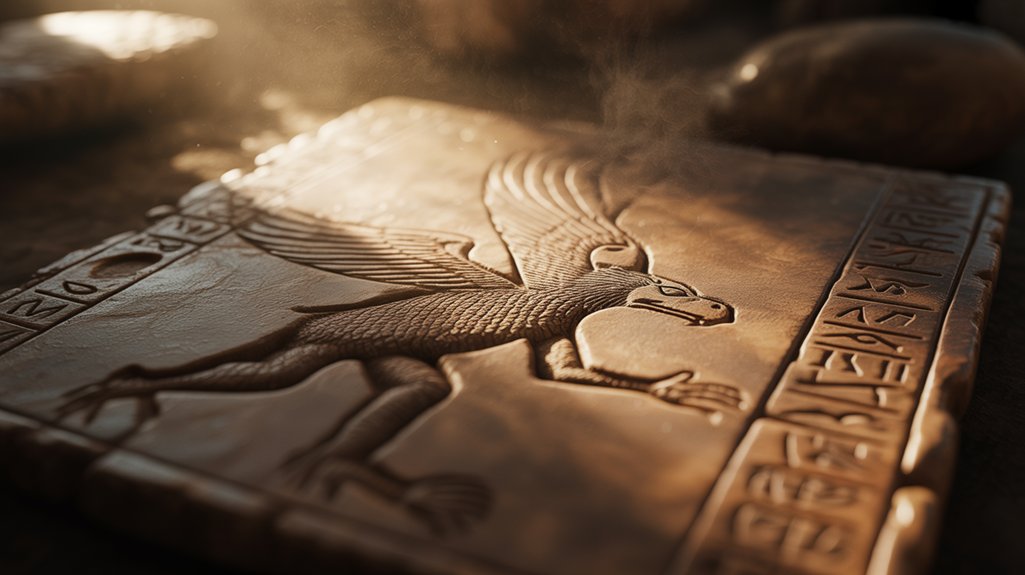
The cuneiform-etched clay tablets of ancient Mesopotamia—weathered repositories of eldritch cosmogonies—preserve accounts of Tiamat, the primordial chaos-dragon whose dismembered corpse became the heavens and earth circa 2000 BCE within Sumerian liturgical traditions.
These fragmentary records culminated in the Babylonian *Enuma Elish*, a seven-tablet epic codifying Marduk's supremacy through ritual recitation during the *Akitu* New Year festival, wherein priests enacted the cosmic battle that established divine order from chimeric dissolution.
The tablets themselves functioned as sacred instruments, their very substance—river clay altered through fire—mirroring the narrative of humanity's creation from the earth's substance, binding religious doctrine to material reality through hieratic script.
Sumerian Tiamat From 2000 BCE
Four millennia separate modern readers from the earliest clay tablets bearing witness to Tiamat's eldritch presence, yet her primordial essence hasn't diminished—it's merely crystallized into cuneiform impressions that scholars continue deciphering from Mesopotamian archives.
This dragon-serpent goddess embodied the saltwater ocean itself, her chimeric form representing primordial chaos before cosmic order emerged. Tiamat's symbolism reaches beyond mere monster narrative—she birthed the pantheon, mothering divinities who'd eventually turn against her ancient sovereignty.
The Enuma Elish recounts Marduk's triumph, his blade splitting her corpse to forge sky and earth from her remains. Here lies creation's violent mathematics: chaos subdued becomes cosmos structured.
Her defeat wasn't annihilation but alteration, primordial chaos transmuted into habitable domain, demonstrating how Mesopotamian cosmology understood existence itself as contested territory wrested from primeval forces.
Ancient Babylonian Enuma Elish Origins
Preserved across seven clay tablets inscribed during Nebuchadnezzar I's twelfth-century BCE reign, the Enuma Elish emerged from Babylon's scriptorium as theological manifesto and cosmological architecture combined. This narrative established Marduk's supremacy through eldritch combat, altering chaos into ordered existence.
| Primordial Element | Cosmic Creation Result |
|---|---|
| Tiamat's bifurcated corpse | Heaven and earth separation |
| Qingu's spilled blood | Humanity's genesis |
| Divine warfare aftermath | Celestial mechanics |
| Marduk's sovereign decree | Universal maintenance |
From watery abyss emerged gods, then conflict. Tiamat, chimeric mother-goddess of salt waters, birthed deities who'd eventually rebel. Marduk, storm-wielding champion, shattered her serpentine form, sculpting cosmos from her remains. Humanity arose from defeated divinity's essence—servants maintaining creation's machinery, liberating gods from toil. Pure power theology.
Ritual Practices and Priesthood Roles
When dawn broke over Babylon's ziggurats, priests commenced rituals that'd convert clay-walled temples into cosmic connections—sacred theaters where Marduk's primordial victory played out anew.
These priestly rituals weren't mere performances but essential maintenance of reality itself, reenacting the eldritch confrontation between Marduk and Tiamat. Through offerings, incense, and chanted invocations, the priesthood wove humanity into the cosmic narrative—binding agricultural cycles to divine will, fertility to celestial favor.
Clay tablets document this intricate choreography. Each ceremony anchored communities to creation's foundational moment, altering mundane existence into mythic participation.
Temples became chimeric spaces where mortal and divine domains intersected, where the world's survival depended upon precise ritual execution. The priesthood interpreted these sacred texts, ensuring cosmic order endured through ceremonial repetition—dawn after dawn, harvest after harvest.
Chinese Dragon Creation Divergence
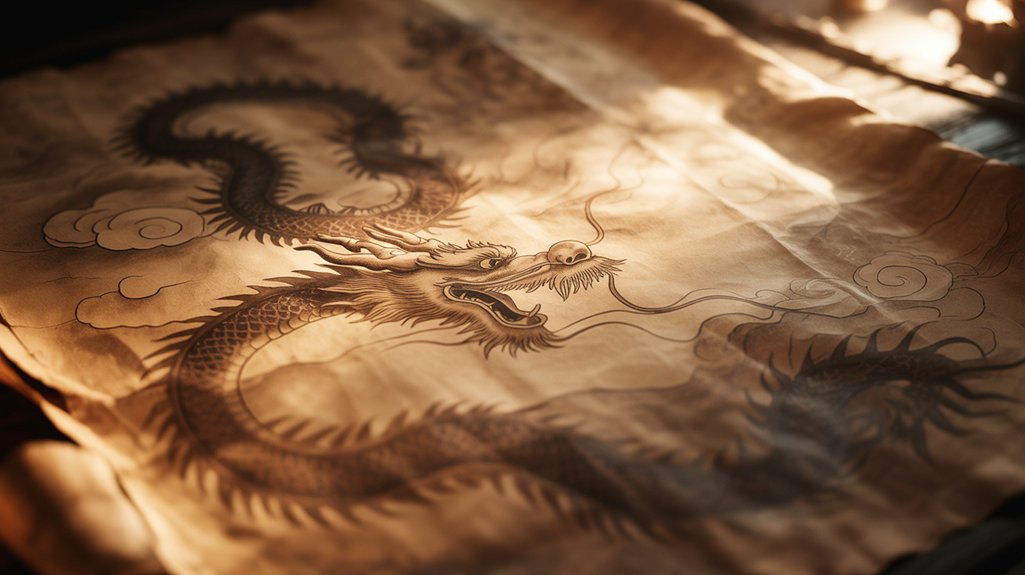
Through the mists of antiquity, the Chinese dragon emerges not as a creature of terror but as a cosmic architect—a being whose serpentine form coils through creation narratives with profound divergence from its Western counterparts. Where European myths cast dragons as chaos incarnate, Chinese dragon symbolism reveals benevolent guardians wielding meteorological sovereignty, commanding rainfall, orchestrating agricultural abundance, and maintaining the celestial order.
The goddess Nüwa, herself possessing draconic attributes, exemplifies this chimeric divinity—molding humanity from yellow clay, later mending fractured heavens with turtle-limb pillars after eldritch catastrophe threatened cosmic dissolution.
| Aspect | Chinese Dragons | Western Dragons |
|---|---|---|
| Nature | Benevolent guardians | Malevolent destroyers |
| Association | Water, fertility, order | Fire, hoarding, chaos |
| Role | Cosmic architects | Antagonistic forces |
| Symbolism | Fortune, strength, protection | Greed, danger, evil |
| Function | Agricultural prosperity | Obstacles to overcome |
Within creation narratives, dragons embody duality itself—simultaneously representing primordial chaos and the ordering principles that shape existence.
Chaos Versus Order Archetypes
The draconic duality observed in Chinese cosmology represents merely one manifestation of creation mythology's most fundamental architecture—the eternal oscillation between chaos and order, where primordial monsters serve as both antagonists and necessary preconditions for structured existence.
Tiamat's eldritch form embodied Babylonian chaos embodiment before Marduk's triumph circa 1800 BCE established cosmic sovereignty. The Titans' chimeric rebellion against Olympian authority demonstrated how order restoration demands perpetual vigilance.
These archetypal confrontations reveal liberation's paradox:
- Chaos births possibility—formless potential preceding oppressive structure
- Monsters challenge stagnation—serpentine Yam threatening Baal's complacency
- Order enables agency—predictable cosmos permitting meaningful choice
- Balance transcends tyranny—neither absolute disorder nor suffocating control
Ancient mythographers understood that freedom emerges not from chaos's triumph nor order's totality, but from their dialectical tension.
Dragons and sea-serpents weren't merely obstacles requiring elimination; they represented necessary counterforces ensuring cosmic dynamism. Maintaining equilibrium between these polarities remains humanity's eternal challenge.
Greek Hydra and Typhon Battles
Within the primordial struggle between cosmos and chaos, the Hydra embodied an eldritch regenerative force that defied mortal logic—each severed head spawning two more in a serpentine multiplication of disorder.
Typhon, that chimeric storm-father whose hundred dragon heads once scraped the stars themselves, mounted a catastrophic assault upon Olympus that threatened to unmake Zeus's carefully ordered pantheon and return creation to its original, roiling darkness.
These titanic confrontations demanded heroes willing to anchor divine order through strategic cunning and unwavering resolve, altering supernatural threats into opportunities for cosmic restoration.
Hydra's Regenerative Chaos Power
When ancient Greek poets sought to articulate the primal terrors that preceded cosmic order, they conjured the Lernaean Hydra—a creature whose very essence defied mortality's logic. Each severed head spawned two more, an eldritch multiplication that changed violence into futility.
This regenerative symbolism embodied chaos itself—self-perpetuating, ever-multiplying, unstoppable through conventional means. Heracles confronted this chimeric horror during his second labor, discovering that mere strength couldn't suffice.
The hero adapted. Fire cauterized each wound, preventing regeneration's dark miracle. Through this innovation, he demonstrated that overcoming chaos demands alteration of tactics, not simply escalation of force.
The Hydra's defeat represented humanity's capacity to evolve beyond brute confrontation, to meet impossible challenges with creative sovereignty—a tribute to those who refuse submission before insurmountable odds.
Typhon's Challenge to Olympus
Before Zeus could establish his celestial sovereignty, Gaia—primordial Earth herself—birthed one final champion to shatter Olympian order.
Typhon erupted from Tartarus's depths, a chimeric horror bearing one hundred dragon heads that belched eldritch flames across the heavens. This wasn't mere rebellion. This was existential warfare between cosmic structure and primordial chaos, between the fledgling pantheon's vision and the ancient world's untamed fury.
Zeus met this challenge with thunderbolts forged in Cyclopes‘ workshops, his lightning carving through serpentine necks until Typhon collapsed beneath Etna's volcanic weight.
Yet Typhon's legacy persists—Mount Etna still trembles with his imprisoned rage, reminding mortals that chaos merely sleeps beneath civilization's fragile crust.
Olympian resilience triumphed, but the victory demanded everything, establishing divine authority through fire and struggle.
Heroes Restoring Cosmic Order
Though Zeus's thunderbolts subdued Typhon beneath volcanic stone, the ancient world's chaos couldn't be vanquished by divine decree alone—it required mortal champions willing to wade into primordial darkness and emerge victorious.
Heracles embodied this necessity when confronting the Hydra's regenerating heads, that chimeric serpent whose eldritch nature defied simple conquest. These heroic narratives transcended mere adventure tales, functioning as mythic symbolism for humanity's eternal struggle against disorder.
The collaboration between Heracles and Iolaus—cauterizing each severed neck before new heads sprouted—revealed ancient wisdom: cosmic balance demands both courage and strategic cunning.
Through such battles, mortal heroes became essential instruments in maintaining universal order, bridging the gap between divine authority and earthly chaos, their victories eternally preserving civilization's fragile boundary against primordial forces.
Contemporary Fantasy Literature Adaptations
Modern fantasy literature breathes new life into the primordial forms that once populated humanity's earliest cosmogonies, altering ancient dragons, phoenixes, and chimeric beasts into vessels for contemporary meaning.
Authors like Tolkien and Rowling have mastered mythical symbolism, reshaping elves and phoenixes into living embodiments of narrative evolution—creatures that simultaneously honor their ancestral origins while speaking to modern struggles for autonomy and self-determination.
This literary resurrection manifests through deliberate patterns:
- Dragons evolve from chaos-bringers to complex guardians of knowledge, challenging rigid hierarchies
- Griffins and chimeric beings represent hybrid identities, celebrating multiplicity over conformity
- The Minotaur transforms from monster to misunderstood outcast, questioning societal judgments
- Eldritch entities bridge ancient wisdom with contemporary alienation, illuminating paths toward liberation
Works like Gaiman's “American Gods” demonstrate how these primordial archetypes continue shaping cultural consciousness, their evolution reflecting humanity's eternal quest to transcend imposed limitations while maintaining sacred connections to cosmological origins.
Jungian Archetype Analysis Framework
When Carl Jung first articulated his theory of the collective unconscious in 1916, he provided scholars with an alchemical key to reveal the psychological architecture underlying mythical creatures across disparate cultures.
These eldritch beings—dragons guarding forbidden wisdom, chimeric guardians at temple thresholds, primordial serpents coiling through cosmic balance—function as archetypal symbolism emerging from humanity's shared psychic substrate.
The Hero's evolving journeys through mythic narratives mirror individual psychological development, confronting shadow integration through monstrous adversaries.
Mythic monsters externalize our inner darkness—the hero's battle mirrors the psyche's confrontation with its own shadow self.
Ancient Mesopotamian Tiamat, the chaos-dragon slain in Enuma Elish (circa 1800 BCE), embodies primal forces requiring conscious mastery. Shadow integration.
Anima expression manifests through creatures like Greek sirens or Hindu apsaras, representing feminine mystery and creative power within cultural reflections of gender interactions.
These archetypal beings transcend mere folklore, operating as psychological technologies—mapping internal landscapes, catalyzing change, bridging conscious understanding with unconscious depths.
The collective unconscious speaks through scales, wings, claws. Ancient wisdom encoded in mythic DNA.
Modern Environmental Movement Symbolism
Beyond the psychological dimensions Jung illuminated, these archaic creatures now resurrect themselves within contemporary consciousness as ecological emissaries—the dragon's territorial guardianship reimagined through biodiversity hotspots, the phoenix's cyclical rebirth echoing regenerative agriculture, serpent wisdom coiling through watershed protection campaigns.
The White Buffalo Calf Woman's sacred covenant evolves into species preservation mandates. The Great Spirit's stewardship principles materialize in rewilding initiatives across fragmented landscapes.
Mythical symbolism anchors environmental movements precisely because these eldritch forms never represented mere fantasy—they encoded survival knowledge, carrying warnings about ecological transgression through generations.
Dragons hoarding treasure become metaphors for resource extraction's chimeric promises. The thunderbird's storm-bringing sovereignty mirrors climate disruption narratives.
Contemporary environmental stewardship increasingly borrows this ancient lexicon, recognizing that statistical data alone fails to catalyze evolution.
These creatures speak to something deeper, primordial. They remind fragmented modernity that humanity remains woven into nature's fabric, not separate from it. Their enduring power lies in making the invisible visible, rendering abstract planetary crisis into visceral, mythic urgency.
Lessons for Cultural Preservation
As cultural memory fractures under globalization's homogenizing pressures, these primordial beings—griffins guarding thresholds, world-turtles bearing cosmic weight, trickster-ravens reshaping reality—stand as irreplaceable vessels of ancestral knowledge systems that can't survive translation into bureaucratic preservation frameworks.
Their eldritch wisdom demands organic transmission through storytelling heritage, not sterile documentation. Cultural continuity thrives when communities actively embody these chimeric forms rather than merely archive them.
The Mesopotamian Tiamat, dismembered to birth worlds, teaches creation through destruction—a paradox spreadsheets can't capture. Australian Aboriginal Rainbow Serpents, carved into rock faces across millennia, embed ecological knowledge within sacred narrative, refusing separation of myth from land.
True preservation means letting these creatures breathe through living practice: oral transmission circles, ceremonial reenactments, artistic reinterpretation by descendant communities.
Museums display lifeless artifacts. But when grandmothers whisper dragon-birth stories under star-scattered skies, sovereignty survives. Cultural autonomy flourishes.
Frequently Asked Questions
How Do African Creation Myths Incorporate Mythical Creatures Differently Than Asian Traditions?
African symbolism manifests through creatures embodying primordial forces—serpents coiling through cosmic waters, chimeric beasts birthing entire tribes from their essence.
These beings act directly, altering themselves into landscape and lineage.
Asian allegories, conversely, employ dragons and phoenixes as celestial mediators, philosophical emblems bridging heaven and earth through structured hierarchies.
While African traditions celebrate immediate, visceral creation through flesh-become-world alterations, Asian cosmologies position mythical entities as eldritch intermediaries, teaching humanity divine principles through their ordered, symbolic presence.
What Role Do Phoenix-Like Birds Play in Ancient Middle Eastern Creation Stories?
Phoenix-like birds embody primordial rebirth themes across ancient Mesopotamian and Persian cosmologies, their fire associations illuminating evolution stories of cyclical renewal.
The Bennu bird—Egypt's sacred herald—transcended mere phoenix symbolism, representing Ra's generative essence.
These eldritch creatures didn't create worlds but sustained them, their immortality beliefs reflecting humanity's yearning for transcendence beyond temporal constraints.
Their cultural significance remains profound: fierce guardians of eternal return, burning through death's veil. They offer liberation through perpetual metamorphosis.
Are There Common Mythical Creatures Shared Across Native American Creation Narratives?
Like cosmic architects coding reality's operating system, trickster figures—especially Coyote and Raven—emerge across disparate Native American traditions as primordial agents of change.
These chimeric beings don't merely populate myths; they embody creation symbolism itself, shaping mountains, liberating fire, and introducing mortality.
From Crow nation narratives to Tlingit cosmologies, these eldritch entities transcend tribal boundaries, manifesting freedom's paradox: creation through disruption.
They're neither heroes nor villains. Pure chaos given form.
How Did Ancient Egyptian Creation Myths Use Animal-Human Hybrid Deities?
Ancient Egyptian cosmogony employed chimeric deities as primordial architects—Thoth, the ibis-headed scribe, shaped cosmic order through hieroglyphic utterance.
Anubis, jackal-crowned psychopomp, emerged from predynastic darkness to guide souls through liminal domains.
Animal symbolism wasn't mere decoration but essence itself; hybrid mythology embodied ma'at's sacred balance, each creature-form channeling specific divine energies.
These eldritch beings transcended human limitation, their bestial aspects granting access to mysteries the purely anthropomorphic couldn't contain.
Power flows through alteration.
What Similarities Exist Between Norse and Celtic Mythical Creatures in Creation Tales?
Both traditions venerate primordial chaos-beings who precede cosmic order—remarkably, over 80% of Indo-European creation myths feature giant antagonists.
Norse giants embodied raw, untamed elemental forces before the gods' reign, while Celtic fae represented liminal powers dwelling between worlds.
Norse dragons guarded ancient wisdom in subterranean domains; similarly, Celtic heroes confronted serpentine guardians protecting otherworldly knowledge.
These eldritch creatures weren't merely obstacles but necessary forces—embodiments of wild, untethered existence that freedom-seeking peoples understood must be respected, never fully conquered.
Conclusion
These chimeric beings—wyrms coiled round cosmic eggs, leviathans wrestling primordial chaos—remain humanity's oldest mirrors. They're archaeology of the psyche, encoded in clay and myth. Contemporary scholars excavate their eldritch wisdom not as antiquarian curiosity but as essential gnosis, for these creatures guard threshold knowledge between wilderness and civilization. Their serpentine forms still writhe through our collective unconscious, reminding us: creation demands destruction, order births from chaos, and we're forever shaped by monsters we've conjured.