Many mythical creatures encode tangible encounters with fossilized remains and extinct megafauna. Ceratopsian skulls inspired griffin legends across ancient trade routes, while Diprotodon bones shaped Aboriginal bunyip narratives in Australia's interior. The pouākai wasn't mere folklore—Haast's eagle once terrorized New Zealand with its three-meter wingspan. Dragon myths frequently emerged where mammoth vertebrae and crocodilian remains punctuated medieval soil, altering biological memories into chimeric visions. Even twentieth-century discoveries like the mountain gorilla validate indigenous testimony, suggesting cryptozoological archives preserve fragments of zoological truth awaiting scientific scrutiny.
Key Takeaways
- Some mythical creatures like Haast's eagle (pouākai) and giant squids were real animals later confirmed by science.
- Fossil discoveries, including Protoceratops and Diprotodon bones, likely inspired griffin and bunyip legends across ancient cultures.
- Misidentified living animals such as manatees, oarfish, and crocodiles contributed to mermaid and sea serpent myths.
- DNA analysis and modern technology have debunked creatures like yeti, revealing bear origins instead of unknown species.
- Most mythical beasts represent cultural interpretations of fossils, real animals, or natural phenomena rather than actual creatures.
Dragons, Mermaids, and Bigfoot Debates
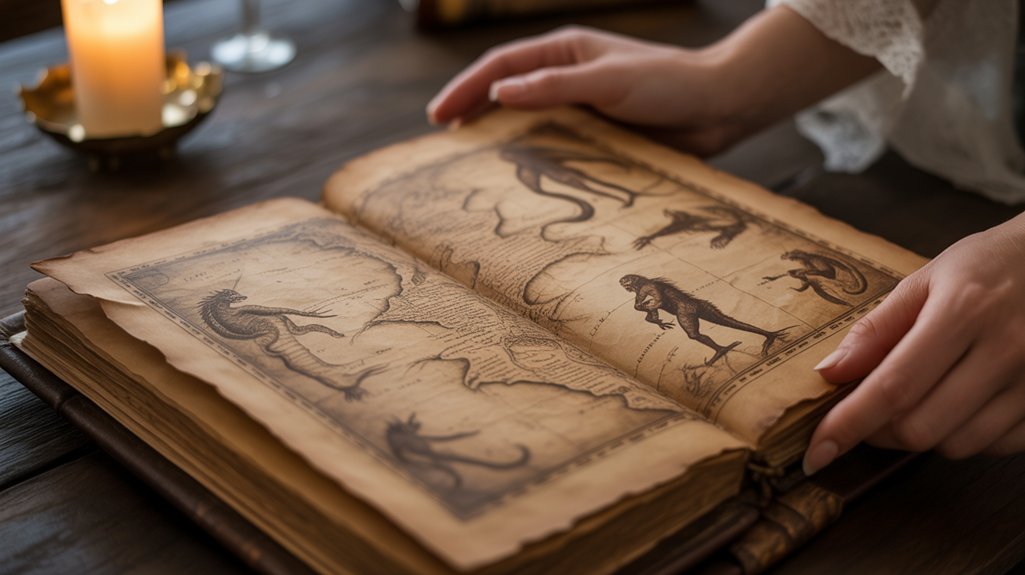
Although civilizations across the globe have never collaborated on their mythologies, they've independently conjured remarkably similar beasts from the depths of collective imagination—dragons that coil through Chinese imperial courts and European medieval tapestries, mermaids whose songs echo in Greek amphitheaters and Caribbean oral traditions, and towering humanoid figures that stride through Indigenous American narratives and Himalayan folklore.
These mythical origins demand scrutiny beyond dismissive skepticism. Dragons' serpentine forms may encode ancestral memories of unearthed dinosaur bones, their eldritch presence reflecting attempts to rationalize prehistoric remains through cultural interpretations.
Dragon myths may preserve ancestral memories of dinosaur fossils, transforming prehistoric discoveries into serpentine legends through cultural interpretation.
Maritime societies constructed mermaid legends from fleeting encounters with manatees and dugongs, creatures whose mammalian qualities generated chimeric visions in exhausted sailors.
Sasquatch's 1967 Gimlin-Patterson footage crystallizes modern cryptozoological debates, though scientific verification remains absent. The scientific community requires tangible evidence—bones, DNA, verifiable specimens—yet these narratives persist, suggesting humanity's enduring need to populate shadows with beings that transcend mundane reality. The Myth and Folklore Wiki serves as a community-driven platform where enthusiasts collaboratively document these cross-cultural legends and share knowledge about cryptid sightings across diverse mythologies.
##
The boundary separating chimeric fabrication from zoological reality grows remarkably thin when ancient accounts undergo rigorous scientific scrutiny, revealing how fossilized remains and encounters with cryptic megafauna seeded humanity's collective imagination with eldritch forms.
Historical chronicles, from Herodotus to indigenous oral traditions, document encounters that modern paleontology now recognizes as misidentified species—the Māori pouākai emerging from Haast's eagle predation, Aboriginal bunyip tales echoing Diprotodon sightings, griffin legends potentially sparked by Protoceratops excavations in Central Asian goldfields.
These convergences between myth and materiality suggest that many so-called fabrications represent humanity's attempts to categorize, through cultural frameworks and limited taxonomic knowledge, creatures that genuinely stalked the earth alongside our ancestors.
The Science of Mythical Creatures: Could Any Have Existed?
When ancient peoples unearthed massive bones protruding from eroded cliffsides and desert sands, they couldn't have known they'd stumbled upon creatures that predated human existence by millions of years—yet their attempts to reconstruct these beasts from fragmentary remains birthed some of humanity's most enduring myths.
The griffin's chimeric form mirrors Protoceratops fossils, those beaked quadrupeds whose skeletal architecture suggested avian characteristics merged with leonine power. Aboriginal traditions speak of the bunyip, its mythical origins perhaps rooted in encounters with Diprotodon, a marsupial colossus that walked alongside humanity's ancestors.
The pouākai embodied genuine terror—Haast's eagle, three-meter wingspan unfurled, diving upon moa. Sea serpents weren't mere fantasy; oarfish undulating through abyssal currents created eldritch silhouettes.
Even Yeti tracks possess mundane explanations: bear prints, elongated through melting snow, converted into evidence of the impossible.
Historical Sightings and Evidence
Cryptozoological archives overflow with testimonies—mariners' logbooks, monastical chronicles, indigenous oral histories committed to colonial parchment—each document preserving encounters that defied rational categorization.
Sixteenth-century Scandinavian texts catalogued the eldritch Soe Orm with startling specificity. Aboriginal accounts of the bunyip—chimeric, protean—may encode memories of Diprotodon megafauna.
Māori traditions preserved the pouākai's terror: evidence analysis confirms Haast's eagle soared with three-meter wingspans, capable of striking human prey. British expeditions returned from Himalayan vastness bearing yeti relics. DNA testing revealed mundane origins—bear follicles, nothing more.
The griffin persists across millennia; scholars initially connected leonine-aquiline descriptions to Protoceratops remains, though geographic correlation studies now challenge such tidy explanations.
Historical sightings dissolve into ambiguity. Truth fragments. Memory distorts. Yet something witnessed left indelible marks. Some cryptids transitioned to scientific legitimacy through verification processes that transformed folklore into zoological fact.
Ancient Texts Document Encounters
Across millennia, scribes committed extraordinary visions to papyrus, vellum, clay—preserving encounters that straddled reality's threshold.
The 1555 chronicle of the Soe Orm materialized through meticulous illustration and testimony, binding serpentine terror to historical record. Greek texts positioned griffins as eldritch sentinels guarding auriferous deposits, their chimeric forms perhaps inspired by protoceratops skeletons weathering from fossil-rich Scythian wastes.
Māori oral traditions crystallized the pouākai's violence—giant raptors seizing human prey—echoing authentic predation by Haast's eagle before its extinction.
Aboriginal Dreamtime narratives wove the bunyip's protean essence through countless tellings, possibly sparked by Diprotodon remains emerging from dried billabongs.
These mythical encounters weren't mere fantasy. They represented genuine attempts at comprehending the uncanny, where folklore origins intersected with paleontological evidence, cultural memory preserving fragments of vanished megafauna.
Fossil Misidentification Through History
Before scientific methodology illuminated the deep past, fossilized bones emerged from eroding cliffs and excavated earth as enigmatic fragments demanding interpretation through available cultural frameworks.
Fossil misidentification altered ancient remains into chimeric beasts—ceratopsian skulls birthed griffin legends across Central Asian steppes, while Diprotodon bones whispered the bunyip's existence into Aboriginal dreamtime narratives.
Marine vertebrae, elongated and eldritch, became serpentine leviathans haunting collective memory. Dragon myths across disparate civilizations likely stemmed from dinosaurian discoveries, cultures weaving paleontological truth into mythic tapestry without comprehending temporal gulfs separating human witness from Mesozoic extinction.
These misreadings weren't failures of imagination but necessary bridges spanning epistemological voids, ancient peoples constructing meaning from inexplicable ossified evidence.
The boundaries between prehistory and mythology dissolved where knowledge ended, fossil misidentification becoming humanity's first paleontology—imperfect, reverent, profoundly human.
Ancient Mesopotamian Monster Descriptions
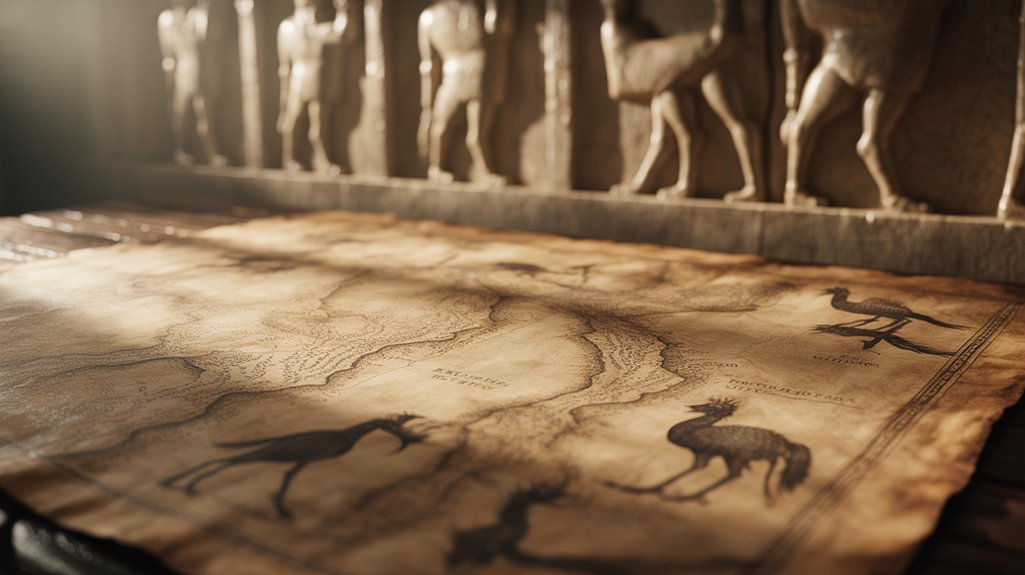
Upon the ancient clay tablets of Sumer, etched in cuneiform script circa 3000 BCE, emerged humanity's earliest recorded accounts of chimeric beings—guardians, demons, and eldritch manifestations born from the fertile consciousness of civilizations dwelling along the Tigris-Euphrates River Valley.
These monster descriptions weren't mere flights of fancy but theological architecture, integral components of Mesopotamian religious belief systems that positioned such creatures as intermediaries between divine domains and mortal existence.
The Lamassu stood sentinel at palace gates, the Apkallu rose from primordial waters bearing forbidden wisdom, and Humbaba's roar echoed through cedar groves—each entity serving specific cosmological functions within a worldview where the numinous permeated every aspect of existence.
Sumerian Clay Tablet Recordings
While modern scholars sift through fragments of cuneiform pressed into sun-baked earth, they're confronting humanity's earliest systematic cataloging of the monstrous—a bestiary carved not in margins of medieval manuscripts but into clay tablets that predate written law itself.
Dating to 3000 BCE, these Sumerian records immortalized creatures like Anzu, that chimeric lion-headed eagle embodying primordial chaos. The Gallu prowled through their mythical symbolism as underworld demons, snatching victims from life's threshold.
Most profound was Tiamat, the saltwater chaos-mother whose eldritch form represented the cosmos before order's triumph. These weren't mere fantasies. They were sophisticated attempts to render comprehensible the incomprehensible—natural forces, psychological terrors, cosmic mysteries—through Sumerian mythology's rich vocabulary of the monstrous, the sublime, the utterly Other.
Tigris-Euphrates River Valley Locations
The geography itself shaped the monsters. Ancient Mesopotamia's river civilizations birthed creatures reflecting their environment's duality—life-giving waters harboring primordial terrors. The Tigris-Euphrates convergence became sacred ground where eldritch beings materialized from collective consciousness.
| Creature | Physical Form | Symbolic Role | Geographic Origin | Cultural Function |
|---|---|---|---|---|
| Lamassu | Lion-eagle-human chimeric guardian | Protection of cities | Palace gates, Assyrian heartland | Threshold defender |
| Apkallu | Fish-human hybrid sages | Wisdom transmission | Primordial Apsu waters | Divine intermediary |
| Tiamat | Serpentine chaos monster | Primordial ocean | Salt-water domain | Cosmic opponent |
| Humbaba | Forest demon-guardian | Wilderness protection | Cedar Mountain ranges | Nature's sentinel |
| Anzu | Lion-headed storm bird | Celestial power | Mountain peaks | Divine challenger |
Ancient geography dictated mythic architecture. River valleys demanded explanations for floods, droughts, abundance—monsters embodied these forces, making chaos comprehensible.
Mesopotamian Religious Belief Systems
Because divine authority permeated every stratum of Mesopotamian existence, monsters weren't mere folkloric embellishments—they constituted theological architecture itself.
The Lamassu—chimeric fusion of leonine strength and human wisdom—stood sentinel at palace gates, embodying divine protection through their hybrid forms.
Tiamat, the eldritch dragon-serpent of primordial chaos, represented cosmic forces requiring subjugation; her defeat by Marduk literally fashioned reality from disorder.
The Epic of Gilgamesh immortalized Humbaba, whose terrifying countenance guarded sacred cedar groves, while the Apkallu—half-fish sages—delivered forbidden knowledge from aquatic depths.
Mythical symbolism reached its apex in creatures like Anzu, the destiny-stealing bird, and the Galla demons, who personified humanity's existential dread.
Each monster encoded profound theological truths: chaos lurking beneath order's fragile surface. Freedom demanded understanding these forces.
European vs. Asian Dragon Myths
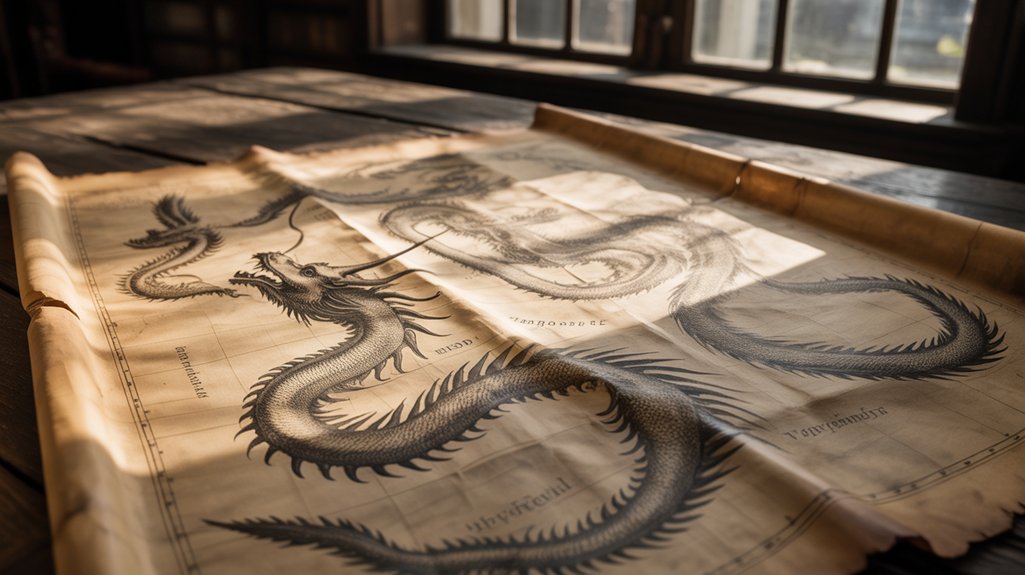
Across vast continents and millennia, two distinct draconic archetypes emerged from humanity's collective imagination, each bearing the indelible mark of its birthplace's fears, aspirations, and environmental realities. European wyrms embodied eldritch chaos—winged, fire-breathing harbingers of destruction whose chimeric forms may trace to fossilized leviathans unearthed by medieval communities. The cultural significance of these beasts positioned them as adversaries to be vanquished, symbols of primordial disorder threatening civilization's fragile order.
| Characteristic | European Dragons | Asian Dragons |
|---|---|---|
| Physical Form | Winged, fire-breathing reptiles | Serpentine, water-associated |
| Dragon Symbolism | Chaos, malevolence, evil | Wisdom, protection, power |
| Possible Origins | Dinosaur fossil discoveries | Monitor lizards, Komodo dragons |
Asian dragons emerged from entirely different cosmological frameworks—benevolent serpents governing rainfall, agricultural abundance, imperial authority. Their sinuous bodies, inspired by monitor lizards and other tangible creatures, represented not chaos but cosmic harmony. Both traditions evolved across centuries, reflecting environmental contexts and societal values that shaped these enduring mythological constructs.
Dragons Representing Natural Disasters
When catastrophe descended upon ancient settlements—floods swallowing entire villages, lightning fracturing the heavens, volcanic fissures spewing molten earth—humanity's instinct wasn't merely to observe but to anthropomorphize, to render incomprehensible destruction into tangible form.
Dragon imagery emerged as civilization's primordial answer to elemental chaos.
Dragons transformed incomprehensible natural catastrophes into mythological frameworks that granted ancient civilizations interpretive power over elemental forces beyond their control.
These chimeric beings embodied nature's most terrifying manifestations:
- Chinese dragons commanded torrential monsoons, their serpentine forms representing water's dual capacity for sustenance and devastation, exercising elemental control over agricultural prosperity or famine.
- European wyrms breathed volcanic fury, their fire correlating directly with lava flows and ash clouds that buried settlements beneath pyroclastic nightmares.
- Storm-dragons conjured hurricanes, their wings generating tempests that obliterated coastlines before meteorological science demystified atmospheric pressure systems.
This mythological framework granted traumatized populations cognitive sovereignty over eldritch forces.
Dragons weren't mere fiction—they were interpretive vessels reshaping chaotic destruction into narratives humans could comprehend, fear, and ultimately petition through ritual.
St. George Slaying the Dragon
The legend of St. George subduing the eldritch wyrm transcends singular cultural origins, manifesting across disparate civilizations as dragon-slaying heroes emerged from Germanic sagas, Mediterranean hagiographies, and Near Eastern chronicles.
Scholars have traced these chimeric adversaries to humanity's encounters with monstrous fossils—the bleached bones of prehistoric leviathans unearthed by medieval plowshares, misinterpreted through the lens of religious cosmology.
Historical accounts, sparse yet compelling, suggest that St. George's martyrdom in 303 CE became interwoven with older dragon myths, altering a Roman soldier's death into sacred narrative where serpentine evil yielded to Christian valor.
Dragon Legends Across Cultures
Dragons—those serpentine harbingers of primordial chaos—have coiled themselves around humanity's collective imagination since time immemorial, manifesting in myriad forms across the world's mythological landscapes.
The cultural significance of these chimeric beasts reveals itself through stark contrasts: European traditions portrayed them as eldritch antagonists breathing flame and destruction, while Chinese cosmology raised them to celestial guardians embodying imperial power and auspicious fortune.
Dragon symbolism consistently represents humanity's confrontation with chaos itself, their defeat by heroes like St. George restoring cosmic order.
Medieval artisans, inspired by travelers' encounters with crocodiles and serpents, rendered these creatures with fearsome majesty.
Though no empirical evidence confirms their existence, prehistoric fossil discoveries may have seeded these enduring myths, changing ancient bones into legendary terrors.
Dinosaur Fossils as Inspiration
Beneath medieval soil, scattered across hillsides and quarries where monks labored and shepherds wandered, lay the petrified remains of creatures whose very existence defied comprehension—massive vertebrae, serrated teeth longer than daggers, clawed appendages that spoke of primordial violence.
These fossil interpretations birthed the legend of St. George's dragon. Without paleontological frameworks, medieval minds encountered Tyrannosaurus rex bones and crafted chimeric beasts from evidence. Dinosaur myths emerged organically where skeletal discoveries occurred, altering scientific reality into moral allegory.
The dragon's eldritch presence symbolized chaos incarnate—a corruption demanding righteous destruction. Regional folklore consistently manifested monstrous narratives alongside fossil beds, suggesting causation rather than coincidence.
Ancient cultures possessed no vocabulary for extinction, only for evil. Hence prehistoric predators became theological adversaries, their fossilized terror reanimated through saintly combat narratives.
Historical Accounts and Evidence
From geological evidence emerged literary canonization—the fossilized dread altered into hagiographic narrative.
The fourth-century legend of St. George wielding sword against serpentine chaos represents historical interpretations rooted in tangible encounters with crocodiles, pythons—creatures that prowled Mediterranean marshlands and Middle Eastern river valleys.
These chimeric beasts, magnified through oral tradition, became eldritch symbols of paganism's final throes.
Medieval artisans rendered the dragon with bat-wings and flame, reshaping biological memory into theological allegory.
The cultural significance resonated across centuries, elevating George to England's patron saint, his triumph painted on countless altarpieces and carved into cathedral stones.
Here stood testimony: ancient peoples witnessed genuine reptilian terrors, then wove those visceral memories into sacred mythology.
The boundary between natural history and divine intervention blurred, irretrievably.
Game of Thrones Dragon Symbolism
When Daenerys Targaryen's three dragons emerge from funeral flames in George R.R. Martin's epic saga, they herald nothing less than the return of eldritch forces long dormant in Westeros. These chimeric beings transcend mere weaponry, embodying the ancient dialectic between creation and annihilation.
The dragons' symbolic resonance operates across multiple dimensions:
- Dragon power manifests as political currency, reshaping the contest for the Iron Throne through their capacity for unprecedented destruction.
- Emotional bonds between Daenerys and her creatures demonstrate intelligence and loyalty that raise dragons beyond simple beasts into sentient partners.
- Medieval iconography informs their visual design, connecting contemporary fantasy to centuries of cultural mythology and artistic tradition.
Their presence interrogates fundamental questions about authority's nature. Raw power demands moral reckoning.
The series channels historical anxieties surrounding mythical creatures, weaving real-world legendary traditions into narrative fabric that explores humanity's perpetual fascination with beings existing beyond natural law's boundaries.
Cryptozoology's Role in Folklore Studies
At the intersection of empirical inquiry and folkloric tradition, cryptozoology occupies a contested methodological space—one that scholars dismiss as pseudoscience even as it illuminates humanity's enduring compulsion to materialize the mythical.
Through anecdotal evidence and unverified sightings, practitioners trace eldritch connections between indigenous legends and tangible fauna, disclosing how cultural interpretations preserve ancestral encounters with megafauna. The pouākai myth's correspondence with the extinct Haast's eagle exemplifies this chimeric methodology—Māori oral tradition encoding genuine predatory encounters across generations.
Expeditions seeking Mokele-mbembe in Congo's swamps haven't validated the creature's existence, yet they've disclosed previously unknown species. This paradox defines cryptozoology's fractured legitimacy.
The field exposes psychological substrata underlying myth-making: misidentified animals, discovered fossils, sociocultural anxieties given form. Whether investigating Bigfoot or Loch Ness denizens, cryptozoologists function as inadvertent folklorists, documenting humanity's perpetual negotiation between empirical reality and numinous possibility—cartographers of liminal territories where legend bleeds into zoological fact.
Modern Species Discovery Efforts
Though skeptics relegate cryptozoological pursuits to fringe pseudoscience, the twentieth century's empirical record undermines such categorical dismissal—the mountain gorilla emerged from colonial myth into zoological taxonomy in 1902, validating indigenous accounts that Western naturalists had scorned as savage fabrication.
Species classification continues evolving through technological augmentation: motion-sensitive cameras now document eldritch phenomena in unmapped territories, while genetic analysis penetrates chimeric mysteries once confined to folklore's domain. The giant squid, pursued through centuries of maritime legend, materialized before cameras in 2012's abyssal darkness. Discovery techniques have altered fundamentally.
Remote expeditions persist—Loch Ness still draws cryptozoologists wielding sonar arrays and spectral imaging. The International Cryptozoology Museum archives these ventures, honoring the space between dismissal and proof.
Uncharted oceans, primordial forests—areas where science hasn't yet imposed its nomenclature—harbor possibilities that orthodox taxonomy can't foreclose. Ancient wisdom whispers through such places, suggesting extinction's proclamations may prove premature. Freedom demands we investigate rather than assume.
Separating Myth From Reality
The pursuit's enthusiasm can't eclipse methodology's demands—between legend's persistence and zoological validation lies a necessary crucible where folklore surrenders its metaphorical flesh to empirical examination.
Mythical origins trace definitively to tangible creatures: Diprotodon and Haast's eagle walked alongside humanity's ancestors, their imposing forms encoded into bunyip and pouākai narratives. Cultural adaptations altered Protoceratops fossils into griffin iconography, though recent scholarship contests this chimeric genealogy. Oarfish undulations spawned sea serpent testimony. Basking sharks, decomposing eerily, became eldritch leviathans.
The Yeti's dissolution proves instructive—DNA analysis strips supernatural vestments from Himalayan bears, reducing sacred mystery to misidentification. Cryptozoology falters here, its anecdotal foundations crumbling beneath scrutiny's weight.
Fossil evidence illuminates ancient encounters. Living species explain maritime phenomena. Yet validation requires rigorous protocols, peer review, reproducible findings.
Truth liberates rather than diminishes. Understanding alters fear into knowledge, superstition into appreciation. These creatures existed—just not as imagined.
Frequently Asked Questions
Could Giant Sea Creatures Have Inspired Kraken Legends?
Giant squids certainly seeded ocean myths across maritime cultures, their eldritch forms surfacing in Nordic waters and Mediterranean depths alike.
These cephalopods, reaching sixty feet in documented specimens, possessed the chimeric anatomy—writhing tentacles, savage beaks, eyes vast as dinner plates—to traumatize any sailor who glimpsed them breaching.
The kraken legend persists because Architeuthis dux exists, a creature simultaneously biological fact and threshold guardian between humanity's knowledge and the sea's untamed mysteries, forever entwining science with ancestral terror.
What Role Did Unicorns Play in Medieval Medicine?
Medieval physicians prized purported unicorn horn for its profound medicinal properties.
These eldritch talismans—actually narwhal tusks traded along Byzantine routes—commanded sovereign fortunes throughout twelfth-century apothecaries. Healers prescribed powdered alicorn against poison, pestilence, epilepsy.
The chimeric remedy embodied humanity's eternal quest: freedom from mortality's constraints. Ground into draughts or fashioned into ceremonial cups, these mystical artifacts represented medicine's liminal threshold between empirical practice and sacred belief, where desperate hope converted oceanic ivory into salvation itself.
Are There Biological Explanations for Werewolf Transformation Myths?
Several biological phenomena illuminate lycanthropy folklore's enduring power.
Hypertrichosis, a rare genetic mutation causing excessive hair growth across the body, manifested in documented medieval cases—eldritch alterations made flesh.
Porphyria, another genetic disorder, triggered photosensitivity and physical disfigurement, creating night-wandering outcasts.
Clinical lycanthropy, a psychiatric condition where individuals believe they've changed into wolves, reveals the mind's chimeric potential.
These conditions didn't create werewolves, yet they forged the experiential foundation upon which alteration myths took root in collective consciousness.
Did Ancient Civilizations Encounter Living Dinosaurs or Their Fossils?
Ancient encounters with dinosaur fossils certainly shaped draconic mythologies across civilizations.
Remarkably, over 50 distinct cultures independently developed serpentine beast legends. The ancients, discovering massive bones protruding from earth's deep strata, wove these eldritch remains into their cosmologies—Chinese dragons, Greek chimeric monsters, Mesopotamian Tiamat.
They couldn't have met living dinosaurs; sixty-five million years separated them. Yet these paleontological mysteries, unearthed without modern context, became sacred keys revealing humanity's primal fascination with vanished leviathans.
How Do Phoenix Myths Connect to Actual Bird Behaviors?
Phoenix legends draw from actual avian phenomena observed across millennia. Flame birds' resurrection symbolism mirrors molting behaviors—particularly in raptors and vibrant species like peacocks—where creatures shed plumage in dramatic, seemingly destructive cycles before renewal.
Ancient observers witnessed birds rising from ash-covered nests after volcanic eruptions, or Egyptian herons emerging at dawn through Nile's smoky mists. These natural spectacles, combined with humanity's yearning for immortality, crystallized into chimeric narratives that've transcended mere ornithology to become eldritch symbols of metamorphosis itself.
Conclusion
The boundary between myth and zoology remains permeable, eldritch. While dragons likely emerged from humanity's collective confrontation with catastrophe—volcanic eruptions, monsoons, predatory terror—their chimeric forms encoded genuine wisdom about nature's devastating power. Modern cryptozoology continues this ancient impulse, seeking corporeal manifestations of archetypal fears. Yet perhaps the question isn't whether these creatures existed, but why civilizations across millennia required their existence. The myth, ultimately, proves more enduring than any fossil.