
Eyes dominate monstrous forms across civilizations as humanity's primordial vessels for encoding anxieties about surveillance, judgment, and supernatural power. From Medusa's petrifying stare that weaponizes vision into lethal force, to the Eye of Ra's protective gaze against cosmic chaos, to the Cyclops' concentrated sight channeling primordial strength, ocular symbolism alters observation into metaphysical threat. These chimeric eyes activate ancient predator-prey circuitry within the amygdala, manifesting fears that persist through modern surveillance culture's omnipresent cameras—an unbroken lineage connecting sacred wadjet amulets to contemporary biometric scanners, revealing how observation itself becomes power's ultimate expression across millennia.
Key Takeaways
- Eyes in mythical monsters symbolize power and control, representing humanity's primal fear of being observed and judged by superior forces.
- Medusa's petrifying gaze weaponizes vision itself, transforming sight into lethal force that strips victims of choice and movement instantly.
- The Cyclops' single eye represents concentrated power and focused will, serving as both creative forge and destructive weapon simultaneously.
- Multi-eyed creatures like Argus Panoptes symbolize omniscient surveillance and fractured awareness, achieving expanded consciousness through multiplicative sight.
- Ancient Egyptian ocular symbols like the Eye of Ra embody dual purposes of destruction and protection against chaos and malevolent forces.
Eyes Pierce Mythological Imagination Universally
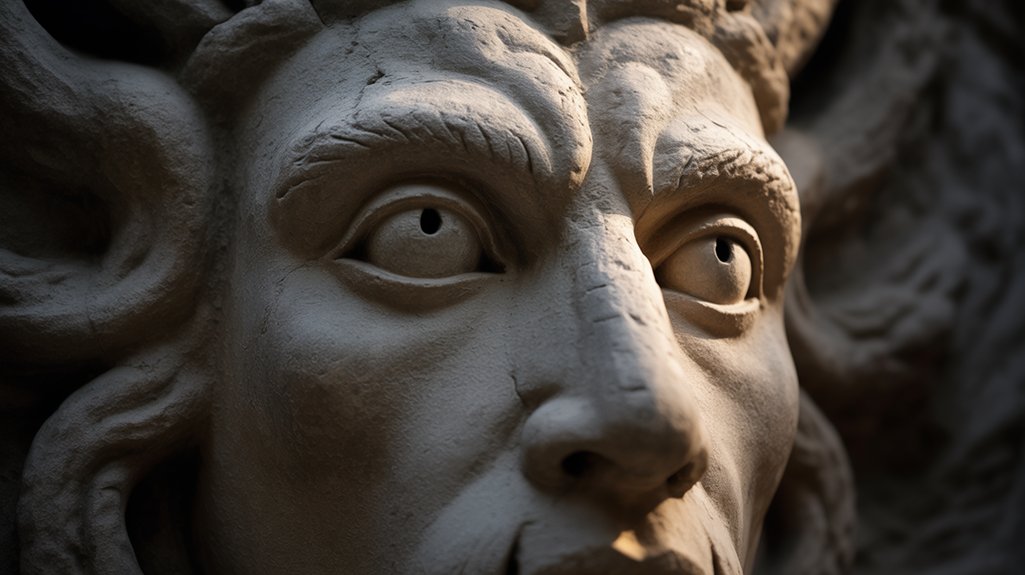
Since humanity first conceived of beings beyond mortal comprehension, the eye—that orb of sight and soul—has dominated the architecture of monstrous forms across civilizations.
From the Mediterranean basin emerged Medusa, whose petrifying stare weaponized mythical vision itself, altering perception into lethal force. The Cyclopes wielded their singular oculus as both vulnerability and terrible focus, channeling primordial strength through concentrated gaze interpretation.
Tolkien's Eye of Sauron later echoed this tradition, manifesting surveillance as eldritch omnipresence. These optical symbols transcend mere anatomy. They represent humanity's deepest anxieties about being seen, judged, controlled.
The basilisk's deadly glance, the Gorgon's terrible beauty—both exemplify how vision becomes chimeric weaponry in mythological consciousness. Eyes in these narratives function as thresholds between worlds, offering either enlightenment or annihilation.
They pierce the veil separating mortal limitation from divine terror, altering simple sight into instruments of cosmic power that echo through cultures separated by continents and millennia. The Wendigo's sunken deep eyes reflect this pattern, embodying starvation and decay as visual markers of transformation from human to monster.
##
The eyes of mythical monsters function as portals between the mortal domain and the numinous, manifesting through diverse cultural expressions—from the apotropaic wadjet adorning Egyptian demons to the serpentine glare of Medusa that alters flesh into stone, from the singular orb of the Cyclopes radiating primordial fury to the multiplied gazes of chimeric beasts that pierce through dimensional veils.
Each ocular configuration carries distinct metaphysical weight: the Gorgon's eyes weaponize vision itself, the monocular giant's stare channels concentrated divine wrath, while creatures bearing excessive eyes—such as the hundred-eyed Argos Panoptes—embody omniscience verging on the eldritch.
These variations reveal humanity's profound ambivalence toward sight, that most privileged sense, converting it into an instrument of cosmic terror and transcendent authority.
Ancient Egyptian Monster Eyes
When ancient Egyptian artisans carved the piercing gaze of divine monsters into temple walls and funerary texts, they weren't merely decorating—they were encoding cosmic truths into stone and papyrus.
The ocular symbolism of ancient Egyptian deities transcended mere aesthetics, embodying power itself. Sekhmet's luminous lioness eyes blazed with dual purpose: destruction and healing intertwined. The Eye of Ra surveyed creation while simultaneously manifesting as protective force against Apep's serpentine chaos.
Most terrifying was Ammit's stare—that chimeric devourer whose crocodilian gaze administered supernatural judgment upon souls weighed against Ma'at's feather. Each eye functioned as threshold between mortal and divine domains, between mercy and annihilation.
The Cyclopean tradition, though sparse, emphasized concentrated vision as pathway to eldritch understanding. These weren't windows to souls. They were weapons, shields, and scales of cosmic justice.
Medusa's Petrifying Gaze
Athena's curse altered mortal beauty into lethal weapon, birthing Western civilization's most iconic ocular terror. Medusa's metamorphosis from priestess to monster embodied divine retribution's cruelest irony—her eyes, once enchanting, became instruments of absolute annihilation.
This petrifying beauty merged Eros and Thanatos into singular glance, creating an eldritch paradox that challenged heroes' courage across Mediterranean antiquity.
Perseus understood perception's power. His mirrored shield reflected death's gaze back upon itself, weaponizing wisdom against brute force. The serpent-crowned Gorgon consequently became threshold guardian, her eyes marking boundaries between mortal audacity and divine consequence.
Contemporary reinterpretations reclaim this ocular symbolism. Medusa's stare alters from patriarchal punishment into feminist armor—protection against violation, agency crystallized through sight.
Her chimeric visage endures, simultaneously repelling threat and asserting autonomy through the very curse meant to destroy her. Like Pan's horned appearance, Medusa's monstrous transformation represents divine power manifesting through physical alterations that inspire both terror and reverence.
Cyclops Single Eye Power
Where Medusa's multiplied serpentine vision fragmented perception into deadly facets, the Cyclops inverted this ocular architecture—collapsing sight into monolithic singularity.
This concentrated gaze embodied raw, undiluted power, altering vision itself into weapon and forge simultaneously. Cyclops symbolism reveals humanity's ancient understanding that limitation breeds intensity; the single orb represented focused will, uncompromising judgment, primal authority distilled to its essence.
Yet these eldritch craftsmen weren't mere brutes—they wielded Mythical craftsmanship that birthed Zeus's thunderbolts, forging divine arsenals within volcanic depths.
Homer's Polyphemus demonstrated this duality: simultaneously creator and destroyer, visionary and blind. The solitary eye became metaphor for dangerous tunnel vision, the peril of singular perspective.
Cultural traditions recognized this concentrated sight as the evil eye's origin—observation altered into curse, awareness weaponized through intensity alone.
Multi-Eyed Beast Symbolism
If the Cyclops concentrated vision into devastating singularity, multi-eyed creatures achieved the opposite transcendence—fractured omniscience through multiplicative sight.
Argus Panoptes, crowned with a hundred eyes across his eldritch form, embodied mythical vigilance that never slumbered. His guardian symbolism persisted through Hera's divine appointment as eternal watcher.
Hindu tradition enhanced this concept further: Ravana's ten-headed manifestation bore twenty eyes perceiving all cardinal directions simultaneously, representing unbound knowledge that transcended mortal limitation.
The biblical seraphim carried this multiplicity into sacred domains, their countless eyes witnessing divine mysteries forbidden to earthbound consciousness.
These chimeric sentinels weren't merely observing—they existed as living thresholds between ignorance and omniscience, their surplus vision granting freedom from the constraints of singular perspective.
Each additional eye symbolized expanded awareness, the liberation that comes from perceiving reality's infinite facets simultaneously.
Egyptian Eye of Horus

Long before the dynastic pharaohs consolidated their power along the serpentine Nile, predynastic burial sites across the Delta region yielded artifacts bearing ocular motifs—primordial precursors to what would crystallize into the Wedjat's formalized iconography.
The Eye of Horus emerged from these archaeological strata as more than mythic emblem; it functioned as apotropaic shield, a guardian glyph inscribed upon tombs and temples to repel malevolent entities that lurked in threshold spaces between mortal domain and afterlife.
Each fractional component of this chimeric symbol carried mathematical precision, altering protective magic into quantifiable ritual, where cosmology intersected with engineering and terror demanded structure.
Predynastic Egyptian Burial Artifacts
Through the ochre-stained sands of Naqada and Abydos, archaeologists have unearthed burial assemblages that reveal humanity's earliest sustained engagement with ocular symbolism as a threshold between mortality and divine preservation.
These predynastic artifacts, dating to 4000-3100 BCE, showcase the wedjat's eldritch power—a chimeric fusion of human and falcon anatomy that promised restoration beyond death's veil. Funerary symbolism centered on this protective eye, adorning amulets pressed against mummified flesh and coffins painted with lunar precision.
The symbol wasn't merely decorative. It functioned as spiritual technology, embedding healing spells within its curved lines, each mathematical proportion corresponding to fractional measurements that ancient priests understood as keys to wholeness.
Here, in Egypt's primordial cemeteries, the eye became humanity's first sustained attempt to encode protection through vision itself.
Nile Delta Archaeological Sites
Where the Nile fragments into seven distributary channels before surrendering to the Mediterranean, ancient settlements arose from marshy ground that concealed—and ultimately preserved—millennia of ocular devotion. These Nile Delta excavations unearthed ancient artifacts bearing the Eye of Horus, that eldritch symbol merging protection with cosmic sovereignty.
| Artifact Type | Ritual Function | Archaeological Context |
|---|---|---|
| Protective Amulets | Funerary Safeguarding | Burial Chambers |
| Inscribed Tablets | Mythological Documentation | Temple Precincts |
| Offering Vessels | Ancestral Veneration | Tomb Complexes |
The wadjet—another name for this chimeric emblem—emerged from Horus's conflict with Set, materializing in countless forms throughout Delta sites. Each carved iteration whispered of healing, of royal authority transcending mortal boundaries. Tombs yielded these talismans, their presence confirming beliefs in divine protection extending beyond corporeal dissolution into that mysterious threshold separating existence from eternal alteration.
Protection Against Evil Forces
As darkness descended upon the Nile's fertile banks each evening, ancient Egyptians invoked the wadjet's power—a sacred geometry of protection forged in divine violence and celestial mathematics.
This Eye of Horus emerged from Set's brutal dismemberment of the falcon god's ocular organ, altering trauma into talismanic sovereignty. The restored eye became humanity's shield against eldritch forces prowling nocturnal hours, its lunar associations reinforcing protective symbolism when shadows threatened mortal existence.
Mythical guardians materialized through this symbol in funerary contexts, where amulets bearing the wadjet accompanied deceased souls through liminal afterlife passages.
Priests incorporated the eye into ritual offerings, channeling its apotropaic properties through deliberate ceremony. Each hieroglyphic rendering functioned as mathematical formula and spiritual barrier simultaneously, repelling chimeric entities that haunted Egypt's conceptual boundaries between order and chaos.
Mesopotamian Evil Eye Beliefs
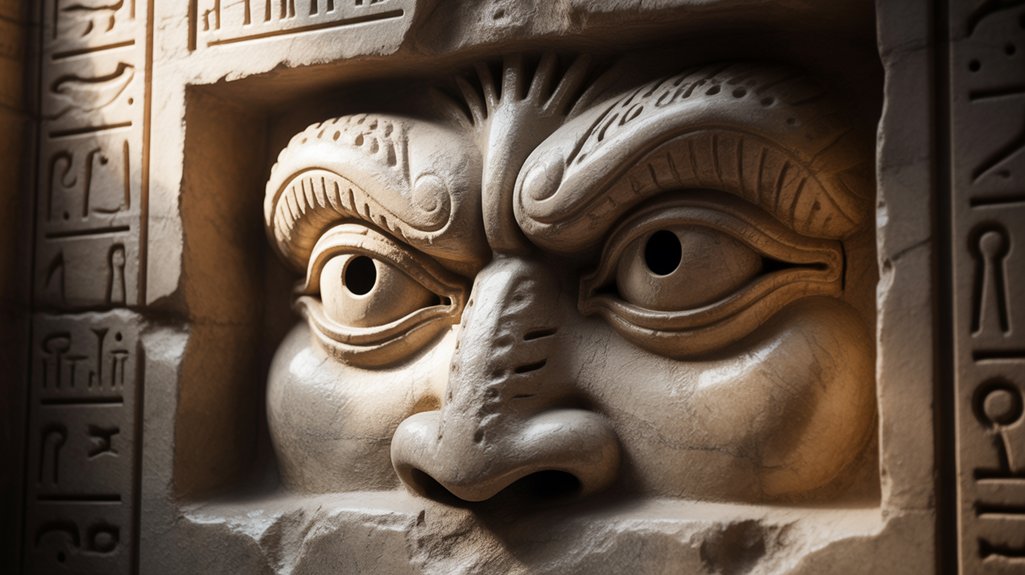
In ancient Mesopotamia's dust-swept cities—Uruk, Babylon, Nippur—inhabitants moved through their daily commerce beneath an invisible threat, one that couldn't be deflected by bronze blades or city walls. The evil eye manifested through envious glances, altering malevolent thoughts into tangible harm. Protective amulets became essential armor against this eldritch danger.
| Protective Element | Function & Symbolism |
|---|---|
| Nazar (Blue Eye) | Deflected harmful gazes through mirrored vigilance |
| Lilith Incantations | Warded against night-dwelling entities bearing malicious sight |
| Clay Tablets | Inscribed with apotropaic formulas binding malevolent forces |
Mesopotamian cosmology positioned sight itself as chimeric—simultaneously gift and weapon. Lilith, goddess dwelling in liminal darkness, wielded her gaze as instrument of corruption. Citizens responded through elaborate rituals, speaking ancient words that created invisible barriers. These practices acknowledged a fundamental truth: vulnerability existed not in physical flesh but in the soul's exposure to another's jealous attention. The evil eye's legacy persists, its ancient terror echoing through millennia.
Gaze as Divine Power
Though mortal eyes merely receive light's information, divine gazes actively reshape reality itself—a distinction that separates human perception from the cosmic authority wielded by gods and monsters. Medusa's petrifying stare alters flesh to stone, embodying divine retribution's terrible finality. Her eldritch power transcends simple vision, weaponizing sight itself.
Where mortal sight passively observes, divine vision actively transforms—the fundamental chasm between witnessing and commanding reality itself.
The omniscient quality of divine observation manifests across cultures through singular, penetrating eyes:
- The Cyclopes' monocular vision concentrates raw strength into focused intent, channeling primal fear through undivided attention.
- Hinduism's third eye awakens divine insight, piercing illusion's veil to reveal cosmic truth.
- The Eye of Horus radiates protective authority, maintaining ma'at through celestial vigilance.
These chimeric anatomies communicate fundamental truths about power's nature. The All-Seeing Eye watches eternally, its unblinking surveillance suggesting consciousness unbounded by mortal limitations.
Where human vision falters in darkness, divine sight illuminates hidden dimensions, altering observation into ontological force that commands, protects, and destroys with equal sovereignty.
Medusa's Petrifying Stare
Athena's curse altered the once-beautiful Medusa into a chimeric sentinel whose serpentine crown and eldritch gaze wielded the ultimate apotropaic power—the ability to petrify any soul who met her eyes directly, turning flesh and bone to cold stone in an instant.
This petrifying stare operated through direct visual contact, a metaphysical weapon that collapsed the boundary between seeing and being destroyed, making the eyes themselves both conduit and catalyst for annihilation.
Yet this same terrifying gaze evolved into a protective symbol, the *Gorgoneion*, which ancient Greeks emblazoned upon shields, temples, and doorways to ward off malevolent forces, altering Medusa's curse into an apotropaic guardian against the evil eye itself.
Origin of the Curse
When Medusa committed sacrilege within Athena's sacred temple—accounts vary between consensual liaison and violent assault by Poseidon—the virgin goddess released a metamorphosis that would render the once-beautiful maiden into something profoundly eldritch.
This divine retribution altered her flowing locks into writhing serpents, each fang dripping with venom, while her eyes acquired their lethal properties. The cursed beauty became weaponized, twisted into an instrument of petrification that reflected Athena's wrath and the unforgiving nature of Olympic justice.
Her gaze, once capable of enchanting admirers, now delivered instant calcification to any mortal who dared meet it directly. The metamorphosis stripped away innocence, replacing mortal vulnerability with monstrous strength—a chimeric fusion that embodied both punishment and terrible enablement, forever binding Medusa's identity to her destructive, inescapable stare.
Power Through Direct Gaze
Medusa's altered state crystallized into a singular weapon—her eyes became portals of absolute annihilation, requiring nothing more than visual contact to execute their irreversible sentence.
This transformative vision operated through gaze interactions that transcended mere ocular mechanics, functioning as an eldritch conduit between divine punishment and mortal vulnerability. The petrification wasn't gradual—instant, complete, final. Those who met her stare found their flesh changing to marble, their screams frozen mid-utterance, their defiance captured in eternal stone.
Unlike chimeric beasts requiring physical proximity, Medusa's power liberated her from conventional combat constraints. The directness of her gaze eliminated intermediaries, creating an unmediated connection between perceiver and doom.
This terrifying autonomy embodied freedom's dark inverse: absolute power concentrated in an involuntary glance, stripping victims of choice, movement, life itself.
Protection Against Evil Eye
Against this weaponized vision, ancient minds constructed intricate countermeasures—defensive protocols encoded in myth, metallurgy, and strategic indirection that acknowledged one couldn't simply overpower such absolute force.
Perseus's mirrored shield exemplified this wisdom: reflection rather than confrontation, cleverness over hubris. The shield's polished bronze surface created a liminal viewing space—neither direct nor entirely absent—that neutralized Medusa's eldritch potency.
This protective philosophy proliferated across Mediterranean civilizations through amulet designs: the Hamza's outstretched fingers, the Nazar's concentric blue circles.
Each artifact carried profound cultural significance, altering Medusa's destructive gaze into apotropaic power. The Evil Eye concept—rooted in envy’s corrosive energy—became synonymous with her petrifying stare.
These talismans didn't merely shield; they redirected malevolent attention, weaponizing the very mechanism they defended against. Ancient wisdom recognized that true protection required understanding one's adversary intimately.
Berserk's Godhand Eye Symbolism
The Godhand manipulation operates through three primary mechanisms:
- Omniscient surveillance that strips away privacy and self-determination
- Fate-weaving authority that alters free will into predetermined tragedy
- Sacrificial contracts binding victims through branded eye-marks
This chimeric fusion of the divine and monstrous exposes power's fundamental duality.
The Brand of Sacrifice—itself an eye perpetually bleeding—marks bearers like Guts as eternal prey, watched ceaselessly by predatory forces beyond mortal comprehension.
Here, vision becomes weaponized control, the gaze itself an instrument of cosmic tyranny.
Neurological Basis of Eye Fear
When confronted with the multi-ocular arrangement of an Ophanim or the petrifying stare of a Gorgon, the human brain doesn't merely process visual information—it activates ancient circuitry forged through millions of years of predator-prey interactions.
The neurobiological response originates in the amygdala, that almond-shaped sentinel of survival, which ignites when confronted with threatening gazes. Simultaneously, the fusiform gyrus springs to life, parsing the eldritch geometry of chimeric eyes with unsettling precision. This dual activation explains why multi-eyed entities trigger such visceral dread.
Our ancient brain circuitry, designed to detect predatory stares, misfires catastrophically when confronted with impossible arrangements of watching eyes.
The limbic system orchestrates this primal symphony, interpreting ocular symbols as predatory warnings. Evolutionary instinct compels humans toward gaze-following behavior, an adaptation that once distinguished stalking threats from passive observers.
When mythical monsters return that gaze—unblinking, multiplied, omniscient—they exploit this hardwired vulnerability. The brain recognizes what can't be: eyes that see beyond mortal comprehension, altering biological defense mechanisms into spiritual terror. Ancient creators understood this neurological truth intuitively.
Modern Surveillance Culture Echoes
Looking up from our devices, we find ourselves ensnared in a web of mechanical eyes that would make the hundred-eyed Argus Panoptes seem modest by comparison.
Contemporary surveillance anxiety mirrors the ancient terror of Medusa's petrifying stare, converting citizens into frozen subjects beneath omnipresent observation. The All-Seeing Eye, once confined to temple friezes and mystical texts, now manifests through camera lenses, biometric scanners, and algorithmic watchers that track our digital footprints across virtual and physical domains.
This chimeric fusion of mythology and technology reveals an uncomfortable truth: the eye remains humanity's most potent symbol of control. Where ancient peoples carved protective amulets against malevolent gazes, modern individuals drape fabric over webcams, disable location services, encrypt communications.
The eldritch power attributed to supernatural vision has altered into governmental and corporate apparatus, justifying intrusion through promises of security while eroding the very autonomy our ancestors fought to preserve against tyrannical gods.
Eyes Still Watch Us
Beyond silicon valleys and fiber-optic networks, ancient ocular symbols persist in humanity's collective consciousness with unsettling significance. The eye symbolism that once manifested through Medusa's petrifying stare and Argus's hundred vigilant orbs now permeates contemporary existence through subtler, yet equally pervasive channels.
These mythical interpretations weren't mere cautionary tales—they represented humanity's primal recognition of observation as power, control as sight.
The Cyclops's singular vision. Medusa's lethal gaze. The omniscient Eye of Horus.
Each embodies autonomy's greatest adversary: the watched life, the monitored soul. Modern individuals instinctively recoil from camera lenses and data collection with the same visceral unease ancient peoples felt contemplating the Evil Eye's malevolent attention.
This isn't coincidence but continuity. The eldritch dread of being perceived, catalogued, understood against one's will transcends millennia.
These chimeric watchers remind us that surveillance—whether divine, monstrous, or technological—strips away the fundamental human right to exist unobserved, altering free individuals into perpetual subjects beneath an eternal, unblinking gaze.
Frequently Asked Questions
How Do Cyclops Myths Relate to Eye Symbolism in Ancient Greece?
Cyclops representation embodies the ancient Greeks' paradoxical eye perception—singular vision symbolizing both prophetic enlightenment and catastrophic limitation.
These eldritch giants, first catalogued in Hesiod's *Theogony* (circa 700 BCE), wielded thunderbolts for Zeus yet remained spiritually blind to civilization's nuances.
The monomatic eye. A portal to divine forge-fire.
The cyclopean gaze simultaneously represented focused creative power and the dangerous myopia of those who can't perceive multiple truths, reflecting Hellenic values prizing balanced wisdom over narrow perspective.
What Role Do Eyes Play in Asian Dragon Mythology?
Though Western interpretations often dismiss dragon vision as mere aesthetic detail, Asian traditions reveal profound metaphysical significance.
In Chinese mythology, dating to Shang Dynasty oracle bones, dragons' eyes possess altering power—their gaze penetrates illusions, perceiving chi flows invisible to mortals.
Eye interpretation wasn't decorative symbolism but practical wisdom: open eyes commanded storms, closed ones signaled meditation.
Japanese ryu and Korean yong inherited this eldritch knowledge. Their lidless stare guards authentic truth, liberating seekers from conventional perception's constraints.
Are There Protective Amulets Against Evil Eye Still Used Today?
Evil eye amulets endure across Mediterranean, Middle Eastern, and South Asian cultures—the Turkish *nazar*, Greek *mati*, Hamsa hand—still adorning doorways, vehicles, jewelry.
Modern protection manifests in these talismanic forms, their apotropaic power undiminished by centuries.
Travelers purchase them freely in Istanbul's Grand Bazaar, Jerusalem's ancient souqs, Mumbai's bustling markets.
These cobalt-blue wards, often bearing concentric circles mimicking the watchful gaze, represent humanity's persistent need to deflect malevolent attention, converting fear into material defense.
Why Do Some Monsters Have Multiple Eyes Instead of One?
Multiple-eyed beings embody improved perception—like ancient cartographers who needed countless vantage points to map unknown domains.
Argus Panoptes, the hundred-eyed guardian of Greek antiquity, represents omniscience incarnate.
Eldritch entities bearing chimeric ocular arrays transcend mortal limitations, perceiving multiple perspectives simultaneously: past and future, physical and ethereal spheres.
This proliferation of eyes liberates these creatures from singular viewpoints, granting them freedom to witness all dimensions of existence.
They see what bound, finite humans cannot.
How Did Renaissance Art Portray Mythological Eye Symbolism?
Renaissance artists altered mythological eye symbolism into theological allegory, weaving pagan imagery with Christian doctrine.
Botticelli's Argus (1480s) rendered the hundred-eyed guardian as divine omniscience manifest.
Renaissance symbolism raised ocular motifs beyond mere monstrosity—each painted iris became a portal to gnosis.
Artistic interpretation during this period treated chimeric vision as sacred geometry, mathematical precision meeting mystical revelation.
The Medici court particularly championed such works, commissioning pieces where eldritch gazes weren't threats but transcendent truth.
Conclusion
Ancient civilizations carved eyes into temple stones to repel darkness; modern cameras now mount them on street corners to surveil citizens. The gaze persists—transformative, liminal, eldritch. From Horus's protective wadjet to Medusa's petrifying stare, humanity's ocular obsessions bridge millennia, revealing primal neurological terror hardwired into consciousness itself. These chimeric watchers haven't vanished. They've merely transmuted, their mythological potency echoing through surveillance states and digital screens. The eyes still watch. We still fear their seeing.