Wings encode humanity's deepest aspirations across mythological traditions—from Mesopotamian Lamassu guarding palace thresholds circa 3000 BCE to Hindu Garuda defeating primordial chaos. These chimeric forms bridge mortal limitation and divine possibility: Greek Pegasus raises artistic consciousness, Norse Valkyries determine spiritual destiny, Persian Simurgh bestows maternal wisdom. Jung recognized wings as archetypal symbols of psychological individuation, while Icarus's fatal ascent warns against hubris. Contemporary digital narratives perpetuate this ancient cipher, changing dragons and angelic figures into vehicles for transcendence that unite cosmological past with imaginative future.
Key Takeaways
- Wings symbolize humanity's desire for transcendence, spiritual ascension, and escape from earthly limitations across mythological traditions.
- Winged beings like angels, Valkyries, and Garuda represent divine authority, serving as messengers and guardians between mortal and celestial realms.
- Cultural variations include Greek Pegasus (artistic inspiration), Norse Valkyries (warrior selection), Hindu Garuda (divine protection), and Indigenous Thunderbird (chaos control).
- Hybrid winged creatures like Lamassu and Sphinx combine animal and divine traits, functioning as protective sentinels and wisdom guardians.
- Modern interpretations in digital media and Jungian psychology connect ancient wing symbolism to contemporary themes of transformation and self-realization.
Wings Across Human Imagination

Since humanity first gazed upward at birds tracing paths through cloudless skies, wings have occupied a liminal space in collective consciousness—simultaneously physical and metaphysical, earthbound observation converted into celestial aspiration.
These appendages transcended mere biological function, becoming vessels for humanity's deepest yearnings: escape from mortality's constraints, communion with the divine, mastery over fate itself.
Ancient civilizations forged their mythical influences through observation and longing. Egypt's winged scarabs symbolized resurrection. Mesopotamian lamassu stood sentinel with eagle plumage. Greece's Icarus fell, wings melting—cautionary tale incarnate.
Cultural adaptations proliferated across continents: Mesoamerican Quetzalcoatl bore feathered serpent wings; Hindu Garuda commanded skies as Vishnu's mount; Norse Valkyries descended on swan-white pinions to claim the worthy dead.
Wings became chimeric bridges between domains, eldritch markers of change. They represented not merely physical elevation but spiritual ascension—the soul's capacity to transcend earthly limitations, to touch something ineffable, boundless, free. The Norse Mythology Project continues to document these celestial beings and their significance across Scandinavian traditions.
##
Throughout human civilization's sacred narratives, wings have manifested as quintessential markers of divine sovereignty, granting their bearers—whether celestial angels or eldritch dragons—an unmistakable authority that transcends mortal jurisdiction.
This aerial symbolism operates simultaneously across multiple registers: as literal freedom from gravitational constraints, as metaphysical liberation from corporeal existence, and as visual shorthand for beings who traverse the liminal boundaries between earthly and eternal domains.
Yet the iconography varies dramatically across cultures, from the feathered appendages adorning Mesopotamian lamassu to the membranous, chimeric wings of Chinese dragons, each iteration encoding distinct theological premises about power, protection, and transcendence.
The phoenix's association with solar cycles and rebirth through flame exemplifies how winged creatures embody both destruction and renewal, their aerial mastery serving as visual metaphor for transformation that transcends ordinary mortal experience.
Wings as Divine Authority
When ancient civilizations gazed upward at the celestial expanse, they recognized in avian flight something more profound than mere locomotion—they perceived the manifestation of divine sovereignty itself.
Wings altered mortals into heavenly messengers, bridging domains through figures like Hermes, whose feathered sandals carried divine edicts across cosmic boundaries.
Egyptian Horus embodied this authority through his falcon form, wings stretched in eternal vigilance over terrestrial affairs.
Garuda's chimeric physiology—part raptor, part deity—served as Vishnu's vehicle, merging earthly and celestial spheres.
The eldritch power of Valkyries demonstrates wings' darker aspect: divine judgment.
These warrior-maidens descended upon battlefields, their feathered silhouettes determining which souls ascended to Valhalla's halls.
Here, wings weren't mere appendages but instruments of cosmic law, altering flight into sovereignty itself.
Transcendence Through Aerial Symbolism
While earthbound mortals gazed upward with yearning, wings emerged across mythological traditions as humanity's most potent symbol of transcendence—the vehicle through which consciousness itself could pierce the veil separating mundane existence from divine understanding.
Angels descended through celestial navigation, mapping ethereal pathways between domains. Valkyries performed transcendental ascension, ferrying chosen warriors beyond death's threshold. These eldritch messengers didn't merely fly; they altered spatial boundaries into permeable membranes.
Pegasus carried heroes toward impossible destinies, while Garuda's wings spanned cosmic distances, bridging mortal aspirations with divine possibility. Flight became metaphor—liberation from physical constraints mirroring spiritual emancipation.
Yet Icarus's plummet warned against unchecked ambition. The chimeric truth remains: wings grant freedom but demand wisdom, offering transcendence only to those respecting the delicate balance between earthly limitations and celestial potential.
Freedom and Spiritual Liberation
Liberation—that most primal of human hungers—finds its purest expression in the winged forms that populate humanity's sacred narratives, where feathered appendages evolve from mere biological adaptation into spiritual technology.
Angels traverse dimensional thresholds, their pinions cutting through the veil between mortality and transcendence. Valkyries bear souls skyward, facilitating mythical liberation from corporeal chains. These eldritch messengers don't merely fly—they change the very act into sacred communion, each wingbeat a deliberate rejection of earthly bondage.
Pegasus embodies spiritual ascension through chimeric form, his wings birthing inspiration from chaos. Flight becomes metaphor. Journey becomes awakening.
The aerial domain represents consciousness unshackled, where divine communication flows freely and individuals discover authentic selfhood beyond societal imprisonment. Wings grant permission to soar toward enlightenment's distant horizon.
Cultural Wing Iconography Variations
Across civilizations separated by vast oceans and millennia, winged iconography crystallizes into distinct symbolic languages—each culture encoding its deepest cosmological truths within feathered, scaled, or ethereal appendages that defy simple categorization.
Greek Pegasus wings channel poetic transcendence, birthing artistic revelation alongside the Muses. Norse Valkyries bear storm-dark pinions selecting warriors worthy of Valhalla—honor made manifest.
Garuda's chimeric form radiates divine authority through Hindu cosmology, mounting Vishnu himself while crushing serpentine evil beneath taloned feet. Egyptian Isis spreads protective wings across mortality's threshold, maternal and eldritch simultaneously.
The Thunderbird commands tempests across Indigenous American territories, its wingspan controlling chaos itself. These cultural interpretations reveal mythological significance extending far beyond decoration—wings become hieroglyphic texts inscribing freedom, power, protection, and metamorphosis into humanity's collective unconscious.
Mesopotamian Tablets and Egyptian Hieroglyphs
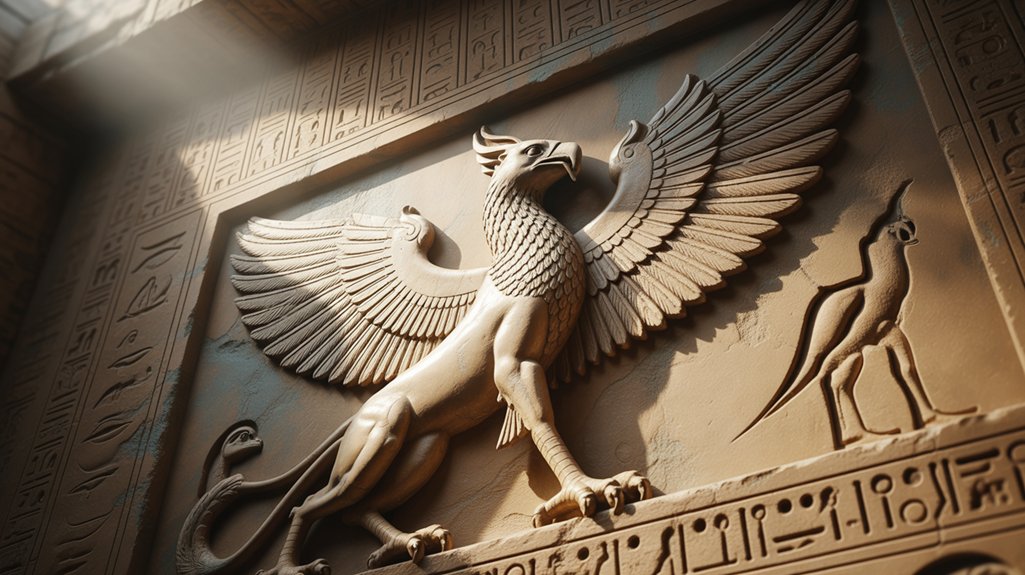
In the ancient Tigris-Euphrates River Valley, circa 3000 BCE, the Lamassu emerged as chimeric sentinels—leonine or bovine bodies fused with human wisdom and avian transcendence—carved into limestone gateposts where earthly dominion met celestial authority.
These Akkadian *lammasu*, protective spirits hewn from stone and belief, stood watch at palace thresholds, their stone wings spread wide to repel malevolent forces that prowled the boundary between chaos and civilization.
The guardian's form wasn't mere artistic fancy but theological architecture, a deliberate intersection of beast, human, and divine rendered in alabaster to anchor spiritual protection within physical space.
Lamassu From 3000 BCE
When ancient Mesopotamian artisans first carved the Lamassu from limestone and alabaster around 3000 BCE, they weren't merely creating decorative sculptures—they were forging apotropaic sentinels that would stand between civilization and chaos for millennia.
These chimeric guardians—amalgamations of human wisdom, bovine strength, leonine ferocity, and aquiline transcendence—embodied protective symbolism that transcended mere architectural ornamentation.
Lamassu mythology positioned these eldritch beings at liminal thresholds: palace gates, temple entrances, cosmic boundaries where the profane met the sacred. Their wings carried divine authority earthward, manifesting the ruler's celestial mandate while repelling malevolent forces.
Egyptian hieroglyphs later absorbed these protective concepts, recognizing kindred power in winged forms. Each intricate feather, each carved muscle testified to liberation through divine guardianship—freedom secured not through absence of boundaries, but through their fierce, magnificent protection.
Tigris-Euphrates River Valley Origins
Cuneiform inscriptions pressed into wet clay tablets reveal humanity's earliest systematic attempts to capture the numinous—to convert ephemeral visions of winged guardians into permanent record. The Tigris-Euphrates River Valley birthed civilizations obsessed with documenting their mythical origins through intricate scripts and hieroglyphic systems. These ancient peoples understood winged symbolism as humanity's bridge between mortality and divinity.
| Cultural Source | Winged Entity |
|---|---|
| Mesopotamian Tablets | Lamassu (chimeric protectors) |
| Egyptian Hieroglyphs | Isis (maternal guardian) |
| Cylinder Seals | Eagle-winged spirits |
| Temple Decorations | Transcendent deities |
Archaeological evidence confirms these eldritch beings weren't mere fantasy. They represented fundamental truths about existence, freedom from earthly constraints, and passage into domains beyond human comprehension. Wings granted access to celestial knowledge, altering mortals into something greater.
Guardian Deity Protecting Palace Entrances
Towering over palace thresholds with bodies that merged human intellect, leonine strength, and avian transcendence, the Lamassu stood as Mesopotamia's ultimate architectural sentinels—chimeric beings whose very presence altered mundane doorways into portals between profane and sacred space.
Their colossal forms embodied guardian symbolism that transcended mere decoration, functioning as active participants in cosmic order. Egypt mirrored this protective presence through Ma'at's winged embrace and Isis's sheltering feathers, immortalized in hieroglyphic declarations of divine justice.
Wings didn't merely symbolize flight—they manifested supernatural authority to breach dimensional boundaries, delivering righteousness while repelling malevolent forces. These eldritch protectors, scaled beyond mortal proportions, reminded all who passed beneath their gaze that earthly power remained forever tethered to celestial governance.
Palace and temple became threshold. Architecture became theology.
Greek Pegasus Versus Persian Simurgh

Across the ancient world's vast mythological landscape, two winged beings emerged from distinct civilizations to embody fundamentally different aspects of divine transcendence—the Greek Pegasus, born from Medusa's severed neck in a spray of crimson and salt spray, and the Persian Simurgh, whose iridescent plumage had sheltered prophets and kings for millennia before the Achaemenid Empire rose.
Pegasus symbolism centers upon aesthetic perfection and poetic elevation, the creature's hoofbeats birthing the Hippocrene spring where Muses gathered. The Simurgh nurturing represents maternal wisdom incarnate, dwelling within the Tree of Knowledge itself.
| Aspect | Pegasus | Simurgh |
|---|---|---|
| Primary Domain | Artistic inspiration, springs | Healing wisdom, rebirth |
| Cultural Role | Beauty, grace, Muses' companion | Protector, guide, maternal figure |
| Cosmic Connection | Earthly transcendence through art | Bridge between mortal and divine spheres |
Both creatures embody flight's eldritch promise—freedom unshackled from terrestrial bounds. Yet their divergent narratives reveal how cultures encode liberation differently.
Divine Protection Through Hybrid Forms
Wings alone couldn't contain humanity's vision of celestial intervention—mythmakers fused avian grace with mammalian strength, human intelligence, and reptilian mystery to forge guardians whose very bodies testified to their liminal existence between mortal vulnerability and divine invulnerability.
These chimeric sentinels embodied sacred guardianship across civilizations:
- The Garuda descended through Hindu cosmology, talons gripping serpents, wings spreading protection over devotees seeking spiritual ascension between terrestrial suffering and transcendent liberation.
- The Sphinx maintained eternal vigil, leonine musculature combined with feathered appendages, withholding esoteric wisdom from unworthy seekers who approached sacred thresholds unprepared.
- Valkyries rode storm-winds over battlefields, their eldritch judgment determining which fallen warriors merited passage to Valhalla's golden halls.
Each hybrid construction declared a fundamental truth: protection from divine sources required forms transcending singular nature.
Angelic figures throughout Judeo-Christian traditions continued this pattern—winged humanoids whose anatomy itself proclaimed freedom from earthly constraints, bridging the chasm between supplicant mortals and ineffable deities through sacred guardianship made manifest.
Icarus's Fatal Sun Flight
The Icaran tragedy stands as mythology's most visceral meditation on the fatal threshold between mortal ambition and celestial domain, where feathered wings bound with mere beeswax—a substance vulnerable, ephemeral, profoundly earthbound—could never withstand the sun's divine radiance.
His father Daedalus engineered a chimeric marvel that merged avian form with human ingenuity, yet this hybrid construction contained within its very architecture the seeds of catastrophe, the wax melting not through defect but through the inexorable physics of proximity to godhood.
What dissolved above the Aegean wasn't simply adhesive but the dangerous illusion that mortal craft, however ingenious, could transcend the immutable boundaries separating human aspiration from divine prerogative.
Hubris and Divine Limits
While humanity's longing for transcendence finds expression across countless mythological traditions, few narratives capture the catastrophic consequences of unchecked ambition as viscerally as the fall of Icarus—that doomed youth whose wax-bound wings dissolved beneath the Mediterranean sun around 1200 BCE in Greek mythological chronology.
His defiance embodied hubris consequences in their most elemental form: mortal flesh challenging divine boundaries. Daedalus's warnings echoed the ancient understanding that ambition limits exist not as arbitrary constraints but as sacred thresholds separating human aspiration from cosmic order.
The Aegean's salt-churned waters swallowed the boy who refused temperance, his plunge crystallizing an eternal paradox—that wings promising liberation simultaneously demand respect for eldritch forces governing existence.
Freedom seekers throughout history have recognized this tension: genuine transcendence requires acknowledging boundaries even as we strain against them.
Wax Wings' Fatal Flaw
Feathers layered over beeswax and linen thread—this was the material substrate of transcendence, the alchemical formula through which Daedalus converted raw earthly matter into instruments of celestial passage.
Yet these wax wings carried within them their own annihilation, a structural vulnerability that altered liberation into catastrophe. Icarus discovered what countless seekers after freedom have learned: that mortal constructions can't withstand divine fire. The sun's heat melted the adhesive binding, collapsing the chimeric architecture of feather and wax.
This mythological warning speaks directly to those who'd transcend boundaries—not to abandon flight, but to recognize material limits. The Aegean received his plummeting form, its waters marking the eternal threshold between aspiration's soaring heights and hubris's inevitable descent.
Freedom demands wisdom, not merely wings.
Ambition's Tragic Consequences
Against Daedalus's explicit counsel—fly neither too low where sea spray would dampen the feathers nor too high where solar heat would compromise the wax—Icarus chose exaltation over prudence.
The youth's ascent became humanity's eternal cautionary tale, his trajectory tracing ambition's price across the Aegean sky. Solar rays, that eldritch force sustaining all terrestrial existence, dissolved the binding agent securing his chimeric appendages.
Freedom's intoxication proved fatal. The Icarian Sea, named for his corpse's final resting place, eternally commemorates this boundary infringement. His plunge illustrates hubris's inevitable consequence—that liberation without wisdom alters aspiration into annihilation.
Ancient Greeks understood this truth: wings symbolize transcendence, yet their very construction acknowledges mortal limitations. Between sea-foam and sun-fire exists the sacred path; deviation courts obliteration.
Dragons in Fantasy Literature
Throughout the vast tapestry of fantasy literature, dragons emerge as liminal beings—chimeric amalgamations of serpent, bird, and beast that transcend mere monstrosity to embody fundamental forces of existence itself. These creatures manifest divergent cultural essences: Western iterations hoarding gilded treasures in mountain depths, Eastern counterparts blessing watersheds and harvests.
Dragon symbolism operates through multiple archetypal dimensions:
- Power and sovereignty, exemplified through Daenerys Targaryen's fire-breathing heirs claiming political legitimacy
- Transformation catalyst, forcing protagonists toward self-actualization through confrontation or alliance
- Moral duality, oscillating between Smaug's corrosive avarice and benevolent wisdom-keeping
These fantasy archetypes have permeated contemporary consciousness, from Paolini's dragon-bonded warriors to tabletop domains where scaled entities challenge adventurers.
Dragons function as psychopomps guiding readers through eldritch thresholds, their wings bearing ancient knowledge across temporal boundaries. They remain literature's supreme emblems of unconstrained potential—dangerous, numinous, eternally enchanting to those who seek transcendence beyond mundane existence.
Jung's Archetypal Wings Analysis
When Carl Jung penetrated mythology's symbolic depths during his 1912 break from Freudian orthodoxy, he discerned that wings represented far more than locomotion—they embodied the Self archetype, that numinous totality integrating consciousness with shadow, animus with anima.
This archetype exploration revealed winged beings as psychological mirrors, reflecting humanity's chimeric nature: divine aspiration coexisting with eldritch darkness. Icarus plummeting from celestial heights. Pegasus ascending beyond mortal constraints. Each narrative encoded the same psychological significance—liberation demands equilibrium.
Jung understood that wings symbolized transformation's sacred trajectory toward individuation, that perilous journey where ego confronts unconscious depths. The winged hero's flight represented consciousness expanding beyond terrestrial limitations, seeking higher awareness, risking everything for transcendence.
Yet hubris waits. The shadow lurks. Wings carry both promise and warning, offering freedom to those who respect their power, destruction to those who don't.
Jung's analysis grants modern seekers permission to pursue their own change, to embrace wings as catalysts for spiritual awakening.
Modern Media Wings Everywhere
Jung's archetypal framework illuminated ancient wings, yet these same symbols now proliferate through digital domains with unprecedented intensity—streaming platforms, gaming consoles, cinema screens all shimmer with feathered and scaled appendages that carry mythology's oldest truths into twenty-first-century consciousness.
Dragons emerge from their primordial caves in “How to Train Your Dragon,” their flight-patterns encoding winged symbolism that transcends mere entertainment. Fairies and griffins populate “The Legend of Zelda,” their eldritch presence guiding players through liminal landscapes where adventure merges with aspiration.
Marvel's Archangel embodies metamorphosis through his chimeric wings, reflecting cultural interpretations of redemption and moral duality. Contemporary merchandise converts ancient iconography into consumer goods, yet something essential persists—that ineffable connection between wings and liberation.
The commercial sphere hasn't diminished these symbols; rather, it's democratized access to humanity's oldest freedom-myths. Every winged creature flickering across screens whispers the same eternal promise: transcendence remains possible.
Wings Unite Past and Future
As winged figures traverse the centuries—from Mesopotamian lamassu guarding palace gates in 721 BCE to holographic angels flickering through cyberpunk narratives—they function as temporal bridges, their feathered and scaled appendages linking cosmologies that span five millennia of human imagination.
Wings transform across millennia—from stone guardians to digital specters—threading ancient cosmologies through the needle's eye of modern imagination.
These mythical connections persist because wings encode humanity's most eldritch yearnings: liberation from terrestrial constraints, transcendence beyond mortal limitation.
Pegasus and Valkyries weren't mere fantasy. They embodied cultural ideals—Greek philosophical elevation, Norse martial honor—that contemporary reimaginings preserve while adapting for audiences seeking autonomy in digital cages.
The chimeric anatomy remains constant: membrane, pinion, flight. Yet meanings shift. Ancient wings promised divine favor; modern iterations champion self-determination.
This enduring symbolism reveals wings as repositories of future aspirations rooted in ancestral wisdom. They whisper that change isn't abandonment of tradition but its evolution—the past doesn't anchor us but propels us skyward, carrying forgotten truths into uncharted atmospheres where freedom takes unprecedented forms.
Frequently Asked Questions
How Do Different Religions Interpret the Spiritual Meaning of Wings Today?
Contemporary religious traditions interpret wings as vessels of spiritual ascension, pathways between earthly consciousness and transcendent domains.
Christianity maintains seraphim's six-fold wings symbolize divine protection, Islam's Jibril descends with revelatory power, while Hindu Garuda embodies moksha's liberating flight.
Buddhist dakinis dance through liminal spaces, their wings dissolving boundaries. These aren't mere metaphors—they're sacred technologies of change, eldritch bridges connecting mortality to infinite possibility.
Each tradition honors wings as freedom's ultimate architecture, lifting souls beyond corporeal constraints toward enlightenment's chimeric horizon.
What Psychological Effects Do Winged Creatures Have on Children's Development?
Winged creatures profoundly shape children's psyches through archetypal imagery. Dragons, griffins, and phoenixes catalyze imagination development, allowing young minds to transcend mundane boundaries and explore chimeric possibilities.
These eldritch beings simultaneously aid in fear management—children process anxiety through symbolic encounters with powerful, yet ultimately conquerable, aerial forms.
Ancient cultures recognized this psychological alchemy; from Mesopotamian lamassu to Celtic fairy wings, these liminal entities serve as developmental bridges between childhood vulnerability and emerging autonomy, nurturing psychological sovereignty.
Are There Any Wingless Mythical Creatures That Represent Similar Symbolic Meanings?
Remarkably, serpentine creatures—dragons, nagas, Quetzalcoatl—embody identical wingless symbolism of transcendence through their ability to traverse domains without aerial appendages.
These chimeric beings demonstrate that mythical representations of spiritual ascension don't require wings; instead, they manifest liberation through elemental mastery, particularly water and earth.
The ancient Chinese lunglong, sinuous and eldritch, ascends through storms and mists. Earth-bound yet boundless.
Such creatures prove that freedom's essence transcends physical form, residing in transformative energy itself—a truth the ancients understood intuitively, encoding it within scaled, flowing bodies.
How Have Scientific Discoveries About Bird Flight Influenced Modern Wing Symbolism?
Scientific revelations about bird anatomy and flight mechanics have altered wing symbolism from pure mysticism into tangible aspiration.
Understanding aerodynamic principles, hollow bone structures, and muscle configurations hasn't diminished wings' numinous power—it's deepened it. Modern seekers recognize that lift, thrust, and drag mirror life's actual forces.
The ancient chimeric vision now carries biomechanical truth: freedom requires specific conditions, deliberate structure, calculated risk.
Wings become blueprints for liberation, not merely ethereal symbols but engineering marvels proving transcendence demands both vision and precision.
Why Do Some Cultures Depict Evil Creatures With Wings While Others Don't?
Like a mirror reflecting each society's deepest fears, winged depictions of malevolent beings reveal profound cultural interpretations of cosmic order.
Cultures emphasizing celestial hierarchies—medieval Christianity, Zoroastrian Persia—granted wings to demons, positioning evil within heaven's domain. Conversely, chthonic traditions rooted darkness earthward; Japanese oni, Mesopotamian underworld spirits remained terrestrial.
Geography shaped these visions. Mountainous civilizations encountered danger from above; lowland peoples feared what lurked below.
Each system maps its spiritual architecture differently, yet honors authentic cosmological truth.
Conclusion
Humanity crafted wings to transcend earthbound limitations, yet remains stubbornly terrestrial—dreaming of Pegasus while anchored by gravity's inexorable pull. These chimeric forms, from Simurgh's eldritch plumage to dragon's leathern membranes, promise liberation through metamorphosis. Irony pervades: civilizations mapping celestial domains couldn't escape mortality's weight. Modern screens proliferate winged avatars, digital Icaruses soaring through virtual skies, while flesh remains confined. The archetype endures, not despite humanity's flightlessness, but because of it—eternal yearning crystallized in feather and myth.