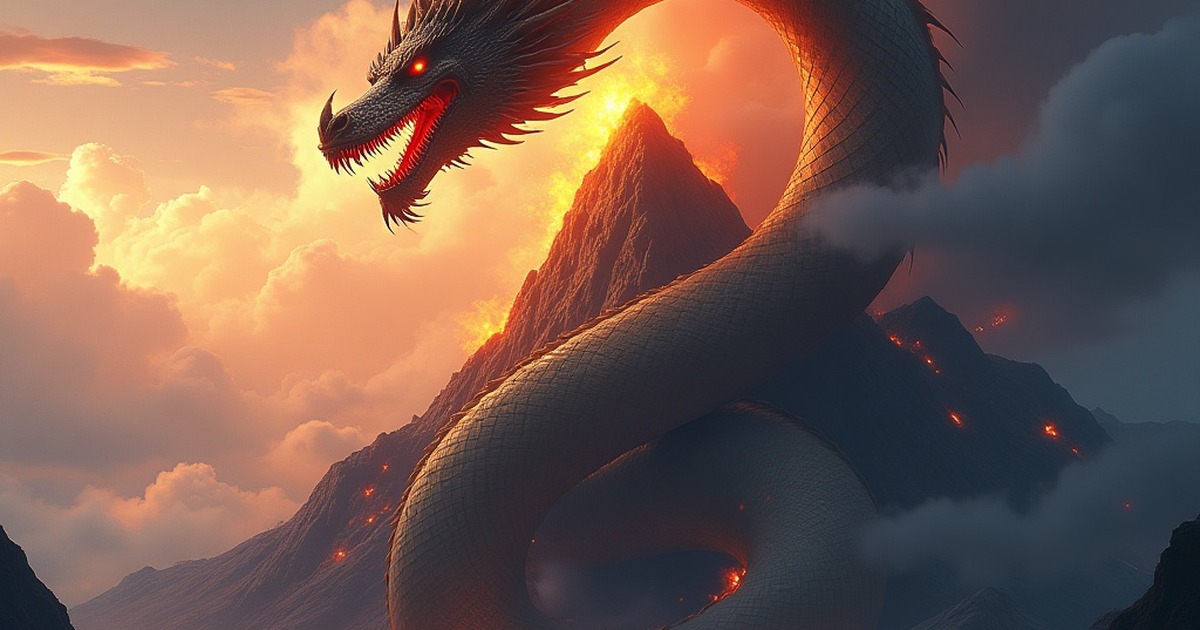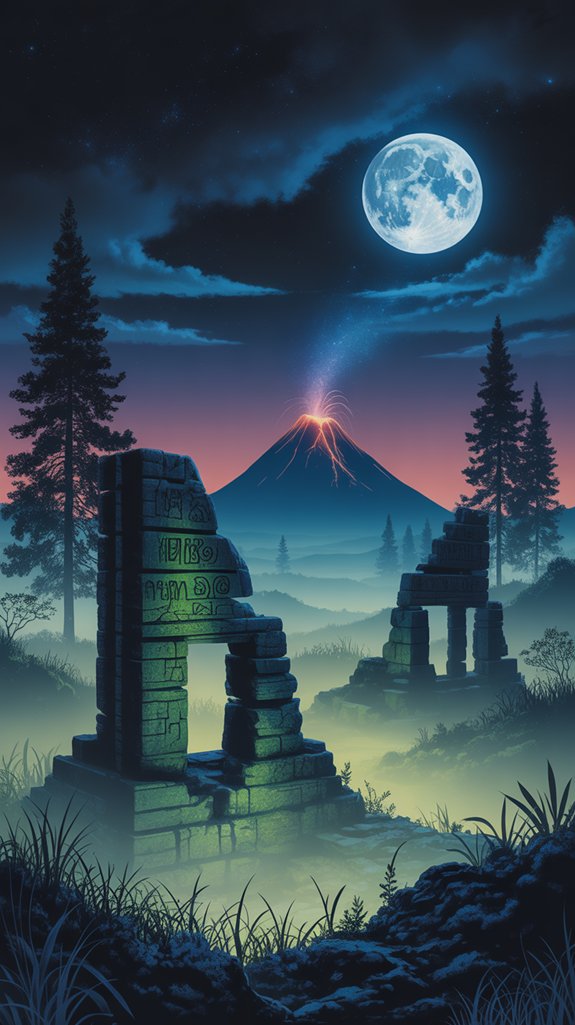
You'll find volcano spirits across every fire-scarred landscape—Pele commanding Hawaii's lava flows, Pillan merging with Chile's volcanic ancestors, Batara Mahadewa presiding over Indonesian craters. These aren't primitive superstitions but sophisticated geomythologies where eruptions manifest as divine retribution for human transgression, where offerings of flowers and livestock negotiate with geological consciousness itself. The Klamath preserved Crater Lake's cataclysmic birth through oral traditions spanning seven millennia, while contemporary volcanologists now consult tribal knowledge-keepers, discovering that ancestral warnings about volatile peaks align precisely with seismic data and tephra chronologies, revealing how these eldritch narratives encode survival protocols within mythic frameworks that continue guiding communities today.
Key Takeaways
- Cultures worldwide view volcanoes as conscious spirits like Pele, Pillan, and Batara Mahadewa rather than mere geological formations.
- Eruptions are interpreted as divine responses to human behavior, requiring rituals and offerings to maintain spiritual harmony.
- Oral traditions encode volcanic events into myths, preserving eruption chronologies and hazard zones across generations without written records.
- Volcano legends like Skell and Llao's battle merge geological observations with mythic narratives, creating sophisticated environmental documentation.
- Modern volcanology increasingly integrates indigenous knowledge with scientific monitoring, validating ancestral wisdom about volcanic behavior and eruption patterns.
Mountains Alive With Spirits

When the earth trembles and smoke rises from ancient peaks, countless cultures recognize not mere geological processes but the stirring of conscious, willful entities—spirits who've inhabited volcanic mountains since time immemorial.
These sacred landscapes pulse with ancestral connections, their slopes harboring memories older than written history.
The Mapuche honor the Pillan—eldritch forces dwelling within Chile's volcanic chain, each peak a chimeric fusion of ancestor and elemental power.
Through offerings and ritual acknowledgment, communities maintain reciprocal bonds with these mountain spirits, understanding that neglect breeds catastrophe.
Eruptions aren't random events. They're responses.
Across continents, indigenous traditions describe life-altering narratives: giants petrified into peaks, mythical beings crystallized into stone.
Physical geography becomes spiritual archive. These aren't metaphors but lived realities, where volcanic activity signals the mountain's mood, its satisfaction or displeasure with human behavior.
Remembrance matters. Respect endures.
The mountains watch, breathe, decide.
##
You'll find that volcanic spirits transcend the Mapuche worldview, manifesting across continents as elemental beings who convert Earth's molten core into sacred narrative.
From Polynesia's Pele dwelling in Kīlauea's churning caldera to Indonesia's Gunung Agung sheltering Batara Mahadewa, these eldritch presences demand recognition through offerings—flowers, livestock, incense—lest their divine fury rupture the world's skin.
The crater becomes threshold, chimeric space where human supplication meets geological violence, where communities negotiate survival through ritual technologies as ancient as fire itself.
These supernatural beings serve as fundamental elements in the worldview of volcanic societies, explaining both the origins of their landscapes and the capricious forces that reshape them.
Sacred Flames Across Cultures
Across the volcanic arcs and fault lines of our planet, where tectonic plates grind against one another in their ancient, relentless dance, cultures separated by vast oceans and millennia have independently recognized flame as the visible breath of the divine.
You'll find sacred flames interpreted through remarkably parallel lenses: the Hawaiian Pele wielding volcanic fire as both creative and destructive force, the Mapuche Pillan demanding offerings to maintain cosmic equilibrium, the Klamath witnesses documenting supernatural warfare through eruption.
These aren't mere metaphors. They're testimonies to humanity's unmediated encounter with something eldritch, something that transcends the mundane boundaries you've inherited.
Cultural interpretations converge on a singular truth—where mountains breathe fire, the spirits speak, and your reverence becomes the necessary response to forces that shaped continents before your ancestors learned speech.
These volcanic narratives function as creation myths, explaining not only natural phenomena but the very origins of landscapes and the institutions that grew from humanity's relationship with earth's primal forces.
Spirits Dwelling in Craters
Where lithospheric ruptures pierce the world's surface, creating calderas that plunge toward the mantle itself, indigenous cosmologies insist something watches from below—sentient, ancient, demanding recognition.
You'll find the Mapuche's Pillan dwelling in volcanic throats, spirit guardians who remember your ancestors' names. These entities don't merely inhabit stone; they constitute the mountain's consciousness itself. Their moods dictate eruption cycles. Their hunger requires appeasement.
Communities maintain bonds through crater offerings—textiles, chicha, prayers carried on sulfurous winds. Neglect invites catastrophe. The spirits' emotional states manifest geologically: rage becomes pyroclastic flow, contentment yields dormancy.
This isn't primitive superstition but sophisticated ecological philosophy. When you honor these eldritch presences, you're acknowledging forces that transcend your modern frameworks—chimeric beings whose power predates your civilization's first breath.
Eruptions as Divine Anger
When magma breaches containment and alters landscape into scorched wasteland, traditional societies don't invoke tectonic mechanics—they recognize retribution.
You'll find eruptions symbolizing wrath across continents: the Klamath witness Skell and Llao's eldritch combat birthing darkness, their battle reshaping Crater Lake through chimeric forces.
Mount Baker's Komo Kulshan releases landslides when disrespected, the mountain's consciousness responding to transgression.
Hawaii's Pele embodies this paradigm most vividly—her volcanic temperament manifesting as molten fury, emotional turbulence made geological.
These aren't primitive misunderstandings but sophisticated frameworks where divine messages interpreted through seismic violence demand reciprocity.
Communities developed intricate protocols of appeasement, understanding that mountain spirits required reverence, offerings, careful conduct.
Ignore these ancient contracts at your peril. The earth remembers disrespect, and spirits dwelling in magma chambers possess long memories, infinite patience.
Volcanic Deities and Offerings
Ritual significance permeates every offering: flowers, food, reverence itself becomes currency in negotiations with geological consciousness.
Neglect these protocols? Mountains remember. Eruptions follow forgotten covenants, catastrophic reminders that reciprocity flows both ways.
Your ancestors understood—harmony requires vigilance, remembrance, the courage to honor powers beyond human dominion.
Ancient Pacific Ring Eruption Accounts

You'll find that pre-Columbian communities encircling the Pacific's volcanic rim preserved eldritch testimonies of eruptions through oral traditions that transcended mere historical record—these weren't simple chronicles but sacred knowledge systems binding cosmology to geological violence.
The Pacific Northwest's Indigenous peoples, from the Tlingit to the Lummi, encoded volcanic cataclysms within their narrative architectures, altering pyroclastic devastation into chimeric spirit-battles where mountains themselves became conscious actors in humanity's drama.
Through carefully structured transmission methods—ceremonial recitations, initiation rites, seasonal storytelling—these communities maintained millennium-spanning memories of eruptions that modern volcanology has only recently confirmed through tephra analysis and radiocarbon dating.
Pre-Columbian Oral Tradition Records
Throughout the volcanic crescents of the Pacific Ring, Indigenous peoples wove catastrophic eruptions into their cosmological frameworks, changing geological violence into sacred narrative—a process ethnologists now recognize as sophisticated environmental documentation.
Your ancestors watched mountains collapse. They encoded pyroclastic devastation within oral tradition, converting Mount Mazama's cataclysm into Skell's triumph over the eldritch Llao. These volcanic narratives weren't mere mythology—they were mnemonic technologies, preserving eruption chronologies through generations without written script.
The Kalispel witnessed Mount St. Helens' fury as chimeric apocalypse. The Spokane interpreted ash clouds as spiritual warfare. Each telling refined observational precision, embedding geological markers within ceremonial contexts.
These traditions functioned as both historical record and cautionary wisdom, demanding respect toward volatile peaks like Rainier and Baker. Sacred knowledge, rigorously maintained.
Pacific Northwest Volcanic Legends
Where Cascade peaks puncture the gray Pacific sky, Indigenous communities constructed elaborate theological frameworks around volcanic temperament—frameworks that encoded genuine geological observation within mythic architecture. You'll discover volcano legends altering catastrophic eruptions into divine warfare: Skell and Llao's chimeric battle birthing Crater Lake from Mazama's collapsed caldera. These cultural narratives weren't primitive superstition but sophisticated mnemonic devices preserving seven millennia of geological memory.
| Sacred Peak | Indigenous Name | Mythic Manifestation |
|---|---|---|
| Mount St. Helens | Loowit | Cannibal beings dwelling within smoking stone |
| Mount Mazama | Giiwas | Llao's subterranean domain breaching surface reality |
| Mount Rainier | Tacobud | Bleeding mountain weeping rivers of eldritch fire |
| Cascade Range | — | Battleground where Above World confronts Below World forces |
Oral traditions established forbidden zones around devastated landscapes—practical cartography disguised as spiritual prohibition, protecting generations from pyroclastic ghosts still haunting ancient ashfall boundaries.
Indigenous Knowledge Transmission Methods
When Polynesian navigators committed eruption chronologies to chant-cycles spanning forty generations, they weren't merely preserving history—they were encoding survival algorithms within rhythmic memory architecture that predated written language by millennia.
These oral traditions altered geological catastrophes into pedagogical frameworks, where eldritch mountain spirits became mnemonic vessels for hazard zones and eruption intervals.
The Klamath embedded Mount Mazama's cataclysmic collapse within sacred narratives, ensuring descendants recognized Crater Lake's chimeric beauty as ancestral warning.
Cultural preservation demanded more than recitation—it required ceremonial performance, where rhythm and melody locked geological data into neurological pathways resistant to generational decay.
You witness here humanity's earliest disaster preparedness systems, where volcano spirits served dual functions: objects of reverence and repositories of empirical observation, bridging metaphysical understanding with pragmatic survival knowledge across centuries.
*Hawaiian Vs Andean Deity Types**

While volcanic deities across cultures share fundamental connections to earth's molten fury, the divine hierarchies of Hawaiian and Andean traditions reveal strikingly divergent cosmological architectures.
You'll find Hawaiian reverence centers on Pele's eldritch fire-realm, where volcanic symbolism manifests through ancestral worship of living kin. Her domain pulses with chimeric intensity—Hi'iaka, Laka, and other family members embody natural phenomena directly. These deity relationships demand offerings, respect, recognition of the volcano's creative-destructive duality.
Andean reciprocity operates differently. Here, agricultural fertility supersedes fire's dominance. Pachamama and Inti command a broader pantheon where cultural narratives interweave earth's abundance with celestial cycles.
| Aspect | Hawaiian | Andean |
|---|---|---|
| Primary Focus | Fire, lava, volcanic creation | Earth, sun, agricultural cycles |
| Key Deity | Pele (volcano goddess) | Pachamama (earth mother) |
| Relationship Model | Kinship, direct offerings | Reciprocal exchange, fertility rites |
Both traditions honor mountains that breathe. Yet their cosmological frameworks diverge fundamentally—one blazing with volcanic kinship, the other rooted in terrestrial abundance.
Fire as Divine Punishment Theme
Across the volcanic archipelagos and mountain ranges where earth's fury breaches the surface, ancient cultures forged narratives of cosmic retribution—frameworks through which molten stone became divine judgment, changing geological violence into moral imperative.
You'll discover volcanic symbolism etched into humanity's oldest warnings: mountains altered into sentient arbiters of morality, their eruptions calibrated responses to transgression.
The Klamath preserved divine retribution through Skell and Llao's eldritch confrontation, darkness swallowing lands where deities warred.
Consider these chimeric manifestations:
- Mount St. Helens: Interpreted as punishment for severed bonds between community and earth-spirits
- Crater Lake's formation: Physical evidence of apocalyptic judgment, crater depths measuring spiritual debt
- Tribal reverence protocols: Ritualized acknowledgment preventing catastrophic divine displeasure
You're witnessing theological geology—mountains breathing condemnation through incandescent plumes.
These narratives liberate you from viewing eruptions as random catastrophe, revealing instead reciprocal cosmologies where respect sustains existence, negligence summons annihilation.
Ancient observers understood: fire descends when harmony fractures.
Pele's Battles With Snowgoddess
You witness in these Hawaiian narratives an eldritch confrontation where Pele's molten fury collides with Poli-Ahu's glacial sovereignty, their territorial disputes carving the archipelago's chimeric landscape through epochs of elemental warfare.
The snow goddess claims Mauna Kea's summit as her sacred domain, while the fire deity asserts dominion over the volcanic slopes below, their boundaries shifting with each eruption, each unseasonable frost.
These aren't mere mythological conceits—they're indigenous frameworks for understanding the thermodynamic tensions that shaped Hawaii's geology, where lava tubes pierce through permafrost and steam vents puncture snow fields in defiance of natural law.
Fire Meets Ice: Rivalry
Though separated by millennia of oral tradition and countless retellings, the elemental clash between Pele and Poli-Ahu remains one of Polynesia's most compelling theological narratives—a cosmological drama where molten basalt confronts crystalline frost atop Mauna Kea's sacred summit.
You'll discover how the fire goddess and ice goddess embody mythological symbolism transcending mere entertainment, representing profound environmental impact through their eldritch confrontations. Their battles forge volcanic landscapes while maintaining elemental balance—creation destruction intertwined, neither force conquering permanently.
This cultural significance resonates through generations, demonstrating how natural forces shape both geography and consciousness. The rivalry's climatic influence manifests tangibly: Pele's eruptions versus Poli-Ahu's frozen peaks, a chimeric duality essential to Hawaiian cosmology.
Here exists freedom's paradox—opposing powers sustaining equilibrium, teaching that true liberation requires embracing contradiction.
Sacred Territory Claims
When Pele first claimed Kilauea's smoldering caldera as her eternal sanctuary, she didn't merely occupy territory—she consecrated it through volcanic transubstantiation, altering basalt and obsidian into divine demarcation.
You'll find that ancient Hawaiians recognized these sacred landscapes as boundaries demanding reverence, where Pele's divine guardianship manifested through molten declarations against Poli-Ahu's encroaching frost.
Each eruption became territorial assertion, chimeric displays of sovereignty that warned rival deities against trespass. The goddess changed geographical features into spiritual cartography—lava flows marking property lines between fire's dominion and winter's domain.
These weren't abstract claims but tangible, eldritch changes where volcanic rock itself testified to ownership. Hawaiian oral traditions preserve this understanding: respecting Pele's territory meant acknowledging her absolute dominion over these consecrated grounds, where disobedience invited catastrophic retribution.
Elemental Forces Clash
Beyond these territorial pronouncements lay something far more volatile—the catastrophic encounters between Pele's ascending magma and Poli-Ahu's glacial descent upon Mauna Kea's summit.
You'll witness here no gentle elemental harmony, but rather a divine rivalry etched into Hawaii's very geology. When Pele's molten wrath surges upward, meeting Poli-Ahu's crystalline domains, the earth itself convulses.
These eldritch confrontations birthed volcanic spectacles ancient Hawaiians understood as sacred warfare—fire goddess against snow deity, each claiming dominion through elemental supremacy.
The balance they achieved wasn't peace but perpetual tension, a chimeric state where opposing forces coexisted through constant struggle.
Their battles manifested in observable phenomena: eruptions cracking through permafrost, steam clouds rising where heat met ice.
This mythological framework offered your ancestors interpretive power over an unpredictable landscape, altering chaos into comprehensible divine narrative.
Volcano Deities in Contemporary Media
As digital screens illuminate faces across continents, volcano deities—those primordial entities born from magma's eldritch depths—have surged into contemporary media with unprecedented significance, their essence altered yet undiminished.
You'll encounter Pele's volcanic symbolism throughout animated narratives, her dual nature embodying creation's genesis and obliteration's finality. These cultural representations manifest across multiple platforms:
- Interactive gaming environments where you command chimeric volcano spirits, steering environmental stewardship through indigenous wisdom.
- Graphic novels that resurrect ancestral guardians as protectors of geological consciousness.
- Social media communities celebrating traditional iconography through contemporary artistic interpretation.
Literary adaptations reshape these deities into vibrant forces influencing human destiny, their mythological resonance preserved within modern storytelling frameworks.
Ancient fire deities transcend time through narrative reimagining, their primordial power channeled into contemporary tales that reshape mortal trajectories.
You witness sacred knowledge democratized yet honored, ancient beliefs rendered accessible without dilution. This resurgence represents more than entertainment—it's cultural preservation through digital transmission, ensuring volcano spirits endure, breathing fire into collective imagination while maintaining ceremonial gravitas across generations.
Geological Origins of Volcano Myths
Though ancient peoples possessed no seismographs or petrological laboratories, they documented volcanic phenomena with startling precision—their myths encoding geological truths within narrative frameworks that sustained cultural memory across millennia.
The Klamath people's chronicles of Mount Mazama captured the mountain's cataclysmic collapse, their narrative of celestial combat preserving the volcanic origins that birthed Crater Lake.
You'll find similar patterns threading through Northwest traditions surrounding Mount St. Helens, where eldritch beings and cannibalistic spirits marked territories of geological violence.
Geomythology reveals how cultural interpretations altered eruptions into chimeric battles, dragons, and warring titans. These weren't mere fantasies. They were mnemonic devices encoding pyroclastic behavior, tephra distribution, landscape alteration.
The oral traditions functioned as geological archives, though caution remains necessary—generations reshape narratives, obscuring direct correlations between specific eruptions and their mythic counterparts.
Yet the pattern persists: where mountains breathe fire, stories preserve their fury.
Modern Hazard Prediction Insights
While ancestral narratives preserved volcanic memory through metaphor and myth, contemporary volcanology has woven seismographs and spectrometers into an equally potent system of prediction—one that increasingly recognizes the prophetic value embedded within those ancient chronicles.
You'll find scientists now coupling real time monitoring of seismic activity with indigenous oral traditions, creating chimeric frameworks where gas emission sensors dialogue with ceremonial warnings passed through generations.
Satellite arrays track ground deformation while elders recount familial escape routes carved during ancestral eruptions. This synthesis acknowledges what industrial rationalism once dismissed: communities dwelling beneath volcanic shadows developed sophisticated hazard literacies, encoded in ritual and story.
Modern volcanologists collaborate with these knowledge-keepers, discovering that grandmother's tale of mountain breathing patterns corresponds precisely to pre-eruption fumarole behavior. The data streams merge.
Ancient and contemporary prophecies converge in evacuation plans that honor both spectrometer readings and spiritual thresholds, forging survival strategies from dual epistemologies.
Myths Meet Modern Science
The convergence reaches its fullest expression in geomythology—that emergent discipline where tephra layers become textual evidence and oral chronicles change into seismic calendars.
You'll discover how Klamath oral traditions, once dismissed as chimeric fancy, now correlate precisely with Crater Lake's cataclysmic formation seven millennia past. Mythological interpretations evolve into geological truths when ethnologists map spirit-giant narratives onto stratigraphic sequences.
The eldritch fire-beings haunting Mount Hood and Mount St. Helens weren't mere superstition. They were mnemonic devices. Survival protocols encoded in symbol. Modern volcanology validates what your ancestors preserved through generations—that certain peaks harbor volatile temperaments, that smoking summits demand reverence and distance.
Indigenous fire-being legends encoded volcanic hazard knowledge as mnemonic survival protocols—ancestral wisdom now validated by contemporary geological science.
Recent eruptions haven't diminished these legends. They've amplified them. Scientists now consult tribal knowledge-keepers, recognizing that ash-fall patterns and pyroclastic testimonies survived where written records perished.
This synthesis liberates understanding from institutional constraints, acknowledging that wisdom flows through multiple channels—seismographs and songs alike.
Frequently Asked Questions
How Do Different Cultures Perform Rituals to Appease Volcano Spirits Today?
You'll find cultural variations persist across volcanic regions, from Hawaii's annual Pele ceremonies involving chants, lei offerings at Halemaʻumaʻu Crater, to Indonesia's Kasada Festival where Tenggerese pilgrims hurl livestock, vegetables into Mount Bromo's caldera.
The ritual significance endures. Japan's Shinto priests conduct Asama Shrine purifications with sake libations, sacred rice.
These aren't quaint performances—they're living traditions, eldritch contracts between humanity and primordial forces, practiced by communities who understand mountains as sentient beings demanding reciprocal respect.
What Offerings Were Traditionally Given to Volcano Deities Across Various Civilizations?
Like flames demanding fuel, you'll find volcano deities consumed sacred offerings spanning precious metals to human lives.
Ancient Hawaiians cast pork, fish, and ‘ohelo berries into Halema'uma'u Crater for Pele. Aztecs offered jade, obsidian—even beating hearts—to Popocatépetl's eldritch fires. The ritual significance transcended mere appeasement; these chimeric exchanges bound mortals to primordial forces.
Romans scattered wine and incense at Vulcan's altars, while Balinese devotees still present flowers, rice, blood at sacred Agung shrines, maintaining ancient covenants.
Are There Any Documented Cases of Eruptions Matching Mythological Prophecies?
You'll find compelling eruption predictions woven through Iceland's saga literature, where 1104's Hekla eruption aligned eerily with Norse prophetic verses describing fire-mountains heralding change.
Mount Vesuvius's 79 CE devastation echoed Sibylline oracles warning of “earth's burning breath.”
Yet mythological accuracy remains elusive, chimeric—these correlations reflect pattern-seeking consciousness rather than supernatural foresight.
Ancient observers documented seismic precursors, translating geological signs into prophetic frameworks.
You're witnessing humanity's eternal struggle: reading earth's eldritch language through cultural lenses, altering raw observation into transcendent meaning.
How Have Volcano Myths Influenced Local Architecture and Settlement Patterns Historically?
You've inherited landscapes shaped by reverence and dread—ancient cartographies written in ash.
Throughout Indonesia, Japan, and Mesoamerica, volcanic architecture deliberately positions temples, shrines, and dwellings beyond perceived divine boundaries.
Settlement patterns reveal your ancestors' eldritch wisdom: communities clustered at respectful distances, creating buffer zones they considered sacred thresholds.
The Balinese *pura* temples face Agung's summit; Kamchatka's villages maintain chimeric distances from Klyuchevskaya.
You're witnessing millennia of negotiation between human ambition and mountain spirits—defensive geographies born from mythological memory, not mere geological prudence.
Do Modern Volcanologists Consult Indigenous Myths When Studying Specific Volcanoes?
You'll find contemporary volcanologists increasingly embrace indigenous knowledge through scientific collaboration, recognizing ancestral narratives encode geological truths.
Hawaiian oral histories guided researchers to Kīlauea's hidden lava tubes; Māori accounts revealed Taupō's eruptive chronology.
These partnerships aren't mere consultation—they're recognition that communities dwelling beside eldritch peaks possess generations of observation.
The chimeric fusion of empirical data with traditional wisdom creates richer understanding, liberating science from colonial constraints while honoring those who've read volcanic breath for millennia.
Conclusion
You've traversed millennia of volcanic mythos, witnessed Pele's eldritch fury clash with primordial ice, traced chimeric deities across tectonic boundaries. Now you stand at that liminal threshold where magma meets meaning, where seismographs decode what shamans once divined through sacrifice and prophecy. The mountains haven't stopped breathing fire—they've merely exchanged oracles for volcanologists. Yet in every pyroclastic surge, in every sulfurous exhalation, ancient spirits whisper still. Listen closely. They're teaching survival.