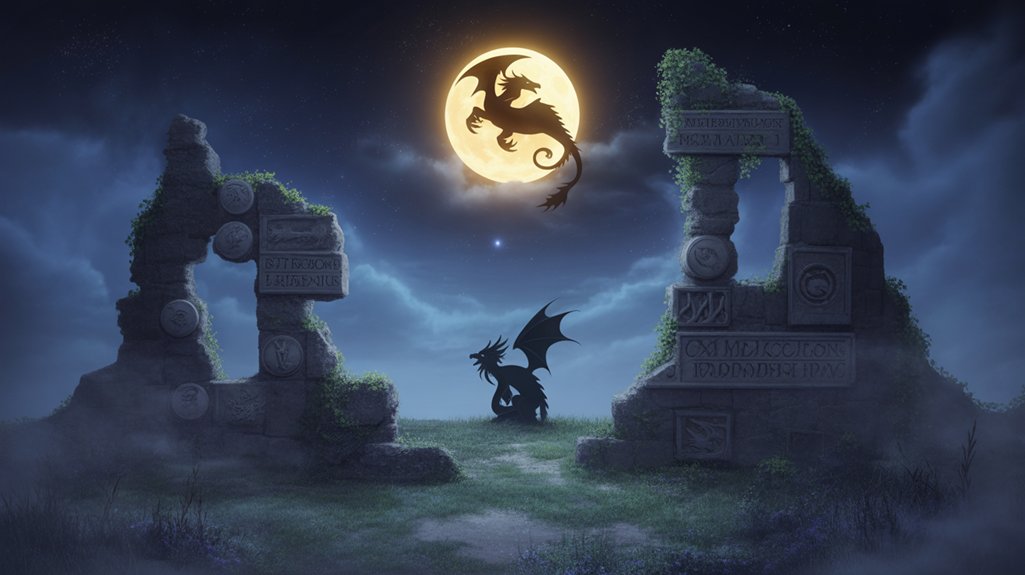
Dragons embody mythology's fundamental paradox—Eastern *lóng* manifest as celestial guardians controlling agricultural fertility and cosmic harmony, while Western wyrms represent chaos, greed, and Satan's primordial evil requiring heroic annihilation. This duality stems from cultural priorities: agrarian societies revere water-bringing protectors, whereas warrior civilizations demand monstrous adversaries to conquer. From Tiamat's creation-destruction dichotomy to Fafnir's corrupting treasure-hoards, dragons mirror humanity's ambivalent relationship with concentrated power and untamed nature. Contemporary literature continues exploring these chimeric archetypes, revealing deeper truths about civilization's eternal struggle between order and chaos that ancient traditions preserve.
Key Takeaways
- Dragons embody humanity's ambivalence toward power, simultaneously representing salvation and destruction across different civilizations and cultural contexts.
- Eastern dragons serve as benevolent protectors ensuring cosmic harmony, controlling weather and agricultural fertility as celestial guardians.
- Western dragons symbolize chaos, greed, and evil, requiring heroic intervention to restore order and tame destructive forces.
- Dragons represent the eternal struggle between chaos and order, hoarding treasures as concentrated natural power threatening civilization's boundaries.
- Modern adaptations depict dragons as complex figures—both allies and adversaries—reflecting humanity's contradictory relationship with power and nature.
Dragons: Saviors or Destroyers?

How can a single mythological creature embody both salvation and annihilation across the span of human civilization? Dragon symbolism reveals humanity's profound ambivalence toward power itself, manifesting in chimeric forms that defy simple categorization.
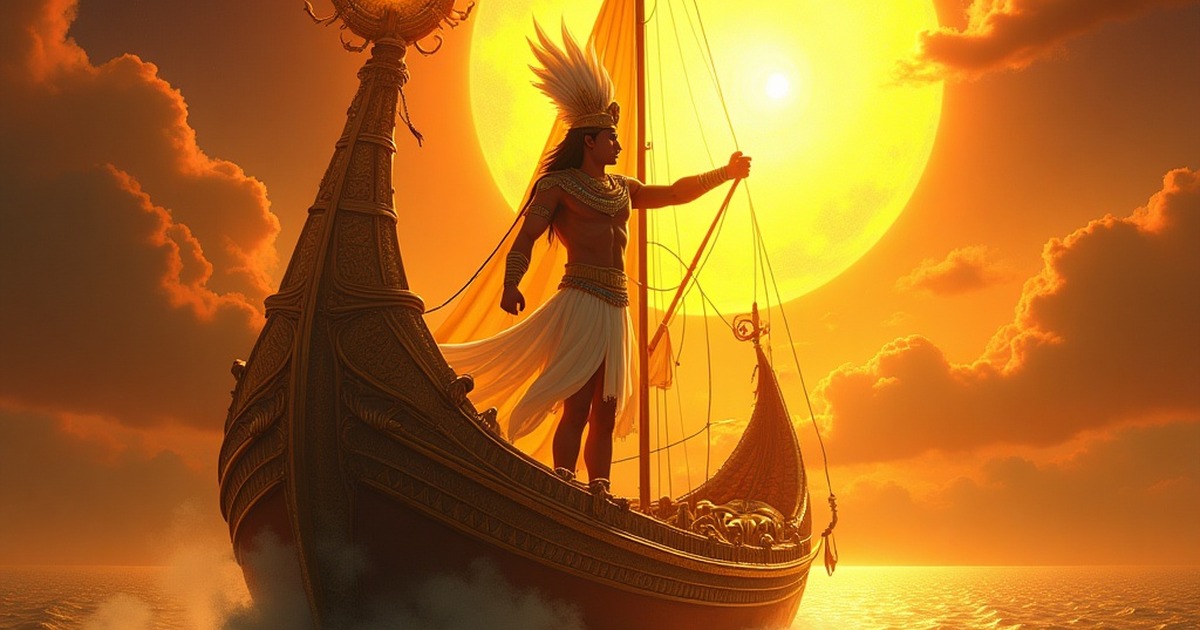
Chinese dragons, serpentine and eldritch, command rainfall for agricultural prosperity, their presence ensuring survival. Yet Apep writhes through Egyptian darkness, eternally threatening Ra's solar journey with primordial chaos.
Western traditions cast dragons as hoarded wealth and ash. Destruction incarnate.
This duality extends beyond simple good-versus-evil frameworks. Iranian Azhi Dahaka opposes Rostam not merely as villain but as crucible, the necessary adversary through which hero archetypes achieve metamorphosis.
Saint George's dragon symbolizes conquered evil, yet its defeat represents humanity's struggle against internal darkness rather than external threat alone.
Even Smaug's greed reflects corrupted power's seductive nature, his treasure-guarded mountain becoming metaphor for ambition's dangerous allure.
Dragons mirror civilization's deepest anxieties and highest aspirations simultaneously. These timeless tales continue to convey moral lessons about power's dual nature, inviting each generation to interpret their symbolic meaning anew.
##
The geographic divide between East and West manifests most strikingly in dragon morphology and purpose, where Chinese *lóng* emerge as celestial benefactors wielding dominion over monsoon rains and harvest abundance, while their European counterparts—scaled, fire-breathing engines of avarice—threaten pastoral existence itself.
These polarized representations aren't mere aesthetic choices but rather crystallizations of foundational cosmologies: Eastern traditions embracing dragons as agents of cosmic harmony, Western narratives positioning them as primordial chaos requiring heroic subjugation.
The cultural architectures that birthed these creatures reveal profound truths about how civilizations conceptualize power, with protection and destruction existing not as absolutes but as interpretive frameworks shaped by agrarian necessity, imperial symbolism, and the eternal human struggle to impose order upon an eldritch universe.
Eastern Dragons as Protectors
While Western civilizations crafted dragons as malevolent hoarders deserving of slaughter, Eastern cultures raised these serpentine beings into celestial guardians whose very presence sanctified the land.
The Lóng embodied wisdom, strength, and benevolence—no chimeric terror, but rather an eldritch force channeling agricultural prosperity through rain and rivers. Dragon Kings commanded seas and weather, intermediaries between mortal domain and heaven itself, maintaining cosmic balance with divine authority.
Cultural interpretations diverged profoundly: these wingless, serpentine forms appeared in temples and palaces as treasure guardians, fortune bringers, protectors of natural order. Dragon symbolism permeated ritual life—dances undulating through festival streets, boats racing across sacred waters—each ceremony invoking blessings for fertility and harvest.
Japan's Ryū continued this reverence, solitary water deities embodying nature's inherent harmony. Liberation through protection, not destruction.
These myths and legends served as fundamental narratives explaining natural phenomena and societal ideals, transforming dragons from mere beasts into cornerstones of Eastern cosmology.
Western Dragons as Threats
Across medieval European landscapes, dragons materialized as apocalyptic harbingers—scaled embodiments of avarice, devastation, and primordial chaos that demanded annihilation rather than veneration.
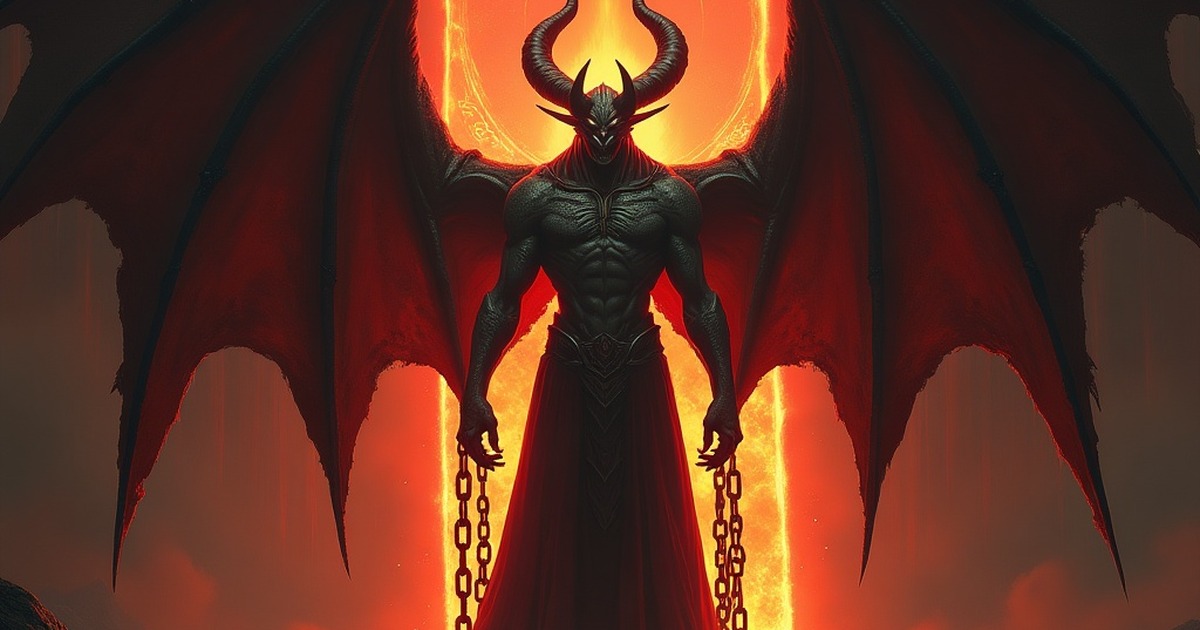
Dragon symbolism in Christian iconography equated these eldritch serpents with Satan himself, positioning them as irredeemable adversaries within cosmic warfare narratives. Fafnir exemplified this alteration—a dwarf corrupted by greed into something chimeric and monstrous, hoarding gold until Sigurd's blade brought liberation.
Hero archetypes emerged specifically to confront these territorial beasts; Saint George's legendary confrontation crystalized civilization's need to destroy rather than coexist. Unlike Eastern counterparts, Western dragons couldn't be reasoned with, appeased, or honored.
They guarded treasures zealously, breathed annihilation, represented everything untamed that threatened ordered society. Their existence demanded heroic response. Unconditional warfare. The sword, not supplication. Complete eradication of the threat they embodied.
Cultural Values Shape Roles
When dragon-lore sprawls across civilizational boundaries, it reveals cartographies of the human psyche—each culture projecting its deepest anxieties and aspirations onto these serpentine titans.
Chinese dragons embody agricultural prosperity and cosmic harmony, their sinuous forms channeling life-giving rains across rice terraces. Western wyrms hoard gold, manifesting feudal fears of unchecked power and avarice. This cultural symbolism alters identical chimeric forms into contradictory archetypes.
Iranian Azhi Dahaka and Levantine Lōtanu represent eldritch chaos requiring heroic subjugation, while Eastern lung dragons guard natural order itself. The moral dichotomy isn't arbitrary—it crystallizes societal values.
Agrarian civilizations revere water-bringers; warrior cultures demand monstrous adversaries for their champions. Dragons become mirrors, reflecting whether communities prize harmony or conquest, collaboration or individual glory.
Chaos Versus Order Battles
Beyond these cultural reflections lies mythology's most primal narrative architecture: the cosmic confrontation between formlessness and structure.
Dragons embody eldritch chaos—the untamed, instinctual forces threatening civilization's fragile boundaries. Heroes confronting these serpentine guardians don't merely seek glory; they wage metaphysical warfare against dissolution itself.
The mythical symbolism runs deeper than simple good versus evil. These chimeric beasts hoard treasures not from greed but as manifestations of nature's raw power concentrated, crystallized, made tangible.
Warriors who face them represent humanity's desperate need for control, for pattern imposed upon randomness. This narrative duality reveals profound truths: dragons simultaneously protect sacred spaces while menacing those who approach, embodying the paradox that order and chaos aren't opposites but interdependent forces.
The battle never truly ends—it cycles eternally through consciousness itself.
Mesopotamian Serpent Deities Documented
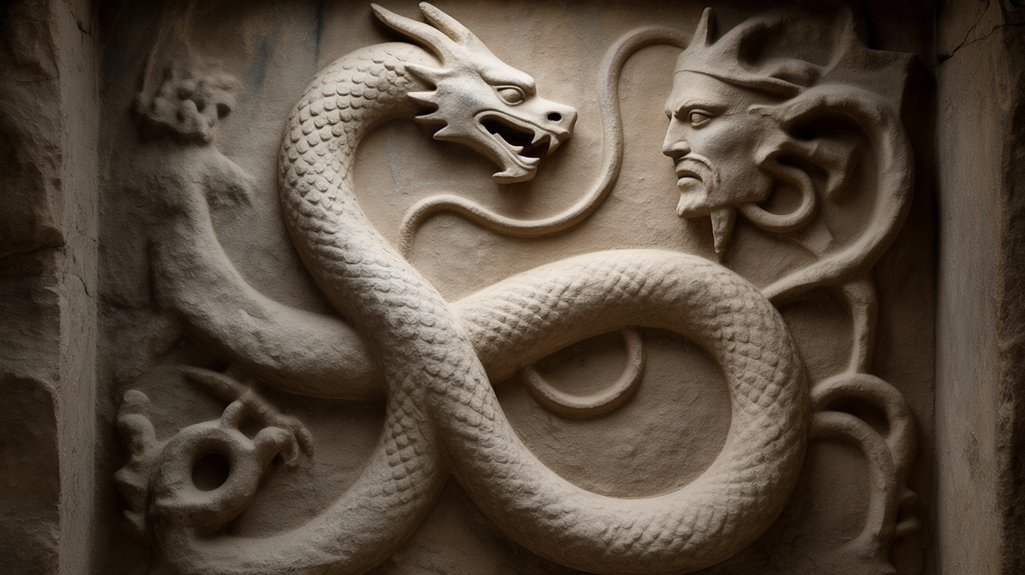
In the fertile crescent of the Tigris-Euphrates River Valley, where humanity's earliest cities rose from alluvial plains circa 3500 BCE, the Babylonians chronicled Tiamat—the primordial dragon-goddess whose churning salt waters embodied the eldritch forces of chaos that predated creation itself.
The Enūma Eliš, compiled during the reign of Nebuchadnezzar I (1125-1104 BCE), recounts how Marduk, patron deity of Babylon, cleaved her massive serpentine form to establish cosmic order, splitting her body to fashion heaven and earth from her corpse.
This violent theomachic struggle between divine authority and chimeric primeval disorder became the foundational cosmogonic narrative of Mesopotamian civilization, encoding within its cuneiform tablets the eternal tension between structured kingship and untamed nature.
Tiamat in Babylonian Texts
The ancient scribes of Babylon recorded Tiamat's presence in the *Enuma Elish*, a cosmogonic text dating to the late second millennium BCE, where she emerges not as mere monster but as *mummu*—the primordial mother of all existence.
Her eldritch form, part serpent and part chimeric dragon, embodied the saltwater abyss from which gods themselves sprang forth. Tiamat's symbolism defies simplistic interpretation: she births deities, nurtures cosmic potential, yet changes into destroyer when her divine offspring threaten her dominion.
Marduk's violent triumph—splitting her corpse to forge sky and earth—reveals creation myths' brutal truth. Order requires chaos's annihilation.
Her dual nature persists across millennia, influencing dragon archetypes worldwide. Mother. Monster. Both simultaneously. Tiamat teaches that heroism and villainy occupy the same liminal threshold.
Tigris-Euphrates River Valley Origins
| Creature | Physical Form | Symbolic Role |
|---|---|---|
| Mušḫuššu | Snake-bodied, lion-forelimbed | Divine protection, guardian force |
| Ušumgal | Serpentine deity-companion | Godly power, cosmic authority |
| Tiamat | Primordial sea-dragon | Chaos incarnate, creation's womb |
| Apsu | Freshwater serpent-god | Primeval order, masculine principle |
Dragon symbolism oscillated between cosmic threat and sanctified protector—duality reflecting humanity's eternal negotiation with untamed forces. These scaled deities embodied both generative potential and annihilating fury, their ambivalence mirroring the rivers themselves: life-giving channels that periodically released devastating floods.
Chaos Versus Cosmic Order
When primordial Tiamat stirred in the abyssal depths of the Apsû, her serpentine coils contained all the unbounded potential of pre-creation—that terrifying, generative chaos preceding form itself.
The Enûma Eliš chronicles her inevitable confrontation with Marduk, whose blade severed her draconic form, altering chaotic nature into structured cosmos. Her defeat wasn't mere annihilation but transmutation—ribs becoming sky-vault, tears flowing as Tigris and Euphrates.
This mythical symbolism permeates Mesopotamian consciousness: the mušḫuššu's chimeric anatomy (serpent-bodied, lion-limbed) embodied civilization's perpetual negotiation with untamed forces, while the ušumgal threatened divine sovereignty itself.
Temple reliefs immortalize these confrontations—gods wrestling eldritch serpents, establishing cosmic law through sacred violence.
Here dragons represent freedom's double edge: liberation from stagnation, yes, but also dissolution's terrible promise.
Chinese Dragons Bring Fortune
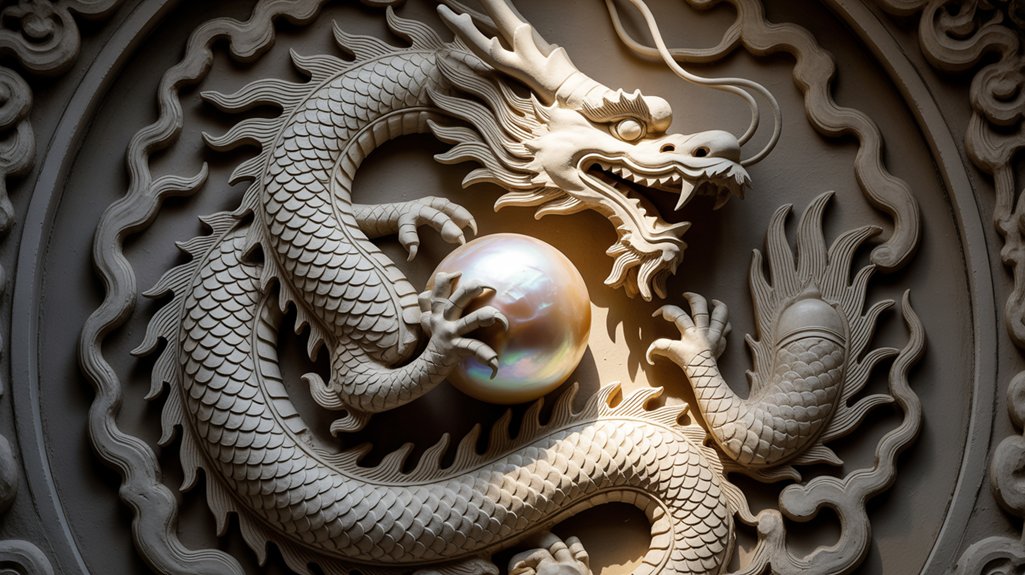
Unlike their Western counterparts who hoard gold in mountain lairs and release devastation upon hapless kingdoms, Chinese dragons—the *Lóng*—emerge from ancient mythology as celestial benefactors, their serpentine forms coiling through the cultural consciousness of East Asia as harbingers of prosperity, agricultural abundance, and imperial legitimacy.
Dragon symbolism permeates every stratum of traditional Chinese cosmology. The Dragon Kings command water and weather from their subaquatic palaces, invoked through ritual supplication to guarantee fortune blessings upon rice paddies and wheat fields. Emperors claimed descent from these creatures—Sons of Heaven wrapped in dragon-emblazoned silk.
| Aspect | Manifestation | Cultural Practice |
|---|---|---|
| Water Governance | Dragon Kings control rainfall | Ritual invocations for crops |
| Imperial Authority | Emperor's divine lineage | Dragon imagery on robes |
| Seasonal Celebration | Duanwu Festival | Dragon boat races |
| Agricultural Prosperity | Benevolent weather patterns | Dragon dances for rain |
These chimeric beings flow between celestial and terrestrial domains, embodying harmony rather than chaos. Pure power, channeled toward human flourishing.
Duality of Creation and Destruction
Consider this chimeric duality manifested through:
- Tiamat's Mesopotamian metamorphosis—the Babylonian dragon-goddess personified primordial chaos, yet her destruction birthed ordered reality, demonstrating how annihilation precedes creation in mythical symbolism.
- Eastern rain-bringers versus Western hoarders—Chinese dragons summon life-sustaining waters and agricultural abundance, while European wyrms represent avarice, demanding heroic narratives like St. George's triumph to restore societal equilibrium.
- Seasonal cycles encoded—dragons mirror nature's eldritch rhythm, simultaneously nurturing spring's fertility and releasing autumn's destructive storms.
This fundamental ambivalence challenges binary thinking, positioning dragons as liminal guardians between cosmos and chaos.
They aren't merely adversaries or allies—they're archetypal forces embodying existence's necessary tensions, reminding humanity that creation and destruction remain eternally intertwined threads.
Greek Hero Slays Python
In the primordial mists shrouding Delphi's sacred slopes, the serpent-dragon Python—that eldritch spawn of Gaia herself—coiled around the prophetic chasm, its immense bulk a living barrier between mortals and divine wisdom.
Apollo's arrows sang through the ancient air, each shaft a declaration of cosmic order piercing the ophidian chaos that had terrorized the Hellenic world since time's shadowed beginning.
The god's triumph wasn't mere violence but hierophantic alteration: Python's death consecrated the site, establishing the Pythia's throne upon the serpent's very bones, where Apollo's oracular voice would speak through mortal lips for a thousand years.
Apollo's Divine Serpent Battle
When the sun god Apollo descended upon Delphi's primordial slopes around 1000 BCE, he confronted Python—a drakon of immense proportions whose coils had encircled the chthonic sanctuary since the world's youth.
Born from Gaia herself, this eldritch guardian embodied primal chaos, its presence suffocating the land with archaic terror. Apollo's arrows pierced the serpent's scales, each strike reverberating through the mountain passes. Divine radiance shattered darkness.
Apollo's symbolism altered through this victory—the god claiming the Delphic Oracle, establishing cosmic order where pandemonium once reigned.
Python's legacy endured through the Pythian Games, quadrennial celebrations where music and athleticism honored the serpent's defeat. This wasn't mere monster-slaying; civilization itself was forged in those sacred moments, the serpent's death birthing prophecy's clearest voice.
Python Guards Delphi Oracle
Python's serpentine bulk stretched across Delphi's limestone crags long before Olympian worship crystallized into ritualized practice, its primordial consciousness intertwined with the earth's prophetic vapors that seeped through Mount Parnassus's fissured bedrock.
Born from Gaia herself, this eldritch guardian embodied chaos's raw authenticity—nature unfiltered, untamed, uncompromised by civilization's demands.
The Oracle's guardianship wasn't mere territorial defense; Python channeled earth's ancient wisdom through those sulphurous fumes, speaking truths too primal for sanitized pantheons.
Apollo's arrows ended this. Order conquered chaos. Yet Python's legacy persists in the Pythian Games, in the Oracle's continued reverence, in recognition that sacred knowledge requires monstrous protection.
The serpent died defending humanity's access to unmediated truth—both villain blocking Apollo's divine claim and hero preserving wisdom's dangerous, liberating power.
Victory Establishes Sacred Shrine
Apollo's golden arrows pierced Python's coils where prophecy and power converged, each strike altering Delphi's bloodied stones into consecrated ground. The serpent's demise marked one of mythology's most profound sacred victories, changing eldritch chaos into ordered divinity.
From Python's decay emerged something transcendent—a shrine where mortals could bridge mortal and immortal domains, seeking wisdom from the Pythia's trance-induced utterances. These mythical alterations weren't merely symbolic; they represented fundamental shifts in religious consciousness throughout ancient Greece.
The site's consecration around the eighth century BCE established Delphi as Hellenism's spiritual nexus, where Apollo's cult flourished for millennia. Python's blood sanctified the earth, paradoxically making destruction the catalyst for creation.
Order conquered primordial disorder. Light vanquished serpentine darkness. The hero-god's triumph birthed sacred space itself.
Fantasy Literature Reshapes Dragons
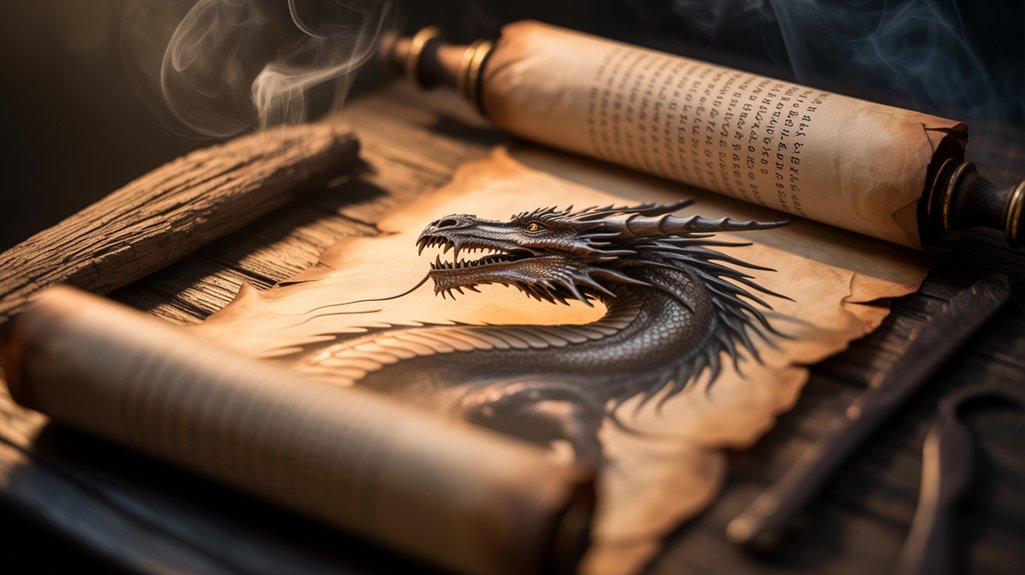
As the twentieth century dawned and modernist sensibilities fractured traditional narratives, fantasy literature emerged as an eldritch sanctuary where dragons could elevate their archetypal binaries—no longer confined to the roles of treasure-hoarding beasts or divine adversaries that had dominated medieval bestiaries and folklore.
Writers reconstructed dragon symbolism through deliberate cultural interpretations that challenged millennia of prescribed morality.
Three transformative approaches reshaped these chimeric beings:
- Tolkien's 1937 introduction of Smaug established dragons as psychologically complex antagonists, their greed reflecting human corruption rather than pure malevolence.
- Martin's post-2000 dragons embodied rebirth mythology, their flames simultaneously destroying and renewing civilizations.
- Novik's 2006 *Temeraire* granted dragons unprecedented agency, intelligence, and emotional landscapes previously reserved for human protagonists.
*Dungeons & Dragons* codified this multiplicity through chromatic and metallic classifications, yet modern literature ultimately dissolved such boundaries.
Dragons became mirrors reflecting humanity's own contradictions—capable of nobility and destruction simultaneously.
Jung's Archetypal Collective Unconscious
When Carl Jung penetrated the depths of human consciousness during his 1912 break from Freudian orthodoxy, he unearthed what he termed the *kollektives Unbewusstes*—a primordial repository where dragons coil as eternal inhabitants, neither invented by individual cultures nor borrowed through contact, but rather emerging spontaneously across civilizations separated by oceans and millennia.
Through Jungian symbolism, these chimeric beasts manifest humanity's fundamental duality: the nurturing mother and devouring chaos, the guardian of treasures and the destroyer of kingdoms.
Archetypal analysis reveals dragons as psychological mirrors reflecting our eldritch inner landscapes, where moral ambiguities writhe beneath consciousness's surface. They embody what Jung identified as the eternal struggle between order and entropy dwelling within each psyche.
Heroes confronting dragons aren't merely slaying external monsters—they're wrestling with shadow aspects of their own nature. Protector or predator? The dragon refuses singular classification.
It exists in liminal space, forcing individuals who engage with these myths to navigate their own psychological depths, altering inner conflict into wisdom.
Dragons in Modern Media
Contemporary cinema, television, and digital domains haven't merely recycled ancient dragon imagery—they've altered these primordial archetypes into narrative vehicles that probe humanity's evolving relationship with power, nature, and the numinous.
Tolkien's Smaug exemplifies dragon symbolism through his eldritch intelligence and acquisitive malevolence, a hoard-guardian embodying capitalism's shadow. HBO's “Game of Thrones” resurrects mythical narratives wherein dragons catalyze both annihilation and resurrection—chimeric forces beyond moral binaries.
Dragons embody our shadow economies—hoarding wealth, breathing destruction, yet transcending simple villainous archetypes into forces of primordial transformation.
Disney's Maleficent transforms into draconic sovereignty, feminine power incarnate. The revolution arrives with “How to Train Your Dragon,” dismantling millennia of antagonistic mythology. Here dragons become companions, co-creators of interspecies harmony.
Video games like “Skyrim” complete this contemporary alteration, positioning players within liminal spaces where dragons shift fluidly between ally and adversary.
These modern manifestations don't abandon ancient wisdom—they interrogate it, revealing how dragon symbolism adapts to each generation's deepest anxieties and aspirations. The archetype endures, shape-shifting across pixels and celluloid, forever reflecting humanity's contradictions back upon itself.
Enduring Myth Across Cultures
Though separated by continents and millennia, disparate civilizations independently conjured dragon-forms from their collective unconscious, each culture encoding distinct cosmological truths within serpentine coils. This phenomenon reveals profound patterns in cultural evolution, where humanity's primal fears and aspirations crystallized into chimeric guardians and adversaries alike.
Mesopotamian Tiamat embodied saltwater chaos. Egyptian Apep threatened solar order. These eldritch beings weren't mere monsters—they represented existential thresholds between civilization and wilderness, between known and unknowable domains.
The mythological symbolism persists because dragons capture something essential about human struggle. They manifest as treasures' guardians, rain-bringers, wisdom-keepers, and apocalyptic destroyers simultaneously.
Chinese dragons spiraled through agricultural cycles, blessing harvests and rivers. Western wyrms hoarded gold in mountain caves, demanding heroic sacrifice. Both archetypes served identical purposes: externalizing internal battles against greed, chaos, ignorance.
Dragons endure because they're mirrors reflecting each culture's deepest values, their most profound anxieties—shape-shifting symbols that refuse simple categorization, forever dwelling in liminal spaces where fear evolves into reverence.
Frequently Asked Questions
What Biological Features Would Dragons Need to Breathe Fire?
Dragons would require extraordinary fire anatomy: specialized glands producing volatile chemicals like phosphine or methanol, reinforced throat chambers resistant to immolation, and muscular bellows to expel combustible compounds.
These evolutionary adaptations mirror bombardier beetles' defensive mechanisms, magnified to eldritch proportions. The creature's chimeric biology demands heat-resistant scales internally, perhaps lined with asbestos-like proteins.
Ancient texts suggest serpentine lung structures, metabolizing sulfurous compounds. Such physiological marvels transcend mundane biology, dwelling in that liminal space where natural history meets mythic imperative, freedom embodied through flame.
How Do Dragon Myths Differ Between Island Nations and Landlocked Civilizations?
Island dragons emerge from maritime cultures as serpentine, aquatic entities—guardians of storms and tides, their scales reflecting ancestral voyages across untamed waters.
Japan's ryu and Polynesian mo'o embody this eldritch fluidity.
Conversely, landlocked dragons manifest as territorial, cave-dwelling hoarders in European and Central Asian traditions, their chimeric forms rooted in desert bones and mountain passes.
Geography shapes mythology profoundly: seafaring peoples envision altering, boundary-crossing serpents; continental civilizations conjure possessive, earth-bound beasts guarding finite resources.
Are There Any African Dragon Myths and What Do They Represent?
African folklore reveals profound dragon representation through serpentine deities like the rainbow-scaled Ayida-Weddo of Dahomey and Zimbabwe's Nyaminyami, the Zambezi River's chimeric guardian.
These entities embody cultural symbolism linking water, fertility, and ancestral power—not Western malevolence.
Regional variations span the continent: the Bida of Niger folklore demands virgin sacrifices, while Ethiopia's eldritch Arwe serpent births origin stories.
They're protectors and destroyers simultaneously, manifesting humanity's relationship with untamed natural forces demanding respect, not conquest.
Why Are Western Dragons Typically Depicted With Wings While Eastern Dragons Fly Without?
Western dragons' winged flight emerged from chimeric Greco-Roman traditions, blending serpents with birds of prey—physical manifestations requiring corporeal means of ascension.
Eastern dragons, born from ancient Taoist cosmology, embody qi itself, the essential breath permeating existence. They're atmospheric spirits who don't require wings; they simply *are* the wind, the storm, the celestial current.
This divergence in cultural symbolism reveals profound differences: Western dragons as earthbound beasts who must conquer gravity, Eastern dragons as transcendent forces already dwelling within heaven's domain.
What Role Do Female Dragons Play in Various Mythological Traditions?
Female dragon symbolism weaves through myth like moonlight through ancient trees—powerful, altering, primordial.
Tiamat, Mesopotamia's chaos goddess, births creation itself through her serpentine form. Chinese nüwa bears draconic features while forging humanity.
These eldritch mothers transcend mere monstrosity; goddess associations link them to fertility, wisdom, sovereignty. They're guardians of sacred thresholds, keepers of chthonic mysteries.
Unlike their often-villainized male counterparts, female dragons embody creative destruction—the untamed force that breaks chains and reshapes worlds through primal, feminine power.
Conclusion
Like mirrors reflecting humanity's divided soul, dragons embody our chimeric nature—neither wholly benevolent nor entirely malevolent. From Tiamat's primordial chaos to Shenlong's celestial benediction, these eldritch beings transcend simple categorization. They've endured across millennia because they're vessels for our deepest contradictions: creation and annihilation, wisdom and destruction, salvation and damnation. Dragons don't merely inhabit myths—they illuminate the liminal spaces where fear and reverence intertwine, forever shape-shifting through humanity's collective unconscious.