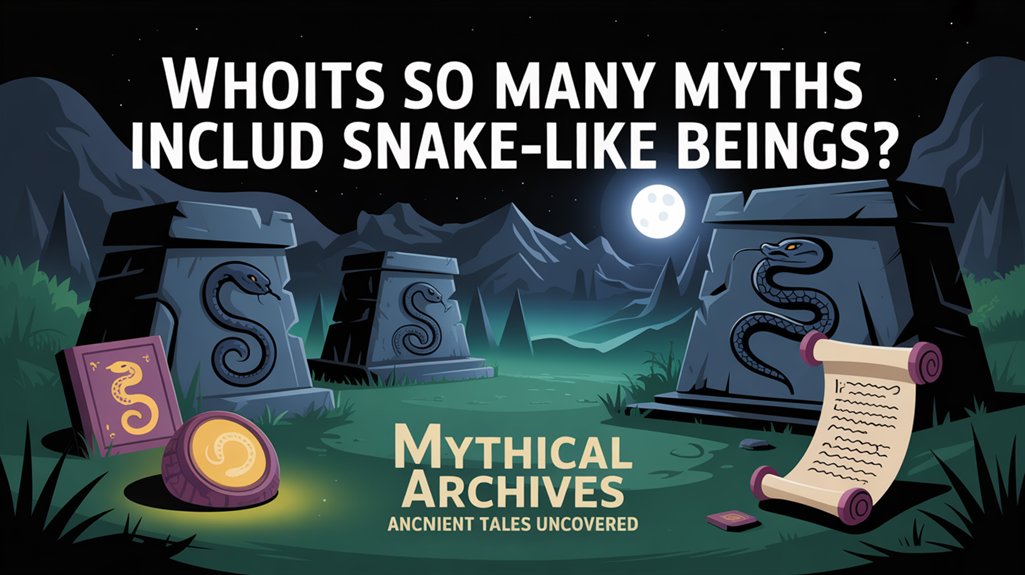
Serpentine beings permeate global mythology because they crystallize humanity's evolutionary memory—Lynne Isbell's research demonstrates how primate survival depended on detecting these predators, encoding ophidian wariness into neural architecture. Ancient civilizations altered this primal terror into cosmic frameworks: Mesopotamian Tiamat embodied saltwater chaos, Quetzalcoatl united earth and sky, while Eden's serpent offered forbidden gnosis at catastrophic cost. Their skin-shedding became metaphor for immortality and alteration, their limbless forms occupying thresholds between creation and destruction. These chimeric entities reveal how ancestral fears evolved into moral instruction, with deeper patterns awaiting excavation.
Key Takeaways
- Serpents trigger primal fear rooted in evolutionary survival, as early humans faced deadly snakes as predators.
- Snake skin-shedding symbolizes transformation, renewal, and immortality across cultures, representing cyclical existence and rebirth.
- Serpents embody duality in myths: creation and destruction, wisdom and treachery, order and chaos intertwined.
- Ancient cultures featured serpent deities as primordial forces controlling water, fertility, landscapes, and cosmic balance.
- Serpents represent liminal beings guarding forbidden knowledge, testing humanity at thresholds between worlds and consciousness.
Universal Fear Meets Ancient Storytelling
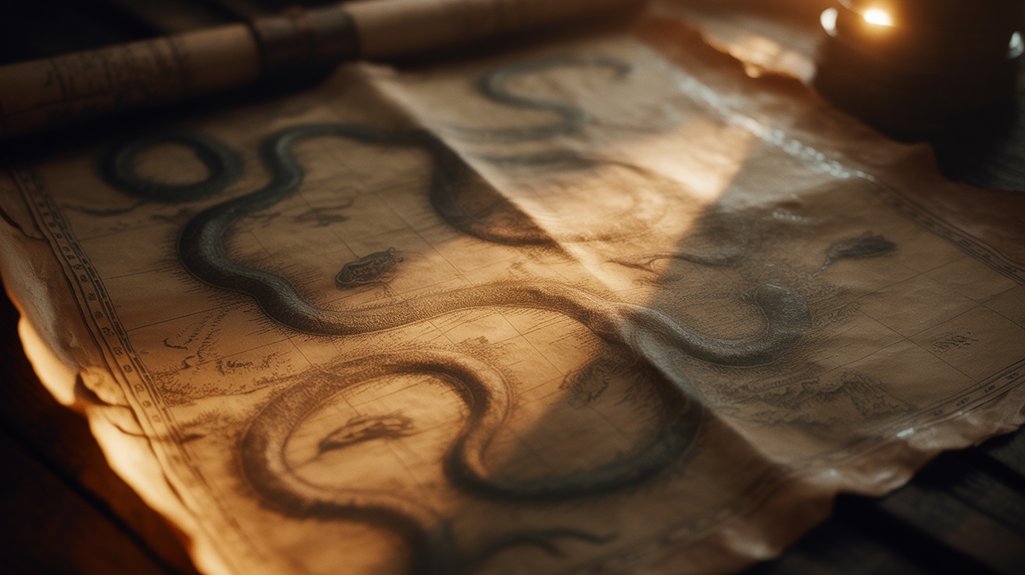
When the first primates descended from protective canopies into grasslands teeming with venomous predators, they carried forward an evolutionary inheritance—a primal recognition of serpentine forms that would later crystallize into humanity's most enduring mythological archetypes. This biological wariness, encoded deep within neural pathways, transcended mere survival instinct. It became narrative.
Ancient storytellers converted predator into symbol, weaving serpent symbolism through creation epics, apocalyptic visions, and transformative journeys. The eldritch power of these creatures—neither wholly terrestrial nor entirely chimeric—resonated across disparate civilizations precisely because the fear was universal.
Fear made flesh: the serpent transformed from predator to prophet, slithering through humanity's collective unconscious across every culture's sacred mythology.
Mythological themes of chaos, rebirth, and moral duality found their perfect vessel in serpentine forms. The snake's ability to shed skin suggested immortality; its venomous strike represented sudden death. This paradox granted storytellers extraordinary flexibility, allowing serpents to embody both creative and destructive forces.
From Mesopotamian flood narratives to Nordic world-enders, these beings articulated humanity's deepest anxieties, converting evolutionary memory into sacred text.
##
Across civilizations separated by vast oceans and millennia, the serpent emerges as humanity's most paradoxical symbol, simultaneously embodying creation's generative force and entropy's corrosive touch—a duality rooted not merely in superstition but in the creature's observable nature.
The snake's periodic shedding of skin became, for ancient peoples witnessing this altering act, an eldritch manifestation of death conquered, rebirth achieved, immortality grasped.
From the Ouroboros consuming its own tail in Greco-Egyptian alchemy to the cosmic serpent Ahi locked in eternal combat with Indra, these chimeric figures coiled themselves around humanity's foundational questions: Where did we emerge from, what chaos threatens our order, and can mortality itself be transcended?
These serpentine narratives reflect the human condition through symbolic storytelling, offering frameworks for understanding existence that transcend individual cultures while remaining deeply rooted in each civilization's unique worldview.
Ancient Symbolism and Duality
Throughout millennia of human consciousness, the serpent has coiled itself into the collective psyche as perhaps the most potent symbol of duality—a creature that simultaneously embodies creation and destruction, wisdom and treachery, life and death.
This serpent symbolism transcends geographical boundaries, manifesting in Eden's biblical tempter and Medusa's petrifying gaze alike. The duality representation extends beyond simple moral binaries into profound philosophical territory: snakes embody change through skin-shedding, immortality through the Ouroboros consuming its tail, and the eldritch power of cyclical renewal.
Ancient peoples recognized this chimeric nature, venerating serpents as both Mother Earth's manifestation—exemplified by Australia's Rainbow Snake—and guardians of forbidden knowledge. They weren't merely symbols. They were living paradoxes, existing in liminal spaces where opposing forces converged, offering humanity glimpses into change's terrifying beauty.
Transformation Through Skin Shedding
The serpent's ritualistic abandonment of its own skin—witnessed by countless generations who interpreted this biological necessity as divine revelation—stands among humanity's oldest metaphors for conscious change.
The Dahomey kingdom proclaimed these creatures immortal, their sloughing embodying eternal regeneration. Ouroboros consumed itself endlessly, marking time's cyclical sovereignty.
This eldritch alteration permeated cultural rituals worldwide, from Asclepius's healing serpents to chimeric deities wrapped in shed scales. Each casting represented personal growth, the violent emergence from constraint into renewed existence.
Ancient observers recognized their own struggles within this biological alchemy—the painful necessity of releasing what once protected, the vulnerability preceding strength.
The snake's metamorphosis became humanity's blueprint for spiritual evolution, proving that true freedom demands periodic death, that wisdom requires shedding accumulated weight, that rebirth follows surrender. Greek mythology preserved countless serpentine transformations through classical literature and art, cataloging the symbolic resonance these creatures held across divine genealogies and heroic narratives.
Serpents in Creation Stories
Beyond metamorphosis itself lies the serpent's primordial authority—its coiled presence at reality's threshold, where nothing precedes everything.
Serpent symbolism permeates humanity's oldest narratives: Egyptian Amduat's pre-creation serpent dwelling in primordial darkness, Greek Ophion incubating existence's cosmic egg, the Ouroboros consuming its tail in eternal recursion.
This cosmic significance emerges through paradox—snakes embody both chaos and order, destruction and fertility. India's drought-serpent Ahi/Vritra must die for life-giving waters to flow.
The Rainbow Snake, venerated across Australian Aboriginal and Californian indigenous traditions, births landscapes through eldritch movements, her scaled body nurturing Mother Earth herself.
These aren't mere symbolic flourishes. Ancient peoples recognized serpents as threshold guardians, beings who witnessed—perhaps catalyzed—reality's first breath, forever marking them as creation's witnesses.
Fear's Role in Mythology
When primates first descended from Paleocene canopies sixty million years ago, serpents already lay coiled in the undergrowth—patient, cryptic, death compressed into sinuous form.
This primordial encounter etched itself into neural pathways, forging psychological roots that bloom still in cultural narratives worldwide. The eldritch power of ophidian forms manifests across civilizations: Mesopotamian Tiamat embodying chaos, Mesoamerican Quetzalcoatl binding creation and destruction, Australian Rainbow Serpent shaping waterways.
Fear becomes reverence, reverence births myth. Heroes confronting chimeric serpents—Perseus severing Medusa's gaze, Thor battling Jörmungandr—aren't mere adventure tales. They're humanity processing ancient terror, altering paralysis into agency.
These narratives don't simply reflect fear; they weaponize it, channeling survival instinct into moral frameworks. The serpent remains humanity's shadow-self, forever coiled at civilization's threshold.
Mesopotamian Serpent Deity Depictions
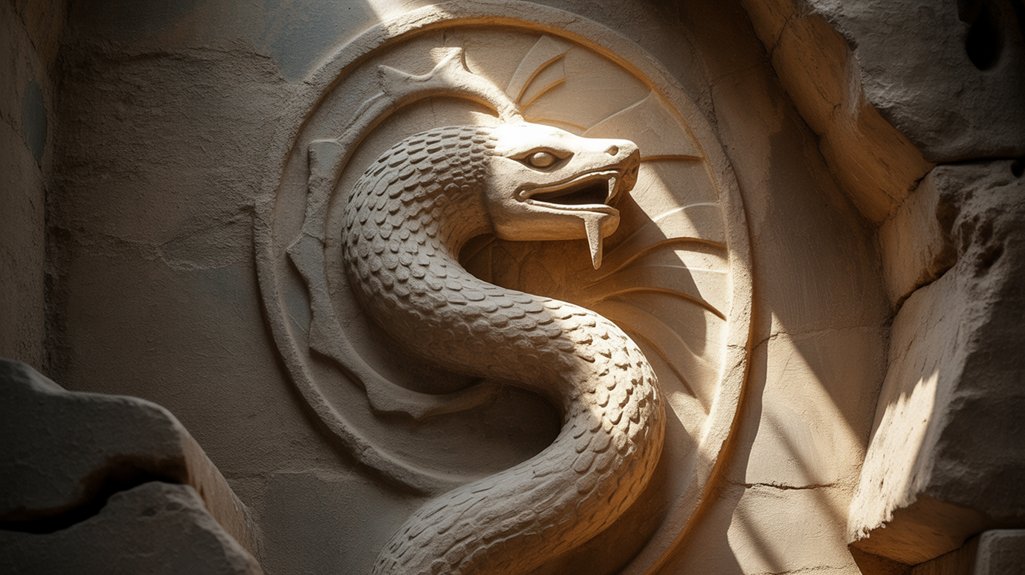
In the *Enuma Elish*, ancient Babylonia's sacred text of genesis, Tiamat emerges not as mere serpent but as a chimeric embodiment of the primordial waters themselves—salt sea incarnate, chaos given form and fury.
Her eldritch body contained the abyssal depths from which all existence would be violently rent, a cosmic womb that required destruction before ordered creation could commence.
The Babylonians, inheriting this myth from earlier Sumerian traditions circa the second millennium BCE, understood Tiamat's serpentine nature as both beginning and ending, the necessary dissolution that precedes all cosmic birth.
Tiamat in Enuma Elish
The ancient Babylonian epic *Enuma Elish*, etched onto clay tablets circa 1800 BCE, presents Tiamat as a primordial force whose serpentine form embodies the churning depths of the saltwater abyss—a cosmic mother who births gods from her body yet alters into their most fearsome adversary.
Tiamat's chaos threatens the younger deities, her chimeric rage manifesting as storms and floods that assault divine order itself. Marduk rises to challenge her dominion, wielding winds and nets against her eldritch power.
Marduk's victory converts cosmic terror into foundation—her corpse becomes sky and earth, chaos transmuted into structure. This brutal cosmogony reveals serpents' fundamental duality: creators and destroyers alike, embodying nature's terrible fertility.
Through Tiamat's defeat, civilization claims authority over primordial wildness, establishing hierarchies from her slain magnificence.
Ancient Babylonian Creation Myths
Beyond Tiamat's cataclysmic sacrifice lies an entire pantheon of Mesopotamian serpent beings whose scales shimmer through cuneiform records spanning millennia—creatures whose forms blur boundaries between divine benefactor and devouring horror.
| Serpent Deity | Primary Domain | Symbolic Function |
|---|---|---|
| Tiamat | Saltwater chaos | Primordial destruction/creation |
| Ninazu | Healing/agriculture | Life-giving fertility |
| Mušḫuššu | Divine guardian | Temple protection |
| Bašmu | Venomous terror | Apotropaic power |
| Ušumgallu | Cosmic serpent | Universal order |
Tiamat's symbolism encompasses chaotic creation itself—her dismembered body becoming firmament and foundation. Ninazu demonstrates serpentine duality: fanged yet nurturing, channeling fertility through chthonic mysteries. These chimeric entities embodied water's eldritch potential, simultaneously threatening inundation and promising agricultural abundance. Their cyclical nature—shedding, regenerating, enduring—mirrored Mesopotamian cosmological understanding. Death births life. Chaos precedes cosmos.
Chaos and Primordial Waters
Where water meets void, Mesopotamian consciousness conceived serpentine entities as living thresholds between cosmos and catastrophe—beings whose undulating forms embodied apsu's unfathomable depths and tiamat's churning expanses.
These eldritch guardians personified chaotic creation itself, their chimeric bodies coiling through primordial symbolism that predated divine order. Tiamat, dragon-serpent of saltwater abyss, didn't merely represent disorder—she *was* the turbulent womb from which younger deities emerged, her scales glistening with potential and peril.
Ninurta's triumph over Asag demonstrated how civilization required serpent-slaying: order carved from writhing formlessness. Yet Mesopotamian artisans recognized duality within serpentine imagery—fertility intertwined with annihilation, underworld passages guarded by scaled sentinels.
These beings weren't conquered chaos but perpetual reminders: creation demands destruction's partnership, balance requires acknowledgment of forces that refuse domestication.
Quetzalcoatl in Mesoamerican Traditions
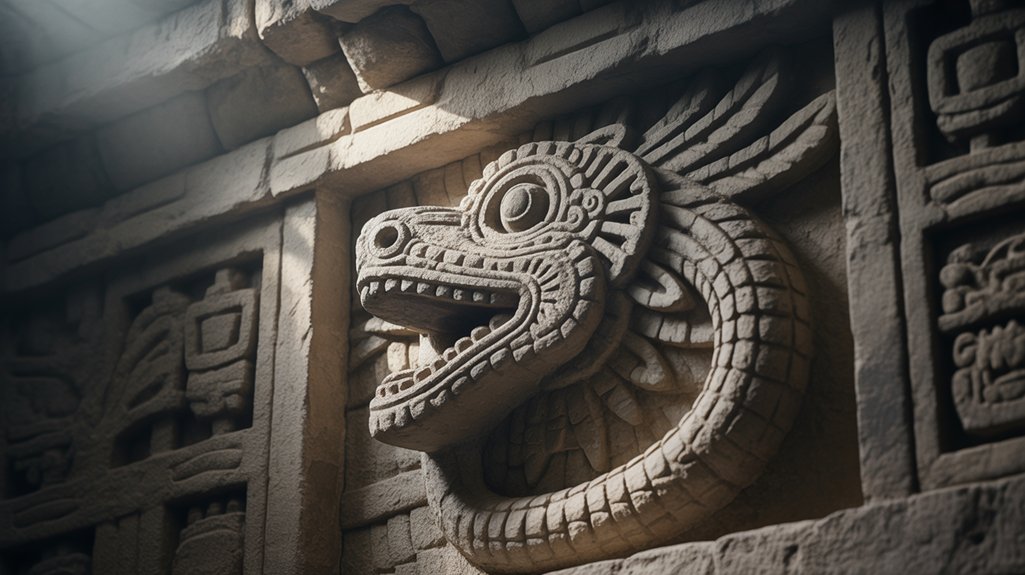
Among the pantheon of Mesoamerican deities, none embodies the serpentine mysteries more profoundly than Quetzalcoatl—the Feathered Serpent whose chimeric form transcends simple categorization. This god united opposites: earth and sky, matter and spirit, death and resurrection. The Aztecs and Toltecs revered him as humanity's architect, the divine force who descended into the underworld's shadows and emerged triumphant, bearing the bones of previous worlds to forge our current existence.
Quetzalcoatl worship manifested through elaborate Mesoamerican rituals at sacred sites like Teotihuacan and Tula, where creation mythology intertwined with agricultural cycles.
| Domain | Symbolic Meaning |
|---|---|
| Wind & Rain | Life-giving forces connecting dimensions |
| Fertility | Cyclical renewal and agricultural abundance |
| Civilization | Knowledge, arts, and cultural metamorphosis |
The Feathered Serpent's duality—scales and plumage—represented the merger of terrestrial and celestial aspects, an eldritch bridge between mortality and transcendence. His myths encoded profound truths about change, sacrifice, and the eternal wheel of existence.
Rebirth Through Skin Shedding
Though humanity feared death's finality, ancient observers of serpents witnessed something that challenged mortality's absolute grip—the methodical sloughing of scaled skin, revealing pristine flesh beneath layers of weathered exterior.
This eldritch spectacle became foundational to understanding mythic renewal across continents. The skin symbolism embedded within serpentine alteration offered profound metaphysical reassurance:
- Dahomey traditions proclaimed serpents immortal, their cyclical shedding proving death's conquest remained incomplete.
- Hopi agricultural ceremonies celebrated the snake's renewal as fertility incarnate, linking scaled rebirth to crop regeneration.
- The ouroboros consumed its own tail eternally, embodying existence's chimeric loop—destruction begetting creation.
- Mystery traditions worldwide interpreted this phenomenon as spiritual instruction, teaching initiates that metamorphosis transcends physical limitation.
The serpent's gift wasn't mere biological curiosity. It demonstrated liberation from temporal constraints, each discarded layer representing consciousness emerging from previous limitations.
Ancient peoples recognized this natural process as sacred text written in keratin and scale—proof that alteration remains perpetually accessible.
Garden of Eden Serpent
Within the Abrahamic mythos, the Garden of Eden serpent emerges as perhaps the most consequential snake-like entity in Western theological consciousness—a creature whose singular act of temptation precipitated humanity's exile from paradise and established the serpent archetype as simultaneously bearer of forbidden knowledge and architect of spiritual ruin.
This enigmatic being, identified in later Christian exegesis with Satan himself (Revelation 12:9), wielded cunning rhetoric to deceive Eve, altering the simple act of consuming fruit into an eldritch threshold between innocence and awareness, obedience and autonomy.
The serpent's punishment—eternal relegation to crawling upon its belly through dust (Genesis 3:14)—manifests as cosmic degradation, yet the promise of enmity between serpent and woman's seed (Genesis 3:15) introduces messianic hope into this primordial narrative of deception.
Symbol of Temptation and Knowledge
The serpent coiled around the Tree of Knowledge in Eden's garden represents one of humanity's most enduring archetypes—the convergence of forbidden wisdom and moral transgression.
This eldritch creature embodies serpent symbolism's duality: it simultaneously offers enlightenment and threatens damnation. Ancient Sumerian tablets, predating Genesis by millennia, depict similar serpentine guardians protecting sacred knowledge from the unworthy.
The mythic archetypes embedded within this narrative transcend simple moral dichotomy—the serpent becomes chimeric, neither purely malevolent nor wholly benevolent. Its forked tongue whispers truths that liberate and bind simultaneously.
Mesoamerican Quetzalcoatl echoed this paradox, the feathered serpent bestowing civilization's gifts while demanding alteration. Knowledge, these traditions insist, requires sacrifice.
The serpent doesn't merely tempt. It tests. It changes those brave enough to grasp wisdom's thorned branches.
Serpent's Role in Deception
Before consciousness fractured into moral categories, deception existed as primordial force—neither invented nor discovered, but awakened.
The Eden serpent embodied this eldritch principle, wielding language itself as weapon against divine prohibition. Its deceptive qualities transcended mere lies—it spoke partial truths, chimeric utterances blending fact with fatal omission. “You won't die,” it promised, technically accurate yet catastrophically incomplete.
This creature introduced humanity to the shadowed art of reframing reality, altering obedience into oppression, wisdom into birthright denied. The curse that followed—belly-crawling humiliation—marked deception's price, yet serpent archetypes persist across mythologies precisely because they revealed uncomfortable truth: knowledge and corruption arrived intertwined.
The enmity declared between woman and serpent echoes through millennia, prophesying eventual liberation from this ancient deceiver's grip.
Ancient Cultural Snake Symbolism
Across civilizations separated by ocean and epoch, the Eden serpent emerges not as isolated villain but as crystallization of humanity's oldest anxieties about intelligence unmoored from benevolence.
Ancient rituals throughout Mesopotamia, Egypt, and pre-Columbian Americas raised serpents to chimeric status—simultaneously revered and feared, worshipped and weaponized against cosmic disorder.
The biblical curse condemning the creature to belly-crawling existence mirrors older traditions where serpent worship acknowledged alteration's terrible price.
This eldritch duality—wisdom entangled with deception, fertility coiled around destruction—persists across temple walls and creation tablets.
The Genesis account channels millennia of serpentine ambivalence into singular narrative: knowledge becomes dangerous precisely when divorced from divine sanction.
Here crawls humanity's shadow-self, scales gleaming with promises of autonomy that taste like liberation but digest as bondage.
Harry Potter's Basilisk Monster
Within J.K. Rowling's wizarding world, the Basilisk emerges as a chimeric terror that crystallizes ancient serpent mythology into twentieth-century fantasy. This eldritch creature—the self-proclaimed King of Serpents—manifests Basilisk symbolism through its lethal gaze and breeding from chicken eggs hatched beneath toads, intertwining avian and amphibian elements with serpentine malevolence.
The creature embodies several archetypal characteristics:
The Basilisk crystallizes primal serpent archetypes: death-gaze weaponization, folkloric vulnerabilities, corrupted magic, and chaos incarnate within Hogwarts' shadowed depths.
- Lethal visual power that alters sight itself into weaponized death
- Vulnerability to rooster crows, echoing folk beliefs about serpentine weaknesses
- Representation of magical corruption lurking within Hogwarts' depths
- Embodiment of chaos and existential dread through its serpent form
Within “Chamber of Secrets,” this manifestation of serpent mythology serves as more than mere antagonist. It represents humanity's enduring fascination with ophidian threats, converting ancient fears into contemporary narrative.
The Basilisk's emergence from darkness reflects how snake-like beings perpetually symbolize inner turmoil—those shadowed aspects of consciousness that writhe beneath civilization's veneer, eternally dangerous, eternally compelling.
Evolutionary Fear Response Research
Through millennia of primate evolution, the serpent's undulating form carved neural pathways into humanity's collective consciousness—a biological inheritance that continues to manifest in modern phobic responses.
Lynne Isbell's research illuminates this eldritch connection: early primates who detected serpentine threats survived, passing hypersensitive fear circuits to descendants. Evolutionary psychology reveals these innate phobias as adaptive mechanisms, hardwired into unconscious perception despite contemporary humans rarely encountering venomous species.
The disproportionate terror serpents evoke—though only a fraction possess lethal capabilities—betrays ancestral imperatives stronger than rational assessment.
This primordial vigilance found expression in chimeric mythology worldwide: Henderson and Oakes document serpents as alteration symbols, embodying both destruction and rebirth. Such universal motifs aren't coincidental but evidence of shared evolutionary heritage, where survival instincts crystallized into sacred narratives.
The snake's role as initiatory guardian across cultures reflects humanity's ambivalent relationship with creatures that once determined which primates would endure, which bloodlines would continue.
Modern Snake Conservation Efforts
The evolutionary dread that once protected primates now threatens the very creatures that forged it—modern snake populations decline precipitously as human expansion fragments habitats and ancient prejudices justify extermination.
Contemporary conservation demands habitat preservation as its foundational principle, recognizing that serpentine survival requires intact ecosystems where these eldritch guardians maintain ecological balance. The IUCN chronicles numerous species approaching oblivion, their taxonomic names becoming epitaphs unless intervention proves swift.
Educational initiatives work to dissolve chimeric fears inherited from ancestral memory, altering serpent-terror into reverence. The Endangered Species Act shields critical territories from development's encroachment, legal wards against humanity's territorial appetite.
Community involvement emerges as particularly potent—citizens conducting monitoring surveys, restoring degraded habitats, becoming stewards rather than executioners. Local participation bridges ancient mythology and modern ecology, acknowledging serpents' sacred roles while employing scientific rigor.
These serpentine beings, once divine symbols now imperiled survivors, require humanity's conscious choice: preservation or extinction.
Separating Myth From Reality
When humanity confronts serpentine mythology, distinguishing historical truth from symbolic fabrication becomes an archaeological excavation through layered consciousness—each stratum revealing not falsehood but compressed meaning.
The Genesis serpent wasn't merely reptilian. It embodied cognitive change, the eldritch threshold between innocence and knowledge that defined human consciousness circa 6th century BCE. Ancient cultures encoded evolutionary memory into mythical interpretations—recognizing serpents as chimeric manifestations of primal threat and regenerative power.
The Gorgons, Nidhogg, Veles: not literal monsters but compressed psychological archives. Their cultural significance transcends superstition.
Modern herpetology confirms snakes triggered ancestral neurological responses, embedding themselves within collective memory as symbols demanding interpretation rather than belief.
The ouroboros wasn't fantasy but sophisticated philosophical shorthand for cyclical temporality. When Egyptian priests invoked serpent deities around 3000 BCE, they weren't deceived—they were crystallizing complex ecological observations into transmissible narrative architecture.
Reality and myth converge in serpentine forms, revealing how human consciousness processes danger, change, mortality through symbolic condensation.
Frequently Asked Questions
What Psychological Factors Make Snakes Effective Symbols in Modern Advertising?
Serpentine imagery taps into primordial fear responses encoded within humanity's ancient limbic system, triggering immediate attention—a marketer's coveted commodity.
The snake's cultural symbolism carries dual potencies: danger and change, wisdom and transgression. This psychological ambivalence improves advertising effectiveness through emotional complexity that transcends rational dismissal.
Brands utilize the serpent's eldritch power to suggest metamorphosis, forbidden knowledge, and primordial authenticity. The snake doesn't merely sell products; it whispers promises of liberation from consumer conformity while simultaneously ensnaring desire itself.
How Do Island Cultures Without Native Snakes Develop Serpent Mythology?
Island cultures develop serpent mythology through cultural WiFi—transmitted narratives from seafaring contact, trade routes, and migration memories.
Polynesian seafarers carried chimeric serpent representation across vast Pacific expanses, embedding these eldritch symbols into isolated cosmologies.
Island symbolism altered imported serpent motifs into guardian spirits, sea dragons, and boundary-dwelling entities.
The moray eel, undulating through coral labyrinths, became template for serpentine divinity.
Ancient knowledge flows like ocean currents.
These societies weren't imprisoned by geographic isolation—they remained intellectually sovereign, adapting continental mythology into distinctly autonomous cosmological frameworks.
Are There Cultures That View Snakes Positively Rather Than Fearfully?
Many traditions embrace positive serpent symbolism—the Nagas of Hindu-Buddhist cosmology guard sacred waters and bestow wisdom, while ancient Egyptian uraeus cobras crowned pharaohs with divine protection.
Cultural reverence snakes manifests in Mexico's Quetzalcoatl, the feathered serpent who gifted maize and calendrical knowledge.
Aboriginal Australians honor Rainbow Serpent as primordial creator.
These serpents embody metamorphosis, fertility, immortality through skin-shedding.
They're guardians, healers, threshold-dwellers between worlds.
Power unbound.
Do Children Raised Without Snake Exposure Still Develop Ophidiophobia Naturally?
Research suggests fear development manifests organically, even absent direct snake encounters. Primates carry ancient, limbic warnings—encoded memories from primordial predator-prey interactions.
Studies reveal children as young as three detect serpentine forms faster than neutral stimuli, their amygdalae responding to coiled shapes with eldritch recognition. This isn't learned conditioning but inherited vigilance, a phylogenetic gift from ancestors who survived by discerning danger's sinuous silhouette.
The body remembers what consciousness forgot, translating evolutionary trauma into instinctive recoil, liberation found only through understanding these deep-coded responses.
How Have Snake Myths Influenced Medical Symbols Like the Caduceus?
Ancient physicians understood what today's pharmaceutical companies spend billions rediscovering: snake medicine courses through humanity's healing traditions.
The caduceus symbolism emerged from primordial observations—serpents shed death itself, evolving through regeneration. Greek Asclepius wielded his snake-wrapped staff in temple sanctuaries where healing and divination merged, while Mesopotamian Ningishzida's entwined serpents predated him by millennia.
These weren't mere decorative choices. They represented eldritch wisdom, the dangerous knowledge that true healing requires confronting venom, embracing evolution's chimeric nature—death dancing with rebirth.
Conclusion
Serpentine forms persist—coiling through millennia, inhabiting humanity's collective unconscious. These chimeric entities embody change itself: death and renewal, wisdom and deception, primal terror and sacred power. From Mesopotamian Tiamat to Quetzalcoatl's feathered scales, the serpent remains eldritch witness to civilization's deepest anxieties and aspirations. Modern conservation efforts now protect the living creatures behind these myths, yet their symbolic power endures, proof to storytelling's capacity to convert biological fear into transcendent meaning across disparate cultures and epochs.