In the lakes and canals of ancient Tenochtitlan, the Aztec capital built upon water, lurked a creature that made fishermen fear the depths. The Ahuizotl (pronounced ah-WEE-zotl) was a dog-like water monster with a hand on the end of its tail—a hand it used to drag unsuspecting victims beneath the surface to their doom. Those who died by the Ahuizotl's grasp were considered chosen by the rain god Tlaloc, their bodies sacred and untouchable. This nightmarish creature embodies the Aztec understanding that water, essential for life, was also a realm of terrible danger.
Quick Facts About the Ahuizotl
| Origin | Aztec (Mexica) mythology |
| Name Meaning | “Spiny aquatic thing” or “Water opossum” |
| Type | Aquatic monster / Divine servant |
| Domain | Lakes, rivers, canals, underwater caves |
| Associated Deity | Tlaloc (rain god) |
| Distinctive Feature | Human-like hand at the end of its tail |
Origins and Cultural Context
The Ahuizotl appears in several Aztec codices and was described by Spanish friars who documented Aztec culture after the conquest. The most detailed account comes from Fray Bernardino de Sahagun's Florentine Codex, a comprehensive encyclopedia of Aztec life compiled in the 16th century.
The creature's name, “ahuizotl,” derives from Nahuatl words meaning something like “spiny aquatic thing” or possibly relating to the opossum. Interestingly, an Aztec emperor who ruled from 1486-1502 took this name as his royal title—Ahuizotl—perhaps signifying his ferocity and connection to the watery realm that sustained the island capital of Tenochtitlan.
For the Aztecs, who built their capital city on an island in Lake Texcoco and relied on water for transportation, agriculture, and daily life, the Ahuizotl represented the ever-present danger lurking in the waters that surrounded them. Every fisherman, every person traveling by canoe, every child playing near the canals knew that something terrible might be waiting below.
Physical Description
The Ahuizotl's appearance combined familiar and horrifying elements:
- Body: Roughly the size of a small dog, covered in smooth, slick, waterproof fur that could be black, brown, or dark gray
- Head: Dog-like or monkey-like, with small ears and a pointed snout
- Hands and Feet: Monkey-like paws with opposable digits, adapted for grasping and climbing
- Tail: Long and prehensile, ending in a fifth hand—the creature's most distinctive and deadly feature. This hand was fully functional, capable of grasping with the strength of a human hand
- Spines: Some accounts describe the creature as having spines along its back, contributing to its name
- Size: Small enough to hide easily but strong enough to overpower grown adults
The tail-hand was the Ahuizotl's weapon. It could extend from hiding places beneath the water, grab unsuspecting victims by the ankles, arms, or torso, and drag them down before they could cry for help. The hand's grip was described as unbreakable once it seized prey.
Hunting Behavior
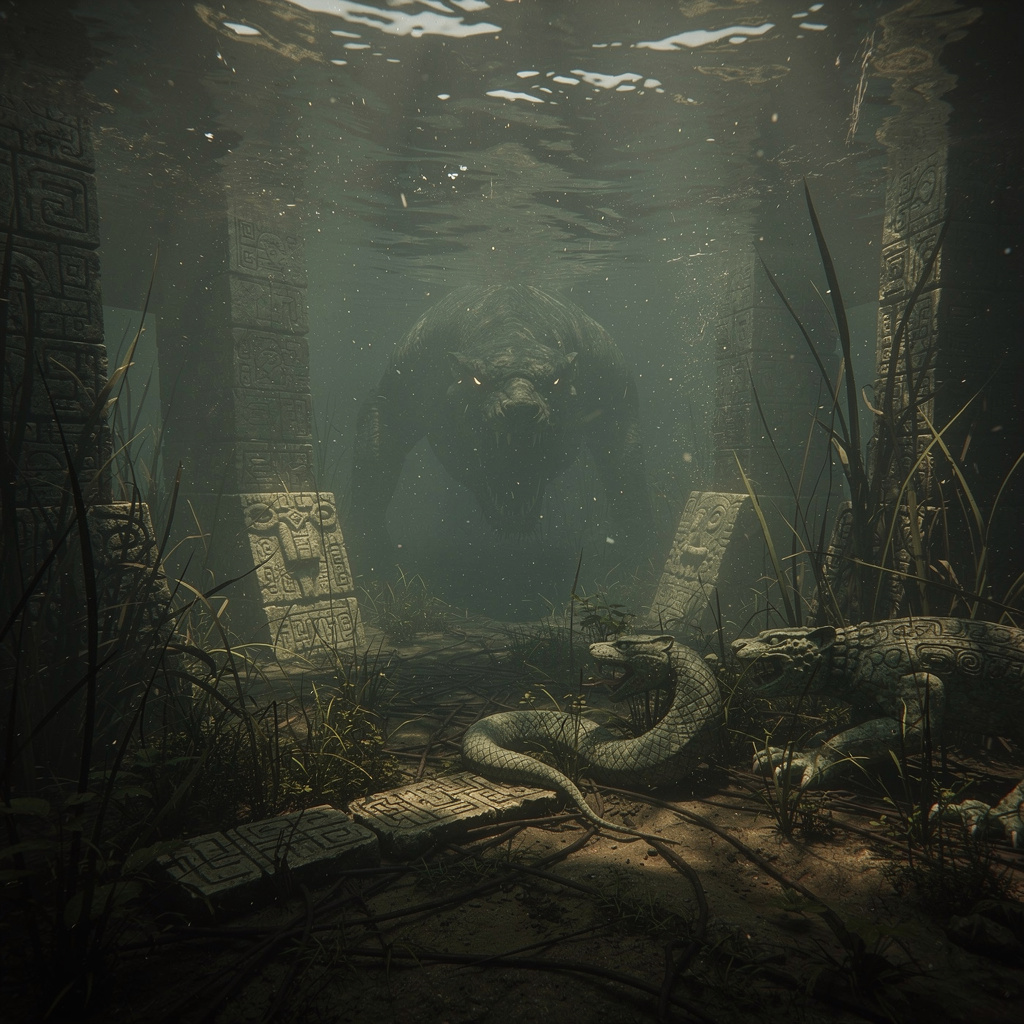
The Ahuizotl employed cunning tactics to lure and capture victims:
The Crying Baby Trick: The creature could perfectly imitate the sound of a crying baby, drawing compassionate people to the water's edge to investigate. When they leaned over to look, the tail-hand would strike.
Fish Lures: The Ahuizotl would sometimes create disturbances in the water that appeared to be schools of fish, attracting fishermen who would reach into the water to make an easy catch.
Lurking Strategy: The creature would hide in underwater caves, beneath banks, or among water plants, waiting with infinite patience for victims to come within reach of its tail-hand.
Preferred Victims: While the Ahuizotl would take anyone, it particularly targeted the eyes, teeth, and fingernails of its victims. Bodies recovered from Ahuizotl attacks (when they were recovered at all) were often found missing these specific parts.
Connection to Tlaloc
The Ahuizotl was not merely a monster but a servant of Tlaloc, the powerful rain and water god. This divine connection had profound implications for how the Aztecs viewed the creature and its victims:
Sacred Deaths: Those killed by the Ahuizotl were considered chosen by Tlaloc himself. Rather than going to Mictlan (the common underworld), they were believed to travel to Tlalocan, Tlaloc's paradise—a realm of eternal spring, abundant water, and perpetual plenty.
Untouchable Bodies: The bodies of Ahuizotl victims were sacred and could only be handled by Tlaloc's priests. Anyone else who touched them risked divine punishment. The bodies were not cremated (the standard Aztec practice) but buried, as befitting those who would journey to the water god's realm.
Divine Selection: In this context, the Ahuizotl wasn't simply killing people—it was selecting them for a blessed afterlife. The terror of the death was offset by the honor of the destination.
Sacrificial Equivalence: Death by Ahuizotl was considered equivalent to sacrifice to Tlaloc, making the creature a kind of divine executioner performing the rain god's will.
Signs of an Ahuizotl Attack
According to Aztec accounts, bodies of Ahuizotl victims displayed distinctive marks:
- Eyes, teeth, and fingernails removed (Tlaloc's favored offerings)
- Bodies remarkably intact otherwise, as if preserved
- No signs of struggle or defensive wounds
- Bodies often found in underwater caves or sacred pools
- Sometimes the corpse would appear to be sleeping peacefully despite the violence of death
These signs helped identify whether a drowning victim had been taken by an Ahuizotl or simply drowned by accident, which had different religious implications.
Protection Against the Ahuizotl
The Aztecs developed various strategies to protect themselves:
Avoidance: Certain pools, caves, and water bodies known to harbor Ahuizotl were avoided, especially at dawn and dusk when the creature was most active.
Offerings to Tlaloc: Regular offerings to the rain god might persuade him to restrain his water servants. Those who pleased Tlaloc might be protected from his creatures.
Never Approach Crying Sounds: Knowing the Ahuizotl's trick, people were warned never to investigate the sound of crying or wailing coming from the water.
Traveling in Groups: The Ahuizotl preferred solitary victims and might hesitate to attack groups.
Priestly Blessings: Priests of Tlaloc could provide protective charms and rituals for those who needed to work on or near the water.
The Ahuizotl in Aztec Society

Beyond its role as a terrifying monster, the Ahuizotl served several social functions:
Explaining Drownings: In a society built on water, drownings were common. The Ahuizotl provided a meaningful explanation that transformed senseless tragedy into divine selection.
Water Safety Teaching: Stories of the Ahuizotl taught children to respect and fear the water, potentially preventing accidents through healthy caution.
Religious Reinforcement: The creature reinforced the power and presence of Tlaloc, reminding people that the rain god's reach extended into every lake and canal.
Royal Symbolism: Emperor Ahuizotl took the creature's name, suggesting it represented qualities valued in leadership—cunning, patience, hidden strength, and deadly efficiency.
Emperor Ahuizotl
The eighth Aztec emperor (ruled 1486-1502) chose this creature's name as his royal title. Emperor Ahuizotl was one of the most successful Aztec rulers:
- Expanded the empire to its greatest territorial extent
- Oversaw the completion of the Great Temple (Templo Mayor) in Tenochtitlan
- Conducted the largest mass sacrifice in Aztec history at the temple's dedication
- Built major infrastructure projects including aqueducts and causeways
- Died in 1502, possibly from a head injury sustained during a flood—an ironic connection to his water-creature namesake
The emperor's adoption of this name suggests the Ahuizotl was seen as powerful and fearsome—qualities any Aztec ruler would want to embody.
Modern Interpretations
Some researchers have speculated about what real animal might have inspired the Ahuizotl legend:
- Otter: River otters have grasping paws and playful but potentially dangerous behavior
- Water Opossum: The yapok, a semi-aquatic opossum, has grasping hands and a prehensile tail
- Cacomistle: This ring-tailed cat relative is an excellent swimmer with dexterous paws
- Composite Creature: The Ahuizotl may combine features of multiple animals into a mythological whole
The Ahuizotl in Popular Culture
- Fantastic Beasts: The Ahuizotl appears in the “Fantastic Beasts and Where to Find Them” book as a creature native to Mexico
- Video Games: Featured in games like Age of Mythology and various creature-collection games
- Literature: Appears in fantasy novels drawing on Mesoamerican mythology
- Cryptozoology: Sometimes mentioned in discussions of unknown aquatic creatures
Ahuizotl Compared to Other Water Monsters
| Creature | Culture | Key Difference |
|---|---|---|
| Ahuizotl | Aztec | Hand-tipped tail, divine servant, victims are blessed |
| Kelpie | Scottish | Horse form, drowns riders, no divine connection |
| Grindylow | English | Humanoid, lake-dwelling, no special killing method |
| Kappa | Japanese | Turtle-like, weakness in water-dish head |
| Jenny Greenteeth | English | Hag figure, targets children specifically |
| Vodyanoy | Slavic | Old man form, demands respect, drowns the disrespectful |
Frequently Asked Questions
Was the Ahuizotl considered evil?
Not exactly. While terrifying, the Ahuizotl was a servant of Tlaloc performing divine will. Its victims were considered blessed, going to Tlaloc's paradise. The creature was dangerous but not malevolent in the way Western monsters are often portrayed.
Could the Ahuizotl be killed?
Sources don't describe methods for killing an Ahuizotl. As a divine servant, it was likely considered beyond human ability to destroy. The proper response was avoidance, propitiation of Tlaloc, and acceptance if taken.
Why did it take eyes, teeth, and nails?
These body parts were associated with offerings to Tlaloc. The Ahuizotl was essentially preparing sacrifices for its master, taking the parts the rain god favored while leaving the body for burial in a manner appropriate for Tlaloc's chosen.
Is the Ahuizotl still believed in today?
Traditional belief in the Ahuizotl has largely faded, but the creature remains an important part of Mexican cultural heritage and appears in contemporary art, literature, and discussions of Mesoamerican mythology.
The Hand From the Deep
The Ahuizotl reminds us that for the Aztecs, the natural world was alive with supernatural presence. Every lake, every canal, every pool potentially harbored divine agents whose actions, however terrifying, served purposes beyond human understanding. The water that gave life could also take it, and in that taking, confer a kind of blessing.
In the murky waters of Lake Texcoco, the tail-hand waited. It waits still in stories and imagination—a reminder that what lies beneath the surface is never fully known, and that the waters of Mexico once held terrors that could reach up and pull you down to a god's embrace.
Sources and Further Reading
- Sahagun, Bernardino de. “Florentine Codex: General History of the Things of New Spain.” University of Utah Press.
- Baquedano, Elizabeth. “Aztec Sculpture.” British Museum Press, 1984.
- Miller, Mary and Karl Taube. An Illustrated Dictionary of the Gods and Symbols of Ancient Mexico and the Maya.” Thames & Hudson, 1993.
- Read, Kay Almere and Jason J. Gonzalez. “Mesoamerican Mythology: A Guide to the Gods, Heroes, Rituals, and Beliefs of Mexico and Central America.” Oxford University Press, 2000.