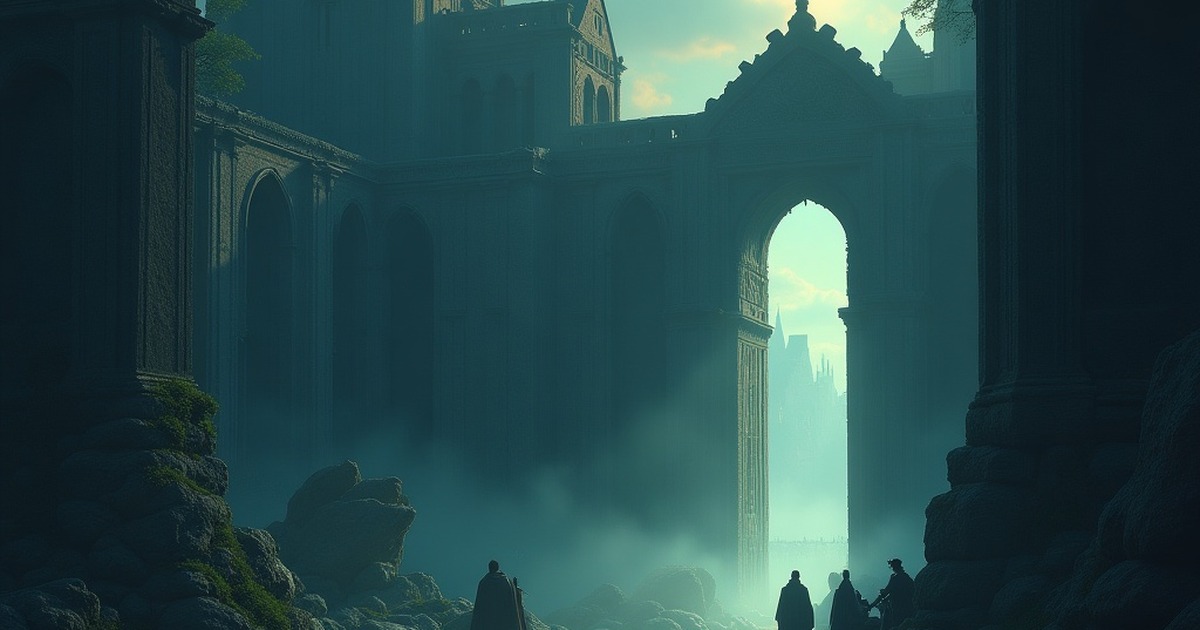
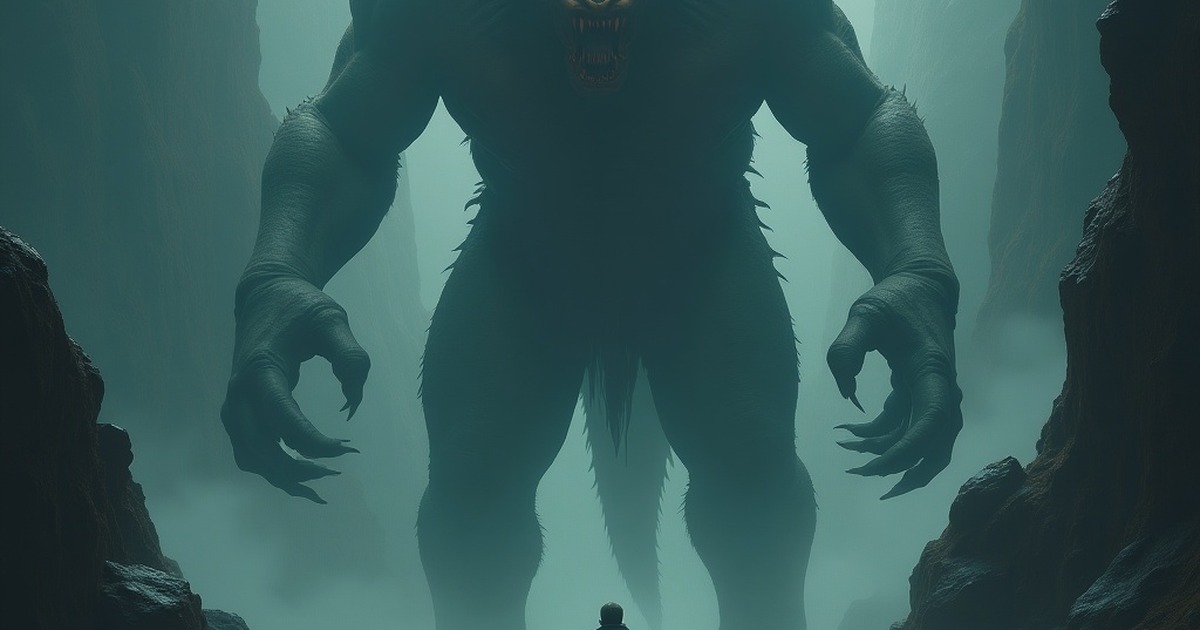
Deep within the darkest forests of Eastern Europe, where ancient trees twist toward a perpetually gray sky and the paths seem to shift when no one watches, there stands a hut unlike any other. It perches atop giant chicken legs, spinning to face—or flee from—those who approach. And within this impossible dwelling lives Baba Yaga, the most enigmatic and terrifying figure in all of Slavic folklore. Neither purely evil nor wholly benevolent, she embodies the wild, untameable forces of nature itself.
Quick Facts About Baba Yaga
| Origin | Slavic folklore (Russia, Ukraine, Belarus, Poland, and others) |
| Also Known As | Baba Yaga Kostianaya Noga (“Baba Yaga Bony Leg”), Jezi Baba (Czech), Ježibaba (Slovak), Baba Roga (South Slavic) |
| Type | Witch / Forest spirit / Supernatural being |
| Domain | Deep forests, the boundary between worlds |
| First Recorded | 18th century written records (oral traditions far older) |
| Associated Symbols | Chicken-legged hut, mortar and pestle, skull lanterns, birch broom |
Origins and History of Baba Yaga
The origins of Baba Yaga stretch back into the prehistoric depths of Slavic culture, long before written records existed to document her tales. Her name itself presents a linguistic puzzle that scholars continue to debate. “Baba” clearly means “grandmother” or “old woman” in Slavic languages, but “Yaga” remains mysterious—some connect it to Proto-Slavic words meaning “horror,” “anger,” or “witch,” while others link it to words for “snake” or “disease.”
What scholars generally agree upon is that Baba Yaga represents an ancient figure, possibly predating the Slavic peoples' conversion to Christianity in the 9th and 10th centuries. Some researchers believe she originated as a goddess of death and regeneration, a guardian of the passage between the world of the living and the realm of the dead. Her forest domain, in ancient Slavic cosmology, represented the boundary between civilization and the otherworld.
The earliest written references to Baba Yaga appear in 18th-century Russian collections of folklore, though these tales had been passed down orally for countless generations. The character gained significant literary attention through the work of Alexander Afanasyev, whose collections of Russian fairy tales in the mid-1800s preserved many Baba Yaga stories that might otherwise have been lost.
Physical Description: The Fearsome Crone
Baba Yaga's appearance is consistently depicted as grotesque and unsettling, though specific details vary by region and tale:
- Skeletal Frame: She is invariably described as extremely thin, often with her bones visible through papery skin. Her epithet “Bony Leg” emphasizes her corpse-like thinness—one leg is said to be nothing but bone.
- Enormous Nose: Her nose is so large and hooked that it touches the ceiling when she lies down in her hut. Some tales say she can smell human blood from miles away.
- Iron Teeth: Her teeth are made of iron or sharpened steel, and she uses them to devour her victims—particularly children who wander into the forest.
- Wild Hair: Her gray or white hair is perpetually tangled and unkempt, sometimes described as standing on end like flames or snakes.
- Piercing Eyes: Her eyes glow or burn with supernatural intensity, able to see through lies and into the souls of those she encounters.
Despite her terrifying appearance, Baba Yaga is not simply a monster. She dresses in traditional peasant clothing, performs domestic tasks (though in supernatural fashion), and observes certain rules of hospitality that clever heroes can exploit.
The Chicken-Legged Hut: Izbushka
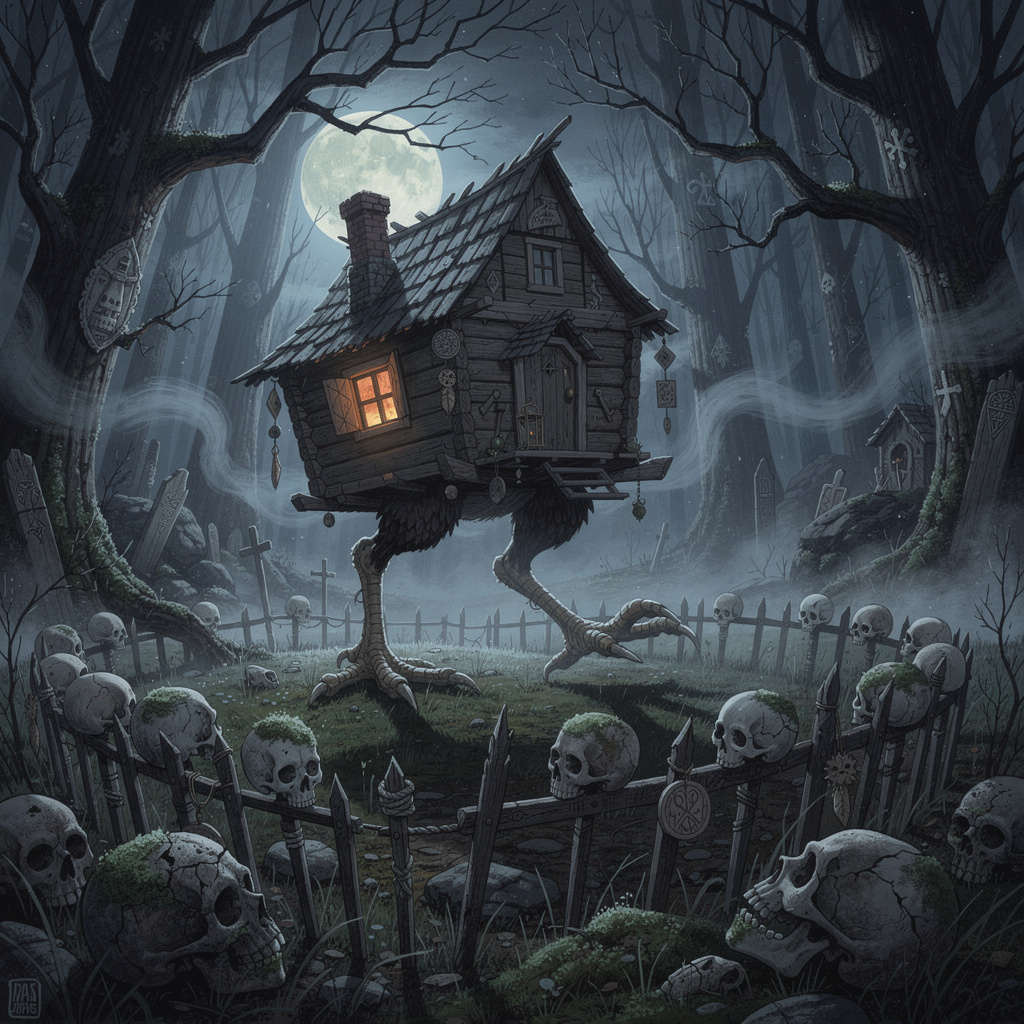
Perhaps no element of the Baba Yaga legend captures imagination quite like her dwelling. The izbushka na kuryikh nozhkakh (hut on chicken legs) is an iconic image of Slavic folklore:
- Living Architecture: The hut stands on two giant chicken legs that allow it to walk, spin, and even dance. It can move through the forest at will and seems to possess a degree of sentience.
- No Windows on One Side: The hut traditionally has no doors or windows facing the visitor, requiring a specific incantation to make it turn around: “Izbushka, izbushka! Turn your back to the forest and your front to me!”
- Skull Fence: The hut is surrounded by a fence made of human bones, topped with skulls whose eye sockets glow with supernatural fire, illuminating the darkness.
- Impossible Interior: Inside, the hut is described as cramped yet containing everything Baba Yaga needs—and sometimes larger on the inside than physics would allow.
Scholars have proposed various interpretations of the chicken-legged hut, from connections to traditional Slavic burial structures raised on stumps to keep animals away from corpses, to shamanic imagery of the world tree or the dwelling between worlds. The hut's ability to spin and face different directions may represent Baba Yaga's role as a guardian of the threshold between life and death.
Powers and Abilities

Baba Yaga wields formidable supernatural powers that make her one of the most dangerous beings in Slavic folklore:
- Flight: She travels through the sky in a giant mortar, using a pestle as a rudder and sweeping away her tracks with a silver birch broom. This flight is often accompanied by terrible storms.
- Command Over Nature: Forests obey her will—trees move to block pursuers, paths appear or vanish at her command, and animals serve as her spies and servants.
- Control of Day and Night: In some tales, Baba Yaga commands three horsemen—the White Rider (Dawn), the Red Rider (Sun), and the Black Rider (Night)—who control the cycle of days.
- Shapeshifting: She can transform into various animals or alter her appearance, sometimes appearing as a beautiful young woman to deceive travelers.
- Magical Knowledge: She possesses vast arcane wisdom, knowing the answers to virtually any question—for those brave or clever enough to ask.
- Power Over Fire: The glowing skulls around her hut can dispense magical fire that burns enemies or, in some tales, can be taken as a gift to light the darkness.
The Duality of Baba Yaga: Helper and Devourer
What makes Baba Yaga unique among folklore villains is her profound ambiguity. She is neither purely evil nor reliably good—she is a force of nature that can help or harm depending on the circumstances and the behavior of those who encounter her.
Baba Yaga as Villain
In many tales, she fulfills the role of a terrifying antagonist:
- She kidnaps children to cook and eat them
- She sends heroes on impossible tasks intended to kill them
- She allies with other dark forces against the protagonists
- She guards treasures and magical items that heroes must steal
Baba Yaga as Helper
Yet in equally many stories, she serves as a crucial helper:
- She provides magical gifts—horses, swords, or knowledge—to worthy heroes
- She gives advice that proves essential to completing quests
- She tests the character of visitors and rewards those who pass with their hearts' desires
- She serves as an initiator, transforming those who survive her trials into wiser, stronger versions of themselves
The key to surviving—and potentially benefiting from—an encounter with Baba Yaga lies in proper behavior. Those who are polite, honest, and brave often receive her help. Those who lie, show cowardice, or violate the rules of hospitality typically become her dinner.
Famous Tales Featuring Baba Yaga
Vasilisa the Beautiful
Perhaps the most famous Baba Yaga tale, this story follows young Vasilisa, who is sent by her cruel stepmother to fetch fire from Baba Yaga's hut. Armed only with a magical doll given to her by her dying mother, Vasilisa must complete impossible tasks and survive the witch's scrutiny. Her politeness, honesty, and the doll's guidance see her through, and she departs with a glowing skull that incinerates her stepfamily while leaving her unharmed.
The Frog Princess
In this tale, Baba Yaga (or multiple Baba Yagas—some traditions hold there are three sisters) helps Prince Ivan find his enchanted bride by providing magical items and crucial information about how to defeat the villain Koschei the Deathless.
Baba Yaga and the Brave Youth
Various tales feature young men who seek out Baba Yaga deliberately to gain magical horses, weapons, or knowledge. These heroes typically must perform tasks for the witch—herding her mares, fetching water in a sieve, or sorting mixed grains—and succeed through cleverness or magical assistance.
Cultural Significance
Baba Yaga serves multiple functions in Slavic culture that extend far beyond simple entertainment:
- Embodiment of Wild Nature: She represents the untamed forest—dangerous, unknowable, but also a source of wisdom and power for those who approach it correctly.
- Death and Regeneration: Her cannibalistic tendencies and skeletal appearance connect her to death, while her role as a helper in transformation narratives links her to rebirth and renewal.
- Feminine Power: In a predominantly patriarchal society, Baba Yaga represented autonomous female power—dangerous, yes, but also awe-inspiring and commanding respect.
- Coming-of-Age Symbol: Many Baba Yaga tales function as initiation narratives, where young protagonists must face terror and prove themselves to transition into adulthood.
- Moral Teaching: The tales emphasize values like honesty, respect for elders (even terrifying ones), bravery, and proper social behavior.
Baba Yaga in Modern Media
The terrifying witch of the Slavic forests has made significant inroads into contemporary popular culture:
- John Wick Films: The protagonist is nicknamed “Baba Yaga” by Russian criminals who fear him, though the films mistranslate this as “Boogeyman” rather than the more accurate “terrifying supernatural force.”
- Hellboy Comics: Mike Mignola's comics feature Baba Yaga as a recurring antagonist, closely following traditional folklore depictions.
- Video Games: She appears in games like Quest for Glory, Rise of the Tomb Raider, and Smite, often as a boss character or quest-giver.
- Literature: Authors like Katherine Arden (The Bear and the Nightingale) and Naomi Novik (Spinning Silver) have incorporated Baba Yaga into acclaimed fantasy novels.
- Animation: The character has appeared in various animated films and series, from the Soviet classic Morozko to the DreamWorks film Bartok the Magnificent.
- Music: Modest Mussorgsky's famous piano suite Pictures at an Exhibition includes “The Hut on Hen's Legs (Baba Yaga),” one of the most dramatic pieces in the classical piano repertoire.
Frequently Asked Questions About Baba Yaga
Is Baba Yaga good or evil?
Neither—or both. Baba Yaga transcends simple moral categories. She can help heroes achieve their goals or devour them without remorse. Her actions depend largely on the behavior of those she encounters. She represents the amoral forces of nature, which can nurture or destroy with equal indifference. Those who approach her with proper respect, honesty, and courage may receive her aid; those who don't become her next meal.
Why does Baba Yaga's hut have chicken legs?
Several theories exist. Some scholars connect it to traditional Slavic practices of building small “houses for the dead” (storage structures for remains) on raised stumps that resembled bird legs. Others see it as shamanic imagery, with the hut representing a threshold between worlds that can move between them. The chicken legs may also symbolize the hut's “living” nature and its role as an extension of Baba Yaga's wild, animal-connected power.
Does Baba Yaga eat children?
In many tales, yes. Baba Yaga is frequently described as a cannibal who particularly favors children, and parents in traditional Slavic cultures used her as a cautionary figure to keep children from wandering into the forest. However, in the actual stories, children who demonstrate proper values—bravery, honesty, and respect—typically escape or even receive her help. The threat of being eaten serves as a narrative stake and moral lesson rather than an inevitable outcome.
Are there multiple Baba Yagas?
Some traditions hold that there are three Baba Yaga sisters, all identical and all equally powerful. In tales featuring multiple encounters, heroes may visit each sister in turn, receiving help or facing trials from each. This trinity may connect to ancient concepts of the triple goddess or simply reflect the story logic of many fairy tales, where events occur in threes.
The Witch Who Endures
For thousands of years, Baba Yaga has haunted the Slavic imagination—a figure of terror and wonder, death and transformation, danger and potential aid. She is the forest's darkest depths given form, a reminder that nature is not gentle, that wisdom comes at a price, and that the old ways held power we can barely comprehend.
Today, as her chicken-legged hut appears in video games, films, and novels around the world, Baba Yaga continues to serve her ancient function: she tests us, terrifies us, and—if we prove worthy—might just help us on our way. Just remember, when approaching her spinning hut, to speak the proper words, show proper respect, and hope that today is a day when the old witch feels more helpful than hungry.
Recommended Slavic Folklore Books
Fascinated by Baba Yaga and Slavic folklore? These acclaimed books offer deeper exploration into the mysterious world of Eastern European mythology:
Top Slavic Mythology Books

Sources and Further Reading
- Afanasyev, Alexander. Russian Fairy Tales. Pantheon Books, 1945.
- Johns, Andreas. Baba Yaga: The Ambiguous Mother and Witch of the Russian Folktale. Peter Lang, 2004.
- Hubbs, Joanna. Mother Russia: The Feminine Myth in Russian Culture. Indiana University Press, 1988.
- Warner, Elizabeth. Russian Myths. University of Texas Press, 2002.
- Ivanits, Linda. Russian Folk Belief. M.E. Sharpe, 1989.