Among all the monsters of Norse mythology, none inspires more dread than Fenrir (also spelled Fenrisúlfr), the monstrous wolf destined to kill Odin himself at Ragnarök. Born of the trickster god Loki and the giantess Angrboða, Fenrir grew so immense and powerful that the gods themselves feared him. Though they bound him with magical chains and thrust a sword through his jaws, Fenrir waits—and at the end of days, he will break free to bring about the twilight of the gods.
Quick Facts About Fenrir
| Origin | Norse mythology |
| Also Known As | Fenrisúlfr, Hróðvitnir, Vánagandr |
| Type | Monstrous wolf / Jötunn offspring |
| Parents | Loki and Angrboða |
| Siblings | Jörmungandr (world serpent), Hel (goddess of the dead) |
| Fate | Will kill Odin at Ragnarök, then be slain by Víðarr |
Origins and Parentage
Fenrir is one of three monstrous children born to Loki, the trickster god, and Angrboða, a giantess whose name means “she who brings grief.” His siblings are equally fearsome:
- Jörmungandr: The Midgard Serpent, so vast it encircles the entire world and grasps its own tail.
- Hel: Half-living, half-dead goddess who rules the realm of the dead, also called Hel.
When the gods learned of these three children being raised in Jötunheimr (the land of giants), they grew alarmed. Prophecies warned that Loki's offspring would bring doom upon the gods. Odin ordered them brought to Asgard, where each was dealt with differently: Jörmungandr was cast into the ocean, Hel was given dominion over the dead, and Fenrir—the most dangerous—was kept in Asgard where the gods could watch him.
The Growing Wolf
At first, Fenrir was kept among the Æsir as a kind of pet or hostage. But he grew at an alarming rate—each day larger than the last, his appetite insatiable, his strength increasing exponentially. Soon only Týr, god of war and justice, had the courage to feed him.
The gods realized they faced a problem: Fenrir was becoming too powerful to control. Prophecy told them he would one day kill Odin, but they could not simply slay him. The killing of a hostage in their own home would violate sacred laws and defile Asgard itself with the bloodshed. They needed another solution.
The Binding of Fenrir
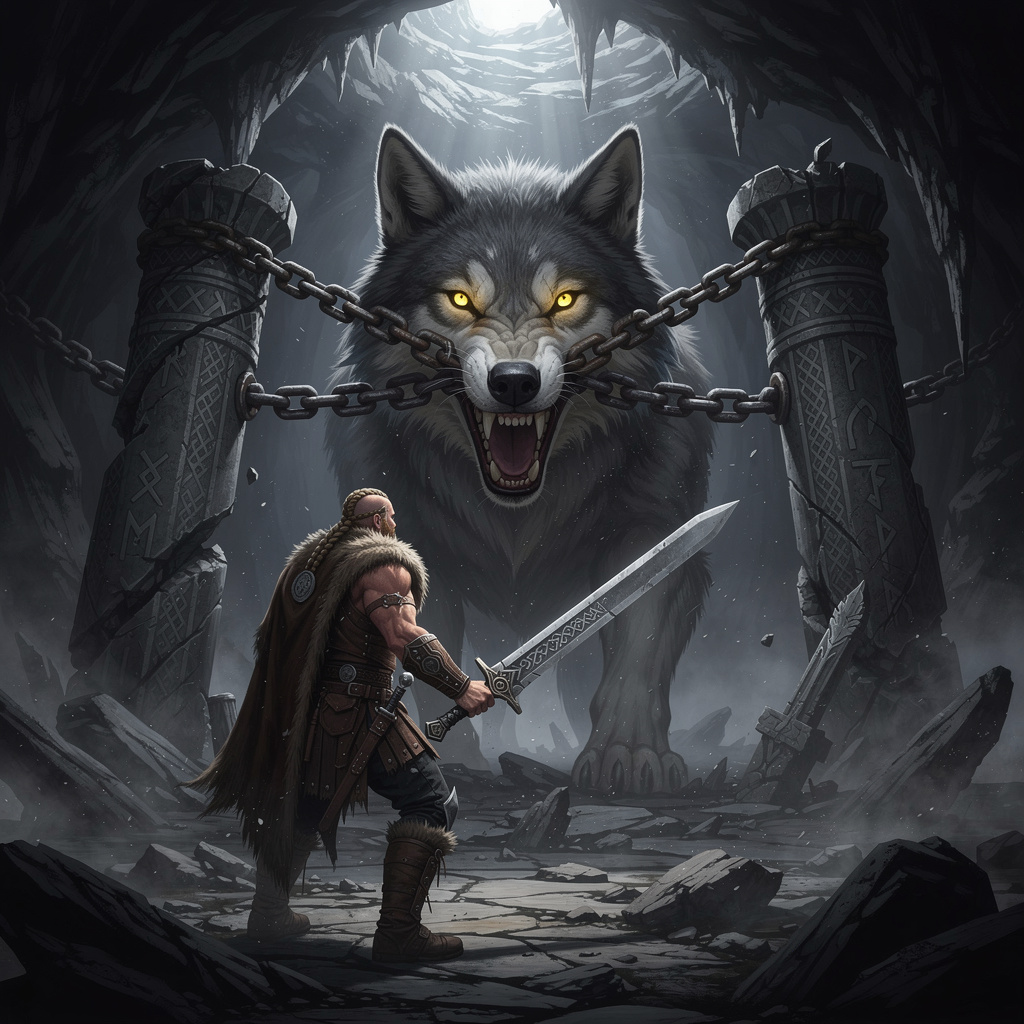
The gods decided to bind Fenrir with magical chains. They presented this as a game—a test of the wolf's strength.
Leyding: The first chain, immensely strong. Fenrir snapped it with a single flex of his muscles. The gods laughed nervously and praised his strength.
Dromi: Twice as strong as Leyding. Fenrir strained, then shattered it. The gods' laughter became more strained.
Gleipnir: Desperate, the gods commissioned the dwarves of Svartálfaheimr to forge something that could hold the wolf. The dwarves created Gleipnir, a magical ribbon made from six impossible things:
- The sound of a cat's footfall
- The beard of a woman
- The roots of a mountain
- The sinews of a bear
- The breath of a fish
- The spittle of a bird
This is why, according to the Norse, these things no longer exist in the world—they were used up in Gleipnir's making.
Though thin and silken, Gleipnir was unbreakable. When the gods brought it to Fenrir and proposed another test of strength, the wolf grew suspicious. The ribbon looked far too flimsy—this must be a trick.
Týr's Sacrifice
Fenrir agreed to be bound by Gleipnir only on one condition: one of the gods must place their hand in his mouth as a pledge of good faith. If this was truly just a game, they would release him afterward. If it was a trap, he would have his revenge.
The gods looked at one another. None wanted to make such a sacrifice. None except Týr.
Týr, who had fed Fenrir when no one else would, who alone among the gods had shown the wolf kindness, stepped forward and placed his right hand in the wolf's jaws.
Gleipnir was wrapped around Fenrir. The wolf strained against it—and could not break free. He struggled harder. The ribbon held. The gods laughed in triumph.
Fenrir, realizing he had been betrayed, bit down and severed Týr's hand at the wrist.
This is why Týr is depicted as one-handed, and why he is honored as the most courageous of the gods—he knowingly sacrificed his hand to bind the wolf.
Fenrir's Imprisonment
The gods were not finished. They took the bound Fenrir to a desolate place and drove a sword through his jaws—the hilt against his lower jaw, the point against the upper—propping his mouth forever open so he could never bite again. The drool that flows from his jaws became the river Ván (“hope”).
There Fenrir waits, bound and gagged, howling his fury at the sky. His howls shake the world. And he will remain there until Ragnarök—the doom of the gods.
Ragnarök: Fenrir Unbound

At Ragnarök, the prophesied end of the world, Fenrir will finally break free from Gleipnir. His freedom marks the beginning of the final battle:
Fenrir will advance across the battlefield with his jaws stretched impossibly wide—his lower jaw against the earth, his upper jaw against the sky, and he would open them wider still if there were room. Fire blazes from his eyes and nostrils.
Odin, the Allfather, king of the gods, will ride to meet him. Odin with his spear Gungnir, accompanied by the einherjar—the warriors of Valhalla who have trained for this battle since their deaths.
It will not be enough. Fenrir will swallow Odin whole.
But vengeance will follow: Víðarr, Odin's son, will avenge his father. Wearing a shoe made from all the leather ever discarded by human shoemakers (which is why, according to tradition, one should always discard leather scraps—to help Víðarr at Ragnarök), he will step on Fenrir's lower jaw and, gripping the upper, tear the wolf's mouth apart, killing him.
Fenrir's Offspring
Fenrir himself has monstrous offspring:
Sköll: A wolf who chases the sun across the sky. At Ragnarök, he will finally catch and devour it.
Hati: A wolf who pursues the moon. He too will catch his prey at the end of days.
Thus Fenrir's line ensures the death of the celestial bodies themselves, plunging the world into darkness before its destruction.
Symbolism and Interpretation
Fenrir represents several concepts in Norse thought:
Inevitable Doom: Despite all their efforts, the gods cannot prevent their fate. Binding Fenrir only delays the inevitable—he will break free, and Odin will die.
Consequences of Deception: The gods' trickery in binding Fenrir—while necessary—is itself dishonorable. Týr's sacrifice of his hand represents the price of necessary evils.
Chaos vs. Order: Fenrir represents primal chaos that threatens the ordered cosmos the gods maintain. His binding represents the constant struggle to keep chaos contained.
The Monstrousness Within: As Loki's son, Fenrir represents the destructive potential that comes from within the gods' own circle. The greatest threat comes not from outside but from within.
Fenrir in Modern Media
- Marvel Comics/MCU: Appears as “Fenris Wolf,” Hela's mount in “Thor: Ragnarok”
- Video Games: Featured in “God of War” (2018), “Assassin's Creed Valhalla,” “Smite”
- Literature: Appears in numerous Norse mythology retellings
- Music: Referenced frequently in Viking and black metal
- TV: Various adaptations of Norse mythology
Fenrir Compared to Other Wolves
| Wolf | Mythology | Key Difference |
|---|---|---|
| Fenrir | Norse | Destined to kill Odin, bound by gods |
| Romulus & Remus's Wolf | Roman | Nurturing mother figure |
| Amarok | Inuit | Hunts alone, tests hunters |
| Warg | Norse/Germanic | Evil wolf or wolf-rider, less cosmic |
| Loup-garou | French | Werewolf, human transformation |
Frequently Asked Questions
Why didn't the gods just kill Fenrir?
The Æsir held sacred the concept of frith (peace) within their own halls. Killing a hostage—even a monstrous one—in their own home would defile Asgard with blood and violate their own laws. This reflects the Norse emphasis on hospitality and the sanctity of oaths.
Was Fenrir evil?
The Norse didn't necessarily see it in those terms. Fenrir is dangerous and destined to destroy, but he was also betrayed by the gods who raised him. His rage is at least partly justified. He represents chaos and destruction, but these are natural forces rather than moral categories.
What does “Fenrisúlfr” mean?
“Fenris” means “fen-dweller” (fen being a swamp or marsh), and “úlfr” means wolf. So Fenrisúlfr means “the wolf of the fens” or “swamp-wolf.” His other name, Vánagandr, means “monster of the river Ván.”
How big is Fenrir?
The sources describe him as immense—large enough that when he opens his jaws at Ragnarök, one jaw touches the earth and the other the sky. He is cosmic in scale, befitting his role in the world's destruction.
The Wolf at the World's End
Fenrir represents one of mythology's most powerful images: the chained monster waiting to break free and destroy the world. He is inevitability given form—the knowledge that all things end, that even the gods will die, that no chain can bind destruction forever.
But the Norse faced this inevitability with courage rather than despair. They knew Ragnarök was coming. They prepared anyway. They bound Fenrir knowing he would break free. They fought knowing they would lose. The glory was in the struggle, not the outcome.
Somewhere, in the darkness at the edge of the world, Fenrir still waits. The chain still holds—for now. And when it breaks, when the wolf runs free and the gods ride to meet him, the world will end in fire and fury. But something new will rise from the ashes, and the old stories will begin again.
Sources and Further Reading
- Sturluson, Snorri. “Prose Edda.” Translated by Jesse Byock, Penguin Classics, 2005.
- Larrington, Carolyne, trans. “The Poetic Edda.” Oxford University Press, 2014.
- Lindow, John. “Norse Mythology: A Guide to Gods, Heroes, Rituals, and Beliefs.” Oxford University Press, 2002.
- Crawford, Jackson. “The Wanderer's Hávamál.” Hackett Publishing, 2019.