In the rivers, ponds, and waterways of Japan lurks one of the country's most recognizable yokai: the Kappa. These cucumber-loving water creatures have terrified and fascinated the Japanese people for centuries, appearing in countless folktales as both dangerous predators and comical tricksters. With their turtle shells, beaked faces, and the mysterious water-filled dishes atop their heads, Kappa represent one of folklore's most distinctive supernatural beings—and their influence on Japanese culture remains powerful to this day.
Quick Facts About Kappa
| Origin | Japanese folklore (Shinto/Buddhist influences) |
| Also Known As | Kawataro, Kawako, Kawaranbe, Gataro |
| Type | Yokai / Water spirit |
| Domain | Rivers, ponds, lakes, irrigation channels |
| Weakness | The water dish (sara) on their head |
| Favorite Food | Cucumbers (and human shirikodama) |
Origins and History
The Kappa's origins are debated among folklorists. Some theories suggest they evolved from water deity worship in ancient Japan, while others connect them to Chinese legends of river spirits that traveled to Japan along with Buddhism. The word “kappa” itself means “river child” (河童), reflecting their aquatic nature.
Early written records of Kappa appear in the Edo period (1603-1868), though oral traditions certainly predate these accounts. During this era, Kappa became standardized in popular imagination through woodblock prints, theatrical performances, and collected folklore. Regional variations gave rise to dozens of local names and slightly different descriptions across Japan.
Some scholars believe Kappa legends served practical purposes: warning children away from dangerous waters and explaining drowning deaths. Others see them as degraded water deities, once-worshipped spirits who became yokai as Japan's religious landscape changed.
Physical Appearance
Kappa possess one of the most distinctive appearances in world folklore:
Size and Build: Child-sized, typically standing three to four feet tall, with a hunched posture. Their bodies are described as either scaly like a reptile or smooth and slimy like an amphibian.
Coloration: Usually depicted as green, blue-green, or yellowish. Some regional variants describe them as red or entirely blue.
Shell: A turtle-like carapace covers their back, providing protection and emphasizing their aquatic nature.
Face: A beaked or pointed mouth resembling a turtle or bird. Large, round eyes. Some descriptions include a monkey-like face.
Limbs: Webbed hands and feet for swimming. Despite their small size, Kappa possess tremendous strength, especially in water.
The Sara (Dish): Most critically, Kappa have a bowl-like depression on the top of their heads that must remain filled with water. This “sara” is the source of their supernatural power—and their greatest vulnerability.
The Sara: Source of Power and Weakness
The water-filled dish atop a Kappa's head is central to understanding these creatures. The sara contains water from the Kappa's home river or pond, and this water is the source of their supernatural strength. As long as the sara remains filled, a Kappa possesses power far exceeding its size.
However, if the water spills, the Kappa becomes paralyzed or severely weakened. This vulnerability has given humans their primary defense against these creatures: the bow. Kappa are obsessively polite and will always return a bow. When they bow, the water spills from their sara, leaving them helpless.
This detail has generated countless folktales where clever humans escape Kappa attacks by exploiting their compulsive courtesy. The lesson embedded in these stories—that politeness can be both a virtue and a vulnerability—reflects deep currents in Japanese culture.
Behavior and Diet
Kappa behavior ranges from harmlessly mischievous to lethally dangerous:
Mischief: At their least harmful, Kappa engage in pranks like loudly passing gas, peeking up women's kimonos, or stealing crops. They are known to challenge humans to sumo wrestling matches and other contests.
Dangerous Behavior: More seriously, Kappa drown swimmers, drag horses and cattle into water, and attack humans. They are particularly dangerous to children playing near water.
The Shirikodama: Kappa are said to crave a mythical organ called the shirikodama—a ball supposedly located inside the human anus. Kappa extract this organ from drowning victims, which is why drowned bodies were sometimes found with distended anuses (actually a natural effect of decomposition). This gruesome detail made Kappa warnings particularly effective at keeping children away from water.
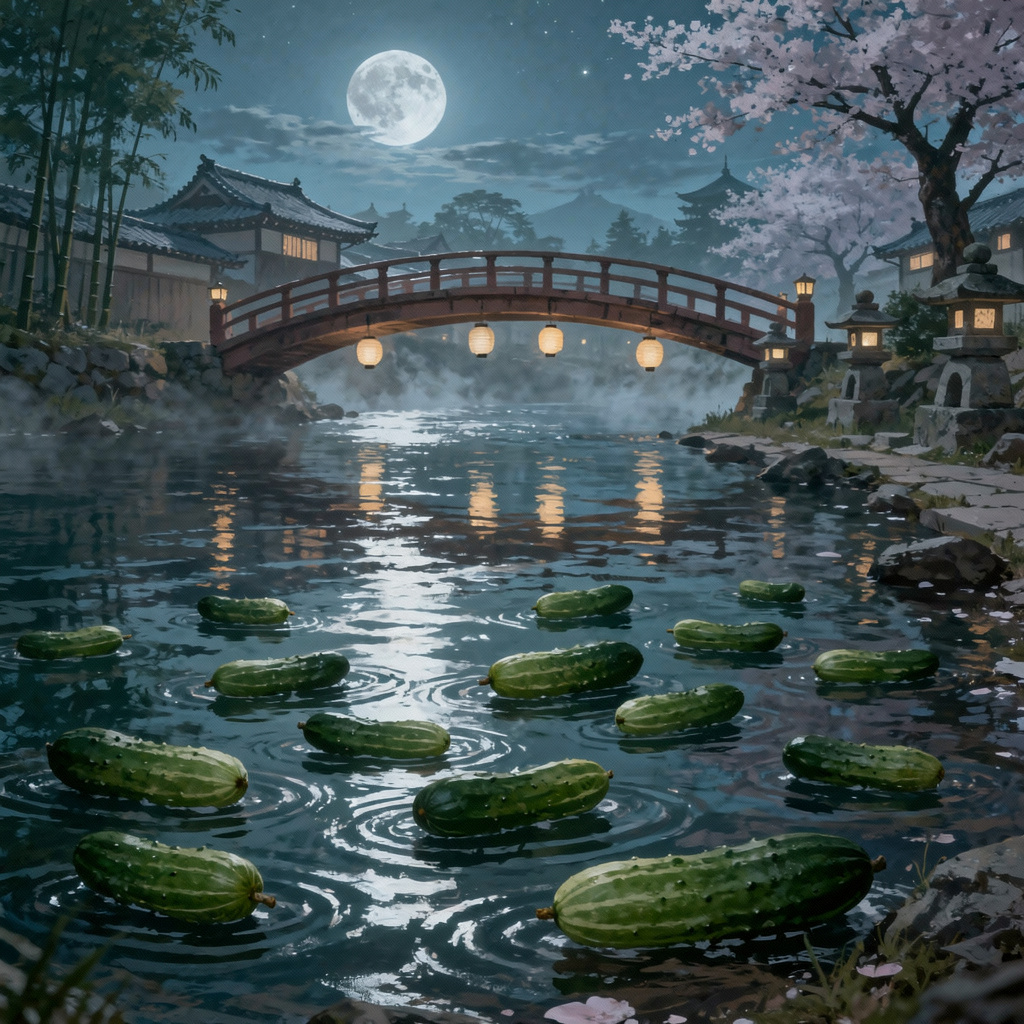
Cucumber Obsession: Despite their fearsome reputation, Kappa love cucumbers above all other foods. This quirk has led to the tradition of throwing cucumbers into water to appease local Kappa. The cucumber sushi roll “kappamaki” is named for this association.
Befriending Kappa
Not all Kappa encounters end badly. Japanese folklore contains many stories of humans who befriended or earned the gratitude of Kappa:
- Medical Knowledge: Grateful Kappa have supposedly taught humans bone-setting techniques and other medical secrets. Several traditional medicine families in Japan claim Kappa-taught techniques as their heritage.
- Agricultural Help: Kappa who owe debts to humans may help with irrigation, fishing, or farming.
- Written Promises: Some tales describe Kappa writing formal apology letters or promises never to harm local residents after being captured and released.
- Offerings: Communities have traditionally made offerings to Kappa—especially cucumbers inscribed with family names—to ensure safe water travel and prevent drownings.
Kappa in Japanese Culture

Few yokai have penetrated Japanese culture as thoroughly as the Kappa:
Warnings and Education: “Don't go near the water or the Kappa will get you” remains a common warning to children. Signs near rivers and ponds often feature Kappa imagery.
Shrines and Worship: Several Shinto shrines are dedicated to or associated with Kappa. The Kappa-dera temple in Tokyo enshrines Kappa and draws visitors seeking water safety blessings.
Festivals: Kappa festivals occur throughout Japan, celebrating these creatures with parades, performances, and cucumber-themed foods.
Mascots: Numerous Japanese towns have adopted Kappa as official mascots, particularly communities near rivers. The friendly “Kappazon” and similar characters appear on local products and tourism materials.
Proverbs: Japanese includes Kappa-related sayings like “kappa no kawa nagare” (even a kappa can drown)—meaning even experts make mistakes in their own field.
Regional Variations
Kappa appear under different names with varying characteristics across Japan:
- Kawataro: “River boy” – common in western Japan
- Gataro: Found in the Chugoku region
- Hyosube: A hairier variant from Kyushu known for infectious laughter
- Shibaten: Shikoku's version, more otter-like
- Medochi: Tohoku variant with a single eye
These regional variations suggest Kappa legends developed independently in different areas before becoming standardized in popular culture.
Kappa Compared to Other Water Creatures
| Creature | Culture | Key Difference |
|---|---|---|
| Kappa | Japanese | Polite, cucumber-loving, weakness in head-dish |
| Grindylow | English | Purely malevolent, no exploitable weakness |
| Vodyanoy | Slavic | Old man appearance, demands respect |
| Nixie | Germanic | Shapeshifter, often beautiful human form |
| Bunyip | Australian | Larger, more monster-like, less personality |
| Ahuizotl | Aztec | Hand-tailed, serves rain god, victims are blessed |
Kappa in Modern Media
- Anime/Manga: Featured prominently in “Sarazanmai,” “Yokai Watch,” “Nura: Rise of the Yokai Clan,” and countless others
- Video Games: Appear in “Nioh,” “Yo-kai Watch,” “Final Fantasy XIV,” “Sekiro: Shadows Die Twice
- Film: “Summer Days with Coo” (2007) – an animated film about a boy who befriends a Kappa
- Literature: Ryunosuke Akutagawa's “Kappa” (1927) – satirical novel about Kappa society
- Pokemon: Lotad and Lombre are clearly Kappa-inspired
Frequently Asked Questions About Kappa
Are Kappa good or evil?
Kappa are morally complex. They can be dangerous predators who drown humans, but they can also form friendships with people, keep promises faithfully, and teach valuable skills to those who earn their respect. Like many yokai, they exist outside simple good/evil categories.
How do you escape a Kappa attack?
The traditional method is to bow deeply. Kappa are compulsively polite and must return the bow, spilling the water from their head-dish and losing their power. You can also throw cucumbers inscribed with your name into the water as an offering.
Why do Kappa love cucumbers?
The exact reason is unclear, but cucumbers have long been associated with water and summer in Japan. Some theories connect the cucumber's cooling properties to water spirits. The association is so strong that cucumber sushi rolls are called “kappamaki.”
Do people still believe in Kappa today?
While few Japanese people literally believe in Kappa, the creatures remain culturally significant. Warning signs featuring Kappa still appear near dangerous waters, and Kappa festivals and shrines continue to draw visitors. They occupy a space between belief and cultural heritage.
The Enduring River Child
The Kappa endures because it embodies contradictions that resonate across cultures: the water that sustains life can also take it; politeness can be both virtue and vulnerability; the monstrous can become lovable. These small, cucumber-obsessed, compulsively polite water imps have transcended their origins as warnings about dangerous waterways to become beloved cultural icons.
From ancient warnings whispered to children playing near irrigation ditches to modern anime protagonists, the Kappa continues its centuries-long swim through Japanese imagination. And somewhere in the rivers of Japan, if folklore is to be believed, they still wait—ready to wrestle, ready to bow, and always hungry for cucumbers.
Sources and Further Reading
- Foster, Michael Dylan. The Book of Yokai: Mysterious Creatures of Japanese Folklore.” University of California Press, 2015.
- Yoda, Hiroko and Matt Alt. “Yokai Attack!: The Japanese Monster Survival Guide.” Kodansha International, 2008.
- Ashkenazi, Michael. Handbook of Japanese Mythology.” ABC-CLIO, 2003.
- Meyer, Matthew. “The Night Parade of One Hundred Demons.” Self-published, 2012.