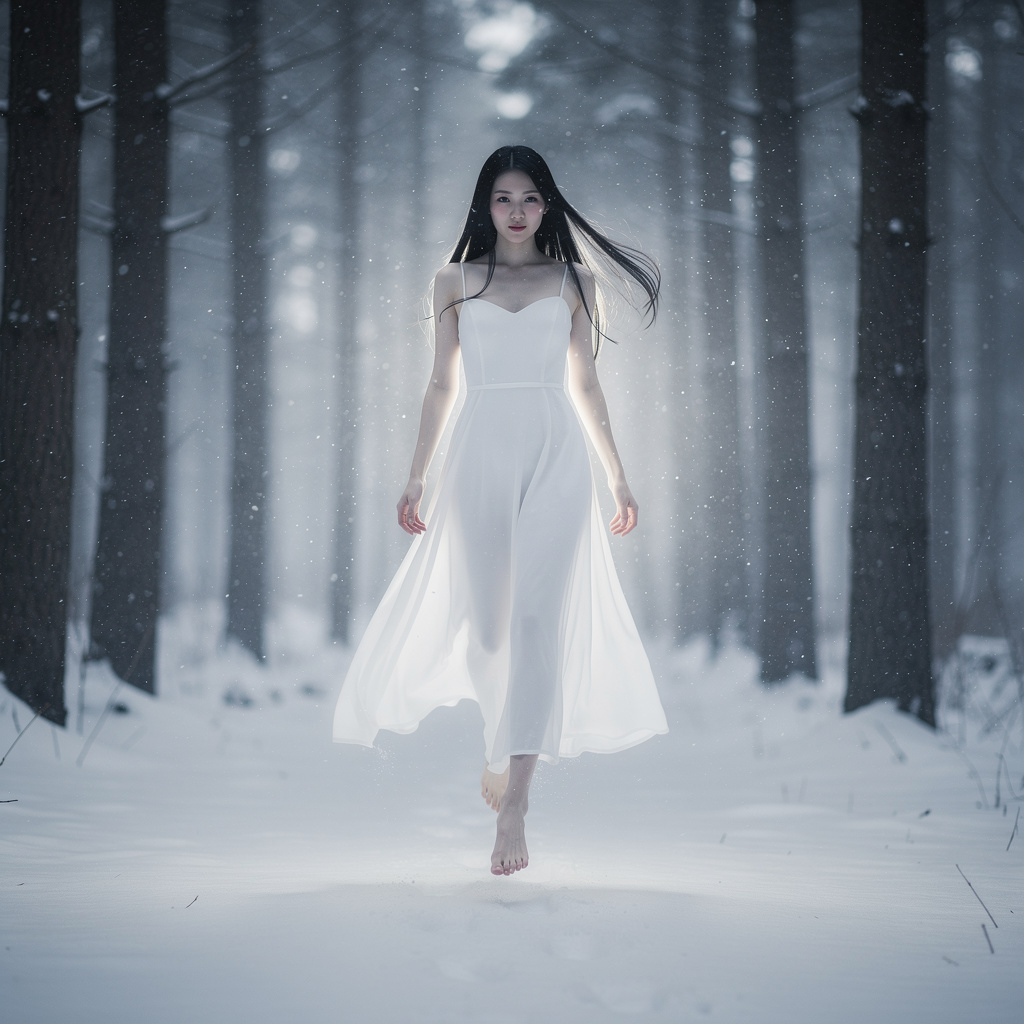
In the frozen mountain passes and snow-covered villages of Japan, travelers fear encountering the Yuki-onna (雪女), the “snow woman.” She appears during blizzards and snowstorms—a tall, ethereally beautiful woman with skin white as snow, long black hair, and lips that are either pale blue or blood red. Her beauty is hypnotic, but her touch is death: those who fall under her spell freeze where they stand, their life force stolen by this spirit of winter. The Yuki-onna is winter itself given human form—beautiful, serene, and utterly deadly.
Quick Facts About Yuki-onna
| Origin | Japanese folklore |
| Name Meaning | “Snow woman” (yuki = snow, onna = woman) |
| Type | Yokai / Spirit |
| Domain | Snowstorms, blizzards, mountain passes, winter |
| Appearance | Tall woman with white skin, black hair, wearing white kimono |
| Method of Killing | Freezing victims, draining life force, cold breath |
Origins and Development
The Yuki-onna has appeared in Japanese folklore for centuries, with the earliest written accounts dating to the Muromachi period (1336-1573). However, she likely existed in oral tradition long before that, born from the fears of those who lived in Japan's snow country—the mountainous regions where winter meant isolation, danger, and death.
The most famous literary treatment comes from Lafcadio Hearn's 1904 collection “Kwaidan: Stories and Studies of Strange Things,” which introduced her to Western audiences. Hearn's version, set in Musashi Province, established many elements that became standard in later retellings.
Regional variations exist throughout Japan's snowy regions. In some areas she's called Yuki-musume (snow daughter), Yuki-onago (snow girl), or Yuki-jorō (snow courtesan). Each region added its own details to the legend, but the core elements remain consistent: a beautiful woman in white who appears during snowstorms and brings death to those she encounters.
Physical Appearance
The Yuki-onna's appearance reflects her nature as a spirit of winter:
Skin: Impossibly white, often described as translucent or even transparent—some accounts say you can see through her against the snow. Her skin is cold to the touch, like ice.
Hair: Long and black, providing stark contrast against her white skin and clothing. In some versions, her hair floats as if underwater or blown by an unfelt wind.
Eyes: Usually described as beautiful but terrifying—sometimes human-seeming, sometimes clearly inhuman. Some accounts describe them as violet, others as completely black.
Lips: Either pale blue like a corpse's, or bright red—the only color on her otherwise white face.
Clothing: A white kimono, often thin or transparent despite the freezing cold. Some stories say she wears no clothing at all, her white body camouflaged against the snow.
Feet: In many accounts, she leaves no footprints in the snow, or hovers slightly above the ground. Some versions give her no feet at all—she simply fades into mist below the waist.
Powers and Methods
The Yuki-onna possesses several supernatural abilities:
- Death Breath: Her breath is supernaturally cold. One exhalation can freeze a person solid.
- Life Force Absorption: She drains the life energy of her victims, leaving frozen corpses.
- Weather Control: Some stories say she can summon or intensify blizzards.
- Transformation: She can transform into mist, snow, or wind to pursue or escape.
- Hypnotic Beauty: Her appearance mesmerizes victims, preventing them from fleeing.
- Intangibility: She can pass through walls and doors, appearing inside locked buildings.
- Snow Camouflage: She blends perfectly with snow and blizzards, appearing and disappearing at will.
The Classic Tale: Lafcadio Hearn's Yuki-onna
The most famous Yuki-onna story comes from Lafcadio Hearn:
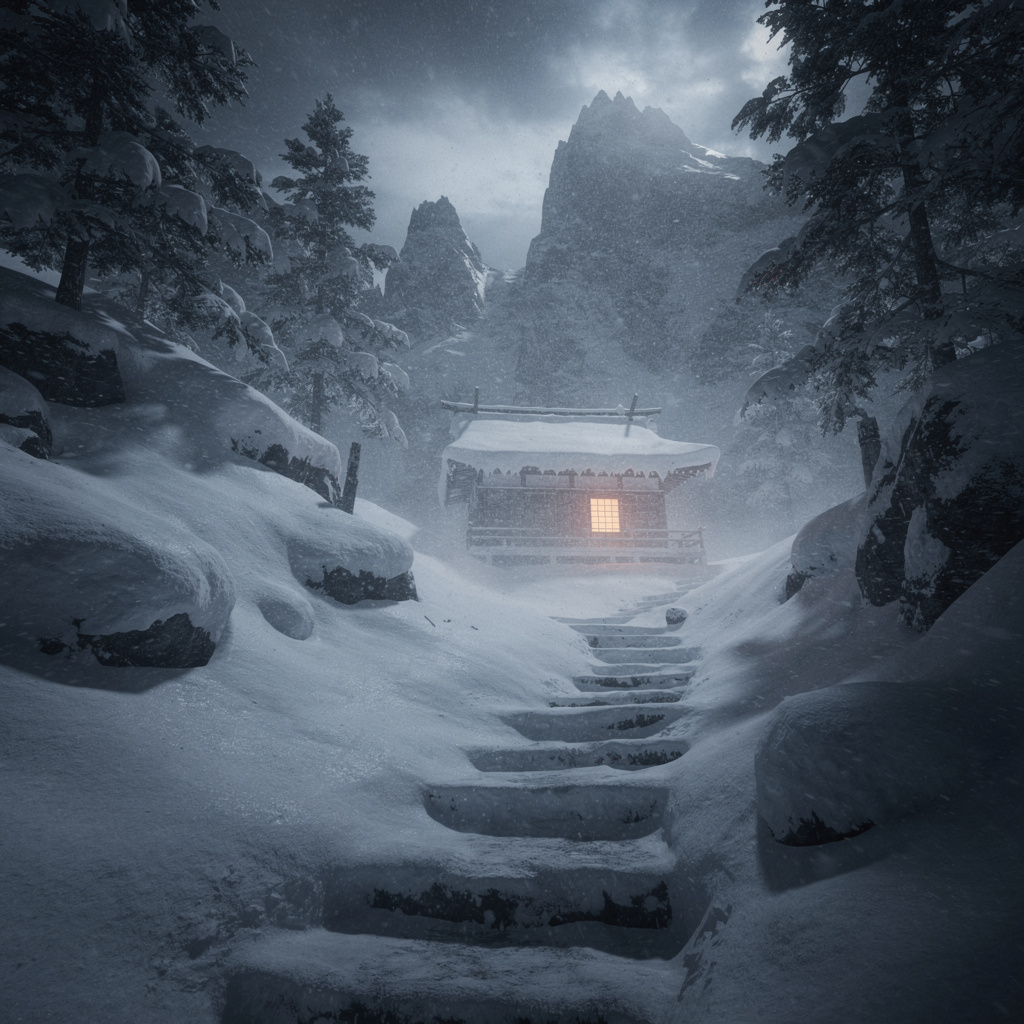
Two woodcutters, old Mosaku and young Minokichi, are caught in a terrible blizzard and take shelter in a ferryman's hut. During the night, Minokichi awakens to see a beautiful woman in white bending over Mosaku, breathing on him. Mosaku dies, frozen.
The woman turns to Minokichi. She tells him she spares him because he is young and beautiful, but if he ever tells anyone about what he saw, she will kill him. Then she vanishes.
Years later, Minokichi meets a beautiful woman named Oyuki (“O-yuki” can mean “snow”) and marries her. They have children and live happily. One winter night, watching his wife sew by lamplight, Minokichi is reminded of that night in the hut. Without thinking, he tells Oyuki the story.
Oyuki's face transforms. She reveals that she is the Yuki-onna—and he has broken his promise. She would kill him now, but for their children's sake, she cannot. She warns him to take good care of them, then transforms into white mist and vanishes through the smoke hole, never to return.
Variations on the Legend
Different regions tell different versions of Yuki-onna stories:
The Vampire Version: Some stories describe her literally sucking the life force or blood from victims rather than freezing them.
The Child-Stealing Version: In some regions, she kidnaps children, either to freeze them or to raise as her own.
The Helpful Version: Rarely, she appears to guide lost travelers to safety, suggesting she may have once been a more ambivalent figure.
The Ghost Version: Some stories identify her as the ghost of a woman who died in the snow—perhaps frozen while searching for a lost child or fleeing an abusive husband.
The Nature Spirit Version: Other traditions see her as a kami or nature spirit personifying winter itself, neither good nor evil but simply a force of nature.
Yuki-onna and Marriage
Many Yuki-onna stories involve marriage to humans:
In these tales, the Yuki-onna disguises herself as a human woman and marries a mortal man. These marriages often produce children and can last years or decades. However, the union typically ends when her true nature is discovered—either the husband breaks a prohibition (as in Hearn's tale) or some accident reveals her supernatural origin.
What happens next varies: sometimes she kills the husband, sometimes she simply leaves, and sometimes she departs in sorrow rather than anger. The theme of supernatural wives who cannot remain in the mortal world appears throughout Japanese folklore, reflecting anxieties about the boundaries between human and spirit worlds.
Protection and Survival
Traditional folklore offers limited protection against the Yuki-onna:
- Staying Warm: Maintaining body heat through fire or shelter might deter her.
- Not Traveling in Blizzards: The obvious prevention—she appears only during snowstorms.
- Baby's Cry: Some stories say the sound of a baby crying can drive her away.
- Keeping Promises: If she makes you promise not to tell, never break that promise.
- Recognition: Seeing through her disguise might break her power, though this is inconsistent.
However, in most stories, once the Yuki-onna targets someone, escape is nearly impossible. She is as inescapable as winter itself.
Symbolic Meaning
The Yuki-onna embodies several themes:
Winter's Danger: In pre-modern Japan, winter in mountainous regions was genuinely deadly. The Yuki-onna personifies this danger, transforming abstract cold into a beautiful predator.
Beautiful Death: Like the snow itself, she is beautiful but deadly—a reminder that beauty can be dangerous and that death can come in attractive forms.
Feminine Power: She represents a terrifying form of feminine power—sexually attractive yet deadly, capable of destroying men with a breath.
Nature's Indifference: As a personification of winter, she embodies nature's indifference to human survival. She kills not from malice but because that is what winter does.
Yuki-onna in Modern Media
- Film: “Kwaidan” (1965), “Snow Woman” (2016), numerous horror films
- Anime/Manga: “Nurarihyon no Mago,” “Rosario + Vampire,” “GeGeGe no Kitaro”
- Video Games: “Nioh,” “Persona” series, “Shin Megami Tensei,” “Sekiro: Shadows Die Twice”
- Literature: Neil Gaiman's “The Sandman,” numerous horror anthologies
- Western Adaptations: Inspired ice queens and snow spirits in various media
Yuki-onna Compared to Similar Beings
| Being | Culture | Key Difference |
|---|---|---|
| Yuki-onna | Japanese | Snow/winter spirit, freezing death, marriage themes |
| Frost Giants | Norse | Enemies of gods, cosmic forces, not seductive |
| Jack Frost | English | Mischievous rather than deadly, male |
| The Snow Queen | Danish | Fairy tale character, emotional coldness theme |
| Ded Moroz | Slavic | Gift-giver (like Santa), can be dangerous |
Frequently Asked Questions
Is Yuki-onna always evil?
Not necessarily. While most stories portray her as dangerous, some versions show her as a neutral or even helpful spirit. In marriage stories, she often seems genuinely loving toward her human family, departing in sorrow rather than anger. She might be seen as amoral rather than evil—dangerous as winter is dangerous, but not malicious.
Why does she spare some people?
In various stories, she spares people for being young, beautiful, kind, or simply because she chooses to. Her motivations are often mysterious, reflecting the unpredictability of nature itself.
Is she a ghost or a spirit?
Traditions vary. Some stories clearly identify her as a yūrei (ghost) of someone who died in snow. Others treat her as a yokai or nature spirit who was never human. The distinction may not have mattered much to traditional storytellers.
How do you pronounce “Yuki-onna”?
YOO-kee-OHN-nah, with relatively even stress. “Yuki” means snow, “onna” means woman.
The Face in the Blizzard
The Yuki-onna endures because she gives form to one of humanity's deepest fears: being trapped in a cold, white void where death comes silently and beautifully. She is winter personified—not as a jolly snowman or gentle snowfall, but as the killing cold that claims unprepared travelers and snows in villages for months.
In Japan's snow country, she remains a powerful figure, a reminder that nature's beauty and nature's danger are often the same thing. When the blizzard howls and visibility drops to nothing, when the cold seeps through every layer and the world becomes a featureless white void—that is when the Yuki-onna hunts.
Those who venture into the snow would do well to remember: if you see a beautiful woman walking through the storm, look for her footprints. If there are none—run.
Sources and Further Reading
- Hearn, Lafcadio. “Kwaidan: Stories and Studies of Strange Things.” 1904.
- Foster, Michael Dylan. “The Book of Yokai.” University of California Press, 2015.
- Reider, Noriko T. Japanese Demon Lore: Oni from Ancient Times to the Present.” Utah State University Press, 2010.
- Yoda, Hiroko and Matt Alt. “Yokai Attack!” Kodansha International, 2008.