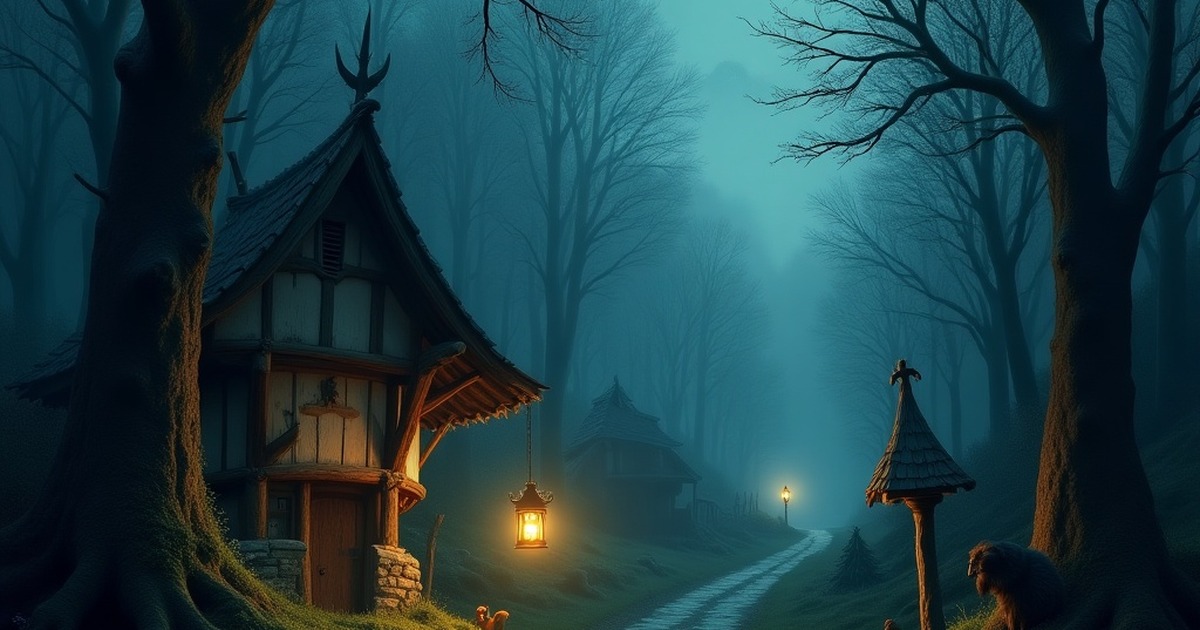
Deep within the darkest forests of Eastern Europe, where the trees grow so thick that sunlight never reaches the ground, stands a hut mounted on giant chicken legs. Within dwells Baba Yaga (Баба Яга), the most fearsome and enigmatic figure of Slavic folklore—a being who is neither wholly evil nor entirely good, but something far more ancient and complex.
Origins and Name
The name “Baba Yaga” combines “baba” (old woman/grandmother) with “yaga,” whose meaning is debated—possibly “witch,” “horror,” or deriving from Proto-Slavic words for snake or disease. Her origins may trace back to pre-Christian goddess worship, making her one of the oldest figures in Slavic mythology.
Appearance
Baba Yaga is described in terrifying terms:
- Extremely thin, almost skeletal
- A long, hooked nose that nearly touches her chin
- Iron teeth for grinding bones
- Legs of bone, one often described as fleshless
- So tall she fills her entire hut
Her nickname “Baba Yaga Bony Leg” emphasizes her death-like aspect.
The Hut on Chicken Legs
Baba Yaga's dwelling is as legendary as she is:
- A wooden hut standing on enormous chicken legs
- It can spin and move through the forest
- The door faces away from visitors until commanded to turn
- Surrounded by a fence of human bones topped with skulls whose eyes glow at night
- The lock is a mouth full of sharp teeth
Powers and Transportation
Baba Yaga travels through the sky in a giant mortar, steering with a pestle and sweeping away her tracks with a silver birch broom. She commands the White Horseman (Day), Red Horseman (Sun), and Black Horseman (Night), controlling the cosmic cycles.
Ambiguous Nature
Baba Yaga defies simple categorization. She eats children and threatens heroes, yet also provides magical assistance to those who approach her correctly—with proper respect and completing impossible tasks. She represents the dangerous wisdom of the wild, the threshold between life and death.
Related Creatures
Baba Yaga has counterparts in other Slavic traditions: the Bulgarian Baba Roga and the Polish Jędza. She parallels the German Frau Perchta and other European crone figures. Her hut echoes the Norse concept of magic dwellings.
Related Posts






Your Weekly Dose of Inspiration
Journaling ideas, family tips, and gentle inspiration.