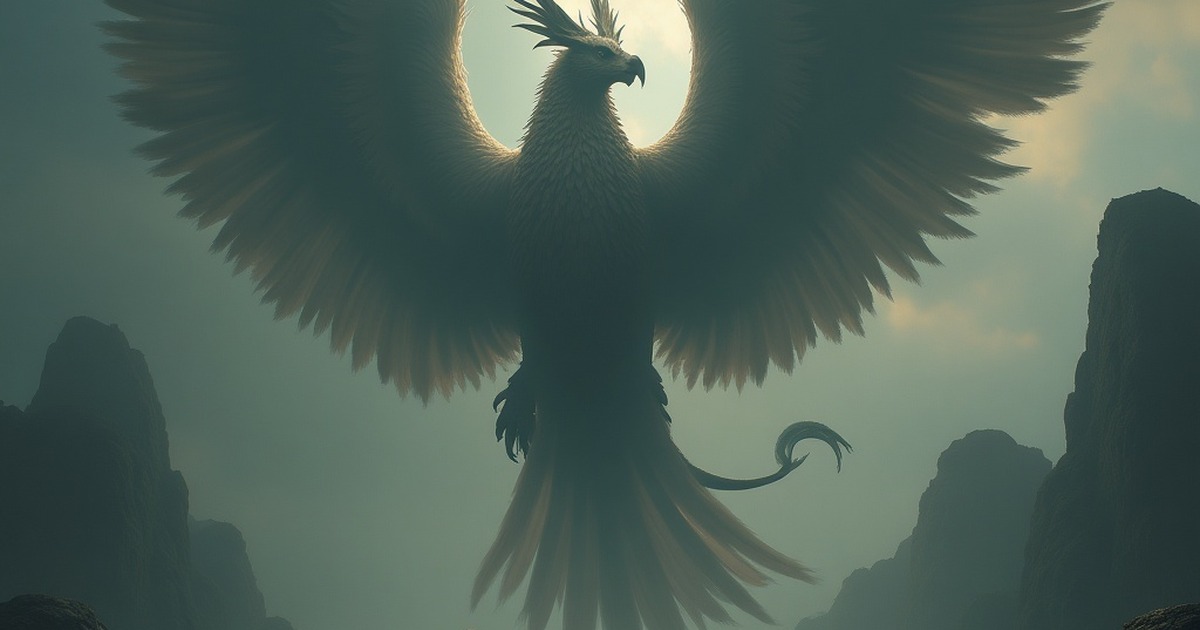
In the celestial realms of Hindu mythology, where gods wage cosmic battles and divine beings traverse the universe, there soars a creature of unparalleled majesty and power. Garuda, the king of birds and eternal enemy of serpents, serves as the divine mount (vahana) of Lord Vishnu, the Preserver of the Universe. With wings that eclipse the sun and talons that can seize the mightiest serpent, Garuda embodies devotion, strength, and the triumph of good over evil—and his influence extends across Southeast Asia as one of the most revered mythological beings in the world.
Quick Facts About Garuda
| Origin | Hindu and Buddhist mythology (India, Southeast Asia) |
| Also Known As | Garutman, Vainateya, Suparna (“beautiful-winged”), Khageshvara (“lord of birds”) |
| Type | Divine being / Celestial bird |
| Domain | Sky, celestial realms, Vaikuntha (Vishnu's abode) |
| First Appearance | Rigveda (c. 1500-1200 BCE), extensively in the Mahabharata |
| Associated Deity | Lord Vishnu (as his mount and devotee) |
| Enemies | Nagas (serpents), particularly the serpent king Takshaka |
Origins and Birth of Garuda
The story of Garuda's birth, as told in the Adi Parva section of the Mahabharata, is among the most dramatic origin tales in Hindu mythology. It begins with the sage Kashyapa, progenitor of many beings, and his two wives: Vinata (mother of birds) and Kadru (mother of serpents).
Kashyapa granted each wife a boon. Kadru asked for a thousand powerful serpent sons, while Vinata requested only two sons who would surpass Kadru's offspring in glory. From Kadru's eggs hatched the Nagas, the great serpents who would become rulers of the underworld. Vinata's eggs, however, required a much longer incubation.
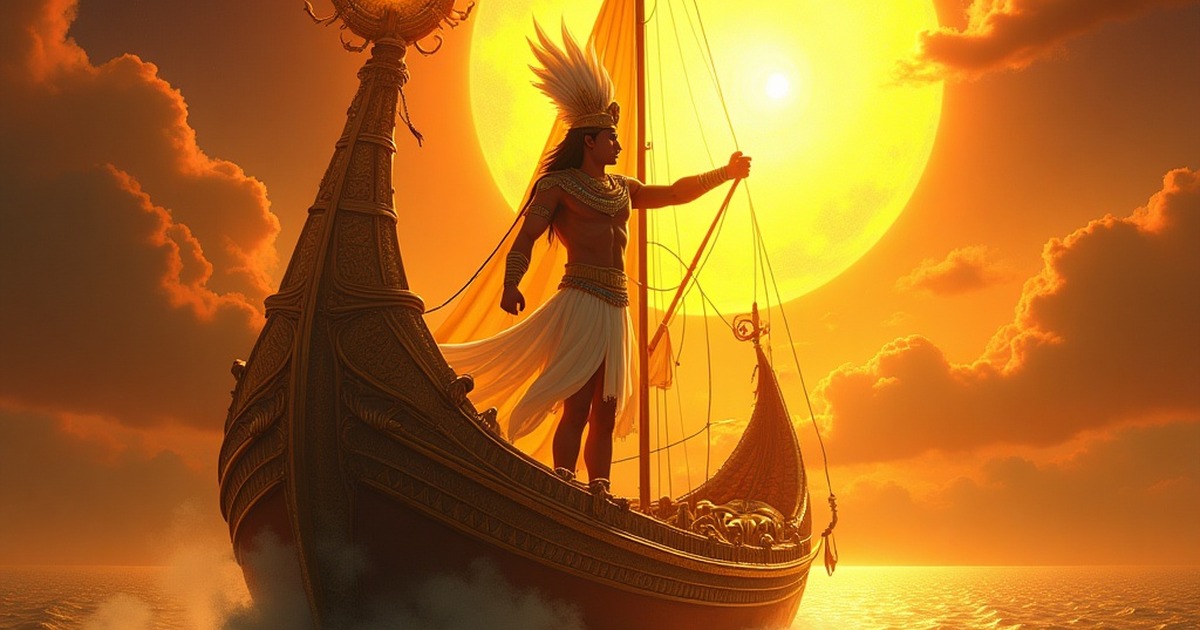
Impatient after five hundred years, Vinata broke open one egg prematurely, releasing Aruna, who emerged incomplete—radiant from the waist up but formless below. Cursed by his early birth, Aruna became the charioteer of Surya, the sun god, and serves as the personification of dawn. He cursed his mother to suffer slavery for her impatience, a prophecy that would come true.
The second egg incubated for another five hundred years before Garuda burst forth—fully formed, blazing with the light of a cosmic fire, so brilliant that even the gods mistook him for Agni, the fire god, and bowed before his radiance. From his first breath, Garuda was destined for greatness.
Physical Description: The Magnificent Form
Garuda's form combines avian and humanoid elements into a being of breathtaking power and beauty:
- Body: Golden-feathered body of an enormous eagle or kite, often described as spanning the sky itself. His plumage gleams like molten gold touched by divine fire.
- Face: Either an eagle's head with a sharp, curved beak, or a human face with an eagle's beak—depictions vary by region and tradition. His eyes blaze with fierce intelligence and divine purpose.
- Wings: Massive wings whose beating creates storms and whose span can eclipse the sun. When Garuda flies, the wind from his wings can flatten mountains.
- Arms: Four arms in many depictions, often shown carrying symbolic items—a pot of amrita (nectar of immortality), weapons, or making sacred gestures (mudras).
- Talons: Powerful claws capable of seizing the mightiest serpent. His grip is inescapable, his strike fatal.
- Coloration: Typically gold or white body with red or green wings. His face is often shown as white, symbolizing purity and divine nature.
When depicted carrying Vishnu, Garuda is shown in a characteristic pose—kneeling or flying with the great god seated upon his shoulders, often accompanied by Vishnu's consort Lakshmi. This image is among the most recognized in Hindu iconography.
The Quest for Amrita: Garuda's Greatest Feat
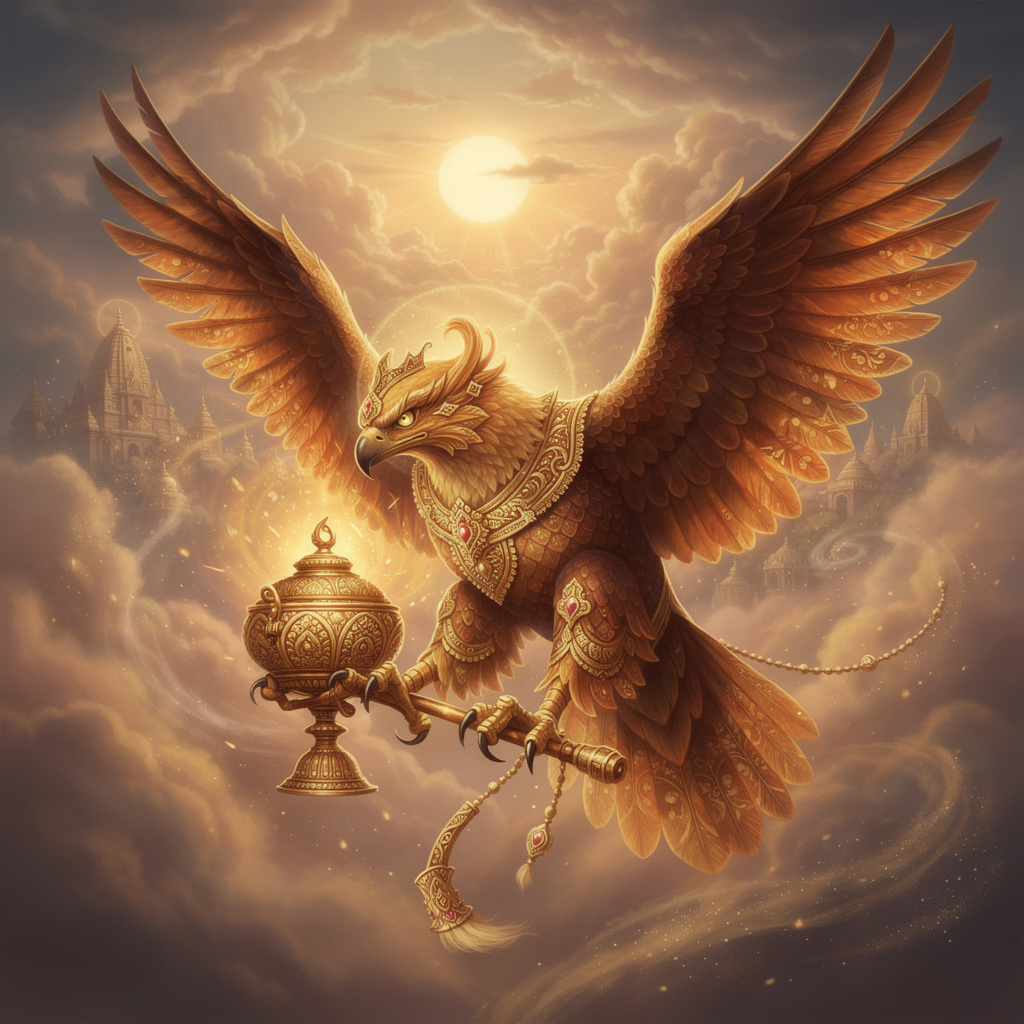
The central myth of Garuda tells of his heroic quest to free his mother from slavery—a tale of devotion, power, and cosmic consequence.
Vinata and Kadru had made a wager about the color of the divine horse Uchchaihshravas's tail. When Vinata lost through Kadru's deception (the Nagas wrapped themselves around the horse's tail to make it appear dark), she was forced into slavery to her sister and the serpents.
When Garuda learned of his mother's bondage, he demanded to know what price would secure her freedom. The serpents, believing no being could accomplish it, demanded the amrita—the nectar of immortality—which was guarded by the gods in heaven.
What followed was one of the most spectacular displays of power in Hindu mythology:
- Feeding: Before his journey, Garuda devoured an elephant and a tortoise who were locked in eternal combat—a meal to fuel his cosmic journey.
- Assault on Heaven: Garuda flew to the realm of the gods and single-handedly defeated the divine armies sent to stop him. He extinguished the fires surrounding the amrita, destroyed the rotating blade mechanisms protecting it, and overcame two terrible serpents guarding the final approach.
- Meeting Vishnu: Impressed by Garuda's power and devotion, Lord Vishnu appeared before him. Rather than fight, Vishnu offered Garuda two boons. Garuda asked to become Vishnu's eternal mount and to be placed above Vishnu—thus Garuda sits atop Vishnu's flagstaff. Vishnu, in turn, granted Garuda immortality without needing to drink the amrita.
- Meeting Indra: The king of gods, Indra, attacked Garuda but his thunderbolt merely dislodged a single feather. Amazed, Indra befriended Garuda and they struck a deal—Indra would reclaim the amrita after Garuda used it to free his mother.
- Freeing Vinata: Garuda delivered the amrita to the serpents, freeing his mother. When the Nagas went to purify themselves before drinking, Indra reclaimed the pot. The serpents licked the kusha grass where the pot had rested, which is why snakes have forked tongues to this day.
Powers and Abilities
Garuda possesses powers befitting the king of birds and mount of the supreme preserver:
- Immense Strength: Garuda can carry Lord Vishnu, Lakshmi, and all of Vishnu's divine attributes without strain. He defeated the entire army of heaven single-handedly.
- Incredible Speed: He can traverse the universe in moments, moving faster than thought itself. His speed allows him to appear anywhere instantly when Vishnu calls.
- Serpent Slaying: Garuda has a particular power over serpents. His very presence can paralyze snakes with fear, and he feeds upon the Nagas as his natural prey. He is the supreme enemy of serpent-kind.
- Weather Control: The beating of his wings can create hurricanes, and his descent can cause earthquakes. He controls the winds and can summon storms.
- Size Manipulation: Garuda can alter his size at will—from small enough to enter a palace to large enough to eclipse the sun.
- Immortality: Granted by Vishnu, Garuda cannot die. He has existed since before the current age of the universe and will exist until its end.
- Venom Immunity: No serpent venom can harm Garuda. He can consume even the most poisonous snakes without ill effect.
Garuda and the Nagas: The Eternal Enmity
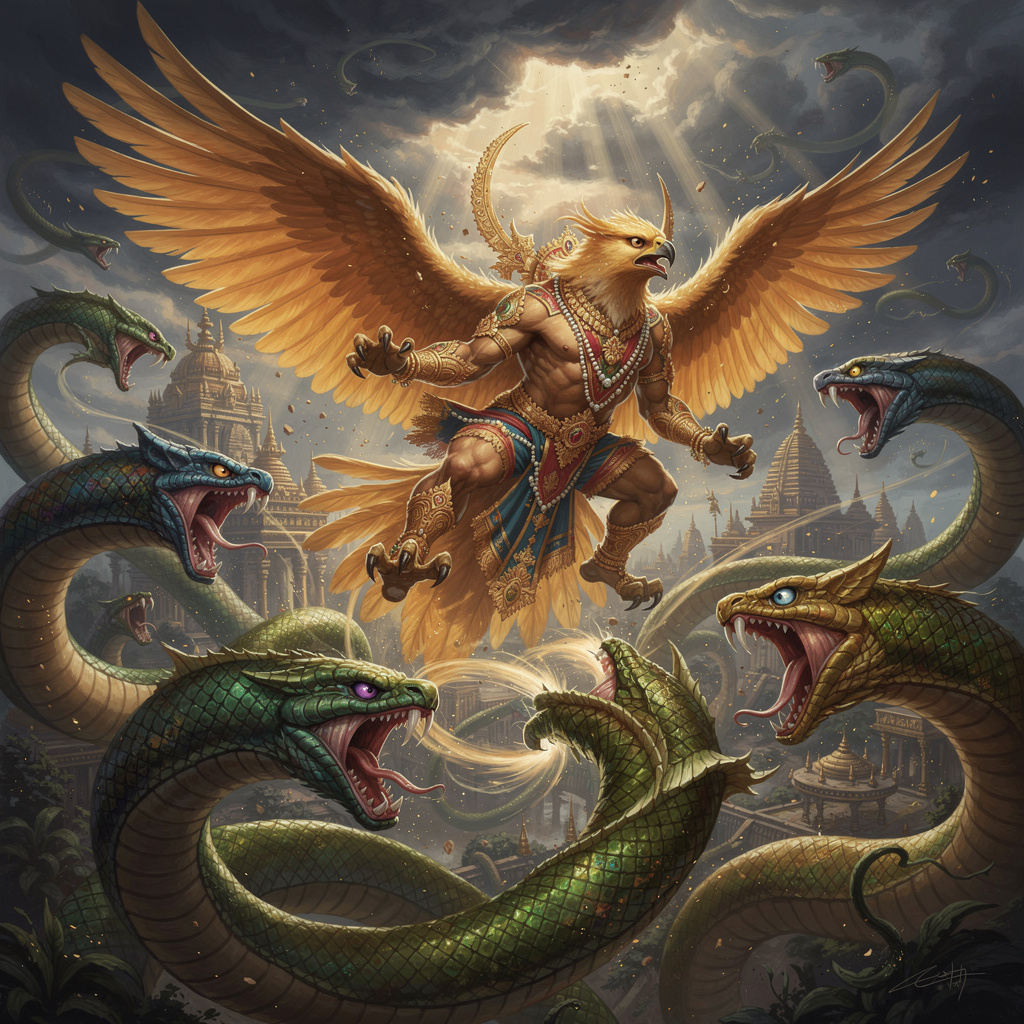
The conflict between Garuda and the serpents (Nagas) represents one of the most significant mythological rivalries in Hindu tradition. This enmity stems from multiple causes:
- Family Feud: The serpents enslaved Garuda's mother through trickery, earning his eternal hatred.
- Natural Opposition: In Indian cosmology, birds (particularly eagles) and serpents represent opposing forces—sky versus earth, light versus darkness, virtue versus cunning.
- Cosmic Balance: Garuda's predation of serpents keeps their population in check, maintaining cosmic balance. Without Garuda, the Nagas would overrun the three worlds.
However, this enmity is not absolute. In some tales, Garuda and certain noble serpents develop mutual respect. He serves as a protector against harmful serpents while recognizing that not all Nagas are evil—some, like Shesha, serve important cosmic functions.
Cultural Significance
Garuda's influence extends far beyond Indian borders, making him one of the most widespread mythological figures in Asia:
In Hinduism
- Symbol of divine protection and Vishnu's power
- Remover of obstacles and destroyer of evil
- Protector against poison and snake bites
- Embodiment of devotion (bhakti) and selfless service
- Worshipped during Garuda Panchami festival
In Buddhism
Garuda appears in Buddhist traditions as the Garuda (or Suparna), one of the beings who protects dharma. In Tibetan Buddhism, Garuda represents wisdom that destroys the poisons of hatred, desire, and ignorance—the “serpents” of the mind.
National Symbol
- Indonesia: Garuda Pancasila is the national emblem, representing the state philosophy
- Thailand: Garuda (Krut) is a royal symbol and appears on government insignia
- Mongolia: Garuda (Khangarid) features in traditional symbolism
- India: Appears in various state emblems and military insignia
Garuda Compared to Other Mythological Birds
Garuda shares characteristics with divine birds from other traditions while maintaining distinct features:
- Phoenix (Various): Both are solar birds, but the Phoenix embodies rebirth while Garuda represents eternal devotion and cosmic power.
- Thunderbird (Native American): Both control weather and are associated with sky power, but Thunderbird is a nature spirit while Garuda is a divine servant.
- Simurgh (Persian): Both are gigantic bird-kings with healing powers, suggesting possible cultural exchange along ancient trade routes.
- Roc (Arabian): Both are enormous birds capable of carrying elephants, though the Roc lacks Garuda's divine nature and cosmic significance.
Garuda in Modern Media
The king of birds has taken flight into contemporary popular culture:
- Final Fantasy Series: Garuda appears as a recurring summon or boss creature throughout the franchise, often associated with wind magic.
- Shin Megami Tensei: Features Garuda as a powerful demon ally in multiple games.
- Avatar: The Last Airbender: The Fire Nation's giant war balloons resemble Garuda's imagery.
- Airlines: Garuda Indonesia airline takes its name from the divine bird, using a stylized Garuda as its logo.
- Martial Arts: Garuda Purana is referenced in various Southeast Asian martial arts traditions.
- Comics: Various comic publishers have incorporated Garuda into superhero narratives, particularly those featuring Hindu mythology.
Frequently Asked Questions About Garuda
Is Garuda a god or a bird?
Garuda occupies a unique position—he is a divine being, often classified among the Devas (celestial beings), but he serves Vishnu as a mount and devotee rather than being worshipped as a primary deity himself. He is immortal, possesses godlike powers, and receives worship in his own right, but his primary role is as Vishnu's devoted vehicle and servant. In some regional traditions, particularly in Southeast Asia, Garuda is venerated almost as a deity in his own right.
Why does Garuda hate snakes?
Garuda's enmity with serpents began when the Nagas, children of his mother's sister Kadru, enslaved his mother Vinata through deception. To free her, Garuda had to steal the amrita from heaven and deliver it to the serpents. Though he succeeded, this humiliation and the suffering of his mother created an eternal hatred. Beyond the personal vendetta, Garuda and serpents represent opposing cosmic forces in Hindu cosmology—sky versus earth, light versus darkness, order versus chaos.
Can Garuda be killed?
No. Garuda was granted immortality by Lord Vishnu himself. Even before this boon, he demonstrated near-invincibility by defeating the entire army of heaven and shrugging off Indra's thunderbolt—the weapon that could slay nearly any being in the universe. Garuda will exist until the end of the current cosmic cycle, eternally serving Vishnu.
What does Garuda symbolize?
Garuda carries multiple symbolic meanings: devotion to the divine (through his service to Vishnu), the power of righteousness over evil (through his destruction of serpents), the sun and its life-giving energy (through his golden plumage and sky domain), speed and the power of thought, spiritual aspiration and the soul's journey upward, and martial valor and royal power. His image is used to represent these qualities across Hindu, Buddhist, and national symbolism throughout Asia.
The Eternal Devotee
Garuda represents something profound in Hindu philosophy: that true power lies not in conquest for its own sake, but in devoted service to a higher purpose. Though he could have drunk the amrita himself, though he defeated the gods themselves, Garuda chose instead to serve—and in that choice, he achieved greater glory than any throne could offer.
Today, Garuda soars across the skies of human imagination from Indian temples to Indonesian government buildings, from Tibetan thangka paintings to Japanese video games. His wings span cultures and centuries, carrying with them an ancient message: that courage combined with devotion can achieve the impossible, that the mightiest beings can also be the most faithful, and that sometimes the greatest power is the power to serve.
When you see an eagle soaring against the sun, remember Garuda—king of birds, enemy of serpents, mount of the divine, and eternal symbol of what devotion and courage can achieve.
Sources and Further Reading
- Van Buitenen, J.A.B., trans. The Mahabharata, Book 1: The Book of the Beginning. University of Chicago Press, 1973.
- Dallapiccola, Anna L. Hindu Myths. University of Texas Press, 2003.
- Doniger, Wendy. The Hindus: An Alternative History. Penguin Press, 2009.
- Zimmer, Heinrich. Myths and Symbols in Indian Art and Civilization. Princeton University Press, 1946.
- Kinsley, David. Hindu Goddesses: Visions of the Divine Feminine in the Hindu Religious Tradition. University of California Press, 1988.